Rootstech Ramblings – my pick from the live online schedule

So the Rootstech schedule is now available and the excitement is building as we can begin to plan our time for the three days of intensive family history fun from 29 February to 2 March. Do you need to head off to Salt Lake City? – no – although I am sure in-person attendance would be great. Do you need to part with large sums of hard earned cash? Again no, if you are attending virtually, as I am, absolutely free. If you haven’t registered yet you can do so here.

I’ve been trawling the schedule of online talks deciding how to spend my time. It has required tricky choices, as there are often clashes but here is what I’ve decided. Bear in mind that there are plenty of great sessions and because this is not geared to UK time, I have had to forego some presentations that really are in the middle of the night. You can make you own choices here.

These are my decisions, though I reserve the right to change my mind. I’ll be back to tell you about some of them after the event. Thursday first. I am going to kick off at 3pm UK time with Nicholas Dixon’s Metropolitan Ancestors: finding families in Georgian and Victorian London. This complements my own ten minute recorded session that you can view any time London Calling, listing some key online resources for London research. With Smith ancestors in London this one is a must. I’ll follow it with Who is my Ancestor? Tracing individuals with similar names by D Joshua Taylor. Although it is US based, I thought it might be fun. Then an evening session with Diane L Richard Researching Modern Ancestors: unlocking the life of an English Rose, focussing on twentieth century research. This takes me to past my bedtime, so I will call it a night.

Friday next. I thought I’d listen in to the Impact Forum about the impact of family history beyond the genealogy community. I’ve changed my mind several times about the 7pm session but have gone for Reconstructing the Lives of our Female Irish Ancestors by Stephanie O Connell. I don’t have any Irish ancestors of my own, although my grandchildren do but with Forgotten Women in mind, I thought it would be interesting. No choice for what follows as it is my own Marginalised Ancestors talk, so I guess I’d better be there. The talk is written but is a bit too long, so I will need to decide what to leave out. It is going to be a fun talk to do going forward, as I can swap the case studies in and out for variety. Just a heads up. I will be mentioning my Marginalised Ancestors book, which is due to be published on 29 February. At the moment, you can pre-order this at a reduced price from Pen and Sword here. I am not sure if this offer will still be available by 1 March, when I am giving the talk, so if you think you might want the book of the talk, now is the time.

On Saturday I am going for Finding your Common Name Ancestor, with Shaunese Luthy – those Smiths again. Then, with my interest in the history of medicine in mind, Diseases our Ancestors Faced and How those Illnesses Changed our World with Gregory C Gardner. I am going to finish my smorgasbord of in real time talks with Nick Barratt’s Researching English Industrial Labourers.

But there’s more – literally hundreds of recorded talks that I can pick and choose from over the coming weeks. I’ll be back to tell you about my choices from these another time.

Oooh and I’ve just spotted that these delivered live talks will also be available after the event. I’ll definitely be reviewing the schedule and adding more from those that clashed with my choices, or were at less favourable times.

Tales of sorting the garage/sheds and garden will resume shortly – P.S. 190 boxes.

Is it Time to get the Kilt Out?

In a few months’ time I will be embarking on my 48th year of serious family history research. In all that time, all but one of my lines can be taken back into the eighteenth century, several into the seventeenth century and a few to the sixteenth century. My direct ancestors are spread across nine English counties, from Northumberland to Cornwall, with an additional three counties if I count where I am pretty certain brick wall lines came from. Every single one of all those direct ancestors and there are well over two hundred of them, that I have identified, was born or baptised in England. Until perhaps now. I have been whiling my waiting to move time away by revisiting my Northumbrian ancestry. Part of the story has already found its way on to my Granny’s Tales website. Incidentally, I decided to splash out and convert Granny’s Tales to a paid website so it now has a new URL, although the old one will still work.

Northumbrian ancestors then. This is an eighth of my ancestry, so there’s a lot to tell, even though great great grandad is a brick wall. I sorted the Hoggs and the Pearsons to the best of my ability, so it was time to turn to the Eadingtons. The Eadingtons are tricky; partly because there are so many spelling variations and partly because every last one of them, well almost, is called Patrick, David or James. Except of course when some of the Patricks decide to call themselves Peter just to add to the fun.

My earliest Eadington ancestor is 5x great grandfather David Eadington who married in Embleton in 1756, had some of his children baptised about ten miles from Embleton in Warenford Presbyterian Chapel and had some more children who he didn’t baptise at all, or whose baptism records don’t survive, then ended his days in Alnwick. His gravestone gives his age at death, which suggests that he was born in 1731 or January 1732. Of course, ages at burial are notoriously inaccurate but that’s all I have to go on. Conveniently though, David left a will and this includes mention of several nieces and nephews, children of his late, unnamed, brother. Following up these nephews and nieces, one of whom was also David’s daughter-in-law, at least some of whom have baptism records, revealed that the brother was called James. James married on Holy Island in 1768. James too has a convenient gravestone that leads to a birth between October 1729 and October 1730; so I was now looking for two brothers. There the research sat for several years.

If you believe the ‘wisdom’ of online trees (I don’t), David was baptised in Earlston, Berwickshire, Scotland in 1738, the son of Robert. Not only does these mean he was probably only eighteen when he married but there isn’t a single Robert in my Eadington family, nor was there a brother James. Although this was possible, I remained to be convinced. Investigating the Eadingtons of Holy Island, I discovered an Alice, or Alison Eadington who had an illegitimate son Patrick in 1763. It is almost certain that this Alison was the daughter of Patrick and Alison Eadington née Allen, who moved from Coldingham, in Berwickshire, to Bamburgh, Northumberland. Better still, this Alison had a brother James baptised in 1730. There is no David in the family but the family are on the move between 1729 and 1740 and there is a ten year gap in the children’s baptisms after James. The naming patterns of James and David’s children are a good match for this family; Alison Allen’s father is called David. Even supposing I adopted Patrick and Alison as my 6x great grandparents and I really feel I need more than this, there is another unanswered question. My ancestor is David’s son Patrick (when he isn’t calling himself Peter). He is mentioned in David’s will and on his gravestone as ‘son’ but there is no baptism. He was born c.1762/3. Alison’s son Patrick has no future as Eadington, Chirnside (his father’s name) or Anderson (his step-father’s name). Did David bring his sister’s illegitimate son up as his own child?

Scottish research is not my area of expertise. If anyone has any idea how I might find more evidence that would support or refute this theory I’d be very grateful. I really would like to be able to confirm my Scottish ancestry and get my kilt out.

Dinosaur Poo, Milking Pigs and Being Me

I apologise for yet another post with poo in the title. This stems from the great discussions I’ve been having with my current cohort of Pharos students on the Discovering more about your Agricultural Labourering Ancestors course. They are a brilliant bunch and our chats range far and wide, including, yesterday, investigations into the use of coprolite (that’s the dinosaur poo) for fertilizer and whether it is possible to milk a pig. The jury is kind of out on that one. Obviously pigs do produce milk but milking them is not generally advised, although there are some ‘interesting’ YouTube videos. Don’t be distracted by the possibilities of milking Minecraft pigs however, that’s another thing entirely.

So someone has decided they’d like to be me. Well, I know I am pretty cool and all that but seriously, although I enjoy being me, it is a bit of an acquired taste. What appears to be (and hopefully is) a very restricted portion of my friends and colleagues have received emails from a spurious email address that does not include my name but is signed with by me with the title of one of my volunteer roles. After a full investigation it has been confirmed that this is not hacking or a virus but identity theft and there’s not a lot I can do. If you get one of these weird emails, check with me on an email address you know is mine and then, if it isn’t me, forward the offending message to report @ phishing.gov.uk. On the upside, as I am now two people, I will race through the to do list at the speed of light. The other me is a little tardy doing the washing-up though.

Excitingly, the first proofs of Marginalised Ancestors have arrived. Less excitingly, that means the dreading black hole that is indexing is looming. Hey, maybe the other me could do that part.

Things or Heirlooms?

Two things have prompted this post. Firstly, today and tomorrow I have two rather different, yet similar, presentations to give about heirlooms. The first is a 15-20 minute conference paper for the Family Archives and their Afterlives conference. Wednesday is a 90 minute heirlooms workshop for the Society of Genealogists. The clue is in the title. Workshop means that I will be putting the audience to work. The second thing is that I am embarking on the inevitable ‘you might be going to move this year/next year/who knows’ cull of possessions. Incidentally, because I know people don‘t like to ask, the position is that someone is desperate to buy my house but is waiting to sell theirs, so I may be here some time.

I am faced with the accumulated ‘stuff’ that survived my major downsize seventeen years ago, augmented by the additional stuff that I acquired when my mother died. Why are some items more precious than others? What has prompted me, my mother and in some cases preceding generations, to keep x over y and z? What do I keep or discard and why? Many of these things have no aesthetic qualities and serve no practical purpose, yet they ‘need’ to be kept. They have moved beyond the realm of being ‘things’ to be heirlooms. I don’t envisage that I will be disposing of anything that has a family significance. If it has already been treasured for two, three, or more generations, then it is my role to continue to do that, even if I feel that the generations that come after me may not wish to do the same. I hope to persuade them to keep at least some of these treasures. That is part of the aim of the Treasures section of my Granny’s Tales website. It is the stories that turn things into heirlooms, so I need to tell the stories. It will be a long job, I just need to last long enough for all the stories to be told. At least I have made a start.

Then there are the things that have a personal significance for me, important of course but somehow perhaps on a lower rung than the items that stretch back to touch the past. At the moment, I can’t be sure how much space I will have when I move. The aim is not to have less than I do currently, so in theory I could keep everything. In practice, it is a good opportunity to reduce the task that my descendants will face when I go and join the ancestors. I’ve made a start. I’ve done the bathroom. Not much of a challenge there. I did throw away manky looking products that have been around for years. I even threw away a few stiff flannels. My bathroom is officially the second smallest in the world (ironically larger than the one I had in my previous 5 bedroomed house) so there were only two small cupboards to go through.

Slightly more demanding were the two sheds, although the majority of the contents of one contained the possessions of the fisherman of my acquaintances (who has four garages a barn and a shed of his own and those are the ones that he admits to). I decided that I really didn’t need 200 plastic flower pots or a dozen tins of solid paint. Easy this throwing away lark isn’t it? I am actually very pleased with the shed clearance. A trailer load disappeared to the tip and more to the owner’s barn.

Moving inside, the conservatory is also done. Well, it is awaiting visits from my descendants to triage the children’s books. That will be trickier. I know most are now too young for my grandchildren but they have seen two generations and some three. What will stay and what will go? I know we will be keeping some that probably no one will read in my lifetime. I do hope my body will keep working to read them to a fourth generation but realistically, it probably won’t. I don’t see my grandchildren being likely to have children young. So they will sit in a box in a loft, in an as yet to be identified property, until my children have to repeat the triage in the future.

The conservatory also contains many inherited ornaments, some dating from my great-grandfather’s trip to India and China. They stay, waiting to appear as one of Granny’s Treasures; another culling decision deferred.

Today maybe I’ll start on the bedroom. The clothes part is easy. I do an annual cull and in any case, as anyone who has met me will know, I am not a clothes person. But and there’s a huge but the bedroom also contains a china cabinet, itself an heirloom, inherited from my mother’s cousin and we believe, made by my great grandmother’s brother. It holds more ornaments, ornaments that I have known all my life. They have sat in the china cupboards of my mother and grandmother and now they sit in mine. A few of the items reach back to touch my great-grandparents’ lives. Then there are the photograph albums. Many of these are the sticky plastic variety, containing colour photographs from the 1980s. Photographs that are fading into weird and wonderful versions of their former selves. I did have a spell of remounting these and scrapbooking them in new albums. Maybe I will have time to continue that process. Do I now take the opportunity to be selective? Shall I retain the images of people and remove the pictures of random stately homes and scenery? I have yet to decide. In any case that is for that dim and distant time labelled ‘later’. Unless my worst moving nightmares are realised and it takes years rather than months for me to complete a chain, they will move with me in their current state.

With the honour of being the custodian of the family archive, comes the responsibility for its curation and care. I also need to be its interpreter. What I should be doing of course is writing those stories, preserving those memories, making sure that I am not the only person who understands the significance of these items. Some already have partial or damaged stories. There are things that I know belonged to my mother’s grandparents but which grandparents? I am committed to making sure that the items I pass on are real heirlooms, with what is left of their stories intact.

A Few Yorkshire Days with a Family History Twist

Last week, we made a whistle-stop trip to York. This was mainly so that I could take part, along with the rest of the A Few Forgotten Women Team, in the York Festival of Ideas. We were working with The Mount School and The Rowntree Society to raise the profile of women’s history. After a panel discussion, we helped attendees to research a woman or girl who was associated with The Mount School, either as a pupil, a teacher, or another member of staff. The school is a Quaker foundation, so there was some delving into Quaker records and some fascinating stories emerging. With the aid of our team, other researchers worked on a Voluntary Aid Detachment nurse. If this sounds like your idea of fun, you can join in. For details see here.

York isn’t exactly next door, 335 miles to be exact, so we went a couple of days early to spread the driving load. The journey up was protracted, not least because of the ten mile/one hour tail-back on the motorway as people tried and failed to exit on to the gridlocked slipway at Castle Donnington for something called the Download Festival.

We decided to steer clear of the city on our two days ‘off’ and visited the lovely gardens at Beningbrough Hall. The Georgian house itself, former home of the Bourchier family, is closed for refurbishment until next month but the gardens were beautiful and we did an extended walk round the parkland by the River Ouse. In the evening, I was virtually chatting all things ag lab with Wiltshire Family History Society. The next day, we opted for Kirkham Priory and another riverside walk. The priory was founded in the mid-twelfth century and was an Augustinian foundation. Dissolved with other monastic foundations by Henry VIII, Kirkham fell into disrepair. Unusually, it was used for military training purposes in the run-up to the D-day landings.

After the research day in the beautiful surroundings of The Mount School library, Mistress Agnes and Master Christopher were on parade, extoling the delights of life in the seventeenth century. With soaring temperatures, it was just a little cosy being in the seventeenth century, especially as I had neglected to bring my thinner bodice. Good fun was had nevertheless.

We left at very silly o’clock to try to beat the forecast heat and fortunately, were driving towards the cooler (when cooler is a relative term) part of the country. The homeward journey was not beset with festival goers and as a bonus, none of my plants seem to have died during my absence. Now to the rigours of the job we must not mention; I may be quiet for a while.

Beningbrough Gardens

From Elusive Ancestors to Ag Labs

Amidst a quick trip to Yorkshire (of which more another time) and the uber frustrations of fourteen tedious hours attempting (and mostly failing) to get access to vital software for the job we must not mention, I have been spreading the family history love with my latest cohort of Pharos family history students. Unbelievably, I have been teaching online family history courses for Pharos Tutoring and Teaching for seven years now. Last night saw the first presentation of a new course draw to a close. The learners have been investigating ancestral migrations. Those pesky ancestors who won’t do the decent thing and spend their whole lives living in one place lead us a merry dance as they trip from one area to another, often leaving gaping holes in their life stories in their wake. This course was designed to help the students tell those migration stories, investigate possible motivations for movement and hopefully come a little closer to tracking down their elusive ‘brick wall’ ancestors. Unfortunately, I don’t have a magic wand, otherwise I wouldn’t have any brick wall ancestors of my own but it was pleasing to find the students reporting that they had to change their case study elusive ancestors as they had found them!

No sooner does one course end than another begins, or, in my case, two begin. Next up, Agricultural labourers, a five week course that starts on 17 July. We all have them don’t we? The ubiquitous ag labs who drip from every branch of the family tree. Do we dismiss them as somehow more boring than the sagger-maker’s bottom knockers? Not such a great job tile of course but ag labs are fascinating in their own right. What I love most about leading this course is seeing the students create stories about their own ag lab ancestors, stories that I then sometimes see published in family history society journals or online. Sometimes I join in with the students and use the course as an opportunity to tell an ag lab story of my own. The job I must not mention won’t allow it this time around, so, just to prove that I do sometimes practice what I preach, here is one I prepared earlier (you will also need this outline pedigree to follow the twists and turns). This is the story of a Wiltshire ag lab filled family, or series of families, who, like many others, ended up abandoning the countryside for life in Reading and later Croydon.

My second course for July is for those starting out on the all-absorbing branch of research that is one-place studies. They have such an adventure ahead! To add to the excitement, Pharos have a brand new shiny website, which not only looks good but make life easier for students and tutors. Most importantly, it is stuffed full of exciting and absorbing courses (not just mine) to help you hone your family history skills. I recently had a discussion about the importance of getting the balance right between learning more about how to do family history and actually doing it. Even if you’ve been a researcher for years there is always more to learn and joining a group often provides great encouragement. Important though gaining new skills is, you need to keep this in proportion and allow time to actually put it into practice. I do try to bear this in mind when I am writing courses and make sure that students can learn more about their own families as they work their way through the suggested exercises. Why not come along and join me for the ride? Last time I looked there were still spaces on the Ag labs and One-place studies courses. If you want to track down elusive and migratory ancestors, you will have to wait until next year.

Family Stories, Family Treasures and some Memories: a task for the family archivist

For the past few months, I have been trying to discover that useful commodity ‘spare time’ and use it to create a small website to be the repository of all the family stories that run round my head. This is rather different from the family history accounts that appear on this website. These are mostly uninspiring narratives, designed to record all the facts that I have found for that branch of the family. The new website is for stories rather than accounts and in future, these will vary from long biographies to short paragraphs about particular anecdotes from the past. There is also a section for my own memories, taken from my auto-biography. In particular, I wanted a vehicle for the stories of the family treasures that I am privileged to have in my temporary care. Without the associated narratives, these heirlooms become mere ‘things’; I feel the need to explain their significance and let others know why they are precious. Artefacts also provoke memories; memories of their owners, memories of occasions when they were in use and associated narratives.

All this may this seem self-indulgent and perhaps it is but I am the only person with most of this knowledge; it is my responsibility not to let it be lost. If I were able to see my descendants more often these would be the accounts that they would hear verbally from me but there may be more stories than there is time, so I decided that I would make a start. The website is tiny at the moment. I plan to add more stories on a regular basis but I didn’t want to begin with an overwhelming number. The intention is that my descendants will actually read this and I thought that they might be put off if I inflicted too much on them at once.

I am not expecting hundreds of hits on the site, or anyone outside the immediate family to read it much, although you’d be very welcome to do so. In fact, I may be optimistic thinking that my descendants will read it but at least now they have the option. What I hope may happen, is that others will take a quick look and be inspired to tell their own family stories. So, if you have five minutes, pop across for a brief glance at Granny’s Tales and then go out and do likewise.

New Book, New Ventures and a Random Shopping Order

Firstly, I am now allowed to tell the world the exciting news that my next book is at the publishers. This is a non-fiction volume, commissioned by Pen and Sword, about tracing Marginalised Ancestors. So, my usual fare of tragedy and trauma, with chapters on Poverty, Criminality, Illegitimacy, Mental Health, Sickness, Prostitution, Witchcraft and more. Each chapter includes a case study and they were such fun to research. I can’t wait to introduce you to Sarah and Joseph and Charity and Harriet and Frederick and co.. Don’t hold your breath though. I am hoping that this may be out by the end of the year, so in your Christmas stockings but it could be 2024. This isn’t exactly a cover reveal as it is still provisional but I have been given the green light to share.

Then two new ventures that will also involve writing. I am to join The History Girls as a reserve blogger. This blog contains a fascinating range of posts on all things historical and is billed as ‘A blog from great writers of historical fiction’. I am having a serious bout of imposter syndrome but it should be fun. As I clearly don’t have enough to do, I applied for and have been accepted as a contributor to the Mass Observation Project. This is particularly exciting as my mother was a contributor in the early 1960s. The website does say that the original project ran from 1937 to the early 1950s but does also mention some material from the 1960s and I distinctly remember my mother having to write down what was on her shopping list. They have asked for a biography ‘it can be as long or as short as you like’. Do they realise that I have an 80,000 word, as yet unfinished, auto-biography stashed away? I am assuming they don’t want all of that. On the other hand ……….

Last week, I encountered that thing when you accidentally click on the wrong day for your T****s order without realising (meant to be next week) and just bung all the favourites in the basket regardless to hold the order, thinking you’ll sort it out and delete stuff a couple of days before. Then you get an email confirming that goods to the value of twice your normal shop are on their way and you have no space in the freezer, because obviously the order is the following week and you daren’t even look at what you’ve ordered, as probably it includes stuff that your daughter, who eats funny modern stuff, ordered when she was here and a load of random things you don’t want. I never did look at the order, so Mr T****’s delivery man turned up with quite a lot of trays of stuff. Well, it could have been worse. Not too much frozen stuff, no weird modern stuff but I have all the ingredients ready for next year’s Christmas cake and puddings!

RootsTech Roundup Day 2 #NotAtRootsTech

The second day of RootsTech began, which meant an opportunity to catch the sessions that had screened late in the US day on day one, if that makes sense. I decided to take a look at the virtual expo hall. Unlike what you might be used to at UK genealogy shows, the vast majority of the stands that are available virtually are commercial, with only a tiny handful of society stands. A couple of the stands did catch my eye. Artifcts, if you can get past the spelling contraction, is a great concept, encouraging us to tell the stories of heirlooms. This is a lovely idea but I need convincing that you need to do this via a commercial site; just tell the stories for yourself in what ever format suits. This is something I have been working towards for a few months but other projects, such as A Few Forgotten Women’s free online sessions for International Women’s Day on 8 March, have rather taken over. The RootsTech expo hall also led me to a really good offer price, for in-person and virtual attendees, from Family Tree Magazine for membership of their Family Tree Plus Club.

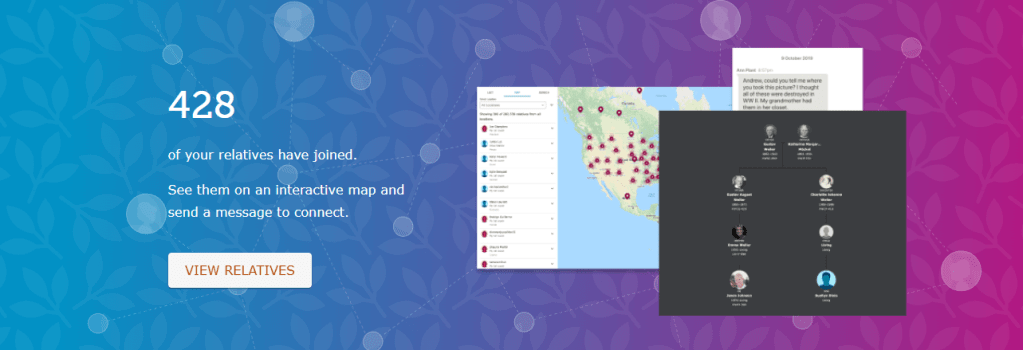
I also had a look at my Relatives at Rootstech, which is a bit of fun for those who have linked themselves to the composite tree at Family Search. This is available until the end of March and you can connect with other RootsTech attendees whose ancestry you allegedly share. I have to say that most of my contacts are 7th-9th cousins and some of the family trees delve into realms where I would not dare to tread but I am hopeful that my third cousin will respond to my message at some point.

In preparation for our Forgotten Women Friday on 24th March, when some of the women needing research are of Irish origin (volunteers welcome for tracing these and those from England), I began by listening to Brian Donavan’s Irish Family History is Easy. Seriously!. He focussed on using FindmyPast and Irish Genealogy. Definitely a great introduction to Irish research and I hadn’t realised so much was on FindmyPast. Next, I chose Hidden Stories Discovered in just Three Documents by Patti Gillespie, which sounded intriguing. Be warned on this one, the talk doesn’t start until four minutes twenty seconds in, so don’t be put off by the long silence. I liked her phrase ‘compassionate context’; our ancestors’ lives and life decisions should viewed in this way. Patti also emphasises the importance of citations. She regards any system of citation that will allow another person to recreate the research path as being adequate; a woman after my own heart.

I then watched Meet Storied; the next chapter in family history with Brandon Camp and Finn Larson. Storied is one of the sponsors of RootsTech. Their product is a way of encouraging and preserving stories and there’s a good deal on if you sign up during the RootsTech period. Whilst I am one hundred percent behind the principal, I can’t help feeling that, a bit like Artifcts, you could just write it down for yourself. The software also has a feature whereby artificial intelligence can assist you with your story. This is impressive but I do have some reservations about this. I suppose it might be useful for those who have concerns about their writing skills. There are some real plus points to the software though. I did particularly like their emphasis on including information about those with whom we have non-familial relationships, such as friends, neighbours and co-workers. In addition, there is the opportunity to capture relationships to communities, be that a village, a workplace, a church or other institution. The software even supports the inclusion of pets. There is a free account option, which seems to include quite a few features. The paid version include access to records but these are all US based.

That was all I had time for yesterday but there is no rush as the presentations remain available for you to watch at your leisure, I am still catching up on 2021 and 2022! If you didn’t think to register in advance for the free virtual event there is still time.

RootsTech Roundup Day 1 #NotAtRootsTech

Yesterday saw the beginning of the genealogical extravaganza that is RootsTech. I am attending virtually, which is free and there is an unbelievable variety of presentations to choose from, with over 1300 speakers from across the globe. My playlist is best described as ‘eclectic’ and it reflects my particular interests, so I thought I’d share those I have watched so far, in case there’s something that appeals to you too. As I am in the UK, some the talks I am hoping to hear from day one are a bit late in the day for me but I will catch up on those today and there were plenty to choose from in the ‘On Demand’ section that I could watch yesterday. I could also catch up on a few from 2021 and 2022 that I didn’t manage to listed to then. I decided not to offer any sessions myself this time but two of my sessions from 2022 are still available, How to Handle Sensitive Topics in Family History and Family Photographs and a Sense of Belonging.

I began with Davina Wilson’s, Considering Age When Researching Your Ancestors, stressing the importance of age and giving a summary of key dates in English and Welsh research. This is an interesting and important topic and something we should all be aware of. I followed this with Help! My Ancestors were related to each Other! by Diahan Southard, as my Smith and Seear ancestors have first cousin marriages in two successive generations, which probably accounts for a great deal. Diahan gave a clear explanation of the difference between multiple relationship, pedigree collapse and endogamy and the impact that these have on our DNA. The advice to focus on our  ‘best’ DNA matches, those with the largest longest segment, particularly was useful.

Something a little different next, with Judy Nimer Muhn’s introduction to The Argyll Papers at Inverary Castle: the family and estate archive of the Duke of Argyll and Tackling Photo Albums: identify, preserve and share with Maureen Taylor

While I was waiting for the time difference to catch up, I looked back at some 2022 presentations and found Penny Walter’s Damnatio memoriae: condemnation of a person’s memory to be a thought provoking presentation about iconoclasm, selectivity and the considerations for family historians when dealing with difficult ancestral connections; definitely worth a listen for us all. Another presentation from 2022 was P J Elias’s How can FANs give context to your Ancestors’ Lives? Using his Polish-American family as examples. It is so refreshing to listen to presentations from young genealogists.

As well as taking the opportunity to listen to presenters who are now to me, it is always a pleasure to catch up with talks from my world-wide genealogy friends. I couldn’t resist another listen to Michelle Patient’s heart-warming Finding Frank story from last year. I love case study stories and this is a great one.

Better still, we do it all again tomorrow.