And in an Historical Household this Week….

Just to prove that my family have been busy training up the next generation and putting my booklet Harnessing the Facebook Generation: ideas for involving young people in family history and heritage into practice, Edward, aged nearly 3, has been investigating social history. He told his mother very seriously, ‘In the olden days they ate porridge.’ In the world according to Edward we now live in ‘newen days’ – got to love the logic.

I spent a lovely morning with my authors’ group, chatting about choosing titles and other book related gossip. We hope that we will soon be able to announce an exciting ‘writers in residence’ event for our group, in a stunning and inspirational location. All we can say at present is, if you would like to come and chat to us about our work, keep part of 29 April – 1 May free. Edward again, ‘Where have you been Granny?’. Me: ‘I’ve been talking to my friends who write books’. ‘I’d reeeely reeeely like to read those Granny’! That’s my boy! His cousins are just as keen on books, although, to be fair, the youngest tends to regard them as a dietary supplement.

#Daisy is actually making progress. You have no idea how long it takes to work out the state of the tide in relation to a newspaper account of a shipwreck. You’ve no idea but I can tell you that the answer is all afternoon, even with the expertise of a fisherman of my acquaintance. At 4.30am one morning inspiration struck and the blurb for #Daisy popped into my head almost fully formed. Even I am not up at 4.30am so I scrabbled for something upon which to write these beautifully crafted sentences before they slipped into oblivion. It is surprising how much you can scribble in the margins of a TV paper. As a bonus I could even read most of it afterwards, no mean feat with my handwriting.

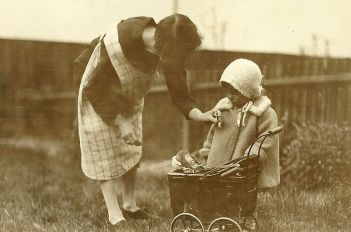
ivy-and-gwenFamily history has led to fun tracing World War 1 Red Cross volunteers, oh and spending a small fortune on an online auction site acquiring a related medal. I’ve also enjoyed immersing myself in plague and pestilence, partly to revamp our Swords and Spindles history of medicine revision session and also to work on my new Pharos course In Sickness and in Death: researching the ill-health and deaths of our ancestors. I am looking forward to the start of Discovering your British Family and Local Community in the Early Twentieth Century on Tuesday – still time to sign up if you are interested. It is an online course so no excuses. In celebration this post includes one of my favourite family photos from the time.

The weather is taking a chilly turn so the garden bird feeding regime has been stepped up a notch. I am also still ploughing my way through the post-Christmas visitor laundry pile. My only method of drying laundry is to hang it on a washing line outside. Well fed birds and a line full of washing are not the greatest combination methinks, as I scrub away at the after effects of a very large flock of starlings.

New Year, New Discoveries, New DNA Results

Well, here we are, 2017. Who knows what the year will bring? This time last year I am sure few could have predicted the seriously scary political machinations and plethora of celebrity deaths that accompanied 2016. So far this year I have learned that it is possible for a memory stick to survive being vacuumed up along with Christmas tree prickles.

I would also like to share an incident from the lacuna that is that gap between Christmas and New Year during which the descendants descend. The phone rings at 7am. A phone call at this time of day normally means bad news – or that your daughter has arranged for T****s to deliver food to your house later in the day. I am a T****s delivery virgin; I know not how these things work. Having the food delivered was deemed easier than having my personal shopper struggling to identify various ‘modern’ ingredients on the list. We do not know our humus from our quinoa sadly – even spell checker doesn’t recognise quinoa, so we are not alone. The main challenge for the T****s delivery driver will be finding the house. If he uses his satnav he is doomed. It turns out, for some reason that he tried to justify, he was expecting to be delivering to a building site. The justification involved my house name – any suggestions anyone? He had a list of what had been ordered. What would a building site do with several dozen nappies of a suitable size for a two year old?

The DNA results arrived sneakily early, before I had finished restoring the house to a semblance of normality and before I had made any discernable impression in the mountainous pile of post-Christmas laundry. This means that I still haven’t completed my documentary trail hunt for third cousins, so more on that when I get the chance. What have I learned from my results? To be honest, not a lot. Sadly, no previously unknown half-siblings have climbed out of the woodwork. I have 788 matches. Big deal, or not, actually. Eleven people are predicted to be related in the range 2nd-4th cousins. Sorry FTDNA, unlikely I think. I know these people are not my second cousins (or second cousins with a few removes). I think it is very unlikely that they are my third cousins, so that leaves fourth cousins. Three of these matchees (it’s ok, I just invented that word) do not provide any surnames apart from the one they now carry. To be honest I don’t blame them. It was a bit of a learning curve working out how to add these. I have included the surnames of all my great great grandparents and will be adding those for the previous generation when I get a minute (like in about 2031).

As expected, most of the testees have families trees that seem to still be rooted in the US and the only surname that is common with any of my ancestors is Smith and I really don’t think this is the same Smith. What is slightly worrying is that there appears to be no commonality with members of the Braund family who have done this test, although, to be fair, our likely relationship is more distant than 5th cousins. This didn’t stop me from hoping for a remote cousin match. Two of the eleven 2nd-4th cousin matches have uploaded a family tree. I guess that this is the next challenge for me to tackle. No areas of commonality here either. There is one match that looks possible, although it wouldn’t be at 4th cousin level. He does at least have Cornish ancestry and a surname that appears on my family tree, although not amongst my direct ancestors. I know I am supposed to do something with my centimorgans. Maybe we don’t share enough of them. I will await instruction. I had a play with the chromosome browser. The most likely match and I share seven segments. I am not sure why therefore they are identified as a closer relative than someone with whom I share 18. I clearly need someone to explain the significance of this in words of half a syllable.

What other fun can I have with these results? I am 99% European, no surprises there then. This is allegedly Britain, Scandinavia and Western Europe, although not Iberia. As regards my ancient origins, I am 10% a Metal Age Invader. What does that even mean? I am 40% Farmer, which seems to mean I may have origins in Aleppo. Excuse me, I’m just off for a bit of hunter gathering, in line with 50% of my ancient origins.

C20th Research, Third Cousins, DNA and another Writer

Well, today has been exhausting. Slightly delayed start (still in my pyjamas at 9.30am) because I got carried away with the hunt for third cousins. The more I do of this the more I am convinced that anyone who takes an autosomal (family finder) DNA test should be doing the same. Without verifying our documented trees down to at least our own generation, what use are all those suggested cousins going to be? I should make it clear I am being pretty thorough (ok, so I am a perfectionist – very thorough) about this and adopting the sorts of techniques used by probate researchers/heir hunters to trace living people. Actually, that is not quite true as I am doing it on a zero budget, so can’t order eleventy million certificates to prove or disprove theories. Apparently Ancestry estimate that the average person has 175 third cousins (Thanks to Debbie Kennett for that information). Obviously there are huge variations either side of that number and it looks like I am going to be at an extreme end of the scale. It was probably fitting that real ‘work’, when I got round to it, was finally finishing off the course that I’ve been preparing about C20th family and local history. I am now going to market it to anyone who has taken an autosomal DNA test!

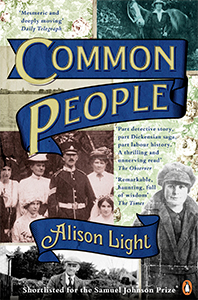
common-people-book-cover-usa1Now for the advent calendar. This is a book I haven’t actually read yet but it looks so good that I am going to include it – shamelessly relying heavily on the blurb and other people’s reviews. It isn’t actually a novel either but the story of a family. The author has done exceptionally well to find a publisher for her family’s story in the days of the hobby’s boom. I remember when I first started, reading Marjorie Reeves Sheepbell and Plougshare – don’t read that unless you want to be seriously envious about the amount of family documents and memorabilia that she inherited. Others from that era were John Peters’ A Family from Flanders. Must also mention John Titford’s Come Wind, Come Weather but all these date from the 1970s and 1980s. Now the world and his wife are writing up their family stories getting one commercially published is next to impossible, which is why I think Alison Light’s Common People: the history of an English family is going to be something special. As the title suggests, Alison has woven and interesting story around the lives of ordinary people.

It is an opportunity to find out more about Victorian England in the throes of its industrial heyday and it is by setting her own family’s experiences into the broader context of their time that Alison has produced such a successful book. Now all I need is time to read it. I shall be recommending it to students on my Writing and Telling Your Family Story course – advert alert – you can register now for this – it starts at the end of February and it is online, so no excuses for those of you overseas.

And in my Life this Week…… history and other weirdness

This week I had an early doctor’s appointment. Early is easy, I can do early, especially now I have rediscovered my lost-for-months pocket alarm clock that has been sneakily hiding in a rarely used bag. Appointment was 7.40am. Doctors is a 20 minute drive away. I wake up before 6am as usual and turn off the alarm (set for 6.15am – who needs it). I start my day (aka check emails and social media). There’s a handy little clock in the corner of my computer screen. I really should learn to look at it more often. Suddenly it is 7.06am. I am still in bed – arrrrrggh. Undaunted, I am out of the house by 7.15am. Then I realise that although I know where I live (fortunately) and where the doctors is, I go so rarely that there is a piece missing in the map in my head that should tell me how to get from one to the other. Luckily automatic pilot works and I arrive in time.

‘Early appointments’, I’ve been warned, mean that the doors are locked and I have to be ‘buzzed in’. I fail to grasp the logic of this. Are mad receptionist threatening maniacs only abroad before the hour of 8am (after which time the doors are unlocked)? And if I were said mad receptionist threatening manic would I announce myself as such on the intercom? And another of life’s mysteries, how can the doctor be running twenty five minutes late when I can be no more than appointment three?

Returning from the doctors, I decided that today was the day for making the Christmas cakes; running a bit late with this this year. As regular readers (amazingly there are some) will know, cooking is not high on my list of enjoyable activities, or indeed my abilities. I do however ‘do’ Christmas cake, usually several Christmas cakes. This year I have managed to convince myself that I really don’t need four but two will be sufficient. Cakes happily in the oven I get on with my day. After the required time, I check the cakes and decide that one could do with a little longer to cook thoroughly. I leave it in the Rayburn which is on tick-over (for non Rayburn/Aga users this means it isn’t actually turned on but is still warm). I return to the fascinations of my real life. The next morning I come downstairs to get breakfast and spot a Christmas cake on the kitchen table where I had left it to cool. That’s funny, I think (turns out it is hilarious), where is the other Christmas cake? Realisation dawns. It is still in the Rayburn. The well cooked cake is quite dark and I think ‘solid’ would be a good description. Even my usual remedy (disguising the burned bits by turning it upside down) will be inadequate. Helpful Facebook friends make suggestions as to what to do with this creation, most of which involve copious amounts of alcohol – not sure if that is for me or the cake. I will be making another cake but I have found a volunteer to consume the middle if I cut the edges off.

It has been another week of dealing with incompetents. Just one of several examples:
Me to prospective venue on the telephone: ‘We would like to book your venue for 21 November 2017’
Venue: ‘We will email you’
Venue (by email): ‘Here are the dates we have available in February.’
The months have been changed to protect the guilty.

Last weekend was a rare occurrence. I went to a concert. The performers were Chris Conway and Dan Britton and I had been invited on two counts. Dan’s family were involved in the 1838 Clovelly fishing disaster, that I had researched in 2013 and some of the songs were related to the incident. I was also attending with fellow author Liz Shakespeare, in order to sell books. What a great evening.

Writing tasks this week have included finishing off lessons for my forthcoming online course about twentieth century family and local history research – don’t neglect more recent decades folks, you could even do a course ……… I have also written a guest blog, ready for my appearance on Jenny Kane’s website on 9 December, so look out for that one. Two of my blog posts (here and here) have now appeared on the In-Depth Genealogist’s website and I am writing the next in my series of articles about women’s work for their magazine. I’ve met with our lovely authors’ group again. That’s work right? Surely drinking coffee and eating cake is work.

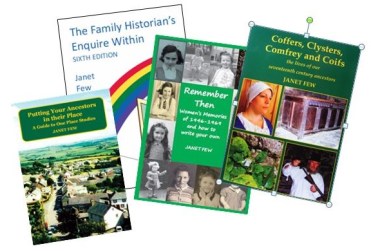
booksNext week I am being interviewed for Tiverton Radio. So, amidst the pre-Christmas busyness and posting out books for discerning Christmas shoppers, it is all go. On the subject of books, a well known online book retailer has my books at ridiculously high prices at the moment. Don’t let this deter you. Buy from the publisher, even better buy from me but please don’t pay above the cover prices that are listed here.

Serendipity or ……….?

You know those weird ‘meant to be’ moments when a facet of your family history falls in to place and it seems to be more than just co-incidence? There are even suggestions from the scientific community that memories can be passed on through our DNA. Genetic memory or not, there are certainly some inexplicable twists of fate that lurk within the stories of some people’s family history research trails. Often we find that our skills, abilities and interests reflect those of our ancestors. To be honest, we’ve an awful lot of ancestors out there; it probably isn’t too difficult to find someone who shares your musical ability or your love of dressmaking. I feel drawn to certain landscapes and parts of the country. Many of these have ancestral connections but my ancestry spreads over most of the counties of southern England, with a few rogues from the north, so again not much of a co-incidence.

Serendipity then. Here is my hairs standing up on the back of the neck tale. I spent most of my adult life living on the Isle of Wight. I chose to live there and have an affinity to the island but as yet, no ancestral connections, although my parents went there on honeymoon (no I wasn’t conceived there!). Although both my children were born on the island, neither was christened there. The elder was baptised in a Buckinghamshire village during a brief, work related, three years that we spent living in that county. The younger was christened, far from home, at the annual church service arranged by our one-name society.

ann-howe-nee-stratford

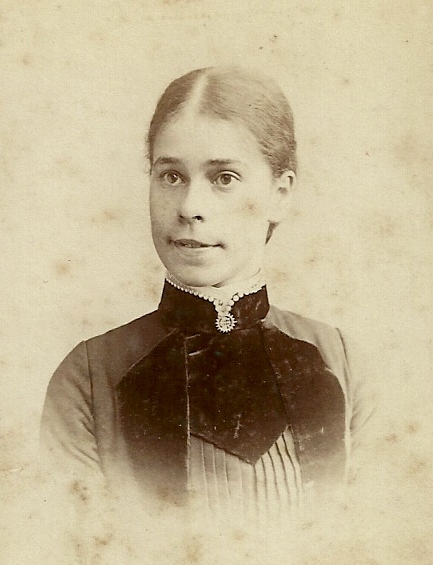
Great great grandmother Anne Howe née Stratford

Several years after we returned to the island from Buckinghamshire I took another look at my paternal grandmother’s side of the family. This was decades before online research made life easier. My uncle, by then deceased, as was everyone on this side of the family, had been adamant that his grandmother came from Cumberland. It made some sort of sense, her husband was from Northumberland. After diligent searching I found her, not in Cumberland but in Buckinghamshire. At the time I was living there I had no knowledge of any ancestral links to the county. She was born fairly close to where I had been living. In those days, the only way to see the census returns was to travel to London, so it was some months before I could take this any further back and reach the next generation, my great-great grandmother, who, the census revealed, had lived in not just the same county, not just in the same village but in the same road that I had inhabited for three years.


We so nearly didn’t live there. At the time neither I nor my husband drove. The houses we had been looking at were all in the town where he was to be working. Typically, in the days before online house-hunting, the estate agent had also sent details of properties that did not meet our spec, one of them was this village property about five miles out of town. A colleague offered to drive us out for a viewing and we were hooked. Thus my elder daughter was baptised in the same church as her 3 times great grandmother, although we did not know it at the time.

Even my current home has a family history connection. I had decided to downsize and relocate to North Devon but had not yet started to search seriously for a new home. We were visiting Devon and taking someone round parishes that had connections to their ancestry. We drew up near the churchyard. This was churchyard number seven. It was, inevitably, pouring with rain. By this time I was losing the will and in need of drying my socks on the car radiator so I remained in  the car whilst my companions plunged knee deep in wet graveyard. I looked up and saw a For Sale sign. After six months and various trials and tribulations, that are an almost essential concomitant of UK house buying, I moved in. Do I have any ancestral connections to my current home? Well – and there will be questions on this later – my 4 times great grandfather’s, sister’s, husband’s father was baptised here – I’m not sure that counts!

More Writing, Nature’s Wonders and Family History Events

dscf3381So what has this week brought? A hedgehog joining the two frogs who are crazy enough to inhabit the scummy indentation that passes for a pond in my garden. Luckily this hedgehog was not actually in the pond, though others of its species passed that way, with unfortunate results, before I inserted an escape route. The garden revamp is progressing slowly. I have (that would be the royal I) reclaimed three foot of garden by decimating the privet hedge. I have also had fun creating a nature book for my descendants. I seem to have photographs of quite a number of unidentifiable plants and birds. The latter are mostly waterfowl that do not feature in my not-so-comprehensive ‘Birds of Britain and Europe’ book. Do the authors not know how inconvenient this is?

Writing, of various kinds, has been featuring highly on the agenda. I have been introduced as a forthcoming columnist for the In-Depth Genealogist. Do take a look at what they have to offer. I’ve drafted the first article for my column, which will focus on the work (paid and unpaid) of women. The plan is to alternate between household tasks, home-working and work outside the home; I’m looking forward to it. My Telling Your Family’s Story course for Pharos is into its second week and I’ve already had one online ‘chat’ with an enthusiastic band of participants. Just wish I had time to write up more of my own family history! The course is being re-run in February and Pharos are already taking bookings. They have also begun to advertise another of my courses Discovering Your British Family and Local Community in the Early Twentieth Century. You can sign up for this from anywhere in the world, although the focus will be on British research. If you are local there are still places on Devon History Society’s Nineteenth and Twentieth Century One-place Studies course that I am leading on 18th October. What else can I get you to sign up for? Oh yes, a trip back in time to the 1600s on October 24th. This is ideal for family historians wanting to know more about seventeenth century social history and for families. It will be a great chance to encourage your descendants to engage with history and heritage – there will be armour to try on, pikes to wield, Master Christopher’s treatments to avoid…… A number of you out there (unbelievably, more than one person and a dog read this blog) have said you’d like to come but you do need to register or the organisers will think no one is interested.

Thanks to Exeter Authors’ Association pointing out that my books are available on Amazon.com, as well as Amazon.co.uk, I decided that I needed to create an Amazon.com author profile. Annoyingly you can’t just transfer the one from .co.uk. More technological challenges, especially trying to make my RSS feed (had to look that one up) appear on .com, which you can’t do on .co.uk. By the time I’d done this there was little time left for actually writing anything. #Daisy is expanding but I will give details of that another time.

I must also mention the excellent Devon Family History Society conference last weekend. There was music, there was cake – always a good combination – there were chances to meet friends and browse the many displays. The speakers, Nick Barrett and Dick Eastman, were excellent and really made us think about the future of family history. The future is bringing your family to our event on 24th October!

Clipboards, Cruises and Challenges of the Technological Kind (yes again) and books – always books!

A variety of activities this week. Firstly, I was lucky enough to win a free electronic copy of  Saving Sophie by Sam Carrington. This had to be emailed to me for me to email to my Kindle errr ummmm. This sounded like a technical challenge too far. After diligent research (I Googled for instructions) I was ridiculously pleased to discover that my Kindle does indeed have an email address – well who knew? Not me, obviously. Mission accomplished and I am looking forward to reading my prize.

More peculiarities on the telephone. During a boring car journey I decided to have a conversation with someone who wanted me to change my electricity supplier. Actually he wanted the phone’s owner to change their electricity supplier but was happy to talk to me when I explained that said owner was driving. After moments of incredulity on his part when I confirmed that there really was no gas supply to the property, the next question was ‘do you have your latest bill with you?’ Hands up who carries their electricity bill with them in the car at all times. Then not an unsolicited call but an attempt on my part to find out who could verify my identity for prevention of money laundering purposes, not many people apparently. This needed to be done in a hurry during the day, when those of my neighbours who might qualify were at work. I telephoned to enquire whether a retired accountant/doctor/teacher etc. might be acceptable (the village is stuffed full of those of a certain age). It seemed it had to be someone in office, presumably so that their identity could be checked on a professional register. The person on the other end suggested I popped in to the local bank. I had already explained that I lived in a small rural village. ‘Popping’ involves a six mile drive, many circuits of the block in search of a parking place and a six mile drive home. Oh of course, I could get a bus but not on a Wednesday. Did he have any other ideas? I could use my ‘local’ post office’s checking service. Ah my local post office was, thanks to the wisdom of someone who has never lived here, closed. The man is now sounding desperate, ‘Did I have a church?’ Oh yes, I have one of those just over there, a vicar though is a different matter. One and a half vicars for seven parishes and neither lives here. At this point I gave up, planning to  accost a teacher outside a school, or wait until later in the day. The urban/rural divide never seemed so wide, the chap on the phone clearly had no clue how the other half lived.

Want to know how to arouse fear and suspicion amongst your neighbours? Wander round in pairs carrying a clipboard, pausing now and again to stare meaningfully at a property. In fact, my friend and I were preparing a village trail but I am sure there are now rumours of extensive development or criminal activity.

UTP0263-2TMy Harnessing the Facebook Generation booklet, with ideas for inspiring young people with a love of history and heritage, is finally available in Canada (as well as the UK, Australia and as an ebook). Unlock the Past, for whom the booklet was written, have announced their genealogical cruising plan for 2017-18. If you are thinking about booking, don’t hesitate, you’ll love it.

The season of evening presentations is well and truly upon me. Quite apart from any school Swording and Spindling, did I really agree to do seven presentations to adults (I put ‘adult presentations’ there at first but it sounded a bit dodgy) in one month (one down six to go)? In addition, that is to finishing tutoring one Pharos course and starting another. Incidentally, there is still time to book for the online course  Writing and Telling your Family History, which starts on 28th September. It is lovely to see some familiar names amongst those who are signed up already. One day I will get time to write up more of my own family history!

Fame at Last – shame about the fortune

What a couple of weeks it has been. Firstly, frantically preparing for our trip to Canada, when I still haven’t quite got my head round not being at sea on the Baltic Cruise. I polished off my school-girl French (never a strong point) in order to book camp sites in Quebec – only to get the replies in English! Be fair, I tried.

Before that I have my talk at Cambridgeshire Family History Society Fair to look forward to. This involved creating a Swords and Spindles display. Thanks to Jo Rutherford and her Alter Ego project, I had some great material to work with. I also have a school day in the seventeenth century coming up – a great start to their (and our) school year.

And the fame? Well, in the space of a couple of days, my Canadian presentations were mentioned on the Anglo-Celtic Connections blog, a blog post that I wrote was referred to by Dear Myrt and then this is picked up in Randy Seaver’s blog. To add to this, today I find that my cruise presentations and Coffers, Clysters book have been mention in Jennyology’s August podcast. For non-genealogy readers, who are now totally bemused and going, ‘So?’, these are some of the big names in the world (and I do mean world) of family history. What am I doing being mentioned in the same breath?

I have also been struggling to finish ‘editing’ the Braund Society journal. Why is it that sometimes ‘editing’ just means ‘write the whole darned thing yourself’? That is a little unfair but I did seem to have to do the lion’s share this time. In the course of this though I found an interesting and comparatively recent, murder accusation that did not seem to come down in family or local gossip and was all over the newspapers in 1919. Such are the excitements of an historian’s life.

Trumpton Bonfire August 2015 (8)Then there was the spectacular Torrington Bonfire last night. These extravaganzas take place every few years and are truly bonfires like no other. This year they were setting fire to a life sized model of Trumpton – as you do. It was amazing but also a chilling reminder of how fire would have spread through, predominantly wooden, towns in the past.

Trumpton Bonfire August 2015 (14)Trumpton Bonfire August 2015 (15)Trumpton Bonfire August 2015 (3)

Cyril Albany Braund 1915-1965 #1ancestor

A number of family historian bloggers take part in the #52 ancestors project, where they write about one ancestor each week. I don’t have time to participate but today would have been my father’s 100th birthday, so I thought that I would devote today’s blog post to him. This then is my #1ancestor.

My father died when I was nine. When I decided to write the story of his branch of my family, in the late 1990s, I realised that I had spent many hours tracing more distant ancestors but that I had neglected to document my grandfather and father, whom I had known. So I decided to research their lives and published their story in In the Shadow of the Iron Horse.

Although I have very good recall of my early childhood, my own memories of my father are fleeting; probably because he worked long and unsocial hours, so our time together was limited. I was able to talk to my mother but inevitably, now she is no longer here to be questioned, I realise that there is still so much I don’t know. I have some facts. Dad, Cyril Albany Braund, was the middle of the three sons of Albany and Elizabeth Ann [Bessie] Braund née Hogg. All three boys were born within three and a half years so times were hard for the family, who were not well off. My grandfather, Albany, was a cleaner and later a porter for London South Western Railway.

Dad went to infants’ school at St. Mark’s in Battersea; a one room school attached to the church. The story in the family is that Dad and his brothers often had to take it in turns to attend school, so that they could share a single pair of boots. Another story relates that Dad, who was very keen on drawing, had to swap his teddy bear in order to obtain a pencil, because the family were so poor. Drawing and painting was a lifelong hobby, as was music. He taught himself to play the piano in the pub owned by the parents of his great friend Eric John Golding. Dad was eighteen and earning before he could afford piano lessons.

At the age of eight, Dad transferred to St Peter’s School, in Plough Lane, Battersea, an enormous, seven story, building, where he remained until leaving school when he was fourteen. He had been punctual and regular in his attendance and exemplary in his behaviour. Like his older brother, he began working in the exciting new world of the cinema as a ‘page boy’, employed in the foyer under the supervision of the doorman. This was the ‘dream job’ for boys of the time; perhaps akin to being a computer games developer today. He joined The Majestic, Clapham in an era when silent films were giving way to the talkies’, eventually working his way up to become a projectionist.
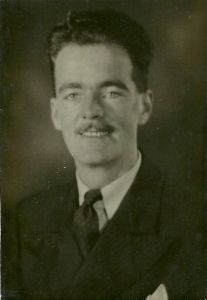
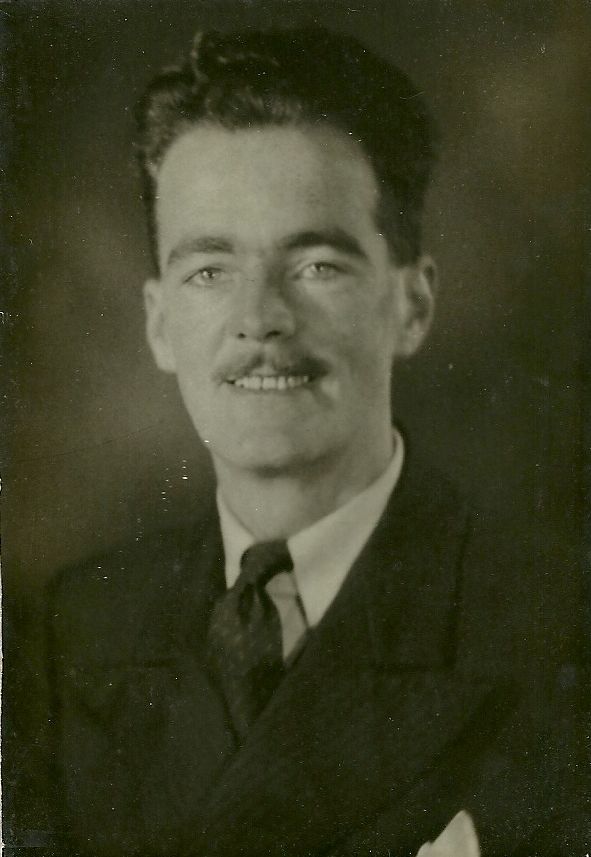
Cyril Albany Braund 1945In 1939, Dad was employed by the Granada Group, who owned several London cinemas, at their Wandsworth Road branch. Thanks to a wonderful history of Granada Cinemas (Morgan, Guy Red Roses Every Night: an account of London cinemas under fire Quality Press 1948), I know many details of life in this cinema chain during the second world war. For example, on the 28th of August 1939, the staff were read the following memo from the managers of the Granada Group. A priority air-raid warning will be given to cinema managers when enemy aircraft are sighted over the North Sea. You will not on any account pass on this priority warning to your audience. You will merely give the warning RED ROSES to your staff so that they will be prepared. Today, this conjures up rather farcical images of staff rushing round whispering behind their hands and it seems unlikely that regular patrons would have remained ignorant of the password for long.

Nearly half the men Dads age were in uniform and with the extension of the call-up, in May 1940, he enlisted, together with Eric Golding. They joined the Royal Air Force Volunteer Reserve on the 4th of July; thus losing their independence on Independence Day. Dad became Gunner 1351715 and was described as being five foot eleven inches tall, with a thirty two inch chest, black hair, hazel eyes and a fresh complexion. I have used service records and family memorabilia to follow Dad’s second world war career, part of which was spent on Sicily and in southern Italy. He was actively involved in the entertainment of the army camp. By the spring of 1945, the end of the war was in sight and Dad was effected by the War Cabinets move to draft naval and air force personnel into army. On the 13th of March 1945 he was officially discharged from 2859 squadron on enlistment in the army. His air force report read, A very good type Airman though not a good J.N.C.O. He could be well employed in his civilian trade. General Conduct excellent.

In the spring of 1945, he met my mother and despite the RAF report, he spent time as a gunnery instructor in Ireland. Once the war was over, Dad remained in the army, as a sergeant with the Department of National Service Entertainment, resuming his civilian trade as a cinema projectionist. He returned to Naples and helped to set up a cinema at Pomigliano. Dad was formally transferred to the army reserve on the 23rd of August 1946, with effect from the 6th of November. His reference reads This N.C.O. has proved himself a capable worker and given consistently good service in the Cinema Division. He is a qualified projectionist and is keen hardworking and reliable. An efficient and valued N.C.O..

He went back to his work as a projectionist and my parents married in 1947. During the first months of their marriage, they lived with their respective parents, staying with each other only on Dads days off. In June 1948 they found a flat, 65 Mallinson Road, just round the corner from Cyrils family. During the first years of their marriage my parents often went on outings and holidays with Eric Golding and his wife, Eileen. In 1951, this time with mums school friend Joyce Chaplin and her husband Peter, they took their first holiday on the Isle of Wight. They stayed at Norton Grange holiday camp in Yarmouth where, fifty years later, their granddaughters performed regularly with the Shanklin Town Brass Band.

Dad was never really satisfied with his working life and changed jobs fairly frequently to try to find something more congenial. One of my particular memories is of being aware of how much he hated his short spell of employment at Cinerama cinemas. His dream had been to set up his own business with Eric Golding but this never transpired. He left for work on the first day of the school holidays in 1965 and died of a heart attack on his journey.

So I have managed to document quite a few facts. When my mother died, I found ‘Forces War Record’, recorded for her by my father in 1946. I had no real recollection of how he sounded. I was able to get this recording put on to disc, just before it deteriorated beyond saving. He was sending my mother birthday greetings. He had got the date wrong but they hadn’t know each other long at this point! I was amazed to hear that his Battersea roots were not noticeable in his accent, which was distinctly BBC – probably a legacy of his career as a cinema projectionist – all those clipped tones of the film stars of the 1930s! So I have his voice.

What I strive to recapture however is some sense of his personality. I know he always felt inadequate in the shadow of mum’s more middle class family and certainly was of the opinion that he had to make up for her ‘marrying beneath her’. I do have a few diaries of the 1960s, which record notes of appointments and events. Just occasionally Dads personality shines through the bald statements of fact in these diaries. One such entry is Beat Bob at Chess!!, accompanied by a doodle of a flag. Family pets also get a mention in the diaries, for example, the birth of the family dog, Sparky. Even the death of the remarkably long-lived hamster, Nora, is recorded, in the same way as the many deaths of family members, with her name surrounded by a black box. I do have the chance to learn more, as I inherited all Dad’s letters to mum, written whilst they were apart in 1945 and 1946. So far, I have only had time to skim through these but I have promised myself I will study them in detail to try to recapture more of the essence of the man behind the facts that I have gleaned.

More details of Dad’s life and that of his father, can be found in my book In the Shadow of the Iron Horse which is available from me.
Is the Twentieth Century History?

The obvious answer is ‘of course it is’; yesterday is already history. Certainly anyone who knows anything about current UK secondary school history teaching would be forgiven for thinking that the twentieth century is the only history. Students seem to leap from conflict to conflict – the second world war, the cold war, the Arab-Israeli conflict, the Irish troubles and if they are really lucky, that dim and distant event, the first world war. For community historians, the twentieth century has an appeal because it is within living memory; oral history projects abound. Why then do family historians seem reluctant to venture further forward than the 1911 census? Some adhere to the concept that the twentieth century is somehow ‘too recent’ and therefore not worthy of investigation. Perhaps this is partly because we often already know the names of our twentieth century ancestors, without the need for research. Are some put off by the difficulties of researching in the twentieth century? Records are subject to closure, people migrate or emigrate more frequently, there are just more people. Then what do you do with any information that you might find? Plastering the names of living second cousins twice removed, whom you have never met, all over family trees is, for most, an unacceptable invasion of privacy.

So do we just go back to the comfort of the nineteenth century and beyond? No; your twentieth century ancestors are every bit as much part of your family tree. Perhaps begin with your direct ancestors who are no longer living. Try this exercise:- Make a list of all parents, grandparents, great-grandparents and so on, who were alive between 1900 and 1940 but who have since died. If they were born during this period, make a note of when, otherwise write their age in 1900 next to their name, so you can appreciate their life stage at the time. You will probably be surprised by how many names are on this list. If you have photographs of any of these ancestors you may like to create a montage, otherwise keep the list of names handy. These are important links in your chain of ancestry. You owe it to them to find out more about their lives, their communities and what they experienced.

So here are my direct ancestors who were alive between 1900 and 1940 – no great aunts, great great uncles or cousins – just my direct line.

Cyril Albany Braund 1915

Gwendoline Catherine Smith 1925

Albany Braund 12

Clara Dawson 1858-1949 possibly taken 1886

Clara Dawson

Elizabeth Ann Hogg 14

Frederick Herbert Smith 6

Ivy Gertrude Woolgar 7

Fanny Thomasine Bishop 31

John Hogg 45

Herbert Havet Smith 34

Catherine Seear 34

Philip James Woolgar 45

Clara Dawson 42

Elizabeth Buckingham 67

Elizabeth Pearson 72

William Howe 69

Anne Stratford 66

Mary Archer Bowyer 69

Eliza Seear 77 – she only just makes it, Eliza died on 1 January 1900

Anne Balls Bulley 65

Writing that felt a little like reading the Roll of Honour on Remembrance Day. Perhaps that is how it should be. These nineteen individuals are my personal role of honour, as are all those who died before 1900. I shall be holding them in my mind as I begin my online course on Tuesday ‘Discovering Your Ancestors’ Communities in the early Twentieth Century’. I still have a couple more spaces in the ‘room’ if you would like to join in and feel you can cope with Google+.