More from our Neighbours and Tallinn, Estonia – day 6

Another all night session from our neighbours, with their stateroom door slamming approximately every ten minutes between 12.15 am and 4.30am. This is like some sort of sleep deprivation torture and I reach the stage of not wanting to go to sleep because I know as soon as I do doze off, there will be a rude awakening. We are beginning to regret handing back all Master Christopher’s tools. By morning and after approximately three hours broken sleep, I am far from my usually tolerant self. We complain (again) to the lovely Emma on Guest Relations – words will be had!

We foregather in the theatre prior to our tour of ‘Tallinn Town and Country’ and join ‘Pink 8’ group, led by Tanel, who is a university lecturer earning extra holiday money. The Old Town of Tallinn was granted UNESCO World Heritage status in 1997 and its Medieval importance was as a key port of the Hanseatic League. Country first though and we head out of Tallinn, learning about Estonia as we go. There are signs of Neolithic settlement in Tallinn, which was then a fishing village. Changes in sea level mean that the site of this area is now inland. In 1246, the King of Denmark gave city status to Tallinn and the limestone fortifications were built, making Tallinn a walled city until the middle of the C19th, when building outside the walls began. By this time, Tallinn had lost its military importance, so defence was not so vital. The original wall was 3km long and incorporated 60 watch towers. Now only 1km of wall and fourteen towers remain, including ‘Fat Margaret’.

049 The Dome Church, Tallinn 16 July 2016 (18)

The Dome Church

The Estonian language is very different from most European languages, bearing the closest resemblance to Finnish. Some German vocabulary found its way into Estonian, as German was the language of the upper classes, Estonian being spoken only by the peasants in Medieval times. We are reminded that Estonia is a similar latitude to Alaska and the Shetland Islands.
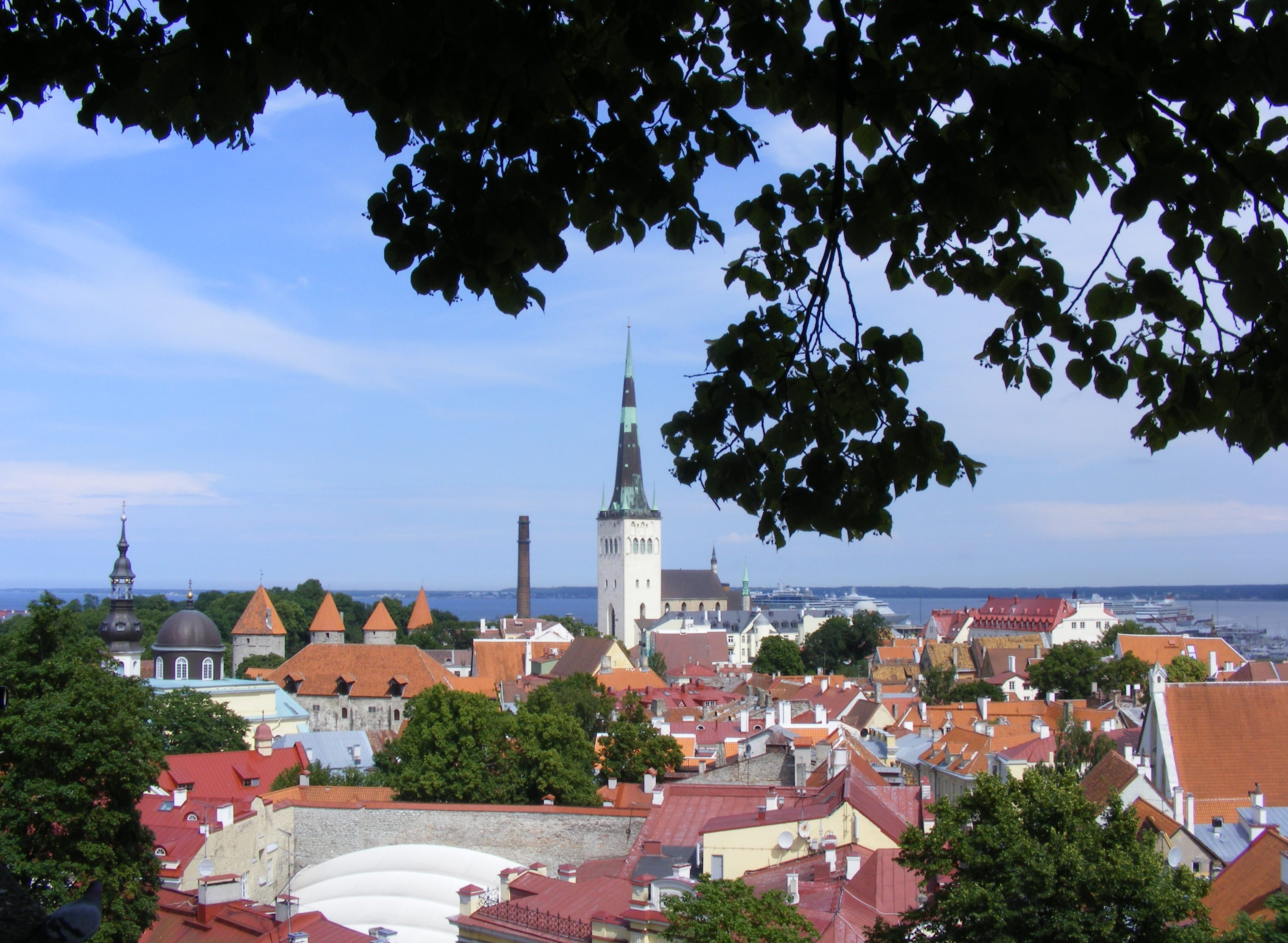
053 Lower Old Town, Tallinn 16 July 2015

Lower Old Town, Tallinn

We arrive at Esko Farm, which is a dairy farm that produces its own products for sale rather than selling the milk. They also have some beef cattle and we notice that most of these retain their horns. For Esko, diversification has included becoming involved in tourism and also providing the location for a famous long-running Estonian soap opera – not famous enough for it to have been heard of outside Estonia but famous nonetheless. We sample some of the produce – yoghurt and strawberry jam, Gouda and Feta-like cheese (you can’t call it Feta as it is not produced in Greece). There is also a drink called Kama powder, which is a mixture of rye, wheat, oats, peas, yoghurt and sugar and is singularly revolting – resembling a concoction of Complan and bran flakes. A hero of the Estonian soap narrates a video explaining how Saku cheese is made on this farm; it takes 10 litres of milk to make 1kg of cheese.

Leaving the farm, we drive through Saku, which is also well-known for its beer and vodka production. Hunting has become an important aspect of tourism, predominantly bear, wolves and lynx. We are taken to visit a typical, ordinary Estonian home, although my guess is that ‘typical comfortably-off Estonian home’ might be a better description. Peter, the owner, has obviously learnt how to cash in on the tourists and who can blame him. Mind you, I would not want a coach load of tourists traipsing round every room in my home. Apart from the library on the large landing, this is sparsely furnished and décor is reminiscent of the 1960s. The building itself is clad in plastic, wood-effect sheets.

We move on to the Old Town of Tallinn itself and visit the Cathedral of Saint Mary the Virgin, also known as the Dome Church, which contains many heraldic carvings. We also see the church of St. Olaf, whose spire was once the highest building in the world at 159 metres. Following numerous lightening strikes it is now reduced to 123 metres. Formerly a Catholic cathedral, it is now a Baptist congregation. We pass the Danish Crusaders’ Castle, Toompea Loss and the impressive, Russian Orthodox Alexander Nevsky Cathedral, built in 1900 as a sign of Russian domination. There have been suggestions that this should be pulled down because of what it symbolises. With a population of 400,000, 25% of whom are Russian, Tallinn is the largest city in Estonia. Traditionally Lutheran in belief, the religious landscape includes, Russian Orthodoxy, Baptists and Catholics.

Most of the tourist shops are selling amber jewellery and Matryoshka or ‘Russian’ dolls. I pass on one and succumb to the other. As we leave Tallinn to return to the ship, someone lies down in the road in front of the coach. Is this some sort of anti-tourist protest we wonder? Our driver manhandles said individual to one side – apparently he has just imbibed too much vodka.

The evening session is another entertaining one from Cyndi Ingle, on Google Maps.
Inflicting Pain on our Fellow Travellers – day 5

Although our neighbours were somewhat quieter during the night, at 5.30am (this was 4.30am for those who had forgotten to alter their watches), there is a noise in the corridor. After an hour, being already up, we investigate. Four Spanish teenagers in underpants are playing some sort of game involving distributing all the metal-covered room-service dishes down the corridor. On seeing us they hide round the corner and Chris stands guard whilst I summon security. My body clock allows me to be more tolerant of the early morning escapade than the constant all night door slamming.

On moving from floor to floor we play an ongoing game of ‘Guess the Lift’. There are four lifts together at each end of the ship but there is a communal button to press. When the lift is summoned you have to stand in front of the one that you think will arrive first; I rarely predict correctly. We listen to Helen Smith talking about DNA and then go to give ‘Guest Relations’ fair warning of our need for our confiscated items to be returned in time for tonight. Two men from security stagger forward with our surgeon’s kit and we are allowed it straight away – a whole day in which to run amok with sharp tools! We enter the lift. Another couple enquire what the box contains. Do they really want to know that they are trapped in a lift with people who have access to knives and axes?

Despite a serious accident whilst on shore yesterday, Shauna Hicks bravely gives her ‘Caring for Family Archives’ presentation; excellent once again. This is followed by Rosemary Kopittke on ‘Directories and Almanacks’. After lunch it is time for my ‘’Til Death us do Part’ session, which was well attended, with sixty-five delegates foregoing the sunny deck-side to hear tales of vomit, pox and purging. Other interesting sessions follow: ‘Getting the most out of Google’ from Rosemary Kopittke; Paul Milner on ‘Parish Registers’ and Chris Paton with ‘Irish Records Online’.

DSCF2704

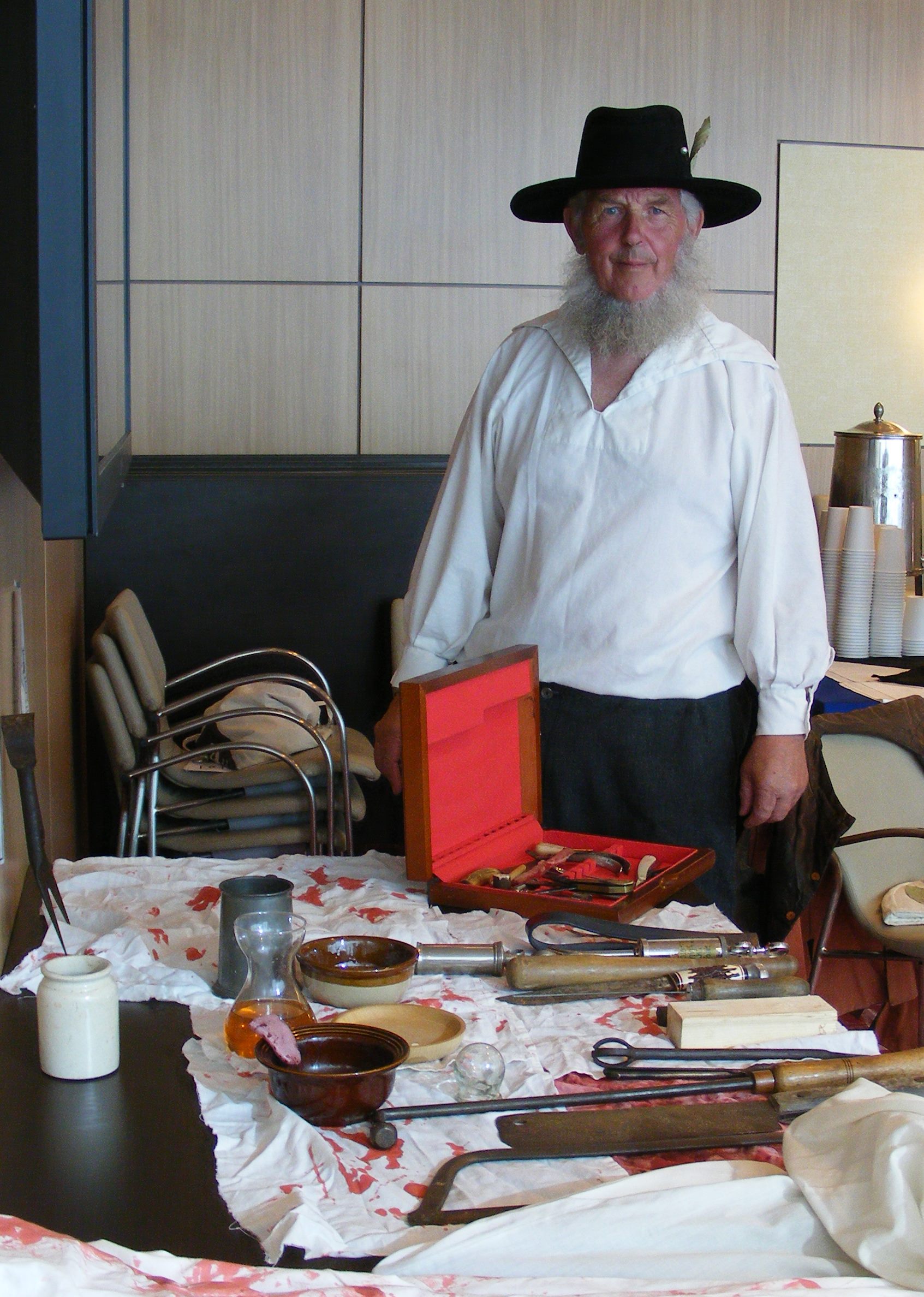
Master Christopher Preparing to Operate

It is another formal night but we are eating informally and are already in C17th costume ready for Chris’ session. None-too-bright British cruise goer to Chris: ‘Are you in National Costume? Where do you come from?’ Chris to none-too-bright cruise goer: ‘Devon’. He didn’t know how to respond! We also overhear muttered comments about the possibility of the Wurzles performing tonight but we take it all in our stride. Many people deprived themselves of dessert in order to flock to seek Master Christopher’s medical advice. To say it was well received is an understatement. We return our weapons of mass destruction and a rather under-sized security officer struggles manfully away with our box. No one has any idea what is meant to be inside (although we have a list, we have not been asked to produce this), nor do they know how many axes and knives have been hidden about our person instead of being returned to the box. The answers is none but we could easily have retained any number. I guess some sort of effort has been made and that is sufficient to prevent people successfully suing the cruise line if we inflict injury on our fellow passengers.

Molli Steam Train, Warnemunde, Germany – day 4

Up early for a lovely breakfast on deck 14, where there is the world’s biggest buffet and hence portion sizes to suit. We watch as we enter Warnemunde Harbour earlier than scheduled, as someone had to be taken to hospital. The windmills are incongruously juxtaposed against power stations and there are plenty of shipping movements to observe. An unheard of experience for us – dozing and reading on deck for the morning; we had forgotten how to relax.

Our ‘Historic Mecklenburg’ tour, ‘Purple 28’, is being led by Ann and driver Roland. We leave the fishing port of Warnemunde, which has just finished hosting the equivalent of Cowes week. This state comprises the Duchy of Meckenburg and part of the former Duchy of Pomerania (most of which is now in Poland). Although it is the largest state in terms of area, it is relatively sparsely populated and lacks natural resources, so focuses on agriculture. Rhubarb is farmed locally, as organic rhubarb juice is the latest health fad. Beef cattle are reared, primarily for MacDonalds. Crops include, wheat, barley, rye and oil seed rape. Under the socialists, farming was collective. Although basic necessities were cheap, anything deemed to be a luxury (e.g. televisions, cars, tinned pineapple) was prohibitively expensive. We are told that, since unification, west Germans have been resentful of money spent on rejuvenating and updating the east.

In 1323, the Duke of Mecklenburg sold Warnemunde to neighbouring Rostock, who wanted to secure access to the sea. Measures have been taken to prevent the area becoming overloaded with second homes and holiday lets and no new ones are allowed. The centre of the town, with its apartments, has now been surrounded by suburban housing. The shipyard and tourism are the main employers in the area. Local ‘allotments’, were created so that apartment-dwellers could have outdoor space. These all seem to have full blown chalets erected on them.

In the C12th, Slavs from modern day Russia, who were settled in the area, were driven out by Germans from further south, leaving the area with a Slavic/Germanic ethnic mix. The Duchy of Mecklenburg was in the same family, through the uninterrupted male line, for eight centuries. During this time, the Ducal family has intermarried with most royal families of Europe, including providing George III with his bride, Charlotte.

In the 1820s, iron-laden turf was collected from the riverside and was used for its health giving properties, it seems as some sort of poultice. It is still used by a local sanatorium. The locals complain about fuel and house prices but they are significantly cheaper than ours, despite average wages being similar.

023 Molli Train 14 July 2015

Molli Steam Train

We board the ‘Molli’ steam train, which uses Polish coal and runs on a line that was originally constructed to link the Duke’s residence at Bad Doberan to the nearby coast at Heiligendamm. Disconcertingly, it runs along the road through the town. We return to the coach, thankful that we are not on coach 29, which has a particularly officious guide, shooing her charges along. Heiligendamm was a destination for European nobility from 1900. The first sea bathing was popularised here in 1793, when the fad was brought from Brighton.

We drive to Kuhlungsborn’s prestigious three kilometre beach, This is the largest resort in Mecklenberg, it was created, in 1938, from three small villages. Under the Nazi regime, supporters were rewarded with holidays and the accommodation was state run by the Central Tourist Agency, who allocated accommodation to holidaymakers. There are about fifty watch towers along the Baltic coast. Under the socialist regime, they were reputedly to protect Eastern Germany from the dangers of incoming capitalist influences but were in fact used to spot those attempting to defect to the west.

024 Paddling in the Baltic at Kuhlungsborn 14 July 2015

Paddling in the Baltic

We stop for delicious apple cake and coffee in a posh hotel. The drawback is that three full coach loads into two ladies’ toilets is not a happy equation. Two enterprising American ladies help the situation by using the gents, heavily guarded by one of their spouses. We look at the generic tourist shops, a local craft market and a very crowded beach. There are plenty of basket-weave chairs with canopies that were designed locally in 1882. I dip my toes in the Baltic. Overnight visitors pay a ‘beach tax’ as a contribution towards the upkeep of the resort. School holidays here vary from state to state and are staggered on a rotational system, to avoid overcrowding.

We drive down the linden (lime) tree avenue towards the minster at Bad Doberan. The avenues marked the routes and also provided shade. In the wealthy west these were felled in order to widen the roads but the pre-unification east could not afford to do this, so they have retained their avenues and narrower roads. Cistercian monks arrived at Bad Doberan from France in 1186, to evangelise amongst the non-Christian Slavs. They dried out the swamps for farming and a settlement grew up. The original monastery was quickly rebuilt and enlarged in 1260, taking thirty five years to complete. Unusually, at this date, it was built from 7kg bricks made on site, which was an easier alternative to transporting stone. The façade has noticeable holes for scaffolding poles. All that is left of the monastery, following the Reformation in 1552, is the minster (or church) itself. It was retained because it was the burial place of many members of the ducal family. The minster, now a Lutheran Church, is 100 feet high, the soft ground making the deeper foundations necessary for a higher building, impractical.

026 Bad Doberan 14 July 2015

Bad Doberan

Inside, the lay brothers, or working monks, were separated from the choir monks, who performed religious duties. Each stall has a unique carved roundel, which may have related to a specific individual, who would sit in that place. We see Frederick Francis’ enormous granite sarcophagus. There is no inscription because it was designed following his instructions and he considered himself to be too well known for this to be needed. The internal walled have been painted to emphasise the bricks. Paintings of Slavs, depict them unrealistically in Turkish attire, as this was how non-Christian were portrayed. Some of the tombs of C13th-C15th monks have carved images of the deceased. They are all shown at the perfect male age of 38, regardless of their age at death. All the surviving medieval glass has now been put together in one window. There is also an allegorical C15th triptych showing the ’Eucharist mill’ – the word of God being made suitable for the laity. Unlike communist Russia, the socialist regime in East Germany did allow churches to remain open, although Christians were discriminated against.

We drive back to the ship and learn that there is an imminent Frank Zappa festival to be held locally. Our re-entrance to the Celebrity Eclipse is hindered by a local ‘Ooompa Band’ struggling through security, complete with instruments. To commemorate our stop in Germany, a Wurlitzer is playing in the restaurant on deck 14. There is also an impressive ice sculpture on display and a German themed menu; Chris devours five meat and one veg for tea. I then listened to another writing session by Carol Baxter in the evening, whilst Chris explored the fishing village of Warnemunde.

Scenic Flanders and Sleep Deprivation – days 2 & 3

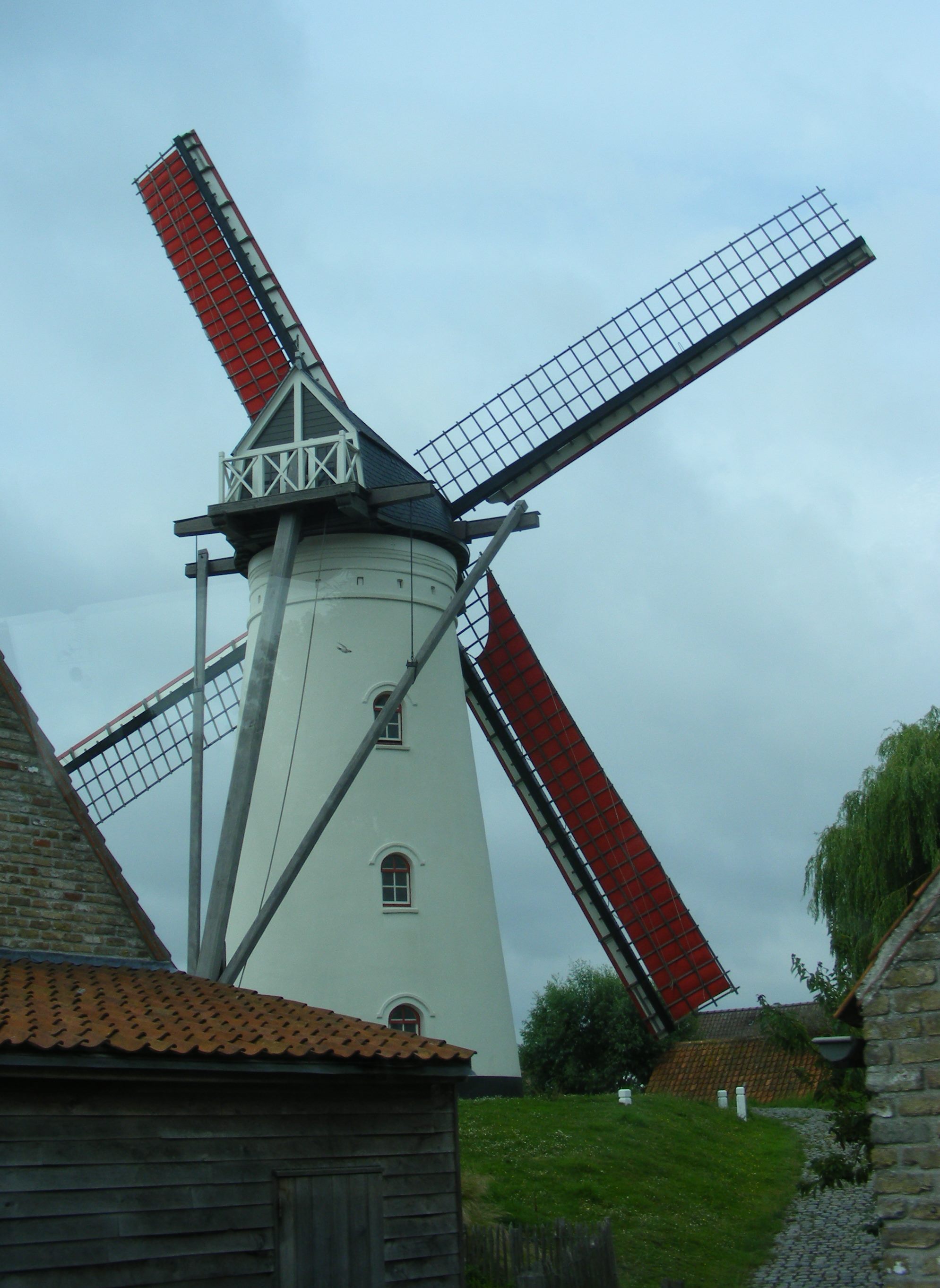
003 Ramskapelle C17th Grain Mill 12 July 2015

Ramskapelle

For breakfast I attempt the granola. I have managed to circumvent the normal menu and on request get, guess what, yoghurt to accompany it. Let’s just say that the granola was more like sugar puffs – an acquired taste that I have not yet acquired.

We dock in Zeebrugge, yet another port associated with an appalling sea disaster, this time the Herald of Free Enterprise. Along with two of our dining companions, we join folk with yellow stickers in group 26 for a tour of ‘Scenic Flanders’. Clearly seat belt wearing is not an option on Flemish coaches and off we set on a grey Bruges day. For a while, Flanders is looking anything but scenic but our brilliant Flemish guide, incongruously called José, manages to make a virtue out of driving through a port. He tells us that Zeebrugge is the entrepot for the car industry. Over a million cars have already been transhipped from here this year. 6000-8000 cars are loaded onto each ship for onward transportation; these ships take 100 drivers four hours to empty. We drive through Ramskapelle (Church of the Ram), the site of a celebration yesterday commemorating a Flemish defeat over France in 1302. We also pass the C17th grain mill at Ramskapelle. Most of the buildings use very small bricks, similar to Elizabethan bricks in the UK.

We see the poplar-lined canals known as ‘The Blinker’ and ‘The Stinker’; the latter is so named because it used to take the garbage out of Bruges. The landscape is predictably flat and there is wheat and sweet corn being grown for animal feed. The tops of several of the Medieval church towers were used as lighthouse beacons. We alight to tour the Medieval city of Damme. The town hall, outside which some kind of horse drawn carriage rally is taking place, was built in 1388. In 1468, the Duke of Burgundy (Charles the Bold) married Margaret of York in Damme. We visit the site of the old herring market, where 33 million tons of Scandinavian salt herring was shipped in. I failed to grasp over what time period. On occasions, this saved the area from starvation, notably when the potato crops failed at the same time as the more well known Irish Famine. A dog appears on the flag of Damme as, allegedly, a dog was once used to plug a hole in a vital dam from which the town gets its name. Damme is the Hay-on-Wye of Belgium and there are many book stalls. We also view the ruined church at Damme, which was sacked and burnt by Protestants in 1582. In the grounds of the church is an impressive sculpture by Delporte.

Next stop is Roose’s chocolate factory. The chocolate making demonstration is carried out by someone who is neither wearing gloves nor head covering. Maybe they don’t have food hygiene certificates in Flanders. We don’t buy any chocolate! We move on to the neo-gothic ‘Castle’ of Loppem or Lophem. This was designed by Pugin in 1856 for the Catholic Baron de van Calden. At this time, a member of the Braund family was working with Pugin and we wonder if he had any hand in the furniture design but we can find no proof. This is certainly neo-gothic in the extreme, with Catholic iconography overload, some very nice tiles and wooden carved banisters that took two men ten years to complete. A stuffed grizzly bear in the entrance hall was once an inhabitant of a local zoo. We learn that the treaty of Versailles was prepared here.

On our return, we listened to a very amusing presentation by Chris Paton on his Scottish/Irish identity crisis, followed by Cyndi Ingle, of ‘Cyndi’s List’ fame. Then a quick change to try to appear ‘formal’ for dinner. Lacking a ‘cocktail dress’, I hide behind Chris and we are deemed acceptable. I have some very appetizing lamb chops and we repair upstairs for a talk by Carol Baxter, which engenders some heated and very interesting, debate about genealogy standards.

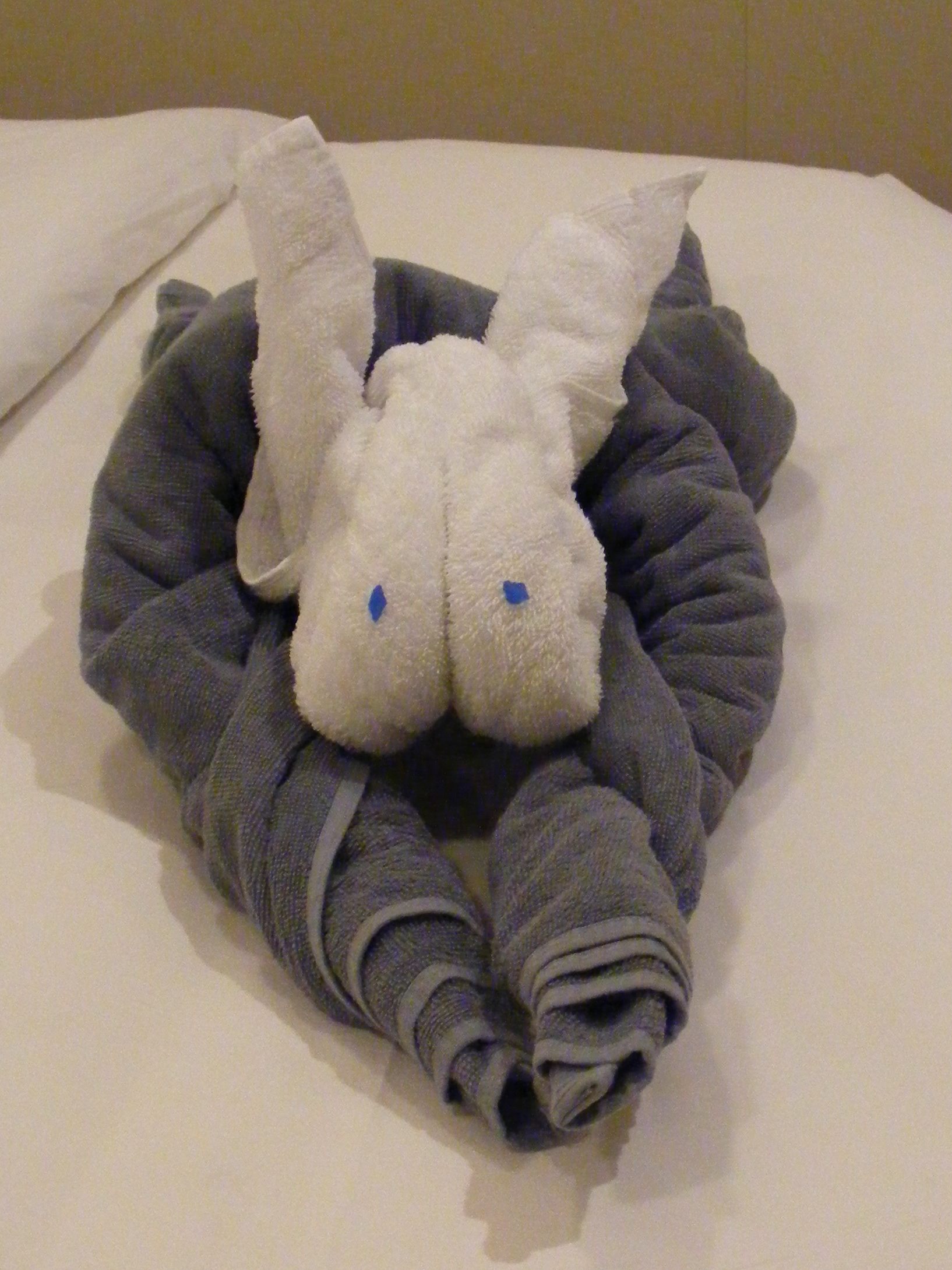
017 Rabbit Towel by Jeffrey 12 July 2015

Towel Origami

Jeffery, our stateroom attendant, has left chocolates on our pillows and an origami towel creation, which is very impressive.

We chose our stateroom because it was on the end of a corridor in the bow (that’s the pointy end to you and me) and we would only have one neighbouring stateroom. Unfortunately, our one set of neighbours are the proverbial neighbours from hell. The first night was bad but last night they went in and out of their stateroom about twenty times between 1.00am and 5.30am. This was accompanied by jiggling of locks and slamming of doors. Add to this the loud music and chatter, together with periodic falling against the adjoining wall and no sleep was had by all. It even kept Chris awake, something that I thought was impossible. Mine could be the first after lunch presentation where the speaker falls asleep. I finally got to sleep at 5.45am, only to wake again briefly at 6.30am and eventually get up at 7.50am. Sadly, this meant missing the first session of the day and being semi-comatose for most of the rest of it. Very interesting session by Shauna Hicks on records of emigrants (or from her perspective immigrants) to Australia. Then I retired to try to get some sleep but I find sleeping in the day difficult, so I gave up the attempt.

Back to the fray to listen to Jane Taubman on Family Historian and then after lunch it was my turn. A to Z of family history sources this time. I am competing with an art auction next door but despite mis-pronouncing Wagga Wagga (why it should be said Wogga Wogga I will never know), it seemed to be well received and there was a good crowd. Another session from Shauna Hicks, this time focussing on diaries and letters, excellent once again. Paul Milner’s informative presentation on the Parish Chest and time for our evening meal; Chris continued to work his way through his cow.

After dinner today was Cyndi Ingle talking about her eponymous list, in a very entertaining vein. And so to bed and blessedly only twenty minutes of door slamming at 1.15am this time.

Setting Sail – day 1

001 Celebrity Eclipse 7 May 2015

Celebrity Eclipse

Having climbed out of an internet black hole, I can now share the excitements of the past fortnight with my loyal readers. After all the frustrations of the past few weeks, during which I seem to have encountered more than enough incompetence to last me a life time, we manage to leave ahead of time for two weeks as ‘cruise ship entertainers’. The only difficulty seems to be that I am suffering from a surfeit of yoghurt (you may remember that yoghurt appeared in another post recently). Waste not, want not and there was the majority of a large pot left that I was loath to throw away. Consuming it seemed like a good idea at the time. We drive merrily along in our very small but fuel efficient, car, with a ridiculous amount of luggage. I would like to place on record a) that two thirds of one of my suitcases is full of C17th attire (oh, what a shame, no room for cocktail dresses) and b) that the other suitcase contains books that I am hoping to persuade people to acquire AND it was suggested to me by someone of my acquaintance, who normally does plenty of under the breath muttering when transporting of books is mentioned, that I may need to take more!

We head to Southampton. I have already been reminded several times that this is the port from which Titanic sailed – I was aware of this but probably could have done without it being brought to my attention. Then comes our attempt at making a security officer’s day. We approach with trepidation and a box full of axes, knives and saws.

Security Officer: ‘What is in that trunk sir?’

Master Christopher: ‘Axes and knives.’

Said security officer is clearly thinking ‘We’ve got a right wit here’.

To save my partner from arrest for flippance, I add hurriedly, ‘He’s not joking.’

Numerous security staff flock to the scanner to watch knives etc. being scanned. We are instructed to abandon our precious tools and are assured that they will be collected by security and make their way to the ship. Good luck with that one, they weigh several ton. We will need to keep an eye out for a security officer with a hernia. At the time of writing, I still have no clue whether or not there is a bereft barber surgeon’s kit loitering somewhere in Southampton Port security office.

After a very long and very hot, wait in a queue (this despite advance ‘express’ check-in) we board the Celebrity Eclipse. One thing is for sure, we are going to get plenty of exercise going from one activity to another. Our ‘stateroom’ 7188 is the most basic but fine for us. It is lovely to get to know people I have only previously ‘met’ online. We then have the obligatory but farcical, security muster. The majority of passengers were mustered before the alarm sounded so the crew have no idea how long it would take in a real emergency. We watch a weird cartoon with an annoying jingle exhorting us to wash our hands. Hints on how to abandon ship are provided in English and Spanish (there seems to be a significant Mexican contingent on board) and we are away.

002 Southampton Water 11 July 2015

Southampton Water

We watch the Isle of Wight slip past. A very pleasant meal in good company. Chris devours a steak that is so rare that it looks as if it is still capable of meaningful life – he likes it that way. Then an excellent opening presentation from Paul Milner. And so to bed. We have to put our clocks forward an hour. I am already panicking that we may not find ourselves in the right place at the right time for tomorrow’s Scenic Flanders trip.

Genealogy all at Sea

Just a quick message as I await collection in order to be whisked off to board the Celebrity Eclipse for Unlock the Past’s genealogical cruise of the Baltic. The chaos of preparations – when we really don’t know what to expect – was not helped by 20 hours worth of the job I must not mention arriving on my doorstep on Thursday morning. I was also trying (and failing) to get my house ready for a visiting small person (and her parents) who will be here in my absence – not good timing once again!

I have twice as much luggage as I have ever taken abroad before however sixty percent of that is books and seventeenth century costume as Mistress Agnes is to put in a performance. I am likely to be in an internet black hole while I am away but I promise that the tales of daring do (whatever that is) will be recorded for your delectation and edification upon my return, or if I manage to sneak my way into somewhere with a wifi connection, sooner than that.

I am never a fan of customs and security (is anyone?) and with the added complication of Master Christopher and his nice safe surgeon’s kit (which, we have been informed, ‘will be confiscated IMMEDIATELY’), I am approaching the initial stages of the trip with trepidation.

Chauffer awaits … more anon.

Of History Books, Insurance and General Randomness

The usual mixture of history has been interspersed between bouts of the job I must not mention over the last few weeks. Said job involves putting in an expense claim. I had carefully preserved my receipts from descending to the recycling pile by balancing them on top of my printer’s paper tray. That would have been fine had I not decided to print out pictures of my grandchildren for a relative. I wonder if the fact that my receipts are now emblazoned with pictures of small children has anything to do with the tardiness of the repayment?

John Rylands Library

John Rylands Library

The visit to the industrial north, that is part and parcel of the mystery job, gave me an opportunity to visit the John Rylands Library. A wonderful place but just a pity that the need to order documents in advance is not made clear on their website – even mentioning it in teeny tiny print would help. We threw ourselves on the mercy of the twelve year old (it isn’t just policemen who get younger) behind the desk and documents were eventually produced, while we clock-watched – very much aware of the horrendous parking charge that we were racking up. The place is a treasure trove, I need to spend a week, a month, whatever. Next year I will (I will) be concentrating on my Bible Christian emigrants’ research and I managed to get copies of some beautiful photographs. I did have to convince the twelve year old (having explained to them how their catalogue worked) that a picture of someone who died in 1894 came into the category of being photographed by someone who is dead but hey – maybe there are some very precocious 111 year olds out there.

We nearly did not escape from the multi-story car park following this visit. After several circuits following exit signs that clearly did not lead to anything resembling an exit, we tried enquiring of fellow car parkees. ‘I bet you didn’t have a beard when you arrived’ quips one wit, observing my hirsute companion – actually one of the funnier beard comments that he has had, just a shame they didn’t know the way out either.

The same trip north allowed us to visit the Derbyshire plague village of Eyam. Eyam House was a delight and what better than to witness the rehearsal of the annual street performance of ‘The Roses of Eyam’. What more could a seventeenth century lover want?

I have also participated in a Hangout-on-air on Three-dimensional One Place Studies, which gave rise to some amazing coincidences, there may be more about this if the story develops.

Work on compiling the book about life between 1946 and 1969 is now coming on really well. The role of my lovely volunteers is all but over and it is now down to me. The book has a cover design (still under wraps), five (of ten) chapters ready for the publisher and a proper title, ‘Remember Then: women’s memories of 1946-1969 and how to write your own’ (okay I know it is a mouthful.) The book and chapter titles are all songs from the period. It is still possible that this may be ready for Christmas – I am doing my best and am really enjoying it.

A book that is finished is The Ones That Got Away: tracing elusive ancestors who move into, out from and within Britain (I know, I love colons and wordy titles but I have avoided alliteration this time). It is also an ebook. It will shortly be available via UK and Canadian outlets as well. This is just in time for my Baltic Cruise – getting very excited about that now. I still have no cocktail dresses, or indeed room for many clothes at all as my seventeenth century attire takes up most of my suitcase. We do at least finally have permission to take instruments of torture a.k.a. Master Christopher’s barber surgeon kit on board. We have however had bizarre conversations in the pursuit of public liability insurance.

Insurance company: ‘Do you check your equipment regularly to ensure that it cannot cause injury?’

Me: ‘Well, we check swords and bladed tools to make sure they are blunt’ (thinking ‘how on earth are they going to un-blunt themselves?’).

Insurance company: ‘That’s not sufficient, we need to know that they can’t injure anyone’.

Me: ‘Look, madam, (through gritted teeth) these are heavy metal objects, if used inappropriately they might potentially hurt someone.’

Insurance company: disapproving silence

Me: ‘I am not wishing to be facetious, merely accurate. If I drop a book on my foot it will hurt, I could strangle myself on an innocuous looking shoe-lace. We take every reasonable precaution to ensure that these do not cause injury.’

Flippancy clearly does not pay; the quote came back three times higher than anyone else’s and we went with a different company.

Post cruise, I am looking forward to presenting a webinar for The Society of Australian Genealogists in August. Amidst all this, I am ‘racing’ for life, in aid of cancer research in next weekend’s forecast heat wave. So many lovely people have already parted with money; more sponsors welcome. Retirement? Remind me what that is – mind you I am still chasing official retirement age, which is receding rapidly into the unattainable distance.

History for Toddlers

113 29 May 2015

Playing with toys from Previous Generations. Trolley made by great-grandfather, played with by Granny and mum

I know, I do take my obsession with making history accessible to children to extremes. After all, my first conversation with my granddaughter, whose birthday is 5th November, centred on the fact that Guy Fawkes was the scapegoat and she was really born on Robert Catesby Day. That said, if we want to interest young people in history and heritage in all its forms, we need to ignite that spark when they are young and I do mean very young. So here we are, the long promised post suggesting how pre-school children can be immersed in history and family history before they even realise it. Thank you for your patience.

Special people cards

Special People Cards

Something really simple, like playing with toys that belonged to parents, or even grandparents can start conversations about continuity – ‘that was Daddy’s when he was a little boy’. Of course, it is a while before children can understand that their parents were once children but it is never too young to start introducing this concept. Reinforcing this with family photographs, showing Mummy and Daddy getting gradually younger, can help. How about laminating pictures of special people, starting with parents, grandparents, aunts, uncles and cousins and then moving on to family members who are no longer alive? If all the toys from earlier generations have been re-homed, you might find it easier to obtain copies of books that were past favourites. Some of these will have illustrations that evoke past eras. Janet and Allan Ahlberg’s beautiful Peepo, for instance, features 1940s’ interiors. You could also provide an opportunity to play with replica toys from earlier periods. This does not involve a great financial outlay; most of these toys were home made, so you can make your own.

Dressing-up

Dressing-up

Nursery rhymes, of course, have been enjoyed for generations and many reflect historical characters or events. Humpty Dumpty, for example, is believed by some to originate from a nickname given to a cannon at the English Civil War siege of Colchester. There have been many Dukes of York but the Grand Old Duke is thought to be James II (formerly the Duke of York) and to refer to the incident, in 1688, when his troops were marched across Salisbury Plain to combat with his son-in-law William of Orange.

DSCF2607

Toys in Period Costume

Dressing up in old fashioned clothes can be fun, remember that this includes the fashions of the 1990s! Alternatively, toys can be dressed in period costume. Even quite young children can be taken to historical sites and many of these are realising the need to be child friendly and interactive. Do not assume that you cannot visit such places with under 5s. Obviously, you need to ensure that they do not disturb other people’s enjoyment of the place and you cannot expect them to benefit from the visit unless you are willing to act as an interpreter. Talk about what you can see, even if they cannot understand what you are saying, newly verbal children just enjoy ‘conversations’. If the venue does not already have a children’s trail, invent your own. As you enter a room, look for an object that is in your child’s vocabulary and ask if they can see it. We recently had fun spotting peacocks on a tapestry with Edward (aged 16 months). If there are opportunities for hands on interaction with artefacts at heritage sites, do take them.

Toys from previous generations

Toys from previous generations

Small world toys, such as Lego and Playmobil (other toy manufacturers are available) produce figures from the past, – knights, Victorians and so on. Once your toddler is safe with small pieces, these are great fun. Most small children love dinosaurs – these too are history! Remember to start to introduce the idea that dinosaurs are different from cats, cows or elephants, in that they are from the distant past. There are many more ideas and there is a booklet in preparation, finishing it is a little way down the ‘to do’ list but I will get there.

Before you dismiss your descendants as not being interested, ask yourself just how hard you have tried to bring history to them at their level.

Of Yoghurt, Sat-Navs and Special Chairs

After some time in Granny mode, it was off to the industrial north for the job I must not mention. We arrived from the east, having detoured via Cambridge, so approached through Longendale – a much better route than our usual crawl up the M6. Safely settled in to our motel, we descended for food. Who decided that many decibels loud rap ‘music’ was a suitable accompaniment for food? Add to that the numerous violently flashing fruit machines and I felt the need to lie in a darkened room.

We are travelling with our old and trusty Sat-Nav (the new one is irrevocably attached to another vehicle), that would be an old and defunct Sat-Nav, which wimpered into inactivity on our way to the city centre. Fortunately we did have some idea where we were heading and I emerged unscathed and without requiring detours. Other incidents relating to our foray north include being attacked by the contents of a yoghurt pot, whilst attempting to liberate my breakfast. Then we went in search of a Harvester (or indeed anywhere to eat in relative peace and calm). Inevitably, the now recovered Sat-Nav does not recognise the road name, ‘Arena Approach’. Using what is left of my initiative, I spot a sign to a Stadium and think that this may be the arena that we need to approach. It turns out that this was, for once, a good move – hurrah!

!cid_8F5DD1BA-1F13-432D-9EF4-23903B2EDC02@lanOur trip also incorporated a photo shoot. Now before you comment that we are hardly model potential, we were responding to a request for those who don period costume to take part in a photography project. You can read all about our brilliant time with the lovely Jo Rutherford on Swords and Spindles’ blog page but here I must mention the chair. After my mum died, precious heirlooms were divided between my daughters and myself. There has been a certain amount of reassignment of some of these possessions since then and I had just re-taken possession of a folding carpet chair that belonged to my great-grandmother. This was in the boot, along with sword and buff coat, when we arrived at the photographers. Jo spotted this and suggested that we incorporate it in some of the shots. There was something wonderful about sitting in seventeenth century costume, on a chair that was the favourite of an ancestor, in order to have my picture taken. Jo also took a very evocative picture of the empty chair. I was able to send her a picture of the chair’s owner and even a very blurry picture of great-granny sitting in said chair.Clara Woolgar née Dawson 1858-1949 1932

Nope, I still haven’t forgotten that I promised to report back about bringing history to the next generation – patience is a virtue and all that.

Talks, Books and other Busyness

This week saw me give two remote presentations to Ontario Genealogical Society’s annual conference. This is always a strange procedure as I usually feed off my audience and screen-sharing my power-point means that the audience are hidden from sight. I did explain that it was their chance to sleep through a lecture without the speaker knowing – who knows how many took the opportunity? Their set-up meant that I could only hear what was being said when the speaker was very close to the Canadian lap-top and in the absence of any loud noises their end, I could not hear what was going on. It turned out that at one point they couldn’t hear me either. It seems that the lap-top that was being used lacked a power cable and the battery died. Who needs an insightful conclusion? My second talk, on one place studies, included a question from someone who, by co-incidence, was researching a place a mere three miles from where I was born. I was therefore able to give some detailed information. Fortunately no one else expected me to have a similar in-depth knowledge of their place or I may have been stuck!

Also on the agenda was a very interesting meeting, on behalf of Devon Family History Society, with people looking to develop heritage provision on Lundy Island – some intriguing ideas and possibilities. The meeting was on The Oldenburg, Lundy’s passenger ship. You can only get on and off the boat at certain stages of the tide. It was touch and go whether we would escape in time. In the end we descended a very wobbly gang-plank, dodging ropes and cables, at the very last minute, Just as well we did, as then it was off to entertain Langport History Group as Swords and Spindles.

I was thrilled to find that the Institute of Heraldic and Genealogical Studies have made Putting your Ancestors in their Place: a guide to one place studies their book of the month. I do hope this isn’t because they bought lots of copies that they can’t get rid of! It is being offered at a reduced price and postage free in the UK – so June is the month to buy, if you haven’t already succumbed to the temptation.

LHN_cov_115_174_250_80_sMore excitement, as I have been invited to present a webinar for The Society for Australian Genealogists, so I shall be talking on three continents and at sea this year. There have also been some lovely remarks about my recent article in Local History News, the magazine of the British Association for Local History. It describes how Buckland Brewer History Group have been working to take history into the community.

I haven’t forgotten that I promised to report back about bringing history to the next generation – more on this soon.