Across the Border Again and a Lesson in Hydraulics

So yet again we cross the border and are on the doorstep of Eyemouth World of Boats as it opens. A lovely lady directs us on a short drive to the storage sheds. She makes no mention of ostriches, perhaps I misunderstood. She had said that she was unable to locate the boat we were interested in but when we provide a few more details (like giving her the correct name) we are in luck. I can see why this is a health and safety nightmare. Someone has removed the steps up to a three foot high platform on which most of the boats are stored. Undaunted, we scramble up on the platform and are able to see the Flying Foam. Ironically she was on display at World of Boats until last year when she was moved to make room for the whaler.

We manage to get back in order to move the van at the approved time and head for a site near Alnwick, which we are learning to call ‘Annick’, so that we sound like locals. We have been to this site before (see archive posts for October 2012 for that visit) and we are on the adjacent pitch to the one that we occupied on that occasion. Unusually, I have planned no itinerary for this part of the holiday. The weather is still demanding an inside venue so it is a case of looking for a National Trust property near us. This turns out to be Cragside, near Rothbury. We encounter a first at a National Trust property, we have to queue to get in. The house has been subject to several extensions and is a distinctly strange shape. The imposing Victorian house was the home of the Armstrong (later Watson-Armstrong) family. William George Armstrong, was an engineer who specialised in hydraulics, meaning that there are various gadgets in the house. Cragside was the first house in world to be lit by electricity that had been generated by water power. He also installed a hydraulic lift in the 1870s.

Unusually, there are decorative tiles on the walls, up to dado rail height, on all floors. There is a very interesting kitchen, with high ceilings and a mechanical jack to turn the joints of meat. There is an over-the-top chimney breast in the drawing room, probably installed to impress the future Edward VII, who visited with his wife and children in 1884. There is also an exhibition about the local businessman, David Dippie Dixon, who, amongst other things, was in charge of the Northern Picture Puzzle Exchange. These were not the lobed jigsaw pieces that we are used to but interlocking, push-fit puzzles.

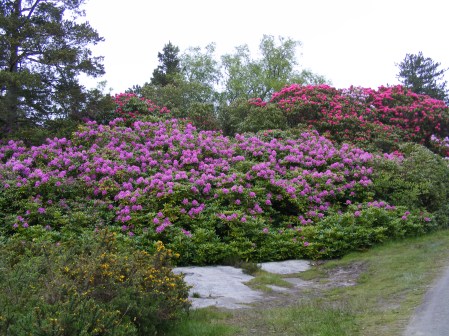
438 Cragside Rhododendrons 31 May 2016Cragside has plenty of opportunities for outside exploration, with gardens and extensive grounds. Given the temperature, we opt for driving along the six mile estate drive, which commences by driving under an arch through the house. This is obviously the right time for a visit as the rhododendron lined woodland paths are spectacular. It is a shame that we have neither the time, energy, or the warmth, to explore on foot. Home then via a quick shopping stop at Rothbury.

Across the Border

It is ten degrees as we leave Scotland. Arriving in England, it might be a little warmer but there is a thick mist. Too late we realise that the earliest entry on the site at Berwick on Tweed is not midday but 1.00pm. We arrive at 12.10pm and are third in the queue. There is not much room for queuing so our arrival effectively blocks the exit, meaning that no one can get a vehicle, much less a caravan, in or out. The harassed warden arrives, pointing out that we are all early. She has no option but to let at least one of us through the barrier. In the end she kindly allows us all on site. Having set up we return to Scotland. The sole reason for us stopping here is to see a Bucks ledge boat that is currently owned by World of Boats in Eyemouth. This small west country fishing boat is carvel constructed in a style that is unique to Bucks Mills and it belonged to a member of the Braund family. We arrive in a very chilly Eyemouth and locate World of Boats. We pay our modest entrance fee and converse with the very chatty custodian who explains all about their new acquired whaler. World of Boats own over 400 boats from across the globe. Unfortunately, 395 of them are not on display, including, inevitably, the Bucks ledge boat. On enquiring we learn that they are off site in the ostrich sheds. The ostrich sheds? These are not open to the public on the grounds of health and safety as the boats are stored on racks. Illogically, we can however view these if accompanied by a custodian. I assume that said custodian is briefed to catch any boat that looks likely to land on our heads. There will be someone who can take us tomorrow. In theory we are not available tomorrow as we have to be off site and heading south in the morning. We decide however that, by dint of arriving as the museum opens, we can just fit in a quick trip to the ostrich sheds before we leave.

Our boatless excursion leaves us with an afternoon free, so we cast about for something to do in Eyemouth, ideally something indoors, so not the thrilling trip in a speed boat that is on offer. There is a large yellow flag saying ‘house open’ and signs to Gunsgreen House, so we give that a try. Although this is not a venue that we can enter free of charge on the strength of our memberships, it has the advantage of being only hundreds of yards from World of Boats. The name Gunsgreen probably dates from the time when soldiers from nearby forts practiced in this area. The house, designed by John Adam, was built for John Nisbet in 1753. Nisbet was a local merchant who was also involved in organised smuggling on a very large scale. This was not usual on the east coast, especially after the Union of the Crowns, in 1707, imposed the crippling English taxes on Scotland. The nearest customs house was a three hour ride away at Dunbar, so Eyemouth was an ideal spot. An interesting aside: Dunbar Kirk Sessions reveal that, in the 1730s, Nisbet had been in trouble for an association with servant girls.

429 View from Berwick site 30 May 2016The main product that was smuggled was tea, which in Nisbet’s time attracted 119% tax. The house includes a hidden chute where large quantities of tea could be stored, a hidey hole under the floorboards, capable of concealing three men and warren like cellars, where our tour began. The top floors were not finished for twenty years, by which time a tenant, John Stewart, was in residence. The house was sold to rival merchant and smuggler, Alexander Robertson, to pay debts and then passed to the Home family. From 1906-1965 the house was run as a guest house by the Dougals. It then did time as a clubhouse for golfers and was finally acquired for restoration by the trust in 1998. In fact very little had been altered by the succession of owners. Pleased with our choice of ‘bonus’ visit, we return to Berwick Seaview site, which is by then living up to its name.

Edinburgh and an Encounter with the Earl of Moray

Despite not being the greatest fans of cities, we feel we do have to spend time in Edinburgh and today’s the day. Unfortunately, as we discovered yesterday, it is also the day of the Edinburgh Marathon but we hope that this won’t cause too many problems. We feel that we are unlikely to be mistaken for competitors. There is a half-hourly minibus service from the site into the city. You appear to just queue up for this. I am not daft, I can work out that if all of the 400 or so people on the site want to get on a 16 seater minibus at  the same time, we may be unlucky. Obviously we need to be at the front of the queue. We plan to catch the first bus at 9.30am. Left to me I’d have been there at 8.00am but I am restrained until 9.10am. We are the only people waiting. By the time it gets to 9.25am I am feeling that I would be comforted if there were some other people in the queue, as reassurance that a) we are waiting in the right place and b) we weren’t supposed to ring up and request the minibus. 9.30am and we (and no-one else) board the vehicle for the city centre.

We walk along Prince’s Street and through the beautiful Prince’s Gardens, making our way up and it certainly is up, to Edinburgh Castle. Yet again our English Heritage membership comes in handy, gaining us free entry. We join a guided tour in a group which includes Americans, Australians, Germans and Japanese. Our leader is Laura, whose delivery is very amusing and we learn of the castle’s history. This site has been occupied for 3000 years but the earliest remains are 900 years old. It has been used continuously, at times as a royal residence, a seat of Parliament and it is still a working garrison. At 400 feet above sea level the castle dominates the city and it is in an ideal defensive position. Laura comments on the historical inaccuracies of Braveheart – Wallace was a rich lowlander and not a kilt-wearing peasant a la Mel Gibson.

416 Edinburgh Castle 29 May 2016The weather is much better today. Not as much better as some of the locals, with their bare chests and shorts, are implying; I still have my coat and jumper on. We can at least see the view over the Firth of Forth as the mist has lifted. The castle fire a cannon at 1pm daily, except Sundays, so we shall miss that. St Margaret’s Chapel is the oldest part of the castle. It was built in memory of Margaret, the mother of David I. It is very tiny and although it is still used for weddings, you are limited to 25 guests. After our tour we wait for an excellent presentation by an historical interpreter, representing Sir Thomas Randolph, Earl of Moray who, in 1314, was charged with recapturing the castle from English occupation. It was one of three castles in English hands at the time. Roxborough was re-taken by men disguised as cows. Randolph, whose half uncle was Robert the Bruce, climbed the rock using a secret path revealed to him by the son of a former castle governor and got inside the castle with thirty men, whilst others created a diversion at the gates, so the castle was recaptured from inside. It is great to chat to the interpreter and try his weaponry. The chain mail is seriously heavy and the full face helmet certainly restricts the field of vision. He has a fiendish looking mace, which was designed for use by churchmen who were not allowed to let blood, although bashing people over the head was fine!

We queue for a considerable time to see the Scottish crown jewels. The sceptre, sword and crown were first used together for the coronation of the infant Mary Queen of Scots in 1543. These had to be hidden from Cromwell’s troops and somehow went missing from 1707-1818. We also see the Stone of Destiny, also known as the Stone of Scone, which has been used in coronation ceremonies for centuries. It was ‘acquired’ from the Scots by Edward I and taken to England. In 1950, four students stole it and broke it in the process, after four months they abandoned it at Abroath as a political protest. It was returned to England until 1996 when it was finally given back to the Scots on the proviso that it can be borrowed for future coronations. A quick look through the royal apartments and then off to view the Great Hall, with its impressive hammer beam roof and vast collection of armour and armaments. We also tour the Scottish war memorial that commemorates nearly 150,000 Scottish war dead.

By this time we have been on our feet for 2½ hours so decide to invest in the hop on hop off open-top city tour bus. We don’t actually do any hopping but make nearly two complete circuits, once listening to the standard commentary and once to a Horrible Histories version. The latter makes much of the connection with Burke and Hare.  We are warned to beware of the tram lines. We must not stand on the seats or take ‘anything lengthy’ on the top deck. The examples given are fishing  rods and helium balloons. We have neither so we are fine. Edinburgh’s contribution to medicine is mentioned. It is home to the oldest College of Surgeons, founded in 1505. We stop at the grass market, where sales of grass for animal feed, as well as other produce, have been held since 1477; it was also the site of the gallows. Now it is a trendy area with cafés and outside eating spaces. Being Scotland, these are full because the sun is out, despite the piercing wind. We see the back of the Greyfriars Bobby statute, commemorating the dog who held a vigil on his dead master’s grave for fourteen years. The Royal Mile (actually a Scottish mile so longer than ours) links the castle to Holyrood House, which comes next along with Holyrood Park, the latter is the largest royal park in Britain. Arthur’s Seat towers 800 feet above us. Several Edinburgh streets are actually bridges, not over rivers but linking areas of higher ground. Most of the streets in the new, planned, city have Hanoverian inspired names. The city is the largest urban world heritage site in the world. We see our first pipers of this Scottish trip.

The only evidence of the marathon was some rubbish and a few abandoned traffic cones. We are only half an hour early for the first return minibus trip of the day and we are the only passengers. This is our final full day in Scotland but the holiday is not quite over.

Rubbing Shoulders with the Knights Templar

The journey this time is a very short one in to Edinburgh. We approach what we believe is the Forth Road Bridge. It seems to have some rather disconcerting gaps in it. Ah! Fortunately this is not the Forth Road Bridge, or at least not yet; it is still under construction. I am disappointed that no one is actually in the process of painting the real Forth Road Bridge. There are warnings of a running event in the city but we are aiming for the north of Edinburgh so hope to avoid this. We later discover that this event is not until tomorrow and that it is the Edinburgh marathon. I am quite excited to be directed down Quality Street; this does actually appear to be the Quality Street. It might have been better if we had not been directed down Quality Street as we are in the midst of another sat-nav fail. This time it knows where site is (unlike the last two destinations) but seems to think that our caravan will fit down a road blocked by bollards with the gap between them barely wide enough for a car, sigh.

Today is the first time since we reached Scotland that we have been able to go out in tee-shirts, well Chris is in a tee-shirt; I still have a jumper on. We are trying to find the Chapel of Rosslyn, which has associations with the Knights Templar, always a fascination for me. Wouldn’t you think it would be in a place called Rosslyn? Nope. It is in Roslin, which is not what I was putting in the sat-nav! When we find it, along with four coach loads of other tourists, there are guide leaflets in every language but English. The rationale behind this is that the interpretation boards are in English, so we won’t need a leaflet. I would like to take one home so I opt for French on the grounds that I may understand one word in three. First comes the Old Rosslyn Inn, which was opened from 1660-1866 but is now a private house. It was patronised by ‘celebrities’ such as the future Edward VII, Walter Scott, William and Dorothy Wordsworth and Robert Burns.

The Chapel was begun in 1446 by Sir William St Clair, Prince of Orkney, who owned nearby Rosslyn Castle. What was known as the Collegiate Chapel of St Matthew, was intended as a private chapel so masses could be said for the souls of the St Clair family. The chapel was built in an over the top gothic style using local stone and probably employing French masons. It took forty years to ‘complete’ but was half the size of that which was originally planned, perhaps because the impetus was lost with the death of St. Clair.

One advantage of all the tour buses is that we can eavesdrop on a group’s commentary. A French guide explains, in very good English, some of the symbolism behind the many carvings. She is aided by a green laser pointer. Our attention is drawn to over 100 green man carvings. This pagan symbol is not unknown in chapels but so many of them is very unusual. There are, understandably, carvings that are full of religious symbolism as well as animals and plants. The plants include maize, which is strange as it was carved fifty years before Columbus discovered America. There are angels playing instruments, including bagpipes, a dance of death and depictions of the seven deadly sins. There is a legend attached to two of the carved pillars. One was supposed to be executed by the master mason and a more elaborate one by the apprentice, who was inspired by a dream. The incensed mason then killed the apprentice in a fit of jealous rage. Two of the gargoyles are supposed to depict the mason and his apprentice, complete with head wound. Ironically, the mason is sited so that he stares at the apprentice’s column.

The chapel is associated with the Knights Templar, early twelfth century warrior monks whose role was to protect pilgrims on crusade and to find and guard treasures from the Temple of Solomon in Jerusalem. The chapel came to prominence because it features in Dan Brown’s Da Vinci Code and the visitor footfall increased five fold as a result. After the Reformation, prayers for the dead were no longer customary but the chapel is still in use for regular services. Monck stabled the horses of the Parliamentarian forces in the chapel in 1650. By the eighteenth century it had fallen into disrepair and as a ‘ruin’, become a focus for Romantic poets and artists including Turner. Its initial restoration was inspired by Queen Victoria and now there are 175,000 visitors a year, many of whom seemed to be there on the same day as us. I was a bit disappointed that there was not more information on the Knights Templar but it was fascinating nonetheless.

412 Currie Kirk 28 May 2016On the way back to the van we call in at Currie, where my granddaughter’s ancestors came from but no luck with the graveyard here. There are some very unusual stones there though.

Puffins and other Birds

It is twenty degrees and sunny in the Highlands today. Sadly we are no longer in the Highlands and we have mist, drizzle, ten degrees and a very cold wind. We set off for the twenty mile trip to Anstruther, still unsure if our boat to the Isle of May will sail today. We arrive early, that would be early even by our standards. The boat, The May Princess, which takes 100 passengers, is full. It is mostly full of a party of fourteen year olds whose degree of preparedness for today’s activity varies. One girl is wearing a thin jumper that stops a few inches above her waist and has slashed sleeves. The lady next to us works on an Antarctic survey project. She at least is appropriately dressed. She claims that the Isle of May is one of her favourite places on earth. There are some very serious cameras on board. One man has a four foot long lens; I dread to think what it weighs or how it will fare in this drizzle. We have secured what appear to be the best seats on the boat, outside yet under an overhang to protect us from the rain.

Another toilet related comment alert. The comfort system that increases the availability of toilets, which we used in Aberdeenshire, has been disbanded in Fife. Chris therefore used the time whilst we were waiting for the boat to walk through the rain quite a long way and then was indignant at being charged thirty pence for the privilege. I have elected to wait until we board. This means that I have to wait until the boat is at sea before using the facilities. These are typical boat ‘heads’, with another puzzle as to how the flush works. Too late I spot the instruction to put toilet paper in the bin rather than down the pan. Without going into too many gory details, I will report that it did end up in the correct receptacle. Then comes the challenge of trying to keep on my feet whilst returning to my seat.  The boat is lurching in a spectacular manner, with waves crashing on deck to the accompaniment of many girly screams from the school party and that was just the boys. This is the roughest sea I have experienced since whale watching. I am the proud possessor of seasickness tablets. They are at home. I remember the whale watching instructions to put pressure on the pulse points, this seems to work.

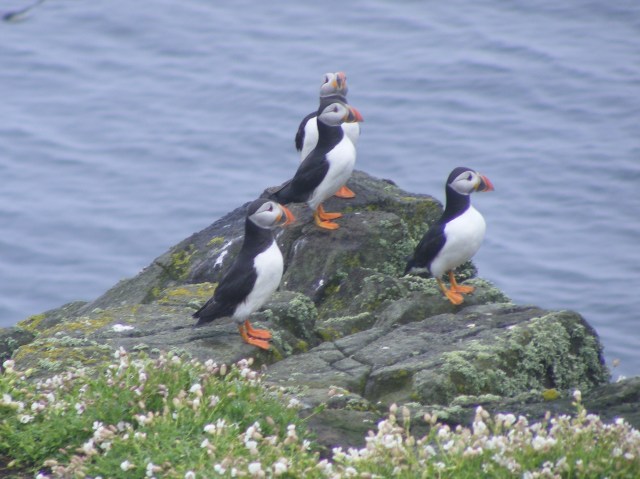
We see gannets and learn that they are part of the 150,000 strong colony on Bass Rock, the largest colony in the Northern Hemisphere. There are ¼ million sea birds on the Isle of May, including 92,000 puffins, surely I will at last see one. Puffins return to the same burrows each year and once they leave the island, the chicks do not come back to land until they are mature enough to mate three years later.

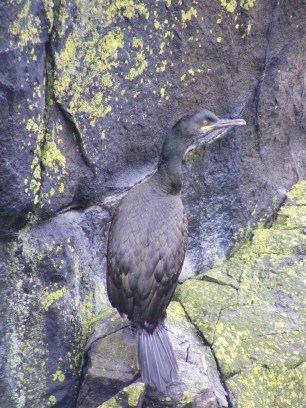
386a Puffins Isle of May 27 May 2016We start to see more and more seabirds through the mist and drizzle, including my first ever puffin! As we near the island the water is thick with guillimots, razorbills and more puffins. We have three hours to spend on the island and we walk most of the pathways. Departing from the marked routes is strictly forbidden in case puffin burrows are damaged. Even with my very basic £100 camera I manage half decent, recognisable shots of the islands birds. Apart from the puffins, razorbills and guillimots there are, oystercatchers, shags, fulmars, black-backed gulls (lesser and greater), fulmars and kittiwakes. There is also an active tern colony and the terns dive bomb the visitors making their strange ticking cries (that would be the terns’ cries, not the visitors). Eider duck nest right by the pathways; I had forgotten that the females were a drab brown, in contrast to their gaudy husbands. A tremendous plus for having had to do this part of the trip two years later than originally planned is that, had we made it here as intended in August 2014, there would have been far less to see. Despite the chilling wind I am having a great time, though I agree that slightly warmer weather would have been the icing on this particular cake.

394 Shag Isle of May 27 May 2016A great deal of what is known about sea birds and migrations patterns is thanks to data collected on May. Only the researchers live on the island as the lighthouse is now automated. It is 200 years old and was built to replace the oldest lighthouse in Britain, which was a coal fired beacon tower dating from 1636. This took between one and three tons of coal a night to maintain, all of which was brought from the mainland and hauled to the top of the tower. The island used to be a monastic foundation, with St Ethernan’s shrine attracting pilgrims since the seventh century. The island was home to St Adrian until he carelessly got murdered by the Vikings in 875. In 1500, James IV had a picnic on the island, because he could I guess. After the 1715 Jacobite rebellion, three hundred fleeing Jacobites somehow got stranded on May for eight days without food.

We return to the boat and choose to sit on the top deck, as the drizzle has stopped. I ask which is the appropriate side of the boat to sit for the best view of the cliffs on the return journey. The island is home to 100 or so grey seals and we see these as we travel along the coast. The tide is very low and the gangplank is at a ninety degree angle. The chap in front of me is on crutches, he manages better than I. Yet another day when a serious defrosting is required when we get home.

The Kingdom of Fife

It is back along the now familiar A96 to a grey Aberdeen, which our sat-nav insists on pronouncing Abradeen. There are glimpses of sun as we head south on the A90. At Dundee, we cross the Tay Bridge, which is celebrating its 50th birthday. Finally it is on to the A92 into Fife. Our sat-nav is especially designed for those with caravans and includes all our sites as points of interest, so we have put in our destination – Balbirnie Park in Markinch. Markinch is the home of the ancestors of my grandson but I have left the family history to his other grandma.

We begin to lose confidence in the sat-nav as we wind our way through the backstreets and end up down what appears to be a dead end. We are being directed to turn left in a few yard, the road appears to stop. I get out to investigate and discover that the ‘road’ is a metre wide earthen footpath. Chris does a several point turn with the van and I turn navigating using the postcode instead (there is no road as part of the site’s address). This sends us to a spot three miles away and still no site in sight (there’s a pun in there somewhere). Plan c is to put in ‘Markinch’ and use the written directions in the Caravan Club book. Success! This is a heavily wooded site, which looks pleasant but the trees make the van very dark. As someone who has only just acquired a car that can be opened remotely, I am excited by the barrier key, which allows me to zap the site barrier from a distance using a fob and watch the barrier rise. Ok, so I am easily amused.

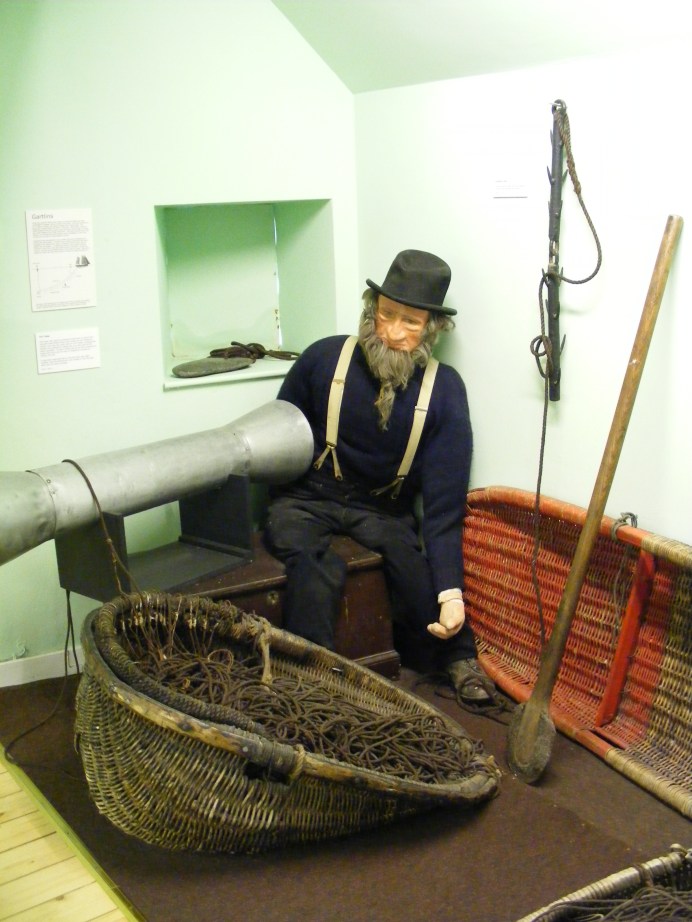
373 Scottish Fisheries Museum 26 May 2016.JPGA nature reserve was on the itinerary for this afternoon but we are still in single digit temperatures, with biting winds and drizzle, so we think again. We decide to head for Anstruther to see where tomorrow’s boat trip starts. We drive along the Fife Coastal Tourist Route, through the East Neuk villages, past fields of potatoes and arrive at Anstruther. This areas was described as a fringe of gold by James II. ‘Neuk’ means corner and here we are on a small corner of the east coast. We spot some shell houses in Anstruther and then we find the harbour and enquire at the ferry office. Yesterday’s and today’s sailings have been cancelled due to bad weather, this does not bode well. It is definitely a day for an indoor activity so we look round the Scottish Fisheries Museum, which used to be home to some Braund family boats. We knew that these had moved to Eyemouth and we hope to see them in a few days’ time. The museum is very well done, part of it is housed in the former occasional lodgings of sixteenth century abbot of Balmerino. There is another strange toilet-related incident at the museum. These are very strange contraptions and I am initially at a loss as to how to effect a flush. There are tiny hand basins on top of the cisterns and turning on the tap also flushes the toilet.

On the way home, we drive back through Pittenweem, which is an historic fishing village that the guide book recommends. Maybe on a sunny day….. One of our party is hardy enough to wander round and inspect the fishing boats. Enough is enough and it is time to batten down the van’s hatches and thaw out yet again.

In Search of the Wights

Chris has managed to get his phone to tell him that it is currently 7 degrees (whatever happened to phones that made telephone calls?). What his phone doesn’t tell him is that there is also a wind chill factor of quite a lot. I packed thermals to go to Canada and arrived in temperatures of 27 degrees; here the reverse seems to be true. Undaunted – well maybe just a little daunted – we go forth and search ancestral areas. A quick trip to Chapel of Garioch first. It has to be a quick trip, it is very small. I photograph the cross slab known as the Maiden Stone, one of many Pictish relics in the area. Then it is on to Old Rayne, a few cottages larger than Chapel of Garioch and with a church that is over two miles away from the settlement. As we get out to explore the graveyard we understand the attraction of Penge (south London) where my children’s ancestor from this area ended up. It is truly freezing, although I have to own that Penge probably lacks the scenic value of Rayne.

As the temperature has encouraged us to be pretty swift with our churchyard excursions, we are now much too early to go to the museum at Insch, so we return to the van to thaw out. Sustained and warmed we head back to Insch just as the volunteer is opening up. The museum is only open one afternoon a week so I was glad that I could arrange the itinerary to coincide. I was a bit worried that this museum might be another homage to Pictish culture, very interesting but not what I was after. We wait patiently whilst an Australian, who now lives on the English south coast, tells the complete story of his family history to the volunteer, who makes all the right noises. We have already exhausted the potential of the displays in this very small museum, which is part of the still functioning railway station. Fortunately, it is more nineteenth century than ninth century, with, understandably, a preponderance of railway history. The railway linking Inverness and Aberdeen came through Insch in 1854 and had an enormous impact on the small village. Our fellow enquirer has come by train and needs to get the 2.19pm back again. I know we are in the station but given that the next train isn’t for two hours, I would have been on the platform sooner than 2.18 and thirty seconds. Well, I would have been there from about 2.00pm just in case but I am sure there is a happy medium.

His departure gives us a chance to ask the volunteer, without holding out much hope, if she has heard of Wight’s Inn. She chats away about how old Mrs Wight came down from up country to run the pub. She is past the first flush of youth but she is implying that she remembers Mrs Wight and my Mrs Wight died in 1862 so my heart is sinking. But no, it turns out that she really is talking about my Mrs Wight. The bad news is that Wight’s Inn and the neighbouring Pauper Lodging House run by Mrs Wight’s daughter in law (also Mrs Wight of course but I am attempting not to confuse) have been demolished. Mrs Helpful Volunteer finds a picture and map of the rough location that I can copy. I say we had failed to find a gravestone yesterday and add that I wasn’t really expecting there to have been a marker. Au contraire, our kind assistant is sure there would have been one as she would have been ‘quite wealthy’. She pulls out a list of memorial inscriptions for the old kirk where we were yesterday. This has been compiled by someone we have met through the family history world, so thank you Sheila, we couldn’t have managed without you. Yes, there is Mary Wight, husband James and other members of the family on stone 193. ‘Oh’, she says ominously, ‘it is flat’. We have seen these flat stones, they are buried under an impenetrable layer of strimmed grass. We take note of the rough position and the names of those on the surrounding stones that are still standing, thank our helper and take our leave.

I apologise if something of a theme is developing here but I must again mention toilets. We use the ones in the station. I fail to find the light switch and am in total darkness. I manage to locate the toilet itself but toilet paper proved more of an initiative test. If you are ever in Insch station, on top of the cistern, though I advise trying for the light switch in preference.
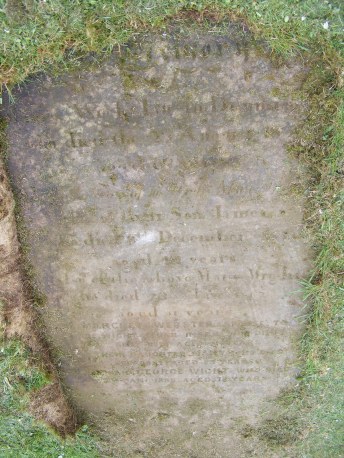
372 Wight Tomb ,Insch 25 May 2015After about five minutes casting our eyes round stones with all the wrong names on and on the point of giving up. I locate Mr Sharp who should be next door to the Wight family. Yes, there is a flat stone nearby but compacted grass, the product of many mowings, is stuck firmly to its surface. I wish, too late, that I had taken a ‘before’ photograph. We begin rubbing away, being careful not to obliterate the sandstone surface at the same time. Grass has grown quite a long way over the edges of the stone, covering the inscription. I decide that we need a spade to remove this. We do not have a spade, how short sighted of us. Chris has his barber surgery kit in the boot ready for a conference at the end of our trip. I suggest using one of his many knives, saws or axes to hack back the grass; he seems less keen. We imperil our finger nails by hauling at the grass roots. As for the mowing detritus, in the end we perfect a technique of rubbing the soles of our shoes over the grass, which eventually loosens and can be swept away. This works better with my trainers as Chris has smooth soled shoes on. Well, that was his theory and he was sticking to it. It is quite a large stone and I am rubbing vigorously. If you are ever tempted to try this, be warned, it involves a lot more effort than you would think. The weather has meant that today is the first day we haven’t been for a walk but I decide that stone clearing constituted sufficient exercise. Ten minutes later and the stone is as clear as it is ever going to be and I am well pleased.

We go to the former site of Wight’s Inn, very close to the leisure centre we visited yesterday. We have a much better impression of the lives of this family now. The railway predated Mary Wight junior’s move south by more than two decades and was presumably her route to the outside world. Mary Wight, her grandmother, sounds quite a character, widowed at sixty, taking over the pub and living to be over ninety. The only disappointment is that the building no longer stands. Back to the van then to write up what I have found.
Rabbits

Today we are travelling eastwards to Huntly. This stop is not in aid of finding anything earth shattering in the way of scenery, wildlife or heritage and indeed our journey along the A96 is not especially inspiring. This is the family history part of the trip as my children have ancestors from the area. We ponder how and why their great great grandmother made her way to south London in order to marry there in 1879. I suspect the railway would have been here then but it still seems a very long and unlikely journey.

Today’s equipment failure was the jockey wheel (that’s the little wheel at the front of the caravan that helps to hold it up when it isn’t attached to the car.) I am not quite clear as to the nature of its malfunction but it didn’t seem to go up when required and  the next thing I know it is detached from the caravan and in the back of the car. The good news is that Chris appears to have fixed it.

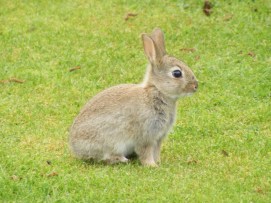
We are on site363 Rabbit Huntly Castle Caravan Park 24 May 2016 for 12.15, along with many rabbits. This is my first internet access for four days and even this is only courtesy of Chris’ phone. Three hundred emails arrive on my computer, deep joy. Nothing features on our to do list for this afternoon. Our map indicates that there is a National Trust for Scotland property nearby so we head off to Leith Hall. Leith Hall itself, it turns out, is shut however we can follow the Kirkhill trail rounds the grounds and look at the gardens, which we do. A collapsed bridge means that the pond trail is impassable but we see a Dule Tree. This we learn is a large sycamore, allegedly used as a gallows. Dule is from the Gaelic for grief and sycamores on mounds may have been used as sites of mourning. Today is overcast and the wind is chilly but we complete our walk without getting rained on.
We are now only a few miles from the ancestral village of Insch that was ear-marked for tomorrow’s itinerary so we can’t resist a preview. The trouble with Leith Hall being shut was that there was no access to its facilities. Fortunately Insch subscribes to an Aberdeenshire scheme to make toilets that are not actually public toilets accessible to the public. This means that we traverse the corridors of the local leisure centre, trying to look like we are regular frequenters of gyms and the like, in search of relief.

We fail to find the addresses where the family I am seeking used to live, although I do identify a likely pub that may have had a previous existence as the Wight Inn. This is often the way with such searches but at least the church is a banker and I can photograph that. Or, in this instance, I can’t; it was demolished in 1882. We look round the graveyard of St. Drostan’s without expecting to find anything of relevance. We do see a grave marker for Radulphus who was chaplain to the bishop of Aberdeen in the late twelfth century but nothing for the families on my list. Maybe we will have better luck tomorrow.

In Search of Monsters and Fairies

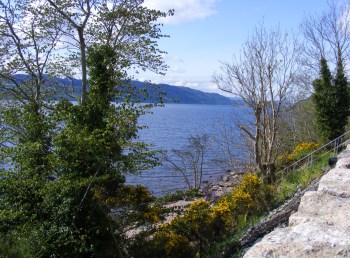
It is a sunny day as we drive down the side of Loch Ness, with not a monster in sight. We pass on the opportunity to visit ‘Nessieland’ and wonder how many tourists have been fooled into thinki358 Loch Ness 23 May 2016ng that they might see bears at ‘Highland Bear Lodge’. Maybe highland bears are akin to yellow tits and indeed the Loch Ness monster. We drive through pretty birch woods to Glen Affric. There are more sheep in the road; these are sitting down contentedly as if they were in a field. There are deer relaxing nearby, maybe they have evicted the sheep. We pass the Fasnabyle HEP plant, reminding us how important the energy business is to Scotland. We head back towards Inverness by a different route, with the River Glass on the right and a bluebell wood on the left to enter the Black Isle, between the Moray Forth and Cromarty Firth. This peninsula, previously named Ardmeanach, was given to Lord Darnley by Mary Queen of Scots. The views are glorious. I find this one of the most attractive parts of Scotland, yet I was expecting to prefer the west coast.
We head to Rosemarkie, which was notorious as a spot for burning witches. I seem to escape unscathed. We are now in the land of the Picts, who inhabited Rosshire until they were overrun by the Scots in the ninth century. Picts or ‘painted people’ are believed to have arrived in Scotland from northern Europe during the Bronze Age. No signs of houses remain, so it is assumed that they were wooden but hill forts survive. In 563 St Columba left Iona to begin the Christianisation of the Picts. We are able to see Pictish carved stones at the tiny Groam House Museum, most of these date from the eighth and ninth centuries. There are debates about the purpose of these large, carved stone slabs. It is thought that they are unlikely to be grave markers as they don’t record names but they may be indicative of alliances between groups. The designs include representations of animals, hunting and biblical scenes and geometric patterns. The carvings known as cross slabs depict crosses but the arms do not protrude beyond the sides of the slabs. The volume of carvings found in the immediate area lead historians to presume that there must have been a monastery here, although no remains have been found. The Museum also celebrates the work of George Bain ‘the Master of Celtic Art’.

A little way up the road is the RSPB reserve known as Fairy Glen. It isn’t the easiest to find but having located it we take a lovely stroll through the wooded reserve. There is a notable lack of birds and fairies but it is pretty boggy so any self respecting fairies are probably residing elsewhere.

In the Steps of the Bonnie Prince

Time to retrace our steps southwards down the A9 alongside the beautiful, sunny east coastline and across Black Isle, through Inverness and on to Culloden Moor. We are the second of four vans who arrive on site at the same time. It is then a race to see who can get set up first, a race that we win hands down. Today we have passed the 1000 mile mark on this trip

As we have arrived in good time, we are able to visit the site of the Battle of Culloden or Cùil Lodair this afternoon. This battle marked the end of the Jacobite cause and we have just missed the 270th anniversary on 16 April. I am please to see that signage is in Gaelic first, with English underneath. We have free entry courtesy of the reciprocal arrangement between the English and Scottish National Trusts but we need a car sticker to confirm our membership status and thus avoid having to pay for parking. We do not have a current car sticker in this car. We enquire at the pay desk and put Chris’ National Trust ‘I am a volunteer therefore very important’ card in the window instead as suggested. We later realise that this expired at the end of March and he hasn’t yet collected a replacement but it seemed to do the trick.

Typically of Scotland, this is a very high quality attraction with plenty of interactive aspects and interpretation boards. I take a look at a book describing families who were involved at Culloden but none of the names I am interested in feature. I did have some knowledge of Culloden and the Jacobites but I hadn’t really appreciated the extent to which this was part of a wider European conflict. Scots who fought for the Jacobite cause did so out of loyalty to the Stuart line but also because they wanted a return of the Episcopalian Church. We enjoy looking at the weaponry, which is similar to what we are used to in the seventeenth century. An historical interpreter is on duty to exchange ideas.

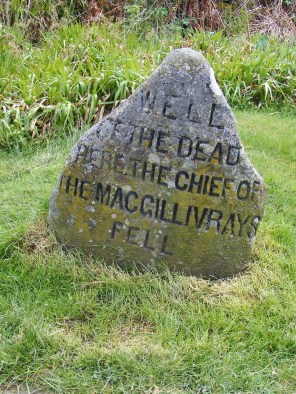
356 Clan Marker Culloden Moor 22 May 2016It is interesting to fully appreciate that Cumberland’s government red-coat army of 10,000 men would need 10,000lb meat and 10,000lb bread each day to sustain them. The lack of supplies for the Jacobite forces was a significant feature at Culloden, along with the boggy terrain which led to the failure of their previously successful charging technique. The battle lasted less than an hour and nearly half the 1500 Jacobite casualties fell in the few minutes of this failed charge. The government troops lost only 50 men, although some of the 250 wounded died later. The Irish and French, who were fighting for the Jacobites, shielded Bonnie Prince Charlie’s retreating army, who headed for Inverness after the battle. These Irish and French were subsequently treated as prisoners of war not rebels. The Jacobites did regroup at Ruthven and were prepared to fight on but Bonnie Prince Charlie sent orders to disperse and the cause was lost, leaving Charlie to escape ‘over the sea to Skye’ with the aid of Flora MacDonald.

We move outside for a battle field walk, complete with slightly temperamental audio guides. The sun is shining and we are in lovely surroundings but we are mindful of looming black clouds. The Jacobite casualties were buried in mass graves and in 1881 the land owner had a memorial cairn built, along with markers for each clan that participated and another marker for the fallen government troops. Wounded Jacobites were bayoneted and the high ranking officers were taken prisoner. The wounded government troops were probably cared for in farm buildings that were commandeered as a field hospital. All in all another excellent day.