Days 21-23 New Zealand Society of Genealogists Conference

Still not firing on all cylinders and equipped with a very unflattering over the ear and round the head mike, I deliver my keynote presentation about the story of Isabella Fry. It is the tale of an unfortunate woman, chocolate and a very bad man, which appears to go down well. Afterwards, we choose to stay in the main hall to listen to our friends talk about DNA. Firstly Michelle Patient and then our housemate for the duration, Maurice Gleeson. After lunch, Maurice is up again, this time talking about using DNA to identify unknown world war 1 casualties. By co-incidence, he was focussing on the Battle of Fromelles, which is featured in Barefoot on the Cobbles, although I don’t name it. Maurice used the session to launch the ‘Commemorating the Missing’ project. This encourages people to look at the list of the world war one soldiers whose bodies have never been recovered and ‘plant’ a virtual family tree on their behalf. Thus, if bodies are recovered in a location that links to those personnel, it might be possible to contact relatives so DNA can be obtained. I have already committed to ‘planting’ trees for the six Braunds on the list and we do already have relatives who have taken DNA tests, although obviously, it would be their decision whether or not their results should be used in this way.

There is a session on New Zealand School records and then I have to summon the adrenaline to talk about One-Place Studies at the end of the day. People are taking pity on my lurgy ridden state and keep pressing medication into my hands!
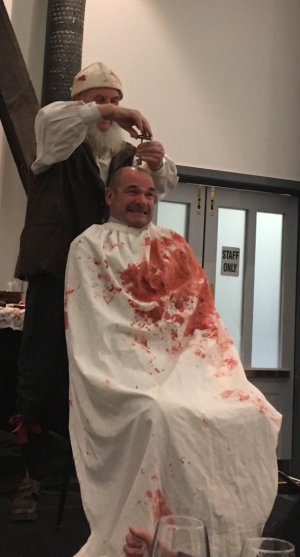
Det7qRgVMAAF8WVWe are taken to the Chateau on the Park for the conference dinner where we have an unusual but very tasty, hot/cold buffet mixture and delectable but clearly not very good for us desserts. Chris ‘entertains’ all-comers with the delights of seventeenth century barber surgery. We do present to adults on a regular basis but the addition of alcohol has an effect on the levels of audience participation! At the request of the maitre d’, one of Chris’ patients is a young waiter, who enters into the spirit of the thing. Fiona, our self- appointed chauffeur and also the overworked conference convenor, explains about the psychological impact of the earthquake on Christchurch residents.

The Sunday begins with our seventeenth century presentation. Yesterday’s sessions were very well received but now I am feeling as if I am giving of my best. There is an overwhelmingly positive response afterwards, which gives us a warm fuzzy feeling. I listen to a double-handed talk on ‘Research Tips and Tricks’, which includes a very effective use of Power Point as a way of recording family history from the ’other Fiona’. I then listen to a story-telling session from Margaret Copeland, an historical interpreter who represents the wife of the goaler of nineteenth century Lyttelton Goal. I have to leave before the end to prepare for my own Facebook Generation talk. It was very well attended (there are three streams of lectures) and there was a real buzz afterwards, with plenty of questions and comments.

In the evening, we have invited a few fellow members of The Guild of One-Name Studies round to our adopted home. We are feeling more and more like riotous students by the minute. We have an hilarious evening, with the humour partly fuelled by the fact that the local pizza house names its offerings after the seven deadly sins. One of our party ordered a ‘Twelve inch lust’, no comment! There was also this hysterical attempt to take a picture with all of us in, using the time on someone’s precariously balanced phone. We had a lovely time but we are obviously showing our age, as our guests had left by 9.15pm and we managed to keep the house in very good order. Our hostess has been incredibly generous with her home and my early blog comment about Hokey-Pokey ice cream led to the freezer being stocked with the same – yum.

The final day already. I can’t believe it has gone so fast. I listen to Fiona talking about The Time Travelling Genealogist, encouraging us to record our own lives as part of our family history. Her ‘Memories in Time’ business has some great products and it is a very good presentation. Next, I learn about the ‘Decimation by the Invisible Enemy’, which is about the appalling effect of the Spanish flu on those on board the ship the Tahiti. I finish the conference with my ‘Remember Then’ session. I wondered how it would adapt to an international audience but judging by the reaction, nothing was lost in translation. It is sad to say goodbye to people who have become friends. We have had a wonderful time and have been looked after exceptionally well by all concerned.

Four of us take a trip to the Antarctic Centre in the afternoon. Included is a ‘Hagglund’ ride, deemed to be unsuitable for those with heart conditions, of a nervous disposition or who are pregnant. I briefly debate the wisdom of this and decide I should enter into the spirit of the thing. The Hagglund are the all terrain vehicles that are used on Antarctic expeditions and we career across a track hanging on tightly. It was a bit on the bumpy side but pales into insignificance in comparison to sand-dune buggy riding, so I survived unscathed. We pat some huskies and watch the blue penguins being fed. These are all rescue penguins, who would not survive in the wild. Then a chance to sit and relax whilst watching a 4D film. We don the approved glasses. It turns out that this is not as relaxing as all that, as the seats tilt alarmingly, to simulated power boating across a lake and at intervals, water is hurled in our faces.

We are then collected for a meal with some of the conference organisers. This is followed by Te Reo Maori lessons, which are being put on, free of charge, by the owner of the Fush restaurant. He is concentrating on teaching us ‘pidgen’ Maori, where we substitute English words for those we don’t know (which is most of them). We had already picked up that Maori is not actually pronounce Mawree but more like Mardi. Te Reo Maori was not originally a written language and there is no equivalent of the letter s for plurals. Instead, what comes before the noun indicates several, rather than one. So ‘the‘, followed by something singular is ‘Te’ but if it is plural, ‘the’ would be ‘nga’ (pronounced nar). This is great fun but my inability with languages has not undergone a great transformation and the fact that it is in the evening after a very hectic five days does nothing for my concentration. Somehow, this ends up with us appearing on Maori TV news, fortunately not at the point when it all caught up with me and my eyes closed momentarily.

Then, after reluctantly bringing our last evening chat to an end, comes the applied mathematics that is our packing. We have a baggage allowance of 30kg each; easy, 60kg you’d think. But we only have three bags, one small one having gone to meet its maker on the outward journey. We cannot be deemed to have one and a half bags each, so two of these bags cannot contain a total of more than 30kg. In addition, no one bag must weigh more than 23kg. Effectively, this reduces our total allowance to 53kg between us providing we can, without the aid of scales, distribute our belongings appropriately between the bags. If you think 53kg is a ridiculous amount of luggage for two people, you’d be right but remember that we have three sets of seventeenth century clothes, including hefty shoes and numerous heavy surgical instruments. I also have the clothes that I abandoned in Peru that have been, very kindly, brought to me from Australia. In addition, we have also picked up a few things from the conference and our preceding trip, which have to be accommodated.

Days 19 & 20 Workshops

A sensibly early start to avoid the rush hour sees us heading into Christchurch. My first, of two, ‘Writing up your Family History’ workshops is held in the impressive looking Christchurch Boys High School. The precise location is the former stables of the Deans’ (yes Martha, that is where the apostrophe goes) Building, which has recently been refurbished as the school archive, following the earthquake. Nineteen participants are present to hear me croak my way through the day. Actually, thanks to being heavily medicated, I am not a croaky as I was. The students are lovely and the day seems to go well. Back home to conserve my energy in order to do it all again tomorrow. Chris has been introduced to the resident bull in my absence and survived; our hosts breed champion Lowline cattle. He has also been cleaning the van, prior to us returning it tomorrow.

The next day, I am back for my ‘repeated due to popular demand’ ‘Writing up your Family History’ workshop. Different students give the day a slightly different feel but there seems to be plenty of enthusiasm. Chris successfully returns the van and Apollo agree to refund us for the replacement fire that we had to purchase. At least now we don’t have to work out how to get it home. We travelled 1804km, or 1121 miles in our van and it is sad to say goodbye to it, even if it was beginning to malfunction – still, we have more to look forward to.

After the workshop, we repair to the historic and impressive Riccarton House, former home of the Deans family, for a meet and greet. It is certainly a stunning property, although the severed animal heads on the wall seem somewhat unnecessary. We meet and we greet. Most of my students from the past two days are present and some people I am connected with on social media.

Then we are taken to our home-stay location, where the owner has kindly moved out to allow three conference speakers to hold wild parties enjoy her home. On the way, we pick up some exceptionally tasty fish and chips from a shop called Fush, which is how the locals pronounce ‘Fish’. This ‘house-sharing’ makes it hard not to feel like we are students again. We stay up later than we should putting the world to rights.

Days 17 & 18 Akaroa and Beyond

I am still trying to convince myself that my nose and eyes have not turned themselves into taps – just keep taking the medication. Today there is a slight mishap whilst emptying the chemical toilet. One of our party inadvertently drops the lid down the pit into which the contents of said toilet are destined to go. Someone therefore has to retrieve the lid from the hole into whence it has gone. I played no part in this procedure. We have distinct jobs whilst on the road, mine are things like trying not to get us lost and making sure all the cupboards are locked before we set off. Emptying toilets is not on my list.

119 30 May 2018 Leaving AkaroaWe drive into Akaroa and learn that there will be no boat trips today. We are cynical enough to wonder if the predicted winds have been exaggerated in order to justify cancelling a loss making trip, on which we may well have been the only passengers. The tour booking lady says it just means we will have to come back. Sadly, that is unlikely but we are glad we visited Akaroa anyway. It is a distinctive, slightly hippified community (plenty of crystals and crafts on sale) with a French flavour. We suspect it is the holiday home location of choice for the wealthy of Christchurch. It is marketed as an ‘historic’ town, with many of its original, mid-nineteenth century buildings. We visit the very interesting museum and learn about the town’s history, its Maori heritage and development from a whaling station to an agricultural area and now a tourist centre. A would-be French colonist arrived with French and German settlers in August 1840, just as New Zealand was being assigned to the British, giving Akaoa a mixed national heritage.

The area became well known for producing seeds for cocksfoot grass, which was the pasture grass of choice in Australasia. The museum, which had the advantage of being free (donations are welcome), is partially housed in the old court house. There is an impressive collection of old photographs, these include a couple with a surname that we recognise. There are/were properties called Clovelly and Ilfracombe in the town, so we suspect a local connection.

Whilst I attempt to recouperate whilst doing yet more Suduko, Chris is trying to work out why, when our water tank is full, no water is coming out of the tap. Fortunately, as this is our last day dependant on the van, it is not the problem it might have been. If the van is going to malfunction, let it be when we no longer need it, that’s what I say.

The next day, we manage to pack up all our belongings without too much trouble and set off to Woolstone in Rangiora, just north of Christchurch. Thanks to excellent directions, our only mishap was to turn slightly too soon and end up detouring round a Christchurch shopping centre. Our hosts make us very welcome and drive us round the locality, so we can learn about the area. We are staying on this farm for the next two days. I am slightly less germ ridden today, although my voice is still somewhat deep and interesting.


Days 15 & 16 to Akaroa

107 27 May 2018 Moeraki BouldersToday we leave Dunedin for Timaru. Martha has recommended a stop off at Moeraki Boulders and who are we to disagree? I am not sure of the precise geological term for these enormous ball-shaped rocks and with limited data allowance, I can’t look it up. They appear to be huge geodes and one has cracked open. Definitely worth a stop.

We call in at a couple of Four Square supermarkets on the hunt for Hokey Pokey ice-cream, which has become a bit of an addiction. Locating the site at Timaru prove to be the most problematic so far. I have taken the precaution of drawing a sketch map. We are looking for Grassmere Street. Would you believe this was the ONE street without a visible name and we have to seek assistance from the information bureau in town. Once on site we do yet more laundry and I do some Suduko, of which I am a new convert. I am trying to pretend I don’t seem to be developing a cold. Five days of presentations when I can’t breath should be fun. Don’t panic conference organisers (if you are reading this) I will be fine!

The next day we continued our journey north along the 1, criss-crossing the railway, with the Southern Alps on our left. In an attempt to appear like I am not suffering from a streaming cold, we invested heavily in medication. The latest bulletin is that the worst is hopefully over and I should be fit for the weekend, even if I will be doing great Rudolph impressions.

Today is the day that we really did need the sat-nav. In an attempt to take the scenic route alongside Lake Ellesmere, we get hopelessly lost. We drive round Southbridge a few times, that would be a few more times that we wanted to and finally ask for help. Eventually, we escape the vortex that contains the very similar looking roads that aren’t the ones we need and find our way on to the Banks Peninsula. This is a lovely drive along twisting pathways over the hills and in to Akaroa. We take a quick look round the town before finding our site, which overlooks the bay. Yet more rainbows are in evidence.

We can tell that we are near our journey’s end. The gas has run out and it isn’t worth purchasing a refill, so we use the site kitchen for our cooking. We are also finishing up the oddments of food that we have in the cupboard. It is like one of those cookery competitions – and what can you create from an onion, chilli powder, chocolate chip cookies and marmalade? An email arrives to say our wildlife cruise tomorrow has been cancelled but that they hope the predicted strong winds will abate in time for us to go in the afternoon instead. This trip has allegedly been voted ‘the best wildlife experience in New Zealand’. It will need to be pretty special to beat the Monarch one but hopefully we shall find out. It is also another of the 101 ‘must do’ activities, so that will be another crossed off the list. Hang on, I don’t actually have the list, who knows how many we may have inadvertently accomplished? The list does seem to be somewhat arbitrary. For example, Akaroa itself is one and the nature cruise is another, two for the price of one.

Day 14 Otago Peninsula Wildlife Tour

The bus to collect us for our wildlife tour is five minutes late. I am only a little bit panic stricken. There are just three of us on today’s trip, with Paul in charge. We learn something of Dunedin, which contains many Victorian and Edwardian buildings. It developed due to the 1860s gold rush and used to be the industrial hub of New Zealand, until the opening of the Panama Canal, forced trade further north. The first Europeans on Otago were whalers, who arrived in the 1830s. By 1846, a permanent Scottish settlement had been created, producing cheese and lamb. Now cattle are more popular as there is a huge Chinese export market for dried milk products for baby formula. We see a memorial to Annie Dickenson, who was instrumental in extending the franchise to women. New Zealand was the first country to grant women this right, in 1893. There is also a lime kiln, reminding us of home. The ‘six molars’ is a controversial piece of public art, created at the ‘mouth’ of the river.

The first part of our four activity day, is a drive round Hooper’s Inlet, which is tidal, in search of birds. Paul, our driver and guide is a wildlife photographer and our usual ‘kiss of death’ effect on wildlife seems to be in abeyance today. We get a brilliant view of a kingfisher and also see fantails displaying, pied stilts, oyster catchers, white-faced heron, pukeko and many paradise ducks. The spur-winged plovers, which we also see, came over from Australia in the 1950s.

Next it is off to the only mainland breeding colony of Northern Royal Albatrosses. Taiaroa Head, where the Albatross Colony is situated, was once a barracks and a stone jail still survives. Joel takes us out to see four albatross chicks on their nests. The birds only come to land in order to breed and the incubation period is eighty days. The chicks grow to weigh 9kg, heavier than the adults, before they are forced to lose weight prior to fledging. Their first flight will take them all the way to Chile and it will be about five years before they return to the Otago Peninsula to breed. The adult wing-span is approximately three metres but no adults return to the chicks while we are watching. We also see what is allegedly about 25% of the world’s Otago Shags. We have lunch in the Albatross Centre before moving on to the harbour.

We are loaned super warm jackets for our Monarch Cruise round Otago Harbour. Our guide is enthusing about what a brilliant day this is for seeing albatross in flight and we are informed that we have seen four different varieties. Just don’t ask me to tell one from another. I take a large number of photographs of the sea where there was a flying albatross a split second earlier.

Finally, it is off to the yellow-eyed penguin centre, hoping to see some come ashore. There are thought to be only about 700 yellow-eyed penguins left and numbers have plummeted recently. We walk through tunnels, which took the landowner six years to dig. These keep us out of the penguin’s view. We are told that we will be lucky to see two or three penguins come ashore at this time of year but today is a ‘buy a lottery ticket day’, as we see seven. I guess that means we have seen 1% of the population! There are also some blue penguins and fur seals to spot. We have been allowed to keep the jackets for penguin colony viewing but sadly, have to return them when we are delivered back to our camp site. Just as we are leaving the colony, the rain that has held off all day, begins. It has been a long day but probably the best of the holiday.

For those interested in bird watching, our bird roll call is as follows:- Kingfisher, Pied Stilt, Pukeko, Fantail, Paradise Duck, Mallard, Oyster Catcher, Little Black Shag, Pied Shag, Black-backed Gull, Red-billed Gull, Otago Shag, Black Swan, Spur-winged Plover, White-faced Heron, Australian Harrier Hawk, Dunnock, Blackbird, Northern Royal Albatross, Southern Royal Albatross, Buller’s Albatross, White-capped Albatross, Australasian Gannet, Cape Petrel, Giant Petrel, Blue Penguin, Yellow-eyed Penguin.

Days 12 & 13 The Catlins

We left Te Anau at 9am in 4 degree temperatures and driving rain. We managed to navigate ourselves to Fiordland Electrical to buy a fire, as we have had to return our borrowed one to Te Anau Top 10. Allegedly this is likely to be the worst New Zealand winter for years. We debate the possible merits of two alternative routes, hoping to avoid snow. We opt for the possibly more risky one, snow wise, which was our original intention and set off towards Manapouri. We travel along the South Scenic Route with no sign of snow. It would probably be slightly more scenic if we could see much of it through the mist and murk. We stop to admire the racing seas and Stewart Island lurking in the low cloud. After a slight detour we find our site at Invercargill.

Not being fans of oysters, we pass up the opportunity to visit the Bluff, where the annual oyster festival is in full swing. ‘Bluffies’ are apparently world renowned in oyster circles. Deciding that we have had enough of getting wet, we relax in the van. Now we are only getting wet from the dripping laundry that is hanging round our ears.

079 25 May 2018 Rainbow, Fortrose, South Scenic HighwayWe safely negotiate our way out of Invercargill, where the street names bear testament to the Scottish/Victorian heritage. Keeping a sharp eye out for the maroon triangles that denote the South Scenic Route, we head eastwards. Today there are spells of sunshine amidst the showers, creating impressive rainbows at Fortrose. Many of the cattle are Belted Galloways and I wonder at the logistics of bringing mammals out to New Zealand from Europe by boat. How much food would be required? What would one do with the results of cows/sheep/deer consuming said food?

The bird life so far has been disappointingly European in flavour, compared to our previous visit; perhaps because we are further south, or maybe it is the season. Today though we do see black swans, pukeko and heron. The Catlins National Park is beautiful and there is very little traffic. We encounter several hundred cattle being walked along the road in the opposite direction. We are used to stopping for cows at home, just not quite so many of them! At Waihola Lake there is a long fence that has been stuffed with hundreds of trainers, presumably odd ones that have been washed up on the shore.

For some reason, we exceeded our internet access at Invercargill, despite doing very little online. This meant that we could not check on the directions to today’s site, which is 2½ km outside Dunedin. It would be helpful to know in what direction. We are know on New Zealand’s ‘motorway’, a slightly more busy dual carriageway, which makes going slowly looking for likely turn off more difficult. Fortuitously, we spot a road sign to Kaikorai Valley. The site is in Kaikorai Valley Road. Adopting the strategy that worked in Queenstown, we take the exit and apart from overshooting the well hidden drive-in entrance, we reach Aaron Lodge Top 10 without incident. So far, we feel not investing heavily in a sat-nav was the right decision – famous last words.

Day 11 Doubtful Sound

And tonight’s nocturnal disturbance was the battery going in the smoke detector, so that it bleeped annoyingly every few seconds. We finally braved the cold in order to disconnect it. Another day, another Sound; this time Doubtful Sound. Typically, although it has been dry all night, it begins to rain at breakfast time. We walk down to the Real Journeys office and board our coach for Lake Manapouri. Randomly, the driver detours round a housing estate in order to deliver a letter. Then it is on board the MV Titiroa to cross the lake to West Arm. We manage to avoid the lake’s thirty three islands. Next it is on a coach with Mike to Deep Cove. Actually it is on two coaches as the road have given way, so we have to walk across a bridge at one point. This road is only accessible by water at either end. We cross the snowy Wilmot Pass and see the HEP station. Most of the electricity generated is used at the aluminium smelting works near Invercargill.

We finally board the Fiordland Navigator for our cruise of Doubtful Sound. ‘Sound’ is actually a misnomer – blame Captain Cook. Technical a sound is a V shaped inlet, created by river action, whereas a fiord is a glacially cut U shape, so this is a fiord. The ‘Doubtful’ part of the name was because Cook was doubtful that the prevailing wind would allow vessels to get back out of the ‘sound’ easily. We tuck into our complimentary Mitre Peak lunch from yesterday. I have never seen such huge sandwiches. They were about three inches thick, making eating them delicately a bit of a challenge. They were accompanied by similarly large-scale muffins.

063 23 May 2018 Rainbow, Doubtful SoundOur geography field trip continues. We sail up Crooked Arm, which on its own is a similar size to Milford Sound. Today we can enjoy a sound that we can actually see, as the rain stops and there is even occasional sunshine. There are also rainbows, which, inevitably, are not done justice by the photography. The majority of our fellow travellers are American university students. Some are wearing more make-up than I have possessed in a life-time. Others are clad in tee-shirts and thin cardigans – it is three degrees, still others sleep the cruise away. At one point the captain cuts the engine and generator ‘so we can listen to nature’s silence’ for about ten minutes. This was never going to go well, especially as the rain begins again during the process.

Our return trip proceeds without incident and we are hoping that our journey tomorrow will not be impeded by snow. as we head still further south and east. Today there was snow between Queenstown and Te Anau, so we are only narrowly escaping the weather.

Day 10 Milford Sound

A some point in the middle of the night the heater we rented with the camper van whimpered and died. In other nocturnal news, having left Chris’ phone on in case of yet more re-arranging of our itinerary, we received a call at mid-night about PPI. It was a night of torrential rain, with thunder and lightening rolling and roaring round the lake. This was marginally quieter than the door of our neighbour’s camper van, which they felt obliged to open and shut approximately every thirty seconds between 11pm and 1am. This they recommenced at 6am.

We were ready in good time for our 7.45am pick up to (hopefully) go to Milford Sound. We can actually see the road from the camper van. Given the pouring rain, one of us wanted to wait until we saw a vehicle draw up and then make a run for it. The other one would have been out there getting soaked from at least 7.30am. No prizes for guessing which was which. In the end, the mini-bus was early so it was a case of head out when we spotted it, which was at 7.40am. One of us had only asked, ‘Can we go outside and wait now?’ about eleventy billion times by this point. We were the first on board, which meant that we could sit at the front but this position came with the responsibility of being umbrella monitor. Our super ace guide for the day on our Fiordland Tours/Mitre Peak Cruise was Jonathan. He began by asking us if we would rather go tomorrow instead, as the weather was forecast to be better. None of the fourteen on board were able/keen to do this so we headed intrepidly on.

Jonathan gave us some information about what we couldn’t actually see due to the poor visibility. He did try to make a positive out of the heavy rain: the waterfalls will be more impressive. Between the years 1000 and 1800 half of New Zealand’s rainforest was burnt in order to aid the hunting of the now extinct flightless bird, the moa. Farmers moved in and free ranging deer were introduced. These soon became a pest and wild deer were killed or corralled into venison farms. This apparently involved leaping out of helicopters and winching up deer in order to transport them. We do indeed see some impressive waterfalls through the murk and also some cabbage trees, the southernmost growing palm tree. There is beginning to be a problem with non-native pine trees. These have been planted as a carbon-emissions pay back but they are encroaching on the National Parks and altering the habitat. Fiordland covers 5% of New Zealand and at 1.25 million hectares, it is the country’s largest National Park. It is also one of the world’s wettest places. They are not wrong there. The ten metres annual rainfall here is twenty times the annual rainfall of Christchurch. Just a bit of a shame that all ten metres have decided to fall today.

We stop for morning tea and very acceptable scones at Gunn’s Camp. Then comes the news that the Milford Road is closed due to a ‘wet slide’ avalanche. The heavy rain has put weight on the snow and the road is blocked. It may, or may not, be passable later. We walk the Marian Lake trail while we wait to see what transpires. I was lured on this short walk by the possibility of seeing blue ducks or Pukeko. The rain is still torrential and we are wielding complementary umbrellas. I have my camera in my other hand. Then comes the unbelievably wobbly suspension bridge over the rushing torrent. I am never a fan of anything high up or wobbly and the feeble looking safety wires on either side were only about 2 foot six high. Given the umbrella and camera, I was left with no spare hand with which to cling to the side wires for grim death. I lurch from side to side alarmingly but somehow make it across and indeed back. There was not a Pukeko in sight.

We return to the road junction to find the road still closed so we resign ourselves to having to miss Milford Sound. As compensation, Jonathan drives us up back past Gunn’s Camp to the Humboldt Falls. Then comes the news that the road is open after all. We are too late for our scheduled cruise but Jonathan thinks they will hold a boat for us. We are now very short of time as we have to be back on the Te Anau side of the tunnel before 4.00pm when the road will be closed due to forecast snow and we may be marooned in Milford, perhaps for days. Either that or the mini-bus will turn into a pumpkin, probably the former. We decide to give it a go.

Our own boat is not sailing but we can hitch a ride on a Juicy cruise instead. Their booked party has given up and not risked coming through the tunnel. Better still there is a selection of curries on board that they have ordered and which we can consume. This is our second free meal of the day as we still have the bonus packed lunch awarded to us in return for not being able to go to Milford Sound yesterday. We set off on Juicy’s Gem of the Sound. We learn that the rainwater forms a layer on top of the salt water in the sound. This is a rare phenomenon that only occurs in a handful of places in the world. We stop at McKenzie falls and venture out to view the Tasman Sea, ‘the Roaring Forties’, with its four metre swell. Our voyage is slightly shortened to ensure that we get back through the tunnel before the witching hour. We do get up close an personal with Stirling Falls. Some of those on board accept the invitation to stand on deck. Any parts that were not already drenched by the rain are now soaked in spray. Judiciously, we remain indoors at this point.

049 22 May 2018 Mirror LakesWe make it back through the tunnel in time, just as snow is beginning to fall. There are a few stops on our way back to Te Anau, including a fruitless Kea hunting stop, a chance to photograph the Mirror Lakes and also to view Lake Te Anau from Te Anau Downs. By this point, the rain has almost stopped and we can actually see not just our hands in front of our faces but the lake as well.

Back on site, I become very grateful for the charm offensive that Chris has been launching on the ladies at reception since we arrived. He has managed to blag us the loan of a heater.

Day 9 Te Anau Glow Worm Caves

The night’s snowfall is visible on the mountains but hey, the good news is that we can actually see the mountains. Chris has managed to work out how to use the umbrella, there’s a magic hidden button that results in it springing into action. Fortunately, this vital information isn’t needed at the moment as there is no sign of rain. Despite 1 degree temperatures, it is quite pleasant in the sun as we set off to explore Te Anau. The tour company who were to take us to Milford Sound today have offered to take us tomorrow instead. The snag is that we have a trip to Te Anau Glow Worm Caves booked then. Our cunning plan is to see if we can go to the caves today, freeing us for the rearranged Milford Sound trip. Hurrah there is space for us on the 10.30am glow worm trip today. Unfortunately, the trip may not run as they are currently inspecting the caves for flooding. We wait for the verdict to be phoned in. This morning’s trip is off but we can go this afternoon, providing the flood water has subsided. On the strength of this and with the assistance of the very helpful receptionist at Te Anau Top 10, we call the Milford tour company and agree that we will be on their trip tomorrow. They even offer to throw in a free lunch for our inconvenience – result! Well done Mitre Tours.

We stroll along the lakeside and manage to look round the visitors’ centre that closed hastily yesterday. The Maori legend is that the demi-god Tu-te-raki-whanoa carved the fiords with his ko (digging stick). He practiced on the southern fiords and perfected the technique by the time he got to Piopiotahi, or Milford Sound. We learn about the parrot like Kakapo, of which there are believed to be only 160 remaining. I don’t think we are likely to spot one of those. In fact, so far, the birdlife has been disappointingly European, although we do see a tui today. In 1888, Quintin Mackinnon and Ernest Mitchell became the first Europeans to travel overland from Te Anau to Milford Sound, establishing the Milford Track. Mackinnon disappeared on the lake in 1892.

In the afternoon, we set off across the lake in the Luminosa, heading for the glow worm caves. The fiords, of which there are 14 in the Fiordland National Park and the lake are glacial formations. Lake Te Anau is the largest in Australasia and is 410 metres deep. 210 metres of this is below sea level, making it a crypto-depression. The surrounding vegetation is a cool, temperate rainforest, consisting largely of beeches, mosses and lichens. The caves were rediscovered in 1948. Te Ana-au means ‘caves with a current of swirling water’, which prompted the search. We are to explore only the first 250 metres of the 7km Aurora caves system, which spreads under the Murchison Mountains, this will take us 40 metres underground. The caves are comparatively young, at 12,000 years of age, thus no stalagmites or stalactites have formed yet.

034 21 May 2018 Fantail by Glow Worm Caves, Te AnauWe have been warned that there is to be no photography or noise in the caves, in order not to disturb the glow worms. Experiences whilst penguin watching on our previous visit, suggests that this may not go well. As we disembark, a fantail gives a great display but they don’t stay still for long making photography a challenge. Last night’s rain means that the underground torrents are particularly fast and we have to enter the cave by crouching under a one metre high overhang. After a short walk, we sit on a punt in order to view the worms. The people on our trip were a bit more law abiding than the penguin watchers and it turns out that the worms don’t really mind lights from cameras or noise but this instruction is just a crowd control mechanism.

A brief presentation tells us about the life cycle of the glow worm. They lay 120-150 eggs then, when hatched, the larvae, which are 2mm-3cm long cling to the cave roof. They catch their insect prey on strings of mucus droplets and the flies are attracted by the glowing lights. Once they are caught, the ‘worm’ sucks up the droplets and the food. There is a short nature trail to enjoy and the fantail is in evidence again. Credit to ‘Real Journeys’ for a great trip and for allowing us to change our booking. Now to hope that the weather is in our favour for the next two days’ trips.

Days 7 & 8 Queenstown and Te Anau

025 19 May 2018 Shotover River, near QueenslandA shorter journey today, down the 6 to Queenstown. This does involve travelling alongside some rather scary sheer drops. There are plenty more vineyards along this route. Queenstown is by far the largest settlement we have encountered since Christchurch. Although we have a map of the town centre, this does not include the road in which the campsite is situated. Reasoning that Arthur’s Pass Road, Queenstown, should be somewhere between Queenstown and Arthur’s Pass, we head out beyond the town, in search of the site. Our suppositions are vindicated and we locate the site without much trouble.

There is a shuttle bus back in to town but it is just that, a town, so instead we stroll along the banks of the Shotover River in the Morningstar Reserve. There is some adrenaline inducing powerboat racing going on but we decide to leave that for another day. That would be another day in the very distant future. In the 1860s, the Shotover River was known a ‘the richest river in the world’ because of the gold workings, discovered by the Redfern brothers. Today’s gold dredges are based on the bucket dredge design that was pioneered here by Chinese Sew Hoy. By 1906, the easily accessible gold had been worked, so the Oxenbridge brothers and others spent three years and £10,000 creating a 170 metre tunnel to divert the river, thus giving them access to a new area of former river bed. They must have been a bit jolly annoyed to discover that they had miscalculated and when they broke through the tunnel, it was four metres too high. Their attempts to build a dam to raise the water were largely unsuccessful and their huge investment yielded just £600 worth of gold. We spent the late afternoon relaxing in the van, also known as ‘pacing ourselves’.

Our luck with the weather has finally run out and the rain begins during the night. There is a slight detour finding our way out of Queenstown but soon we are heading south on the 6 beside what we can see of Lake Wakatipu through the mist and rain. At appropriate points, we politely pull over to allow faster traffic to pass us, occasionally we even get an acknowledgement. Chris is keeping up a campaign of trying to get other camper drivers to wave to him as they pass. Although this is common practice in Britain, he isn’t having much success here.

We arrive at our destination, Te Anau. It seems very pleasant from the van but it really is too wet to explore properly. We pay a short visit to the visitors’ centre; somewhat shorter than we’d have liked! On realising the displays look interesting and we may want to stay a while, we repair to the adjoining toilets for a very brief ‘comfort stop’. In the half minute that this takes us, the centre has closed! We have purchased an umbrella before our departure, designed to protect us from inclement weather. We got this cheap in a discount store near us. We have got what we paid for. It is a bit of a shame that we didn’t realise that said umbrella does not have any visible means of being fixed in the open position. Nonetheless, a slight cessation in the downpour sees us venture out for a quick trip round the block on the hunt for souvenirs. Whilst sheltering in the information centre we hear the news that the Milford Road is to be closed tomorrow due to forecast bad weather. This is very disappointing as it was to be one of our special trips. Sure enough, a knock on the camper van door in the evening sends Chris, who was in a state of undress, hurriedly making himself in a fit state to greet the reception team, who confirm that tomorrow’s trip has indeed been cancelled. We don’t really have the wriggle room to rearrange this, which is a shame. There is some good news, we have rediscovered the missing shampoo down the back of a cupboard!