I thought that it was about time I wrote something, so that people didn’t start enquiring after my welfare. It’s been the season for the descendants to descend; typically, they were here during the few days of less good weather. Plenty of board game opportunities, with Taverns of Tiefenthal being the current favourite, alongside the obligatory visits to the pick and mix sweet shop, the ice-cream shop, the rock pools and the playground. We also watched people attempting to paddle cardboard boats across the river and some of us acted like ninjas (best not to ask) and that was summer fun done for another year. There then followed what passes for a spring clean, as I removed buckets of sand from various corners of the house, washed a million sheets and towels and returned things to their rightful places. Though, to be fair, the visitors were pretty good and setting things to rights.
Now it is back to the computer, interspersed with occasional paddles and even a very quick swim. A quiet month for talks this month but I am gearing up for a hectic September. I’ve done some brick wall busting. Well more of a chipping away, as Devon FHS members have got too good at solving their own, so we tend to only get almost impossible ones sent in now. I have practiced my ag labs workshop for the end of the month and am very excited to launch that on the unsuspecting public at the end of a whole day of exploring agricultural labouring ancestors.
Biography club was concentrating on household tasks this month. This must be at least the eighth time I’ve run courses to help people write their life stories and this time (like all the other times) I am determined to keep up with the participants and finish mine. On the strength of having done quite a bit already, I am just about on schedule. The plan is to finish in time for next year’s ‘big’ birthday. No one will want to read it of course but it is fun to write, if an exercise in self-indulgence. Seriously though, everyone has a story to tell and everyone’s story is important. Of the planned fourteen chapters, eight are done, two are almost done and four are figments of my imagination. One of these will be about voluntary work and that’s going to take some time. I’ve got as far as making a list and have come up with twenty different things I’ve done over the past fifty-five years that come under this category. Some were short-lived, most were fun and almost all are chocked full of memories. The trouble is that voluntary work and hobbies, another chapter that is as yet a blank page, overlap so I am going to need to distinguish between then somehow. The first three chapters alone are 40,000 words and run to 145 pages including illustrations. I told you it was self-indulgent – I may not be printing this out! The expurgated versions of some of the chapters are over on Granny’s Tales, just in case anyone is curious.
Related to all this looking back, I’ve been preparing a talk for the 40th anniversary of Isle of Wight Family History Society, which is one of three big live performances scheduled for next month. As well as what I hope will be some thought-provoking comments on the family history community’s past and future, there’s plenty more self-indulgence in the shape of ‘do you remember?’s. Family history has been and still is an enormous part of 70% of my life. Most of my friends are those I’ve made through family history. It has been a blast and it isn’t over yet.
In between all this, I am still plugging away at my seafarers and shoemakers in Southampton – see I didn’t even have to try to create the alliteration. This too is growing like topsy. What I should be doing is more to the next book. It is on the, rather dauntingly long, to do list! By way of encouragement, reviews have been coming in for Women’s Work. I am particularly chuffed with Julia Packman’s review in this month’s, Who Do You Think You Are? Magazine ‘a creation to be reckoned with’. Oh and it is currently on offer at 30% off from Pen & Sword, that’s a hardback at paperback price (ebooks also available). So if you want a creation to be reckoned with you know where to go.
The title of this blog illustrates the wonderful variety that is family history, also known as, how many rabbit warrens can you plunge down head-first in a short space of time? Some lovely news first. I have had the huge honour of being made an honorary life member of the Society for One-Place Studies. I am always very unsure what I’ve done when these tributes come my way, except for having been around for a very long time but I am very grateful. I will continue to champion the cause of one-place studies, as there is so much that you can learn by focusing in on a small area and for family historians, it is important to understand the environment in which they lived.
I’ve also had great fun creating an interactive workshop about researching rural communities and their workers. This is due for its premier on 30 August and you can book for a whole day of fascinating presentations with an agricultural history theme here. I shall be persuading some friends to practice this workshop first but I think we are going to enjoy ourselves.
I’ve decided to take a step across to look again at a branch of my children’s ancestry, which is also the family for which I have an, admittedly pretty much dormant, one-name study. So a few days have been spent with the Sweetingham family who include generations of seafarers and shoemakers who settled in the Hamble estuary near Southampton. An area with an interesting history, ripe for a one-place study I’d say but emphatically not undertaken by me. Repeats to self ‘you do not need any more projects’. Once you untangle the Hughs who like to call themselves Luke and the Henrys who call themselves Hugh, because they can, you are on a roll with this lot, helped by several wills. Mind you, two family members were in court for destroying a will but the odd criminal adds to the story. Although I set up Granny’s Tales for my own ancestry, I am tempted to start uploading stories of ‘the other side’ because they too need preserving. The Sweetinghams are currently a series of notes so don’t hold your breath.
I’ve also been sent a book by a fellow genealogist from the US, Cheri Hudson Passey. This is on the important topic of tracing forward and finding living relatives; what Cheri calls ‘Genealogy in Reverse’. This has always been a key part of family history research; who knows what nuggets of information, memorabilia or photographs those distant cousins may have? With the advent of DNA testing, we have another reason to trace forwards to try to identify those DNA matches that come our way, or maybe to find people to persuade to test. Although we live in an era when there is a whole plethora of documentation about every individual, it is also a world of privacy laws, mobile populations and an awful lot of people. Tracking down distant living relatives, especially those who want to remain hidden, is an art. Although Cheri’s slim volume (54 pages), entitled Genealogy in Reverse: finding the living, is written for the US market, much of it is applicable across the English-speaking world and in any case, some of our living relatives may well be outside the UK. I don’t have a price but it is obtainable from the Genealogical Publishing Company in Baltimore, Maryland, if you are interested.
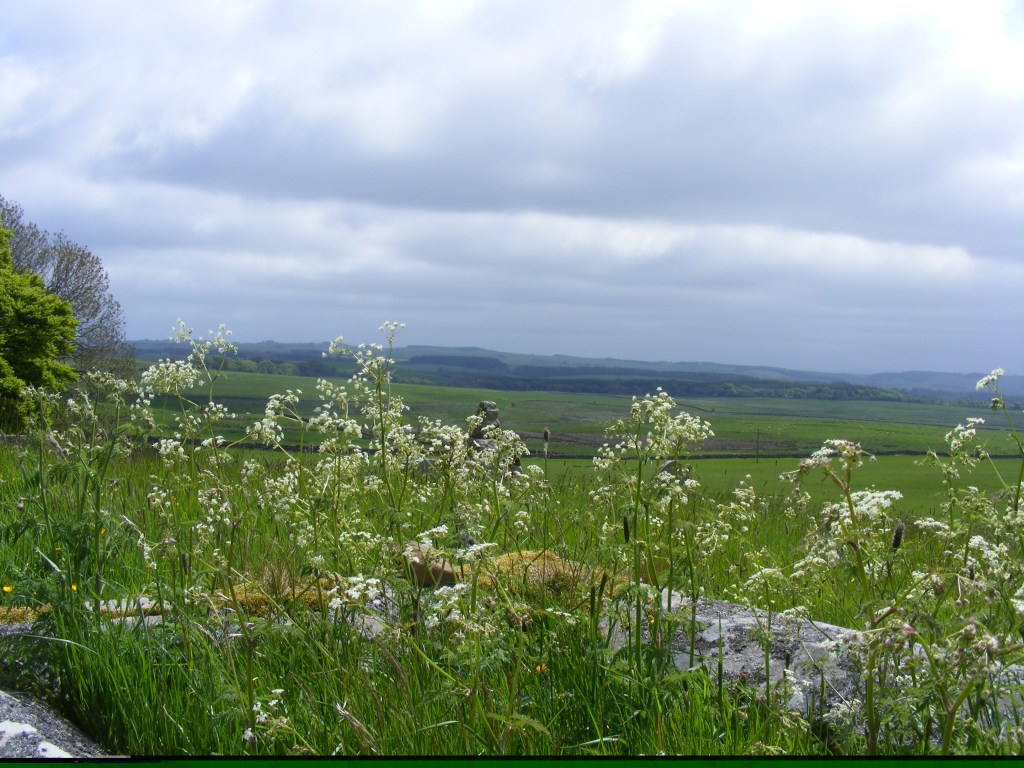
Another picture to remind you that I live somewhere beautiful.
The busyness has continued this month. For some reason best known only to myself, it seemed like a good idea to open bookings for Devon Family History Society’s 50th anniversary residential conference during my most hectic week with the job we must not mention. As I am the person who processes these bookings and they went slightly crazy, it was all a tad overwhelming. We’d done our research into the numbers of attendees at similar conferences in recent years, we’d added 20% because it is in beautiful North Devon, we’d added some more because the programme is something special and we were optimists and that was our predicted audience. Bookings opened and we filled half the rooms within 48 hours. There followed an anxious wait for an appointment with the venue’s events manager and finally more rooms were secured. Even with additional rooms, we are two thirds full. If you want to come along, don’t delay.
It is going to be a hectic year next year, as I am also running ‘how to’ family history courses, and a couple of workshops, as well as my usual programme of online courses and presentations. Oh and then there’s holidays, with a couple of special trips planned and before we know it, it will be 2027!
There has been more family history, this time delving in to my children’s Hampshire ancestry; seafarers and shoemakers along the Hamble Estuary. There have been outings with friends and now it is time for family school summer holiday visits, cue excitement and exhaustion in equal measure.
There are home improvements to add to the mix. I’ve had solar panels installed. I had them previously, so was already a convert. All very efficiently installed and I have a mound of certificates, warranty documents and the like. I am now just waiting for a magic number so I can start to sell excess power back to the grid, on top of lowering my own electricity bill. Next stop, a replacement for the ‘interesting’ salmon pink bathroom suite. At the moment I have one large shower en-suite and a bath in the bathroom. I’ve decided to go for a second shower, as opposed to replacing the bath, as that suits me better and any future owner desperate for a bath could always swap it back.
There’s been more research into fallen women, because, well, why not and it is one of my subjects for September’s Secrets and Lies conference (another event that’s proved very popular). A bit of a foray into nunneries, that’s for a book chapter and a day researching women born in 1819 (the same year as Queen Victoria) for A Few Forgotten Women. Now, apart from Biography Club, I have a lull in presentations until September and yes I am still (yet again) trying to keep up with biography club so my own is finally finished, at least as regards what’s happened so far! Not sure I will make it but that’s the aim. Come September, it is full-on round the country talks again, as well as a chance to catch up with friends.
This post should have gone live on 1 June, the 217th anniversary of the death of Mary Hogg née Newlands. It has taken four solid days to put together (much longer than I anticipated), so it is late – sorry Mary but better late than never. For nearly five decades, the earliest ancestor in my grandmother’s Northumbrian paternal line has been great great grandfather John Hogg. For almost as long, I have been fairly sure that I know who John’s parents are but I have been waiting for an additional piece of evidence before ‘inking them in’. All brick walls are annoying but this is definitely in my top three that I really want to crack, not least because I love the area where I believe they came from; so much so that I embarked on a one-place study of the parish.
Here is a brief summary of the in-depth research that I have done to try to confirm John Hogg’s parentage. I should say at the outset, that this is the only branch of the family that come from anywhere near the north of England, next best are the Bulleys from Norfolk.
The story starts with my great grandfather, also John Hogg. I have his original 1885 marriage certificate, to Caroline Howe, naming his father as John Hogg, a gardener. The marriage took place in south London but census returns for my grandmother, Elizabeth Ann Hogg and her parents, confirm that great grandfather John junior was born in Morpeth, Northumberland. Family stories linked the Hoggs to Morpeth and to Russell ‘cousins’. I have a card that Elizabeth Ann wrote but never posted, addressed to Mr B. Russell, 3 Dacre Street, Morpeth. She referred to him as ‘Bertie’ and signed herself ‘Cousin Bessie’.
From census returns, we can deduce that John Hogg knew where he was born (Morpeth) but was a little vague as to when (April 1855 – March 1858). He was 28 when he married in 1885, so that fits within that date range. John’s death certificate shows that he died, in December 1926, at 3 Dacre Street and the informant was Bertie Russell ‘nephew’. John’s age was 71 (so born between December 1854 and December 1855). The births of four John Hoggs were registered in Morpeth registration district between 1853 and 1859 inclusive. There were no ‘male’ (i.e. no forename) Hoggs registered in Morpeth in this period. I followed up all four. Only one fitted the criteria of being born in Morpeth itself, having a father called John and not having a future that precluded him from being my ancestor. In addition, this family had a daughter who was the mother of Bertie Russell of Dacre Street.
Fully satisfied with my proof argument thus far, I turned to my great great grandfather John senior. He made life difficult by providing three different birthplaces in the census returns, being vague about his age and on one occasion, calling himself George instead of John. Over many years, I obtained copies of every document that I could and built up a detailed timeline of this man’s life, his two wives and nine children. It seemed clear that he was called John; there is just one census return where he is George. He was born somewhere between 1799 and 1809, probably in Bavington or adjacent Kirkheaton, which are about twenty miles west of Morpeth; although one census says Kirknewton, which is on the Scottish borders. He was an agricultural labourer, for the most part specifically a shepherd and he made many short-distance moves in the area during his life.
John’s first wife was buried in 1849, although no death certificate has been found. His first, apparently legitimate, child by his second wife Elizabeth Pearson, my great great grandmother, was in 1854. I could find no marriage either side of the English/Scottish border, within or outwith that date span, using every spelling variant of the names. This was particularly frustrating as a certificate would hopefully have included a father’s name. Comparatively recently, a newspaper announcement came to light, which revealed that they married, in 1853, at Lamberton Toll, a venue for clandestine marriages that is less well-known than Gretna Green. No records survive for this date.
I followed up all John and George Hoggs born 1797-1808 in Northumberland who appear in the 1851 census and looked for them in both the 1841 and succeeding censuses, to see which one could be the ‘George’ Hogg in Newgate Street, Morpeth in 1861 and John Hogg of Well Way, Morpeth in 1871. It was clear by the family members that these two were one and the same. After a great deal of careful research, I came to the conclusion that my great great grandfather John Hogg was almost certainly the son of Robert and Mary Hogg of Hallington, St. John’s Lee and that he was born in 1804 and baptised in Thockrington, which was adjacent to St. John’s Lee. This was the only baptism in the area around the birthplaces that John/George gave in the census and I could find no plausible alternative future for the John baptised at Thockrington, unless he became my great great grandfather.
I was so nearly there but still I hesitated to add Robert and Mary to my family tree. I was after that elusive ‘one more piece of evidence’. I investigated Robert and Mary’s families to see if this might support my hypothesis. Initially, the Hogg family were not very forthcoming. Robert and Mary only had three children and two died without issue, so there was no hope of tracing descendants for a possible DNA match. Going back yet one more generation, was a bit of a stretch but I tried anyway. This didn’t seem helpful. This family were rural agricultural labourers. They do not appear in the newspapers (as per the British Newspaper Library index). There are no surviving poor law records for the relevant parishes at the appropriate times. They do not appear to have owned land or left wills (Northumberland Archives, Prerogative Court of York and The National Archives indexes checked, as well as the excellent North East Inheritance Database). They do not feature in electoral rolls, nor did they serve in the army or navy. There is nothing in the catalogue at Northumberland Archives that relates to the family, leaving me with very little to go on.
I turned to the brides. Robert’s wife had been Mary Newlands; was she my 3x great grandmother?
The Newlands family, despite their reluctance to baptise children in churches or chapels whose records survive, had more potential. Robert Hogg died in 1805 and his wife Mary née Newlands, just three years later. This would have left John and his surviving sister, Mary, orphaned at a very young age, which might account for John’s later confusion regarding his place and date of birth. There is no age at burial for Robert or Mary Hogg ‘relict of Robt’. Mary and Robert were married in 1799, in Chollerton about five miles west of where their children were baptised. A family of Newlands emerged in Elsdon, some ten miles to the north. In 1773, a Mary Newlins had been baptised in Falstone, the daughter of John Newlins, or Newlands, whose wife was an Ann, or Nanny, née Corbitt. The Corbitts were a little more obliging, with a couple of useful wills and some gravestones. I began to build up a picture of the Corbett and Newlands families but were they my ancestors?
I was contacted by a descendant of Sarah Milburn née Newlands, believed to be Mary’s sister. I’ll call the contact SS. If our trees were right we would be fifth cousins once removed. I am used to playing with very small DNA matches. Yes, I know all the caveats but to put this in perspective, I only have a total of thirty matches that are 40cM or higher and anything over 20cM is ‘high’ by my standards. I do treat these with extreme caution but it is all I have. As fifth cousins once removed there was no certainty that SS and I would match and we don’t. This led me to look again at the matches that I do have. It turned out that, although we don’t match each other, SS and I had at least four shared, albeit very tiny, matches, all of whom descended from Sarah Milburn née Newlands. Two were my fifth cousins once removed, one a fifth cousin three times removed and I am unsure of the exact relationship of the fourth. The largest of these is a new match that arrived this week, leading to more delay in getting this posted.
Twenty year old Mary Hogg, almost certainly Robert and Mary’s daughter, died at Smiddywell Ridge, in the parish of Bellingham. in 1827. This was the home of SS’s ancestor, Sarah Milburn née Newlands. My John Hogg married in Netherwitton, the home of another Newlands sister. Were John and Mary each brought up by a different aunt?
In addition, I have an almost respectable 22cM match to a Corbitt descendant. She would be my sixth cousin once removed and yes I have checked that we don’t appear to share any other ancestry.
I am now going to claim Mary Newlands as my 3x great grandmother. To be clear, the weight of the evidence lies in my 48 years of exhaustive research. What I have outlined here barely scratches the surface. I am not basing this on DNA connections that all the DNA experts would tell me are too small to be significant. Every genealogist has to make decisions about how much evidence is enough. For me, I was 97% there with the documentary evidence, the DNA was just a final pieces of a very large jigsaw. If you want to read a fifteen page proof argument, describing in detail why I believe Mary Newlands is my three time great grandmother, you can access it through my Granny’s Tales page. All serious family historians should be setting out why x is the parent of y for all generations of their family tree (and no of course I haven’t done this for all lines yet but I can aim – how long do I have?).
Next step, who were the parents of John Newlands? This is particularly exciting as it will take my direct ancestry out of England for the first time and yes there is one of those tiny DNA matches to the Newlands of Kelso, who are almost certainly John’s family – the question is which John is which?
The view from the churchyard where Mary is buried and one of my favourite places in the world
As usual, you are not getting these reports in real time but I’ll catch up eventually.
Day 1
Having spent the past days soaking my garden plants with water and moving most of what turned out to be nearly fifty plant pots to the shady part of the garden, I felt relatively ready to go away. Turns out there were to be a few hitches. I arrived at Chris’ to be told that he was waiting for roadside recovery as the caravan-towing car wouldn’t start. Fortunately, this was speedily resolved. By this time, I was starting to remember the things that I had forgotten. The list included a belt and the trousers I was wearing were the sort that descend, taking one’s knickers with them. I was able to borrow a belt from the fisherman of my acquaintance. Even better, it looked like I’d borrowed it before, as it had had a me sized hole added to it.
My travelling companion had to stand in for a holidaying churchwarden but I decided to forsake the church with the second most uncomfortable pews in the world and walk down Clovelly High Street instead. I was hoping to get some photos suitable for advertising next year’s Devon Family History Society conference but scaffolding and a dull day put paid to that. I am sure the street is steeper than it used to be; despite not going right down to the harbour, the slog back to the top was a bit of an effort.
We were finally on our way just after midday. I then realised that I hadn’t brought the maps with me. These weren’t needed for finding our way (or so I thought – see below) but I do like to follow along on a map. We arrived at our site not far from Helston, Cornwall. We were the only van on site, with rabbits for company and horses from the neighbouring field and the farm’s resident dog coming to say hello. This was meant to be a restful holiday, so we did just that.
Day 2 Kynance Cove
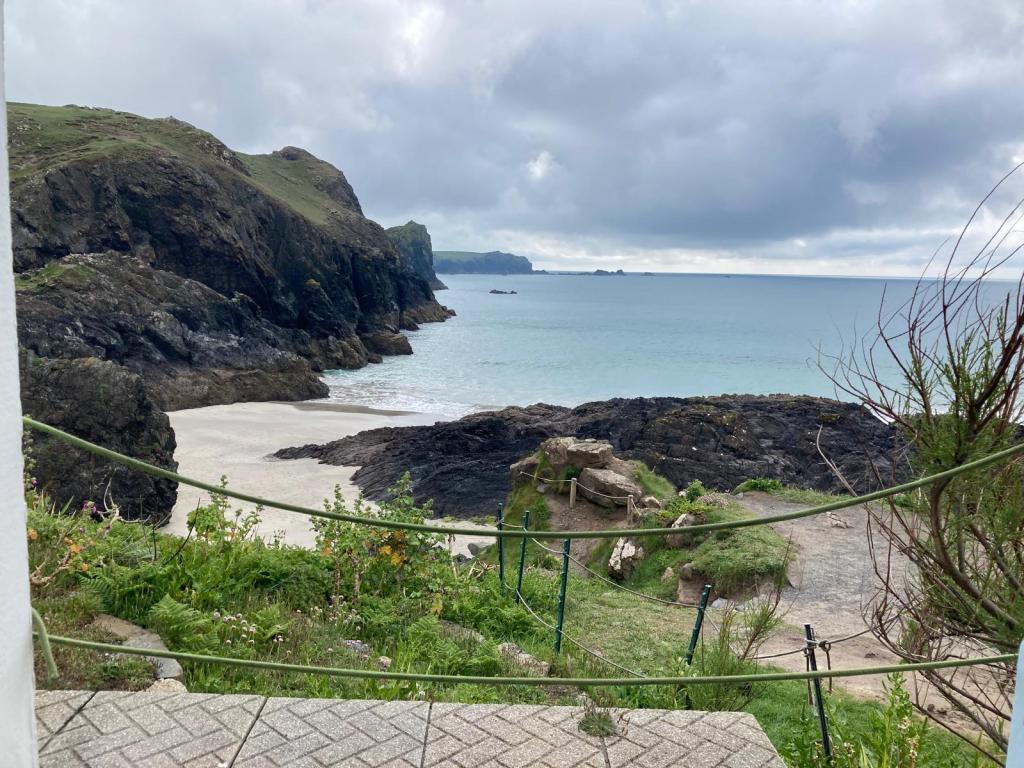
After a short drive, we availed ourselves of the free members’ parking at the National Trust car park and prepared for a short walk along part of the south-west coastal footpath near Kynance Cove. We have previously walked the whole of the Cornish section of this long-distance path but it was soon obvious that we are not as young or fit as we were. If this section of the path isn’t described in the book, which I have also forgotten, as strenuous, then it should be. We scrambled down the cliff side, wandered across the sand at Kynance Cove then struggled back up the other side. One excitement was not only hearing but seeing a cuckoo; I’ve never seen one before. Sadly, I wasn’t swift enough with the camera.
We went a little further on then, being well aware that every step further on also meant an additional step to retrace, we turned round. We treated ourselves to a drink at the café on the way back and I felt that it would be rude to refuse the carrot cake.
Back in the car, we took a short journey to Landewednack to look at the new Lifeboat Station which seems to have some kind of life down to the shore and then for good measure, the old Lifeboat Station at Church Cove. This involved parking under a very noisy rookery and hoping that the car wouldn’t need too much of a clean afterwards. That being enough exercise for one day, we went back to the caravan, where we lazed the rest of the day away.
Day 3 Godolphin
Another short drive, this time to visit the National Trust property, Godolphin. We knew the house itself wouldn’t be open but planned to explore the estate. I cleverly, or so I thought, photographed the map of the various coloured footpaths before we started. I did this on my camera; fail. I should, of course, have photographed it on my phone so that it could be enlarged. We completed most of the not terribly inspiring yellow route through fields and woods, alongside the River Hayle. The plan was to transfer to a short part of the pink route to the house, garden and café. Somehow we ended up on the purple route. Nonetheless, I was pretty sure which way we needed to go. It turned out that I was right. Unfortunately, I decided I should check the map. Finding a landmark on the opposite side of the road to the one I expected, we turned round and walked and walked some more. If only we had a proper map. Never fear we had phones with apps including Google maps and what the family call the spooky stalking app. What we didn’t have was anything resembling a phone signal. We approached a small settlement that boasted a post office, hurrah someone we could ask for directions. Said post office was only open one day a week, inevitably not the day we were there. Finally a passer-by. Better still, one who used to work for the National Trust. She set us on our way, retracing many steps. This also involved scaling walls using a strange for of style, some of which had ‘steps’ that were a very long way apart. She did also admit that the map left much to be desired and it appears that the key landmark was indicated on the wrong side of the road.
We finally approached the house/café/toilets (in reverse order of importance). We felt that we had earned our orange cake and lemon meringue donut. We looked at the C17th exterior of the house, which apparently has a colonnade that is unique in the country. The house and estate were developed by the prestigious Godolgun (later Godolphin) family, who acquired it in the C12th. They made their fortune from mining copper and tin. The mining landscape in the area is a UNESCO World Heritage site. The farm buildings are particularly superior and were built with stone from a former house. There was an interesting film show about dairying in the dairy.
We looked round the grounds and spotted what looked like a water trough. It had inexplicable notches of different depths, set at irregular intervals round the edge. We speculated what it might be used for. Enter stage left my former colleagues on the experimental archaeology course. Something very similar on the continent is described as a Roman olive mill. Another suggestion is that it was used by a blacksmith and cooling irons could be rested in the notches. The jury is still out; further suggestions welcome – answers on a postcard.
My Seear brick wall has been around for decades. Seear is a nightmare to research because it has so many variants and not all are picked up by ticking FindmyPast’s ‘include name variants’ box. Seear, Sear and Seer are the obvious ones but then you need to add an e, or an s, or an es, to all of those. The name is sometimes mis-transcribed as Secar(e/s/es) or Scear(e/s/es). In addition, mis-transcriptions of the initial letter lead to indexing as Teear, Leear etc.. I have used Seear here for consistency here unless the spelling is relevant to the argument.
I have ‘always’ known that my great great grandfather was Frederick Seear from East London , as I have my great grandparents’ original marriage certificate which names him and very early on in my family history journey, I discovered that Frederick’s grandparents were William and Mary Seear. In fact, as my great grandparents, Herbert Havet Smith and Catherine Seear, were first cousins, as were Herbert’s parents, William Joseph Smith and Eliza Seear, William and Mary are my 4x great grandparents twice over, making the brick wall doubly frustrating.
I built up a detailed picture of William’s life. I quickly found nine children born in the 1780s and 1790s. There was a strong suspicion of an earlier son for whom there was no baptism and thanks to marriage witness signatures, amongst other evidence, he later took his place in the family, as did a short-lived daughter, who became the eldest known child of what was now eleven in the family. I still think I may be missing a child, as it seems unusual that there was no son called William after his father.
There were clear connections with the Seear family of St. Albans, with intermarriage and members of both families together in the census. The only clue I have for William’s date of birth is his age at burial, notoriously unreliable, particularly as his wife had predeceased him. This suggested that he was born between February 1753 and February 1754. There was a William Sears baptised in St Albans in January 1755, close but I needed more evidence. I could find no obvious alternative future for the St Albans William unless he became my William. I mined this family for all I was worth but they yielded very little. I could only confirm one marriage and one infant death for the five siblings of the St Albans William. There was almost certainly another sibling, again missing a baptism (they really have an aversion to baptising their Thomases) and here I was more successful but there was still not enough evidence to claim these ancestors.
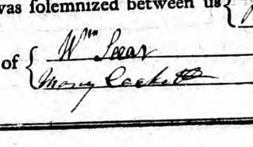
I was also missing ‘my’ William’s marriage to Mary ?. The world and his wife on Ancestry are convinced she was a Mary Stone. I am definitely not convinced. I have ‘my’ William’s signature as a witness on three of his children’s marriages and even allowing for the passage of years, it looks very different. He signs consistently Seear, whereas the marriage to Mary Stone is William Sears.
Although I found out more about William’s descendants, as far as William’s ancestry was concerned, this is how the situation remained for nearly forty years. Then a few years ago I discovered a will for a Joseph Seear, a grocer in Ham, near Kingston. I should mention that three generations of the Seear family intermarry with the Smiths, who originate from Ham, whilst my Seears were in Stoke Newington and Hackney. Joseph appears in Land Tax Records and Freeholders’ Lists in Ham between 1791 and 1806. It is also important to note that Ham at this time was very small, with only a dozen or so householders.
In his will, Joseph mentioned his brother John Seear, a shoemaker of South Mimms and his brother William Seear, a gardener of Stoke Newington. Thirty years before this, my William had been a shoemaker, not a gardener but there is no sign of any other William Seear in Stoke Newington. In addition, the will mentions Joseph’s niece Charlotte Seear, who was my William’s daughter and also Charlotte’s future husband, my 3x great grandfather, (John) Jeremiah Smith. Furthermore, one of John of South Mimms’ daughters and one of ‘my’ William’s daughters married brothers, suggesting a connection. After much investigation, I was happy that this was the right family.
I now had a group of three siblings to look for instead of just one, I also had burials and therefore approximate dates of birth for each brother. There was a John in the St Albans family who tied up beautifully with John of South Mimms but no Joseph. If Joseph’s age was right, he would have been born before the parents’ marriage in the family that I was hoping was mine. I checked for illegitimate baptisms but there were none. There was no alternative Seear family with a Joseph, William and John of the right sort of ages.
In his will, Joseph’s first bequest is to his ‘brother’ John Steel, a ropemaker of Sunbury and John Steel’s son, also John. He also mentions a ‘sister’ Sarah Treakell, a clergyman’s widow, who turned out to be a Sarah Steel. John Steel senior was and remains elusive, with no obvious marriage or burial and John junior was no better. I did track Sarah Treakell down and found an age at burial for her, leading to a possible baptism for a Sarah Steel in Putney, very close to Ham. She came from a large family, which did include a John. I assumed the Steels might be Joseph’s brother and sister in law or possibly half siblings but there was no marriage for a Joseph Seear to a Steel, or to someone who might have been a widow, formerly Steel. I couldn’t unearth any suggestion of half-siblings. Another roadblock.
I revisit this problem every year or so ‘just in case’ and this time round found that Sarah Treakell née Steel had left a will. In this she mentions a sister Ann Birch of Somers Town. I can’t trace Ann, nor can I find a Steel/Birch marriage, although there is an Ann in the Putney Steel family. Sarah also refers to a nephew George Day. Joseph made George Day ‘maltster of Barnes’ his executor but didn’t specify a relationship. He also listed George’s wife Mary Ann and her daughter Anne Marie. Hurrah, I thought, a breakthrough; except George Day is even more elusive than everyone else. No Steel/Day marriages, no Seear/Day marriages. Apart from some land tax lists, no sign of a George Day anywhere remotely close to Barnes. There is a press reference to an Anne Marie Day of Isleworth in April 1841 but is she in the 1841 census? No of course she isn’t.
None of this helped with finding or confirming William’s parentage. Sarah Treakell, bless her, did mention a “ten pounds a legacy left me by my late brother Joseph Steel of Ham near Richmond with the aforesaid sum being in the hands of Mr Day my nephew at Barnes Terrace near Putney”. Ten pounds was the sum left to Sarah by Joseph Seear.
Could Joseph Seear actually be Joseph Steel? In which case, it could be the Seears who were Joseph’s in-laws not the Steels. A Joseph Steel married Sarah in Stepney in 1781. The clerk has written Sears but Sarah’s signature looks much more like Seear. The witnesses were not helpful; Robert Vaughan is a regular witness and I can’t trace Sarah Bradley. No children have been found for this couple as Steel, or Seear in the area surrounding Ham or Stepney.
There is a possible burial of a Sarah Steel, aged 40, in Wandsworth in 1785 and a Sarah Sears in Mortlake in the same year. There is also a marriage of a Joseph Seares widower and Sarah Leach in Wandsworth in 1794. These entries may or may not be relevant.
The Sarah Steel who was baptised in Putney had a brother John, who could be John the ropemaker, a sister Ann, who could become Ann Birch, despite Ancestry trees wanting to marry her off to someone else with no evidence whatsoever of a marriage record. This family also includes a brother Joseph. The age at burial for Joseph Seear who made the will, isn’t quite what I’d like it to be, as it suggests a birth between March 1743 and March 1744 and Joseph Steel, Sarah’s brother, was six years older but he was a widower with no children, who would have provided the details of his age at the time of his death?
So where does that leave me? I know what I think is correct. Thomas Sear and Mary Phillips married in St. Albans, Hertfordshire in 1746. Baptisms for six of the children are recorded in St. Albans: Sarah 1747, Mary, 1753, William 1755, Susannah 1757, Ann, 1759 and John 1762. I believe that in the gap between Sarah and Mary fits Thomas who, according to his age at burial, was born about 1749 and who spent his life in St Albans. He was a shoemaker. His grandson married ‘my’ William’s granddaughter and Thomas’ great grandson, a fruiter’s foreman, was to live in Islington next door to William’s grandson, a fruiterer. Of the other children of Thomas senior and Mary, Ann died young and Susannah married and remained in St. Albans. I believe that William became a shoemaker in Stoke Newington and my ancestor, that John also became a shoemaker and went to South Mimms and that Sarah married Joseph Steel, who changed his name to Seear and was a grocer in Ham.
The same Christian names do recur, although none of them are particularly unusual. Thomas junior of St Albans has Thomas, Elizabeth, Charles Robert (names from his wife’s family), John and William. John of South Mimms has Mary, William, Sarah, Elizabeth, Susanna, Emma, Catherine and Ann. ‘My’ William has Sarah, Thomas, John, Samuel, Mary, James, Susanna Maria, Elizabeth Ann, Frances, Charlotte and Ann. Do I consider that all this is enough to break down the brick wall? No, no quite. There are missing marriages and burials that would help. Locating Ann Birch and even more importantly George Day would be useful. The Putney Steel family does have some unaccounted for daughters who might have married a Day. I guess that, for now, I have to be content with the fact that the brick wall has fewer bricks in it than it did a few days ago. In the meantime, if anyone has a sledge hammer or two to take to the remaining bricks out of my wall I’d be grateful.
There’s been quite a bit going on garden wise. First was the plan to cover the unsightly tarmac in front of the back gate by the new water butt, which leads to the ‘not actually a garage anymore’. This involved creating a barrier to stop any chippings escaping through the back gate. That was the easy bit. Next, to order chippings. The received wisdom was that online would be cheapest. After some research, I discovered a website that indicated how much stone you needed to cover an area of particular dimensions. I measured carefully, more than once. This was not as easy as it sounds as the area to be covered is wedge-shaped. I was reasonably good at geometry and I over estimated, which led to a figure of 362kg. I ordered 450kg, confident that that would be plenty. There’s a huge but coming; I did not order from the same website as the one that provided this figure, as I preferred a slightly different stone.
Next, the non-delivery of said chippings on the day they were due. In the end they were delayed long enough to arrive on a day when I was back from my weekend away. Unfortunately though, it was my birthday and a day out was planned. My kind neighbour signed for the large bag of chippings and all seemed well. Next some shovelling and raking, which actually didn’t take as long as I thought it would. In theory, there should have been chippings to spare but no. I can only presume that the chippings on the measuring website were a different weight to those I actually ordered. There were not enough. We raked them a little thinner, still not enough.
A trip round local builders’ merchants armed with a sample of the stones ensued. Absolutely nothing that looked vaguely similar. I could have ordered more from the original supplier but the delivery charge was punishing and supposing I still didn’t have enough? I wondered if I could put a few raised beds on the area to eke out the stone, as they would not need stones underneath. I decided to think about the best course of action. We then realised that walking on said stones coated the soles of our shoes with a chalky residue. Clearly the adults who were likely to be walking in my garden are perfectly capable of efficiently using a door mat, the three imminently arriving small people, not so much and one of those small people sleeps in the ‘not a garage’.
From the outset, I had considered putting stepping stones on the chippings, this now seemed like an essential requirement. Ideally, I wanted to match the rope-like stones in another part of the garden. I looked online for a nearby supplier. Good news, a large retailer near me sold what I wanted but only if I purchased twenty-five stepping stones at about £350, not an option. The small people were due the next day, it was already close to closing time. Cue a hasty trip to a nearby, normally expensive, garden centre, where lo and behold, I could get the nine stepping stones that I required for a much more reasonable figure and as a bonus, the postman had delivered a 25% off voucher for said garden centre, which I had not only saved but found and remembered to take with me. Nine stepping stones purchased for a seventh of the price of twenty-five. Next to lay the stepping stones. Lining them up was not without incident but moving chippings from underneath the stepping stones meant the chippings covered the whole area – result.
Then there was the birthday visit to a large and economical garden centre to splash quite a lot of cash. The haul included a wisteria, a standard azalea, that I regretted not buying last year, a lupin, a replacement alchemilla mollis, the previous one having drowned as I accidentally planted it in a pot with no drainage hole, a lemon tree, an evergreen clematis, which I hope will grow to cover the tiny gap, which is the only place where the garden is overlooked, some bedding plants and probably more that I am not going to admit to.
Spring has certainly sprung and the recent sunny weather has set many things in bloom. Bluebells are showing colour, the wall flowers are glorious and the clematis are in bloom. There is plenty of blossom on my two apple trees, the olive and the pear are looking healthy. I also have two new trees in pots. These started as bare twigs about nine inches long and were free from the Woodland Trust. To be honest, I didn’t hold out much hope of them ever becoming tree like, especially as the resident magpie was eyeing them up for their nest but they too are shooting. One is a dogwood and I’ve forgotten what the other one is going to be so watch this space.
This past week has been recovering from the Really Useful Family History Fair in Dorset where there was a really friendly vibe and a chance to catch up with long-standing friends. I was multi-tasking with two stands, giving two talks and offering advice. The weekend also involved eating far too much. This was rapidly followed by birthday celebrations, more eating too much and also some serious garden centre spending (of which more in a later post) and a lovely walk round a country park, which hopefully negated a little of the too much eating.
On the 1 April I received a letter from my old school. When I attended, my school was what was known as a direct grant school; basically a private school that took pupils who had achieved a certain level in the 11 plus exam, whose fees were paid by the council. I was one of those pupils. So a ‘posh’ school for me then and loads of properly famous people went there, there’s even a Wikipedia List for notable previous pupils, on which I understandably do not feature. The school is 150 years old this year and they are creating a mural of 150 former pupils who ‘have left an indelible mark on our school’s history and whose achievements inspire future generations’. Weirdly one is me! I have no idea how or why and I assume someone must have nominated me. If that was you, thank you and wow, just wow. I am dumfounded. I do feel as if they may not have had many nominations and I have no idea how I got chosen. The phrase ‘scraping the barrel’ comes to mind. Maybe my ‘indelible mark’ was for all the wrong reasons.
My lovely daughter did point out the date on which the letter arrived and suggest it might be an April Fool but the letter was dated March and the project has a webpage, so it looks genuine. It seems some pupils are working on the chosen women to create their images as art work, embroideries and graffiti. I am placing bets on which I will be! I can only assume that the information is coming from this website, so goodness knows what the poor 12 year old who has been allocated me is thinking. If you are reading this dear pupil, all I can say is, ‘Good Luck’ and I am sorry you got the short straw. I wonder if I will be depicted as Mistress Agnes.
In other news. With more family visiting than I have bed space a whizzy new inflatable mattress thing was ordered. It arrived a few weeks ago in a huge heavy box and I shoved it in the garage until a couple of hours before their arrival. On taking it out of the box and removing the shrink wrapped plastic, it said ‘leave for 72 hours before using’ ooops. In fact it did say that on the outside of the box – bigger writing was obviously required, or maybe instructions on the advertising. If we haven’t totally and permanently ***** it up by sleeping on it a few hours after removing it from the packaging it is supposed to be much more comfortable than an airbed – I await the verdict with trepidation.
Now for some days of beach, arcades, sweetshops, cafes (more excessive eating) and board games. I have already lost at the new dumbed down version of Cluedo; I knew the strategy for the old one.
Forget Bell, Book and Candle, this week has been more about Blind, Book and Stone. First of all though, there were more utilities to deal with, as my internet provider sent an engineer to try to work out why my once stable internet had become decidedly flaky. A new router was installed and not wishing to tempt fate, I won’t say much but fingers crossed. This of course meant that all my devices that were connected to the wifi had to be reconnected using the excessively long and totally unmemorable password. I long for the days when the password was ‘hop-think-lazy’ and not a garbled string of two dozen letters and numbers. At least two people in my family will have memorised it after being told it once but as for me, no chance.
Next, having lived here a year, I treated myself to a new kitchen blind to replace the slightly manky and unattractive one that came with the house. Then came the learning curve known as ‘how to install a blind’. To make life more difficult, the kitchen window is over the sink so there wasn’t even easy access. The fisherman of my acquaintance personfully attempted to install said blind. This was accomplished and I didn’t even hear any swearing, ok so I was six miles away at the time but hey. The process did involve the complete disappearance of a dropped screw, which I suspect probably ended up down the plughole. Despite the liberal use of a spirit level, said blind did look just a tad on the wonk. I was just grateful that it was on the wall and not thrown in the bin in frustration, so was going to let this pass. I treated the harassed workman to celebratory cake in the best café in the world, which meant I got to eat cake too – win! Bless him, he arrived next day, determined to correct the list to starboard. To be honest, I was all for letting sleeping blinds lie but no, it was removed from the wall and after a certain degree of exasperation, it is now parallel to the ceiling. I did wonder if he was angling for another portion of cake.
Stones then. This should probably be a garden make-over post but I will write about their installation there. I decided, as it seemed to be the week for spending ridiculous amounts of money (I’d also booked three expensive holidays), I would buy some chippings to cover some unsightly tarmac. I ordered the chippings, carefully calculating that their ‘delivery in 3-5 working days’ would fall on a day when I was home. Day 5 has come and gone and I am still waiting and according to the tracking, they will now arrive on a day when I am out. I just hope that they don’t deposit them in front of the outward opening back gate. Watch this space for the next episode.
Family history has not be forgotten. I am enjoying leading my Pharos Female Ancestors course. It is quite an intensive course but the students are lovely and seem to be enjoying it. I had visions of working alongside them to get on with a biography of my mother but I am also trying, for the sixth time, to finish my biography with my Society of Genealogists’ biography club members and it just isn’t going to happen. Still, female ancestors runs again in September so maybe I will have better luck then. On the subject of women’s history, my blog for women’s history month has appeared on the Pen and Sword website. In more book news, my publisher has now brought out the second and much revised edition of Putting your Ancestors in their Place in paperback. This weekend will see more family history fun as I multi task at the Really Useful Family History Show in Kinson, near Poole. I am speaking, personning an advice desk and dividing my time between Devon Family History Society and A Few Forgotten Women stands.
Another of this week’s adventures involved a nighttime (well, it was after 9pm) drive out to some nearby countryside in order to look for a forecast aurora, where there wasn’t much light pollution. The only other cars in sight probably contained courting couples – I didn’t look too closely and I spent the time worrying that the gate to the area would be shut early and we, or at least the car, would be stuck until morning. I am not convinced that the vague light in the sky that my phone picked up was anything remotely aurora-like but we tried.
Pretty manic so far anyway. We’ve had Rootstech. I still haven’t found time to listen to the sessions on my watch list, thank goodness for recordings. My own #Rootstech short recorded session ‘Where am I? Are you searching in the right place?‘ is now available – along with my sessions from 2024.
I seem to have wasted hours of my life on the phone to ‘utilities’ this week. First trying to understand why my normally stable internet has become decidedly flaky, randomly particularly in the morning. An engineer is booked. Then a utility company I won’t name want to change the smart meters I didn’t want in the first place (they were already installed when I moved in). Trying to arrange an appointment was not without issue. I was asked all the same questions by two different people, ‘Is there a dog?’ ‘Are the meters accessible?’ etc. Having said I had no long term disabilities the first time I was soooooo tempted to say when asked the second time ‘well only the ones I’ve developed in the last two minutes’. I did get a rant in about how I felt smart meters were of zero use to me whatsoever! Watching the meter whirl round won’t make me turn things off, if I don’t need the appliance on it won’t be on in the first place. I quite like to read my own meters so I know what to expect. Hey Ho – old school I guess. Having arranged said appointment by phone, I am still getting texts asking why I haven’t responded to make an appointment. That would be because I already have one – left hand right hand. After all that I felt in need of a lie down in a darkened room.
Then on Friday it was off ‘up north’ – well at least ‘up north’ from here, I had to de-ice the car – ever tried getting the lid off new de-icer? De-icer canisters are by definition are chilly to grasp – the solution involved a knife. The journey was in order to attend the Midland Family History Show in Malvern where I was personing the Devon Family History Society stand, chatting to friends and eating a lot. In-person get togethers are fewer and further between these days, so it made a change and in two weeks’ time we will be doing it all again in Dorset for the Really Useful Show. Now I am safely home. Mostly unpacked and still eating.








 The History Interpreter - Janet Few