Continuing the Cornish Adventures

We needed to return home for the day and thought it was about time we refuelled the car. The chauffeur of my acquaintance had neglected to bring his wallet. I believe that a newly installed app on my phone might have been a satisfactory substitute but needless to say, despite my increasing proficiency with the phone over the past weeks (to the extent that I have exceeded my, albeit meagre, data allowance), this was a step too far. Fear not, my bank card is in the rucksack. Ah that would not be the rucksack we have with us but the one that is ……. in the caravan. Fortunately, we made it home and were able to retrieve alternative means of paying. Then it was back to the van. The A30 on a Friday rush hour is never a great idea, so the return journey was a little on the slow side but we were back in time for the mobile fish and chip van’s visit to the site and even managed a walk out to Wheal Coates to try to counteract the ill effects of said fish and chips, or in my case, fishcake and chips, in the evening.
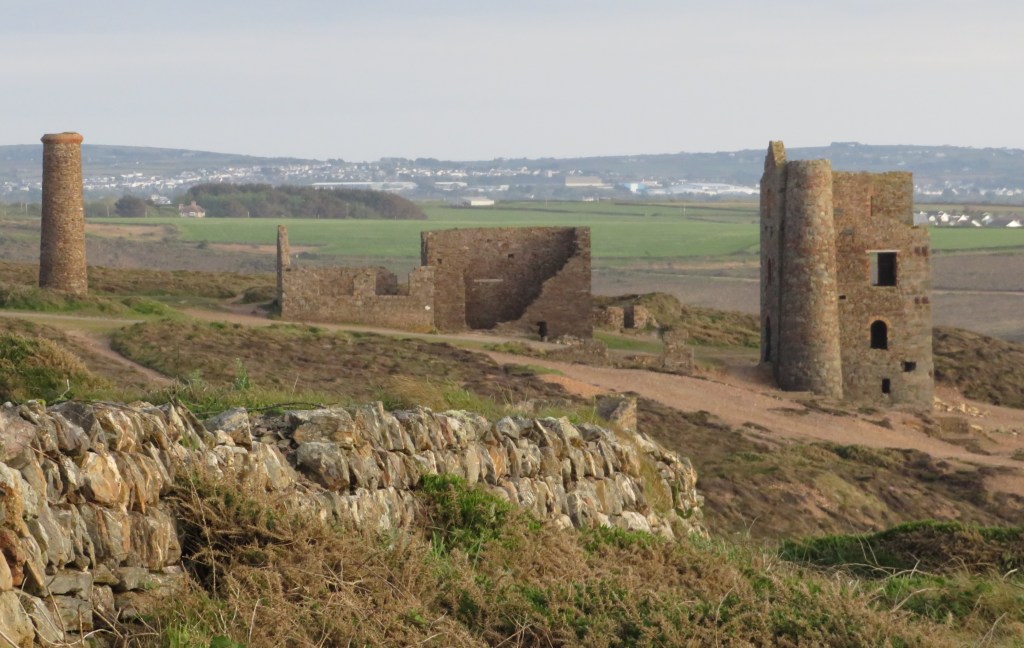
Wheal Coates

Further westward the following day and a trip to Newlyn. We overshot the entrance to the car park and before we had a chance to turn round saw several parked cars with a space for us. We looked carefully for notices that said that parking was restricted, or for permits in the windows of the other cars. A nearby gardener assured us that parking there was fine. I was a little less confident as this lay-by appeared to be a bus stop. Could the other half a dozen cars and the gardener be wrong? I left the decision to the car’s owner and we stayed put. A quick trip to a nearby boatyard so the fisherman of my acquaintance could chat boats, then we walked on to Mousehole where I had the drippiest ice cream cone I have ever encountered. Interesting to see that black-backed gulls seem to be outnumbering herring gulls. No sign of any clamp or parking ticket on the car so we returned to the van via a mercy dash to a supermarket near us to get yoghurt, which we should have brought back from my home fridge yesterday but we failed to do. A late afternoon relax in the sun followed.

Another day and back to the south coast for a visit to St. Michael’s Mount. We’d timed the trip so we could walk out across the causeway. I even managed to show evidence of my booking on my phone, which was an achievement in itself. It is quite a climb up to the castle, so not ideal for anyone with mobility problems but the views over Mounts Bay are impressive.

The Cornish name for the island is Karrek Loos yn Koos, or the grey rock in the woods, which may date from the time 4000 years ago when the mount was not cut off by the tide but was surrounded by woods. The remains of tree trunks are still occasionally seen at very low tides. In 2009, a bronze age hoard was discovered by one of the gardeners, suggesting that, 3000 years ago, the mount was a trading centre. It is thought that Edward the Confessor granted the island to Benedictine monks from Mont St Michel in Normandy and established a chapel there. The mount became a place of pilgrimage but also a focus for conflict. In 1193 it was seized by Henry de la Pomeray, who had disguised his men as pilgrims in order to gain control on behalf of Prince John. John was attempting to stage a coup and take advantage of his brother Richard I’s absence on Crusade. Much of the current building dates from the fourteenth century, with substantial later additions. The dissolution of the monasteries was late to reach the far south west, so the religious community survived until 1548. The following year the mount was seized by those involved in the Prayer Book Rebellion. It became a Royalist stronghold during the Civil War but surrendered to Parliament, with Colonel John St Aubyn as the captain. St Aubyn purchased the castle in 1660 and it has been the home of the St Aubyn family since then.

Several myths and legends are attached to the island. The discovery of a seven foot skeleton on the island, buried vertically, fuelled the legend of ‘Jack the giant killer’; allegedly Jack from Marazion killed Cormoran the giant who built the mount and terrorised locals. Visitors can view the giant’s well and a tiny heart-shaped stone in the cobbles is labelled as the giant’s heart. Some features that caught my eye included the stained glass in the chapel, seventeenth century tiles and the ceremonial barge, that took part in the Queen’s diamond jubilee pageant. This is one of the oldest working boats in the country, having been constructed using wood felled on the St Aubyn estates in 1750. A collection of postcards of the Mount over the decades were cleverly displayed so that you could see both sides. There was also a model of the castle made from champagne corks by the butler. Two observations here, they must have drunk an awful lot of champagne and the butler really needed to get a life.

We wandered back into Marazion, where I felt obliged to sample yet another ice cream flavour, gingerbread this time. Then we beat the rain back to the van.

More Westward Wanderings

With the forecast heavy rain very much in evidence it seemed sensible to head for somewhere with a modicum of ‘indoors’, so it was off to Trerice, a manor house built by John Arundell in 1570. Inside there is a striking 576 pane window, predominantly made up of C16th and C17th glass. There are also numerous portraits, include some by Kneller. A 1950s wing replaces the former north wing. In the grounds there is an Elizabethan knot garden, given over largely to lavender and also an impressive potager full of vegetable and salad produce. If there were 100 hours in every day I’d want my garden to look like this. There are several mown mazes in the grounds, one being based on the maze at Troy Town on Scilly, which is known as the three circuit maze and was used by Scandinavian fishermen to trap bad spirits. I managed to escape.

Trerice is lovely but there isn’t really the scope for an all day excursion. The weather had improved so we decided to move on to Trengwainton Gardens, getting yet more value form the National Trust life membership. Here the rhododendrons were in full bloom. There is always something soothing about being in a garden and this one has the bonus of overlooking the River Fal. We walked down to where the King Harry chain ferry takes vehicles and passengers across the river. A steam ferry first crossed the river in 1888. It is one of only five chain ferries in England.

Next day and I was awake early to watch the misty dawn break over the sea, all accomplished without getting out of bed! The first stop of a busy day was Restormel Castle, which was built for the Earl of Cornwall, in good defensive position, overlooking River Fowey. It was originally used as a hunting lodge and was set in the largest hunting park in Cornwall. The park was also home to several hermits who were expected to pray for the souls of the castle’s owners. The remains are thirteenth century and the castle was owned by the Black Prince in the fourteenth century. After a skirmish during the English Civil war the castle fell into disrepair and was not deemed to be of sufficient use to maintain. English Heritage are now putting the headings of their interpretation boards in Cornish as well as English, A great first step but it is a pity that the text isn’t in Cornish too.

It doesn’t take too long to exhaust the possibilities of Restormel, so we move on to Lanhydrock House. The volunteer asks if I have visited before. I reply that I have but it was ‘a long time ago’. Do I remember the kitchen? I am asked, perhaps I should have explained that ‘a long time ago’, was about 39 years! The house was the home of the Robartes family, which I’ve always pronounced Row-bar-tes but, according to the information video is Row-barts. In April 1881 Lanhydrock was severely damaged by fire and the then owners died shortly afterwards, leaving the next generation of Agar-Robertes to take over. Ahead of her time, in 1894, the then Lady Robartes opened Lanhydrock to the public and establish a ‘bazaar’ there to raise funds in what seems to have been a glorified jumble sale. Her terse instruction cards to visitors have been replicated.

As always, I am attracted to the huge library, whose collection includes twenty five incunables. I had no idea what that meant either but just so that every day is a school day for you too (unless you already knew of course), these are books printed before 1501. There was also a fascinating and enormous steam jack in the kitchen. The National Trust seem to have developed an unfortunate trend for printing interpretation comments on the soft furnishings, which seriously spoils the authentic look of the rooms. I guess someone decided that it appealed to the visitors – not to this one though. We heard the story of how all the house’s laundry was sent to St Faith’s, a home for fallen women in Lostwithiel; I immediately wanted to scramble for census returns. Lanydrock’s gardens are extensive, with more rhododendrons in evidence. I would think that this is the best time of year for the gardens. I suspect they will be less impressive in a few month’s’ time.

Lanhydrock

On to Fowey and first the challenge of finding a car park. We located one at the top of the town but allegedly there could be one nearer to the church, where we want to be, so we decided to keep searching. Fowey is a tortuous warren of narrow, steep, winding streets. We do narrow, steep and winding but this is something else. Some vehicles were pulling in their wing mirrors to negotiate parts of the one-way system. Just because we were enjoying it so much (not), we completed the circuit several times before ending up in the car park where we first started and getting the town bus down the street. This doesn’t run after 5pm but the driver was able to tell us the best way to get back up the hill to the car park. I thought this might have been a first outing for my newly-acquired bus pass but the service was run by a private company and I didn’t like to ask if passes applied.

Fowey has been an established harbour for over 2000 years, exporting fish, wool and tin and being a point of departure for pilgrims to Spain. The returning vessels brought back with them wine, salt and iron. Fowey is noted for being the home of Daphne Du Maurier and we are here for a concert that is part of the Arts and Literary Festival that formerly bore Du Maurier’s name. There is little left of traditional Fowey, which now clearly caters for the yachting fraternity. Most of the food options were of the two peas and a bit of drizzle for £30 variety. We finally found The Lugger, which was more suitable to the sizes of both our pockets and stomachs.

The day finished with a Fisherman’s Friends concert in the local church. I was able to admire the heraldry round the church and practice my extremely rusty blazoning skills, while I was waiting for the concert to start. The downside was the less than comfortable pews. The evening was a sell out and was excellent, as we expected it to be. Even better, there was a community bus, with just two spaces, waiting to take us a ridiculously long way round to the top of the hill car park.

Cornish Meanderings

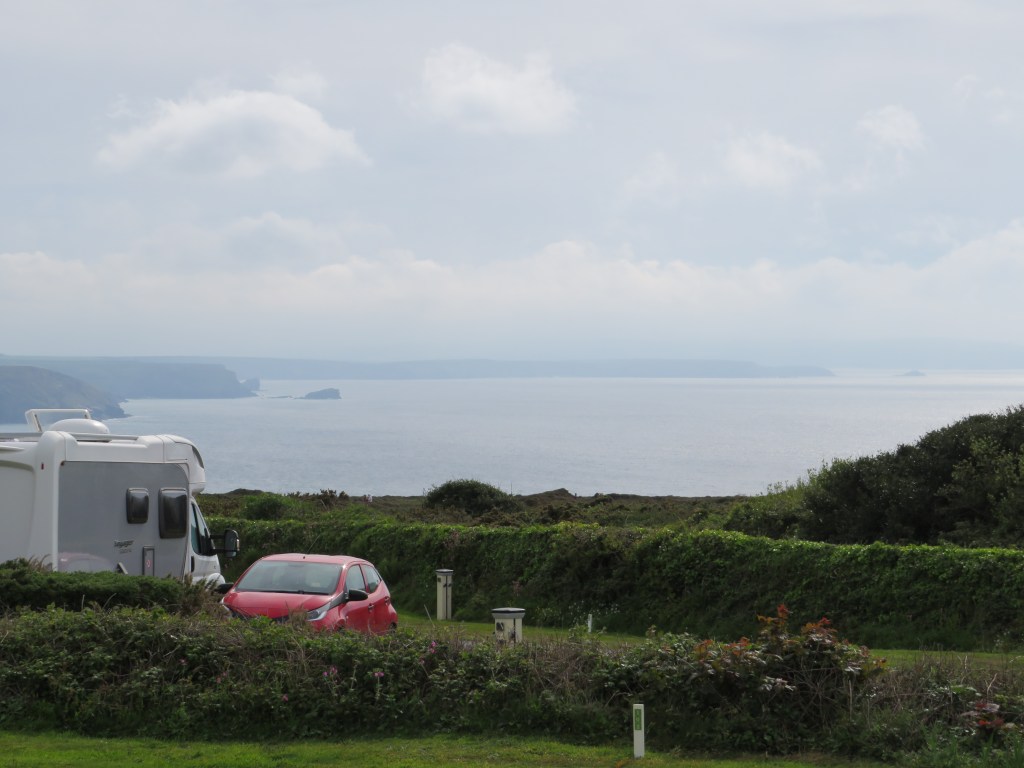
As always, you aren’t getting these posts in real time so apologies if I am saying it is glorious sunshine and it has been pouring with rain with you. May was supposed to be a quietish month so we booked a trip to Cornwall for some R & R. So much for quietish! I have four meetings to attend this week and a heap of writing to do. Nonetheless it makes a change to be somewhere different. As Cornwall is next door and earliest entry to caravan sites is 1pm, we had a leisurely start. I did have a slight panic when, despite what the website implied, on checking the site handbook for directions, I discovered that the wifi was hot spot only. All was well however as by choosing our pitch judiciously, I could avoid standing on one leg under a tree whilst attending my meetings. At least I hope I can. Internet and emails are slow but working, so fingers crossed that Zoom works too. As a bonus, we have one of the best views on site, looking out across the spectacular north Cornish coast.

Arriving at lunchtime provided opportunities for exploration in the afternoon so we set off for a gentle stroll along the south-west coast path, close to the caravan site, heading for Porthtowan, which, on the map, looked about that close (when ‘that’ is not very far). I really should know better. The clue is in the name. We are staying at St, Agnes Beacon. Beacon = high up. Porth = port = sea level. In between there was a lot more upping and downing. We really are too old/too out of practice for six or seven strenuous miles of sliding up and down cliff paths with plenty of loose shingle as an added hazard. The bonus was our encounter with the iconic Cornish coastal landscape, compete with granite cliffs, abundant wild flowers and abandoned tin mines. Limping and panting back to the van, we decided we should have settled for the mid-point at Chapel Porth instead. We survived but resolved not to try that again.

Looking for something somewhat gentler on day two, we drove to the south coast seeking  Pendennis Castle, which after a slight detour, we located. It is nearly forty years since my last visit. Pendennis is one of forty Henrician forts, erected in the sixteenth century, as Henry VIII fell out with many European neighbours. The impressive wooden portcullis was constructed from oaks felled in 1541 but it did seem that wood might not have been the greatest idea if the enemy arrived with fire-power. Guide David took us on a tour of the Tudor part of the fortifications. The castle was built on land owned by the Killigrew family, who provided the first three captains of the castle. The site was subject to continued development, with the large garrison block dating from the early twentieth century and this was still in military use until 1956. There were more incredible views across Falmouth Roads to the companion castle at St Mawes.

After some refreshment, we completed the ‘moat walk’ amidst more spring wild flowers and climbed down to see ‘Little Dennis’ another bastion on the shoreline. Then time to return to the van, via a short walk at Wheal Coates, close to the van. There are records of mining here that go back to the seventeenth century but the buildings that remain are nineteenth century. The tin mine finally closed in 1914.

The view from the temporary office window

More Warwickshire Wanderings

Another day out in Warwickshire. First stop was Baddesley Clinton, just a few miles from our caravan site. This is a fifteenth century, moated manor house, built on the site of a Saxon settlement. We began with a walk round the grounds and were treated with the view of a dozen newly hatched ducklings, hiding in the grass by the side of the lake. Baddesley was the home of the Catholic Ferrers family for twelve generations. In the late sixteenth century it was let to the Vaux sisters and became a centre for secret Jesuit meetings. It boasts a priests’ hole where nine Jesuits managed to escape detection. Said priests’ hole basically doubles as the toilet but anything to avoid being caught, I guess. The house is a joy for fans of heraldry with almost every room boasting coats of arms. We also saw a tapestry in the process of being cleaned and a particularly ornate, nineteenth century chapel.  As an added attraction, the house is the home to the National Trust’s largest collection of children’s books. In a rather more gruesome vein, in the 1480s, Baddesley was the scene of a murder, when Nicholas Brome came home to find the local priest ‘chocking his wife under her chin’ and consequently ran him through. After parting with a considerable amount of money and agreeing to repair two local churches, Nicholas was granted pardons from the king and the pope.

Next was the consumption of chocolate cake. I am not a fan of the regulation requiring the number of calories to be displayed. I am sure it is not a deterrent to those who need to be careful about calorie intake. It only means that we end up overweight and burdened with guilt, rather than just overweight.

In order to walk off just a few of the whopping 534 calories in what was actually quite a modest-sized slice of cake, we went on to Kenilworth Castle. We arrived just in time for ‘Knight School’, sadly we were observers only, being of rather more mature years than the target age for participants. Valuable lessons were nonetheless learned. The first rule of knight school is, ‘don’t get dead’. Kenilworth was established by royal chamberlain Geoffrey de Clinton in the 1120s. He also founded the nearby Augustinian priory of St Mary the Virgin. In 1447, the pope granted the priory abbey status. Kenilworth became a royal residence and was added to by King John, John of Gaunt and Henry V. Much of the twelfth century part is built of sandstone, which is eroding in interesting patterns. Kenilworth is famous for the siege of 1266, when Simon de Montfort held the castle against Henry III for 172 days, the longest Medieval siege. Elizabeth I granted Kenilworth to her favourite, Robert Dudley, Earl of Leicester, who entertained the queen at the castle, creating a pleasure garden in honour of her visit. Dudley was responsible for additional building on the site. He accomplished this largely by using pillaged stone from the nearby abbey, that had been surrendered to Henry VIII during the dissolution of the monasteries. The abbey’s remains were excavated in 1922 but are now protected by soil.

A royalist stronghold during the Civil War, Kenilworth was acquired by Parliamentarian Colonel Joseph Hawkesworth after the war. Retaining the gatehouse as a private residence, Hawkesworth began dismantling much of the castle and selling off the building materials. Kenilworth was saved by Sir John Siddeley, of Armstrong-Siddeley motors fame, who bought it for the nation, giving it to the forerunner of English Heritage in 1937, as well as funding repairs.

Bardic Adventures

Whilst visiting Warwickshire for a lovely family wedding, we decided that we’d look around a little, before heading home. Having never been, we picked yesterday to visit Stratford on Avon and only afterwards realised that we had timed our visit to coincide with Shakespeare’s birthday. We didn’t let the small fact that we hadn’t bought him a card deter us and off we set. We had a timed entry slot at Shakespeare’s birthplace and didn’t want to miss it. As we arrived, it was clear that something was going on as roads were closed and crowds lined the streets. It seemed that Shakespeare’s birthday was to be accompanied by a parade. We listened to a band for a bit and watched some men appear with a bust of Shakespeare, which they proceeded to screw to a plinth (health and safety rules). The band stopped and no one seemed sure what was going to happen next. We needed to be on time for our birthplace visit but it seemed a shame not to see whatever was due to happen too. My intrepid companion approached a man with a clip-board – always a good strategy when in doubt. Said clipboard-toting gentleman suggested that we went for our visit straight away, as then we would be back in time for the planned procession. We complied.

Being seventeenth century types, the birthplace was very interesting, with lovely gardens. Without rushing, we managed to return to the ever-thickening crowds in time to watch the parade of costumed characters, school children, local dignitaries and morris dancers go past and walk to the church where Shakespeare is buried. Only the great and good, most of whom were clutching posies of yellow and purple flowers to lay, were allowed in the church, so that was us out. Instead, we watched the morris dancers and looked at several old buildings clad in wisteria, which is in full flower here; mine at home has barely begun to shoot. Next, a visit to The New Place, Shakespeare’s home in later life. Again, there were lovely gardens, as well as the exhibition itself. There were some Shakespearean themed sculptures in the gardens as well.

A short drive and we were at Anne Hathaway’s cottage, dating from the fifteenth century. More beautiful gardens, an orchard and more sculptures. Here it was the cowslips that were at their best. I invested in a few herbs to take home.

Definitely a recommended visit, even without the bonus of the birthday celebrations. A joint ticket to all three properties is a considerable saving and you don’t have to visit all three on the same day.

Sunny Sussex

I am spending a few days in Sussex, which is indeed sunny. Yesterday, we arrived in time to take a look at the RSPB reserve at Pagham Harbour. This was a pleasant walk with views out towards the sea. The website warned us that the visitors’ centre and toilets would be closed due to staff sickness. Fortunately, only half of this was true.

Today, we headed off to the seventeenth century National Trust property Uppark, the home of the Meade-Featherstonehaugh family. This part of Sussex seems to be overburdened with roundabouts and Sally the Sat-nav was feeling sluggish today, which made exiting said roundabouts in the correct place somewhat tricky but we arrived without too much of a diversion. More Covid related staff shortages meant that only the ground floor of the house was open but there was plenty to see including some incredibly finely worked tapestries, with the tiniest stitches imaginable. Uppark suffered a serious fire in 1989 and had to be extensively restored but there still seemed to be original furniture on view.. We wandered round the grounds and were in time to enjoy the daffodils. Historic plans are being used to restore the garden’s pathways to the original designs by Humphry Repton.

In the afternoon, we explored Bersted Brook Nature Reserve, next to the caravan site. It was a tad underwhelming but it was an opportunity to walk away from the road and the blackthorn blossom was spectacular. We even managed to acquire something for tea from a nearby supermarket, which save us from the decidedly dubious ‘pleasure’ of resorting to one of the numerous local take-away chains.

Down South

Two days at home, two presentations given and now we have also spent a couple of days in South Devon, primarily to attend a Fisherman’s Friends concert. This was an adventure in itself as it marked our first venture indoors with a crowd of people. We had been warned by the venue that we would need vaccination certificates, or evidence of recent negative lateral flow tests to be let in, which was reassuring. I did wonder if we really would have to produce these but yes, long queues were already amassing outside the theatre thirty minutes before the concert started. Everyone’s status was checked and people were being turned away or provided with tests. I wish there was more of this sort of thing. As a bonus we got inside before the rain started. I was planning on wearing a mask throughout but I just couldn’t see. As we were in the front row, we weren’t too hemmed in so I decided to go without, along with 95% of the audience.

While we were down south we took the opportunity to visit Stover Country Park. We managed to dodge the showers and do some more experimenting with the new camera. We also went to Compton Castle but were less lucky with the weather here. It is a small but fascinating National Trust property. The Medieval house was the property of the Compton family. It was transferred to the Gilberts through marriage in 1329 and the house was enlarged in the 1450s and fortified in 1520. This is the family of Sir Humphrey Gilbert the explorer who sailed to Newfoundland in 1583, two years before his half-brother Walter Raleigh attempted to set up a colony on Roanoke. The Gilberts also helped to establish a settlement in Maine. The family had moved to Bodmin by 1800 and Compton was sold. Its extensive acreage was farmed but the building fell into ruin, with only the chapel retaining its roof. By a twist of fate, the house was reacquired by the Gilberts in 1931 and fully restored. It is still lived in today. There was plenty of heraldry on display and costumed interpreters in the rooms. We also spotted some Harry Juniper pottery form Bideford. Now a full on couple of weeks of presenting before our final trip of the year.

Workhouses, Priories and so to Home

The next outing was to Gressenhall Workhouse and Farm. The workhouse opened in 1777 and catered for the poor of the hundreds of Mitford and Launditch; previously, each parish had provided for its own paupers. This pre-dated the Gilbert Act, which advocated parishes combining to provide for the poor. Known as the Mitford and Launditch Incorporation House of Industry it was described as a ‘pauper’s palace’. Subsequent masters of the workhouse, particularly after the Poor Law Amendment Act of 1834, took a rather different view and implemented the principle that life inside the workhouse should not be preferable to life outside. The workhouse was converted to an old people’s home in 1948 and closed as an institution in 1975.

I was particularly impressed with the telling of the stories of real people associated with the workhouse. There was a compelling sampler on view, stitched by an inmate, Lorina Bulmer. The ‘stream of consciousness’ words give some indication of her mental state. A reconstructed 1950s home brought back memories.

There is also an extensive rural heritage museum, with many farming artefacts on display. Across the road, we walked round the farm that was once worked by inmates. We got out feet wet walking through the long grass to say hello to the Suffolk Punch heavy horses.

The next day and we set off to Thetford, to look at the priory, founded by Roger Bigod in the early years of the twelfth century. It was a Cluniac foundation until the dissolution, eventually falling into disrepair. It is also the burial place of Thomas Howard, Duke of Norfolk, who was a commander at the Battle of Flodden. We spotted a muntjac deer, unfortunately too far away for the Zoomless camera to photograph. Next our pre-booked session at the Ancient House Museum in Thetford, or, as it turned out, not. After a bit of banging on the door marked ‘closed’ it turned out that they were unable to open due to staff shortages. We couldn’t rearrange as our holiday was almost at an end so we returned to the site and walked through the forest instead. I have to say that the museum was very swift about refunding our entrance fee.

So to home and being thankful that the delays on the M5 were less serious in our direction than they appeared to be for those leaving the West Country. Fortunately, we managed to get the fuel needed to get us home in Bristol as, by the time we reached Barnstaple and Bideford, garages were either closed or had ridiculous queues as people unnecessarily began panic buying fuel.

Update on the injuries/damage. I now have a fully working camera, body not so much. One hand is healing nicely, the other is still a bit grim, one knee has an impressive bruise and my ribs are ‘interesting’. Still, I now have thirteen talks to give in eighteen days, which will take my mind off it!

Not the Best Couple of Days

Another day of ancestral church visiting, this time in the vicinity of Great Yarmouth. Having driven through a torrential storm, we arrived at our first church, Stokesby, in the sunshine. This is a thatched church pretty much in the middle of nowhere. Next stop Filby. The inhabitants of Filby are obviously gunning for a Britain in Bloom title and boy do they deserve it. I think that every begonia in the country must now be in Filby in a very impressive display.

As we weren’t far away, we decided to call in to Caistor. In some inexplicable manner, I managed to leave a fair amount of skin on a sand-covered concrete walkway by the beach. No idea how or why I left the vertical but it was a spectacular five point landing, two palms, one forearm, one knee and my ribs. This sounds impossible to achieve but achieve it I did. I even managed to escape with just a small scratch on the casing of the new camera (see below). Ouch was a rough translation of what I said. As I was now dripping blood fairly dramatically, we returned to the car and I attempted to wash my wounds in some handy toilets. Not actually in the toilet, that would not be hygienic, although urine is of course a steriliser. In this case it may have been more effective as the taps required me to press down with my palm, which was injured, in order for a meagre trickle of water to appear. Never fear, there will be a first-aid kit in the car. Indeed there is a first-aid kit in more than one car in our possession, just not this car. I wonder if facemasks, of which I have several in my bag, might be adapted for the purpose of staunching wounds. In the end large, cleanish handkerchiefs managed to stop me dripping gore over the car for the journey home. Glad I have never taken to tissues.

We abandoned the idea of going into Great Yarmouth itself and a final church on the itinerary was elusive due to a diversion that basically had us going round in circles. The journey home was also hampered by a twenty minute delay due to roadworks.

Having washed half a beach out of my hands, we went for a short walk in the forest, following the ‘Desert Rat Trail’, with interpretation boards telling the story of the Desert Rats who were stationed here in World War Two. An evening meeting, the sixth in the eight days that I have been away, reminds me that I really should look up the definition of ‘holiday’.

With my left hand still oozing interestingly and a distinct pain in my side, suggesting that all may not be hunky dory in the rib department, we nonetheless set off for Pensthorpe Natural Park. This is a great place to photograph birds. It was also where I realised that the damage to the new camera was a little more extensive that I hoped. The Zoom function no longer works and the camera automatically shuts down with a ‘lens error’. So the bird photography left a little to be desired but we still had a lovely day wandering round the site at a pace that my ribs would allow. There was a good array of woodland birds on display, as well as the wildfowl. Pensthorpe have a breeding programme for red squirrels, which are then released in the wild on Anglesey, where competition from grey squirrels is not a problem.

Back in the van, I unsuccessfully try a few self-help suggestions for rectifying lens errors, refraining from the more invasive, which basically seem to come down to hitting it. Just to add to the not going brilliantly theme, we receive an email to say that our October caravan holiday has been cancelled due to work on the site. We manage to come up with a more expensive and less convenient alternative. Still worse things happen at sea, as they say. Not sure who ‘they’ are and it is a pretty stupid expression but I am well aware that many people are worse off than I am. Onwards and Upwards!

Anglo Saxons and other Adventures

More walking in the footsteps of ancestors as we head off to visit parishes on the outskirts of Norwich. One of these turned out to be right in the centre of the city, involving us in getting to grips with a multi-storey carpark, where, randomly, you had to go to the top floor to pay for you ticket before departure. We didn’t stay any longer than was necessary as our dislike of spending time in cities was confirmed.

In the afternoon, we went for a walk in Brandon Country Park, much more our sort of thing. This, like our caravan site, is part of the ‘Brecks’, or Brecklands, characterised by heathland. In the Country Park a large area of forest has been cleared to reinstate a heathland landscape. When Brandon Park Estate was purchased by Edward Bliss in 1820 it was devoid of trees and he set about introducing a wide variety of native and non-native species, planting eight million trees in just six months. His wealth came from the manufacture of gunflint, which was in high demand during the Napoleonic Wars, although the industry declined rapidly in peacetime. Bliss was able to use unemployed gunflint workers to plant his trees. His mausoleum is situated in the park but the remains of Bliss and his wife were moved to the local churchyard when the estate changed hands. I managed to spot a mandarin duck amongst the mallards hiding in the reeds.

I’d planned a visit to West Stow Anglo-Saxon Village, together with some of my descendants, before I knew it was going to be mentioned in my new course. The course itself is continuing professional development; does this mean the entrance fee is tax-deductible? We had a lovely day involving performing feats of daring on the adventure playground, well for some of us at least. We investigated the reconstructed Anglo-Saxon houses, uncovered archaeological finds and looked at an astounding array of locally excavated artefacts. It was a shame there were no Anglo-Saxon historical interpreters to add to the experience but it was well worth a visit nonetheless.

There were some Napoleonic re-enactors in the shape of the 95th rifles on site, which did seem rather out of period but gave some of our party the opportunity to compare musket firing experiences. We followed the Beowulf and Grendel trail; coincidentally one of the younger members of our party had been learning about the story in school. We also walked round the lake but this was a bit underwhelming, as it is geared up for angling rather than enjoying lakeside views, which were intermittent at best. There was a group clearing reeds from the river and examining the river quality. The had caught some non-native crayfish, which were a cause for concern.

All in all it was an excellent day and the lovely weather was a bonus.

In a change to the planned itinerary, we called in at Grime’s Graves. We’ve been passing the brown sign to it on our travels and having looked it up, it sounded worth a visit, especially as it was only four miles away. This is the site of an early C20th rubbish tip but also a Neolithic flint mine. So it seemed like a good idea to continue our early history theme from yesterday. The mine was in operation from 2600-2300 BCE, about the time that Stonehenge was being constructed. As bronze and iron began to replace flint for tools, the mines which are between six and twelve metres deep, were used for burials. The miners used antler picks and scapulas as shovels. The flint axe heads, arrow heads and knives were ceremonial and symbolic as well as functional. The name ‘Grimes’ comes from the Anglo Saxon god Grim, another name for Woden. In Anglo Saxon times, the site was important as an administrative meeting point but its Medieval use was as a rabbit warren.

We started by looking at the explanatory interpretation boards. Michael Rosen had written some powerful poetry about the site. Then it was time to descend the mine. We were equipped with token hard hats but as there was no under chin fastening, I am not sure what good they would have done if we’d fallen down the mine. I have no idea what part of me decided that it was a good idea for someone who really doesn’t like heights and isn’t too keen on enclosed spaces to descend twelve metres (it felt like about two hundred) down an almost vertical metal ladder but descend we did. Even my companion isn’t super keen on being underground. I ensured there was photographic evidence and then returned to the surface pretty swiftly.

Then back to the itinerary and a drive to the coast at Blakeney. We managed to avoid following the sat-nav to Blakeney in Gloucestershire. It was convinced it must be that one we wanted as we’d been there earlier in the year. Blakeney is noted for its bird life. Despite a calf-killing walk across shingle for a mile or so, all we saw were a few seagulls.

On to look at Sheringham, where I visited as a child. There seemed to be some kind of 1940s fiesta going on, with plenty of people in period costume, including an impressive scout troop, complete with appropriate uniforms. We also saw the heritage steam train pass by. Another drive through Cromer, this time in the sun and then it was time to turn for home. The forecast rain began to materialise but we managed to stop off at a church to look for a tomb for one of my students. Sadly, although the family were well represented, the one we sought was elusive.