Peterborough Days

A few days in Peterborough allowed me to meet up with some of my descendants and see some local sites. First, a trip to Kirby Hall that nearly didn’t happen. As we neared the Hall there was a road closed sign. We followed the, very long, diversion to the other end of the closed road only to find …… a road closed sign; there was no indication that there were exceptions for access. This time there was a man sat in a works van and on enquiring he moved a few cones and we were told we could drive through to the Hall. Wondering if we might actually be able to get out again, we proceeded with our visit. The Hall were going to be in for a quiet day.

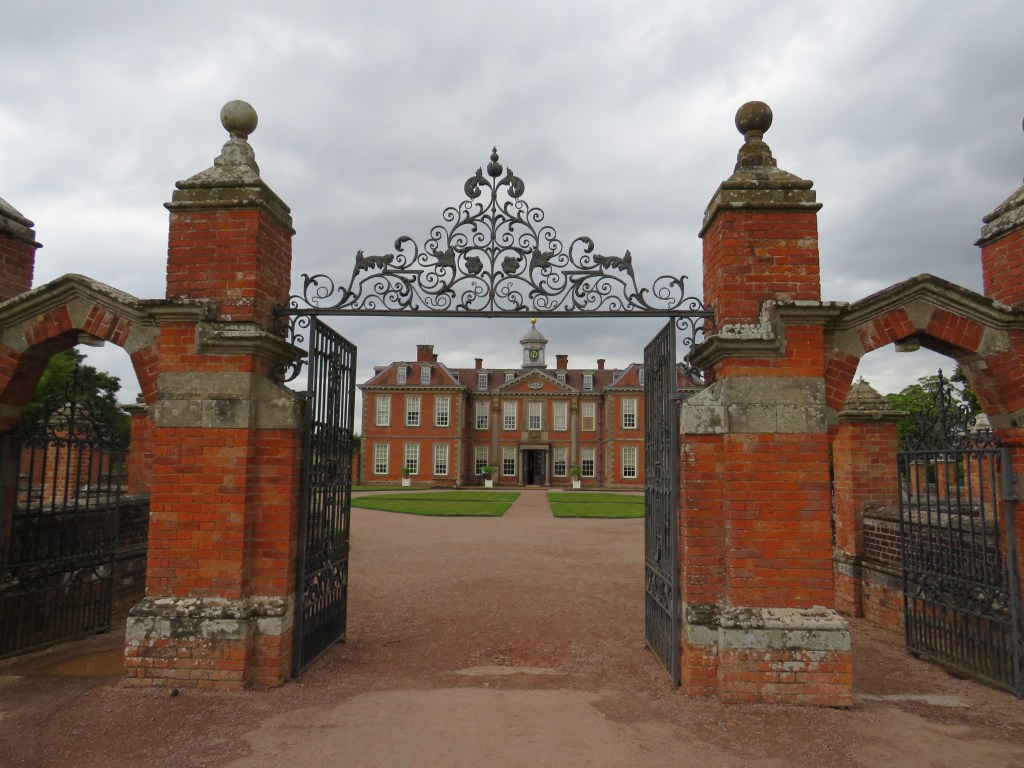
Kirby Hall is a ruin that was one of the first buildings to be acquired by the state for preservation, under the auspices of what is now known as English Heritage. It was built for Sir Humphrey Stafford in 1570; the architect was John Thorne. Five years later, Stafford was dead and four generations of Christopher Hattons went on to own the house. The first Christopher Hatton was a great favourite of Elizabeth I, allegedly first coming to her attention because of his dancing prowess. Yet, although he became her Chancellor, she never visited the Hall. What Hatton lost in prestige over this he probably made up for in the money that he saved by not having to host the Queen. James I, on the other hand, visited more than once. Christopher Hatton mark 3 was a great antiquarian and had the Hall remodelled, including the addition of a library. Inigo Jones provided plans and the appropriately named royal stonemason Nicholas Stone, was hired.

Ardently Royalist, Hatton fled to France during the Civil War and spend years trying to rebuild the family fortunes after the Restoration. His grandfather had been given land in London by Elizabeth I, which CH3 developed into Hatton Garden. Like his father, Christopher Hatton 4 was the governor of Guernsey and his wife and mother were killed when the gunpowder store at Castle Cornet blew up. Hatton himself was saved  by a black servant, John Chappell, who was left a pension of £20 a year in Hatton’s will. Between 1772 and 1831, most of the contents were sold, the owners ceased using the Hall and it was given over to estate workers. It gradually fell into disrepair.

Notable features were the bay windows and the gardens, which are believed to have been designed by George London, who name was familiar from my seventeenth century gardens talks. There were also the most enormous pears and apples I’ve ever seen in the garden, both the size of your average grapefruit.

I can report that we escaped via the ‘closed’ road and that zero work appeared to be happening, or to have happened. Disclaimer – I take no responsibility if I have confused the various Christopher Hattons.

The next day and it was a National Trust destination this time, in the shape of Lyveden Lodge. In Elizabethan times, the manor here was owned by Thomas Tresham. He was orphaned at a very young age and was brought up by and married into the Throckmorton family. Tresham was knighted by Elizabeth I but by 1580 had converted to Catholicism; thus just six years after his knighthood, Trensham was in prison for his beliefs. Trensham had his staff begin to build an impressive lodge for his guests, with plans to surround it with gardens and vistas; directing some of the proceedings from prison. The garden is held out to be one of England’s oldest garden landscapes. The lodge, manor and garden were full of Catholic symbols. Recusancy fines, a lavish lifestyle and having to provide dowries for six daughters meant that, when Trensham died in 1605, he owed the equivalent of a million pounds in today’s money. Realising that they wouldn’t be paid, the workers downed tools and the lodge was never finished. His son rebuilt the manor but abandoned the lodge. It was Thomas’ son, Francis Trensham, who became embroiled in the gunpowder plot. It is likely that it was Francis’ letter, warning his brother-in-law Mounteagle to stay away from Parliament, that led to the plot’s downfall. We planned to go to a garden after leaving Lyveden but it wasn’t open, so back to the van it was.

With a nod to my experimental archaeology course and our neolithic house-building experiences, our final visit was to Flag Fen. This is the site of a bronze age causeway, one kilometre in length, constructed when water levels were higher. The causeway was built from oaks, alder and ash, felled between 1280-920 BC. The uprights and platform required two million timbers. The causeway was in use for 1300 years and is thought to have had a religious significance as many objects found nearby appear to be offerings. There are also some prehistoric logboats being preserved on site. The staff were very informative and there were plenty of volunteers and conservationists on site. They have just been taking core samples and we were able to see wood that has been submerged since the bronze age. Having survived for thousands of years, the causeway is reaching the point where it is almost beyond further preservation due to changing conditions.

A Family History Weekend and a Missed Opportunity

The Malvern trip continued with Gloucester Family History Society’s open day at the Heritage Hub. It was lovely to be able to see people in real life and chat about family history. I listened to Simon from WeAre.xyz, talking about his software (quick resolution to do more with my site), then gave my A to Z talk. After that, it was out for a meal and a catch up with family history friends. This is the first of four in person family history weekends in four different counties this month. A bit like buses, you wait for ever, then they all come at once,

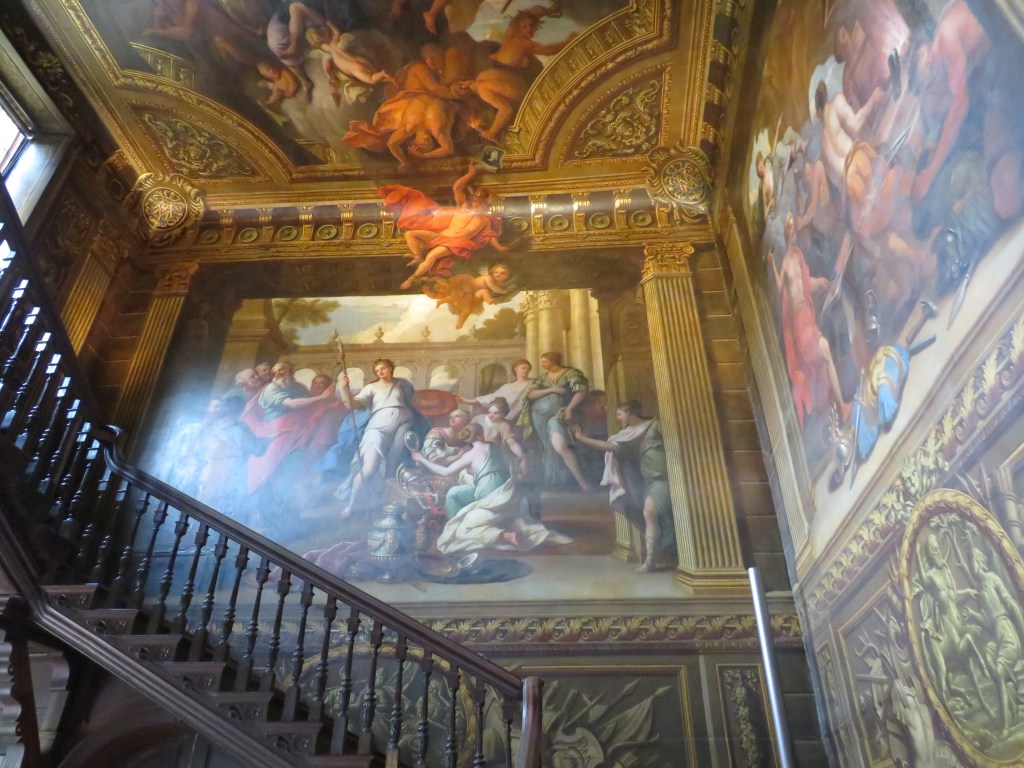
Sunday was rainy. I mean seriously rainy, so rather than  head off early, as we prefer to do, we sat it out, while I looked at the Withenbury family goodies I’d found at the Worcestershire archives. Note, I did not look back at earlier notes, a big mistake. The rain cleared up eventually, giving us just time to visit Hanbury Hall, a nearish by National Trust property and former home of the Vernon family. The most outstanding features are the wall and ceiling paintings by James Thornhill, which, unusually, were painted on dry, not wet, plaster. There are also traditional, knot-garden style gardens, with plenty of topiary, which I photographed for use in my seventeenth century gardens talk. I was also quite taken with a 1715 election ‘poster’, when Thomas Vernon was standing for the Whig cause. This, I thought was about all Hanbury Hall had to offer, how wrong I was.

We returned home. This involved me driving through storm and tempest, with torrential rain meaning that I could barely see the road. Fortunately that was just the last couple of miles, as I am chauffeured most of the way. I then continued to look at the Withenburys. Something I had noted before, when I was trying to prove that they are actually my ancestors, rather than probably my ancestors, was that a James Withenbury was an architect and sculptor. This chap is likely to be my 6x great grandfather’s brother, or maybe a half-brother. ‘That close’, I hear you cry. He is at least on the family tree of the ‘almost my ancestors’. He also, said my notes, which I was viewing from 150 miles away from Hanbury Hall, designed the frontage of the hall in 1718. It is likely that I walked past his architectural sketch while we were at the Hall! Another trip is on the cards.

An Excursion to the Malvern Hills

Today I am due to speak at an event in Gloucester. ‘Let’s go up a few days early’, we said, well I said, thinking that I could sneak a day at not too distant Worcester Archives and pick up some wills. First, I gave a talk to legacy webinars about marginalised ancestors, which you can listen to here if you are so inclined, no charge until 10 September. It was lovely to catch up with the lovely Fiona Brooker from New Zealand, who was my host, as I was part of the early, down-under shift. Then, in theory, we were off.

So leaving early entailed not leaving quite as early as we had intended, as the caravan-towing car randomly failed to start. By the time the recovery people had got it to go, it had been ‘diagnosed’ by the local garage and had been pronounced fit to travel, it was too late for us to reach our final destination in the Malvern Hills before curfew. The very helpful caravan site staff organised an overnight stop in Cheddar for us instead. Next day, when I was supposed to be at ‘The Hive’ in Worcester, we travelled on to Malvern. There was time for a visit to Witley Court in the afternoon. It turns out we had been before, so I won’t repeat the history but you can read about it here. Yesterday, we headed for The Hive. Unlike other archives that have morphed into community spaces, this one does still allow plenty of opportunities for researchers. It is an interesting building that reflects its name and the staff were super helpful. I’d done my best to do my homework before arriving and this mostly paid off.

I had a long list of wills and was directed to a microfilm machine where I could copy images directly to a memory stick. Someone or other’s law dictated that every image I sought was at the end of the film. Unfortunately, the rewind feature on the machine was faulty and many minutes were spent rewinding films by hand. As the archive is part of the library, research was accompanied by enthusiastic renditions of Grand Old Duke of York and Heads, Shoulders, Knees and Toes by a toddler group. I acquired several interesting inventories for ‘probably my ancestors’ but no earth-shattering revelations to convert them into actually my ancestors, not that I was expecting any. It turns out that I no longer have the stamina for all day visits to archives and much remains on the to do list.

The Last of the Cornish Saga

Posting these accounts from the comfort of home always makes holidays seem like such a brief interlude but I didn’t want you to think that I was still stuck in the midst of Cornwall.

Day 7 Round and About

Initially, we thought we’d go to Marazion Nature Reserve but on the way, remembered that this was somewhere we’d been before, so we had a change of plan and headed to Trengwainton, which turned out to be closed. Never fear, we thought, we’d go on to Carn Euny Iron Age Village, open at all times. We followed the signs, we drove for a mile up a single track no through road. We were in the right place but the car park was full. Annoyingly, inconsiderate parking, meant that fewer cars could park than the space warranted. It looked like most of those parked were locals rather than visitors. It also made it extremely difficult to turn round but after a several point turn we escaped. At this point, we decided that we would chalk the day up as ‘a nice ride round the far south west’ and we headed back to the site.

So we weren’t sat down all day, we went for a walk from the site. Still mapless, we had to be careful not to get lost. We followed what was signposted as a footpath. I don’t think anyone had walked part of this for some considerable time as it involved battling through stinging nettles. Bit of a shame I’d decided to put shorts on. We passed a lavender farm and went downhill until the path turned into a steam. A series of well-spread-out stepping stones reached into the distance. We watched a man and two teenaged boys leap agilely from stone to stone. We asked where the path led to. It seemed nowhere much, at least not for a couple of miles. We decided our leaping days were over and retraced our steps.

Day 8 Windmill Farm Nature Reserve

The nature reserve of choice was one nearby at Windmill Farm. It turns out that it was nearer by than the sat-nav would have us believe and we had to give up and use Google maps instead. We headed off across a field of cows, having carefully read the instructions to chat to said cows so they knew we were on our way. The trouble with cow fields that are usually muddy but have been baked dry for a fortnight, is that they are full of potential ankle twisting ruts.

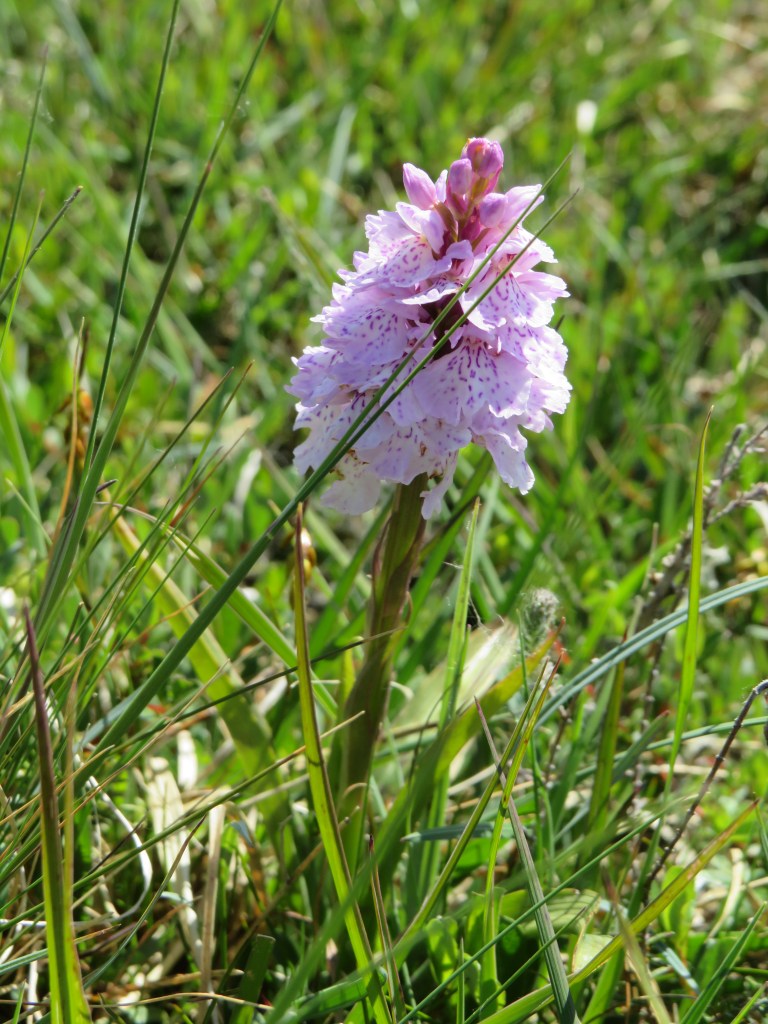
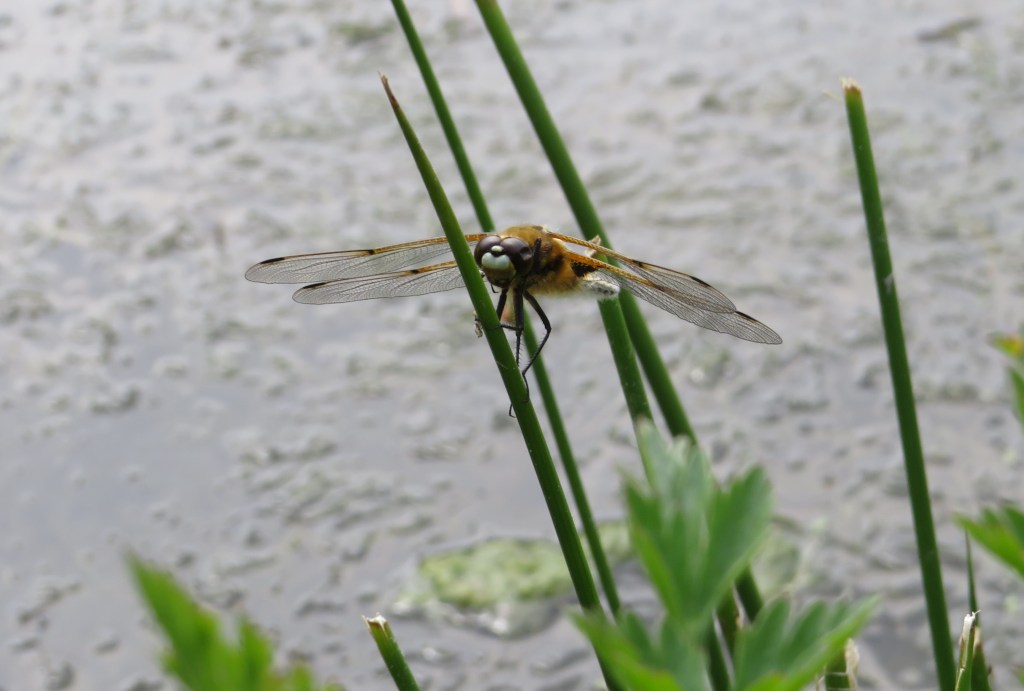
In theory, there was a way-marked route but we somehow missed this and ended up in a field of fennel. Retracing our steps across the cow field we reconnected with the white painted posts that marked our way. Inevitably, there wasn’t much fauna but a variety of flora was a little more in evidence, including heath spotted orchids. We finally came across a couple of drying out ponds, one at least of which looked newly dug. There were dragonflies but little else.

Next, the windmill from which the reserve takes its name. Originally called Lizard Windmill, it is referred to in a document of 1695, although has probably been rebuilt since then. It no longer has sails and ceased working in the 1840s. In the nineteenth century, the notorious Windmill Gang of footpads and sheep rustlers were active in the area. Two members were drowned when trying to escape pursuit.

It is possible to climb to the top of the windmill. My height-hating brain surveyed the see-through metal spiral steps with caution. There might be a good view from the top, thinks I, having read that the windmill was used as vantage point by Home Guard in the Second World War and became part of the RAF base at neighbouring Predannack Airfield. I began to climb. This, dear reader, was a mistake and previous experience with similar scenarios should have been enough to warn me that I would find this terrifying. Locals believe that the windmill is haunted. I often sense when this is the case but in summary, my opinion was – scary staircase yes, haunted no.

Day 9 Monday Minack Theatre

This was the day when we were booked to see Seth Lakeman at the Minack Theatre. I’ll be honest, this was a second best when we failed to get Fisherman’s Friends tickets for the first time in several years. As the campsite is thirty miles from the Minack, I was a little disconcerted when my travelling companion’s remark as we went to leave was, ‘where did I put the car keys?’. Keys located and we were on our way. We were slightly early, what’s new, for the stated ‘car park opens’ time but being a matinee, were let in. We sat in the sun eating ice cream and were within the first fifty or so (of five hundred) in the queue. This is the point at which I panic. Normally, I would have back-up printed tickets but by the time they were emailed, we were in a field miles from any printer. Will my fully charged phone somehow fail to display said tickets when required? Will the back-up fully charged battery pack similarly suddenly be empty? Will I not be able to get a phone signal? None of these unlikely eventualities occurred, although the staff’s scanning machines were being temperamental. We, along with most, people had zone A tickets. As we got to the front of the queue, I was asked to make a snap decision. Did we want to sit on the stone tiered seating, or on a chair directly in front of the stage? Errr, no brainer. Weirdly, some people were opting for stone seats.

The concert was excellent with some virtuoso musicianship from Seth and the other two-thirds of his trio, who had sixteen different instruments between them. There was even a guest appearance from Seth’s father, Geoff, showing just how to play the spoons. All in all we were well pleased with our ‘second best’ choice.

Access to the Minack is ‘interesting’. You don’t want to be trying to head towards the theatre as a show has just ended. Unfortunately, as we and many others wended our way down the single track road both a coach and a tractor were rashly attempting to make their way up the hill. Couple this with a high percentage of drivers who are used to motorway driving, rather than west-country roads and there was somewhat of an impasse for quite a while.

Day 10 A Day of Two Gardens

As it was only half a mile away, we decided we should visit Bonython Gardens. We often stick to places we can get in ‘free’ with my array of life memberships (National Trust, English Heritage, RSPB and RHS) but this was billed as ‘a great garden of Cornwall’, so it seemed like a good investment. This proved to be the case. With the help of two gardeners, the owners have crafted a beautiful landscape, including a walled garden, lakes and a fascinating yew chapel. There was a laid-back refreshment system, where you helped yourself and put the money in an honesty box. The orange cake and fruit cake both got a mark of approval. On the subject of honesty, I also purchased some honesty plants, which have been on my wanted list for a while.

The afternoon was reserved for meeting up with friends of long-standing and we had a lovely wander through the National Trust gardens at Trelissick, reminiscing and catching-up on the last twenty years or so of our lives. As my age advances, far too rapidly, I am on a mission to see in person, as many friends as I can, particularly those who I’ve exchanged Christmas cards with for the last fifty years but rarely see, so I am looking forward to more reunions such as this.

More Meandering

Day 4

Another day and yet another short drive, this time to Helford, as we remembered that as being an attractive section of the coastal footpath. After a bit of a diversion down to the river ferry terminal we headed round to the tiny St. Francis’ Chapel, where St. F’s main animal of choice seems to be a German Shepherd. Then on along the path towards Frenchman’s Creek of Du Maurier fame. We got to the point where we were overlooking the creek and decided that it was quite a long way down, which would, of course, mean quite a long way back up, so we turned round and retraced our steps.

Day 5

The short walk of choice today was round Goonhilly Nature Reserve. We have come to learn what to expect from nature reserves and Goonhilly lived up to expectations – an almost total absence of wildlife. We did hear a cuckoo but not a great deal else. Here we were close to the tracking station, which sits incongruously against the Cornish landscape and occasional menhir. We may also have deviated from the waymarked route a tad. This involved climbing over gates, which fortunately held our weight and did not mean we ended up in a field with a bull. We also had a choice between being up to our ankles in water, or up to our ankles in mud. This despite it being the driest spring on record. We opted for mud. The advantage of this walk was that it was relatively flat and underlined the fact that it is hills that I have issues with, rather than walking itself. Still, we think ourselves lucky that we can walk as much as we can, as we approach our eighth and nineth decades.

We went on to Cadgwith so that the fisherman of my acquaintance could get a fishing boat fix. This also involved passing some free-range geese and observing two delivery lorries trying to escape and turn on the extremely narrow road, which, in addition, was partly blocked by a scaffolders’ lorry. We didn’t stay to see the resolution of this. From the look of the way things were going, despite some seriously skilled reversing up very narrow alleys, they may still be there.

We were visited by the site’s friendly collie, who came into the van calling for Chris. Balls were thrown and the neighbouring horses chatted to.

Day 6 Penrose and Poldu Cove

We drove to Penrose, a National Trust estate that we hadn’t visited before. This was a pleasant walk that took us to where we could overlook Loe Lake, the largest freshwater lake in the county. There was a very acceptable café where we availed ourselves of ice cream. The walled garden, designed by John Rogers when he inherited Penrose in 1772, is being restored by volunteers. We then decided to drive down to Mullion; another day another cove. We stopped off at Poldhu, a cove we remembered from our walking round the coastal footpath days. Mullion, despite the sat-nav, proved elusive, so we decided to leave that for another time.

Mostly about Mull

You will be relieved to hear that this is the end of the Scottish jaunt. It seems like a lifetime ago! Firstly our trip to Mull.

We are pretty keen on islands and this trip will tick two more off the list. The first concern of the day is, will we find anywhere to park, ideally somewhere free. We had identified a possibility yesterday and do manage to locate a spot a shortish walk from the ferry terminal. The next stress inducing issue is that we have had our coach tickets for some time and I have printed these out at home but the ferry tickets, which I need to produce on four occasions, have only just arrived by email so rely on me having a workable phone. Too late, I realise that I could have forwarded this to my companion, so that we had access in two places. It isn’t even just an email, you have to open the email and then download something. This I can accomplish but my phone has days when it decides that the battery life is about five minutes. I spot a USB charging point in the terminal but for some reason this doesn’t work.

First ferry boarded and on the most beautiful, sunny, calm day we sit outside on the ferry to Craignure on Mull. The crew wear hard hats but none of these are fastened, surely that renders them next to useless? One of the deck hands serenades us with Mull of Kintyre. He really should stick to the day job.

We board a double decker bus, securing upstairs seat and with Andrew as our driver, set off for a thirty seven mile drive along a single track road to Fionnphort. It is an enjoyable drive with plenty of information supplied by Andrew, as well as comments on the inadequacy of the driving of other road users. This is the new road, built between the 1960s and the 1980s and halved the previous journey time. There is plenty of reversing and pulling in to passing places. Some of the other drivers appear to be in vehicles that don’t have reverse gears.

Mull’s population is about 3,000, with 200 on Iona. We spot one of the 8,000 deer on the island; there are also fallow deer. We see evidence of the mussel fishery, a seaweed farm and a forestry industry. Travelling in the coach proves hazardous and I manage to bang my head three times and whack my upper arm into the half raised arm rest.

We leave the bus to take the ferry to Iona. A notice tells us to turn our phones off. a) Why? And b) How is that going to work when our tickets are on our phones then? I have tried charging my phone on the bus, that charging point didn’t seem to work either. So far I am two ferries down with more than half my battery left.

After a short trip we alight on Iona and the first stop is the nunnery, founded in 1200. There is allegedly a carving of a naked women over the window of the refectory that was intended as protection from evil but we don’t spot it. Next, St Ronan’s Chapel, which was built about 1200, although there is evidence of an earlier chapel, dating from c.700. Interestingly, all the skeletons that have been found in this area are female.

Unfortunately, the heritage centre is not open but we probably wouldn’t have had time to explore it. We are still able to find out about the island’s history as a centre of religion. Columba, accompanied by twelve monks, arrived on Iona in 563 and founded the monastery, which would have been a timber construction. An account of Columba’s life, written by Adomnan, Iona’s abbot in the 690s, provides details of the early years of the monastery. It became a Benedictine foundation in 1200, which survived until the Reformation. What we see today is a reconstruction of the abbey as it would have been under the Benedictines. This was accomplished by the Iona Cathedral Trust in the early twentieth century and funded by the Duke and Duchess of Argyll.

Iona was famous for its scriptorium, where monks produced beautifully  illustrated religious manuscripts, including the Book of Kells, created about 800, which we saw in Ireland last year. Remnants of a path, dating from 700, survive. This ‘street of the dead’ was used as a processional route, passing the monastery’s holy places and leading to the shrine of St Columba. Crosses were erected on the route to mark places for contemplation. Viking raiders plundered the abbey from 795. In 806, sixty eight monks were killed. This led Abbot Cellach to take the monastery’s treasures and most of the monks to Kells in Ireland. Some monks remained on Iona. There were strong sea links between Iona and other religious houses in Scotland and Ireland. Viking raids continued for two centuries. In 825, Abbot Blathmac was killed when he refused to give raiders the jewelled casket containing St Columba’s bones. The abbot and fifteen monks were killed on the beach on 25 December 986.

The museum on site of the abbey contains many ancient carvings dating from the early 600s onwards, including huge crosses and tomb tops. In Medieval times many  of those from high society were brought here for burial. The twelfth century St Oran’s Chapel is the burial places of The MacDonalds. The site is home to St John’s Cross, thought to be the first Celtic Cross of its type.

We partake of lunch at the St. Columba Hotel, a little upmarket for us. We decide that we should have something regional, so Cullen skink for my companion and haggis, goat’s cheese and onion marmalade quiche for me. I wouldn’t normally eat haggis but the other options didn’t appeal. We sat outside and observed a cucumber eating dog on the next table. The owner had ordered a whole cucumber that he cut up and gave to the dog as treats.

The return journey passes without incident and we opt to stay  inside on the ferry to Oban as the temperature had dropped. We exited the ferry terminal in a different place, leaving us with a route march back to the car. It has been a lovely, if long day and we couldn’t have hoped for better weather.

The next day, the weather had turned grey but an improvement on what those further down south were experiencing, where there are severe floods. We picked a Scottish National Trust property that isn’t too far away and go to Arduaine Gardens. The coastal garden was created by James Arthur and Ethyl Campbell, who purchased the land in 1897. The garden suffered severe storm damage a couple of years ago, with many trees being blown down, so there is much restoration underway. There are some lovely views of the coast, although the visibility isn’t great. We don’t fancy the cake on offer in the neighbouring hotel, so it is back to the van via Lidl’s, who sadly, don’t have any tiramasu muffins this time. The afternoon is spent enjoying the sea views from the van and tomorrow we begin to wend our way home.

Moving Westward

This was a day when it was ten degrees cooler than the previous day, much more in line with expected temperatures and we headed north to Banff, on the Moray Firth in search of fishing boats for my travelling companion. The harbour took 150 years to build. It was started in 1625 but it was not until engineer John Smeaton was appointed that it was completed in 1775. The harbour’s difficulties with silting were first recorded in 1608 and continue today. The outer north pier, built in 1818, was designed by Thomas Telford. In Medieval times, Banff was a centre for  coastal trade, exporting salmon, wool and fleeces and importing timber, coal and salt. It was also a notorious area for smuggling.

A few miles up the coast is Portsoy, much more of a traditional fishing harbour compared to Banff, where many of the vessels were pleasure yachts. The original harbour was built in 1693. Some of the warehouses along the quay date from a similar time. A ‘new’ harbour was built in the 1820s to accommodate the then flourishing herring fleet. It was damaged in 1839 and eventually refurbished in the 1880s. There is a ‘Salmon Bothy’ and museum but they were not open, so we were unable to investigate further.

Four ancestral churches remained on the list. We located the first, failed to find two and abandoned the last. Our search did take us along more routes that no self-respecting tourist usually touches. I don’t have maps for this part of the journey, so we were relying on the satnav. When church hunting, I usually ask for the ‘city centre’, which is often laughable in itself, as some settlements are definitely of the blink and you’ll miss it variety. This tactic does however, usually take you fairly near the historic church, at least it works in England; Scotland not so much. For some reason this doesn’t work at all when I put in Aberlour, no ‘city centre’ option. I’m not daft , I look through the streets for something like ‘Church Street’, nope. What I should have done is gone for High Street. Did I take this sensible option? I did not, I merely punched in any old road. I use the word ‘road’ advisedly. We found ourselves up a very long winding track in the forest above Aberlour before I realised that this really wasn’t going to work. We did manage to find the town but not the church.

The following day, setting off in mist, we reversed the route we travelled home on on the previous day, driving alongside the River Spey. Here we have the archetypal Scottish scenery, pine forests, lochs and mountains with rowan trees sporting their bright berries, suggesting that we may be in for a hard winter. There was a bit of a hold up in Fort William due to the volume of traffic but the mist had lifted, leaving just a haze, meaning we could actually see the top of Ben Nevis, something that had been hidden on previous visits.

The satnav let us down at the end of the journey, meaning we had to ‘turn around where possible’, which ended up being turning around where it wasn’t actually possible with a caravan on the back. This was the second time we’d been to this site and for the second time we were given a premium pitch, with uninterrupted sea views, at least as long as we looked to the right. The only downside was the lack of onsite wifi.

The sun was now glorious and we sat outside for lunch, enjoying the view. We had an early start the next day and unusually on this holiday, had to be at a certain place at a certain time, so we drove into Oban to recee the ferry terminal and parking opportunities ready for the morrow. We watched the beautiful sunset from the van, although it wasn’t a patch on sunsets at home.

Crannogs, Longhouses and other Scottish Things

Time to move sites again and head north-westward into the Trossachs for a few days in Killin. The weather began fine but in typical Scottish fashion, rapidly turned to rain, nonetheless it was a pleasant drive with lovely views. We wanted to arrive at Killin promptly when it opened for new arrivals at 1pm because we planned to visit Moirlanich Longhouse, which is close to the site and which has very restricted opening hours.

We’d passed the longhouse several times on previous visits but had never been able to go inside before. It is in the care of the Scottish National Trust, so we were able to take advantage of the reciprocal arrangements with the English version. The house is a great illustration of how people would have lived in the past. This particular house was built in 1809 for tenant farmers. It is a cruck-framed house, built in a style that had probably been used for centuries. This was the time when many labourers were turned off the land and moved away but the Robertson family were granted the tenancy of Moirlanich and farmed the surrounding thirty acres, trying cattle, then sheep, before changes to growing oats. The once thatched roof was covered with corrugated tin in the 1930s.  The last member of the family left in 1968 and the house remained empty until 1992, when the trust took over.

Various items were found in the house, including ragged and probably discarded clothing, which appeared to have been used to insulate the chimney. There were multiple layers of paper on the walls. Considering there were only three rooms, plus the byre at the end, it is strange that one room was largely reserved for ‘best’, such as entertaining the minister. The room did contained two box beds that were in regular use.

The next day was beautifully sunny, just right for a drive along several miles of the banks of Loch Tay towards Aberfeldy, in the centre of Scotland. We were paying a return visit to the Crannog Centre, or in this case the Crannogless Centre. We visited the earlier version of this Iron Age living history experience on a previous trip to Scotland but a couple of years ago, a fire destroyed the crannog. A crannog is a dwelling that was constructed on stilts over the water and evidence of nearly six hundred have been found across Scotland, which is probably only a tiny fraction of the number that would have been built. Several of these were on the edge of Loch Tay. Building across water is much more difficult than building on land and was done to reserve the land for food production and possibly also as a sign of status and method of protection.

Following the fire and some serious fund raising, the centre moved to its current site, which they were able to purchase for just £1. They reopened in April and have built several roundhouses using different techniques. Erecting the crannog will be a more complex task and building was due to begin the day after our visit. We arrived just in time for a tour and John showed us the museum exhibits, as well as giving us some background history.

Our first presentation was about Iron Age food. Archaeological finds provide evidence of the ingredients but how they were used is largely speculation. We were treated to flat breads made from the ancient cereals, emma and spelt. These were topped with garlic and honey cheese and optional trout. I passed on the added trout but it was very tasty. Emma no longer grows in Scotland, as the climatic conditions have changed since the Iron Age. We saw a saddle quern and it was explained how arduous and time consuming grinding flour would have been.

Next was the blacksmithy and then the woodworking presentation, some of the turning on the pole lathe was highly skilled. The textile demonstration was particularly interesting, with information about dyes, weaving and spinning. I hadn’t realised that woad required soaking in warm urine for a couple of weeks before it was an effective dye. Who first realised that this was the thing to do? It takes 7,000 metres of spun wool to weave a long sleeved tunic. Lastly, we went in the final round house, which had a basket-like woven framework, covered by stone walls and thatch on the roof. Despite the sun, it was still a little chilly and the restaurant was full with a party so we had our carrot cake and drink outside, where it was perhaps a few degrees colder than ideal. Overall, it was a fascinating trip and highly recommended.

Mostly about Wildlife

It was not a great night for our patient but once up there were signs of improvement. Light exercise is recommended and he was keen to embark on another drive. We had left behind the dramatic Northumbrian landscape but the countryside and far reaching views were beautiful nonetheless. This area seems more suitable to arable faming, with heavy red soil and red stone houses. This week seemed to have been designated as harvesting week and there were many tractors.

The church tour of the day met with some success and took us to places other holidays don’t reach. We ended up on the coast at St Abbs. The EbbCarrs Café provided us with a kipper roll and Biscoff cheesecake. Definitely a recommended location and the bonus of fishing boats for the convalescent to look at.

Then it was time to move on again, this time to Balbirnie Park at Glenrothes. We have left behind the area of my own ancestors and potential ancestors and are now moving through territory known to the ancestors of my children and grandchildren. Some traffic hold-ups on the Edinburgh by-pass but otherwise an uneventful journey. We were now on a wifi hotspot only site but the warden kindly allowed us on a pitch where you could get wifi in the van but which is normally reserved for the staff. This meant I could do some essential work while I was there.

So that we didn’t waste the day, we went for a short walk at Loch Leven RSPB reserve in the afternoon. In the 1830s the loch water was harnessed for use in linen bleaching and in the corn, wool and paper mills. This resulted in the loch’s water level dropping, adversely impacting the wetland habitat. Recent management and restoration has provided homes for a variety of wildlife. About a thousand pink-footed geese had just arrived. More will follow, as usually fifteen thousand over-winter there. I also spotted some green-winged teal. The reserve is the site of the country’s first bee reserve but we saw no bees.

Allegedly the weather was supposed to have improved. True, the bitter wind had gone but so had the sun. We decided to visit the nearby Scottish Deer Centre. Currently, this attraction is waving its admission prices in lieu of donations because of refurbishments but we felt it was fair to pay the normal admission price and it was certainly worth it. As the name suggests, there were deer, lots of deer of different types, some of whom you could feed. We walked round by ourselves and then again under the guidance of Owen, who provided us with deer facts, which I will pass on.

Unlike horns, antlers are pure bone and are surprisingly heavy. Reindeer are the only female deer to have horns and as males shed their horns in winter Santa’s reindeer, at least in the northern hemisphere, are all female. There’s also some weird thing about reindeer being able to ensure that the frozen blood supply below their knees doesn’t reach the rest of their bodies in severe weather. In the wild, reindeer form super herds of up to half a million. As it can be hard to see each other in the snow, the use their UV vision to follow urine trails. Fallow deer, the pretty spotty bambi-like ones, are not native but were introduced by the Romans as a food source. Though, as we discovered at Belton, not all fallow deer are dappled. Sika deer, brought from Japan by the Victorians, are an invasive species as they interbreed with native red deer, making it difficult to ensure the continuance of true red deer. Elk, aka moose, like to swim and are predated on by whales. Pere David deer became extinct in their native China but are now part of a successful captive breeding programme.

Our presence normally makes any self-respecting wildlife, including those in captivity, dive for cover but we were luckier than usual this time. Apart from the deer, we saw other species including a wolf, a brown bear and a Scottish wild cat. I was particularly pleased to see the otters. The are clearly ethical issues surrounding keeping animals in captivity but on balance, anything that can encourage people to take an interest in wildlife is important and captive breeding programmes are essential to the survival of some of species kept here. 

We stayed to watch the birds of prey display. You’d think ‘seen one seen them all’ but this was particularly good, with the Eagle Owl landing on the table of the picnic bench where we were sitting. For those visiting with younger family members there was plenty provided in the way of play equipment, so highly recommended as a destination. I did manage to keep the senior member of my party off the zip wire this time.

and Back in Northumberland

This is now nearly a month ago but here is what happened next.

It was lovely and sunny but a with a bitingly cold wind as we revisited Great Bavington Presbyterian Chapel then a detour via Hallington and on to one of my favourite places in the world, Thockrington, subject of one of my One-Place Studies and home of the Hogg family who I am ‘that’ close to ‘inking in’ as my ancestors. I haven’t done so because I am super cautious and am hoping for just one more piece of supporting evidence that probably doesn’t exist. Next to Chollerton and then, a new destination for us, Simonburn. I am busy trying to reach many parishes that ‘probably’ have ancestral connections so that, by the time I decide they are definitely ‘mine’ (if I ever do), I am prepared with photographs and impressions of the area,

We stopped off at Wallington, a National Trust property that we’ve visited before, the former home of the Trevelyan family. This was just a brief visit to avail ourselves of the café and facilities.

We did have a quick look at the house, which the guide described as having a Cluedo board layout.  It was good to see that sensory bags were available. My favourite finds were a Meissen tea set depicting insects, a dolls’ house display and several photographs of the servants. Around the central courtyard, which now has a roof, are impressive murals depicting scenes from Northumbrian history, famous local people and flowers found in the area.  Given the artic wind (that refers to the weather not the state of our digestion) and my companion’s delicate state we gave the gardens a miss.

As said companion’s ailments didn’t seem to be improving it seemed prudent to seek medical advice, This was to be more complicated than you’d think. First stop at 10am the not so local pharmacy. He needs anti-biotics but they can’t prescribe, he’ll need to phone 111 or his own doctor. He opts for 111. ‘What is the postcode of where you are now?’ Errr no clue. The 111 person speaks to the pharmacist. Still no one is keen to do anything, they will ring back. Five hours later they haven’t, so he tries his own surgery, who will ring back. The signal is dodgy here so they text. They won’t prescribe without seeing him. We find details of the nearest surgery (twelve miles from where we are staying). We ring. He will have to go to the pharmacy. Oh wait, we’ve been there. Doctor’s receptionist expresses amazement that the pharmacy was no help. He will have to wait for a call from their doctor. We explain the lack of signal issues and reluctantly they agree we can come in and he can register as a temporary resident. We arrive at just after 3pm. We see just one other person in the waiting room the whole time we are there. We are told we will definitely have to wait until after 5pm, possibly until 6.30pm. We wait and wait some more in the now deserted waiting room. To be fair, perhaps the doctor was dealing with telephone appointments. At 4.45pm my ailing companion was summoned. Turns out he has pneumonia and the vital anti-biotics are issued. The patient insists that he doesn’t want to abandon our trip and to be honest, he is more likely to rest here than at home, so we will be taking it easy. [Progress report, once home a second dose of, stronger, antibiotics was prescribed and seem to be helping].

The next day, first some taking it easy for the patient this morning. We were due to move to another site just thirty miles away and couldn’t arrive before 1pm so an ideal opportunity to do not a lot before we moved on.

We arrived in Berwick on Tweed, overlooking the river. The patient decided he was up for a drive round. This was not a spectacular success as I usually head for a church but any kind of church was conspicuous by its absence. As we left Powburn, I had been informed that we had sufficient fuel for 250 miles. We got to the middle of nowhere, having travelled about fifty miles and it appeared that fuel was low, so finding a garage became a priority. Fortunately, one was located with the bonus of the cheapest diesel that we’d seen since we left home. We drove through Kelso and Jedburgh. The latter looked interesting but we didn’t have much time and in any case it probably wasn’t a good idea for the invalid to walk round in what was still a very cold wind. This time last year we were in Ireland where the temperature was over thirty degrees. Here there was frost forecast overnight.

We did manage to locate Oxnam Kirk, a low-lying seventeenth century building with an unusual T-shaped footprint. Outside is a miniature stell (circular, stone sheep enclosure), erected to remember the 2001 foot and mouth outbreak. The centre stone came from the farm with the greatest losses and twenty six surrounding coping stones represent all the local farms where a total of 4,732 cattle and 21,319 sheep were slaughtered. In this way, the epidemic was contained within the parish and did not spread to surrounding farms.

Back to the van via the supermarket for more convalescing.

Wallington