Another full day of lectures, although I miss the first one in order to prepare for my own. All in all I have attended all but two of the sessions on offer during the week. There have been some difficult choices, as for the most part, there have been two and sometimes three, streams of lectures. I begin the day with Helen Smith on ‘Begotten by Fornication’, an interesting look at illegitimacy. Then Jan Gow with ‘Remember the WWW. No, not the world wide web but the Who, Where and When’. It is over twenty years since I last heard Jan speak, when she was in the UK. This is really a talk about one-place studies so very interesting for me. I follow this with my session on the mental health of our ancestors, a talk I always enjoy presenting. A short break and then it is Pat Richley-Erickson aka Dear Myrtle with ‘Seven Habits of Highly Effective Genealogists’. I volunteer to represent one of the points although I am not sure I quite qualify as ‘highly effective’ as much of my information is still on index cards. Next, more DNA with Maurice again. This time his title is ‘Using Triangulation to Break Through Brick Walls’. The afternoon ends with my Facebook Generation talk, which was very well received and sparked many questions and comments.
An interesting incident in the toilets by the Windjammer. The doors to the cubicles open inwards and an injudiciously position toilet roll holder makes it quite difficult to exit, for even an average sized person. One of the cruise-goers has got herself in but is struggling to extricate herself. She attempts to sidle out facing the toilet roll holder. This fails, so she turns round and gives it a go facing the other way. I have to say she was a lovely lady and was laughing at her various ineffective attempts. We wonder if she will have to do a Winnie the Pooh and remain there until she is thinner but no, somehow she squeezes past the obstacles and is free.
 The evening sees the presentation of the prestigious Prince Michael of Kent Award to Cyndi Ingle for her decades of tireless work on Cyndi’s list. Mia has somehow managed to successfully bring this glass vase from the Society of Genealogists without mishap and there are a few tears as it is handed over. Very well deserved it is too, if you haven’t consulted Cyndi’s List then you can’t call yourself a family historian. Caroline Gurney follows with ‘Are you Related to Royalty?’. The answer is probably yes, so Maurice, who has been trading on his distant relationship to Princess Diana all week, now has to deal with competition from the rest of us.
 As we meet Will Harding, in the penultimate chapter of
  Icebergs prevent us from getting right up Tracy Arm but we still have beautiful views to admire. It is too chilly to sit outside for long so we spend the morning in the Windjammer again, as breakfast blends in to coffee and then into lunch. Great to relax and chat as the scenery and icebergs flash by. I later realise that I spectacularly failed to get any close up iceberg photos. I seem to keep missing out on this trip.
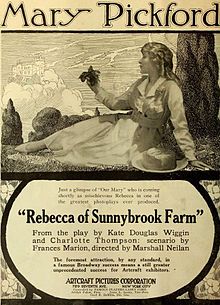 Mary Pickford finds her way on to the pages of chapter ten of

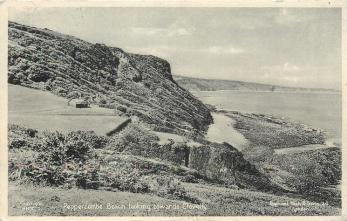 ‘Richard’ Wakely is one of the characters in
 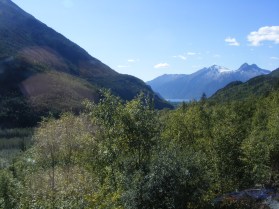 Our railway carriage, one of 83 in the fleet, is named Lake Klukshu. Skagway means ‘land of the north wind’ but we are fortunate that the weather is glorious, so we have great views of the White Pass and Yukon route. Following the discovery of what was actually very little gold, Captain William Moore, founder of Skagway, together with Skookum Jim, one of the two first nations people who found the initial gold, sought to establish a route to the Klondike that was easier than the existing Chilkoot Pass. Their route, past Lake Bennett, was named White Pass. A sensationalist newspaper headline about the discovery of gold, led tens of thousands of prospectors to take steamers up the inside passage and begin a hazardous 600 mile trek across country to the Klondike. No prospector was allowed to begin the journey without a ton of supplies. The slightly easier White Pass was favoured over the shorter Chilkoot Pass as it was, in theory, possible to take pack animals. Over 3000 horses or donkeys perished on the Pass before the railway on which we are travelling was constructed. They began building this narrow gauge railway in 1898 and reached the summit, 110 miles away in 1899. The route involves steep gradients and tight turns and construction was hampered by temperatures as low as minus 60. By the time the track heading north joined the track coming up from the south, in 1900, over 35,000 men had been employed in building the railroad at some point. The tracks ceased to carry ore after the price slumped in 1982 and the railroad became a tourist destination.
 Finally, we are able to dock and the sun is shining on the righteous and on us too. Juneau was a gold rush town, founded in 1880 and is now the state capital. We are invited to join a mad genealogists’ excursion to the Mendenhall Glacier in a hired mini-bus. The first challenge is to cram all twelve of us inside. This involves trying to avoid being garrotted by the seat belt that is strung across the doorway. It is a short drive to the glacier near Nugget Falls. Despite the name, virtually no gold was taken from here and in the early part of the twentieth century, money was made from hydro-electric power, before the area turned to tourism. We learn a little of the local Tlingit people. It is very peaceful here, despite it being a tourist honey pot. Sadly, climate change is taking its toll and the glacier is retreating at an alarming rate. We see some bald-headed eagles on our journey but not in a spot suitable for photographing.
 The History Interpreter - Janet Few