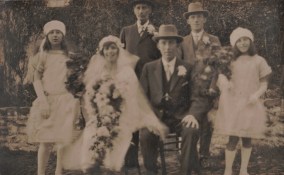
Violet’s Wedding to Walter Daniel
It might be hard to believe that I tried to cull my cast of thousands in Barefoot on the Cobbles but I did and Violet was one of the candidates. She remained in the novel’s pages for two reasons, firstly because to expunge her would have left an unnaturally large gap in Albert and Polly’s family. More importantly, I needed to use the true story of her illness to explain Polly’s reaction to her other children’s ill-health. My interest in the history of medicine meant that I enjoyed researching symptoms and the likely treatments of the time.
Violet was born on the 12 June 1903 in Clovelly. She suffered from rheumatic fever as a child and was never very strong. She married Walter Daniel in 1925 and lived firstly in Upper Clovelly and later in Bideford; the couple had no children but her brother, Bertie, lived with the Daniels after the death of his parents. Violet died in 1977.
‘The next days were a frenzy of fear, as Violet lay, feverish and lethargic, in the bed that she shared with Daisy. Daisy squeezed in with the boys, so that Violet was undisturbed but still the little girl whimpered and moaned. Reluctantly, they sent for Dr Ackland, whose solemnity betrayed the seriousness of Violet’s condition.’
Barefoot on the Cobbles will be published on 17 November 2018. More information about the novel can be found here. Copies will be available at various events in the weeks following the launch or can be pre-ordered from Blue Poppy Publishing or the author.
 In
In 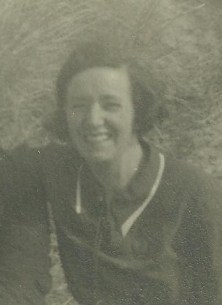 When her step grandfather died, Annie was sent to Clovelly to help her maternal grandmother, Mary Ann Smale, in her Clovelly tea-rooms. It is here that we and Leonard, first meet her. I don’t want to give away too much of her story but she did marry and brought up her family in Bideford. She died there at the age of 97.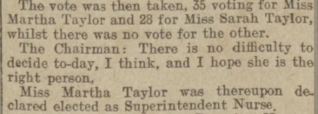
 Despite many of the main characters being Methodists, Clovelly Church appears in several key scenes in
  George Frederick Lefroy appears in the court scenes at the beginning and end of
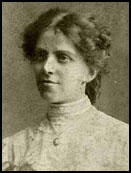 Jessie Kenny was one of three suffragettes who played a key role in an incident that is described in Chapter 5 of
  Our changeover goes without a hitch this time and our luck is in as we have an empty seat beside us. Once again I am struck that aeroplane food involves a ridiculous amount of plastic packaging. Airlines seem to be missing a green credentials USP here. I fail to achieve more than level 6 on Bejewelled; so my level 12 on the journey out must have been exceptional. I am slightly concerned to find water dripping on my head. Is this something I should be panicking about? Is something leaking from the luggage compartment overhead, or is it more sinister? Whatever it is does not seem to have dire consequences and we disembark from our fifteenth flight in the last six months, thankful that there are no more planned.
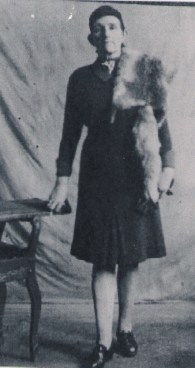 Eadie is another character who had to undergo a name change to avoid confusion. She appears in only three chapters, near the beginning of
  The History Interpreter - Janet Few