Occupational Hazards – Levant Mine

I always encourage my family history students to investigate the working lives of their ancestors and Levant Mine is a ‘must see’ for those with mining ancestors. My own Cornish ancestors worked on the land, rather than under it but it was fascinating nonetheless. Today was a great opportunity to learn more about Cornwall’s industrial heritage.

We arrived at the mine just in time for a guided tour by the indefatigable Richard and boy did he know his stuff. If you plan on visiting the mines, do try to coincide with a guided tour. Tours like this enhance a visit, as there is only so much you can learn from guide books and interpretation boards. Richard talked to us about the mine’s history, without the aid of notes, for two hours. No one dropped out of the tour, not even the two year old or the dog. We gained a real insight into the working lives of the miners. Any errors in what follows are mine and not Richard’s.

There are 1000 mine shafts and hundreds of miles of tunnels on the ‘tin coast’ in the far south-west of Cornwall and commercial mining, notably of copper and tin, has been going on here for 2000 years. There are several Zawns (wave-cut clefts) in close proximity and these might have revealed surface ore that encouraged the early miners. Written records of mining in this area date back to 300BC. The first documentary evidence of speculative mining at Levant is a map of 1748. This mining was by tunnel, rather than shaft and the tunnels were upward sloping, to allow water to drain out and also so gravity would aid the carts loaded with ore. The ore was then taken up to the dressing floor by horse whim. In the eighteenth and early nineteenth centuries there were several small-scale copper mining ventures in the area but in 1820, twenty investors got together to fund the sinking of the first shaft. Their collective initial investment was £400. The shaft was quickly profitable and further shafts were sunk. As they went deeper, water became a problem and a series of increasingly large, steam-powered pumps were purchased over the ensuing years. By 1836 they were not only pumping water but also raising ore by engine.

In 1840 they purchased a beam engine from Harvey’s, the famous foundry in nearby Hayle. This engine remains in situ and running; the oldest engine to be in working order and still at its original site. In the early 1850s a depression resulted in the mass emigration of Cornish miners to hard-rock mining areas throughout the world. They took Cornish customs and the iconic Cornish mine architecture with them to places such as Mexico, South Africa and Moonta in South Australia.

There was some economic recovery in the late 1850s and in 1857, a man engine was installed. This was a hugely significant innovation as no longer did men have to climb 1200 feet of ladders at the beginning and end of the shift. With the engine, they descended in 12 foot increments, in time with the engine’s piston. In this way they made the descent in 130 stages and it took 26 minutes. The structure also allowed the out-going shift to come to the surface and the in-coming shift to descend simultaneously. Previously, there was only space for a single ladder, so it was not possible for miners to be going up and down at the same time.

The mine closed briefly in 1870 as removing water and digging through granite to follow the lodes was becoming prohibitively expensive but new investors were found and it re-opened. This decade saw an increasing use of steam engines and by 1880, pneumatic rock drills were use. These were huge and required several operators. They also created a great deal of dust, that led to lung complaints amongst the miners. Pit ponies were also used. They spent eighteen months continually underground before being retired to the surface, rehabilitated and sold.

In 1919 the man engine collapsed and thirty one miners were killed. This was followed by the bottom dropping out of the tin market. Treasury loans were taken out but they could not repay them and the mine closed in 1930. The workings were in use in the 1960s, as an extension of nearby Geevor mine but this too closed in 1990 and the shafts were allowed to flood.

Conditions underground were harsh, with 30 degree temperatures and debilitating levels of humidity. Add to this the smoke from the tallow candles, which were the only form of lighting and the dust and it is no wonder that the health of the miners was compromised and life expectancy was about forty. Surface work was undertaken by the bal maidens who worked the rock to extract the pure ore. Ragging, spalling, cobbing and bucking gradually reduced the rock in size and finally it was buddled to leave crushed ore. This had to be graded, or jigged, using a pumping action to force water through the ore. Copper smelting took place in Swansea, to save the cost of importing the coal. Tin however was governed by the ancient stannary laws and had to be smelted in Cornwall, so was taken to Penzance.

024 6 July 2019 Levant Mine

The noise of the mechanical tin stamps must have been overpowering. After the tin was buddle, a calciner was used to drive off the impurities, largely arsenic and sulphur. The smoke from the calciners would drift over local villages with resulting ill-effects on health. It was discovered that arsenic was a useful ingredient in insecticides that were used to combat the cotton bol-weevil. This meant that the arsenic was now a valuable by-product. There was an awareness that arsenic could be absorbed through the skin so exposed areas were coated with a thick, white clay paste to combat this. Working with arsenic also caused infertility and allegedly, men volunteered to work with arsenic as a method of family planning.

Richard is going to take us down a tunnel. This is slightly scary but we are up for (almost) anything. It is suggested that we remove our sunglasses as visibility is poor. I have recently acquired glasses that are also sunglasses for the first time. I am proudly wearing them. Great, so now I have the choice between not being able to see because I am wearing sunglasses and not being able to see because I have taken them off. I go for keeping them on. We wander down the tunnel and it certainly is quite dark. Then Richard realises that the lights aren’t working, so all we have is the emergency lighting. He fiddles with the fuse box a bit. We have already walked down the tunnel. I am wondering how we will get back if all his fiddling somehow extinguishes the emergency lighting as well. Never fear, a few messages on his radio and full lighting is restored. The trip ends with a visit to the engine room where we can see the 1840 engine in action, aided by Ron and Tim. Despite all this engagement with mining heritage, there is no sign of Aiden Turner.

I had originally planned to move on to Hayle but decided to go to Trengwaniton Gardens instead. We find this with no trouble but I had failed to check that the opening times would allow for this rearranged itinerary. They don’t. We may or may not return tomorrow. So it is back to the van for more relaxing, more fish and chips (fortunately for the ‘diet’ they only visit twice a week) and some Wimbledon on TV.

For more information about historic Cornish mining see here. If, like me, you are interested in the history of medicine and the ill-health of our ancestors, next month sees another opportunity to take part in my five week online course, ‘In Sickness and in Death: researching the ill-health and death of your ancestors’; there are still a few spaces.
A Day of Culture

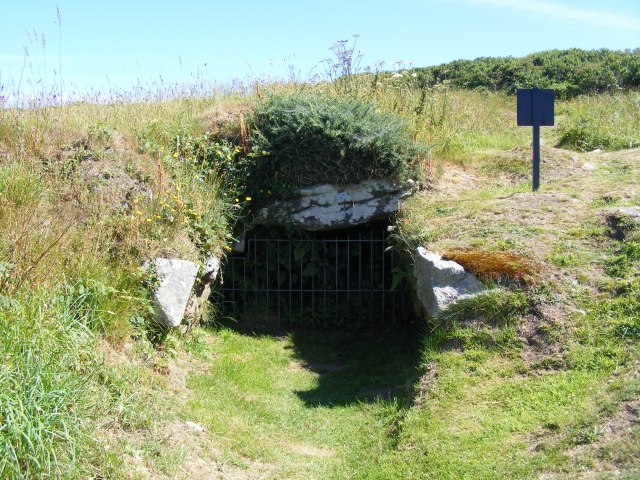
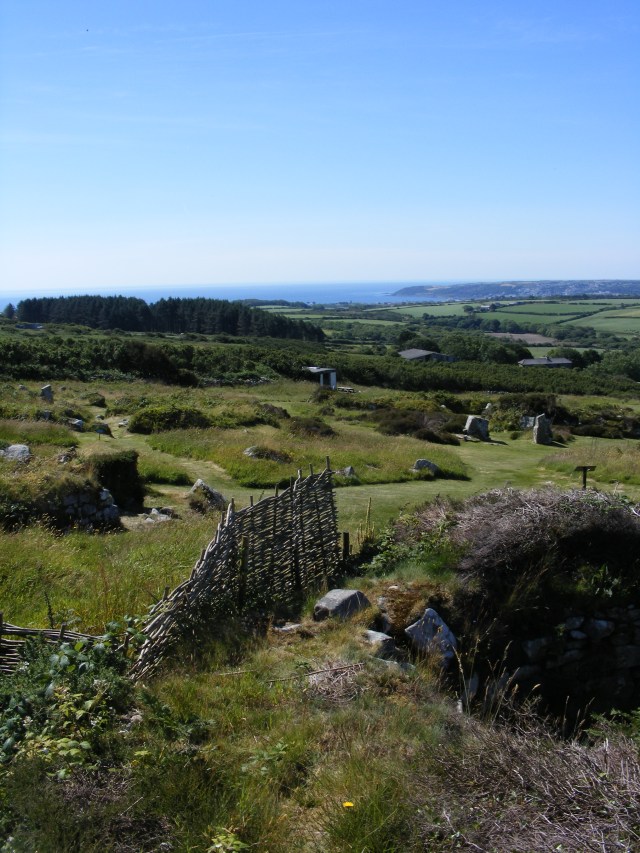
An ancient monument to start the day. No not myself or my travelling companion but Chysauster village, which was inhabited for about two hundred years, two thousand years ago. This was just in case we hadn’t already had enough of steep slopes and uneven paths, as the village is in a prominent hill-top location. The climb is made worthwhile by the impressive views and as the glorious weather continues, we can almost see from coast to coast. I have been here before but I am not sure we actually got to the village then. I know we found the fogou as there is photographic evidence but that may have been it. In those days it was an unattended free site, with no interpretation boards beyond a metal sign saying ‘fogou’ and no arrows to the village above. What is a fogou? I hear you ask. You did ask didn’t you? If only I, or indeed anyone else, knew. It is an underground passageway of unknown function, possibly for storage or, alternatively, it may have had a ritual function.

019 5 July 2019 fogou Chysauster

A Fogou

Chysauster itself is a group of stone houses, which were home to 50-70 people, who were perhaps involved in the tin trade. It reminds us of the time we spent in the Neolithic era. One of the roofless houses was used by itinerant Methodist preachers in the nineteenth century. The congregation must have been pretty dedicated to slog all the way up here, as there are not many settlements in the vicinity.

018 5 July 2019 view from Chysauster

We drive down into Penzance and secure the last parking space in Penlee Park. We are here to listen to my friend Liz Shakespeare talk about her book The Postman Poet. This is not just any book as it features my kitchen in a cameo role. We share a pleasant lunch in the sunny park afterwards, then relax (that word again) in the park to wait for evening. Had it been less cozy, we might have walked down to the centre of Penzance but we decide against this. The evening treat is an open-air concert by Fisherman’s Friends. Open-air and England can be a dodgy combination but we could not have had better weather for it. Being somewhat of a chilly mortal, I have come armed with socks, trousers and fleeces but I am able to survive without any of these extra layers, as we listen to shanties and other songs of the sea.

St Michael’s Mount

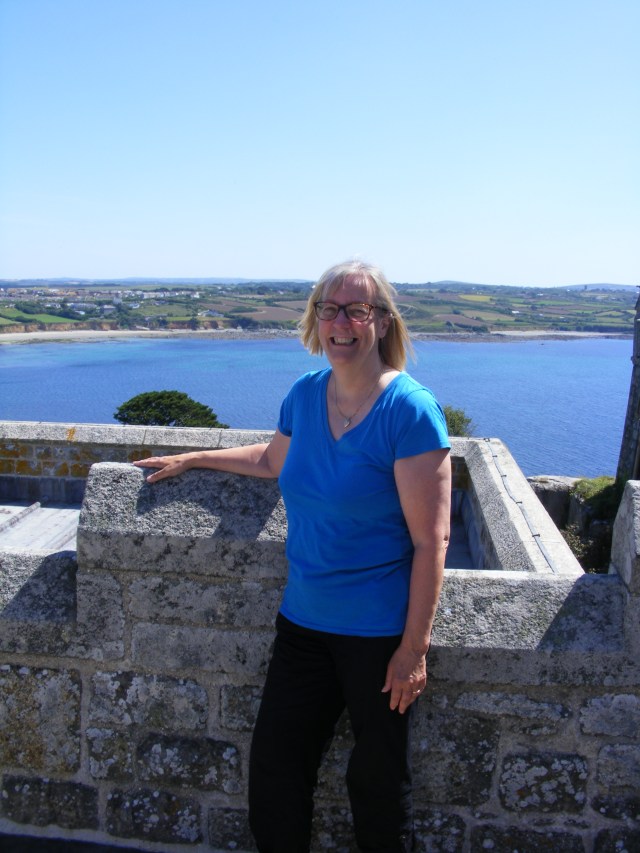
The fixing the water pump thing requires us to make a trip to a nearby electrical accessories store, which we do. Paying the water pump-fixing man means we also need to find a cash point and we manage that too. Then it is back to Marazion in time for the causeway to St Michael’s Mount to become passable on foot. St Michael’s Mount is one of the most visited tourist attractions in the country and it seems that most people have chosen today. It is quite a slog up the steps to the castle, folk making the ascent are getting a tad warm. We are then squished into small rooms in the castle in close proximity with said fellow visitors, hmm. Eau de sweaty humanity is not pleasant.

010 4 July 2019 from St Michael's Mount-2

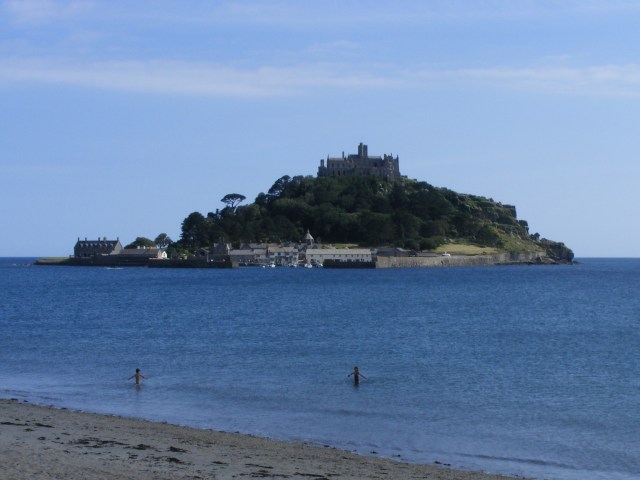
St Michael’s Mount is iconic and its similarity to France’s Mont St Michel is not a coincidence, as monks from Normandy, settled on the Cornish version, building a priory here in the twelfth century. The steep rocky island is just off-shore from Marazion and is cut off by the tide for half the day. A Medieval Castle dominates the island, which, after the Dissolution of the Monasteries, passed into the hands of the Crown. It was briefly owned by Elizabeth I’s favourite Robert Cecil and then by the Bassets, who strengthened its defences when fighting for the Royalist cause during the English Civil War. When the garrison surrendered to the Parliamentarian forces, the St Aubyns took up residence and became the owners in 1659. Almost every generation was John St Aubyn but although they shared a name, the temperaments of the various Sir John’s varied from one who was hailed as ‘the least corruptible Member of Parliament’ and another who fathered seventeen children on three women, none of whom were, at the time, his wife. In the nineteenth century the St Aubyns took the title Lord St Levan and they still inhabit the island today.

We hear the story of the eighteenth century clock, which shows the state of the tides as well as the time. A Medieval skeleton of a man, seven feet in height, was found buried in the chapel. The remains were re-interred in the churchyard. There are several ‘giants’ legends associated with the island. If ascending the steep, uneven stone steps and cobbled paths was hard work, the descent was more difficult, not helped by wearing varifocals but I reach the bottom relatively unscathed.

012 4 July 2019 At St Michael's Mount

On previous visits to the mount, I seem to have missed touring the gardens. These are a huge challenge for the gardeners, who have to adapt to steep slopes, very little soil and salt-laden winds. They have nonetheless done a great job. My legs have barely recovered from walking steep Devon streets and ‘racing’ for life so up and down the rocky paths in the heat of the day was somewhat strenuous but worth the effort. We then return to the van to take part in that rare activity ‘relaxation’, whatever that is. Felt obliged to sample the wares of the site’s mobile fish and chip van.


Heading Westward

So, having spent some time in the most north-easterly county of England, we headed instead for the most south-westerly. Both are in my top three English counties. It seemed everyone else had the same idea and traffic was heavy in western Cornwall. I realised that I had inadvertently booked a site with only ‘hot-spot’ internet. Last time we were lucky enough to pitch on one of only three spaces where there was signal. Will we be as lucky again? If not I am going to spend much of my time balancing on one leg in a field trying to log on, as the job we must not mention requires wi-fi and is not yet over.

On arrival, we chose a pleasant, shady pitch (which had wi-fi – yay!) and sited the caravan, skilfully lining up with the marker peg as required. Pleasant and shady it may have been, flat it was not, even our super-dooper, self-levelling legs (that’s the caravan’s legs not our own) couldn’t cope with the incline. It was clear from the marks on the grass that a previous resident of this pitch had parked considerably to the left of the marker, so we did the same. The legs could cope with this so the van was no longer reminiscent of the Crooked House (Blackgang Chine aficionados will understand what I mean). In order to comply with the ‘park with the back corner to the peg’ regulation we judiciously moved the peg.

The next issue was the water pump, or lack of the same. There are two operative words here – ‘water’ – yes, ‘pump’ – no. The helpful warden took a look. We dismantled bits of the van. We summoned a mobile caravan water pump fixing person. Hurrah! We had running water once again – probably just as well as the temperatures are soaring.

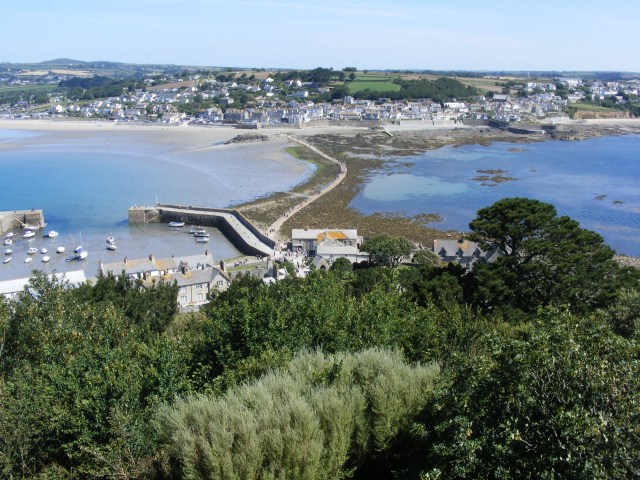
In between all the pump fixing we drove a couple of miles to Marazion. We passed a horse rider who commented that the road was melting. She was not wrong, as there were clear impressions of horseshoes on the tarmac. We wandered through Marazion’s narrow street in beautiful sunshine. Mount’s Bay was looking glorious. Marazion’s name was once thought to originate from ‘Market Jew’ and there is a Market Jew Street in the town. It is now thought that the name comes from ‘Marghas Yow’ or Thursday Market. Until Medieval times, when Penzance became dominant, Marazion was the principal town in the area. It is an ancient settlement, whose economic activity was centred on tin smelting. It is held out to be one of the oldest charter towns in England, having been granted a charter by Henry III in 1257. It is forty years since my first visit to Mount’s Bay, when I stayed in a Penzance guest house. The abiding memory of that trip is the whitebait that was served for breakfast each day; I have not eaten whitebait since.

001 3 July 2019 St Michael's Mount

A Genealogical Conundrum – In search of the 32: who was John Hogg?

[Updated 6 July & 14 July 2019 and 12 September 2020] Recently, there have been various posts on social media, with family historians naming their 32 3 x great grandparents. At present, I can only name 29 of mine, or does this story reveal two more? I have always known that my great great grandfather was John Hogg. His son’s original 1885 marriage certificate was handed down through the family and is now in my possession and that tells me his name and that John was a gardener. After forty two years of genealogical research, I am still not absolutely certain who John’s parents are. I am almost sure I know but I have still not ‘inked in’ the next generation. I know my genealogical friends like a bit of a brain-teaser, so I thought I would outline the story so far and ask the question – if John were your ancestor, would you be adding another generation to your family tree? I am probably doubly cautious having nearly got my fingers burnt earlier this year. I was very close to expanding one of my ancestral lines (the one that involved the third of my missing 32). In that instance, I realised just in time that I would have been climbing the wrong family tree. For that sad story see here. This is an abbreviated account of the story so far but I am afraid that what follows is a long post; I hope you will persevere.

So, back to John Hogg. Working backwards from the most recent document, the twenty five pieces of evidence that I have for great great grandfather, John Hogg are as follows:

  1. According to his death certificate, John died on 23 January 1876. He was a farm servant of Well Way, Morpeth, Northumberland and was then aged 76, meaning, if this was accurate, that he was born between January 1799 and January 1800. The informant was his son, also called John, who was my great grandfather, of the same address.
  2. On 2 April 1871, the census for Well Way, Morpeth, Northumberland (RG10 5164 folio 50) records that John was an ag lab aged 68 (i.e. born April 1802 – April 1803) and his birthplace was given as birthplace Bavington, Northumberland. (Little Bavington is in the parish of Thockrington and Great Bavington is in the adjacent parish of Kirkwhelpington). With him were his wife Elizabeth and 3 children, John, Jane & Margaret.
  3. On 7 April 1861 the census for Newgate Street, Morpeth, Northumberland (RG9 3871 folio 27) lists him as an ag lab age 56 (i.e. born April 1804 – April 1805). This time, the birthplace was Kirknewton (Kirknewton is on the Scottish border, so, looking at the evidence in the other records, it seems possible that the birthplace was an enumerator error and should have read either Kirkwhelpington or Kirkheaton; the latter borders Thockrington.). He is with his wife Elizabeth and four children, Frances, John, Jane and Margaret. A slight spanner in the works is that, in this census, ‘John’ is enumerated as ‘George’. Given that the details of the rest of the family are consistent and they are at Newgate Street, where his son was born in 1855, I am happy that this is the same person. There are no Georges baptised in Kirknewton around 1804/5 and there is no George who fits with this George in 1851 or 1871. After extensive research, I am confident that ‘George’ is indeed the man who appears in every other record as John.
  4. On 1 January 1860, the index to the baptism register tells us that John’s daughter Margaret was baptised at St Mary’s Morpeth and that her mother was Elizabeth. I need to get a copy of the original entry which would give John’s abode and occupation.
  5. 26 October 1859 the birth certificate shows that his daughter Margaret Newgate Street, Morpeth (later calls herself Margaret Catherine) father an agricultural labourer mother Elizabeth Pearson
  6. On 7 February 1858 an index to the baptism register records that John’s daughter Jane was baptised at St Mary’s Morpeth, her mother was given as Elizabeth. Similarly to Margaret, I could get copy of the entry.
  7. 4 September 1857 the birth certificate shows that his daughter Jane was born at Newgate Street, Morpeth, father an agricultural labourer, mother Elizabeth née Pearson.
  8. On 9 March 1856 the original baptism register records that John’s son John junior was baptised at St Mary’s Morpeth. John senior, was a labourer of Morpeth and the mother was Elizabeth.
  9. According to the birth certificate, John junior was born on 4 November 1855 at Newgate Street, Morpeth. John senior, was an ag lab and the mother was Elizabeth née Pearson.
  10. On 14 March 1854 the birth certificate for John’s daughter Frances Isabella, shows that she was born at High Espley, High and Low Highlaws, which is in Mitford parish, John, her father, was a husbandman and her mother was Elizabeth née Pearson.
  11. A newspaper item in the Newcastle Journal of 16 April 1853, records the marriage of Mr John Hogg and Miss Elizabeth Pearson, both of Espley, which took place at Lamberton on 13th April. This was an irregular Scottish marriage at Lamberton Toll, a less well known version of Gretna Green. The records for this date have been lost.
  12. 27 July 1851 death of son James High Espley, High and Low Highlaws. According to the death certificate, the informant was Elizabeth Hogg, his sister. Note that  four months earlier his sister Elizabeth was in service in Rothbury and not at home with the family; perhaps she returned home to take care of James. The eldest sister Mary Jane was at home in March 1851.
  13. 27 July 1851 the Bishop’s Transcripts record the burial of John’s son James in Netherwitton. James was of High Espley, Mitford. His age was 18.
  14. 30 March 1851 the census for Glororum, Stannington, Northumberland (H107 2413 folio 34) lists John as a farm labourer aged 42 (born March 1808 – March 1809) birthplace Kirkheaton (Kirkheaton borders both Thockrington and Kirkwhelpington). John is a widower living with two of his children (Mary and James). See below for why I believe that this is the same John Hogg as the John Hogg who has children with Elizabeth Pearson.
  15. 10 July 1849 the Bishop’s Transcripts record the burial of John’s ‘wife’ Cecily Hogg of Glororum at Netherwitton, Northumberland. Inexplicably there is no death registration in Northumberland for any Cecilys/Sisilys with any surname or any Hoggs who could be Cecily. I asked the local registrar to check in case the record was lost between local and central registration but there is no local registration and she suggested, as this was before the 1874 Birth and Death Act, there may be under-registration of deaths at this period. I am aware of this in relation to births but not deaths. An Act for registering Births, Deaths, and Marriages in England 17 August 1836 6 & 7 Will. IV. c.86, which introduced civil registration required a death certificate to be produced before burial, so how did the incumbent get away with this (there are also two other burials in the extended family for whom no death certificates survive).
  16. 29 January 1844 the Bishop’s Transcripts suggest that John’s ‘wife’ Cecily may have had a child, John, by Mark Ainsley. The child was baptised in Hartburn on 28 April, with the mother given as Cecily Hay. There is no birth registration as Ainsley (or variants) Hogg or Hay. He was possibly buried in January 1848 as John Hay, with the address of Cecily’s brother. There is no corresponding death certificate as Hay, Hogg or Ainsley (and variants). There is no birth or baptism record for John Hay b. c. 1844. There is no record of any other Cecily Hays at this time in Northumberland. Given the propensity for this family to avoid appearing in the records however it is possibly that Cecily Hay, mother of John Ainsley, was in fact an otherwise unrecorded niece of Cecily ‘wife’ of John Hogg.
  17. 6 June 1841 the census for Ashington and Sheepwash, Bothal, Northumberland (HO107 834/1 folio 2) lists John as an agricultural labourer age 40 (rounded down age so born 1796-1800 BUT he was younger than his wife so may have adjusted his age). With him are ‘Siscely’, Elizabeth, James and George.
  18. 10 August 1837 the birth certificate shows that his son George was born at Ashington, Bothal. father as husbandman, mother Sisceley Hogg née Hay.
  19. 5 November 1837 the index to the baptism register, records John’s son George being baptised at Bothal, John was a hind of Ashington. I could get a copy of the entry.
  20. 19 April 1835 the Bishop’s Transcripts show that John’s daughter Margaret was buried at Netherwitton ‘of Buckshaw, Mitford’.
  21. 13 April 1835 the index to the baptism register shows that John’s daughter Margaret was baptised at Mitford. John was a labourer of Buckshaw, Mitford.
  22. 14 October 1832 the index to the baptism register shows that John’s son James was baptised at Mitford. John was a labourer of Edington, Mitford.
  23. 31 October 1830 the index to the baptism register shows that John’s daughter Elizabeth was baptised at Bothal. John was a hind of Ashington, Bothal.
  24. 31 August 1828 the index to the baptism register shows that John’s daughter Mary Jane was baptised at Netherwitton. John was a husbandman of Ruffles, Netherwitton.
  25. 1820-1827 The 1841 census, the baptisms of their children and the burial of John’s ‘wife’, indicates that there was a ‘marriage’ to Cecily Hay but no record has been found. In England or Scotland.

So why do I believe that John ‘husband’ of Elizabeth Pearson and John ‘husband’ of Cecily Hay are the same person? I have followed up all John and George Hoggs who were born between 1797-1808 anywhere in Northumberland, who appear in the 1851 English census (anywhere in the country) and I have looked for them in 1841 and succeeding censuses, to see which one could be the ‘George’ Hogg in Newgate Street in 1861. I have also tried to relate these to baptisms. The John ‘widower’ of Cecily Hay is the only one not accounted for. In addition, his stated birthplace of Kirkheaton in 1851 is not inconsistent with Bavington, his stated birthplace in 1871. After exhaustive research, I am happy with the conclusion that the John Hogg, father of my great grandfather, also had children by Cecily Hay. An added link is that his son James by Cecily Hay was buried in Netherwitton in 1851 and was at the time of High Espley, Mitford (a handful of cottages), which is where John’s first child by Elizabeth Pearson was born in 1854.

I believe that my great great grandfather, John Hogg, was almost certainly the son of Robert and Mary Hogg of Hallington, St John Lee but who was baptised in neighbouring Thockrington. According  to the baptism register, was born and baptised in 1804. There are no John Hoggs baptised in Kirknewton 1795-1814 and the Thockrington baptism is the only one within 10 miles of Bavington. I can find no plausible alternative future for the John baptised at Thockrington. If I have identified the correct baptism, John was orphaned at a very young age, which may account for him being unsure of his birthplace and age. It must however be noted that, as an orphan, this child will presumably have been brought up with another family and could possibly have taken their surname. There is no obvious relative who might have taken John and his younger sister Mary, on. There are no surviving poor law records for Thockrington.

So what do we know of the John Hogg, son of Robert and Mary?

  1. 18 June 1808 the burial register records the burial of John’s mother Mary in Thockrington, of Great Bavington, which is in the neighbouring parish of Kirwhelpington, late of Hallington.
  2. 31 August 1806 the baptism register records the baptism of John’s sister Mary in St. John Lee, of Hallington.
  3. 3 December 1805 the burial register records the burial of John’s father Robert in Thockrington, of Hallington.
  4. 2 September 1804 the baptism register records the baptism of John son of Robert and Mary in Thockrington, of Hallington.
  5. 23 June 1804 the baptism register gives this as John’s birth date

This family are non-land-owning, agricultural labourers who move around frequently. They do not appear in newspapers (as per British Newspaper Library index). There are no surviving poor law records for the relevant parishes at the appropriate times. They do not leave wills (Northumberland Archives, Prerogative Court of York and The National Archives indexes checked) or own land. They do not appear in electoral rolls nor did they serve in the army or navy. There is nothing in the catalogue at Northumberland Archives that relates to the family, leaving me with vital records only. There is a tantalising mention in the Quarter Sessions court records to John Hogg, alias Willes Jock of Redeswood, yeoman; at Chollerton, who stole eight ewes worth 6s. 8d. each, the property of Edward Reed of Chollerton but this is two hundred years earlier and the absence of seventeenth century parish records means that I am very unlikely to get this far back. I have taken a DNA test but there are no matches for any members of any Hogg family. This is unsurprising because there are no known living descendants of Robert and Mary Hogg apart from those who potentially descend from John (‘husband’ of Cecily and Elizabeth).

So are Robert and Mary of Thockrington my 3 x great grandparents? What do you think?

St Aiden's Thockrington (4)

Thockrington Church – was my great great grandfather baptised here?

So what is Rootstech all about? How to win a free ticket

So Rootstech is coming to the UK. Unless you are involved in the international family history world you may not be aware of Rootstech. Or you may have heard of it and are wondering what it is all about. If you are trying to decide if this event is for you, then read on. Even if you are a die-hard Rootstech attendee and have already purchased your ticket, read on, as here is an opportunity to get a refund on your ticket price.

Rootstech, hosted by Family Search, is quite simply the biggest genealogical event in the world. It has been running for several years in the US and is getting bigger and better each year. From 24-26 October Rootstech will be in London. There will be some modifications to the US model to suit a British, or as they hope European, audience but do not expect this to be in the same mode as national events you may have attended in the UK. There will be some similarities but it will be unique is several respects. For a start, the US and the UK are two nations divided by the same language and you will need to familiarise yourself with some different terminology. What we would call lectures, or presentations, are ‘classes’. Don’t be put off by this, you won’t be going back to school but there will certainly be an abundance of learning opportunities.

With the exception of the keynote sessions (of which more later) there are ten, yes ten, sessions, sorry ‘classes’ to choose from at any one time. You will find classes by presenters who are well-known in the UK alongside names that will almost certainly be new to you. The important thing to note is that there is no additional charge for any of these. Once you have paid for your ticket (oops, must remember to call it a ‘pass’) everything, including the keynote sessions, is open to you at no further cost. This means that it is an ideal opportunity for you to try out speakers whose names you do not recognise, as well as your ‘must see’ favourites. I shall certainly be going along to some of the classes on more niche topics; maybe those that I don’t feel will be directly related to my research but nonetheless sound fascinating. I will be speaking on Thursday 24th on Remember Then: memories of 1946-1969 and how to write your ownIf you think you’ve heard me give this talk before – you haven’t. This will be a different version, more directly related to compiling your own reminiscences.

There is no booking system for the talks. I am assured that the area set aside for the keynotes will fit in everyone who has a pass for the day but the rest will be first come first served. The excellent and varied programme – or schedule – is already available, although do check back nearer the time for any minor amendments or additions. With ten sessions running simultaneously, I think we can expect smaller arenas than we might be used to at UK national events, so it might be a good idea to choose a reserve, when planning which sessions you will attend, in case your first choice is full. There will be an app available to help you organise your visit but as regular readers will know, I scarcely recognise an app when it bites me on the nose. As an aside, I am still congratulating myself for managing (at the fourth attempt) to top up my pay-as-you-go mobile (that’s a cell phone to US readers) with credit. It has taken me 13 years to use £25 worth!

Back to the translations. You many find handouts referred to as ‘the syllabus’ or ‘speaker notes’. The concept of keynote speakers seems to be something that some of the UK potential audience are finding it difficult to get their heads around. We are used to these sessions being the opportunity to bring out the genealogical heavyweights. Not so at Rootstech. They embrace the cult of celebrity and choose keynotes who will provide inspiration and motivation, as well as embodying family values. Another reason for choosing non-genealogical keynotes is to encourage attendance from fans who might not otherwise come along. So far, Donny Osmond has been announced as a keynote. He has spoken at the US version of the event and was very well received. So, if you were one of the sceptics, keep an open mind on this one. There will be more razzamataz than we Brits are used to but that’s not necessarily a bad thing.

There will be ‘booths’ – think ‘stands’ or ‘exhibitors’. These have not yet been announced but there will be a mixture of commercial vendors selling products of interest to family historians and societies offering advice and services. The balance between these will become clearer nearer the time. There will be plenty of chance to visit the booths in the ‘vendors’ area’, as a time is set aside each day when there are no classes scheduled. Oh and a word about timing. The first classes start at 9am. Believe it or not, that is later than at the US equivalent. So be prepared for some early starts as you will need to allow time to register on arrival, in the same way as you might expect at a conference – another difference. Just think of all that extra family history time each day.

Now the price; currently, early bird passes are £49. This may seem more than we are used to in the UK but remember this is an all-in payment for all events on that day. Once you walk through those doors, you only need to spend money on refreshments or purchases from the stands. If you are the sort of person who thinks twice about a 30 mile journey and a £15-£20 spend (and that includes your lunch) for your county family history society day conference, why not embrace a different mind-set and make Rootstech your big genealogical adventure. What you glean from those classes or learn from the stall-holders could break down those brick walls and save you time and your research budget. If travel to London really is not for you, keep an eye out for the virtual passes, as some sessions will be being recorded and will be available to you at home.

So how can you avoid paying altogether? Over the next few weeks, Rootstech Ambassadors, myself included, will be offering the chance to win one three-day free pass (full-price value £149). This includes access to any virtual sessions that you may have missed during the three days. If the winner has already purchased a ticket, then they will get a full refund. For my give-away, there is a little more involved than just jumping up and down and saying ‘Me! Me!’ as I know how many people follow this blog and I don’t want a trillion emails. To enter please contact me janetfew @ hotmail.com (without the spaces) with the answers to these five questions all of which can be found on the Rootstech website or on my own webpages (not including the blog posts) or both. I am accepting one entry only from each email address and it must be sent to the email address on the above link, not to any of my other manifestations. The winner will be drawn at random from all correct entries at 12.00 midday British Summer Time on Monday 12 August 2019. The decision is final and I will not enter into any discussion about the competition – though I will try to remember to tell you the answers to the questions! Good luck!

  1. What is the venue for Rootstech London 2019?
  2. I am giving a talk with the same title as my Rootstech session (although it is a different talk) at another venue in the next year. What group am I giving this talk to? (At the moment there is only one answer to this question – if I get another booking there may be more than one – any will be accepted)
  3. The blurb to my novel Barefoot on the Cobbles begins ‘In the euphoria of the armistice a young woman lay dying.’ What eight words follow this? Hint this phrase is obviously on the book itself but is also used elsewhere to advertise the book, including on this website – it is the same 8 words.
  4. What time will the Expo Hall open on Thursday 24 October? (it seems that there have been two advertised times in different places – I will accept either)
  5. What is airport is the nearest to the London Rootstech venue?

Capture

Challenged by Inanimate Objects and a little about Selling Books

They say things come in threes and this week I have been challenged by three inanimate objects. First to turn up its toes was the washing machine. This actually occurred before I went away but this was the first chance to tackle the problem. Turn it on and not a whimper, not a light, nothing. I am quite handy in my own way, so I try fuse changing, a different plug socket, putting a different appliance in that socket, all seems fine but still no response from the machine. The next steps required dragging the machine out; although I would normally tackle this, my back was twinging so I summoned assistance. Randomly, by the time he arrived the ‘dead’ machine had woken up and every available light was flashing wildly but not a button had any effect. The only way to stop the light-show was to unplug it. We de-fuzzed the thingy, we checked the pipe wasn’t blocked, we consulted You-tube, we chatted to ‘Toby’ online. At Toby’s suggestion, we held down buttons for 30 seconds to reset it – zilch. Today the ‘not-actually-going-to-repair-it’ man arrived and pronounced the condition terminal. I have already done one load of washing by hand and the weather isn’t conducive to getting non-spun washing dry, so if I appear in strange garb you will know why.

Next, the car. I arrive back from THE Genealogy Show with the caravan and go to drive my own car home from where the caravan lives and where the car has been parked whilst I have been away. I press the button to open the door – no response. I try the key. The door unlocks and then instantly relocks. The only way I can gain entry is to open the passenger door using the key and then climb across. This isn’t exactly easy, as it is a very small car. I drive home with the window open, just in case none of the doors open when I arrive. To add to this problem, I normally park my car up a drive, which means I need to put the passenger door hard against a hedge. This clearly isn’t an option when the passenger door is the only way in and out. A garage agrees to take a look. I have four days to get a very long ‘to-do’ list done, or it won’t be done until mid-July. I can ill-afford time to go to the garage half an hour away but needs must. Unfortunately, an accident has closed the main road. Even more unfortunately, the alternative route involves two sets of roadworks. It takes 1½ hours to drive 12 miles. The repair is going to take longer than I have, so it is home via a tortuous route, which is marginally quicker than the advised diversion and then repeat in reverse three hours later to collect the car, which is (sort of) fixable – ‘it may not last long you probably need a new something or other’.

I am due to spend a day selling books. At the NEC my gadget for taking card payments let me down. I need this to work. Again I try the online chat; this one is ‘Sabina’. Sabina suggests I ring what is probably a ridiculously expensive premium rate number. Half an hour later a very patient ‘Andrew’ has talked me through what is required. He must be dining out on our conversation along the lines of , ‘you will not believe this thick woman I had on the line today….’ The process involved the use of a mobile phone. As you know, mobile phones and I are not friends. Even if we were before we certainly aren’t now. ‘Is Bluetooth on?’ asks Andrew. Now I am not a complete dinosaur, I know what Bluetooth is, turning it on is another matter. ‘Ah, the app has been updated’, says Andrew. ‘Just delete it and re-install it.’ ‘Just’ is a funny old word isn’t it? It seems ‘Just’ can take a very long time and it doesn’t necessarily mean that’s the end of the adventure. What followed ‘Just’ necessitated me punching in a sequence of eight numbers very quickly; not quickly enough it seems. ‘Faster,’ urges Andrew as I make my nth attempt. Finally, it is accomplished.

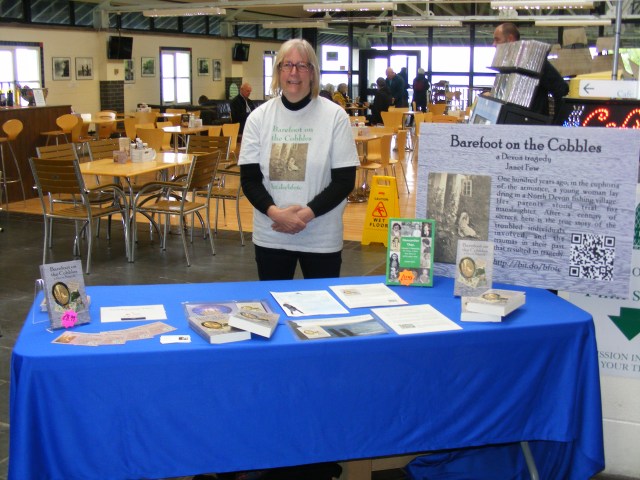
Next day and I am ensconced in the Visitors’ Centre in Clovelly, hoping to persuade attendees at the Charles Kingsley anniversary commemorations to part with money in return for one of my books. I am stationed by a stand that sells inspirational ‘soothing’ CDs. I quickly work out that I can change the CD, so I can lose the whale music. The bad news is that virtually every track involves the sound of running water, with the inevitable effect. I am also forced to try to avoid looking at an apostrophic howler all day. I do suppress the urge to go and correct the notice! Nonetheless it is an enjoyable day, chatting to visitors and an unbelievable number of dogs and even selling some books as well.

DSCF1442

THE Genealogy Show

We set off early to beat both rain and traffic and accomplish this successfully. In the absence of shuttle buses from South Car Park we walk down to Hall 2 at the NEC. There was a happy, gentle atmosphere with a real international vibe. It was lovely to meet several world-renowned genealogists who had only been virtual friends until now. Unfortunately, I had places to be and people to see, so I was unable to spend more than a few minutes in the ever-widening circle of heavyweight genealogical chat that continued in the meeting area throughout the two days of the show.

As a show speaker, I was given two tickets to talks of my choice and I had opted for those by genealogical crime writer, Nathan Dylan Goodwin. His first session described how he researches and writes his books. Very interesting and I appropriated a few ideas. Next, I was acting as a ‘wizard’ attempting to help show-goers with their problems and brick walls. Unfortunately, I was not provided with the required magic wand but I hope I that most people left with a few things they could try. There did seem to be a preponderance of people with Suffolk queries. I coped with foundlings and German ancestry but was a little bemused by the client who spent the twenty minute slot showing me forty or so documents but despite my repeated ‘how can I help?’ comments, didn’t actually appear to have a question or problem. I was reduced to ‘mmm lovely’, as yet another document was whisked past my nose. If you plan to take the opportunity of seeking expert advice in the genealogical equivalent of speed dating, please do come prepared and come with a succinct limited question, or indeed I’d settle for any sort of question!!

Then my allocated two hours on the stall of the Society for One-place Studies, to which I drifted back and forth throughout the day. We had a steady stream of enquiries and a pleasing number of people decided to take up the one-place challenge. The thought of taking on a new, tiny, place did cross my brain, like I have so much spare time! I sold almost all my stock of Putting your Ancestors in their Place and a few other books, despite having issues with the credit card machine. On the downside, my voice was beginning to disappear – cue the Strepsil overdose.

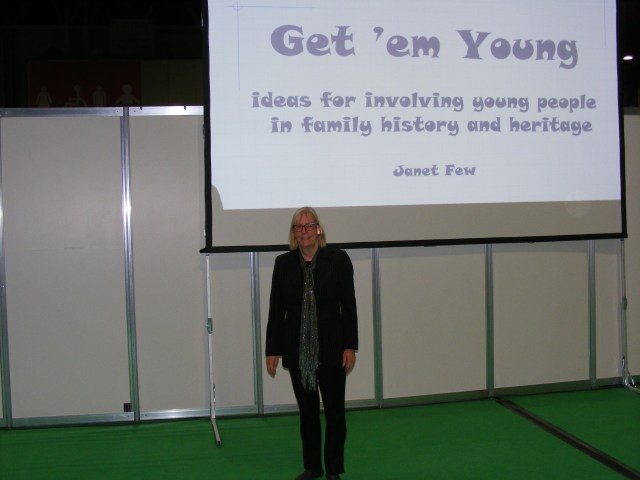
Day two and this time there was no avoiding the rain. Be-decked in waterproof trousers, wielding an umbrella and with spare socks and shoes in my bag, we set forth into the downpour. On arrival, we advise the security staff on tracing ancestry in India. This was more along the lines of ‘we know a man/woman who does.’ My talk was up first. Let us just say the audience was more noted for its quality than quantity. Judging by the ‘I wanted to hear your talk but …’ comments that I received later in the day, a significant reason for this was because I was scheduled half an hour after the show began. At this point, folk were still shaking raindrops from coats and getting their bearings. The real shame was not for me but for the missed opportunity. I was speaking about ideas for engaging young people in history and heritage. This is a crucial topic. On an almost daily basis, I hear people moan that younger generations are not interested in their genealogical research, yet often they are not willing to make any efforts to spark that interest.

DSCF1437.JPG

A quick gap and then I was part of a three-woman panel chatting about surname studies, to a larger audience this time. At least my voice held out. Then back to more wizardry, fielding questions about dancing masters and apprentices amongst other things. The event ended as it had begun, with another talk from Nathan Dylan Goodwin, this time a fascinating account of his own family history research. All too soon, it seemed to be over. I really wish I had had more time to network with people. I had brief chats with so many friends. It is great to be at an event like this, when you know almost every other person. There were evening get-togethers but evenings and I do not get on. Next year and there is to be a next year, I will make more effort to stay awake beyond 6pm and join the fun. The next big genealogical event is Rootstech, of which more later.

Speaker

The job we must not mention is about to hit the fan so there may be radio silence for a few weeks but I will do my best to keep in touch.

Pillories and Preparations

In the brief week at home, idleness has not been an option. Firstly, my home village staged a re-enactment to commemorate the 200th anniversary of the arrival of Methodism in the village. William Reed and Samuel Thorne chose the day of the revels to preach on the village green, were duly arrested and fined. I have to admit that being part of the action, exactly 200 years later, was a ‘hairs standing up on the neck’ moment. Mistress Agnes was present in Victorian guise and a few reprobates were pilloried in the newly acquired community pillory – every home should have one. There was also a truly spectacular flower festival. As someone whose idea of successful flower arranging is remembering to put water in the vase, I was in awe.

1 June 2019 William Reed Commemorations (4)1 June 2019 William Reed Commemorations (6)

I did briefly get back to writing novel number two, after a gap of a few weeks. This has necessitated me buying a book. Thanks to Martha’s research, I did get it half price but it is still the most expensive book I have ever purchased. Then, with assistance, I tried to rediscover my garden. The grass had to be scythed and the weeds still have to be tamed.

Then it was onward and upwards and back ‘up north’ to THE Genealogy Show. Yesterday was spent setting up and greeting friends from across the world, some of whom I have only previously ‘met’ online. My two (well one and a third) presentations are tomorrow so today will be more relaxing. A talk to hear, some brick-wall bashing for attendees who have booked appointments with an expert (a few of them have got me – oh well) and helping out on the Society for One-place Studies stall in between. It is going to be a good day.

TheGenShow

Sheep and Other Adventures

Another day of indifferent weather and we mop up (no pun intended) a few more ancestral locations, although sadly these churches are all locked. We also have a wander round Morpeth and manage to visit the destinations we abandoned due to the road closure two days ago. I am still working on these Northumbrian ancestors during our time back in the van and I am wondering if I should ‘ink in’ the next generation or not. At the moment I am erring on the side of caution and looking for additional evidence. They may make a blog post of their own when I am a bit more sorted.

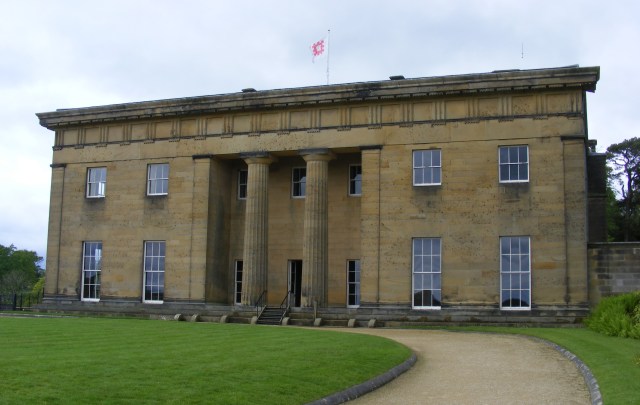
In torrential rain we drive through floods, creating flume-like effects and make our way to Belsay. The site has been home to the Middleton family since at least 1270, when Richard de Middleton of ‘Belshou’ was Lord Chancellor to Henry III. The tour begins in the most recent home of the family on this site, Belsay Hall. This was built in 1817, using plans drawn up by the owner, Sir Charles Monck. He changed his name in order to inherit some other property; later generations reverted to Middleton. Sir Charles was obsessed with Greek architecture and the Hall reflects this. It was designed for effect, not practicality and contains some design flaws, including very steep steps to the entrance and a lack of guttering and downpipes. The latter has led to some serious water damage, which is having to be addressed by English Heritage. There are two high-ceilinged floors to the main house but the same height accommodates five floors on the north side, which were the servants’ quarters. Our tour has to omit the cellars due to flooding. Monck demolished the existing village and a chapel because he did not want the villagers too close to his home. In his defence, he did rebuild cottages further away and these too have signs of classical influences.

155 28 May 2019 Belsay Hall

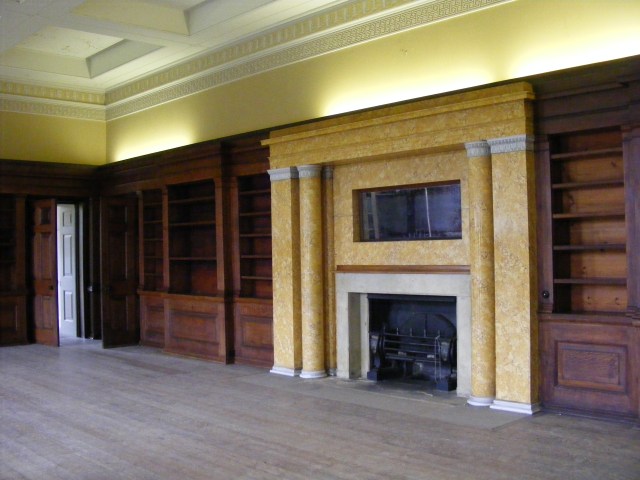
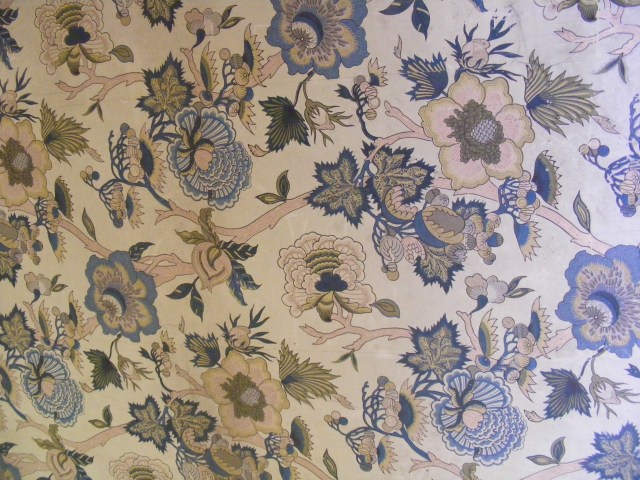
The military took over the Hall in the Second World War and the building deteriorated rapidly afterwards, with the family leaving in the 1960s. It then stood empty for a further two years. Strangely, a condition of giving custodianship to English Heritage was that it would remain unfurnished. There are still remnants of William Morris wallpaper and a large library with 19 bookcases that might just accommodate my current book collection, which was culled by 50% when I left the Isle of Wight.

139 28 May 2019 Belsay Hall

149 28 May 2019 William Morris wallpaper Belsay Hall

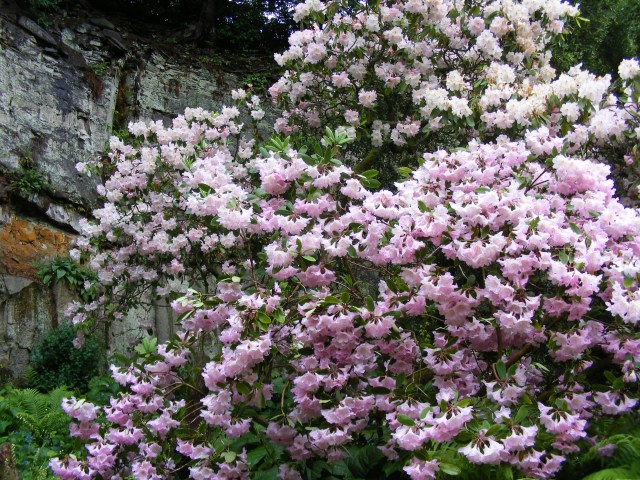
The highlight of the Hall tour was observing a sheep-related incident. Whist admiring the rhododenrons, we notice that a sheep has got its head stuck through a fence that is protecting a sapling. Our guide radios for assistance. Simon the sheep rescuer comes to the aid of the stricken sheep. We watch from the window as he leaps into the rain-soaked ha-ha. As he approaches the sheep, which has been struggling for 10-15 minutes, miraculously, the sheep frees itself. Cue resounding applause for Simon.

153 28 May 2019 Rhododendrons Belsay Hall

The rain eased up sufficiently to allow us to paddle through the rhododenrons in the dramatic quarry garden and reach the castle. The castle is a traditional fortified peel house, designed to repel border raiders. A Jacobean manor was attached in 1614. This was abandoned two hundred years later, when the family moved into the hall. Sir Richard and his squire are bravely conducting some living history in the officially freezing castle. I feel quite sorry that the weather has kept visitors away but a few children are listening to the legend of the Lambton Worm and we discuss armour cleaning techniques.

Another ancestral location stop and then it is back to the van. And so the holiday draws to its close, leaving us with memories of bluebells and birdlife, the smell of guano and of wild garlic that shrouded each time we left the campsite and some ancestral adventures. I have somehow managed to successfully conduct three chat sessions for my Pharos Writing and Telling your Family History students, each one from a different field and now it is home for a week before we will be heading north again, this time for THE Genealogy Show.