Amidst all the #100daysofbfotc blogs, it has been a while since I wrote of other things. Life has been busy; what‘s new? There have been visits to and with descendants, articles to write, courses to run and presentations to give. With All Hallows Eve in mind, my talk about Seventeenth Century Witchcraft has been requested a couple of times, always one that leads to fascinating audience discussion. Also with a seasonal flavour, my colleagues have been out and about recreating life at the time of the Great Fire of London; although I am never quite sure why schools think it is appropriate to book these sessions to coincide with Guy Fawkes Day!
On the subject of anniversaries, preparations for our parish commemoration of the centenary of Armistice day have reached fever pitch. Our village green is bedecked with knitted poppies, we have recruited volunteers to represent almost all of the 90 service personnel from the parish (and have hopes of getting the full complement before next week). Songs of the era are being sung, communal food is being prepared. Every service person has a mini-biography hidden on our history group website, ready to go live at 11am on 11 November (I hope!). I have been in to the local school to chat about Remembrance and the children have produced some wonderful art and written work. It has been four years in the making and next week, all that hard work, by many people, will come to fruition. Someone was heard to mention that next year is the 75th anniversary of D-day and should we be celebrating that? I did turn a deaf ear; someone else can organise that one!
Now to my own personal excitement. Although I finished writing Barefoot in the Cobbles in March, in the few weeks I have been at home since then, the time has been spent editing and marketing. This week, I conquered the learning curve that was necessary to convert Barefoot into Kindle format. I do hope I have got it right. It looks ok to me. So, you can now pre-order copies for your electronic device here. Having said that, I am really hoping that potential readers will opt for paper copies too. There are 54 boxes of books in my very small house. I do need to sell some – please. If you are thinking of buying this book I have been harping on about for forever, please do read a bit more about it first. It won’t be to everyone’s taste and I don’t want people to be disappointed.
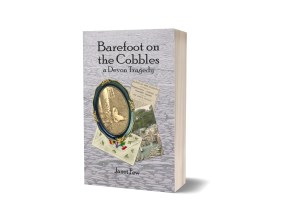 If you still think you might enjoy my creation, can I make a plea that you purchase a copy directly from me, either at one of my many events or other talks, or by emailing me. Alternatively, I would encourage you to order online from my lovely publisher, Blue Poppy Publishing and for the next 13 days, you get £1 off and free postage to the UK. These options deplete my stock, as would ordering from your local independent bookshop. When buying my book, or indeed any other, please make the convenient ‘buy it now’ Amazon button your last resort. It is the easiest option and if you qualify for free postage, it has great appeal. In the past, I have been as guilty as anyone of taking advantage of this immediacy. In my case and that of many other authors who are not working with major publishing houses, it means that you will get a print-on-demand, slightly inferior quality, version and that the stock pile in my house remains the same. You don’t need me to tell you where almost all of the, already very meagre, profits go in this case. The position is obviously different for overseas readers, who will need to use the links on their own versions of Amazon to avoid the horrendous postage costs. Actually, at the moment, I am still struggling to upload a version for Amazon orders of the printed copy but hopefully I will get there by launch day, another learning curve. Two weeks to go!
 When tackling the horrors of the Western Front, I chose Abraham Tuke as my ‘point of view’ character. Research into his background revealed that he had been the editor of his college magazine. I decided that, like others involved in the Great War, he might relieve the stress of being in a combat zone by writing poetry. I re-read the classic World War One poets, Wilfred Owen, Siegfried Sasson, Rupert Brooke, Lawrence Binyon and other well known names. I was also fortunate to have access to a collection of works by poets who are not household names and whose work is a little less polished, The Forgotten Tommy Poets of WW1. I tried to absorb the topics, the timbre and the language used in these poems. The subject matter frequently addressed the futility of war, the blundering of those in authority and the sheer boredom that was punctuated by death and fear. Often, a certain black humour permeates the lines that they composed. This research allowed Abraham to write his own poems; poems that I hope sit comfortably with those written during the war. I did reassure myself that he did not need to be a very accomplished poet! The poetry that I read was also very helpful in my attempt to keep the phrases, the euphemisms and the slang in period. I am not sure that my vicarious poetry writing will inspire me to write more verse but I am tempted to find time to read poetry again, something I have not done for decades.
![Fromelles 1916 by [Cobb, Paul]](https://images-eu.ssl-images-amazon.com/images/I/51aWYDTG-IL.jpg) I had chosen the character who was to be my vehicle for portraying the battlefields of the Great War. It turned out the the campaign in which he was involved was not one of the more famous ones, unless you are Australian. The Battles of Fromelles features prominently in the Australian narrative because there were huge numbers of ANZAC casualties. Most of the books are written from the Australian point of view and for a secondary account, I relied most heavily on Paul Cobb’s
I had chosen the character who was to be my vehicle for portraying the battlefields of the Great War. It turned out the the campaign in which he was involved was not one of the more famous ones, unless you are Australian. The Battles of Fromelles features prominently in the Australian narrative because there were huge numbers of ANZAC casualties. Most of the books are written from the Australian point of view and for a secondary account, I relied most heavily on Paul Cobb’s  As we meet Will Harding, in the penultimate chapter of
 Leonard’s story forms a sub-plot in
  The History Interpreter - Janet Few