After an uneventful journey, we arrived at the caravan site in Newport in beautiful autumn sunshine. We were just in time to explore neighbouring Tredegar House. I had even remembered my National Trust passport. Unfortunately, I had forgotten my membership card. By the magic of technology, I was located on the data base and we gained entry. There was only time for a quick look round this substantial seventeenth century house, home to the Morgan family. It was built on the site of a previous house by William Morgan, with the dowry received for his first wife and cousin Blanche. William’s second wife trued to murder him. The Morgans were substantial land owners
The estate’s downfall came in the 1920s when the then owner lived an extravagant lifestyle as a ‘Bright Young Thing’. He was also involved in the occult. During the Second World War he worked for M18 using carrier pigeons to bring information from Europe. Evan was court martialled for divulging the information to some Girl Guides. The house was sold as as school in 1951 and was acquire dby the council in 1974. It has been run by the National Trust since 2012
On a beautiful autumn day, we set off for St. Fagans. There was a slight issue paying to park as the instructions were in Welsh but English instructions were accessed and entrance to St. Fagans was free. We had been before but there have been many changes since. We began to explore the reconstructed houses, everything from an iron age round house to a pre-fab. The round house was particularly superior, consisting of two circular structures. Unfortunately, the guide was outside enjoying the sun so I could only photograph half of it. The circular pig sty was interesting, circular as pigs are more likely to escape from rectangular structures. There was a urinal, reminding patrons to adjust their clothing before leaving, several farmhouses, Pen-rhiw Unitarian Chapel and St Teilo’s Church with impressive reconstructed wall paintings. There was also a terrace of houses, each one decorated in a different period style. The civil war battle of St Fagans was the largest on Welsh soil and ended in a decisive victory for the Parliamentarians.
Before leaving Wales we popped back to Tredegar Gardens whose points of interest include a forty two foot long shovelboard in the orangery; allegedly the longest oak plank table in Britain.
The final instalment chronicling our adventures in Wales and beyond.
Day 7 Blaenavon Ironworks
We set off for our pre-booked entry at Blaenavon Ironworks. This time the sat-nav, not only gets us to the right place but takes us past some stunning scenery on the way. Blaenavon Ironworks is a fascinating site. We get in free because Cadw, who run the site, have a reciprocal arrangement with English Heritage. The ironworks were established here in the 1780s and the finished products were shipped out by canal. It was at Blaenavon that Sidney Gilchrist Thomas discovered a way to remove phosphorus from iron ore, which was significant for the steel industry. An impressive digital display gave some idea of the noise and heat that was part of the working environment. It was somehow more impactful because part of the commentary was in Welsh. I am drawn to ruined industrial landscapes and this is on par with the Cornish tin mining sites. Here the jackdaws and the feral pigeons have made their home.
A series of workers’ cottages on the site have been furnished to represent different eras from the 1780s to the 1960s, the life of the ironworks. Covid restrictions mean that we can only look in these cottages, rather than enter them but they are still a highlight of the site. Instinctively, I wanted to look them up in the census returns and mentally put real people in them. This is just the sort of site that anyone with ironworking ancestors should visit. An interesting fact that I gleaned was that, in 1851, there were more industrial workers in Wales than agricultural, allowing Wales to claim to be the first industrialised nation in the world.
We went for a short uninspiring walk from close to the car park then headed off home, planning to stop to take photographs of the view on the way. We hadn’t done so on our outward journey as we were keen not to miss our entry timeslot. Strangely, the sat-nav decided to return us to Brecon via a completely different route. Although a circular route has the advantage of exposing us to more of the country, we are disappointed to miss the views. Just as we are lamenting this, the landscape opens up and the vista is amazing. Squelchy bog prevents me getting a great camera angle and views always seem less impressive in photographs, so I will have to rely on memories. The mid-Welsh landscape seems to be darker green than many areas and fields tend to be small and hedged, despite the availability of stone for walls.
On the way home we are reminded that the Brecon Beacons have their fair share of ******* drivers. We reach a bridge that it not only described as weak but is barely wider than the car. This in itself is not a problem but like many Welsh roads, it is not straight and at the point at which you join the bridge you cannot see the end of it. An illuminated sign warns us that there is a vehicle on the bridge. A vehicle emerges the sign goes out and a green light comes on. We launch into the unknown, only to find, as we turn the corner, that someone is coming in the other direction, presumably having ignored the sign at his end. My gallant chauffeur had to reverse 100 yards round corners, with unforgiving walls no more than six inches from the wing mirrors on either side.
Day 8 Thursday Brecon Canal
Today it is sunny, so we decide to walk from the caravan site, down the canal towpath to Brecon. This involves taking our lives in our hands to cross two dual carriageways first but we survive. This is a pleasant walk and we are rewarded by a grey heron allowing us to get to within five yards before flying off. There are more signs of industrial heritage here, with the remains of the limekilns that were in operation in the early nineteenth century. The canal linked Brecon with the industrialised areas in south Wales.
After a short rest we decide to explore more byways of Wales by car. We drive out to Craig-y-nos Country Park but by the time we arrive, dark clouds are looming and as we have already had our walking ration for the day, we return to the van.
Day 9 Friday To Cheltenham (yes, I know this isn’t in Wales)
It is time to move nearer to home and take up residence at the caravan site on Cheltenham Racecourse. We have stayed on racecourses before and although we have views across what is probably the Malvern Hills, I have to say that it isn’t the most picturesque site we’ve been to. Cheltenham too is unexpected, much larger than I was anticipating. In my head I was thinking smallish, Georgian grandeur, maybe a bit like Buxton but it seems not, or not in the part we travelled through.
I hadn’t planned an activity for the afternoon so time to Google for an outside space. I lied when I said that the wifi on the previous site was the slowest in the world, that honour belongs to the Cheltenham Racecourse wifi, which is not the Caravan Club system, for which I have an annual subscription but free Jockey Club wifi. I guess there isn’t much call for surfing the internet when hurtling over jumps on the back of a horse. An additional issue is that we have the ‘delights’ of a ‘Fun Weekend’ event on the racecourse this weekend – deep joy. This appears to involve a fun fair. Peaceful it may not be.
We opt for Beckford Nature Reserve. This comes very close to being another addition to our ‘nature reserves we didn’t find’ list but no, here it is, unsigned until you get to a small gateway hidden in a hedge. A path winds round an algae covered lake. There’s not much sign of wildlife apart from some baby coots, which I am surprised to see have orangy-coloured heads. Despite two perambulations of the lake, I am still 1500 steps short of my target. Time for some jogging up and down on the spot outside the van. This is followed by the Wimbledon men’s singles semi-finals.
Day 10 Forest of Dean
It wouldn’t be a holiday without some family history, so today it is off to the Forest of Dean, the haunt of some of my children’s ancestors. This lot even rate some gravestones, though many were in poor condition. Trailing from churchyard to churchyard is often circumscribed by bladder capacity, because small villages rarely rate toilets but hurrah, today two of the churches on our itinerary had toilets, so we could happily spend hours peering at semi-legible gravestones.
One of our stops is at St. Briavels. St. Briavels Castle, now run as a Youth Hostel, is closed to the public. It was built as a royal hunting lodge in the twelfth century. It became an important centre for the making of cross bows, using iron from the Forest of Dean.
Having got suitably soggy feet from traipsing through grassy graveyards, we take a short walk along a forest path to keep the step count up. Then it is back to the van, where the wifi oscillates from intermittent to non-existent. I hurriedly identify today’s photographs. In the past, I have been known to end up with numerous church photos and not be quite sure which is which.
Day 11 Slimbridge
We have saved the best until last. Today is our pre-booked visit to the Wildfowl and Wetlands Trust centre at Slimbridge, established by Sir Peter Scott seventy five years ago. Last time I visited it was in the spring so there are different things to see today and the opportunity to feed birds is confined to a small area. My favourite part is the new estuary aviary with avocets, oystercatchers, black-tailed godwits, ringed plovers and spoonbills, amongst others. I manage to get a few half-decent photos, despite every bird assiduously going into a preening frenzy at my approach, so that their head are hidden from view.
Now I am back home and no longer in the land of steam driven wifi, I can continue the story of our Welsh adventures.
Day 4 Ynys-hir Reserve
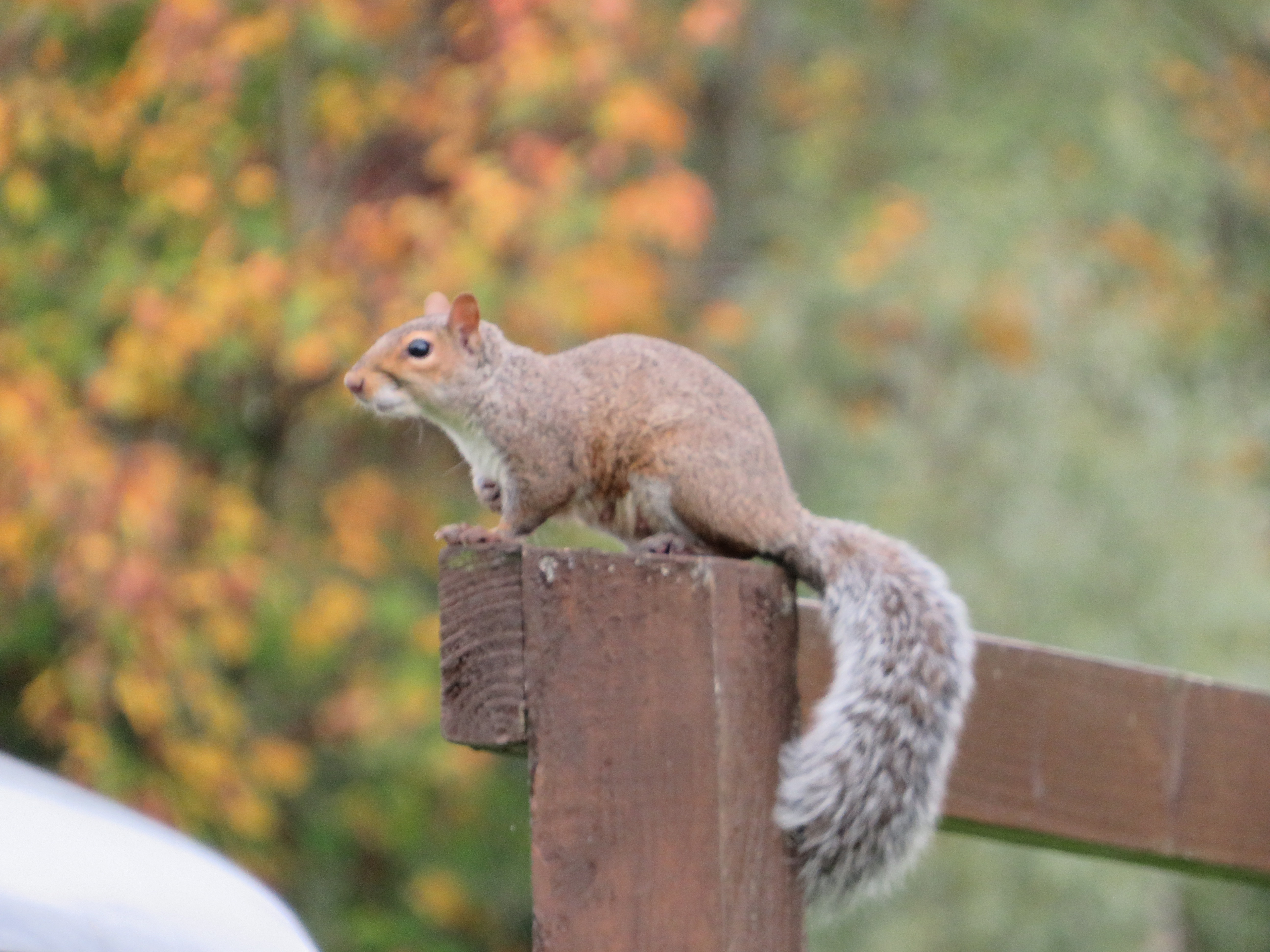
This is a day to make use of my RSPB life member status and we visit the reserve at Ynys-hir. The reserve is a pleasant setting but notable for its lack of wildlife. Tally, one robin, one thrush, a few squirrels and an unidentifiable, distant bird of prey. In the absence of my own coat, which is sitting on the peg at home, I have appropriated a waterproof coat from the caravan. One of those two words, waterproof and coat, accurately describes this garment. Half way round the second of two trails the heavens open, mostly it seems on my head. We squelch back to the car and call it a day.
Day 5 To Brecon and Llangorse Wildflower Meadows
Time to journey 60 miles down the A470, back towards home and move to a new site at Brecon. This has the advantage of us being able to access more than three TV channels and it has wifi that reaches to the van. Ok, so it is officially the slowest wifi in the world but it beats sitting in a car park. We arrive by lunchtime and decide to explore the nearby wildflower meadows at Llangorse. ‘Park by the common’, it says. First problem, identify the common. It turns out that it wasn’t the tiny, scrubby piece of grass where we leave the car. We do find the enormous common on foot but I am not convinced that we reached the wildflower meadow, unless it was an area of unmown grass with some clover growing on it, not quite the poppies, cornflowers and ox-eye daisies that I was expecting. We did find a Crannog, an ancient lake dwelling familiar from our trip to Scotland and plenty of ducks. If you are wondering why we didn’t use a map, there is a bit of a map issue for this part of the trip. As usual, I made sure I purchased an OS map before leaving home. This is the Brecon Beacons, surely I need a map called Brecon Beacons? No. It turns out that there are three that cover this area and I have chosen the wrong one. Map of the western half of the Brecon Beacons anyone?
Sad to see Emma Raducanu’s enforced retirement from her Wimbledon match on our return to the van.
Day 6 National Botanic Garden of Wales
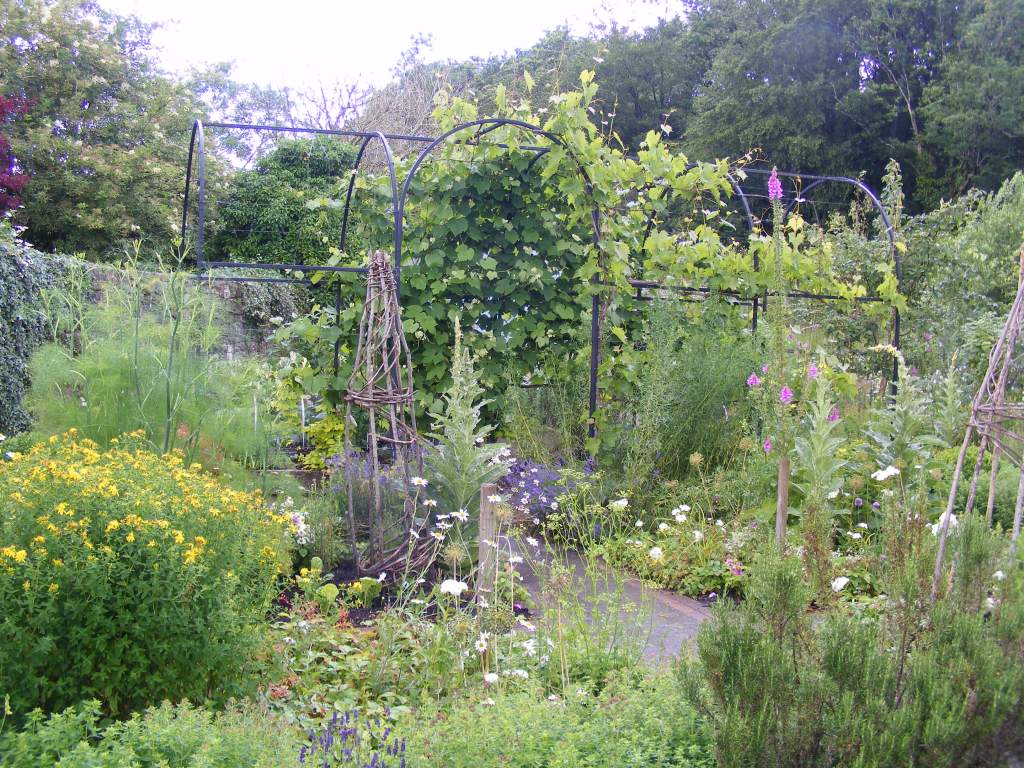
The National Botanical Garden of Wales is on the itinerary today and this is the furthest we plan to go from a site. Today we have our fair share of road re-surfacers again but all the roads that aren’t being re-surfaced are having their verges/hedges cut, so the stop-go board count rises even further. The sat-nav insists that we have reached our destination. We haven’t. We drive round the block a bit in search of helpful brown signs. After a few miles we pick these up and discover that we should have turned left when the sat-nav insisted on us going right. The gardens were definitely worth the drive and the effort. There is plenty to see, including an Eden Project style biome and a bird of prey centre. Inevitably my favourite parts were the less formal apothecary’s garden and the allotments. There is a display associated with medicinal plants and some beautiful quilt panels depicting herbs. I also learn about the physicians of Myddfai, whose story began with Rhiwallon who was the thirteenth century court physician to the Prince of Deheubarth, Rhys Grug. Their tradition continued until 1739 and the Red Book of Hergest, which records their remedies, is held out to be one of the most important Welsh manuscripts from the Medieval period. I couldn’t resist looking for an English translation.
We return via a local supermarket of our choice. This is the second time I have been in a shop since March 2020. I still have 1000 steps to hit my daily target, which I’ve maintained all year. It is now raining persistently. My options are to circle the site in the rain or to make myself look like an idiot jumping up and down by the cold counter in M********* whilst my companion loads up the yoghurt and milk. I’ve tried getting soaking wet doing laps of a caravan site before. Fun it is not. I go for surreptitious jogging as I examine tins of beans and load the bag at the checkout. Yay 1000 steps accomplished.




 The History Interpreter - Janet Few