Southampton – Day 1 of our genealogical cruise adventures

I never need an alarm clock; I can’t remember the last time I set an alarm and did not wake up before it went off. Equally, it must be months, if not years, since I was not awake before 6am. I have to be ready to leave the house at 6.45am. Initially, I don’t bother to set the alarm, then I decide that this might be the one time that I need it. The redundant alarm clock is already set for 6.10am from earlier in the week. I don’t bother to change it. I wake up at 4.45am, maybe just a little too early. I can’t get back to sleep. Oh, it turns out that I can, at about 5.30am, only to be woken by the alarm at 6.10am! Nonetheless, I am only a couple of minutes late when the taxi, aka Chris, arrives.

An uneventful journey is marginally enlivened by being stuck behind a cesspit-emptying van with the registration letters POO. We arrive at Gate 10 of Southampton Docks, having picked up Chris’ daughter, who is kindly going to drive the car back to her nearby house for the fortnight. Now comes the dreaded procedure that is getting Chris’ large metal box of seventeenth century medical instruments on board. As these include axes, saws and knives, albeit blunt ones, we have not left this to chance. The getting permission process started over a year ago when we spoke, in person, to the security officer on this very ship. Since then it has involved several phone calls to America, even more phone calls to Australia, emails, on-line chats, sending out a detailed inventory complete with photographs and the efforts of seven people. Only this week did we get an email that suggested all might be well. Being an American ship, it might have been easier to bring the musket on board; we could claim the second amendment. We encounter a very rude member of staff at baggage handling, when Chris, admittedly a little curtly, explains we have permission to take the box on. She then refuses to tell us where security is, on the grounds that ‘we obviously knew everything’. This left rather a sour taste. Using our prior knowledge from a previous cruise, we find security without troubling her to do her job, only to be greeted with, ‘Oh, we were expecting this last week’. Have we inadvertently gained permission to take the kit on the wrong cruise?

Chris has to carry the box on board himself. It weighs all of four stone. It is a very long way. He is looking in dire need of medical help. Never fear, there’s a barber surgeon on board. Oh, that would be him then. With several thousand people on The Explorer of the Seas, our home for the next two weeks, it is a happy co-incidence that we find ourselves sharing the lift with friends. It will be an hour before our cabin, sorry ‘stateroom’ (it is a windowless box), is ready. Encumbered as we are with a large metal box containing medical equipment, not for us are the refreshments of the Windjammer Restaurant, or sunning ourselves on the open deck. We need to wait until we can dispose of the kit. We pass the time people watching. A security chap complete with riot helmet walks past, pushing a trolley marked ‘clean laundry’. This appears not to be designed to fool. What is inside does look remarkably like freshly ironed sheets. Pristine bedlinen is obviously at a premium.

Cabin inspected, we head for refreshment. Enormous slices of cake, luridly decorated with a Union Jack, are being served. Why is it that red food colouring never comes out red? Numerous portions of untouched cake are being left on plates. As on previous cruises, I am appalled by the food waste. If you don’t like cake, why take a slice? We have a view over Southampton Boat Show. I am unimpressed by gleaming, luxury yachts. There is however a tall ship that looks much more fascinating.

Next, the obligatory but farcical, safety drill. It seems that some of our fellow passengers do not understand the concept of obligatory. Are we all to be kept here in detention until the miscreants arrive? I wonder if any provision is made for those on board with sensory issues. Bright lights, noise, crowds, having to remain in the room, all the stuff of which nightmares are made. I might just ask how they would ensure that such passengers were accommodated. I have zero intention of bringing a person with sensory issues of my acquaintance on a cruise (the mind boggles) but spreading awareness is no bad thing.

We set sail; is that the correct expression for a vessel with no sails? The Isle of Wight slips past and we wave to invisible friends. Chris has already consumed two ice-creams from the help yourself ice-cream bar. Then a meet and greet for conference goers, over half of whom we know; it is great to get reacquainted. Food next and it is ‘Tex-Mex’ night in the Windjammer. We habitually reject the two sprigs of asparagus and a bit of drizzle on offer in the formal dining area. I’ve gone for sweet chilli chicken and Chris is tucking in to salmon and the first of what I am sure will be many steaks. On our last cruise he ate his way through a whole cow. Another reason for rejecting the formal dining is that I find being waited on discomforting. It is not at all the same as in a British restaurant. The staff act like we are better than them. We aren’t. It should not be a job requirement to be so self-effacing but it is.

002 21 September 2019 Southampton Boat Show.JPGPaul Milner begins the conference with an interesting session on ‘The English Context: history, sources, repositories and processes.’ A veritable minefield for those researching from overseas, as most of the audience are; there are only five Brits at the conference. We debate why some counties are shires and some are not. Could it be the migration patterns? Why is County Durham, the only county to be described in this way? Probably because it is the only non-shire to have a county town (or indeed city) of the same name as the county, so it is a way of distinguishing between the county and the city. And so to bed. On our way past a public area an enthusiastic member of the entertainments’ team is exhorting his audience to believe they are butterflies. Numerous apparently sane adults are waving their arms, sorry wings, about. We don’t linger to find out what all this is about. The ways of cruise ships are unfathomable.

More Cornish Wanderings with Family History for Good Measure

I know it was a while ago now but I did have another day of holidaying to share. So just in case anyone is wondering why they have been left in limbo, or in our case in Cornwall, here is the final episode.

After an early morning look at Looe for another fishing boat fix for my travelling companion, we head to Cotehele. On the way we fit in another family history parish. Since I have been home, I have been trying to take these newly-found Cornish ancestors further. One just might be a ‘gateway’ ancestor, taking me back to Medieval times and potentially royalty but let’s not get ahead of myself. It holds together well back to 7x great-grandfather Richard Rowse/Roose/Ruse/Ruze but I need to convince myself that his potential father Walter (who does seem to be the only Walter around at that date, didn’t marry until he was in his forties. Further speculation needs to wait until I can get to the new Cornwall archives.

082 15 July 2019 CoteheleOur first task at Cothele is to hunt out our memorial tree in the fruit orchard. We think we know roughly where it is. We also think we know what variety it is but we fail to locate it. Once again we are hampered by the environmentally friendly attempt to let the orchard go wild. Tramping through long grass trying to find a variety label that has probably long since gone is not fun. Reception provide us with a guide, which suggests that we are looking for the wrong type of tree. I am still not sure that the tree we pay homage to is actually the one that Martha and I planted in 2008; we are both convinced it was a different variety, to the extent that I purchased one of the same type for my garden.

We tour Cothele house, which belonged to the Edgecumbe family. Most of the present building is Tudor but the interior is largely seventeenth century in style. It is one of my favourite National Trust properties and always seems very homely. Surprising then to discover that the family only lived there full time during Civil War. Somehow this had escaped me on previous visits. Not bad for a holiday home. They used it as a showcase for their various collectables. To this end, bizarrely, they have a china closet in the bedroom, presumably so guest can admire the cups and saucers at night. This showcasing lark is not always successful as various tapestries have had bits hacked off them in order to fit the rooms. We manage to miss being in the right place to hear the iconic clock strike twelve. We walk down to the quay before deciding that it really is too hot to be outside and returning to our van.

All in all, it was a gentle sort of holiday and because we are not far from home and have been many times before and hopefully can again, there was no pressure to rush round places thinking this will be our only opportunity. Nothing beats glorious landscapes, the sea, sunshine and the chance to immerse yourself in heritage, both personal and more general.

An Ancestral Odyssey – or churchyards we have known

We spend a day touring round numerous, remote Cornish parishes that have ancestral associations. I am reminded how much I enjoy map reading, or following along on an Ordnance Survey map, with the sat-nav for back-up.

We drive out past Kit Hill, which is a former mining area on the edge of Bodmin Moor and enjoy the spectacular views. I know it is not a good idea to tour churches on a Sunday, nonetheless here we are doing it. On the upside, it may mean they are open but it also means they are full of worshippers. So begins a game of dodge the congregation, at which we are only partially successful.

We start in Sydenham Damerel, which is actually back across the Tamar in Devon and arrive just before the service begins. My 7x great grandparents, Matthew Deacon and Joan Cowl, married here 200 years ago. The church was burned down and rebuilt on smaller scale to reflect diminishing congregations, so only tower is original. This means I cannot imagine them walking down the aisle. The proximity to the River Tamar is significant, as the Deacon family end up further down the river in later generations. It is always a good idea to look at maps to understand ancestral migration routes and remember that, historically, water is far more likely than land. The next stop is Stoke Climsland and here the service is just finishing. Unusually, it seems they have a thriving congregation. Two branches of the family married here. The next generation of Deacons, Walter Deacon and Mary Bennett in 1752 and 6x great grandparents Samuel Braund and Jane Lucas in 1741.

Stoke Climsland 61

Stoke Climsland

I descend from the Kenner family. This is a branch that my online searching in the caravan has potentially extended by three generations. There is a likelihood that they once inhabited Trekenner (Tre being Cornish for farmstead). We drive past but there is no obvious old farmhouse. At this point there is a diversion to a nearby superstore for a toilet stop. The places we are visiting consist of a few cottages and a church. There are no public toilets, cafés or pubs and even if there were, cafes and pubs would necessitate buying a drink and thus somewhat defeat the object.

We resume at South Petherwin where the service is finishing. 7x great grandfather, Thomas Kenner was baptised here in 1664. We take a look at Kennard Farm, another likely abode for the family but again can only spot modern buildings. On to Lewannick and at last, an empty church Two more ancestral marriages took place here. Thomas Buckingham and Ann Davey in 1732 and William DiIling and Susannah Davey in 1733. I am sure the two Davey brides are related but I have not yet found their baptisms.

The final port of call is North Hill and the only locked church of the day. The churchyard has been deliberately left to be wildlife friendly. Whilst this is very laudable, it does mean that we encounter long grass, stinging nettles, ants’ nests and other hazards in our hunt for gravestones. This is the only location where there are any relevant headstones, probably because this was home to more recent generations of the Buckingham family. None of my direct ancestors rate a gravestone but they are here somewhere.

It is so important to walk in the footsteps of your ancestors, to get a feel for where they lived and the landscape they would have encountered. If you can’t do this literally, I recommend a virtual trip using Google Earth. Here, back on the edge of Bodmin Moor, it looks glorious today but it is very isolated and would have been bleak in winter. I suspect the Buckinghams had little time to appreciate the scenery, which would have been unremarkable to them as it was all they knew. I am now fired up for taking another look at this part of my ancestry. All I need is a few days with 48 hours in them……..

Getting Stuck and Making (family history) Progress

I know you thought I’d abandoned you all in the depths of Cornwall but no! There is still more to reveal, it is just that the job I must not mention has kept me busy for the past few days. We move sites again and are now (well not now this minute obviously but we were when I wrote this) just outside Looe, I bet you never even noticed, did you? The journey was uneventful and with the aid of our special caravan sat-nav, we miss the roads that the instructions warn us to avoid. Once pitched, we set off for a supermarket near us. We have told the sat-nav we are now a car, so it takes us up the shortcut. This is clearly the no-go road for caravans as our wing-mirrors are touching the hedges on either side. There are occasional passing places should something be coming the other way, which inevitably it does. Heading up hill towards us is a jeep pulling a large trailer that is wider that the car. We know the drill, give way to things coming up hill, especially when they are bigger than you. All this narrow roads lark is a doddle to us anyway, we are used to it and we go to reverse. Behind us is another car that clearly needs to reverse first. By this time, there is a car behind the trailer too. No one is moving. Eventually, the car behind us begins to go backwards, into the hedge, she drives forward again (I hate to admit it was a female driver). Backwards a couple of yards, into the hedge again, forwards a yard, she repeats this numerous times. The jeep driver and I are exchanging ‘good grief’ gestures. In all she is going to need to go back 200 or 300 yards, we could be here all day. In the end my travelling companion gets out and offers to drive the car for her. She insists she can do this. It is not clear on what experience she is basing this claim. She thinks the car with the trailer should be reversing instead. Granted he was nearer to a passing place but trailers do make reversing difficult. To be fair, it isn’t clear why he is on this road (and I use the word advisedly) in the first place. Eventually, the inept reverser manages to travel backwards sufficiently to tuck into a passing place. After all this, once back in the van we decide to stay there watching Simona Halep slaughter Serena Williams in the Wimbledon final, followed by an incredibly close and lengthy men’s doubles.

074 15 July 2019 Looe

Meanwhile, I am preparing for a family history tour tomorrow by revisiting some of my southeast Cornish ancestral lines. Most of these branchlets of my family tree have been lying dormant for forty years, a long while B.C (before computers – or before home computers at any rate). Time to take them out, dust them off and revisit them. A quick look at what is now online, including the super-useful Cornwall Online Parish Clerk’s website, suggests that I can potentially add several new ancestors. It will need checking out in the original records when I can get to the soon-to-be-opened new Cornwall Records Office but it looks like my 11x great grandfather was one Henry Speare of Lezant, who would have been born about 1515. If this stands up to scrutiny, he will be the earliest ancestor on my tree. It is likely that he was born about thirty years before my previous earliest ancestor (also an 11x great grandfather) William Elford. Coincidentally, they are both ancestors of my great grandmother Fanny Thomasine Bishop.

Sorcery, Seagulls and Sea-Shanties

A later start today, as we work our way along the coast eastwards to Boscastle. There are some boats for the fisherman of my acquaintance to view and we wander down to the harbour. Then a tax-deductible visit to the Museum of Witchcraft and Magic, which was founded by Cecil Williamson in 1960. Sadly, some of the exhibits were lost or damaged when the 2004 flood reached roof level, although many were salvaged. I make a few notes with my presentations on seventeenth century witchcraft in mind.

We move on to Port Isaac. We are here to see Fisherman’s Friends again, this time in what they refer to as ‘their natural habitat’. They began as a group of friends who sang together locally until they were discovered by a holidaying record producer. With the increased exposure following the cinema screening of a fictionalised account of their lives and the continuing good weather, it is likely that there will be many people heading to Port Isaac tonight and I am anxious to secure a parking space. We reach Port Isaac at 4.00pm and have to queue to park. By the time we have walked along the coast path to the harbour, there are already people marking their spot for the evening’s performance. We decide against eating in one of the food outlets. The rising popularity of Port Isaac, not only because of Fisherman’s Friends but also because it is the location of television’s Doc Martin, has impacted on the prices. So it’s takeaway pasty on The Platt and a game of foil the seagulls. Us 1 seagulls nil. It might seem ridiculous to spend three hours sitting on very hard, ridgy concrete waiting to listen to a concert but it is what we came for and the crowds are swelling by the minute, so that’s what we do. I think I may be getting a bit past this sort of thing!

The disadvantage of not eating in a restaurant is that we need to use the public toilets. Keen to extract as much as possible from the visitors and who can blame them, the council charge 20p to enter. I have no particular objection to spending 20p to ’spend a penny’ (ok, well I probably do) but it does mean you need to have the correct coin. We have ensured that we do have one each, as a result of the pasty purchase and I head off to use mine. I insert my coin. The door buzzes. I turn the handle and enter, only to find a surprised gentleman in full flow (it was a unisex toilet). I hastily apologise, although it was his fault for not locking the door and back out. Now I no longer have my 20p. Fortunately, someone held the door of their toilet open for me. Back on The Platt and the seagulls get their revenge. No more 20ps means no way of washing this off my hair, so we go for dabbing a bit and hoping my grey streaks will disguise it. The concrete is feeling less hospitable by the minute but we enjoy people watching and identifying those who are likely to lose their gourmet burgers to the seagulls.

072 12 July 2019 Fisherman's Friends on The Platt

The band arrive; they are fielding nine members tonight. In a way it is a shame that their popularity has made these charity evenings such a big event and that it has lost some its informality but it is certainly big business for Port Isaac and fair play to them for making the most of the local business opportunities. It is lovely that the band seem as excited to see the large crowds as we are to see them. Tonight’s is their largest audience ever; perhaps some two thousand people. I hope they realise how much they would have to pay to hear this band elsewhere and even though they have to bring their own chairs, sit on concrete or stand, I trust they will give generously when the collecting bucket comes round. The Platt is full and there are people lining the paths on both sides of the valley. The music is, as always, stirring and a wonderful representation of our sea-going heritage. The backdrop of the harbour adds to the atmosphere. As the sun dips behind the cliffs, it does get a little chilly. In an attempt to mitigate the ill-effects of the concrete on my anatomy, I am sitting on my coat. I now have to make the decision between continuing to sit on the coat, thus being chilly and putting it on to keep warm but being more uncomfortable than I already am; I opt for the former. All too soon the evening is over and we decide that the atmosphere made the long uncomfortable wait worth the while, although we would do things differently if we came again, including bringing a supply of 20ps. To top it off, there is a wonderful sunset over the sea as we walk back to the car park. It seems we were lucky with our car parking as many of the audience have been directed to a field about a mile away.

073 12 July 2019 Sunset from Port Isaac


Discovering Eden

After more than ten years, we decided to make a return visit to The Eden Project. We arrive early and are directed to Lime 1 car park, which is nearer to the entrance than some. We walk down to the entrance and wave our annual passes, which were the same price as a single in advance ticket. Last time I came, I qualified for reduced student status entry. We wander round the pathways surrounding by a stunning variety of plants. The round the world allotments are fascinating, each growing vegetables that feature in a different international cuisine, that is now represented in the British cultural mix.

Next it was time to enter the biomes. This is the nearest I am going to get to the tropical rainforest. Perhaps it is because there is less contrast with today’s outside temperature but it doesn’t seem to be as unpleasantly hot as we remember from our previous visit. I spend some time trying to photograph the roul roul. These are birds that live in the biome in order to control the insects. They all seemed to travel in pairs and some had chicks. The photography was tricky for several reasons. These little, quail-like birds never keep still, continually making a backward scratching motion with their feet, presumably hoping to bring insects to the surface. They also like to shelter under the leaves, making it quite dark and using flash was not appropriate. My cheap camera is really not up to this. We climb the aerial walkways but pass on the very highest look-out. We then move to the Mediterranean biome, a foretaste of our upcoming holiday.

There is a building called The Core, which I think was being constructed last time we were here. This includes some art installations that I am not sure I fully appreciate. Infinity Blue, billed as a breathing sculpture, is however fascinating. Periodically, it huffs out smoke from apertures around it’s twenty-five foot high form. More not hugely successful photographic attempts ensue, as I try to capture the smoke rings.

I climb round a grassy area to photograph some wild flowers. It is only on my way back past a barrier that I spot the sign that reads no admittance – oops. The whole regeneration concept of Eden appeals to me. It is sited in a former quarry, a legacy of the china clay trade. I would like to see a bit more of the history represented but the use of the site as a way of ‘promoting the understanding and responsible management of the vital relationship between plants, people and resources leading to a sustainable future for all’, is admirable. Being a former quarry, the site is decidedly slopey and we have done our fair share of walking up and down hills over the past few days. We decide to head back to the car, especially as there are black clouds looming. We wander up, we wander down. There are helpful signs directing us to various parts of the site. None seem to indicate the way out. Shades of Glendurgan once again; are we trapped here forever? It seems not and evetually we are on our way.

On our outward journey we passed through Luxulyan. I have Cornish ancestors; much of this part of my family history has had little attention for more than forty years but Luxulyan rings a bell. We stop off so I can take a quick photograph just in case. The rain comes to nothing and I take a look at my Cornish ancestry in preparation for a tour round some ancestral parishes in a few days’ time. I may have made a minor breakthrough.

A Riverside Walk

We return to the south coast to revisit one of our favourite stretches of the south-west coast path. I picked up a ‘where to park for free if you are a National Trust member’ card at Bedruthan and this is proving handy. We head for Bosveal, which is pretty much a car park and nothing else. Following the coastal footpath westwards to Durgan takes us to the back entrance of Glendurgan Gardens. Thinking it would rude not to take a look, we enter. Let’s be clear, this is a legitimate entrance and the notice on the gate instructs us to pay, or in our case show our membership cards, at the main entrance. Main entrance? We walked up, we walked down, we declined the option to walk round the maze, which is in any case full of a school party. We seem to be in a maze of our own. We think we can see where we need to go but that pathway is marked private.

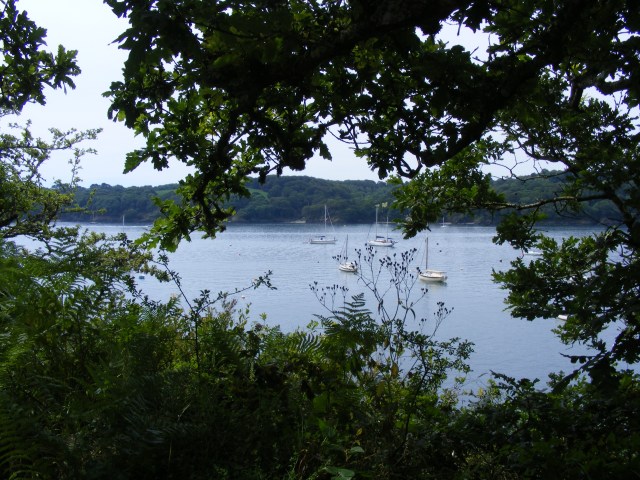
The garden is beautiful by the way, nestled in a valley which gives it a near sub-tropical climate. The weather has turned quite humid today, which adds to the atmosphere. In the end we give up the fruitless hunt for the main entrance and continue along the path to Helford Passage with the Helford River estuary on our left. We are decidedly out of walking practice and it really is very hot. Conscious that every step we go forward, means another step to go back, we return to Bosveal, with a short stop for an ice-cream on the way.

043 10 July 2019 Helford River

A quick supermarket visit before driving north once again The good thing about Cornwall is that is a long narrow county, so it is never very far from north to south. Fortunately, our evening meal was cooking before I noticed that a mobile pizza van, whose owner has enhanced grammatical skills in comparison to that of the fish and chip van proprietor, is due to visit the site tonight.

Elizabethan Delights

The weather continues to be hot and sunny, an ideal counterpoint to the Cornish landscape. Today we head to Trerice, another property owned by the National Trust. Again we arrive in time for an introductory talk. This is not on the scale of Richard’s in-depth presentation at Levant Mine, which is probably just as well, as I am standing in full sun. I am smothered in factor 50, unusual for me as my boot-leather skin withstands most that our climate throws at us but this prolonged sunny spell has had even me turning to the bottle.

This area has been farmed since the iron age and there is a record of an Udo Trerice owning a longhouse in 1300. The name means farmstead (Tre) by the ford on the running water (rice). The fact that, until the sixteenth century, the river at the back of Trerice was navigable to the coast and that the river was fordable at this point, explains the decision to build here. Michael Trerice, son of Udo, had a daughter Jane but no sons. She married Ralph Arundell and the estate passed to the Arundell family. Strangely, I have always pronounced this Arun-dull (like the place in Sussex) but our guide is saying A-rundell. Regardless of pronunciation, the Arundells were on the up and became one of the major landowning families in Cornwall. In 1572, John Arundell built the current Trerice in order to have a home that was commensurate with his status. The house is small but bears many of the hallmarks of the archetypal Elizabethan manor. It was created in the traditional, symmetrical E shape, in honour of the queen. One wing of the house is now missing. We find it difficult to make sense of the layout. The ‘front’ is clearly more ornate but somehow, to us, the ‘back’ is more convincing as the original front, if you see what I mean.

The house is built from locally-quarried Elvan stone, which is a warm yellow colour. The regular-sized, hand-hewn blocks were just one of many features that were a testament to the wealth of the owner. There were fashionable Dutch gables, a ‘feature’ glazed window in the hall, chimneys, plasterwork ceilings and a long gallery, so the residents could exercise in bad weather. There is also a knot garden, which is currently filled with lavender.

The Arundells were staunch Royalists. During the English Civil War, John Arundell, known as ‘Jack for the King’, held Pendennis Castle against the Parliamentarian forces for five months before surrendering, despite being in his seventies at the time. He was also instrumental in getting Queen Henrietta Maria and Prince Charles (the future Charles II) safely to the continent. Although the estate was sequestered, it was returned at the Restoration. A North Devon connection is that his wife was Mary Carey of Clovelly.

The male Arundell line died out and the estate passed firstly to the Wentworths and then to the Dyke-Aclands of Killerton. From this point, Trerice was not lived in on a permanent basis and little maintenance was done, leading to considerable damage. It was owned by Cornwall County Council for a time and they utilised the land to provide tenant farmsteads for soldiers returning from the First World War. In the 1950s the Elton family held Trerice on a repairing lease and amongst other things, replaced the roof with Delabole slate.

040 9 July 2019 Trerice

Inside we find another ‘homely’ residence. There is armour on display, we are invited to try on helmets. It hardly seems fair to mention that I have several of my own at home. There are also replica Tudor games on display and several long-case clocks. I know lighting is kept to a minimum in these places, in order to prevent damage but Trerice does seem particularly gloomy. It is only when I remove my glasses to read some small print that I realise it is the fault of my sunglasses. I need to get used to taking the ordinary glasses round with me as well. We sit and have a refreshing drink, strongly resisting the cake, then wander round the gardens. We decline the opportunity to play kyles, a Cornish version of skittles and slapcock, an early version of badminton but played with participants standing in a circle and batting a chicken’s head to each other. No wonder the shuttlecock was devised as an alternative. I should perhaps add that no chickens would have been harmed had we decided to play as there was a more acceptable alternative available.

Wonderful though the weather is, it really doesn’t make walking very far an appealing option, so once again it is back to the site to sit in the shade. I could get used to this relaxing lark. Despite a sign reading ‘Fish and Chips here on Tuesday’s’, I manage to overcome my hatred of mis-used apostrophes sufficiently to partake of said delights, well I would be rude not to. The diet starts errr……. Let’s just hope the next site doesn’t have a visiting fish and chip van too.


The North Coast

It is time to leave our site and head to one on the North Coast. Unusually for Caravan and Motorhome Club sites, the one we are heading to is not pre-programmed in the sat-nav. The site details in the handbook warn us not to use the sat-nav but they only provide written instructions for those approaching from the east. We are approaching from the west and the route makes little sense from our direction. There is no street address for the site, so we plug in the postcode, hoping not many addresses share the same code. As a back-up I am following along on the map, although it is a little unclear exactly where the site entrance is. This, dear reader, was not a good thing to do. We trail blaze through narrow twisty lanes that are barely wider than the caravan. My map-reading skills have not deserted me and the trusty chauffeur demonstrates his caravan towing capabilities with aplomb. We arrive relatively unscathed.

With caravan ensconced in its new abode, we head out along the north coast and park at Bedruthan Steps. The Cornish coast is looking spectacular once again, with clear views and the sea twinkling in the sunshine. The sky is a bright, intense blue that contrasts with the darker colour of the sea. We agree that, despite all the wonderful all the places we’ve been in the world, it is hard to beat the scenery we’ve encountered here at home in the last couple of months. Even though it is past the middle of the day, it is too hot to walk far but we wander along the south-west coastal path for a short way, remembering when we walked this stretch, before we postponed coastal path walking in favour of grandchild visiting. We completed over 475 miles, walking from Minehead to Dartmouth and I wonder if we will finish the last 150 miles or so before we are too feeble?

038 8 July 2019 Bedruthan

Mostly About Gardens

Today we visited Godolphin House and gardens. Godolphin is only a few miles from our caravan site and the village fête was being held in the grounds; I am not sure that the latter was an advantage! Godolphin house was built in 1475, on the site of an earlier fortified dwelling and the family made its money from mining. There were major renovations to the house in 1540. These were probably funded following an incident that took place in 1527. A Portuguese flag-ship ran aground nearby and the member of the Godolphin family who was then in residence, along with a St Aubyn of St. Michael’s Mount and other gentry, claimed the proceeds of the wreck. There was an enquiry, when the King of Portugal attempted to get his property returned. Those heading up the enquiry claimed that appropriating the cargo of wrecks was ‘the custom of the county’ and there was no case to answer. This may be because both Godolphin and St Aubyn conducted the enquiry!

When the National Trust acquired the house about ten years ago, it was in a poor state structurally. The infrastructure does not allow for sufficient footfall to support the house through visits alone, so it was decided to sympathetically convert it into holiday apartments. This means that the house is only open to the public, one week a month; although the gardens are open every week. We were fortunate that our stay coincided with one of the house open days. It is a very friendly house, with a lovely atmosphere. There is some impressive linen-fold panelling and a carved fireplace dating from 1603. I was also taken with a chandelier and an oak table that appeared to have been patched but I failed to photograph this. The Godolphin family have been notable in the horse-racing fraternity and Sidney Godolphin was Prime Minister under Queen Anne.

We walk round the gardens, which are a profusion of cottage garden plants and wild flowers. We make a cursory circuit of the fête and my travelling companion is able to look at the tractors and military vehicles on display, one of which he was responsible for selling. We go on to Trengwainton Gardens, which we were unable to visit yesterday. I’ll be honest, I am a little underwhelmed here, although I should think they are stunning when the rhododendrons are in full flower. Maybe I am just gardened out.

035 7 July 2019 Trengwainton Gardens034 7 July 2019 Godolphin House033 7 July 2019 Godolphin House036 7 July 2019 Trengwainton Gardens029 7 July 2019 Godolphin House Linen-fold panelling028 7 July 2019 Godolphin House030 7 July 2019 Godolphin House031 7 July 2019 Godolphin House 1603