Back to the Iron Age and various Wildlife Encounters

We are booked on a forest safari with Highland Safaris first thing, so it is up at the crack of dawn. I’ll admit that it was slightly earlier than strictly necessary but we are able to lurk in the car park waiting for them to open. We have been on an excursion with this company before but have decided to do another short trip because we enjoyed it so much the first time. We find our way to the safari centre in the village of Dull without incident. I was amused to learn, on our last visit, that Dull was twinned with a town called Boring in Oregon. Apparently, it is now also paired with Bland in New South Wales! Dull is in fact a corruption of the Gaelic for ‘raised meadow’ and was a seventh century monastic settlement. Our tour guide is Dave and we are accompanied in our land rover by a family with a small boy. Again, I am impressed that a family is introducing their offspring to wildlife. We drive through the beech, birch and larch forest, many people don’t realise that the latter are a needle shedding pine. There are also introduced species of pine and the broom is in full flower.

As usual, we are a kiss of death when it comes to wildlife spotting and red squirrels and red deer are both conspicuous by their absence. We don’t see pine marten either. They are much more elusive, so that would have been less likely; although I have seen one on a previous trip to Scotland. We learn that pine marten are useful because they will predate on the grey squirrels but not on the red. There are awe-inspiring views of the Tay valley and we see patches of snow on the heights. Although there are longer rivers, the volume of water in the Tay is greater than any other British river. The first bridge across the Tay was part of General Wade’s bridge and road building scheme, which aided troop movements when he was tasked with suppressing the 1745 Jacobite Rebellion. The town of Aberfeldy grew up round this bridge. It is thought that the Gallic sounding nearby Coshieville may have been so named because the French POWs used by Wade on his road building projects were billeted there.

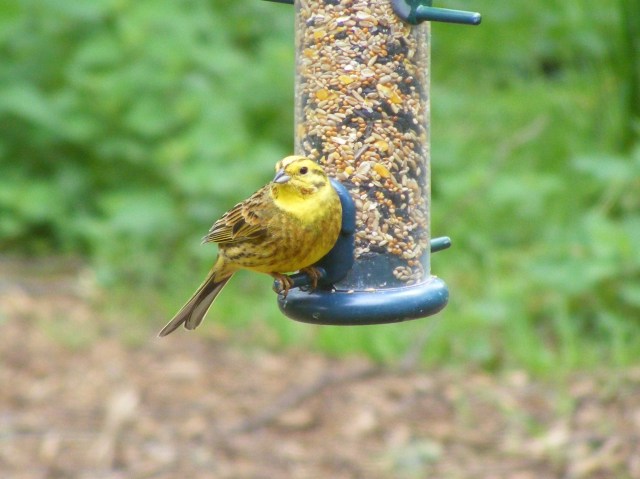
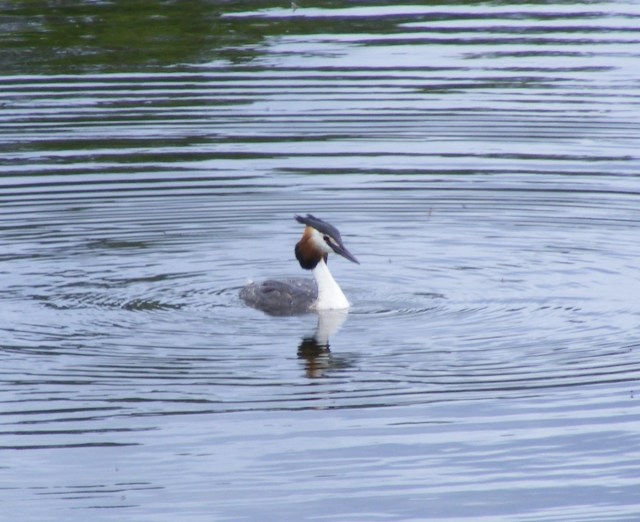
To make up for the lack of wildlife on the nonetheless awesome safari we do see a hare as we leave the site. We head to Osprey Haven at Loch of the Lowes via a slight detour round the golf club courtesy of our sat-nav. We are in luck here as three osprey chicks have hatched this week, the youngest is just four days old. We watch the nest from the hides and via the web-cam, seeing both parents on the nest feeding the chicks. We also see another osprey circling, which caused the staff some concern as it could be a threat to these chicks. I do love the ospreys but watching the birds on the loch and at the feeders is just as good, although again the red squirrels elude us. We get a great view of a pair of great-crested grebes and there are yellowhammers and randomly, a mandarin duck on the feeders. The latter has been visiting for several years and is thought to be an escapee from a private collection.
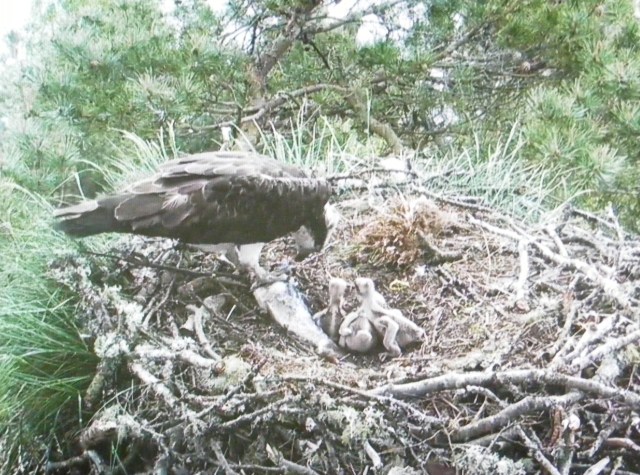
053 20 May 2019 Osprey nest Loch of the Lowes

049 20 May 2019 Great Crested Grebe Loch of the Lowes

063 20 May 2019 Yellowhammer Loch of the LowesDave from Highland Safaris has recommended a visit to the Crannog Centre, which does not feature in the guidebooks or on any leaflets we’ve seen. We don’t have a great deal of time and we wonder if it is worth paying the entrance money. It so was worth it – an amazing reconstruction of an iron age structure complete with a variety of historical interpreters spinning, dyeing, cooking, boat making and creating an enormous set of bellows. With our own ‘neo-building’ experience, this is particularly interesting to us. The whole thing was fascinating, highly recommended.

I will pass on the snippets that we gleaned during our visit. A Crannog is an artificially created island and although there were earlier examples, nine were constructed on the loch between 600 and 400 BC, including the one on which this reconstruction is based. ‘Cran’ means branch and ‘og’ means young. Strictly ‘cran’ is ‘a branch shaped like a pregnant woman’. This led to the, now discredited, theory that these structures were birthing chambers. The word is medieval, not iron age like the islands and may refer to the shape of branches used. Not actually sure I quite buy this explanation. The original would have had a roof of bracken and heather, rather than reed but the charity cannot afford to replace the roof every two years, which would be necessary if bracken had been used and reed is not out of place for iron age structures. Each crannog would house fifteen to twenty people. The last inhabited crannog, lived in by nuns, was abandoned in 1740.

The experimental archaeologists tried several methods of erecting the main piles for the crannog. They discovered that trying to float them out in log boats is a fail, as you can’t stand up in a log boat without it rolling – result – a number of wet archaeologists! They ended up using a jetty instead. The walls are made from two layers of hurdles with bracken in between. Daub is impractical because of the weight. The structure would have been built in a single season and would last about eighty years, although they would begin to decay after about fifty years, with the piles rotting and the floors needing repair. Despite the lack of pollution in this area, piles now need replacing four times more often that they did in the iron age, due to the effects of the poorer water quality of the twenty first century.

There is a central stone fireplace but no hole in the roof. Instead, the smoke lines the underside of the roof, helping with the waterproofing. The excavations suggest that the crannog dwellers had a largely vegetarian diet, although animals were kept for dairying and wool. The animals would have been wintered inside part of the crannog. Meadowsweet was used to separate the curds and whey. Surprisingly there is no evidence here, or at crannogs elsewhere, that fish were eaten. This seems very odd. The theory is that those who lived on crannogs were of higher status and that they may have had a spiritual significance, perhaps acting as intermediaries between the land dwellers and the loch deities. Maybe taking fish from the loch was deemed inappropriate on religious grounds. What seems certain is that the crannogs had no defensive function and weapons have not been found, suggesting that this was a time of peace.

Loch Tay, in the centre of Scotland, was in an important trading position and perhaps 10,000 people lived round the loch, on land and sea, in the iron age. It is thought that the crannogs may have been built to save land that could be used for farming but this seems unlikely to me. Apparently the archaeologists found a collection of Mesolithic arrow heads that it seems a crannog dweller had collected and displayed. The crannog also contains an anachronistic eel trap, left by a basket weaver in residence. Health and safety means that the crannog is fully equipped with smoke alarms. I am not sure how this works when they light the fire.

All in all, a special day, with three highly recommended activities and it was topped off by being able to watch The Generation Frame, a Scottish genealogy programme, with people I know featured amongst the experts.
Rainy in the Trossachs

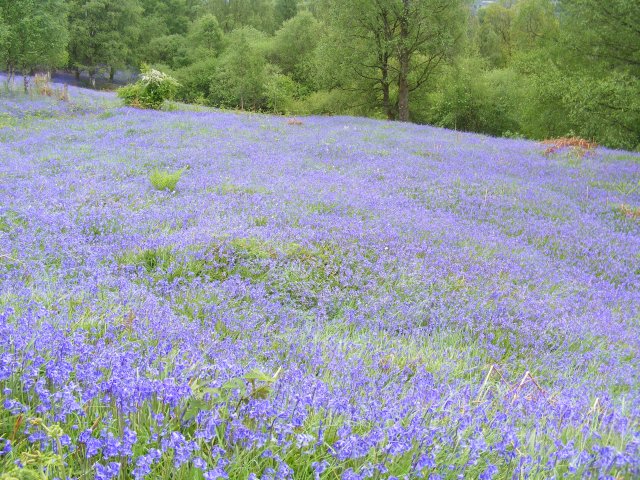
The weather was against us when we moved further north and west to our second and last Scottish stop at Killin. The high ground was blanketed in mist, nonetheless there were glimpses of the impressive scenery as we travelled along the banks of Loch Earn. We secured a lovely pitch on the river bank but decided to have an afternoon in the van rather than brave storm and tempest outside. The next day and the weather was still uncertain, so we opted for a circular drive, recommended in the guide book. This took us round the perimeter of the Loch Lomond and Trossachs National Park. This is a wonderful time of year to be in Scotland. The bluebells were spectacular and many gardens were full of colourful azaleas and rhododendrons.

We stopped off at the RSPB Loch Lomond reserve. This is on a much smaller scale to the one at Loch Levan. Our arrival coincided with a birthday party. I’d be the first to applaud a parent who decides to expose party-going children to the great outdoors but the piercing screams did rather put paid to seeing much in the way of wildlife. The best we could do was hear a cuckoo.

040 19 May 2019 Bluebells Trossach National Park

I was tasked with hiding a panda within sight of Loch Lomond. We stopped by the Loch Sloy hydro-electricity plant, where there is a car park, café and view point. There were also rather a lot of people. I nonchalantly attempted to make it look as if photographing a toy panda is a perfectly normal activity. It is actually quite difficult to do this without drawing attention to oneself. I accomplished the mission as subtly as possible and beat a hasty retreat before I could be accused of leaving litter in a National Park. Not that our lovely pandas are litter of course but you never know.


More Island Misadventures and some Birdwatching

One of the reasons that this holiday to ‘Northumberland’ has seen us detour to Scotland was because I wanted to make a return visit to the Isle of May to see the nesting seabirds, in particular the puffins. Last time we went the weather was truly appalling. It was raining, it was freezing; we were the only sailing that week, all others having been cancelled due to the conditions. This time, I decided I would not book months in advance but would wait until I had some idea of what might be expected from the weather. Unfortunately, everyone else had the same idea, so when I went to book online a few days ago, they were already full. There was no chance on our first choice of day and the only other sailing whilst we were in the area was also full but we were invited to come along on on spec as first reserves.

The sailing is at 9.45 and you have to be there half an hour in advance. The harbour is half an hour away so, naturally, we leave the site at 8am – that is quite restrained for me. By 8.40am we are wandering round Anstruther. The fisherman of my acquaintance comments that, given the state of the tides, the boat looks unlikely to sail within the next couple of hours and indeed the harbour is almost dry. It nears 9am and we approach the booking office. What I have not thought to do is check the sailing times. 9.45am was sailing time on our first choice date. Now the tides have changed and today’s sailing isn’t until 11.30am! We could have had a lie in!

Anstruther is all very lovely, a typical fishing village that has been forced to also embrace tourism. It doesn’t have massive wandering round potential however. An additional problem is that I have believed the weather forecast, which stated that the maximum temperature would be 11 degrees (about 55 in old money). Despite this, people are sitting on the front at 9am in shorts and t-shirts. I however am wearing a long-sleeved t-shirt, my thickest fleece, a waterproof coat and a body warner for good measure, accompanied by my fleecy lined trousers that were purchased for Finland’s minus 23 degree temperatures; I have drawn the line at the thermal long-johns. I am prepared for it being colder out on the ocean. It turns out that the weather forecast is wrong and there is glorious sunshine and despite the keenish wind, the temperature is approaching 20/70. I shed layer after layer. Eventually, the ferry operator arrives and tells us to return at 11.15am. We do as instructed (well, we are there for 11am) and wait with bated breath to see if all those who were booked will turn up to collect their tickets, which are they are supposed to do by 11am. It was close. The last party arrive at 11.27am, so there is no room for us. We are offered places on the rib but I really don’t do adrenaline and this looks a bit ‘adventurous’, so we decline. I am very sad until I realise that we might be able to substitute this trip for a visit to the Farne Islands on our way back through Northumberland.

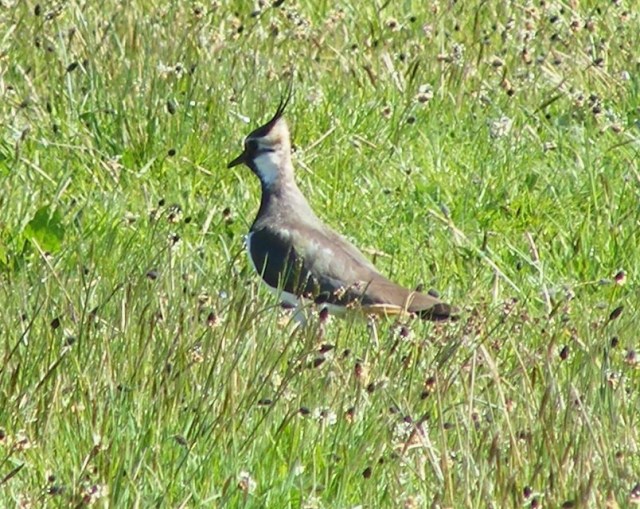
So another day of plan B. I do have thinner clothes in the car and Mr Bean-like, I manage to wriggle my way into these as we set off for the RSPB reserve at Loch Levan. The Loch provided the water supply for local paper and flax industries but was later drained, so the reclaimed land could be used. More recently, the RSPB have restored the wetland habitat and also created the world’s first bee reserve. We walk round the waterside track and see nesting swallows, shelduck, greylag geese, mutes swans, many nesting black-headed gulls, an oyster catcher, a redshank, a grey heron, mallard, a coot and a wood pigeon but the stars of the show are the nesting lapwing, who have declined noticeably in recent years, so we rarely see them now. We watch three adult lapwing mobbing a stoat, to draw attention away from the nests. This causes consternation when we report back to the ranger as the stoat was inside the predator fence.

036 17 May 2019 Lapwing at Loch Levan (1)

Despite some changes of plan, we have enjoyed our stay in Fife and look forward to moving on tomorrow. To top it all we have a booking for a boat to the Farne Islands!

Rubbing shoulders with Mary Queen of Scots in the Kingdom of Fife

Ten minutes up the road and we are at Falkland Palace and gardens. This is still considered to be a royal palace and there was a hunting lodge on this site as early as the twelfth century. We are there for opening time and historical interpreters are assembling to accompany a school party. I don’t want to be picky but we quickly spot a watch, twenty-first century footwear and an unauthentic hairstyle. I shouldn’t judge though, as Mistress Agnes has had to resort to glasses, following two unpleasant contact lens related incidents. I was therefore pleased to see that ‘Mary Queen of Scots’ was also wearing glasses. In my defence I have made some attempt to make Mistress Agnes’ look vaguely old fashioned. I wanted proper re-enactor’s frames but the optician refused to put lenses into anything but their own frames, so I had to settle for the nearest I could get.

We spend our visit playing dodge the school party. The building was extended in the sixteenth century by James IV and improved further by James V, using French architects, hence the resemblance to a chateau. It seems that the influence of his wife, Mary of Guise, was at work here. His daughter, Mary Queen of Scots, spent time at the palace and we were able to view what is allegedly the oldest real tennis court in the world that is still in use; it dates from 1539.

022 15 May 2019 Falkland Palace

A great deal of damage was done during the ‘English’ Civil War (which was not exclusively English at all), when Cromwell’s troops were billeted here and the banqueting hall wing was destroyed by fire. The Marquis of Bute was responsible for the nineteenth century restorations and the twentieth century hereditary keepers of the palace were the Crichton-Stuart family. The palace contains a functioning Roman Catholic chapel and is the only royal residence to do so.

The palace has adopted an effective method of preventing visitors from sitting on the chairs, each one has a sprig of holly placed on it! No photographs were allowed inside but I was particularly taken with the painted ceilings and the tapestry depicting a British woodland, compete with parrot! They also have an apothecary’s room and a physic garden. The gardens as a whole are beautiful and several gardeners are hard at work. They were designed in the 1940s by Percy Cane who also designed palace gardens in Addis Ababa.

This is meant to be a relaxing ‘chill out’ holiday so the remainder of the afternoon was spent sitting in the sunshine on site, planning next year’s trip to Ireland.

Walking Northward

A slight (planned) hiatus in our holiday occurred at the point we have reached in my narration. This required me to use my thirteen year old ‘emergency’ mobile phone in order to summon a lift. We had recently had an issue when such summoning did not work owing to a technical hitch but on this occasion, it seemed my phone and the recipient’s were now communicating. I decide however to send a text message in preference to a call. Simples. I know how to send text messages. It turns out that I can indeed send text messages, I just cannot write them on my phone. My capitalisation is idiosyncratic and I am unable to work out how to create a space between the words. I write the message Ifinishat4wiLLletUkNowifitcHanges and hope the fisherman of my acquaintance can interpret it. Considering that I am reasonably proficient with computers, it is sad but true that mobile phones are another country.

Amongst all this, panda hiding continues. I head out to photograph a hidden panda in the early hours before we are due to move the caravan on to Scotland. I appear to have forgotten to return the SD card to the camera after uploading previous pictures. Fortunately, I don’t have to walk back up the hill and down to the van as there the van is, just the other side of a fence. I call for assistance and my travelling companion retrieves the card and prepares to hand it over the fence to me. Ah. A slight snag, my side of the fence is accompanied by a stinging nettle filled ditch. Hmm. I am terrified that the card will somehow get dropped in the undergrowth but fortunately this danger is averted and the picture is duly taken.

We arrive in Markinch. My children have Scottish ancestry. In fact, all my grandchildren have kilt wearing credentials on both their mother’s and father’s sides. The closest I get is Northumbrian lineage. I pay tribute to Edward’s ancestors, who come from this area. We decide to go for a walk, following a leaflet we have found at the site. It is a five mile walk. We realise that it probably a while since we walked five miles. It may not sound far but we are out of practice and knocking on a bit now. We used to walk regularly until grandchildren visiting seemed like more fun!

The walk instructions are a tad vague. It starts well, with us finding our way through Markinch then on up a footpath. We are to look for a ‘worn stone step style’ (their spelling). We debate whether a couple of steps constitute a ‘style’. They are supposed to be opposite a parish boundary mark. We climb a bank. No sign of said marker. We dismiss these steps and continue. Our first mistake. It turns out that these were the steps we sought. Road signs are conspicuous by their absence but we manage to recover the route, although have walked on road rather than footpath more that we should. I am wearing soft shoes as opposed to walking boots as the latter are slightly narrower than my feet (story of my life). I should have read all the instructions. They are taking us across a peat bog. My shoes are not peat bog proof. Luckily, the recent dry weather means I can safely negotiate the boggy bits. We try to identify the ruins of Kirkforthar Chapel. The guide tells us a former vicar was called Reverend Zong, allegedly a corruption of Yogh/Young – one for the family historians amongst us. We also see the remains of Kirkforthar House and ‘doocot’. Also on the itinerary is Stob Cross, a monolith of uncertain origin but possibly Pictish.

019 14 May 2019 Kirkforthar House and doocot

As a reward for our strenuous exercise, we treat ourselves to an ice-cream. It may be a day or two before we walk again!

Of Lighthouses and Space Hoppers

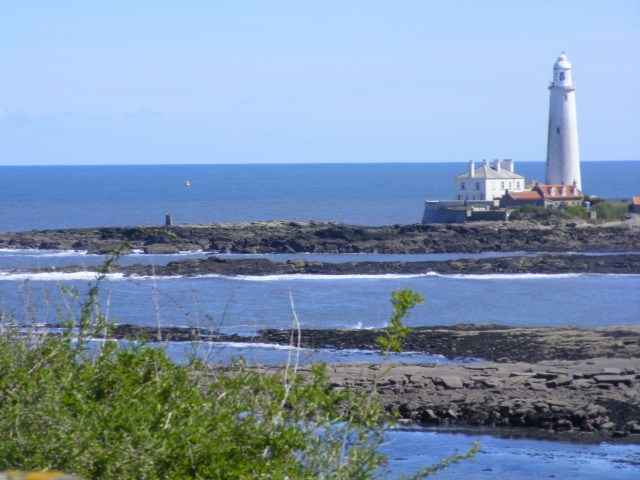
Apologies for not reporting on our holiday adventures in real time but here is the next instalment. We took a short walk along the coast to St Mary’s lighthouse, which is only accessible at low tide. Fortunately, low tide it was. The island on which the lighthouse was built was used as a burial ground by Tynemouth Priory in the C7th. From the C16th it was known as Bates Island after Thomas Bates, the surveyor for Northumberland under Elizabeth I. Interestingly, the island was used to quarantine Russian soldiers who were suffering from cholera in 1799. This was particularly significant as it was 32 years before the first outbreak of cholera in Britain. In 1898, the lighthouse was built on the island to replace one at Tynemouth, as fog meant visibility was poor there. I am sure this should be the cue for a song! The lighthouse is 40m high and was constructed using 750,000 bricks and 654 stone blocks, at a cost of £8000. There are 137 steps to the top. I begin the climb then realise that this is probably not a brilliant idea for someone who suffers from acrophobia – it is making me feel a bit weird just looking up from the ground. I descend to a safer level and send a representative from our party up to the top in my stead. It was still being lit by oil in 1977 and was the last Trinity House lighthouse to be electrified. The lighthouse ceased to be operational in 1984 and is now a nature reserve. Over 50 grey seals are basking on the rocks. The ranger tells us that this is unusual at this time of year. Seals are not a favourite with a fisherman of my acquaintance, so we focus on the eider ducks instead.

012 10 May 2019 View frm the camp site

The next day and it is off to Eureka Children’s Museum at Halifax to meet up with some of my descendants. Some wonderful staff made a small boy very happy by taking the time to talk to him and letting him have a go on the giant space hopper – even though they were about to pack it away for the day. He’d spotted it from an upstairs window and couldn’t get down fast enough but they kindly agreed he could have a turn. The day also involved handing over a very large shrub. Martha had spotted these in a local garden centre when she visited me but did not have room to get it home, so I was deputed to purchase one on her behalf and hand over in Halifax. Unfortunately, what had been qute compact shrubs had assumed triffid-like qualities and grown to the size of small trees in the interim, so our car had been impersonating Burnham Wood. Handover complete, we also hid two pandas ready for the Panda Explosion for PDA Awareness, of which more tomorrow.


Day 5 – Tracy Arm

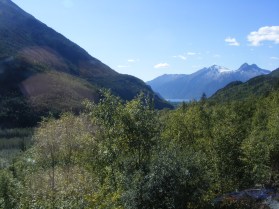
066 11 September 2018 Tracy Arm.JPGIcebergs prevent us from getting right up Tracy Arm but we still have beautiful views to admire. It is too chilly to sit outside for long so we spend the morning in the Windjammer again, as breakfast blends in to coffee and then into lunch. Great to relax and chat as the scenery and icebergs flash by. I later realise that I spectacularly failed to get any close up iceberg photos. I seem to keep missing out on this trip.
An afternoon of lectures. A double dose of Michelle, firstly on getting the most out of our DNA matches and then a really brilliant talk, ‘The Facts, Fun and Fiction of Family History’. Maurice follows on Y DNA projects. We have certainly been well informed about various aspects of DNA. Having scoffed pizza and chips for lunch, I restrain myself with a small vegetable curry for tea. Allegedly, the average weight gain whilst cruising is a pound a day. The amount of food that is consumed and wasted on board is obscene, one of the aspects of cruising that makes me uncomfortable. Another is the servility of the lovely staff. I am not better than them but they clearly feel I am. I can’t quite define what gives me this impression but it definitely goes far deeper than a customer/employee relationship.

The evening is spent with Michelle, Maurice, Helen and Cyndi contributing to a DNA ethics panel, leading to some very interesting discussions. It seems that the northern lights were on display last night. No one warned us to look, so that is something else we have failed to experience. The problem with watching for the northern lights is that it involves the unappealing combination of being somewhere cold and staying up until way past my bedtime; we missed them when we were in Finland too. Bravely, we wrap up in multiple layers and join several other hardy souls to see if they will reappear tonight. It soon becomes obvious that it is far too cloudy so we give up.

We work out a cunning way of accessing the balance on our sea pass cards using our TV. Our refunds from the bear watching trip have arrived in our accounts. We have benefited from currency exchange rates, which have fluctuated heavily in our favour since booking the trip, so the dollars we have received back are worth significantly more than they were when we paid for the trip. This will be a good start for our Mediterranean excursions next year.

Day 4 – Skagway

Finally, we seem to have adjusted to the time difference. I attempt to download my photographs from my camera and after a fruitless search, remember that there is no slot for an SD card in this tiny lap top. Do I have the required cable? Of course I do, I just don’t have it here. Fortunately I am able to borrow a slot enabled laptop and back up copies. We sit chatting while we wait for our White Pass Railway and Scenic Skagway tour. There are rumours of Hurricane Florence approaching, forecast to hit the east coast on Friday. That would be the Friday when we are flying home from the east coast. Deep joy, now we are likely to be stranded in Washington airport.

We leave the ship in plenty of time to get our bus and have a quick look at the pier end of Skagway first. The cliff sides are painted with ships’ flags and captains’ names. We later learn that this is a rolling registry of ships that was begun in 1898 and allegedly, the higher the sign, the greater the regard in which the captain was held.

Our driver on bus 109 is Caleb. He warns us that it is a no smoking bus and if anyone smokes, it will be assumed that they are on fire and they will be duly extinguished. After a couple of minutes on the bus we all disembark in order to watch a short video about the area. The Klondike gold rush of 1898 led to the development of Skagway. The trail to the gold fields took an enormous toll on both horses and men. It takes a ridiculously long time for everyone to get back on the bus and two minutes later we are reversing the process yet again as we are at the station.

036 10 September 2018 White Pass and Yukon RailwayOur railway carriage, one of 83 in the fleet, is named Lake Klukshu. Skagway means ‘land of the north wind’ but we are fortunate that the weather is glorious, so we have great views of the White Pass and Yukon route. Following the discovery of what was actually very little gold, Captain William Moore, founder of Skagway, together with Skookum Jim, one of the two first nations people who found the initial gold, sought to establish a route to the Klondike that was easier than the existing Chilkoot Pass. Their route, past Lake Bennett, was named White Pass. A sensationalist newspaper headline about the discovery of gold, led tens of thousands of prospectors to take steamers up the inside passage and begin a hazardous 600 mile trek across country to the Klondike. No prospector was allowed to begin the journey without a ton of supplies. The slightly easier White Pass was favoured over the shorter Chilkoot Pass as it was, in theory, possible to take pack animals. Over 3000 horses or donkeys perished on the Pass before the railway on which we are travelling was constructed. They began building this narrow gauge railway in 1898 and reached the summit, 110 miles away in 1899. The route involves steep gradients and tight turns and construction was hampered by temperatures as low as minus 60. By the time the track heading north joined the track coming up from the south, in 1900, over 35,000 men had been employed in building the railroad at some point. The tracks ceased to carry ore after the price slumped in 1982 and the railroad became a tourist destination.

The steam engine that works this route is undergoing maintenance, so we are being pulled by a diesel engine. We travel forty miles through impressive scenery and across scarily rickety looking bridges beyond the White Pass summit, which is 2885 feet above sea level, as far as Fraser, where we disembark. We have now crossed into British Columbia, Canada but not for long. The lakes here freeze in winter and there is sometimes still ice in June, so they are lifeless. After our train ride, Caleb collects us in the coach for our drive back down the Tormented Valley to Skagway. The valley gets forty feet of snow a year. Caleb tells us that no-one has been born in Skagway in twenty seven years. There is no doctor here just two nurse practitioners. As soon as someone is thirty weeks pregnant, they are sent to Juneau. As an aside, the women in front of us are each wearing two baseball caps. This is just plain weird.

We are dropped off in the interesting town of Skagway, in which almost every shop is a tourist trap. There probably aren’t many other employment opportunities for the resident population of 850. Many of the shop owners are standing outside, trying to entice us in and deprive them of their end of season stock.

It is very hot and we spend an enjoyable hour on the deck in the sun once back on board. After a meal of chilli jacket potatoes, the waiter entertains us by balancing three forks on top of cocktail sticks that are in turn balanced in the pepper pot holes – you kind of have to see it. In the evening Dick Eastman talks to us about getting the best out of Google.

Day 3 – Juneau or not Juneau

We still haven’t cracked the sleeping thing, so are up at 4.00am. There are allegedly a large number of hump-backed whales round the ship but all I glimpse is a few spurts of foam. We are heading north toward Juneau and the scenery is impressive. Unfortunately, so is the wind, which gusts at 55 knots. We make the mistake of ascending to the top deck and can barely stand up. Today was supposed to be the day of our extra special, incredibly expensive, float plane experience to see brown bears but the plane cannot take off so, disappointingly, the trip is cancelled. In addition, the wind meant that the ship couldn’t dock in Juneau until two hours later than scheduled. Whilst we were waiting, we spent a very pleasant time in the Windjammer restaurant on deck 11, sunning ourselves and chatting with friends.

018 9 September 2018 Mildenhall GlacierFinally, we are able to dock and the sun is shining on the righteous and on us too. Juneau was a gold rush town, founded in 1880 and is now the state capital. We are invited to join a mad genealogists’ excursion to the Mendenhall Glacier in a hired mini-bus. The first challenge is to cram all twelve of us inside. This involves trying to avoid being garrotted by the seat belt that is strung across the doorway. It is a short drive to the glacier near Nugget Falls. Despite the name, virtually no gold was taken from here and in the early part of the twentieth century, money was made from hydro-electric power, before the area turned to tourism. We learn a little of the local Tlingit people. It is very peaceful here, despite it being a tourist honey pot. Sadly, climate change is taking its toll and the glacier is retreating at an alarming rate. We see some bald-headed eagles on our journey but not in a spot suitable for photographing.
We have been encouraged to visit the Red Dog Saloon and this is something else. The atmosphere is dark and crowded and there is live country music being played. The floor is covered in four inches of sawdust and the ceiling in the flags of various ships. In between, the walls are decked in hunting trophies and graffiti. Chris has trouble finding any kind of beverage that the basque-clad waitress recognises. We settle for Sprite. Then it is back to the ship.

I succumb to the international dishes of the day and consume sweet and sour chicken. Afterwards, Michelle and Maurice entertain us with more on DNA.

Day 2 – At Sea

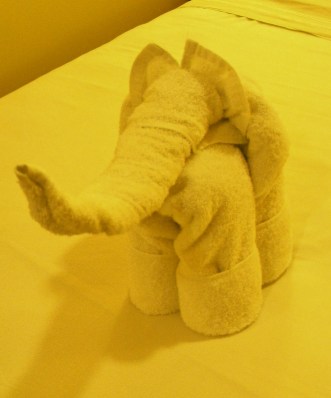
004 8 September 2018 Towel Art

Towel Art

It is 3.50am. My body thinks it is time to get up, so I bow to the inevitable. Today is a conference day so we settle down to some excellent lectures. Firstly it is Maurice Gleeson on ‘Commemorating the Missing’. I have heard this before but this was a slightly different version and my particular interest is because it centres on a battle that has Barefoot on the Cobbles connections. Next, is Caroline Gurney with a very informative presentation, ‘Lost in London’, followed by Susan Brook speaking on the English Poor Law. Cyndi Ingle is as entertaining as usual, this time on ‘Being your own Digital Archivist’.

I am feeling the ship’s motion rather more than I was expecting and have a throat that resembles rough grade sandpaper, add to that the lack of sleep and I am wondering how my session on the impact of non-conformity will go. Go it did, although I didn’t really feel as if I was on fire with it. After a short break to chat, it was time for Helen Smith’s DNA talk and then back to deck 11 to encounter ‘washy washy’. Today she has added ‘happy happy’ to her exhortations. It is Mongolian day in the restaurant. I opt for that well known Mongolian dish – pizza. There has been heavy rain all day so we haven’t missed an opportunity to sun ourselves on deck.

In the evening, Mike Murray gave a hilarious DNA presentation. With a great ‘punch line’ when he revealed that the relatives that he had been talking about were in the audience.