Occupational Hazards – Levant Mine

I always encourage my family history students to investigate the working lives of their ancestors and Levant Mine is a ‘must see’ for those with mining ancestors. My own Cornish ancestors worked on the land, rather than under it but it was fascinating nonetheless. Today was a great opportunity to learn more about Cornwall’s industrial heritage.

We arrived at the mine just in time for a guided tour by the indefatigable Richard and boy did he know his stuff. If you plan on visiting the mines, do try to coincide with a guided tour. Tours like this enhance a visit, as there is only so much you can learn from guide books and interpretation boards. Richard talked to us about the mine’s history, without the aid of notes, for two hours. No one dropped out of the tour, not even the two year old or the dog. We gained a real insight into the working lives of the miners. Any errors in what follows are mine and not Richard’s.

There are 1000 mine shafts and hundreds of miles of tunnels on the ‘tin coast’ in the far south-west of Cornwall and commercial mining, notably of copper and tin, has been going on here for 2000 years. There are several Zawns (wave-cut clefts) in close proximity and these might have revealed surface ore that encouraged the early miners. Written records of mining in this area date back to 300BC. The first documentary evidence of speculative mining at Levant is a map of 1748. This mining was by tunnel, rather than shaft and the tunnels were upward sloping, to allow water to drain out and also so gravity would aid the carts loaded with ore. The ore was then taken up to the dressing floor by horse whim. In the eighteenth and early nineteenth centuries there were several small-scale copper mining ventures in the area but in 1820, twenty investors got together to fund the sinking of the first shaft. Their collective initial investment was £400. The shaft was quickly profitable and further shafts were sunk. As they went deeper, water became a problem and a series of increasingly large, steam-powered pumps were purchased over the ensuing years. By 1836 they were not only pumping water but also raising ore by engine.

In 1840 they purchased a beam engine from Harvey’s, the famous foundry in nearby Hayle. This engine remains in situ and running; the oldest engine to be in working order and still at its original site. In the early 1850s a depression resulted in the mass emigration of Cornish miners to hard-rock mining areas throughout the world. They took Cornish customs and the iconic Cornish mine architecture with them to places such as Mexico, South Africa and Moonta in South Australia.

There was some economic recovery in the late 1850s and in 1857, a man engine was installed. This was a hugely significant innovation as no longer did men have to climb 1200 feet of ladders at the beginning and end of the shift. With the engine, they descended in 12 foot increments, in time with the engine’s piston. In this way they made the descent in 130 stages and it took 26 minutes. The structure also allowed the out-going shift to come to the surface and the in-coming shift to descend simultaneously. Previously, there was only space for a single ladder, so it was not possible for miners to be going up and down at the same time.

The mine closed briefly in 1870 as removing water and digging through granite to follow the lodes was becoming prohibitively expensive but new investors were found and it re-opened. This decade saw an increasing use of steam engines and by 1880, pneumatic rock drills were use. These were huge and required several operators. They also created a great deal of dust, that led to lung complaints amongst the miners. Pit ponies were also used. They spent eighteen months continually underground before being retired to the surface, rehabilitated and sold.

In 1919 the man engine collapsed and thirty one miners were killed. This was followed by the bottom dropping out of the tin market. Treasury loans were taken out but they could not repay them and the mine closed in 1930. The workings were in use in the 1960s, as an extension of nearby Geevor mine but this too closed in 1990 and the shafts were allowed to flood.

Conditions underground were harsh, with 30 degree temperatures and debilitating levels of humidity. Add to this the smoke from the tallow candles, which were the only form of lighting and the dust and it is no wonder that the health of the miners was compromised and life expectancy was about forty. Surface work was undertaken by the bal maidens who worked the rock to extract the pure ore. Ragging, spalling, cobbing and bucking gradually reduced the rock in size and finally it was buddled to leave crushed ore. This had to be graded, or jigged, using a pumping action to force water through the ore. Copper smelting took place in Swansea, to save the cost of importing the coal. Tin however was governed by the ancient stannary laws and had to be smelted in Cornwall, so was taken to Penzance.

024 6 July 2019 Levant Mine

The noise of the mechanical tin stamps must have been overpowering. After the tin was buddle, a calciner was used to drive off the impurities, largely arsenic and sulphur. The smoke from the calciners would drift over local villages with resulting ill-effects on health. It was discovered that arsenic was a useful ingredient in insecticides that were used to combat the cotton bol-weevil. This meant that the arsenic was now a valuable by-product. There was an awareness that arsenic could be absorbed through the skin so exposed areas were coated with a thick, white clay paste to combat this. Working with arsenic also caused infertility and allegedly, men volunteered to work with arsenic as a method of family planning.

Richard is going to take us down a tunnel. This is slightly scary but we are up for (almost) anything. It is suggested that we remove our sunglasses as visibility is poor. I have recently acquired glasses that are also sunglasses for the first time. I am proudly wearing them. Great, so now I have the choice between not being able to see because I am wearing sunglasses and not being able to see because I have taken them off. I go for keeping them on. We wander down the tunnel and it certainly is quite dark. Then Richard realises that the lights aren’t working, so all we have is the emergency lighting. He fiddles with the fuse box a bit. We have already walked down the tunnel. I am wondering how we will get back if all his fiddling somehow extinguishes the emergency lighting as well. Never fear, a few messages on his radio and full lighting is restored. The trip ends with a visit to the engine room where we can see the 1840 engine in action, aided by Ron and Tim. Despite all this engagement with mining heritage, there is no sign of Aiden Turner.

I had originally planned to move on to Hayle but decided to go to Trengwaniton Gardens instead. We find this with no trouble but I had failed to check that the opening times would allow for this rearranged itinerary. They don’t. We may or may not return tomorrow. So it is back to the van for more relaxing, more fish and chips (fortunately for the ‘diet’ they only visit twice a week) and some Wimbledon on TV.

For more information about historic Cornish mining see here. If, like me, you are interested in the history of medicine and the ill-health of our ancestors, next month sees another opportunity to take part in my five week online course, ‘In Sickness and in Death: researching the ill-health and death of your ancestors’; there are still a few spaces.

So what is Rootstech all about? How to win a free ticket

So Rootstech is coming to the UK. Unless you are involved in the international family history world you may not be aware of Rootstech. Or you may have heard of it and are wondering what it is all about. If you are trying to decide if this event is for you, then read on. Even if you are a die-hard Rootstech attendee and have already purchased your ticket, read on, as here is an opportunity to get a refund on your ticket price.

Rootstech, hosted by Family Search, is quite simply the biggest genealogical event in the world. It has been running for several years in the US and is getting bigger and better each year. From 24-26 October Rootstech will be in London. There will be some modifications to the US model to suit a British, or as they hope European, audience but do not expect this to be in the same mode as national events you may have attended in the UK. There will be some similarities but it will be unique is several respects. For a start, the US and the UK are two nations divided by the same language and you will need to familiarise yourself with some different terminology. What we would call lectures, or presentations, are ‘classes’. Don’t be put off by this, you won’t be going back to school but there will certainly be an abundance of learning opportunities.

With the exception of the keynote sessions (of which more later) there are ten, yes ten, sessions, sorry ‘classes’ to choose from at any one time. You will find classes by presenters who are well-known in the UK alongside names that will almost certainly be new to you. The important thing to note is that there is no additional charge for any of these. Once you have paid for your ticket (oops, must remember to call it a ‘pass’) everything, including the keynote sessions, is open to you at no further cost. This means that it is an ideal opportunity for you to try out speakers whose names you do not recognise, as well as your ‘must see’ favourites. I shall certainly be going along to some of the classes on more niche topics; maybe those that I don’t feel will be directly related to my research but nonetheless sound fascinating. I will be speaking on Thursday 24th on Remember Then: memories of 1946-1969 and how to write your ownIf you think you’ve heard me give this talk before – you haven’t. This will be a different version, more directly related to compiling your own reminiscences.

There is no booking system for the talks. I am assured that the area set aside for the keynotes will fit in everyone who has a pass for the day but the rest will be first come first served. The excellent and varied programme – or schedule – is already available, although do check back nearer the time for any minor amendments or additions. With ten sessions running simultaneously, I think we can expect smaller arenas than we might be used to at UK national events, so it might be a good idea to choose a reserve, when planning which sessions you will attend, in case your first choice is full. There will be an app available to help you organise your visit but as regular readers will know, I scarcely recognise an app when it bites me on the nose. As an aside, I am still congratulating myself for managing (at the fourth attempt) to top up my pay-as-you-go mobile (that’s a cell phone to US readers) with credit. It has taken me 13 years to use £25 worth!

Back to the translations. You many find handouts referred to as ‘the syllabus’ or ‘speaker notes’. The concept of keynote speakers seems to be something that some of the UK potential audience are finding it difficult to get their heads around. We are used to these sessions being the opportunity to bring out the genealogical heavyweights. Not so at Rootstech. They embrace the cult of celebrity and choose keynotes who will provide inspiration and motivation, as well as embodying family values. Another reason for choosing non-genealogical keynotes is to encourage attendance from fans who might not otherwise come along. So far, Donny Osmond has been announced as a keynote. He has spoken at the US version of the event and was very well received. So, if you were one of the sceptics, keep an open mind on this one. There will be more razzamataz than we Brits are used to but that’s not necessarily a bad thing.

There will be ‘booths’ – think ‘stands’ or ‘exhibitors’. These have not yet been announced but there will be a mixture of commercial vendors selling products of interest to family historians and societies offering advice and services. The balance between these will become clearer nearer the time. There will be plenty of chance to visit the booths in the ‘vendors’ area’, as a time is set aside each day when there are no classes scheduled. Oh and a word about timing. The first classes start at 9am. Believe it or not, that is later than at the US equivalent. So be prepared for some early starts as you will need to allow time to register on arrival, in the same way as you might expect at a conference – another difference. Just think of all that extra family history time each day.

Now the price; currently, early bird passes are £49. This may seem more than we are used to in the UK but remember this is an all-in payment for all events on that day. Once you walk through those doors, you only need to spend money on refreshments or purchases from the stands. If you are the sort of person who thinks twice about a 30 mile journey and a £15-£20 spend (and that includes your lunch) for your county family history society day conference, why not embrace a different mind-set and make Rootstech your big genealogical adventure. What you glean from those classes or learn from the stall-holders could break down those brick walls and save you time and your research budget. If travel to London really is not for you, keep an eye out for the virtual passes, as some sessions will be being recorded and will be available to you at home.

So how can you avoid paying altogether? Over the next few weeks, Rootstech Ambassadors, myself included, will be offering the chance to win one three-day free pass (full-price value £149). This includes access to any virtual sessions that you may have missed during the three days. If the winner has already purchased a ticket, then they will get a full refund. For my give-away, there is a little more involved than just jumping up and down and saying ‘Me! Me!’ as I know how many people follow this blog and I don’t want a trillion emails. To enter please contact me janetfew @ hotmail.com (without the spaces) with the answers to these five questions all of which can be found on the Rootstech website or on my own webpages (not including the blog posts) or both. I am accepting one entry only from each email address and it must be sent to the email address on the above link, not to any of my other manifestations. The winner will be drawn at random from all correct entries at 12.00 midday British Summer Time on Monday 12 August 2019. The decision is final and I will not enter into any discussion about the competition – though I will try to remember to tell you the answers to the questions! Good luck!

  1. What is the venue for Rootstech London 2019?
  2. I am giving a talk with the same title as my Rootstech session (although it is a different talk) at another venue in the next year. What group am I giving this talk to? (At the moment there is only one answer to this question – if I get another booking there may be more than one – any will be accepted)
  3. The blurb to my novel Barefoot on the Cobbles begins ‘In the euphoria of the armistice a young woman lay dying.’ What eight words follow this? Hint this phrase is obviously on the book itself but is also used elsewhere to advertise the book, including on this website – it is the same 8 words.
  4. What time will the Expo Hall open on Thursday 24 October? (it seems that there have been two advertised times in different places – I will accept either)
  5. What is airport is the nearest to the London Rootstech venue?

Capture

THE Genealogy Show

We set off early to beat both rain and traffic and accomplish this successfully. In the absence of shuttle buses from South Car Park we walk down to Hall 2 at the NEC. There was a happy, gentle atmosphere with a real international vibe. It was lovely to meet several world-renowned genealogists who had only been virtual friends until now. Unfortunately, I had places to be and people to see, so I was unable to spend more than a few minutes in the ever-widening circle of heavyweight genealogical chat that continued in the meeting area throughout the two days of the show.

As a show speaker, I was given two tickets to talks of my choice and I had opted for those by genealogical crime writer, Nathan Dylan Goodwin. His first session described how he researches and writes his books. Very interesting and I appropriated a few ideas. Next, I was acting as a ‘wizard’ attempting to help show-goers with their problems and brick walls. Unfortunately, I was not provided with the required magic wand but I hope I that most people left with a few things they could try. There did seem to be a preponderance of people with Suffolk queries. I coped with foundlings and German ancestry but was a little bemused by the client who spent the twenty minute slot showing me forty or so documents but despite my repeated ‘how can I help?’ comments, didn’t actually appear to have a question or problem. I was reduced to ‘mmm lovely’, as yet another document was whisked past my nose. If you plan to take the opportunity of seeking expert advice in the genealogical equivalent of speed dating, please do come prepared and come with a succinct limited question, or indeed I’d settle for any sort of question!!

Then my allocated two hours on the stall of the Society for One-place Studies, to which I drifted back and forth throughout the day. We had a steady stream of enquiries and a pleasing number of people decided to take up the one-place challenge. The thought of taking on a new, tiny, place did cross my brain, like I have so much spare time! I sold almost all my stock of Putting your Ancestors in their Place and a few other books, despite having issues with the credit card machine. On the downside, my voice was beginning to disappear – cue the Strepsil overdose.

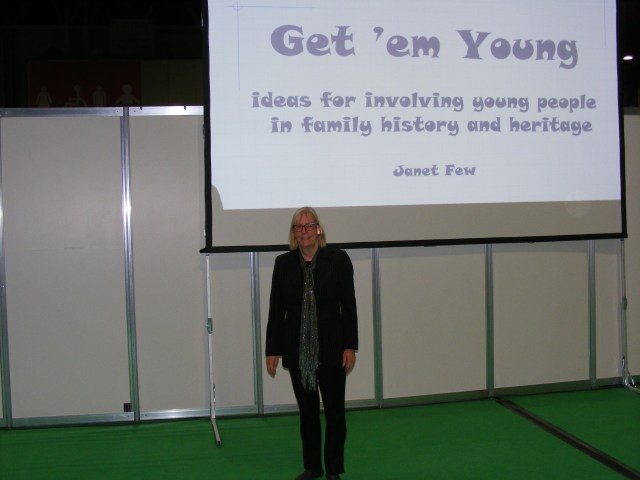
Day two and this time there was no avoiding the rain. Be-decked in waterproof trousers, wielding an umbrella and with spare socks and shoes in my bag, we set forth into the downpour. On arrival, we advise the security staff on tracing ancestry in India. This was more along the lines of ‘we know a man/woman who does.’ My talk was up first. Let us just say the audience was more noted for its quality than quantity. Judging by the ‘I wanted to hear your talk but …’ comments that I received later in the day, a significant reason for this was because I was scheduled half an hour after the show began. At this point, folk were still shaking raindrops from coats and getting their bearings. The real shame was not for me but for the missed opportunity. I was speaking about ideas for engaging young people in history and heritage. This is a crucial topic. On an almost daily basis, I hear people moan that younger generations are not interested in their genealogical research, yet often they are not willing to make any efforts to spark that interest.

DSCF1437.JPG

A quick gap and then I was part of a three-woman panel chatting about surname studies, to a larger audience this time. At least my voice held out. Then back to more wizardry, fielding questions about dancing masters and apprentices amongst other things. The event ended as it had begun, with another talk from Nathan Dylan Goodwin, this time a fascinating account of his own family history research. All too soon, it seemed to be over. I really wish I had had more time to network with people. I had brief chats with so many friends. It is great to be at an event like this, when you know almost every other person. There were evening get-togethers but evenings and I do not get on. Next year and there is to be a next year, I will make more effort to stay awake beyond 6pm and join the fun. The next big genealogical event is Rootstech, of which more later.

Speaker

The job we must not mention is about to hit the fan so there may be radio silence for a few weeks but I will do my best to keep in touch.

Pillories and Preparations

In the brief week at home, idleness has not been an option. Firstly, my home village staged a re-enactment to commemorate the 200th anniversary of the arrival of Methodism in the village. William Reed and Samuel Thorne chose the day of the revels to preach on the village green, were duly arrested and fined. I have to admit that being part of the action, exactly 200 years later, was a ‘hairs standing up on the neck’ moment. Mistress Agnes was present in Victorian guise and a few reprobates were pilloried in the newly acquired community pillory – every home should have one. There was also a truly spectacular flower festival. As someone whose idea of successful flower arranging is remembering to put water in the vase, I was in awe.

1 June 2019 William Reed Commemorations (4)1 June 2019 William Reed Commemorations (6)

I did briefly get back to writing novel number two, after a gap of a few weeks. This has necessitated me buying a book. Thanks to Martha’s research, I did get it half price but it is still the most expensive book I have ever purchased. Then, with assistance, I tried to rediscover my garden. The grass had to be scythed and the weeds still have to be tamed.

Then it was onward and upwards and back ‘up north’ to THE Genealogy Show. Yesterday was spent setting up and greeting friends from across the world, some of whom I have only previously ‘met’ online. My two (well one and a third) presentations are tomorrow so today will be more relaxing. A talk to hear, some brick-wall bashing for attendees who have booked appointments with an expert (a few of them have got me – oh well) and helping out on the Society for One-place Studies stall in between. It is going to be a good day.

TheGenShow

#FamilyTreeLive Adventures

I have, rather belatedly, managed to access the photos from my camera, thanks to being reunited with the ‘big’ laptop. The feet still ache, the back is a little dodgy but I have recovered sufficiently from the two brilliant days at Family Tree Live and am now just about fit to post about our adventures.

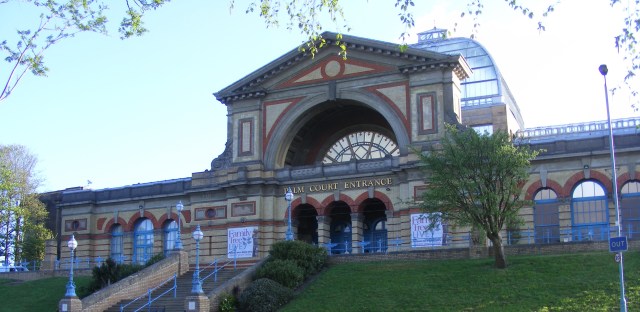
The first issue was to leave our caravan site at a sufficiently early hour. We have no problem with getting up early but a 2.2 metre high barrier is in place on the site from 10pm to 8am, to prevent people being disturbed by moving caravans. Despite knowing that our car will easily fit under this barrier, I am still worried that it will somehow have grown overnight and we will not be able to escape. Needless to say, we exit unscathed and with car roof intact. We have left early to avoid the worst of the rush hour traffic so arrive just a tad early. We are the first to park in the exhibitors’ dedicated car park. The free parking is a real plus at this show. Alexandra Palace is looking beautiful in the early morning spring sunshine.

Alexandra Palace.JPG

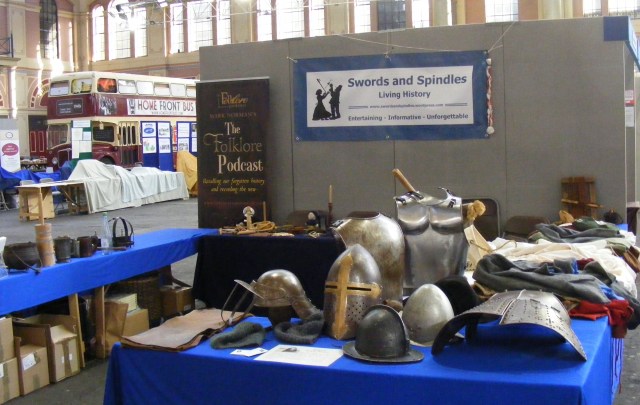
We remove the covers from our stand and are pleased with the way it is looking. This is our first time with a stand and we are excited to share seventeenth century life with show-goers.

Family Tree Live 2019 Open for business.JPG

I manage to sell a book before the show even starts! Then the doors open and there is a steady stream of visitors stopping to chat. The Ally Pally security team are amongst those who are enjoying trying on armour. The morning passes swiftly. I take time to circulate the stands and it seems that every other person is an old friend. I make sure I buy a copy of Nathan Dylan Goodwin’s latest novel. I have all his others on Kindle but have deliberately waited to buy this in hard copy and in person, so I can get it signed. There are also newcomers on the block. I am particularly impressed with Twiggli Trees’ attractive charts.

There are plenty of networking opportunities and our supply of business cards is seriously depleted. It was great to see that every stand was family history/history related and that local societies outnumbered the commercial giants. Family Tree Magazine organised several admirable add-ons, such as their ‘Crack the Code’ activities’ stand, the goody bags containing vouchers that allowed show-goers who purchased a magazine package to get discounts on certain stalls and the children’s packs. Obviously, most children were in school on Friday but it was sad that there were not more in attendance on the Saturday. Encouraging the next generation (or the generation after next) is one of my hot topics, that I speak on regularly. Although many family historians moan that their younger relatives do not take an interest in family history, I wonder how many of these actually take the trouble to make the hobby appealing. A case in point. Our stand was particularly popular with the young people who did attend. Mother, grandmother and grandson stop by. Grandson clearly wants to try on the armour. Grandmother misses this opportunity and heads off determinedly in another direction! It is a chicken and egg situation. If there is nothing provided for young people, young people won’t attend but it must be dispiriting to make provision and then have so few children there. Please show-organisers, do keep trying to encourage young people to take an interest in family history by providing child-friendly activities at shows.

Next, it is time for me to time travel to the twenty-first century, to deliver my workshop on reading Victorian handwriting. This workshop element is a new offering for this type of show in the UK and worked very well. Our stand was next to the workshop area, so we could see how engaged the visitors were throughout the show. This was followed by my presentation on twentieth century research, which was sold-out and well received. Next, I was interviewed by the Family Tree Live team and then it was back to the seventeenth century.

Day two could be spent wholly in costume, although I did miss the opportunity to sit down that the workshop had given me. Ally Pally does have rather unforgiving concrete floors and we were unsure if our feet or legs were hurting most. Nonetheless we were sad when the event drew to a close and then there was the logistical nightmare of trying to fit all the kit back in the car. At this point, I am wishing that it had expanded overnight! Even having fewer books to take home than we arrived with it is not easy. Our team had a great time. Would we do it again? In a heartbeat. If you are amongst those who enjoyed our contribution, please tell the organisers, as we would love to do this all again but probably not until our feet have recovered.Now to tackle the 68 things on the ‘to do before the end of May’ list. This sounds do-able until you know that I only have five free days in that time!

Rose Window Alexandra Palace.JPG

Come and Meet Mistress Agnes at #FamilyTreeLive – a chance to buy my books at reduced prices on stand 167

Just to say that I will be on duty at Family Tree Live as Mistress Agnes, in company with various disreputable characters, on stand 167 – so do come and experience the lives of your C17th ancestors. See Swords and Spindles website for more details of what is in store. All my books will be on sale on that stand. I don’t want to fiddle with 1ps and 5ps so there will be an opportunity to save a few pennies. Coffers, Clysters, Comfrey and Coifs: the lives of your seventeenth century ancestors will be 15% off with the voucher that will be in your Goody Bag.

CCCC front coverThere is a limit to what you can get in a Landrover (there really is – I was surprised too), so what with armour, instruments of torture, costumes of various sizes, toys and a multitude of household items, I will not have an infinite number of every book title – so if you were hoping to relieve me of one of my publications, let me know and I will save you a copy. I would advertise my workshop and presentation but I am afraid (well, afraid for you, glad for me) that they are fully booked.
Looking forward to seeing you all.

Nearly my Ancestors: or how I almost climbed the wrong (very exciting) family tree

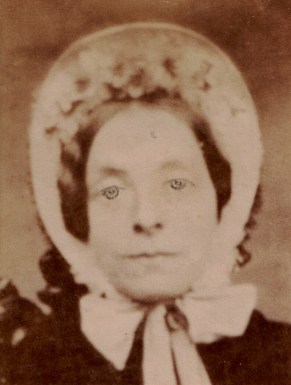
Mary Woolgar née Cardell 1817-1892

Mary Ann Cardell, born c. 1817 in Highgate but who were her parents?

Recently, I issued a challenge to help me find the parents of my great great grandmother, Mary Cardell. Thanks to helpful fellow family historians I confirmed that she had a sister, Catherine. The marriage records of these ladies revealed that their father was called James. Mary and Catherine consistently claimed to have been born in Highgate, Middlesex c. 1817 and c.1813 respectively. In Highgate, in 1813, a James Cadwell married a Mary Ann Gutteridge, who, despite the slight spelling variation, were prime suspects as the next generation. I was tempted to follow Mary Gutteridge further, in the hope that going back a little and then coming back forward might give me the confirmatory evidence I needed. Mary Ann Gutteridge’s ancestry proved fascinatiing. I have already mentioned the royal clockmaker, the vicar of the neighbouring parish, the one who was captured by pirates and the Huguenots. Add to this a poet and an inventor of an early form of shorthand and I was set to add the most fascinating branch ever to my family tree.

I was heard to say, rashly, ‘I am so sure that this is right I just need a little more evidence.’ I purchased four certificates I downloaded wills, I looked for and failed to find, DNA matches with the surnames of these putative ancestors. I wrote an eight page rationale considering the likelihood that these people were my ancestors. For days I followed this line when I should have been doing other things but still I hesitated. I reassessed the evidence again and again. Finally, I returned to the witnesses of the Cadwell marriage, who I had initially dismissed as not seeming to be relevant. One had the unusual name of Thomas Knackston (elsewhere Kneckston/Naxton et. al.). It turned out that he married an Ann Gutteridge. Surely she should be a relative, probably a sister, of Mary Ann Gutteridge? Via her second marriage, I traced Ann née Gutteridge. She had a sister Mary Ann. She was emphatically not the Mary Ann I had spent time and money tracing.

I sighed and returned to the proverbial drawing board. I very quickly discovered that, not only had I got the wrong Gutteridge family but that James Cadwell and Mary Ann Gutteridge were definitely not the parents of my great great grandmother.

I am now investigating a James Cardell and Maria Withinbury who married in Worcester in 1798 and then moved to London. I am not really convinced that these are going to be right either but I have no more likely candidates. What I really need is a baptism for Mary or Catherine, daughters of James Cardell, or even their probable sisters Eliza and Lucretia in the 1820s.

Thankfully, after 42 years of researching, I am by nature thorough and cautious. I was so close to claiming the wrong family as my ancestors. I wonder how many people would have grafted them on to their pedigrees without further thought? I’ll admit that I was very close to doing so. I don’t suppose I will ever find a family as exciting as those who were almost my ancestors. In the meantime, feel free to seek the right ones on my behalf as I have rather lost the motivation for this search. Oh and if anyone wants to know about the ancestry of a Mary Ann Gutteridge, daughter of George and Sarah Gutteridge née Mudge, born in Shoreditch in 1783 and probably married not to James Cadwell but to William Rhodes, you know where to come.

Of Kings, Elizabethans and Things

After a few lovely days with my descendants I headed to Leicester for the annual conference of the Guild of One-name Studies. This is always a great opportunity to meet old friends and make new ones, as well as to enjoy a range of presentations.

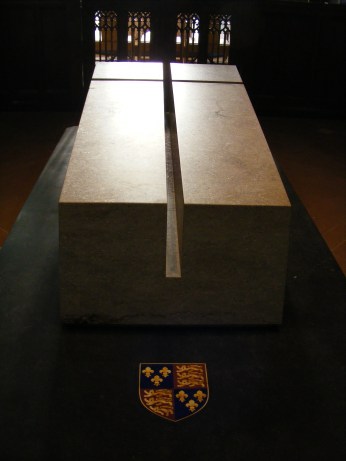
We found our way to the Leicester Marriott Hotel, where the early arrivals were gathering. There were some lovely compliments from people who had been reading Barefoot on the Cobbles. I was booked on to a visit to the Richard III centre. Shortly after the ‘king in the car park’ was discovered, I managed to get a photograph of the car park but now the area has been turned into an impressive visitors’ centre. It seems that there has been plenty of regeneration in Leicester as a result of the discovery of Richard III’s body. There was plenty of information to absorb and we had time to relax in the sunny courtyard, where I consumed honeycomb ice-cream and coffee.

DSCF1134We then had an excellent tour of the cathedral, dedicated St. Martin of Tours, which is very small and largely a Victorian restoration. The main focus is, inevitably, Richard’s tomb and the beautifully embroidered pall; I failed to photograph the latter. There was also some lovely modern stained glass.
Back to the hotel for a swift buffet meal. The food was good but it seemed strange to serve curry without rice, naan or any other suitable accompaniment. I am quite glad that I don’t drink as the bar prices are a bit steep. Even a canned soft drink is £3; I avoided purchasing one of those too. I am currently recouping my funds following my recent certificate buying fest and yes, for the benefit of regular readers, I have ordered three more in an attempt to crack the Mary Cardell impasse – fingers crossed.

Mistress Agnes was on duty in the evening, in order to introduce Maureen Taylor of Talking History, who entertained us with an account of the appropriate garb of an Elizabethan aristocrat. Mistress Agnes was pressed into service as a dresser and is very thankful that she is a mere peasant as the attire of the more affluent is significantly more restrictive and considerably heavier, one of Maureen’s outfits weighs four stone.

Inevitably, my descendants have been generous with their lurgies once again and my throat is resembling something that has had a rigorous going over with heavy-grade sandpaper, so, despite liking a good quiz, we retired to the van. It seems that the van’s supply of Strepsils has been depleted (there weren’t any). I should have realised that agreeing to do seven talks in nine days was bound to result in me contracting some sort of ailment that would affect my voice.

Clock-makers, Vicars, Huguenots and Pirates: some family history excitements

Thank you to the wonderful family history friends who took up the challenge I outlined in my last post, to help me find the parents of my great great grandmother, Mary Cardell. As a result, I have had one of the most exciting weeks in over forty years of tracing my family. Although I have not yet ‘inked-in’ another generation, the people I believe to be Mary’s parents remain the most likely suspects. I have found out more about her sister, who led an ‘interesting’ life, apparently taking a man’s surname, living with him and his wife and eventually having a child by this man before posing as a widow and marrying a man with a criminal record. This pales into insignificance compared to my discoveries about Mary’s putative mother, Mary Ann Gutteridge (other spellings are also available). I must stress that there is still work to do to verify that these people are my relatives but it certainly looks likely. I do know the golden rule – prove each generation in turn before rushing backwards. Let’s just say, do as I say, not as I do. It started as an exercise to see if going backwards a little might confirm the more recent links and then I got carried away.

220px-Thomas_Mudge_-_Uhrmacher

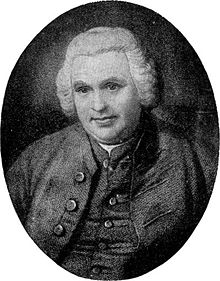
Thomas Mudge wikimedia Commons

Not only is there a connection to Huguenot silk weavers from Spitalfields, exciting enough in itself but I am taken back from London to Devon. It seems I may have Devon ancestry on both sides of my family. I MAY be related to one Thomas Mudge, who was the Royal clockmaker to George III, has a lengthy entry in the Dictionary of National Biography and had his portrait painted by Sir Joshua Reynolds. This is rather different fare from my usual diet of agricultural labourers. There is a book about Thomas, his father and brothers, who had illustrious careers in various fields. Thomas’ father, Zachariah Mudge, was vicar of Abbotsham, just a few miles from where I live and headmaster of Bideford grammar school. Two generations earlier, we find details of a ransom being raised for one Hercules (aka Archelaus) Mudge, who had been captured by pirates in 1666. Wow! Wouldn’t it be wonderful if Hercules could be shown to be my 8x great grandfather.

The morals of this story are, never give up. Revisit your genealogical brick walls often. Seek fresh pairs of eyes to re-examine the evidence. So far, I have ordered one death certificate for the wrong Mary Ann Cardale (spellings are many and varied), who I hoped might be Mary’s mother. I am wondering how many more wrong certificates I can afford.  I have contacted DNA matches who have Mudge in their ancestry but their Mudge connections are too far distant to account for the match – we must be related through a different family. I have accessed wills that could have helpfully mentioned married daughters by name, thus confirming the pedigree but no, not a mention of a daughter married to my ancestor or indeed to anyone else. It would have been helpful if gg grandma or her sisters had been baptised but again no, that would just make it too easy. If anyone feels like undertaking a mission of mercy at London Metropolitan Archives, it might put me out of my misery.

My Problem Female Ancestor #internationalwomensday

Firstly, I must share just how distressing I found typing that hashtag without the apostrophe. Regrettably, it seems that hashtags and apostrophes are not compatible.

On International Women’s Day, I thought I’d introduce my genealogy obsessed friends to my problem female ancestor. I do have information about many of my ancestresses. I wrote about my direct maternal line here and you can find out more about some of these women by clicking on the appropriate surname links on my family history page. There you will find details of what I know about them and their families.

My great great grandmother, Mary Cardell, is proving more of a problem. If anyone feels like a challenge over the weekend, please see if you can confirm who Mary’s parents were (PS I‘d also be pleased to find her in the 1851 census, when she would have been Mary Woolgar). I am afraid there are no prizes but I promise a warm fuzzy feeling and the satisfaction of having succeeded where, so far, I have failed.

Mary Cardell is my great great grandmother. I know quite a bit about her married life; you can read it in my file on the Woolgar family. On her marriage certificate and the birth registrations for her four children, her birth surname is consistently spelt CARDELL. The marriage certificate suggests that she signed her own name. Earlier generations may not have been literate, so the name might be rendered differently and my searches have included all phoenetically likely variants of the name.

I have used a range of documents to calculate Mary’s probable date and place of birth:-
Her burial has not been located
13 January 1892 death certificate age 74 – born 13 January 1817- 12 January 1818
1891 census age 74 born Highgate, Middlesex – born 6 April 1816-5 April 1817
1881 census age 63 born Middlesex – born 4 April 1817- 3 April 1818
1871 census age 53 born Highgate, Middlesex – born 3 April 1817- 2 April 1818
1861 census age 44 born Highgate, Middlesex – born 8 April 1816-7 April 1817
1851 census not located
1841 census age 25 born Middlesex – born 7 June 1811- 6 June 1816
1 May 1841 (when she married Philip Woolgar) marriage certificate ‘of full age’ – born before May 1820

Mary Woolgar née Cardell 1817-1892This seems to suggest that Mary (or at least whoever provided the information to the enumerator) was convinced that she was born in Highgate, Middlesex. Ignoring the 1841 census evidence, when ages should have been rounded down in any case, the suggested dates of birth from the other sources are consistent. If all ages are correct, then Mary was born on 4 or 5 April 1817. It seems probable that she was born between 1816 and 1818.

Other clues are provided by her marriage certificate. This was obtained from the General Register Office in 1983 and is handwritten, so there is scope for transcription errors. Ideally, I would check with the local register office (Edmonton) or, even better, access the registers for St. Mary’s Hornsey where the marriage took place; these are held by London Metropolitan Archives ref. DRO/020/A/01/011. Assuming that the certificate I have is accurate, Mary’s father was James Cardell, a gardener and one of the witnesses was a Catharine Cardell who is likely to be Mary’s mother or sister. There is no indication that either of the fathers were deceased. I know the groom’s father was still alive at the time but it may be that whoever filled in the register didn’t not make a habit of noting if the fathers were deceased

The obvious first search was in the parish registers for Highgate and this was carried out on my behalf by a reputable researcher some years ago. He was however using a transcript of the Highgate baptism registers. I would like to recheck this and use the original baptism register. These are in London Metropolitan Archives P90/MIC1/004 (003 for 1791-1812). He also checked the birth and baptism register of the Highgate Salem Chapel, although the entries in the chapelry registers are sparse. These records are at The National Archives RG4 1131 and I have rechecked this using the online images of the registers at FindmyPast; there is no mention of the Cardell family.

Mary claims to have been born in Highgate and she married in Horsey, giving her address as Fortis Green, which lies between Finchley and Muswell Hill, so Middlesex seems a likely county in which to begin to seek the Cardell family.

NB subsequent research, after this post was written, has established that Mary Ann Guteridge was definitely not my 3 x great grandmother. So most of what follows can be ignored!

A marriage between a James Cadwell and a Mary Ann Guteridge took place in Highgate in 1813 and these are very strong possibilities as Mary’s parents. Mary Ann was the daughter of George and Sarah Guteridge born 14 August and baptised 7 September 1783 at St Leonard’s, Shoreditch. She is likely to be the Mary Ann Cardale who was buried 10 April 1841 at St Andrew’s, Holborn, ‘of Regent’s Park’, just a month after Mary Cardell’s marriage to Philip Woolgar. I could check the original entry for more information and purchasing this death certificate is on the list when the family history budget has recovered from my certificate ordering fest prior to the recent price increase. The burial register records Mary Ann Cardale’s age as 58. The corresponding GRO death indexes can be searched on their website and give age at death. Here, Mary Ann Cardale was said to be 57, which ties in exactly with the Shoreditch baptism of Mary Ann Guteridge.

There is also a Maria Cardell in St. Pancras workhouse in the 1841 and 1851 censuses. (1841 census for St. Pancras workhouse, Marylebone, Middlesex HO107 681/9 folio 9; 1851 census for St. Pancras workhouse, Marylebone, Middlesex HO107 1497 folio 599.) This workhouse would have covered Highgate. Maria Cardell was born in Dudley, Worcestershire and is almost certainly the Maria Withenbury, baptised in 1780, who married James Cardall at St. Alban, Worcester, Worcestershire on the 12th February 1798. These too could be Mary’s parents. A Samuel Cardel was baptised in 1802 in Worcester, son of James and Maria. Samuel cannot be found in the census returns.

A James Cardall aged 49 of ‘Mermaid Court’ was buried 17 November 1824 at St George’s, Southwark, this is probably the James who married Mary Guteridge but is he my 3x great grandfather?

Mary Cardell’s marriage took place only a month before the 1841 census, there is no trace of a likely Catharine Cardell (the witness) in that census and no death or marriage for her in that quarter, using variants of both her names. There is a Catherine CAWDLE aged 27 bur Hoxton 24 Sept 1841 possibly wife of Henry Cawdle and living in Shoreditch in 1841, neither were born in county. So could Catherine have been Mary’s sister-in-law? I don’t find this very convincing.

What this case study does illustrate is that, even after over forty years’ research, it is possible to have that pesky family line that is stuck in the more recent past. It also underlines that it important to periodically revisit sections of our family history that have been in abeyance. With luck, new sources will have become available, or a fresh pair of eyes with bear fruit. My own eyes are feeling far from fresh at present and cost me a significant sum yesterday when I , unexpectedly, had to buy new glasses. So, over to you friends and good luck!