Ailments of various kinds: your ancestors in sickness and death

In the three weeks since my last post (three weeks! – you’ll guess I have been busy) I have spent four wonderful days in schools, swording and spindling away, extolling the virtues of the seventeenth century. Summer hit the west country last week. Temperatures rose to 85 degrees – that’s 30 to some of you and yes, in the UK, that’s hot. Four hours ensconced in crowded classrooms with a bunch of 13 year olds and no air-con – great. Followed by a chance to get outside – hurrah. Or rather not hurrah, as now I am on a scorching sports field for an hour, without a smidgen of shade, banging a drum – as you do. Well as I do. I should perhaps add that I was attired in multiple layers of thick wool at the time. I then went straight on to an evening presentation. Let’s just say that we brought the smells of the seventeenth century with us. I have also been finishing off the job I must not mention and presenting on various topics to adults. Today’s will be the fifth talk in four days – why do I do this?

dscf3202#Daisy is making some progress. Some lovely friends have read a chapter and didn’t hate it, which was encouraging. I am currently immersing myself in suffragette activities, purely in the historical sense, though I am not adverse to a bit of banner waving. Next on the list is research into the wartime experiences of a new character who has forced his way into the narrative. This did lead to that exciting moment when your ‘based on fact’ historical novel requires you to research someone new and you find that he attended a school that has an archivist. Better still, said archivist responds to your email (written after office hours) within minutes with information and a photograph. Ok, so he wasn’t the heart throb I was hoping for but I can get round that with a minor re-write!

I am looking forward to the start of my online course “In sickness and in death: the ill-health and deaths of your ancestors”, next month. I keep finding more and more gems and am resisting the temptation to add them all to the course text or it will become another novel. Did you know that bookbinders are adversely affected “by the smell of the putrid serum of sheep’s blood, which they used as cement.” (C Turner Thackrah 1831)? On the subject of ill health, I manage to move awkwardly and pull a muscle in my back so have been hobbling around all week. Great excuse for not doing any housework; now I just need an excuse for the preceding five weeks. May not try the C18th remedy, which is cow dung and vinegar.

Added to this a new research client has presented me with some fascinating family members to pursue. Despite explaining that I would not be able to start this for some time, it was just too tempting.

I am excited that a webinar I gave earlier in the year on surname studies around the world is now available online. That wasn’t the exciting news I hinted at in my last post; that‘s even more exciting but still under wraps – patience is a virtue and all that.

Heredity, Hammocks and Heat: DNA and other adventures

I really wanted this post to be about some very exciting news but I am not allowed to tell anyone yet (no, no one in the family is, as far as I know, pregnant), so that will have to wait for another time. I could talk about the weather. Here in the UK we have been experiencing a mini heat wave. I was stuck in a northern city in a motel whose room did not go below 29 degrees for three days. What a joy to come back to my beautifully cool home (they knew what they were doing when they built houses in the 1600s) with the sounds of the local sheep baaing, I could even forgive the aroma of silage making. No problem, UK heatwaves never last long and we are back to normal today.

My partly revamped garden is still mid-makeover. Given the heat and my absence I am quite glad that I delayed laying new turf. I was pleased that the plants survived my healthy neglect during the record-breaking temperatures. The hot weather made it seem like a good idea to erect a hammock that I have had for about twenty years but never used (I think it was free with something). All it required was two trees sturdy enough to support my burgeoning weight (it’s all that eating on expenses that does it). My tiny garden isn’t over burdened with trees but two were identified and with assistance from the fisherman of my acquaintance we began to adjust the ropes to what seemed to be a sensible height. This kind of occasion is when it is useful to know someone who can tie a decent knot or two. After one or two false starts (I ended up sitting on the ground) the hammock was in place and I was enjoying a meditate. The observant amongst you will have noted the word ‘trees’ above. Hammocks tied to trees mean, inevitably, that you are, to some extent, under a tree. Trees mean birds. Birds have digestive processes, need I say more? No sooner had I laid back and closed my eyes than I was required to move. Somewhere there is photographic evidence of this. Fortunately the photographer finds getting pictures from his phone to anywhere else a little challenging – phew!

Actually there is some really exciting news that I can convey and that is that my DNA results from Living DNA have arrived. This company calculate your ethnic origin on a regional level. Having ancestry that is, at least on paper, 100% English, I was particularly interested to see what this would reveal. As a teenager I longed to be Spanish, pretended to have Spanish ancestry and despite my total inability at languages, even tried to teach myself Spanish. Was this due to some ancestral memory?

After more than forty years of researching my family history, I know the names and geographical origins of 31 of my 32 3x great grand-parents and 75% of the generation before that. This means that I have a pretty good idea where the families came from before they all began to converge on London in the nineteenth and early twentieth centuries.

Whilst I was patiently (well, ok actually not that patiently) awaiting the results. I analysed my documentary evidence to work out what I might expect. I am aware that the DNA that I have inherited does not come equally from all my 3 x great-grandparents and that some of them may have left no trace in my profile but I had no way of taking account of this. I had a slight issue in that Living DNA don’t seem to acknowledge the existence of Buckinghamshire, which accounts for an eighth of my ancestry but I used my initiative and counted it as South Central England.

So did the test support the proportions that I estimated and what surprises were in store? Living in Devon and having a direct paternal line that for 37 years I believed was Cornish but has now been traced back to Devon, I am particularly attached to the 25% of my ancestry that comes from south-west England. Based on my knowledge, my expectation was that my genetic make-up should show that I was 20% Cornish, with 5% from Devon. Living DNA’s percentages were 7.4% from Cornwall and 11.7% from Devon. As my lot spent their lives on both sides of the Tamar, very close to the Devon-Cornwall border, I can live with this.

Turning to the other end of the country, my estimated 12.5% for Northumberland became 5.8% according to Living DNA. I did wonder if some Scottish blood might creep in, as they lived in border parishes but it seems that I must leave Scottish descent to my children and grandchildren. Living DNA also suggested that 7.2% of my origins were from Cumbria, which, when added to the Northumbrian percentage, comes close to my estimate.
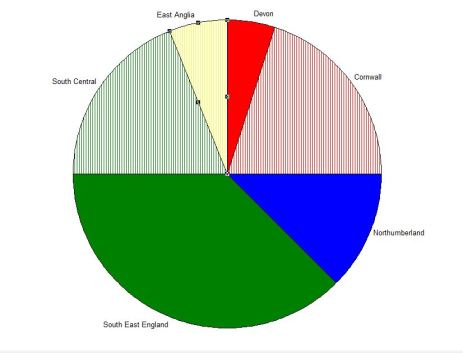
My DNA estimates June 2017

My estimates of my ethnic origins

The marriage of cousins in two successive generations (I know, accounts for a lot) means that I have what is known as a collapsed pedigree, with the same 4 x great grandparents appearing on my tree three times. They came, as far as I know, from the south-east and the bulk of my ancestry (37.5%) is from that region, why do I find this boring? Living DNA agreed, with 35.3% from south-eastern England. I calculated that 19% of my ancestry was from the south central region, not much more exciting. Living DNA put this at 3.9% but also identified 5.8% from Southern England and 2.7% from Central England, which redressed the balance a bit.

What appeared to be missing was the 6% that I believe came from East Anglia but this could be accounted for by the 5.6% that Living DNA attributed to Scandinavia. One of the East Anglian family names was Daines! I do however have another possibility for the Scandinavian connection. Interestingly my test results with Family Tree DNA make my origins 100% British Isles, with not a long ship or horned helmet in sight.

I am still mulling over Living DNA’s 11.1% from North Yorkshire. I somehow don’t see myself as a Yorkshire lass. No disrespect to my friends from Yorkshire, it just doesn’t feel like me. I don’t begin to understand cricket for a start. Could this be the missing 3 x great grandparent or the 4 x great grandmother, who appears three times in my ancestry but whose full name and birthplace I don’t know? Or does the North Yorkshire element represent something earlier in the Northumbrian line?

Interestingly, I also have 1.2% of my DNA from Lincolnshire. Although my maiden name, Braund, is firmly rooted in Devon and is found there back to the mid 1400s. Prior to that (11th-14th centuries) there are instances of the name in Lincolnshire but no connection has been found between the Braunds of Lincolnshire and those of Devon; could this minute trace in my DNA be attributable to this? The theory and it is just a theory, is that as both countries were key wool producing areas in Medieval times and are linked by drovers’ roads, this may have been how the name moved to Devon. The Lincolnshire Braunds are believed to have had Viking origins, so we are back to Scandinavia.
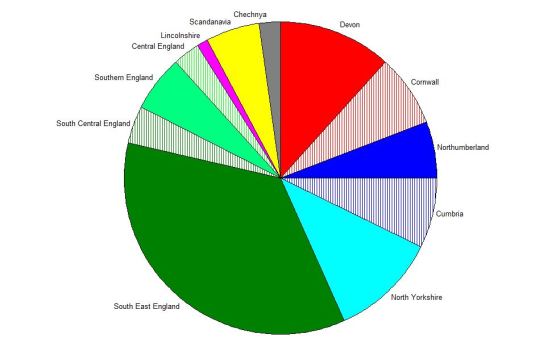
 

Living DNA June 2017

Living DNA’s analysis of my ethnic origins

Finally there is a random 2.1% from Chechnya. To save you looking that up, it is in the bottom right hand corner of Europe, not far from the Caspian Sea and given the political situation there, it probably isn’t the sort of place to be making an ancestral visit any time soon. I have heard of a few others whose profile contains this element and I feel this may be an anomaly that will be ironed out when more data becomes available. In the meantime Салам (hope Google translate has got that right). So much for being Spanish!


Who Do You Think You Are? Live Day 1

Yes, Yes, I know it is the end of Day 2 – give me a break, it’s pretty full on all this networking lark. For once no trolleys were harmed in the process of our Who Do You Think You Are? Live experiences (see previous blog post for links to further details). Today (that’s of course now yesterday) was my busy day. On arrival we were guided to a car park that was as far as possible from the hall as the NEC complex allowed and took the shuttle bus down the hill amidst many folk who looked like they were in for a fun day at some form of transport convention or what appeared to be an OFSTED conference.

I hastened to get my presentations uploaded ready for later in the day (Miss Efficiency me) and was flattered to be remembered from last year by one of the technicians. Then it was off to the experts’ advice tables. Always a good plan to offer to be an ‘expert’ as it does at least ensure that you are able to sit down. I did have one of those ‘arrgggh’ moments. My appointment sat down early for their twenty minute slot, as my previous satisfied customer had gone away early. ‘I don’t know anything about my great grandfather Joe Brown’ (the name has been changed to protect the guilty but it was an equally common name). A large sheaf of typescript, which appears to have been taken from Ancestry is proffered. This contains dates of birth, marriage and death, entries in every applicable census, parentage, spouse and offspring of the ancestor about which the enquirer ‘knows nothing.’ ‘It says here he was born on 6th January 1870’, say I, ‘where did you find this information, was it from the family?’ ‘Oh that’s definitely right.’ says the enquirer.  I pursue the named parents, finding their marriage index entry. I explain how to get a marriage certificate and how that should hopefully give Joe Brown’s grandfathers’ names. I find Joe Brown’s father in more than one census. I find Joe’s spouse’s line back to grandparents. ‘You haven’t told me anything about Joe,’ is the response. I point out what we had discovered. ‘Oh but I knew all that already.’ I gritted my teeth and resisted the temptation to point out that I had not only answered the question he had asked but also the question he should have asked – what more could be expected, great granddad’s shoe size? Well that was thirty minutes of my life wasted then.

Sheridan Parsons

Photo by Sheridan Parsons

It was then time for my first talk, twenty minutes on inspiring young children to take an interest in history and heritage. This session was the best kept secret of the convention, somehow having been left off the website and display boards. Nonetheless it did attract an audience of more than one and led to a very interesting contact. Then it was pretty much straight off to my full length presentation in the main studio. Mustering ‘rent a crowd’ is no longer possible now these sessions are charged for. Nor can you rely on acquiring an audience from those who need to rest their bunions after a long day on their feet, so I was worried about speaking to an empty hall.

John Boeren

Photo by John Boeren

In the end, this was a sell out session with over two hundred people who had parted with real cash in order to hear me talk about finding elusive ancestors. This included several friends who had turned out to support me – thank you. My worries that the audience would demand their money back if they couldn’t find their elusive ancestors by the end of the session were unfounded. I did explain that I had left my magic wand at home. Despite something very weird happening to the formatting of my slides as they translated to the double screen, the talk did seem to go done well and I had a large queue of questioners outside the studio afterwards.


On the strength of the book sales after my talk, I then invested in the most expensive bottle of water in the world, in the form of a ‘free’ gift as a recompense for purchasing a Living DNA kit. This involved a charming young man watched me scraping the surface off the inside of my cheek, all in the name of discovering where my geographical origins might be. At the end of a long day we joined in a world record attempt for how many people you can cram into a shuttle bus and then crawled along the motorway back to the caravan to collapse in preparation for doing it all again tomorrow.

More Talks (by me and others), Another Award and Time with Friends

After three hours of non-stop chatter on Friday, whilst single-handedly womaning the registration desk at the Guild of One-Name Studies conference, my errant voice had all but deserted me. This did not bode well for my presentation on Sunday. Cue throat sweet overdose. To be fair, there were others assigned to the registration desk but they were needed at the main reception to welcome folk in, leaving me to fling bags and badges at what seemed to be a never ending stream of delegates alone. I took a much needed break and attempted to learn more about autosomal DNA with Barbara Griffiths. Having been hard at work all day, we forewent the pleasure of one of Alan Moorhouse’s fiendish quizzes and repaired to the caravan.

IMG_0704a.jpg

Photo by Peter Hagger

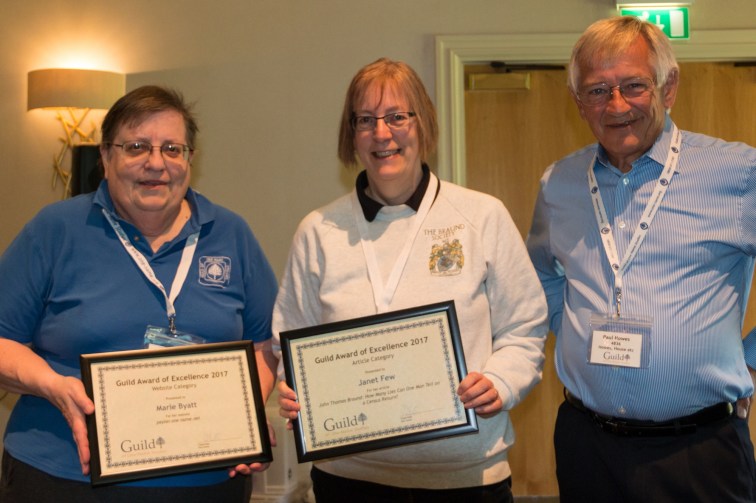
The following day, it was back to the melee by 8am in order to greet the new day’s delegates. We were provided with our room ‘key’ (card), which bizarrely depicted Peppa Pig – nope, no idea. The chance to actually inspect said room was not forthcoming. During the AGM, I was surprised and honoured to be presented with a Guild ‘Award of Excellence’ for an article I had written about a member of the Braund family, whose census entries were an amazing work of fiction. I was very glad that fellow awardee, Marie Byatt, was also in the audience. At least this spared me from smiling inanely at the camera, clutching my award, on my own.

The first presentation of the day was Suzie Cox who told us about the archives of the P & O company. This was followed by Ian MacDonald’s story of the Mewburn family. I then chaired Kim Baldacchino’s session on the Navy in Malta. There’s another destination on the future holiday list then. The final presentation was by Michelle Patient from New Zealand, with some interesting insights on migration. The two hour special general meeting that followed meant that preparations for the banquet had to be swift and we finally got to inspect our room. We were provided with water (free) in an £8 bottle and a coffee making machine but no kettle. We never did tackle the learning curve that may have allowed us to boil water in order to a) fill a hot water bottle or b) dilute ginger cordial (good for non-existent voices). Despite leaving the banquet at what for most people would have been an early hour (the middle of the night by my estimation) sleep eluded me.

After no more than two hours sleep I was required to be alert and audible enough to give my own presentation. This actually seemed to go remarkably well (I did at least stay awake). I promised to pass on a few websites from the talk, although the complete handout can be accessed here. Three of my favourite finds were the British Southern Whale Fishery  database, with 13,500 entries from 1775-1859. The details are mainly taken from The National Archives’ Board of Trade records. Then there is the list of  Lost Trawlermen of Hull. Finally a record of Hastings’ fishermen, which not only provides a list from 1623 but also records nicknames of later fishermen. How do you fancy being related to these characters: Tambourine Jack Cobby, Hard Pudding White, Rum Cheese Tassell, Whip-me-naked Gallop or Licksnot Sutton? Bob Cumberbatch followed on with a session on Caribbean surnames. We then had video presentations from Peggy Chapman and Tessa Keough on Canadian and US records and the day ended with Jean-Marc Bazzoni entertaining us with tales of the London Dock Police. All in all another great weekend, the best part of which was the opportunity to be amongst friends.

Next up a couple of days’ rest. Rare is it that I can describe days with Edward as a ‘rest’ but sandwiched as they were between the conference and Who Do You Think You Are? Live, they did seem comparatively restful. So, I have helped to pitch tents, identified wildlife and spent a day at the Birmingham Think Tank. This was followed by a trip to L**l’s for supplies. A staff member trundled by with a large wire trolley full of yoghurts and other goods to be put on shelves. Regular readers will remember that Who Do You Think You Are? Live is, for us, not infrequently accompanied by wheels falling off things (see 2013 and 2014) and yes dear reader the wheel fell off this trolley leaving groceries descending or suspended precariously. A fisherman of my acquaintance leapt to the rescue and was to be seen supporting trolleys and grovelling on the floor trying to refix wheels. Meanwhile I continued shopping and attempted to remain unobtrusive. P.S. I am still shamelessly touting for an audience for my two Who Do You Think You Are? Live talks on Thursday, especially the one at 2.15 in the Education Zone, which does not yet appear in the programme – come and find out how to inspire young people to take an interest in history – this one is free!

Awards, Book Sales and Young People and Family History

IMG_20170328_132302_467Well, what a busy week it has been. Firstly, preparing my presentations for the Guild of One-Name Studies conference and Who Do You Think You Are? Live. I have come across some great websites whilst working on the former, which is entitled Ship to Shore: sources for researching coastal communities and their inhabitants but no spoilers. For those who aren’t at the conference, all will be revealed next week. Then the really exciting news that I have been allocated an additional presentation slot at Who Do You Think You Are? Live. So at 2.15pm on Thursday 6 April I shall be in the Education Zone talking about Give me a child until they are seven: young children and family history. This is a subject that is very dear to my heart and Edward has been helping me with some of the slides. This is a free, no need to book session but it hasn’t been publicised so please spread the word. It is such an important subject and I don’t want an audience of one. I have the large hall to fill for my second session at 3.15pm The Ones that got Away: tracing elusive English ancestors. There are still some spaces for that one, says she, shamelessly seeking support. Most importantly, if you are there, do come and say hello. I shall be there on all three days.

Then I’ve been writing an article for The In-depth Genealogist about the history of prostitution, well the column is about working women. It has made my internet search history look a bit dodgy. I have learned the hard way that it is best to go for ‘Prostitution in Victorian times’, rather than ‘Victorian Prostitution’. I could but won’t, give you some interesting information about shady goings on in Victoria Australia and Victoria Canada. I managed to restrain myself before searching for ‘copyright free images of prostitutes’.

Next, I attended the excellent book launch event for Liz Shakespeare’s Postman Poet and the accompanying CD by Nick and Becki (with a small contribution from a fisherman of my acquaintance). It was a brilliant evening and I have already started the log-awaited book. I even got VIP treatment and an honourable mention on the strength of providing my kitchen.

Then it was off to the ENT department for the next instalment in what has now become the ‘what Janet hasn’t got wrong with her’ saga. This time it was to determine why my voice periodically sound like a frog on steroids (one drug that has not yet been suggested). Turns out my knowledge of anatomy is more rudimentary than I thought. In order to look at my voice-box, I had a camera shoved up my nose. This is a strange sensation and not to be tried at home, particularly not if you use a Canon G7X. Allegedly all looked fine and the verdict was that I seem to have somehow learned to talk using the wrong muscles (but weirdly not all the time). Nope, I don’t understand it either. I am now being sent for speech therapy. I am viewing this as Continuing Professional Development and wondering if the travel costs to the hospital are tax deductable.

On the good news front, copies of Putting your Ancestors in their Place: a guide to one place studies are now in short supply. It must be the recent publicity. At least, I think this is good  news. I hadn’t really factored working on a revised edition in to the diary. Then even more excitement as I receive a letter to say that an article that I wrote so long ago that I barely remember has been short listed for a British Association for Local History Award. I feel like I’ve been nominated for, if not quite an Oscar, at least a Brit Award. So The Impact of the Bible Christians in Rural North-West Devon: a force for unity or division? must have gone down well. Devon History Society is well represented as another article in the same edition of their journal was also nominated. There are usually about eight nominees chosen from hundreds of local history articles. Now I am just working out if I can possibly get to London to collect the certificate that all nominees are awarded. Fortunately I don’t think I need to prepare a speech that thanks my agent, my family and my dog and makes telling comments about the current political situation.

Now We Are 40: family history reflections

Cargreen shop old postcardBefore anyone suggests that I am not wearing well, or wishes me Many Happy Returns (do people still say that?), I am, sadly, not celebrating my 40th birthday. This week I enter my fifth decade of serious family history research. It was March 1977 when I took myself off, alone, to Cornwall to visit my father’s ancestral village for the first time. I arrived by public transport at a B & B some six miles away. All I can remember about this was that the proprietor chatted incessantly about her late husband’s role with the electricity board. The next day was Sunday. Said small ancestral village not being overly well blessed with Sunday public transport links (there weren’t any) I decided I would walk. I am still of the opinion that Cornish miles are longer than those elsewhere. I plucked up courage to enter the local pub (think lone female, 1977, rural pub) and ask if there was anyone of my surname living locally. It turned out that half the village were related and I was ‘adopted’ by members of the family instantly. They even had a car to take me back to the B & B.

Forty years on and the family history world has changed beyond recognition, not always for the better. The hobby/obsession has shaped my leisure time, my friendships, my working and academic life. I am still of the opinion that an understanding of history is crucial to our well-being, both personally and as a nation, as a world. Only this week a ‘think tank’ (who no doubt were paid a small fortune to work this out) suggested that schools should teach children to recognise fake news. Schools have been doing this for centuries. The subject dear think tank is called history. It teaches the ability to evaluate sources, to recognise the role of propaganda, to think critically – or at least it should. The very personal brand of history that is family or community history, gives us a sense of self, a sense of place. ‘Lone Tester’ has just posted a very interesting blog entitled ‘Are you a Genealogist or a Family Historian?’ I have long-since realised that ‘genealogist’ and ‘family historian’ have different meanings in different parts of the globe and perhaps the way in which the terms are understood also varies according to how long an individual has been researching. To me, genealogy is the basic family tree and family history is the wonderful contextual background, setting those individuals on that family tree into their time and place.

Whilst on the subject of putting our ancestors in their place, I was pleased to see what a great job Family Tree Magazine made of my article on One-Place Studies in their latest issue – than you Family Tree Magazine.

…. and the latest in the ‘what does Janet not have wrong with her?’ saga – having been x-rayed last week, still no idea. Am I alone in thinking it ironic that I was greeted by the radiographer with ‘Hello, are you all right?’ I was tempted to reply ‘Yes, I’m in full health, I am just sitting around waiting to get zapped with radiation for the fun of the thing’.

Who I Really Am – More Adventures with #DNA

The further back we delve into our family’s history, the greater the chance that there has been a ‘non-paternity’ event somewhere in our chain of great great grandparents and that one of our ancestors, child of Mrs X, was not the genetic offspring of Mr X, despite what the baptism register would have us believe. In fact, historically, the child of a married woman was always considered to be the progeny of her husband, however compelling the evidence to the contrary. I have heard of baptism entries reading along the lines of ‘…. son of William and Mary X, the husband was transported two years ago.’

I am a great believer in tracing not just blood parents but also those who have taken on parental responsibilities, such as adoptive or step-parents. These people’s values and attitudes will be passed on every bit as much as genes, so they are important. Nonetheless, most family historians do have a particular interest in their genetic line. How ever much we look like other members of our family, there is always that niggling doubt that one of our great great grandmothers may have strayed and we may not be who we think we are.

Next month marks the 40th anniversary of my first forays into real genealogical research, as opposed to just absorbing what my family members already knew. I was interested in all my blood lines but my direct paternal line fascinated me the most, mainly because I knew so little. I visited what was then the Public Record Office (PRO). I looked at the 1871 census returns (the most recent then available) on microfilm at Portugal Street (remember that?). I purchased my first certificates, for I believe £4.50. This confirmed that my family did indeed originate from a small Cornish village on the banks of the River Tamar, as I had been told.

cargreen-shop-old-postcardAt the age of twenty one I took a solo trip and visited Cornwall for the first time. I arrived at the nearest railway station on a Saturday evening. I stayed in a lovely B & B, which sticks in my memory because the proprietor was obsessed with recounting how her late husband had worked for the electricity board. On the Sunday, I obviously wanted to go ‘home’. The village was seven miles away and there was no public transport. Undaunted, I set off to walk. Since then I have firmly held the belief that Cornish miles are longer than those elsewhere. The local shop, which bore the family surname, was shut. I eventually wandered in to the local pub, not the easiest thing for a lone female in the rural Cornwall of 1977. I asked for relatives and met several fourth cousins. For the first time I saw someone of my own generation from my father’s side of the family. Despite being a clone of my mother and maternal grandmother, others perceived a physical resemblance. I was, naturally, very excited.

Although I research all branches of my ancestry, I suppose I have most emotional investment in my Braund line because it has been the subject of one-name research since 1982. We hold extended family reunions every year, I belong. What if I wasn’t really a Braund? I tried to tell myself that it didn’t matter, that I have borne the name and I am a Braund in all that counts. Despite having encouraged others who have taken DNA tests and received the results that do not match, with those words, ‘it does not matter’, I had a horrible feeling that I might be devastated if it turned out that my genetic roots lay elsewhere.

Someone from my branch of the family had already had a non-matching Y DNA test result but that was done because there were doubts about parentage in that line. So far, I didn’t match other Braunds who had done autosomal DNA tests but I had been convincing myself that that was ok because the paper trail showed that any connection would be very remote and date back to the seventeenth century or earlier. Within my first year of research I had traced back to my 6 x great grandfather Samuel Braund, thirty seven years later I added another generation but were these Braund ancestors really mine? Could DNA prove my genetic line? Apart from the lack of matches with other Braunds so far, my 3 x great grandfather was born out of wedlock to a Mary Jeffery. Ok, so he was named James Braund Jeffery, later took the surname Braund and appears to have been brought up by the Braund family but there were a few misgivings regarding how honest Miss Jeffery may have been.

If you have been following along with my weird and wonderful life you will know that I recently took an autosomal DNA test. My closest matches were in the 2nd-4th cousin range and one of these had a surname that I recognised as marrying in to the Braund family in my 4 x great grandfather’s generation. This person had the largest segment of common DNA of any of my matches. I emailed a tentative enquiry. The response confirmed that we were fourth cousins twice removed. My 5 x great grandparents were his 3 x great grandparents, thus confirming the genetic pedigree back to a couple who married in 1766. So I am sorry I cast aspersions on poor Mary Jeffery. I don’t even know what happened to her. I believe that she may have died in childbirth. Maybe one day I will find an autosomal match with a member of the Jeffery family. For now, I am relived that the DNA match has confirmed the pedigree that was crafted from 40 years’ of documentary research.

Things that go Bump …. in my world of spinning historical stories

Yesterday was a first for me. I attended two workshop for writers of historical fiction, led by Vanni Cook, who is a reviewer for The Historical Novel Society. This was an excellent and thought provoking day, run by the Way of the Wharves project and we were taking the eastern bank of The Torridge at Bideford as our inspiration. The area breathes history and there was plenty to stimulate discussion, from a variety of eras. We were meeting in the beautiful Kingsley Room, with its unique snake bedecked ceiling, overlooked by a portrait that was allegedly of Francis Drake. We were sceptical about this identification; sorry Royal Hotel if this sells rooms but Francis Drake this was not. Our suggestions were Richard Grenville or John Davie, the tobacco merchant who was probably responsible for the seventeenth century building. We were using Grenville as a possible character inspiration and one of our group was reading biographical information about him when a wine glass, thoughtfully provide for water, sudden moved from well away from the table edge and any people to the floor, where it lay in two pieces…… The next sentence of the contemporary description of Grenville that was being read was……. “He would carouse three or four glasses of wine, and in a bravery take the glasses between his teeth and crash them in pieces and swallow them down.” Well there’s an inspiration for a story then.

#Daisy is making gradual progress; this week’s investigations centre round bankruptcy proceedings, hiring domestic servants and walks from Horns Cross to Bideford. Oh, and more on writing, my house is now part of the publicity material for the eagerly awaited Postman Poet  novel by Liz Shakespeare and accompanying CD by Becki Driscoll and Nick Wyke, which also has a contribution from the fisherman of my acquaintance.

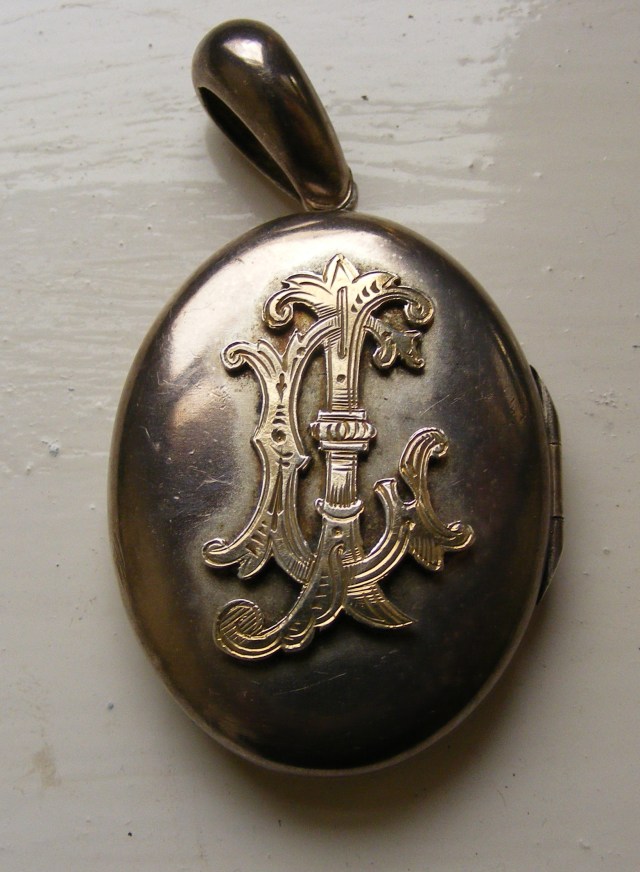
For those of you who are following the story of the five lockets, we have now located a third. Strangely, this one has the initials of the first christian name and surname of its original owner (although she had a middle name), whereas the others use the first and second christian name initials. The only possible explanation that I have for this is that the first name/surname one, which belonged to the oldest daughter, in shades of Pride and Prejudice, was a reflection of the etiquette of the time. Suggestions on a postcard, well in a blog comment box at any rate.

gwen-and-dep-c-1933I have also submitted some pre 1939 photographs of my family’s pets, in order to assist in a research project. Pets are an often forgotten aspect of our family story, do submit your own if you have any.

Finally, in an interesting blog post Jane Roberts asks if Family History is ‘proper’ history. My response: To me (an academic historian and a family historian) the answer is, ‘it depends’. For some, who take their research seriously, investigate context and immerse themselves in primary sources, then the answer has to be yes. They are a valuable part of the historical debate and this intensely personal brand of history is a wonderful way of encouraging people (who might otherwise be disinterested) to engage with history and heritage. There are also pedigree hunters who leap from branch to branch of the family trees of others in pursuit of the shaky leaf. I am not saying this is wrong (ok, deep down it really irritates me but it is none of my business what people do with their leisure time) but it is not history.

Counting Cousins and Descendants and Looking for Lockets

Warning – this post contains something resembling maths but does include jewellery if you persevere. As regular readers will know, I have recently been following the documentary evidence and seeking out my third cousins, in the wake of receiving my autosomal DNA results. This was thrown into particular focus last week when I met with my full complement of second cousins (6) for the first time in seventeen years. Although, inevitably, we were meeting for a sad occasion, a funeral, this was exciting for me as these are my only relatives in my own generation. But back to the third cousins (people with whom you share a great great grandparent).

I was surprised to find that 7 of my 8 sets of great great grandparents married within a thirteen year window 1852-1864; the final set married a little earlier in 1841. Ok, I’ll be honest, one set don’t seem to have married at all but I can estimate a ‘marriage’ date as falling between gg granny having a child by someone else and having a child by gg grandad. What I therefore wanted to know was how many, on average, great great grandchildren might a couple who married in the UK in the mid nineteenth century be expected to have.

I had already found that wiser folk than I estimate that the ‘average’ person has 175 third cousins (people with whom you share a great great grandparent) but nowhere amongst my Googling (other search engines are available) can I find data about the likely numbers of great great grandchildren. We are obviously dealing in averages here and clearly there will be wide deviations from the average; different cultures will have very different experiences. Maybe this is why this is a discussion that does not seem to have been aired very often in family history circles but it is interesting nonetheless. Yes, our families will not be ‘average’ but you would think that, if we look at all eight sets of our great great grandparents, prolific families would be counterbalanced by those with few children and things would even themselves out.

If I am expected to have 175 third cousins, on average, each pair of great great grandparents will have produced roughly 22 of them and me of course. If you have complete data for descendants of any of your great great grandparents I would be really interested to know how many people there are in your own generation, alive and dead, (not the total number of descendants) who are the great great grandchildren of one couple, especially if they married in the mid-nineteenth century. How close is it to 22? Do we have a vaguely accurate figure for first world countries here? How much difference does it make if you are a different generation to me, so your great great grandparents married in the 1820s or the 1890s?

I am confident that I have identified all the descendants of three of my eight sets of great great grandparents. My results for the number of people in my own generation (remembering to include myself in each case) are 5, 7 and 10, far short of the figure I have come up with of 22. So, how do you compare?

caroline-jessie-leighton-1874-1965

Caroline Jessie Leighton 1874-1965

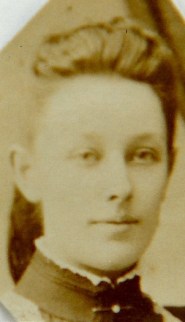
Now the pretty jewellery bit, which also involves cousins. My grandmother had five cousins on her father’s side, sisters whose father was a silversmith. Each girl was given a heavy silver locket that their father made, which was inscribed with their initials. Only one of the girls married and she had no children. The family story was that the five lockets passed to the five girls in the next generation (my mother and her four cousins). The tale of who was given which locket has proved to be incorrect but as a result of last week’s funeral, we are currently investigating where the lockets are now. Two down, three to go! This is important to me. The original recipients have all been dead for fifty years or so. They have no one but us to keep their memories alive. So here is Caroline Jessie and here is her locket. Now you can get back to counting cousins.

dscf3604

Twentieth Century Family History

105372A copy of Karen Bali’s Tracing your Twentieth Century Ancestors (Pen and Sword 2016) has just arrived on my door mat for review. In the light of my recent blog post for the In-Depth Genealogist and as my ‘Discovering your British Family and the Local Community in the early C20th’ course for Pharos has just commenced, this was very timely. As someone who not only teaches courses that focus on the recent past but also as the author of a book on C20th social history [Remember Then: women’s memories of 1946-1969 and how to write your own] Karen’s book was bound to appeal. Like me, she stresses the importance of capturing our own personal history and memories; these are part of our family’s history.

Chapter one looks briefly at the social history of the twentieth century, providing a springboard for discovering the context for the lives of our nearest ancestors. The next five chapters describe different types of record that can be used in the process of C20th research: civil records, censuses, directories, wills and newspapers. The latter chapter also covers photographs and film. These are clear accounts of the sources and their use, helpful for those who are just starting on their family history journey and for more experienced researchers who have decided that now is the time to re-examine the generations closest to them. Family history is a fast-changing world, so although this book was only published in 2016, the scope for C20th research has expanded since then. This means, for example, that the very useful C20th source, the 1939 Register, which was newly released at the time the book was written, is covered only briefly.

Chapter 7 examines the theme of conflict and defence, considering sources that will help with discovering more about those who fought in wars from the Boer War to the Kosovo War and all the conflicts that occurred between these two wars that provide bookends for the C20th. A variety of trades and occupations form the content of Chapter 8 including: railwaymen, policemen, merchant seamen and publicans. In another important chapter, Karen encourages us to research the homes and communities in which our ancestors lived; something that I would certainly advocate. Here you will find information about one of my all time favourite sources, the Valuation Office records, as well as school records. It was a shame that one of my other favourites, the National Farm Survey was not covered. Karen then moves on to helping the reader through the maze of records that have resulted from the wave of C20th emigrations, primarily to the colonies. There is also an emphasis on tracing living relatives, a topic on which the author has written in greater depth elsewhere [New Cousins: How to Trace the Living Descendants of your Ancestors (Family History Partnership 2nd edition 2012) and The People Finder: reuniting relatives, finding friends (Nicholas Brealey 2007)]. Always a key part of family history research, this aspect has assumed a new significance as genealogists seek to establish how they are related to potential DNA matches.

Case studies, which are scattered throughout the book, help the reader to see how the information given could be applied. There is a handy chart that helps to sort third cousins once removed, from second cousins twice removed. The book finishes with suggestions of ways of preserving family printed and photographic ephemera. All in all this is an excellent book, which encourages researchers to examine a period in their family’s past that is often neglected. Even better, it is currently being offered at 20% off the cover price.