On a glorious sunny September day, with temperatures in the twenties, we set off for Leith Hall in nearby Kennethmont. One of the pleasures of visiting Scotland is that most of your journeys from a to b are through beautiful scenery and are as much part of the experience as the destinations. Here though the landscape is not stereotypically ‘Scottish’. Gone is the dramatic, stark scenery of further south. Instead, we have more benign vast vistas of rolling fields that are currently being harvested.
I like to take notes when I am going round places, or I forget everything that I have been told. I managed to find a writing implement in the bottom of the bag but struggled to find anything to write on. Finally, I unearthed a tiny scrap of paper, which I decided would have to do, Leith Hall has a history dating back to 1650, when James Leith had it built. It has a chateau-like appearance and inside there’s an arts and crafts movement influence. We arrived just as a guided tour was beginning. Unlike English National Trust properties, where it is usual to have a guide who specialises in each room, here we have one guide who knows everything. There is a complicated family tree of previous owners and I am not sure I always quite grasped who was who. One was fanatical about recycling and the hall ceiling is panelled using pew backs from a church.
There is an elegant Georgian extension, by Alexander Leith, where Chippendale, Hepplewhite and Sheraton are all on display. When the money began to run short the estate was put up for sale, in the 1780s, by Alexander ‘Sandy’ Leith but it was his saved by his great uncle, Andrew Hay, who purchased it and gifted it back to the family. In return, the family hyphenated the name to Leith-Hay. Although they had been Jacobite sympathisers, the family had not been active in the uprisings, so kept their estates after Culloden. In stark contrast, the saviour of the estate, Andrew Hay, was an active supporter of the Jacobite cause. He fought at Prestonpans and Culloden, fleeing to the continent. After eleven years, he returned to Scotland and was pardoned in 1780. Allegedly, he was seven foot two tall, not ideal for a Jacobite trying to be inconspicuous.
There was an interesting photo of the tenants in 1902, including a few women. The estate extended to include the neighbouring village of Insch, which has ancestral connections, so I searched the list for familiar names, even though they’d left the area by 1902 but no luck. Charles and Henrietta Leith-Hay ran the Hall as a hospital in the First World War. Charles and his only son both died in 1939 and Henrietta gifted the hall to The Scottish National Trust.
We looked round the pleasant gardens. There was a sign urging us to close the gate behind us to keep the ’bunnies’ out but there was no gate on the hinges!
The tea room staff seemed a little distrait but the cake came in a variety of unusual flavours; my companion had plum and ginger and mine had an unpronounceable name but was possibly cherry based. Paying was an ‘interesting’ experience as we’d been presented with no bill but were trusted to return to the admission desk and recite what we had had. Surely this is a system open to abuse.
We visited Insch, a parish where my children and one of my sons in law both have ancestry, I have yet to find a mutual ancestor for my daughter and her husband but I will keep trying. A couple of the churches I was interested in are now private dwellings and one alludeed us completely.
We managed to fit in a visit to Fyvie Castle. Having already made the mistake once today, I compounded the difficulty of taking notes by arriving at the ticket desk without anything to write on or with. It was quite a long way back to the car to find the necessary equipment. I was willing to buy a pencil in the gift shop but they came without points, so that idea failed. I decided to blag something of the chap in reception instead. Here, Bob was our knowledgeable tour guide and we were the only people on the last tour of the day. Having worked at a tourist attraction, we strongly suspect that Bob was hoping we just wanted a cursory look, so that he could head off home early but we disabused him of that idea and assured him we’d like the whole tour. Sorry Bob.
Parts of the stone building were already in existence when Sir Henry Preston captured Ralph de Percy in 1390 at the Battle of Otterburn. Percy was a wanted man and the English Crown rewarded Preston by giving him Fyvie Castle. Allegedly, the castle was already cursed. Tammas the Rhymer and been asked to entertain the inhabitants but perceiving some slight when the door was blown shut in his face, he decreed that the eldest son would never inherit, which proved to be the case. Three specific stones have to be thrown from the castle to lift the curse. One of the stones is inaccessible but another is on display and is said to ‘weep’ filling the basin it is lying on with water. In addition, there is a sealed chamber that has not been accessed since the seventeenth century. Breaking the seal is thought to bring about the laird’s death and make his wife blind. Another gruesome tale is that of Lilias Drummond, who failed to give her husband, Alexander Seton, the required son. Wishing to marry his wife’s niece but being a fervent Catholic, so divorce not being an option, in 1601, Alexander locked Lilias in what is now known as ‘The Murder Room’ and starved her to death. Lilias’s name can be seen carved on an outside window ledge, which supposedly appeared after her death. Her ghost, as ‘the green lady’ is said to haunt the castle.
In 1596, Alexander Seton bought Fyvie from the Meldrum family. Several carved finials adorn the roof. Some of these date from the sixteenth century and six are thought to have been added by Alexander; one strongly resembles a flowerpot man but is allegedly a ceremonial trumpeter. Later owners continued the tradition of adding finials
The future Charles I was brought up at Fyvie, being too sickly to move south with his father James VI when he ascended to the English throne in 1603. The present king celebrated his 60th birthday here.
The towers are named after three of the owning families, Meldrum, Seton and Preston. Steel bands (not the musical kind) have been fitted to the Seton tower to monitor movement and parts of the building are in need of conservation. In the 1890s, Lord Leith installed similar bands, fashioned from railway sleepers. Continued remodelling rendered the foundations insubstantial for the weight of the extended Seton and Meldrum towers. Cracking can be seen and is being carefully monitored.
In 1889, Alexander Leith purchased Fyvie for £175,000, which included the 10,000 acre estate. Born in Scotland, Alexander, along with his wife’s family, had made a fortune in the American steel industry. He added to the collection of armaments, portraits and tapestries at Fyvie. Other symbols of affluence and status include a 1120 piece Waterford chandelier and a large collection of portraits by Raeburn. One portrait bizarrely has a right foot that is always pointing towards you, no matter where you stand in the room. I have no idea how this illusion is achieved. There is a ‘great wheel’ staircase, basically an extra wide spiral staircase. Allegedly, General William Gordon raced horses up and down it.


 Scotland is apparently bathed in sunshine. Typical, here we have drizzle and falling temperatures. Time for another National Trust property near you visit, this time to Wallington House near the weirdly named Cambo. The house was built for William Blackett in 1688 and then passed into the Trevelyan family, who, as the name suggests, originated in Cornwall. The most notable feature of this house is a central courtyard, which was covered over in the 1850s and decorated with murals depicting the history of Northumberland, for which the artist, William Bell, was paid £100 a panel. We are supposed to spot stuffed squirrels in the various rooms. I clearly need a two year old with me for this. Mind you I was not helped by the sample squirrels being three times the size of the hidden ones. There is a group called Robson’s Choice playing the Northumbrian pipes in the hall. These are very different from Scottish bagpipes and are much more suited to an indoor performance. They are not blown but the air is injected by squeezing bellows strapped to the elbow. My favourite features are once again the kitchen and also a series of photographs of former servants that are on display as part of a ‘Silent Voices’ project.
 The main product that was smuggled was tea, which in Nisbet’s time attracted 119% tax. The house includes a hidden chute where large quantities of tea could be stored, a hidey hole under the floorboards, capable of concealing three men and warren like cellars, where our tour began. The top floors were not finished for twenty years, by which time a tenant, John Stewart, was in residence. The house was sold to rival merchant and smuggler, Alexander Robertson, to pay debts and then passed to the Home family. From 1906-1965 the house was run as a guest house by the Dougals. It then did time as a clubhouse for golfers and was finally acquired for restoration by the trust in 1998. In fact very little had been altered by the succession of owners. Pleased with our choice of ‘bonus’ visit, we return to Berwick Seaview site, which is by then living up to its name.
 The weather is much better today. Not as much better as some of the locals, with their bare chests and shorts, are implying; I still have my coat and jumper on. We can at least see the view over the Firth of Forth as the mist has lifted. The castle fire a cannon at 1pm daily, except Sundays, so we shall miss that. St Margaret’s Chapel is the oldest part of the castle. It was built in memory of Margaret, the mother of David I. It is very tiny and although it is still used for weddings, you are limited to 25 guests. After our tour we wait for an excellent presentation by an historical interpreter, representing Sir Thomas Randolph, Earl of Moray who, in 1314, was charged with recapturing the castle from English occupation. It was one of three castles in English hands at the time. Roxborough was re-taken by men disguised as cows. Randolph, whose half uncle was Robert the Bruce, climbed the rock using a secret path revealed to him by the son of a former castle governor and got inside the castle with thirty men, whilst others created a diversion at the gates, so the castle was recaptured from inside. It is great to chat to the interpreter and try his weaponry. The chain mail is seriously heavy and the full face helmet certainly restricts the field of vision. He has a fiendish looking mace, which was designed for use by churchmen who were not allowed to let blood, although bashing people over the head was fine!
 On the way back to the van we call in at Currie, where my granddaughter’s ancestors came from but no luck with the graveyard here. There are some very unusual stones there though.
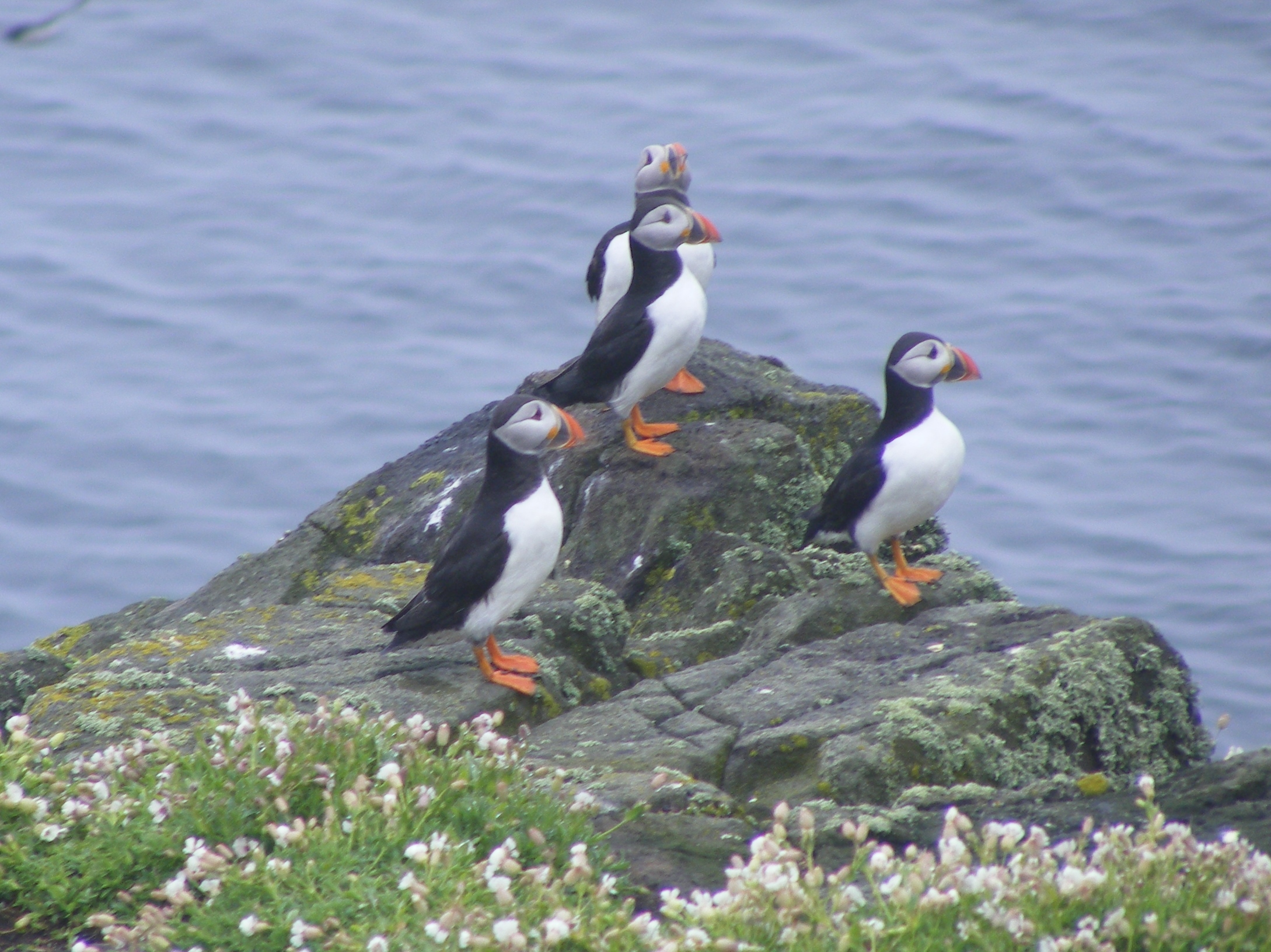 We start to see more and more seabirds through the mist and drizzle, including my first ever puffin! As we near the island the water is thick with guillimots, razorbills and more puffins. We have three hours to spend on the island and we walk most of the pathways. Departing from the marked routes is strictly forbidden in case puffin burrows are damaged. Even with my very basic £100 camera I manage half decent, recognisable shots of the islands birds. Apart from the puffins, razorbills and guillimots there are, oystercatchers, shags, fulmars, black-backed gulls (lesser and greater), fulmars and kittiwakes. There is also an active tern colony and the terns dive bomb the visitors making their strange ticking cries (that would be the terns’ cries, not the visitors). Eider duck nest right by the pathways; I had forgotten that the females were a drab brown, in contrast to their gaudy husbands. A tremendous plus for having had to do this part of the trip two years later than originally planned is that, had we made it here as intended in August 2014, there would have been far less to see. Despite the chilling wind I am having a great time, though I agree that slightly warmer weather would have been the icing on this particular cake.
 A great deal of what is known about sea birds and migrations patterns is thanks to data collected on May. Only the researchers live on the island as the lighthouse is now automated. It is 200 years old and was built to replace the oldest lighthouse in Britain, which was a coal fired beacon tower dating from 1636. This took between one and three tons of coal a night to maintain, all of which was brought from the mainland and hauled to the top of the tower. The island used to be a monastic foundation, with St Ethernan’s shrine attracting pilgrims since the seventh century. The island was home to St Adrian until he carelessly got murdered by the Vikings in 875. In 1500, James IV had a picnic on the island, because he could I guess. After the 1715 Jacobite rebellion, three hundred fleeing Jacobites somehow got stranded on May for eight days without food.
 After about five minutes casting our eyes round stones with all the wrong names on and on the point of giving up. I locate Mr Sharp who should be next door to the Wight family. Yes, there is a flat stone nearby but compacted grass, the product of many mowings, is stuck firmly to its surface. I wish, too late, that I had taken a ‘before’ photograph. We begin rubbing away, being careful not to obliterate the sandstone surface at the same time. Grass has grown quite a long way over the edges of the stone, covering the inscription. I decide that we need a spade to remove this. We do not have a spade, how short sighted of us. Chris has his barber surgery kit in the boot ready for a conference at the end of our trip. I suggest using one of his many knives, saws or axes to hack back the grass; he seems less keen. We imperil our finger nails by hauling at the grass roots. As for the mowing detritus, in the end we perfect a technique of rubbing the soles of our shoes over the grass, which eventually loosens and can be swept away. This works better with my trainers as Chris has smooth soled shoes on. Well, that was his theory and he was sticking to it. It is quite a large stone and I am rubbing vigorously. If you are ever tempted to try this, be warned, it involves a lot more effort than you would think. The weather has meant that today is the first day we haven’t been for a walk but I decide that stone clearing constituted sufficient exercise. Ten minutes later and the stone is as clear as it is ever going to be and I am well pleased.
 ng that they might see bears at ‘Highland Bear Lodge’. Maybe highland bears are akin to yellow tits and indeed the Loch Ness monster. We drive through pretty birch woods to Glen Affric. There are more sheep in the road; these are sitting down contentedly as if they were in a field. There are deer relaxing nearby, maybe they have evicted the sheep. We pass the Fasnabyle HEP plant, reminding us how important the energy business is to Scotland. We head back towards Inverness by a different route, with the River Glass on the right and a bluebell wood on the left to enter the Black Isle, between the Moray Forth and Cromarty Firth. This peninsula, previously named Ardmeanach, was given to Lord Darnley by Mary Queen of Scots. The views are glorious. I find this one of the most attractive parts of Scotland, yet I was expecting to prefer the west coast.
 The History Interpreter - Janet Few