#100daysofbfotc Day 88: Winnie Hamm

Torquay Town Hall Hospital

Torquay Town Hospital

Winnie is a character where a little more imagination came into play. Barefoot on the Cobbles needed a VAD nurse, so I searched the Red Cross database to find someone of a suitable age who actually worked at Torquay Hospital. I also needed to include someone who was a little more street-wise, to introduce Daisy to life in the town and Winnie fulfilled that role. Although there is no evidence that Winnie and Daisy met in real life, they may have and Daisy would have needed a friend in her new home.

Winnie’s employment at Aylwood is another invention. On the other hand, Winnie’s description of her time at the hospital, far-fetched though it may sound, is taken from genuine memories of a VAD who worked at the Town Hospital at the time. In reality, Winnie Hamm worked in the pantry at the hospital from 3 November 1917, earning 9d a day.

Although I have implied, in the novel, that Winnie grew up in Torquay, the real Winifred Muriel Hamm was born on 24 Feb 1899 in Tooting, London to Sydney and Alice Hamm. When she was working at Torquay Town Hospital, Winnie’s address was Ruthven, Meadowfoot Lane, Torquay. At some point after the war, Winnie moved to Bathavon and in 1930, she was fined at Corsham Petty Sessions Court for failing to display a motor registration license. In 1939, Winnie was living with the mother at Laurel Cottages, High Street, Bathavon. Winnie was obviously keen on public service. She was a manager of Bathford Primary School and stood for the Parish Council in Bathavon in 1949. She died at the age of 96, on 20 June 1995 and is buried at St Swithun’s Bathford.

‘Daisy judged that Winnie was the younger by several years, probably not much older than Violet. Although not a hair was out of place, there was a light dusting of freckles across Winnie’s pert nose, which somehow made her seem more approachable.’

Barefoot on the Cobbles will be published on 17 November 2018. More information about the novel can be found here. Copies will be available at various events in the weeks following the launch or can be pre-ordered from Blue Poppy Publishing or the author.
Of Kindles, Witches and Poppies: or how to buy books

Amidst all the #100daysofbfotc blogs, it has been a while since I wrote of other things. Life has been busy; what‘s new? There have been visits to and with descendants, articles to write, courses to run and presentations to give. With All Hallows Eve in mind, my talk about Seventeenth Century Witchcraft has been requested a couple of times, always one that leads to fascinating audience discussion. Also with a seasonal flavour, my colleagues have been out and about recreating life at the time of the Great Fire of London; although I am never quite sure why schools think it is appropriate to book these sessions to coincide with Guy Fawkes Day!

On the subject of anniversaries, preparations for our parish commemoration of the centenary of Armistice day have reached fever pitch. Our village green is bedecked with knitted poppies, we have recruited volunteers to represent almost all of the 90 service personnel from the parish (and have hopes of getting the full complement before next week). Songs of the era are being sung, communal food is being prepared. Every service person has a mini-biography hidden on our history group website, ready to go live at 11am on 11 November (I hope!). I have been in to the local school to chat about Remembrance and the children have produced some wonderful art and written work. It has been four years in the making and next week, all that hard work, by many people, will come to fruition. Someone was heard to mention that next year is the 75th anniversary of D-day and should we be celebrating that? I did turn a deaf ear; someone else can organise that one!

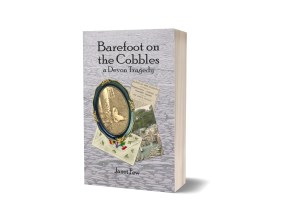
Now to my own personal excitement. Although I finished writing Barefoot in the Cobbles in March, in the few weeks I have been at home since then, the time has been spent editing and marketing. This week, I conquered the learning curve that was necessary to convert Barefoot into Kindle format. I do hope I have got it right. It looks ok to me. So, you can now pre-order copies for your electronic device here. Having said that, I am really hoping that potential readers will opt for paper copies too. There are 54 boxes of books in my very small house. I do need to sell some – please. If you are thinking of buying this book I have been harping on about for forever, please do read a bit more about it first. It won’t be to everyone’s taste and I don’t want people to be disappointed.

3dIf you still think you might enjoy my creation, can I make a plea that you purchase a copy directly from me, either at one of my many events or other talks, or by emailing me. Alternatively, I would encourage you to order online from my lovely publisher, Blue Poppy Publishing and for the next 13 days, you get £1 off and free postage to the UK. These options deplete my stock, as would ordering from your local independent bookshop. When buying my book, or indeed any other, please make the convenient ‘buy it now’ Amazon button your last resort. It is the easiest option and if you qualify for free postage, it has great appeal. In the past, I have been as guilty as anyone of taking advantage of this immediacy. In my case and that of many other authors who are not working with major publishing houses, it means that you will get a print-on-demand, slightly inferior quality, version and that the stock pile in my house remains the same. You don’t need me to tell you where almost all of the, already very meagre, profits go in this case. The position is obviously different for overseas readers, who will need to use the links on their own versions of Amazon to avoid the horrendous postage costs. Actually, at the moment, I am still struggling to upload a version for Amazon orders of the printed copy but hopefully I will get there by launch day, another learning curve. Two weeks to go!

#100daysofbfotc Day 54: Mr Lefroy

Scales_Of_Justice.svgGeorge Frederick Lefroy appears in the court scenes at the beginning and end of Barefoot in the Cobbles. He is the solicitor for the defence, so plays a significant role in determining the outcome of the trial.

He was born in Bristol on 15 February 1882, the son of Reverend Frederick Anthony and Henrietta Lefroy née Gurney. By 1904, George was serving with the 1st Gloucesters, Royal Garrison Artillery Volunteers as a Second Lieutenant. George married Isobel Elaine May Beaman in Eastbourne, Sussex in 1908 and had one son. In the First World War he was a Lieutenant in the Royal Field Artillery. He was invalided out and was awarded the Silver War Badge. The Lefroys lived at Orchard House, Pilton in Barnstaple and he set up in partnership with Mr Seldon. He died in 1938.

‘Mr Lefroy rearranged his papers. He wanted this strange little lady to go free and not just because it would enhance his professional reputation. He prided himself on his ability to represent and take seriously, the cases of the downtrodden and Polly was certainly that.’

Barefoot on the Cobbles will be published on 17 November 2018. More information about the novel can be found here. Copies will be available at various events in the weeks following the launch or can be pre-ordered from Blue Poppy Publishing or the author.

#100daysofbfotc Day 46: Mary – ‘Mrs William’

Mary, a fisherman’s wife, appears in the first chapter of Barefoot on the Cobbles. She is the first mother that we get to know in the novel and through Mary, we can experience a manifestation of motherhood that is rather different from those that are revealed in later chapters. Unlike most Victorian families, Mary has only two children, Albert and Fred. There is no evidence for any other live births but she may have suffered miscarriages. Of course, there could have been another reason for her untypical lack of fecundity. The story of how she opens her heart and home to young Eadie is a true one. Like a number of Bucks Mills’ wives, Mary was often known by the forename of her husband, to avoid confusion with others of the same surname, hence ‘Mrs William’.

St. Anne's Church (old postcard)

St. Anne’s, Bucks Mills

Mary’s post should really have been yesterday. She was born as Mary Jane on 22 September 1842 at Horn’s Cross, Alwington, Devon to Richard and Hannah Hamlyn née Lewis and she was the only child of their marriage. They were a farming family and Mary worked as a launderess; nonetheless, in 1862, Mary met and married William, a fisherman from the neighbouring parish. Theirs was the first marriage in the newly opened Anglican church at Bucks Mills. Their son, Albert arrived nine months later and his brother followed two years after that.

Mary lived at Rose Cottage in Bucks Mills for the last forty years of her life. She died in 1928.

More information about Bucks Mills can be found here.

Albert was explaining to his mother how he had rescued a distressed Eadie from the square.

‘Mebbe you stay here for a day or two maid, ’til your da calms down,’ said Mary.

There was reassurance in the words but who was the more comforted, Mary or this dark-visaged child with sadness in her soul? Mary turned to her son, who had unwittingly presented her with a few days of companionship.’

Barefoot on the Cobbles will be published on 17 November 2018. More information about the novel can be found here. Copies will be available at various events in the weeks following the launch or can be pre-ordered from Blue Poppy Publishing or the author.

#100daysofbfotc Day 44: Captain Thomas Powell

Captain Thomas Folliott Powell was a gift to an author looking for interesting minor characters. He appears only briefly, in chapters 2 and 3 of Barefoot on the Cobbles, yet his behaviour has ramifications that echo through the remainder of the novel. When I first discovered that Polly had been a domestic servant at Chudleigh Villas and that the Powells had advertised for a servant in the local press at the appropriate time, I decided that they made a perfect match. On further investigation, the Powells’ story opened up several opportunities.

The position of troops during the mutiny – wikimedia

Thomas Folliott Powell was born on 3rd August 1834 in Newport Pagnell, Buckinghamshire, the son of William Powell, a solicitor and his wife, Eliza née Miller. The family descended from minor gentry. Thomas bought a commission in the army in 1853 and served in South Africa, the East Indies and India. As a Captain of the 6th regiment of foot, he was involved in the Indian Mutiny of 1857-9. Thomas retired from the army in 1865 and was able to sell his commission for £2500.

There is some confusion about the name of Thomas’ wife, who appears in the novel as Emily but who was in reality Mary Jane Winter (known as Amy), who had been born in the East Indies. They married in London in 1868. Four daughters and a son were born between 1876 and 1882. We can only speculate why there were no children during the first eight years of the marriage. EDIT I have now discovered that there were also two other sons who died in infancy; one was born in 1874 but that still leaves a long gap before the birth of the first child.

The family moved to Chudleigh Villas, Bideford in the late 1880s. Thomas seemed unable to match his lifestyle to his income and he was supported by his widowed mother, who provided the furnishings in their home and made them an allowance of £300 a year. Thomas had first been declared bankrupt in 1883, when he was living in the Plymouth area. He squandered the money he had made from his commission and it seems that a gambling addiction was a major contributor. His father had, perhaps wisely, left Thomas nothing in his will and when we meet him in the novel, Thomas is once again in financial difficulties. The family downsized to Ford Cottages, in New Road, Bideford. His second bankruptcy was annulled in 1898 and Thomas died in Portsea, Hampshire the following year.

‘ Mrs Powell regained her composure and resumed her tirade, ‘Why couldn’t you just have found enough to pay off Mr Tardrew? If you’d only done that, all this might have been avoided. Then there’s that money you owe to Tanton’s Hotel, how could you have run up such a bill? Your mother has been more than generous, we should be able to live comfortably on the three hundred pounds a year that she gives us. What on earth will she think? We cannot expect her to keep making us an allowance if you are such a spendthrift. It is no wonder that your brother has washed his hands of you.’

‘What’s done is done, eh Emily,’ Captain Powell replied. ‘Like as not I shall be declared bankrupt again.’ ’

Barefoot on the Cobbles will be published on 17 November 2018. More information about the novel can be found here. Copies will be available at various events in the weeks following the launch or can be pre-ordered from Blue Poppy Publishing or the author.

#100daysofbfotc Day 40: Bertie

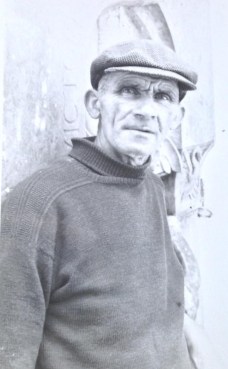
Bert Braund taken by Jim Willis

Taken by Jim Willis

Bertie’s presence in Barefoot in the Cobbles provides an opportunity to examine yet more facets of Albert and Polly’s brand of parenthood. Their second son, Bertie was born in 1900 and he spent much of his life in Clovelly, working on his father’s fishing boat. In today’s world, Bertie might have been labelled as having mild learning difficulties. A family story tells of how, as a schoolboy, he used to hold the donkeys and walk the unladen beasts up and down the street, when the visitors had finished their rides. Any silver coins he received as tips had to be handed to  his parents but bronze and copper were his to keep. After the deaths of his parents, Bertie went to live with his sister Violet in Bideford. He died in 1969.

‘The doctor looked at Bertie appraisingly.

‘Hello young man,’ he said. ‘You look just the age for my Scout Patrol. Have you heard of the Boy Scouts? I am sure you would enjoy the jolly times we have. We are off to camp in a week or two. What do you think of that?’

Bertie looked desperately at his mother for guidance. How on earth should he respond to this gentleman? He might have been speaking a foreign language for all Bertie understood of the words.

‘Oh no, sir,’ exclaimed Polly in horror. ‘Not Bertie sir, he’s well…. He’s not the sort for being away from home, camps and the like, no, no, no it would never do for Bertie.’ ’

Barefoot on the Cobbles will be published on 17 November 2018. More information about the novel can be found here. Copies will be available at various events in the weeks following the launch or can be pre-ordered from Blue Poppy Publishing or the author.

#100daysofbfotc Day 39: King’s Cottage, Bucks Mills

King's Cottage coloured postcard

King’s Cottage, Bucks Mills is the home of Albert and Eadie’s grandparents. We get a glimpse inside in the first chapter of Barefoot on the Cobbles.

On 27 January 1845, Reverend John Thomas Pine Coffin, the landowner, had entered into an agreement with Albert’s grandfather, James, giving him permission to build ‘a house over the watercourse at the machine platform at Buckish, Parkham’. This land was adjacent to James’ father’s home. The new house was to become King’s Cottage and the rent was one shilling a year. By the time we open the front door of King’s Cottage in the novel, the family have lived there for forty five years. They were to remain there for a further twenty years. It was a substantial cottage, with a view over the bay and unique plumbing arrangements, which are mentioned in the book. Kings Cottage was described in the North Devon Journal in 1855, the house ‘at the lower extremity of Bucks, on a towering height above the beach, is a real curiosity. The rivulet that comes down between the hills, by and under part of his eagle’s nest premises, discharges itself in a cataract on the beach where it flows into the Atlantic.’

After the family left, it was tenanted by a relative of Clementine Churchill.

‘Even the gate was exciting, having, as it did, a ship’s wheel at the centre. Eadie’s small fingers would proudly trace the name that was engraved in the wooden frame: King’s Cottage. She smiled; her granfer was a king.’

More information about Bucks Mills can be found here.

Barefoot on the Cobbles will be published on 17 November 2018. More information about the novel can be found here. Copies will be available at various events in the weeks following the launch or can be pre-ordered from Blue Poppy Publishing or the author.

#100daysofbfotc Day 37: Mark

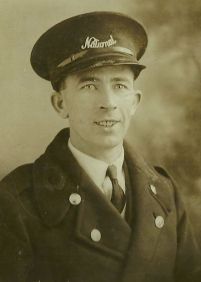
Mark Braund bus conductorGrowing up in Clovelly, Mark was the fifth child in a family of eight. With so many other characters to write about, I did consider leaving Mark out of Barefoot on the Cobbles, yet I found that he needed to be there. Not only would his absence have left an unexplained gap in a run of evenly spaced children but what happened to Mark provided yet another strand that explained the subsequent behaviour of his mother, Polly.
Born in 1906, Mark resisted the lure of the sea and worked for the National Bus Company as a conductor and then a driver. In 1931, he was the conductor on a bus travelling through Horns Cross, when one of the passengers, Joseph Daniels, was killed as he alighted from the bus. No blame was attached to the driver, who was a distant cousin of Mark’s.

In 1935, Mark married Dorothy Good but he fell ill shortly afterwards and died in 1941. The couple had no children. Dorothy outlived him by over sixty years.

 ‘Polly pushed open the door to the bedroom where the boys slept. It always smelled musty, as only a boys’ room can. The clothes Mark had discarded the previous night were pooled on the floor next to the bed that he shared with Nelson. Polly passed her hand across the lad’s forehead. It felt clammy to the touch.’

Barefoot on the Cobbles will be published on 17 November 2018. More information about the novel can be found here. Copies will be available at various events in the weeks following the launch or can be pre-ordered from Blue Poppy Publishing or the author.

#100daysofbfotc Day 36: Independent Street, Clovelly

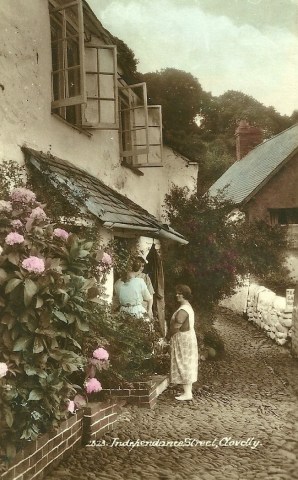
Independent Street Flossie Harris on rightIndependent Street, one of Clovelly’s few side streets, first appears in the pages of Barefoot on the Cobbles when Mrs and Mrs Collins arrive as paying guests in the home of Mrs Stanbury.

There isnt much to be said about a single street, an ordinary street, yet the incidents that took place there are the inspiration for the novel. Those houses, those inhabitants and a particular set of circumstances, all contributed to an appalling tragedy.

‘The path divided; Jack and his sledge swung to the right. Amelia was roused from her musings as they drew up at the far end of a row of cottages. Bright hollyhocks framed the newly painted door and the brass knocker shone.

 ‘You there Mrs Stanbury?’ bellowed Jack, rapping vigorously with the knocker. ‘Your guests be ’ere.’ ’

Barefoot on the Cobbles will be published on 17 November 2018. More information about the novel can be found here. Copies will be available at various events in the weeks following the launch or can be pre-ordered from Blue Poppy Publishing or the author.

#100daysofbfotc Day 35: The Western Front

Fromelles German Federal Archives This file is licensed under the Creative Commons Attribution-Share Alike 3.0 Germany license.

German Federal Archive Used under Creative Commons Attribution-Share Alike 3.0 Germany license

As a significant proportion of Barefoot on the Cobbles is set during the First World War, it needed to contain a scene from the Western Front. This was a challenge. I write by researching my characters’ geographical and emotional backgrounds, not in a vacuum. For the rest of the book, which all takes place in Devon, understanding the physical landscape, albeit with a twenty first century slant, was straightforward. Many of Barefoot’s main characters are female and although I am not a young female, I was once, so I can get inside their heads. I have never visited the battlefields, I have no experience of being on active service and I am not a young male. The thought of composing the battle scene was daunting.

I had already chosen the character, Abraham, that I would use for this part of the book and was interested to discover that he lost his life in one of the lesser known battles, a least from a British perspective (this particular battle has much higher prominence in Australian history). I had already formed an impression of Abraham’s personality but how would he respond to a war zone? I was unable to go to France while I was writing this novel but I read diaries, letters and memoirs written by those who took part in the battle. This gave me a much greater understanding of the landscape and help me to empathise with Abraham. I hope that I have created a believable character and a realistic environment. Despite having serious misgivings about my ability to think and therefore write, from the point of view of a First World War soldier, this is the chapter that I am most pleased with.

There are so many, oft used, words and phrases to describe the Western Front: horrific, damaged, muddy, bloody, terrifying, boring, a tragedy, ravaged; all those things. I think I will leave you with some words from chapter 8. ‘Across the plain where the purple clover once bloomed and the swallows used to dive, men prepared for death in a blood-stained ditch. The lurking mist that accompanied the persistent drizzle obscured the view but the deathly crumps of falling shells resounded as the wire-cutting party were sent into the abyss. From the vantage point of the higher ground, the Germans were set to defend the salient without thought for the cost in human pain.’

Barefoot on the Cobbles will be published on 17 November 2018. More information about the novel can be found here. Copies will be available at various events in the weeks following the launch or can be pre-ordered from Blue Poppy Publishing or the author.