Here, not quite There and almost Everywhere

The last couple of weeks have seen us on our travels again. Sandwiched between seventeenth century presentations to Sheffield and District Family History Society and at the Society of Genealogists were days in the weird and wonderful world of the toddler. I now know my gup-x from my gup-d (great TV series called Octonauts – try it) and my Lightening McQueen from Chick Hicks (Cars). If this makes it sound as if my descendants spend their time in front of a screen, far from it. I have built railway layouts, completed jigsaws and failed spectacularly to create a workable marble run. I have sung and signed. Make that watching admiringly whilst others sung and signed. I didn’t know the signs and really no one wants to hear me singing, even very quietly. I was placed in sole charge twice. This was greeted with varying degrees of equanimity, in direct proportion to the age of the child who was entrusted to my care.

The journey home was a challenge, with four hours at a standstill on the motorway. There are obvious disadvantages to being up the M11 without a ‘rest room’ or even a usable hedge. We missed the opportunity to make our fortunes by renting out our caravan toilet and its presence meant that we were in less of a dilemma than most but it made for a long day. The following day, we were off again to the foreign territory that is south Devon. We approached Axminster with confidence, having programmed the street name in to the sat-nav. It can be difficult to time journeys through the Devon countryside with much accuracy so we often arrive early. Ok, so we often arrive very early. This time, with half a mile to go, we could see that we had got it just right. We were aiming for Silver Street. We turned off the main road rather sooner than expected and in increasing darkness, signs of habitation receded and the road got narrower; that would be much narrower. Even given that we were in the Nissan Micra and not towing a caravan, it was becoming a bit of a squeeze. The likelihood of there being a nearby handy heritage centre up this track seemed remote. We turned around, no mean feat and enquired at a local garage. The girl serving appeared to be of an age to have just left primary school and had imperfect English but told us reassuringly that she knew where Axminster was. Next was the local pub where the helpful landlady sought out the road we required using her phone. The fisherman of my acquaintance has a smart phone, could we not have tried this? Let’s just say that the phone might be smart ……….

For some reason best known to our sat-nav it had no knowledge of Silver Street, Axminster and was under the impression that we really needed to be in Silver Street in Kilmington, a village a couple of miles away. In the end I managed to phone my hosts for advice and we arrived just in time. This makes the presentations that I do from the comfort of my own home seem positively stress free. Apart from the latest run through of my Pharos ‘Writing and Telling Your Family History’ course that has just begun, I have an online session coming up next week for The Surname Society. Hurrah, no traffic hold-ups or sat-nav malfunctions, just the vagaries of the internet connection to be worried about.

How My Kitchen (and I) Became Famous

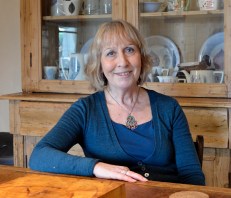
liz-in-cottage-kitchen

Liz Shakespeare

I am mopping. I am cleaning. I am tidying. What is going on? I hear you cry. Are you having visitors? Well no, not exactly. Some of you may remember the story of my friend, author Liz Shakespeare, discovering that my kitchen held a significance for her latest book about the life of Edward Capern. I’ve mentioned before that the book is to be accompanied by a CD by Nick Wyke and Becki Driscoll, who have set some of Capern’s poems to music. This includes a fishermen of my acquaintance reading the occasional poetic excerpt. As the launch draws nearer, the publicity machine is grinding in to action. Actually, it is whooshing into action at breakneck speed.

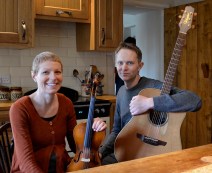
nick-and-becki-in-cottage-kitchen-2

Nick and Becki

My kitchen has been the setting for a photo-shoot; it features in a lovely article in Exmoor Magazine Then, yesterday, the local TV came to call, so I am eagerly anticipating an episode of the local news in the coming weeks.

Strangely, it isn’t just my kitchen that has been in the media lately. Peter Calver reviewed Putting Your Ancestors in their Place: a guide to one-place studies in his Lost Cousins newsletter. Then my seventeenth century social history course for the Society of Genealogists was mentioned in Dick Eastman’s newsletter – wow – fame at last.

Who I Really Am – More Adventures with #DNA

The further back we delve into our family’s history, the greater the chance that there has been a ‘non-paternity’ event somewhere in our chain of great great grandparents and that one of our ancestors, child of Mrs X, was not the genetic offspring of Mr X, despite what the baptism register would have us believe. In fact, historically, the child of a married woman was always considered to be the progeny of her husband, however compelling the evidence to the contrary. I have heard of baptism entries reading along the lines of ‘…. son of William and Mary X, the husband was transported two years ago.’

I am a great believer in tracing not just blood parents but also those who have taken on parental responsibilities, such as adoptive or step-parents. These people’s values and attitudes will be passed on every bit as much as genes, so they are important. Nonetheless, most family historians do have a particular interest in their genetic line. How ever much we look like other members of our family, there is always that niggling doubt that one of our great great grandmothers may have strayed and we may not be who we think we are.

Next month marks the 40th anniversary of my first forays into real genealogical research, as opposed to just absorbing what my family members already knew. I was interested in all my blood lines but my direct paternal line fascinated me the most, mainly because I knew so little. I visited what was then the Public Record Office (PRO). I looked at the 1871 census returns (the most recent then available) on microfilm at Portugal Street (remember that?). I purchased my first certificates, for I believe £4.50. This confirmed that my family did indeed originate from a small Cornish village on the banks of the River Tamar, as I had been told.

cargreen-shop-old-postcardAt the age of twenty one I took a solo trip and visited Cornwall for the first time. I arrived at the nearest railway station on a Saturday evening. I stayed in a lovely B & B, which sticks in my memory because the proprietor was obsessed with recounting how her late husband had worked for the electricity board. On the Sunday, I obviously wanted to go ‘home’. The village was seven miles away and there was no public transport. Undaunted, I set off to walk. Since then I have firmly held the belief that Cornish miles are longer than those elsewhere. The local shop, which bore the family surname, was shut. I eventually wandered in to the local pub, not the easiest thing for a lone female in the rural Cornwall of 1977. I asked for relatives and met several fourth cousins. For the first time I saw someone of my own generation from my father’s side of the family. Despite being a clone of my mother and maternal grandmother, others perceived a physical resemblance. I was, naturally, very excited.

Although I research all branches of my ancestry, I suppose I have most emotional investment in my Braund line because it has been the subject of one-name research since 1982. We hold extended family reunions every year, I belong. What if I wasn’t really a Braund? I tried to tell myself that it didn’t matter, that I have borne the name and I am a Braund in all that counts. Despite having encouraged others who have taken DNA tests and received the results that do not match, with those words, ‘it does not matter’, I had a horrible feeling that I might be devastated if it turned out that my genetic roots lay elsewhere.

Someone from my branch of the family had already had a non-matching Y DNA test result but that was done because there were doubts about parentage in that line. So far, I didn’t match other Braunds who had done autosomal DNA tests but I had been convincing myself that that was ok because the paper trail showed that any connection would be very remote and date back to the seventeenth century or earlier. Within my first year of research I had traced back to my 6 x great grandfather Samuel Braund, thirty seven years later I added another generation but were these Braund ancestors really mine? Could DNA prove my genetic line? Apart from the lack of matches with other Braunds so far, my 3 x great grandfather was born out of wedlock to a Mary Jeffery. Ok, so he was named James Braund Jeffery, later took the surname Braund and appears to have been brought up by the Braund family but there were a few misgivings regarding how honest Miss Jeffery may have been.

If you have been following along with my weird and wonderful life you will know that I recently took an autosomal DNA test. My closest matches were in the 2nd-4th cousin range and one of these had a surname that I recognised as marrying in to the Braund family in my 4 x great grandfather’s generation. This person had the largest segment of common DNA of any of my matches. I emailed a tentative enquiry. The response confirmed that we were fourth cousins twice removed. My 5 x great grandparents were his 3 x great grandparents, thus confirming the genetic pedigree back to a couple who married in 1766. So I am sorry I cast aspersions on poor Mary Jeffery. I don’t even know what happened to her. I believe that she may have died in childbirth. Maybe one day I will find an autosomal match with a member of the Jeffery family. For now, I am relived that the DNA match has confirmed the pedigree that was crafted from 40 years’ of documentary research.

Things that go Bump …. in my world of spinning historical stories

Yesterday was a first for me. I attended two workshop for writers of historical fiction, led by Vanni Cook, who is a reviewer for The Historical Novel Society. This was an excellent and thought provoking day, run by the Way of the Wharves project and we were taking the eastern bank of The Torridge at Bideford as our inspiration. The area breathes history and there was plenty to stimulate discussion, from a variety of eras. We were meeting in the beautiful Kingsley Room, with its unique snake bedecked ceiling, overlooked by a portrait that was allegedly of Francis Drake. We were sceptical about this identification; sorry Royal Hotel if this sells rooms but Francis Drake this was not. Our suggestions were Richard Grenville or John Davie, the tobacco merchant who was probably responsible for the seventeenth century building. We were using Grenville as a possible character inspiration and one of our group was reading biographical information about him when a wine glass, thoughtfully provide for water, sudden moved from well away from the table edge and any people to the floor, where it lay in two pieces…… The next sentence of the contemporary description of Grenville that was being read was……. “He would carouse three or four glasses of wine, and in a bravery take the glasses between his teeth and crash them in pieces and swallow them down.” Well there’s an inspiration for a story then.

#Daisy is making gradual progress; this week’s investigations centre round bankruptcy proceedings, hiring domestic servants and walks from Horns Cross to Bideford. Oh, and more on writing, my house is now part of the publicity material for the eagerly awaited Postman Poet  novel by Liz Shakespeare and accompanying CD by Becki Driscoll and Nick Wyke, which also has a contribution from the fisherman of my acquaintance.

For those of you who are following the story of the five lockets, we have now located a third. Strangely, this one has the initials of the first christian name and surname of its original owner (although she had a middle name), whereas the others use the first and second christian name initials. The only possible explanation that I have for this is that the first name/surname one, which belonged to the oldest daughter, in shades of Pride and Prejudice, was a reflection of the etiquette of the time. Suggestions on a postcard, well in a blog comment box at any rate.

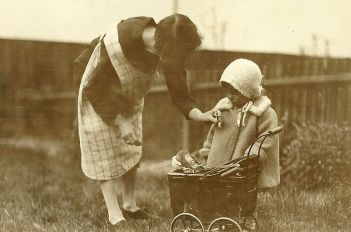
gwen-and-dep-c-1933I have also submitted some pre 1939 photographs of my family’s pets, in order to assist in a research project. Pets are an often forgotten aspect of our family story, do submit your own if you have any.

Finally, in an interesting blog post Jane Roberts asks if Family History is ‘proper’ history. My response: To me (an academic historian and a family historian) the answer is, ‘it depends’. For some, who take their research seriously, investigate context and immerse themselves in primary sources, then the answer has to be yes. They are a valuable part of the historical debate and this intensely personal brand of history is a wonderful way of encouraging people (who might otherwise be disinterested) to engage with history and heritage. There are also pedigree hunters who leap from branch to branch of the family trees of others in pursuit of the shaky leaf. I am not saying this is wrong (ok, deep down it really irritates me but it is none of my business what people do with their leisure time) but it is not history.

Counting Cousins and Descendants and Looking for Lockets

Warning – this post contains something resembling maths but does include jewellery if you persevere. As regular readers will know, I have recently been following the documentary evidence and seeking out my third cousins, in the wake of receiving my autosomal DNA results. This was thrown into particular focus last week when I met with my full complement of second cousins (6) for the first time in seventeen years. Although, inevitably, we were meeting for a sad occasion, a funeral, this was exciting for me as these are my only relatives in my own generation. But back to the third cousins (people with whom you share a great great grandparent).

I was surprised to find that 7 of my 8 sets of great great grandparents married within a thirteen year window 1852-1864; the final set married a little earlier in 1841. Ok, I’ll be honest, one set don’t seem to have married at all but I can estimate a ‘marriage’ date as falling between gg granny having a child by someone else and having a child by gg grandad. What I therefore wanted to know was how many, on average, great great grandchildren might a couple who married in the UK in the mid nineteenth century be expected to have.

I had already found that wiser folk than I estimate that the ‘average’ person has 175 third cousins (people with whom you share a great great grandparent) but nowhere amongst my Googling (other search engines are available) can I find data about the likely numbers of great great grandchildren. We are obviously dealing in averages here and clearly there will be wide deviations from the average; different cultures will have very different experiences. Maybe this is why this is a discussion that does not seem to have been aired very often in family history circles but it is interesting nonetheless. Yes, our families will not be ‘average’ but you would think that, if we look at all eight sets of our great great grandparents, prolific families would be counterbalanced by those with few children and things would even themselves out.

If I am expected to have 175 third cousins, on average, each pair of great great grandparents will have produced roughly 22 of them and me of course. If you have complete data for descendants of any of your great great grandparents I would be really interested to know how many people there are in your own generation, alive and dead, (not the total number of descendants) who are the great great grandchildren of one couple, especially if they married in the mid-nineteenth century. How close is it to 22? Do we have a vaguely accurate figure for first world countries here? How much difference does it make if you are a different generation to me, so your great great grandparents married in the 1820s or the 1890s?

I am confident that I have identified all the descendants of three of my eight sets of great great grandparents. My results for the number of people in my own generation (remembering to include myself in each case) are 5, 7 and 10, far short of the figure I have come up with of 22. So, how do you compare?

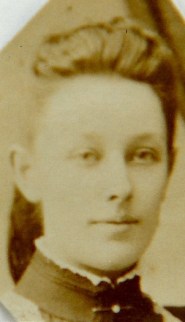
caroline-jessie-leighton-1874-1965

Caroline Jessie Leighton 1874-1965

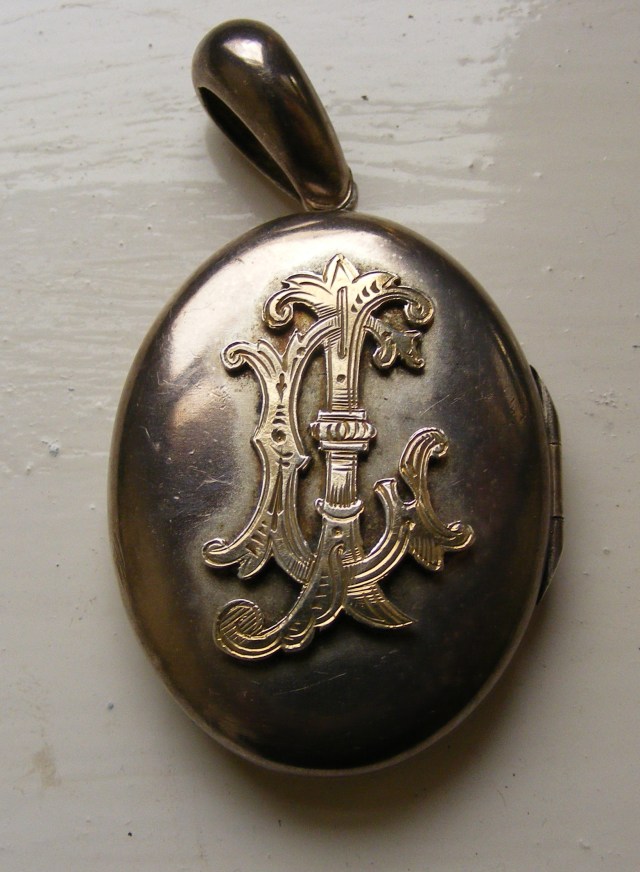
Now the pretty jewellery bit, which also involves cousins. My grandmother had five cousins on her father’s side, sisters whose father was a silversmith. Each girl was given a heavy silver locket that their father made, which was inscribed with their initials. Only one of the girls married and she had no children. The family story was that the five lockets passed to the five girls in the next generation (my mother and her four cousins). The tale of who was given which locket has proved to be incorrect but as a result of last week’s funeral, we are currently investigating where the lockets are now. Two down, three to go! This is important to me. The original recipients have all been dead for fifty years or so. They have no one but us to keep their memories alive. So here is Caroline Jessie and here is her locket. Now you can get back to counting cousins.

dscf3604

A Chance to Meet Devon Authors in a Beautiful Setting

coast-27-april-09

The View from The Cabin

It is time to announce an exciting weekend for our authors’ group. Seven Devon writers will be taking it in turns to spend time in the idyllic setting of Bucks Mills, being inspired and talking about our work to those who pass by. Our venue is The Cabin, the quirky retreat that used to be owned by the artists Mary Stella Edwards and Judith Ackland. The Cabin is now administered by the National Trust and has been unchanged since the early decades of the twentieth century. It is rarely open to the public, so this will be a  opportunity to see inside. The Cabin lacks electricity, running water or sanitation, obstacles that we are womanfully willing to overcome in pursuit of our art!

Do come along if you like chatting about books and writing, if you want to immerse yourself in beautiful scenery or if you want to see a relic of days gone by (that’s The Cabin by the way – though more than one of our authors may recognise the description). We will be in-residence on Saturday 29 April, Sunday 30 April and Monday 1 May. Only one or two of us will be there at a time, so watch the individual authors’ websites for who will be on duty when. Those taking part at some point over the three days are:-

Ruth Downie – author of crime novels set in Roman times.

Susan Hughes – author of twentieth century historical fiction.

Wendy Percival – author of genealogical mystery novels set in North Devon.

P J Reed – poet and author of horror and fantasy novels.

Liz Shakespeare – author of books inspired by the people, history and landscapes of Devon.

Pamela Vass – author of North Devon based fiction and social history.

Oh and me! How did I end up in such illustrious company? Hopefully I might use the opportunity to work on the chapters of #Daisy that are set in Bucks Mills.

Twentieth Century Family History

105372A copy of Karen Bali’s Tracing your Twentieth Century Ancestors (Pen and Sword 2016) has just arrived on my door mat for review. In the light of my recent blog post for the In-Depth Genealogist and as my ‘Discovering your British Family and the Local Community in the early C20th’ course for Pharos has just commenced, this was very timely. As someone who not only teaches courses that focus on the recent past but also as the author of a book on C20th social history [Remember Then: women’s memories of 1946-1969 and how to write your own] Karen’s book was bound to appeal. Like me, she stresses the importance of capturing our own personal history and memories; these are part of our family’s history.

Chapter one looks briefly at the social history of the twentieth century, providing a springboard for discovering the context for the lives of our nearest ancestors. The next five chapters describe different types of record that can be used in the process of C20th research: civil records, censuses, directories, wills and newspapers. The latter chapter also covers photographs and film. These are clear accounts of the sources and their use, helpful for those who are just starting on their family history journey and for more experienced researchers who have decided that now is the time to re-examine the generations closest to them. Family history is a fast-changing world, so although this book was only published in 2016, the scope for C20th research has expanded since then. This means, for example, that the very useful C20th source, the 1939 Register, which was newly released at the time the book was written, is covered only briefly.

Chapter 7 examines the theme of conflict and defence, considering sources that will help with discovering more about those who fought in wars from the Boer War to the Kosovo War and all the conflicts that occurred between these two wars that provide bookends for the C20th. A variety of trades and occupations form the content of Chapter 8 including: railwaymen, policemen, merchant seamen and publicans. In another important chapter, Karen encourages us to research the homes and communities in which our ancestors lived; something that I would certainly advocate. Here you will find information about one of my all time favourite sources, the Valuation Office records, as well as school records. It was a shame that one of my other favourites, the National Farm Survey was not covered. Karen then moves on to helping the reader through the maze of records that have resulted from the wave of C20th emigrations, primarily to the colonies. There is also an emphasis on tracing living relatives, a topic on which the author has written in greater depth elsewhere [New Cousins: How to Trace the Living Descendants of your Ancestors (Family History Partnership 2nd edition 2012) and The People Finder: reuniting relatives, finding friends (Nicholas Brealey 2007)]. Always a key part of family history research, this aspect has assumed a new significance as genealogists seek to establish how they are related to potential DNA matches.

Case studies, which are scattered throughout the book, help the reader to see how the information given could be applied. There is a handy chart that helps to sort third cousins once removed, from second cousins twice removed. The book finishes with suggestions of ways of preserving family printed and photographic ephemera. All in all this is an excellent book, which encourages researchers to examine a period in their family’s past that is often neglected. Even better, it is currently being offered at 20% off the cover price.

And in an Historical Household this Week….

Just to prove that my family have been busy training up the next generation and putting my booklet Harnessing the Facebook Generation: ideas for involving young people in family history and heritage into practice, Edward, aged nearly 3, has been investigating social history. He told his mother very seriously, ‘In the olden days they ate porridge.’ In the world according to Edward we now live in ‘newen days’ – got to love the logic.

I spent a lovely morning with my authors’ group, chatting about choosing titles and other book related gossip. We hope that we will soon be able to announce an exciting ‘writers in residence’ event for our group, in a stunning and inspirational location. All we can say at present is, if you would like to come and chat to us about our work, keep part of 29 April – 1 May free. Edward again, ‘Where have you been Granny?’. Me: ‘I’ve been talking to my friends who write books’. ‘I’d reeeely reeeely like to read those Granny’! That’s my boy! His cousins are just as keen on books, although, to be fair, the youngest tends to regard them as a dietary supplement.

#Daisy is actually making progress. You have no idea how long it takes to work out the state of the tide in relation to a newspaper account of a shipwreck. You’ve no idea but I can tell you that the answer is all afternoon, even with the expertise of a fisherman of my acquaintance. At 4.30am one morning inspiration struck and the blurb for #Daisy popped into my head almost fully formed. Even I am not up at 4.30am so I scrabbled for something upon which to write these beautifully crafted sentences before they slipped into oblivion. It is surprising how much you can scribble in the margins of a TV paper. As a bonus I could even read most of it afterwards, no mean feat with my handwriting.

ivy-and-gwenFamily history has led to fun tracing World War 1 Red Cross volunteers, oh and spending a small fortune on an online auction site acquiring a related medal. I’ve also enjoyed immersing myself in plague and pestilence, partly to revamp our Swords and Spindles history of medicine revision session and also to work on my new Pharos course In Sickness and in Death: researching the ill-health and deaths of our ancestors. I am looking forward to the start of Discovering your British Family and Local Community in the Early Twentieth Century on Tuesday – still time to sign up if you are interested. It is an online course so no excuses. In celebration this post includes one of my favourite family photos from the time.

The weather is taking a chilly turn so the garden bird feeding regime has been stepped up a notch. I am also still ploughing my way through the post-Christmas visitor laundry pile. My only method of drying laundry is to hang it on a washing line outside. Well fed birds and a line full of washing are not the greatest combination methinks, as I scrub away at the after effects of a very large flock of starlings.

New Year, New Discoveries, New DNA Results

Well, here we are, 2017. Who knows what the year will bring? This time last year I am sure few could have predicted the seriously scary political machinations and plethora of celebrity deaths that accompanied 2016. So far this year I have learned that it is possible for a memory stick to survive being vacuumed up along with Christmas tree prickles.

I would also like to share an incident from the lacuna that is that gap between Christmas and New Year during which the descendants descend. The phone rings at 7am. A phone call at this time of day normally means bad news – or that your daughter has arranged for T****s to deliver food to your house later in the day. I am a T****s delivery virgin; I know not how these things work. Having the food delivered was deemed easier than having my personal shopper struggling to identify various ‘modern’ ingredients on the list. We do not know our humus from our quinoa sadly – even spell checker doesn’t recognise quinoa, so we are not alone. The main challenge for the T****s delivery driver will be finding the house. If he uses his satnav he is doomed. It turns out, for some reason that he tried to justify, he was expecting to be delivering to a building site. The justification involved my house name – any suggestions anyone? He had a list of what had been ordered. What would a building site do with several dozen nappies of a suitable size for a two year old?

The DNA results arrived sneakily early, before I had finished restoring the house to a semblance of normality and before I had made any discernable impression in the mountainous pile of post-Christmas laundry. This means that I still haven’t completed my documentary trail hunt for third cousins, so more on that when I get the chance. What have I learned from my results? To be honest, not a lot. Sadly, no previously unknown half-siblings have climbed out of the woodwork. I have 788 matches. Big deal, or not, actually. Eleven people are predicted to be related in the range 2nd-4th cousins. Sorry FTDNA, unlikely I think. I know these people are not my second cousins (or second cousins with a few removes). I think it is very unlikely that they are my third cousins, so that leaves fourth cousins. Three of these matchees (it’s ok, I just invented that word) do not provide any surnames apart from the one they now carry. To be honest I don’t blame them. It was a bit of a learning curve working out how to add these. I have included the surnames of all my great great grandparents and will be adding those for the previous generation when I get a minute (like in about 2031).

As expected, most of the testees have families trees that seem to still be rooted in the US and the only surname that is common with any of my ancestors is Smith and I really don’t think this is the same Smith. What is slightly worrying is that there appears to be no commonality with members of the Braund family who have done this test, although, to be fair, our likely relationship is more distant than 5th cousins. This didn’t stop me from hoping for a remote cousin match. Two of the eleven 2nd-4th cousin matches have uploaded a family tree. I guess that this is the next challenge for me to tackle. No areas of commonality here either. There is one match that looks possible, although it wouldn’t be at 4th cousin level. He does at least have Cornish ancestry and a surname that appears on my family tree, although not amongst my direct ancestors. I know I am supposed to do something with my centimorgans. Maybe we don’t share enough of them. I will await instruction. I had a play with the chromosome browser. The most likely match and I share seven segments. I am not sure why therefore they are identified as a closer relative than someone with whom I share 18. I clearly need someone to explain the significance of this in words of half a syllable.

What other fun can I have with these results? I am 99% European, no surprises there then. This is allegedly Britain, Scandinavia and Western Europe, although not Iberia. As regards my ancient origins, I am 10% a Metal Age Invader. What does that even mean? I am 40% Farmer, which seems to mean I may have origins in Aleppo. Excuse me, I’m just off for a bit of hunter gathering, in line with 50% of my ancient origins.

And Finally ……. Last Historical Novelist for Advent

This morning has been spent doing my bit for the community, wielding a scanner in the local community shop, alongside someone dressed in red, uttering strange ‘Ho, ho, ho’ sounds who looked strangely familiar. A great way to wish my friends and neighbours ‘Season’s Greetings’. Everyone keeps asking me if I am ready for Christmas. Christmas I can do. Whether I am ready for the familial onslaught on 27th is another matter. At this point in time, most of the house is (by my standards) clean and tidy. I have achieved this by shoving all the junk in one room. This would work well if a small person didn’t have to sleep there. The excavation of sufficient space begins on Boxing Day. I really should be finishing an article this afternoon but this may have to wait until next year. I might just spend some ‘me’ time trawling for a few more third cousins.

813sroorzkl-_ac_ul320_sr208320_I started at the beginning of December with twenty four authors in the historical novelists’ ‘hat’. I drew one out each day to determine the order in which I have introduced them to you. Today’s entry is south Devonian Michael Jecks. For his Templar series of books, we return to the Medieval period, where we find former Crusader Sir Baldwin and bailiff Simon solving mysteries in and around Dartmoor. Baldwin’s official title is Keeper of the King’s peace for the shire of Devon and it seems that there are plenty of incidents to keep him busy. The mystery element of these books is well crafted and it is rare that ‘who dunnit’ becomes obvious before the denouement. The history is well informed and the geographical setting is beautifully recreated, all the elements are therefore in place for an absorbing novel or, of course, in this case, whole series of novels – bliss. There really are enough excellent Devon authors for me to be able to ‘read local’ for several years!

I am sorry to those authors amongst my historical fiction collection who did not get included in my calendar; it is not a reflection of my opinion of your work, advent was just too short for everyone to get a mention. I have to say this series of advent blogs has led me to purchase rather more books than I like to admit, as I discovered new titles by favourite authors – now all I need is time to read them.

HAPPY CHRISTMAS!