Christmas Cooking, a Little about Family History and a Bathroom Blitz

Traditionally in my house stir-up whatever day of the week it is is in October half-term. This year was no exception and I was joined on Zoom by some descendants for synchronised cake making. Said descendants don’t make pudding, so I was on my own for that one. Last year, the first attempt at cakes was a total disaster but puddings were a great success. Newly lacking a Rayburn, I decided to try cooking them in a slow cooker, which worked really well. I should explain that I always make three Christmas puddings. This year there will be five of Christmas lunch, some of whom don’t like Christmas pudding but often there’s only two; yet I’ve ‘always’ made three Christmas puddings, so three it is. The recipe makes three and although I am perfectly capable of scaling the quantities down (my cooking may be dodgy but my maths is ok), I don’t. I’d arranged to borrow another slow cooker, so that I could cook more than one at a time. Imagine my surprise, when looking in the cupboard that is really only opened once a year for my annual foray into cooking, to find not one but two slow cookers already there. Thinking I must have borrowed one from the fisherman of my acquaintance last year and not returned it and not being in the slightest surprised that he had just deposited another one for me to use this year (nothing that ‘might come in useful’ is ever thrown away), my reaction was merely – oh good I can cook all three at once. All three puddings duly spent the day in their slow cookers, although I did notice the water in one evaporated quite quickly and had to be topped up. They turned out looking good and I went to wash up the ‘slow cookers’, only to find that one had been cooked in a rarely used and clearly unrecognised, rice cooker instead! For more random Christmas memories see here.

Bathroom next. I have more bathroom space in this tiny bungalow that I had in my five bedroomed house. I use my lovely en-suite and the, similar sized, bathroom is really only used for guests. It was a not-so-delightful salmon pink, with dark mahogany and gold embellishments. For some reason the previous owner had stuck mirror tiles round the bath, which meant you really didn’t want to look in the wrong direction when sat on the loo. A year ago I decided it had to go. It has been a long wait but last week it was my turn to reach the top of the plumber’s list, either that or he was heartily sick of being phoned up to ask exactly which spring he was going to do this by. Still a way to go but he’s really cracking on now and the salmon pink is no more. Firstly, please can someone explain why, when I am having the bathroom done and said bathroom contains only one piece of furniture, why five other rooms (pretty much the whole house) have been impacted and now contain ‘stuff’? To be fair, I have moved the precious china cupboard in the hall to allow for free passage of the ex-bathroom to the van, so that accounts for some of it. Secondly, why is it that, as soon as the water is turned off (despite being warned), you need to use it. I’ve been feeding the Christmas cakes and in the absence of a working tap, I was forced to lick excess brandy off my fingers afterwards. The plumber may have wondered why the house and I, smelt of brandy at 9.30am.

I did promise you some family history and yes there’s been some. Prompted by the upcoming Forgotten Women Friday collaborative research, I remembered that I had a post office worker in my own family. I’ve therefore been writing about my grandmother’s cousin Kathleen. As she was someone with no descendants, if I don’t tell her story no one will. It seems that she was among the first women to qualify for the civil service and subsequently worked in the savings bank department. I’ve also been preparing my Timelines talk, which will be recorded for Rootstech. I’ve got a live one to do as well but that’s for another day. In order to create illustrations for the talk, I used the free version of Canva to produce a timeline for a small section of my grandmother’s life. Very fiddly and not scope for a huge amount of detail but decorative. In other news, a chapter of the next book is finally done. This is definitely a don’t hold your breath thing, as progress is a lot slower than I’d like. This part involved case studies of asylum patients and there were some fascinating but very sad stories. I am also in full-on Pharos course mode, with the one-place studies course drawing to a close – and what a lot of fascination studies are in the offing from the students. Starting on Monday is ‘Elusive Ancestor’, where we look at ancestors who can’t be found where they should be, almost certainly because they’ve changed location. I’ll be readying my sledge hammer to hopefully make some dents in a few brick walls. Feel feel to join us, there still some spaces.

Cousin Kathleen
The Year so Far – a Family History Whirlwind

The year began with family visitors, which is always very special. As a bonus, this year they didn’t include any lurgies amongst their seasonal gifts. The new year also means paying the tax bill. This wasn’t a surprise and the money was put aside but it is always a bit of a shock to see the bank balance suddenly depleted by what seems to be an eye-watering amount. Added to this, it seemed I needed to pay a different HMRC bank account, which meant setting up a new payee. I have one of those little card reader things that gives you a secret code to verify that you are not a fraudster. I’ve had the thing for ages, which is probably why it chose this moment to decide that its batteries had had enough. Before these obscure-sized and expensive batteries died a final death, they gave me a partial glimpse of the vital number. Could I guess what figures they were striving to reveal? It turns out that I could. Hurrah.

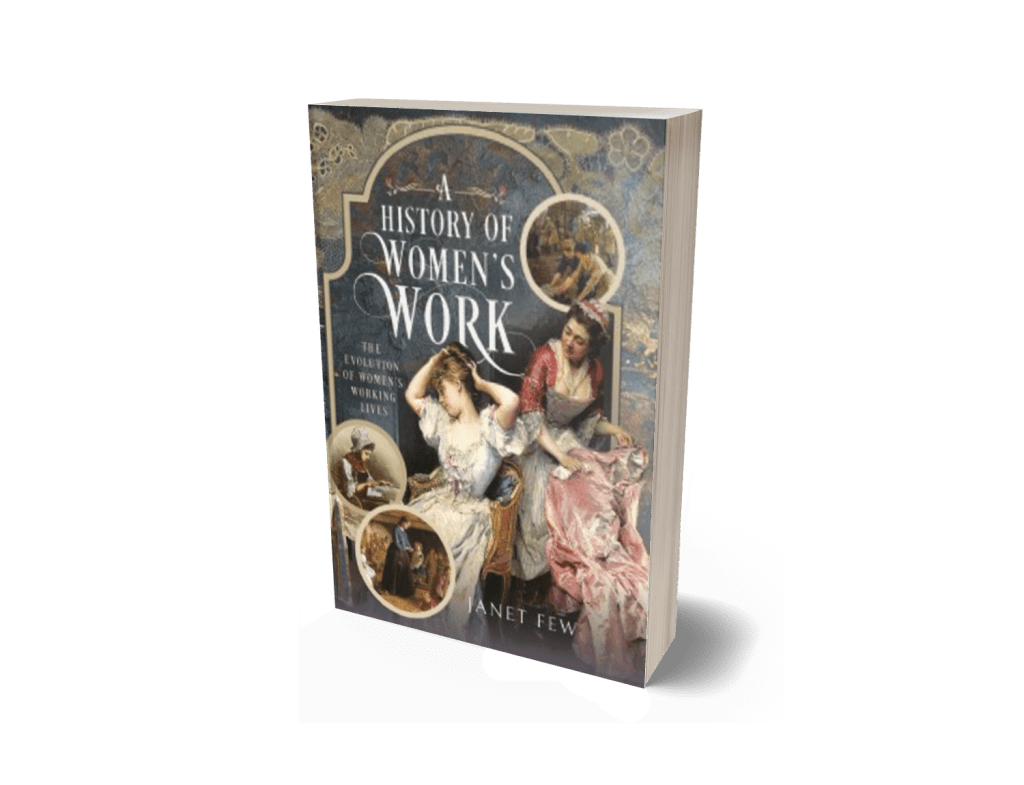
It has been full on family history on many fronts since the visitors departed. I’ve finished a magazine article. My new book is signed off and is due out in May, pre-orders should be opening up soon. I love they cover that Pen and Sword have chosen. I’ve also, rashly, signed a contract for another one. Will I ever learn? Not totally unrelated, is the work I’ve been doing towards the next Forgotten Women Friday collaborative research day for the A Few Forgotten Women project. This one is to be about women associated with Dorchester Prison.

My Pharos Agricultural Labourers online course has started again this week with a full, enthusiastic cohort. Next up on the Pharos front will be the first presentation of ‘Putting your Female Ancestors into Context’ in March. This filled up so quickly, that I agreed to take more students than usual. This means that there are still just two spaces left, if you want to come along for the ride.

I’ve have been giving talks like, well, like someone who gives an awful lot of talks I suppose. I’ve been out and about in person chatting about herbs and plague and online with the history of prostitution, marginalised ancestors and writing your family history amongst other things. This has taken me to Northern Ireland, to Surrey to Lincoln and other points in between. I have also recorded talks for future broadcasts. Rootstech is on the horizon. The pre-recorded talks have not yet been announced but there will be a short session from me in there, when I will be talking about British administrative units, do you know your townland from your wapentake, or your riding from your peculiar? If not, seek out my ten minute chat when Rootstech opens next month. Even better, online attendance is free. Legacy Family Tree Webinars have announced this year’s programme and I will be popping up there too later in the year. It is a fascinating programme, well worth the subscription.

The volume of talks in a sort space of time has obviously been getting to me, as on the night before two talks Monday I had a bizarre dream in which I had double booked myself and my mother was going to deputise for me. A couple of issues with this. She isn’t actually alive and she’d decided she was going to talk about red wine, a subject about which she knew nothing in life.

A little late to the party, I’ve been playing with Family Search’s full text search facility, which is in experimental mode and can be accessed at https://www.familysearch.org/en/labs/ once you are signed in to Family Search, which is free. This allows you to use AI generated transcriptions to search for names within the body of a document, such as the beneficiaries in a will for example. My take on this is that there is loads of good stuff on there and this has the potential to be brilliant but as yet there are still some drawbacks, which is understandable, as this is still being trialled. AI’s palaeography skills are pretty basic and mistakes are made that would not be made by a human, such as ‘Michael wears’ for Michaelmas,, rendering the sentence nonsensical. Searching is clumsy. It is very difficult to narrow down the results. You need to ignore the headings, which are often very misleading. Documents labelled Warwickshire, for example, turn out to also include many other counties. Having said that, it is definitely worth a play but make sure you have a few hours to spare first.

I’ve even found time for some of my own research and am deep down a rabbit hole following the story of a several greats uncle who was transported. It will be coming to a Granny’s Tales site near you shortly.

Crannogs, Longhouses and other Scottish Things

Time to move sites again and head north-westward into the Trossachs for a few days in Killin. The weather began fine but in typical Scottish fashion, rapidly turned to rain, nonetheless it was a pleasant drive with lovely views. We wanted to arrive at Killin promptly when it opened for new arrivals at 1pm because we planned to visit Moirlanich Longhouse, which is close to the site and which has very restricted opening hours.

We’d passed the longhouse several times on previous visits but had never been able to go inside before. It is in the care of the Scottish National Trust, so we were able to take advantage of the reciprocal arrangements with the English version. The house is a great illustration of how people would have lived in the past. This particular house was built in 1809 for tenant farmers. It is a cruck-framed house, built in a style that had probably been used for centuries. This was the time when many labourers were turned off the land and moved away but the Robertson family were granted the tenancy of Moirlanich and farmed the surrounding thirty acres, trying cattle, then sheep, before changes to growing oats. The once thatched roof was covered with corrugated tin in the 1930s.  The last member of the family left in 1968 and the house remained empty until 1992, when the trust took over.

Various items were found in the house, including ragged and probably discarded clothing, which appeared to have been used to insulate the chimney. There were multiple layers of paper on the walls. Considering there were only three rooms, plus the byre at the end, it is strange that one room was largely reserved for ‘best’, such as entertaining the minister. The room did contained two box beds that were in regular use.

The next day was beautifully sunny, just right for a drive along several miles of the banks of Loch Tay towards Aberfeldy, in the centre of Scotland. We were paying a return visit to the Crannog Centre, or in this case the Crannogless Centre. We visited the earlier version of this Iron Age living history experience on a previous trip to Scotland but a couple of years ago, a fire destroyed the crannog. A crannog is a dwelling that was constructed on stilts over the water and evidence of nearly six hundred have been found across Scotland, which is probably only a tiny fraction of the number that would have been built. Several of these were on the edge of Loch Tay. Building across water is much more difficult than building on land and was done to reserve the land for food production and possibly also as a sign of status and method of protection.

Following the fire and some serious fund raising, the centre moved to its current site, which they were able to purchase for just £1. They reopened in April and have built several roundhouses using different techniques. Erecting the crannog will be a more complex task and building was due to begin the day after our visit. We arrived just in time for a tour and John showed us the museum exhibits, as well as giving us some background history.

Our first presentation was about Iron Age food. Archaeological finds provide evidence of the ingredients but how they were used is largely speculation. We were treated to flat breads made from the ancient cereals, emma and spelt. These were topped with garlic and honey cheese and optional trout. I passed on the added trout but it was very tasty. Emma no longer grows in Scotland, as the climatic conditions have changed since the Iron Age. We saw a saddle quern and it was explained how arduous and time consuming grinding flour would have been.

Next was the blacksmithy and then the woodworking presentation, some of the turning on the pole lathe was highly skilled. The textile demonstration was particularly interesting, with information about dyes, weaving and spinning. I hadn’t realised that woad required soaking in warm urine for a couple of weeks before it was an effective dye. Who first realised that this was the thing to do? It takes 7,000 metres of spun wool to weave a long sleeved tunic. Lastly, we went in the final round house, which had a basket-like woven framework, covered by stone walls and thatch on the roof. Despite the sun, it was still a little chilly and the restaurant was full with a party so we had our carrot cake and drink outside, where it was perhaps a few degrees colder than ideal. Overall, it was a fascinating trip and highly recommended.