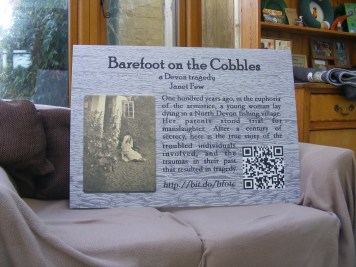
With the end of Barefoot on the Cobbles almost within touching distance, I’ve been thrashing out details of print runs, prices and other such mundanities. I need to make a decision about a hardback edition. Now, personally, I am not a great fan of hardbacks. They are, after all, just that, hard. I read in bed, lying down. It is how I get to sleep. This means that, when I do doze off, whatever I am reading inevitably falls on my nose. This makes hardbacks somewhat of a health hazard. I am aware that there are those who read in a more conventional manner, sitting in chairs for example – how radical. Perhaps these folk would appreciate a hard back version? Can I canvas the opinion of one or two of you who are eagerly anticipating the publication of my magnum opus? Would you pay perhaps an additional £5 for a hardback version? There will be a ebook option for those who prefer reading on an electronic device. Publication and launch day is set for 17 November and the opportunity for pre-publication orders will be available shortly. I am not prepared to commit to how shortly but I am aiming for the end of March. Anyway, please let me know if you are a hardback lover, so I can judge if a hardback run is viable.
Some of you will know that this year is set to be a whirlwind of overseas travel. Planning these trips has been beset with irritations and anxieties and at one point I was heard to exclaim that I was going no further than Cornwall in 2019. So much for that idea. It looks possible that I will be working overseas twice next year as well. With all this trans-continental travel, you would think I could get myself to and from a rural village about fifteen miles away without incident wouldn’t you? You wouldn’t? – Ah, you know me so well. I set off in thick fog yesterday morning, fog that became ever thicker, to the extent of being impenetrable. By some quirk of fate the powers that be have got it wrong. They have inexplicably decided to shut the main holiday route at a time when tourists are not in evidence. This is a radical policy change but I digress. I was thus obliged to go ‘the back way’. ‘The back way’ gave me an opportunity to post a parcel. When our village post office was arbitrarily closed we were reassured that we could use the next nearest post office (in a village 6 miles away, which you wouldn’t want to go to for any other purpose – perfectly pleasant village and all that, just not much reason to go there). Inevitably that post office is now also shut. Never fear, we have a post van that visits our village daily, except when it doesn’t, due to there being a mechanical failure/operator illness/lack of internet access/two flakes of snow/an ‘R’ in the month. So the non-appearance of said van on Friday meant I had a parcel to post yesterday. I visit a fog bedecked post office, what can go wrong? I kid you not, the post office was closed for a computer upgrade. Onwards through the fog to my destination, parcel unposted. I arrive unscathed.
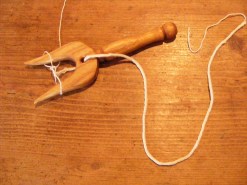 I spin away for a few hours. Well, actually I was plying and lucetting but I don’t want to get too technical. I set off home, deciding on a slightly different ‘back way’, in order to avoid having to execute a three point turn in a road barely wider than a car, at a time when several other cars are also manoeuvring. The fog had lifted, this should have been fine. Except that the other ‘back way’ was also closed for repair. The council are obviously using up their meagre road mending budget before the end of the financial year. I use a combination of common sense and sign posts before realising that I have no clue where I am, I haven’t seen another vehicle since I set off, the last building was two miles back and that was a barn. Do I have my ‘emergency’ phone? Well, no – how did I know there might be an emergency? I do however have a sat-nav. I unplug my cosy seat heater in favour of the sat-nav and follow the directions. Now I am more than comfortable with narrow, winding muddy road but I do like them to actually be roads. I bounce along muddy tracks that could not with any stretch of the imagination be described as roads, even by rural Devon, pothole laden, grass-in-the-middle-of-the-road terms. I idly wonder what would happen should I get a puncture. Even the emergency phone would be useless as I would be incapable of describing where to find me. Fortunately, I eventually arrive home. Forget going to Cornwall, I don’t even want to leave the house.
 ‘Crumplefoot’ Tommy is referred to in the first chapter of Barefoot on the Cobbles. Although we do not actually get to meet him, we form an impression of his character through his wife and daughter. The ‘Crumplefoot’ nickname is supposed to refer to an injury to his foot, that he sustained whilst at sea. I have probably used this nickname anachronistically, as I suspect he was not injured until later in life but it was too evocative to ignore. Thomas is in his late thirties at the point at which he appears in the story. His wife, who was also his first cousin, has just given birth to the eighth of their nine children. Tommy was in the merchant service and also worked a fishing boat from Bucks Mills. His injury was obviously not life-limiting, as he lived to the age of eighty nine.
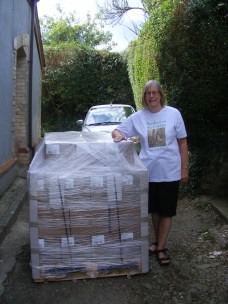 I am an inveterate reader. Despite an unavoidable serious cull when I drastically downsized, I still have 11 six foot high bookcases full of books in my bedrooms. I now have more than 1000 books in my living room as well. The only snag is that they are all the same one and I have read it numerous times! This week saw the arrival of THE novel. In an attempt to ensure that copies were ready for the 17 November launch, various contingencies were allowed for. Rather too many contingencies as it turns out. Now I have to find house room for 54 boxes for three months, before I can start selling. Obviously, I will be pleased to think that anyone might want to read it but I am really hoping that not all purchasers will go for digital copies or Amazon orders, as this will not deplete my stash. Currently, when I sit on the settee my knees are in the fireplace, as the boxes are piled behind said settee.
 You will meet William in the pages of the first chapter. William is a taciturn fisherman, who is content, providing there is a meal on the table and no-one disturbs his afternoon doze. He has lived all his life in the fishing hamlet of Bucks Mills, where he fished alongside his father and grandfather and now runs a small Bucks Ledge Boat with his two sons. By the time the story opens, he has lived in Rose Cottage at the top of the village for about three years. He was born in 1837 at the now ruined cottage The Bluff but grew up in King’s Cottage overlooking the sea. When he married, he moved to John’s Cottage and spent a few years at Mark’s, before settling at Rose Cottage, where he died in 1906.
 Much of
  On 9 August it will be 100 days until
  As I am in full-on
  All that aside, there is super thrilling
  The History Interpreter - Janet Few