We only have forty five minutes between our second and third flights so fortunately we land in good time. The Qantas lady whisks us through security without issues and we belt along the concourse, leaping on and off travellators, from one end of the airport to the other and breathlessly present our boarding passes only to be told. ‘We haven’t started boarding yet.’
When we are settled on board another half empty aircraft, we are presented with our third breakfast in succession. As aeroplane food goes, Qantas’ is not bad at all. The cabin crew on this flight, Belinda and Nathan, keep up a running banter and lighten our day (or possibly night – I have lost track but the lights stay on, so day presumably). Three hours later and we are in Christchurch. We run the gauntlet of immigration and security without being arrested, fined, deported or filmed for an episode of Border Force. No one questions why one of us has axes, saws and knives (albeit blunt ones) in our luggage. To top it all, our cases miraculously appear promptly on the conveyor belt. I did ask for clarification of a couple of questions on the immigration card and decided it would be prudent to declare my walking boots. I am sent behind some screens to present them. I fiddle around hunting for the key to one of my two bags. Inevitably, the boots are in the other bag. I should say that I have never before travelled with two items of hold luggage but half my belongings are seventeenth century outfits. As I scrabble for the second key, the customs’ officer decides it is all too much hassle and she doesn’t need to see my boots after all!
Next, to summon our courtesy car to take us to the camper van depot. This proves more troublesome, as no one answers the phone. We leave a voicemail and hope for the best. As instructed by the website, we assemble by Door 2. We accost every likely-looking shuttle mini-bus without success. After about twenty minutes I return to the lounge to phone again. I should say at this point that we have discovered, perhaps not unexpectedly, that Chris’ mobile does not work here. This time, I get through to a real person. I am not convinced they have a brain cell but they are at least not a machine. It seems that Chris’ rendition of his surname was not recognisable as any of those on their booking list. To add to the confusion, another party with a similar sounding name have arrived at the same time. I think they thought they were collecting them twice. The other party’s luggage mountain makes ours look insignificant. They have travelled from Hawaii for the surfing and have brought several gigantic surf boards with them. We join in the general fun, trying to wriggle these in through the side door of the mini-bus. It is a close run thing but they are in – it just means that all the passengers have to scramble over surf boards to get to their seats.
It takes an interminably long time to complete the paperwork for the van and Chris, who is chief in charge of all things van, is given what is known as a ‘walk through’. This familiarisation process seems to omit vital details, as we were to discover to our cost. We decide that we will save ourselves £100 and not hire a sat-nav. I am going to claim £100 for my map reading skills if we don‘t get lost. This could go badly. The first instruction on leaving the camper van depot was to turn right. I won’t comment on how we somehow ended up turning left. Let’s blame the jet-lag. We head west from Christchurch on the 73 and 77, along what is known as the ‘Inland Scenic Route’. It is winter here and overcast, so it is already beginning to get dark. This is when we discover the first thing that we don’t know about the camper van – how to turn the lights on. After much twisting, pulling and pushing of levers and even stopping in a lay-by to devote all our combined energies to the task, we have a very clean windscreen but have only discovered how to turn on the side lights. We do not linger, hoping to beat the dusk and fortunately there is very little traffic about. A thick mist descends. We have no hope of locating the fog lights. Fortunately, just in time, Chris discovers a well-hidden switch and we have headlights. We drive through several ‘blink and you’ll miss it’ places, including the prosaically named Windwhistle. The scenery is lush and green and the trees are beginning to turn. We pass a venison farm and the impressive Rakaia Gorge. Signs warn that roadworks are currently closing this road for twenty minutes out of every thirty. Either we have hit the favourable ten minutes, or the men have given up for the day. We see New Zealand falcons and large black and white Australian magpies, which I remember from our last visit.

Rakaia Gorge
We find Methven camping ground without too much getting lost, then head off for a cunningly disguised supermarket. With the exception of meat, the food prices are significantly higher than ours, perhaps half as much again. Instant coffee doesn’t really seem to be a thing here and certainly not decaff. I will therefore be caffinated for the duration; you have been warned. As we try to connect the van to the electricity supply, we discover knowledge deficiency number two. Where is the magic master switch to allow us to see what we are doing? By this time it is dark, so Chris is trying to see minute labels on switches in a cupboard by the light of my Kindle and without the aid of his reading glasses. We do eventually get light and power but no hot water. We also can’t work out how to get the gas to turn on for the cooker, although that probably (hopefully) just needs daylight. The van comes complete with a three volume novel about how to drive it, ‘Drive on the left’ etc. etc. but absolutely zilch about the necessary information required to actually live in it. We rise to the challenge of making the microwave work and will leave the hob for tomorrow. By the time we call it a day I have been awake for about twenty four hours. Goodness knows how this will impact on the jet lag.
 It is deemed to be night for the majority of the flight from Heathrow to Singapore, which does at least agree with our body clocks for the first part of the journey. We really do not want to still be asleep at what for us is 9am though. No Bejewelled on this in-flight games system, so I settle for Mastermind. Judging by some of the questions, it was compiled about twenty years ago. Nonetheless, I win a virtual million pounds twice. Not a great deal to recount from this twelve hour flight, apart from the person in the row behind me reaching round and stealing my pillow when I bent forward to get my bag from the floor. Fortunately, the plane is half empty, so we have a row of four seats to ourselves, giving us a spare. The thief though has five pillows to himself!
![DSCF0219[1]](https://thehistoryinterpreter.com/wp-content/uploads/2018/04/dscf02191.jpg?w=312&h=234)
![DSCF0207[1]](https://thehistoryinterpreter.com/wp-content/uploads/2018/04/dscf02071.jpg?w=340&h=255) We encounter toll gates along the Pan-American highway. We are pulled over by the police and our driver has to rattle off the nationalities of all on board. That seems to satisfy the officer and we are waved on our way. There is definitely more vegetation now and even rice fields, irrigated by the Cotahuasi river.
We encounter toll gates along the Pan-American highway. We are pulled over by the police and our driver has to rattle off the nationalities of all on board. That seems to satisfy the officer and we are waved on our way. There is definitely more vegetation now and even rice fields, irrigated by the Cotahuasi river. Along the track to the cemetery, we are excited to see burrowing owls. They do look jolly like rocks but can just about be spotted when they move. There was also another well camouflaged nesting bird and swallows swooping above the cemetery. We are here to see 1500 year old mummies. On a windy plain we see the twelve tombs that remain. It is estimated that there were originally 400-500 burials on this 1km x 250m site but the tombs were destroyed about 70 years ago by robbers looking for grave goods. This is fascinating but I must say it was a bit like death by mummy. It isn’t exactly seen one seen them all but…. The people were buried in a foetal position, mostly facing east and wearing many ponchos. These are made from the traditional Peruvian brown cotton. The corpse was then put in a woven basket and buried with items needed for the afterlife, including shells that were used as currency. The skin was rubbed with resin to preserve it and herbs were put in the basket to repel moth. Fragments of bone are strewn about the site. Our guide draws various styles of tomb in the sand for our edification. Each tomb has a shelter erected over it. Termites are making short-work of the uprights to these shelters.
  Our tour has a special ‘beat the rush’ boat trip to the Ballestas Islands, hence the early start. The islands are known as the poor man’s Galapagos and we are hoping for wildlife. We set off in the Carol 1, which is a speed boat but the shelter of the Paracas peninsula makes for a smooth trip. We spot a colony of pelicans, followed by Turkey Vultures, the only birds on the islands that do not eat fish. There are also Chilean Grey Gulls and Elegant Terns from further north. We stop to photograph the 170 metre high Candelabra geoglyph, carved in the hillside. It may be attributable to the Nazca civilization but others believe the style suggests it is post-Hispanic i.e. after 1532. We see some of the 20,000 seals that inhabit the islands, their pups were born a couple of months ago. Humbolt Penguins waddle along the cliffs and there are Inca Terns, with their distinctive red legs and beaks. Ballestas means ‘arrow slit’ and there are many crevasses and arches in the rocks. We also see large colonies of Boobies. There were those amongst our parties who had different expectations when these were mentioned. A rare Red-footed Cormorant is also spotted.
 After a tasty ice cream our journey continues. We pass a cart loaded with seaweed. Three different types are used for fertilizer, food and cosmetics. The next stop is Huacachina, an oasis in the middle of the Ica district desert. We are here for an ‘optional/compulsory’ ride in a sand buggy. These take eight passengers and career hectically up and down the dunes in an alarming fashion. Nothing ventured, I rashly agree to try these. My judgement may have been clouded by the amount of pisco I had consumed. I wedge myself in the back row between Chris and another sturdy gentleman of our party. Maybe sitting in the back row was not so wise, as it seems that this is where you experience maximum bounce. I have my arms stretched out and am gripping the bar in front of me as if my life depends on it. Oh, hang on ……. My feet are braced. Occasionally I open my eyes and I am flung up and down in the air as we hurtle up and down the dunes at about 30mph. Believe me, it felt considerably faster. We make a few stops to photograph the view and the oasis below. Some of our party sand board down a couple of dunes, to be collected at the bottom. In places the gradient is 1:2. I wonder if this is a good point at which to mention my heart condition. Disconcertingly, the driver periodically gets out of the vehicle to fiddle with it and add more fuel. I don’t contemplate what happens if we break down out here. I mentally debate if this is more terrifying than being on the back of a Skidoo for 2½ hours at minus 23 degrees in Finland – it is a close run thing. At the end of the journey my fingers have to be prised off the bar. On balance, I am glad I went, although I am not likely to repeat the experience. I should point out that I have never been on a roller coaster, which provides a similar ‘experience’ and I have only been down a playground slide a handful of times, so this was definitely out of my comfort zone. We have a very pleasant lunch in the hotel and paddle in their pool. Ok, so I had chicken and chips but it was lovely. This was accompanied by a complimentary pisco sour. I have probably had more alcohol today than in the past year.
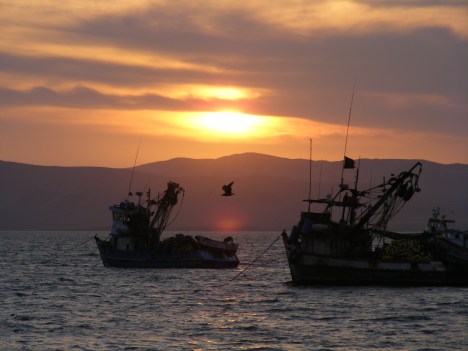 For our evening meal, I settle for a not very adventurous vegetarian pizza. Chris has sea bass in chilli and lime sauce. It really is too hot to eat much. We pay a sol (about 25p) to watch the sunset. We debate what happens if we do not pay – does the sun not set? It sets very quickly just after 6pm and the bay is beautifully peaceful. We have an early start in the morning so we settle down early. It is quite noisy outside and we can hear street musicians but this quietens down but about 10.30pm. We are keeping a tally of how many times we have to fish toilet paper out of the toilet.
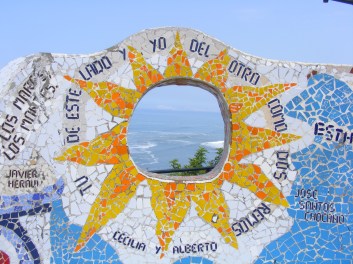 Our Australian friends, with whom we are sharing this adventure (we are blaming them for everything!), arrive. They have already spent two months in South America. We stroll back down to the park in the afternoon. There are street sellers trying to con gullible tourists; we do succumb to an official looking ice cream salesman, who is unperturbed by us paying with a 50Sol note. The lollies were unusual but refreshing and the ‘choc-ice’ was ice cream sandwiched between bourbon like biscuits. The extreme gymnasts and joggers have mostly given up due to the heat but there are tightrope walkers who have strung ropes between the trees. I have already developed some interesting blisters from my first walk in sandals for six months.
 The History Interpreter - Janet Few