#100daysofbfotc Day 50: Mr Moss

Clovelly Harbour 1912John Thomas Moss appears only obliquely in Barefoot on the Cobbles, as the proprietor of the Red Lion Hotel on Clovelly’s quayside. He was born in Clovelly on 22 October 1868, the son of John and Mary Moss née Foley and spent his childhood living at North Hill. Initially, he followed his father’s trade and went to sea. John married Lizzie Arthur Slocombe, in 1893, in Ilfracombe and the eldest of their two daughters was born there. They set up home back in Clovelly, at 15 High Street and when he came ashore, John managed the Red Lion. He died 1951.

‘The members of the Mariners’ Union repaired to The Red Lion for their repast, which would be accompanied by beer, or even whisky. The Club Room had been suitably decorated with garlands of greenery and candles for the occasion. Mr Moss’ staff were on hand to serve a roast dinner, befitting of the status of those on the top table.’

Barefoot on the Cobbles will be published on 17 November 2018. More information about the novel can be found here. Copies will be available at various events in the weeks following the launch or can be pre-ordered from Blue Poppy Publishing or the author.

Day 6 – At Sea

Another full day of lectures, although I miss the first one in order to prepare for my own. All in all I have attended all but two of the sessions on offer during the week. There have been some difficult choices, as for the most part, there have been two and sometimes three, streams of lectures. I begin the day with Helen Smith on ‘Begotten by Fornication’, an interesting look at illegitimacy. Then Jan Gow with ‘Remember the WWW. No, not the world wide web but the Who, Where and When’. It is over twenty years since I last heard Jan speak, when she was in the UK. This is really a talk about one-place studies so very interesting for me. I follow this with my session on the mental health of our ancestors, a talk I always enjoy presenting. A short break and then it is Pat Richley-Erickson aka Dear Myrtle with ‘Seven Habits of Highly Effective Genealogists’. I volunteer to represent one of the points although I am not sure I quite qualify as ‘highly effective’ as much of my information is still on index cards. Next, more DNA with Maurice again. This time his title is ‘Using Triangulation to Break Through Brick Walls’. The afternoon ends with my Facebook Generation talk, which was very well received and sparked many questions and comments.

An interesting incident in the toilets by the Windjammer. The doors to the cubicles open inwards and an injudiciously position toilet roll holder makes it quite difficult to exit, for even an average sized person. One of the cruise-goers has got herself in but is struggling to extricate herself. She attempts to sidle out facing the toilet roll holder. This fails, so she turns round and gives it a go facing the other way. I have to say she was a lovely lady and was laughing at her various ineffective attempts. We wonder if she will have to do a Winnie the Pooh and remain there until she is thinner but no, somehow she squeezes past the obstacles and is free.

DSCF0814.JPGThe evening sees the presentation of the prestigious Prince Michael of Kent Award to Cyndi Ingle for her decades of tireless work on Cyndi’s list. Mia has somehow managed to successfully bring this glass vase from the Society of Genealogists without mishap and there are a few tears as it is handed over. Very well deserved it is too, if you haven’t consulted Cyndi’s List then you can’t call yourself a family historian. Caroline Gurney follows with ‘Are you Related to Royalty?’. The answer is probably yes, so Maurice, who has been trading on his distant relationship to Princess Diana all week, now has to deal with competition from the rest of us.

#100daysofbfotc Day 49: Will Harding

William HardingAs we meet Will Harding, in the penultimate chapter of Barefoot on the Cobbles, he is on his way home from a tour of duty on a merchant ship, just after the end of the First World War. Harding is the forgotten victim in a Clovelly tragedy whose tale is oft told. Whereas the event, which is included in the novel, acknowledges his companion, Harding’s name is not usually mentioned. It was only when researching for the book, I realised that two men were involved. I will hold my hand up to Will’s age being wrong in the novel. I could pretend that there was some valid literary reason for this but then you might ask me what that was. In my defence, Will is very vague about his age on official documents but I can’t justify why I chose to use the incorrect one.

William Robert Harding was actually born in Clovelly in 1882, son of Richard and Mary Ann Harding née Whitefield. Both families had a long seafaring tradition and Will joined the merchant service. He married Rosa Evelyn Jenn in 1903 in Cardiff and they had a son and three daughters. He served on a number of ships together with other Clovelly men.

‘Weary and apprehensive, Leonard hauled his kit bag on to the cart and hunched down next to Will Harding, an experienced sailor who looked older than his thirty four years, with weather-hewn face and prematurely balding pate hidden under a cap. Will was a family man, eager to get back to his pretty wife, his near-grown son Billy and three little girls.’

Barefoot on the Cobbles will be published on 17 November 2018. More information about the novel can be found here. Copies will be available at various events in the weeks following the launch or can be pre-ordered from Blue Poppy Publishing or the author.

Day 5 – Tracy Arm

066 11 September 2018 Tracy Arm.JPGIcebergs prevent us from getting right up Tracy Arm but we still have beautiful views to admire. It is too chilly to sit outside for long so we spend the morning in the Windjammer again, as breakfast blends in to coffee and then into lunch. Great to relax and chat as the scenery and icebergs flash by. I later realise that I spectacularly failed to get any close up iceberg photos. I seem to keep missing out on this trip.

An afternoon of lectures. A double dose of Michelle, firstly on getting the most out of our DNA matches and then a really brilliant talk, ‘The Facts, Fun and Fiction of Family History’. Maurice follows on Y DNA projects. We have certainly been well informed about various aspects of DNA. Having scoffed pizza and chips for lunch, I restrain myself with a small vegetable curry for tea. Allegedly, the average weight gain whilst cruising is a pound a day. The amount of food that is consumed and wasted on board is obscene, one of the aspects of cruising that makes me uncomfortable. Another is the servility of the lovely staff. I am not better than them but they clearly feel I am. I can’t quite define what gives me this impression but it definitely goes far deeper than a customer/employee relationship.

The evening is spent with Michelle, Maurice, Helen and Cyndi contributing to a DNA ethics panel, leading to some very interesting discussions. It seems that the northern lights were on display last night. No one warned us to look, so that is something else we have failed to experience. The problem with watching for the northern lights is that it involves the unappealing combination of being somewhere cold and staying up until way past my bedtime; we missed them when we were in Finland too. Bravely, we wrap up in multiple layers and join several other hardy souls to see if they will reappear tonight. It soon becomes obvious that it is far too cloudy so we give up.

We work out a cunning way of accessing the balance on our sea pass cards using our TV. Our refunds from the bear watching trip have arrived in our accounts. We have benefited from currency exchange rates, which have fluctuated heavily in our favour since booking the trip, so the dollars we have received back are worth significantly more than they were when we paid for the trip. This will be a good start for our Mediterranean excursions next year.

#100daysofbfotc Day 48: Mary Pickford

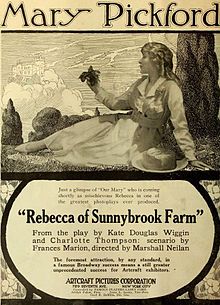
Rebecca_of_Sunnybrook_FarmMary Pickford finds her way on to the pages of chapter ten of Barefoot on the Cobbles, when Daisy visits the cinema, or picture palace. I needed a suitable film for Daisy and her friend Winnie to be watching in 1918. I was excited to realise that the first Tarzan film had recently been released and I was all set to send them off to watch that. Just in time, I discovered that this took eighteen months to reach the UK. I quickly substituted Rebecca of Sunnybrook Farm, which starred Canadian actress Mary Pickford. Like Daisy, I watched the film, although I had to rely on YouTube, so was deprived of the atmosphere of Torquay’s Pavilion cinema.

Mary’s real name was Gladys Louise Smith and she was born in 1892. She was one of the most famous leading ladies of the silent films of the 1910s and 1920s. Famous for her curly hair, she was known as ‘the girl with the curls’ but also as ‘America’s Sweetheart’ and ‘Queen of the Movies’. She grew up in Toronto, where her mother took in lodgers after being deserted by her alcoholic husband. One of the boarders was the stage manager at Toronto’s Princess Theatre and through him, Gladys was given small roles. In 1909 she was taken on by the Biograph Company and began churning out a film a week. By 1916 she had joined the company that was to become Paramount Pictures. Mary and her second husband, Douglas Fairbanks, were the celebrity couple of their day and when Daisy was watching her, Mary was at the height of her career. Her fame began to wane with the introduction of the ‘talkies’. Interestingly, Mary Pickford caught the Spanish flu in 1918 and as she leaves the cinema, Daisy begins to feel unwell…….

‘Winnie was impatient to see her idol, Eugene O’Brien, in Rebecca of Sunnybrook Farm. She hurried Daisy along, anxious that the crowds had made them late. Daisy was daydreaming of having wonderful curls, like the film’s heroine, Mary Pickford. She patted her own straight hair that was caught in a loose bun at the nape of her neck. She still hadn’t plucked up the courage to have it cut short.’

Barefoot on the Cobbles will be published on 17 November 2018. More information about the novel can be found here. Copies will be available at various events in the weeks following the launch or can be pre-ordered from Blue Poppy Publishing or the author.

#100daysofbfotc Day 47: Jack Foley


Donkeys going down

Donkey apparently going down the street

We meet Jack Foley in wartime Clovelly, when he is responsible for supervising the donkeys that transported goods up the cobbled street. As I was writing Barefoot on the Cobbles, Jack’s role in the novel resulted in a lengthy debate. I had composed a passage during which Jack led a laden donkey down the street. It was then pointed out me that donkeys only carried luggage up the street and the downward journey would be undertaken using a sledge. Regretfully, I re-wrote the passage. Then a photograph was found where a laden donkey appeared to be heading down. I regretted my re-write but it seems it was necessary after all, as I later learned that this was a posed photograph and not a reflection of real life in Clovelly.

The John, or Jack, Foley who appears in the novel was born in 1880 into a seagoing Clovelly family. John however remained ashore and became a carriage driver, almost certainly working for Mrs Hamlyn. In later life, perhaps due to the advent of motor transport, he worked as a general labourer. In 1903, he married Dorothy Wonnacott and spent most of his life living at 85 High Street, Clovelly. He died in 1962.

‘The Collins trailed a few paces behind their luggage as the lurching sledge negotiated the cobbles under the adept guidance of Jack Foley.’

Barefoot on the Cobbles will be published on 17 November 2018. More information about the novel can be found here. Copies will be available at various events in the weeks following the launch or can be pre-ordered from Blue Poppy Publishing or the author.


#100daysofbfotc Day 46: Mary – ‘Mrs William’

Mary, a fisherman’s wife, appears in the first chapter of Barefoot on the Cobbles. She is the first mother that we get to know in the novel and through Mary, we can experience a manifestation of motherhood that is rather different from those that are revealed in later chapters. Unlike most Victorian families, Mary has only two children, Albert and Fred. There is no evidence for any other live births but she may have suffered miscarriages. Of course, there could have been another reason for her untypical lack of fecundity. The story of how she opens her heart and home to young Eadie is a true one. Like a number of Bucks Mills’ wives, Mary was often known by the forename of her husband, to avoid confusion with others of the same surname, hence ‘Mrs William’.

St. Anne's Church (old postcard)

St. Anne’s, Bucks Mills

Mary’s post should really have been yesterday. She was born as Mary Jane on 22 September 1842 at Horn’s Cross, Alwington, Devon to Richard and Hannah Hamlyn née Lewis and she was the only child of their marriage. They were a farming family and Mary worked as a launderess; nonetheless, in 1862, Mary met and married William, a fisherman from the neighbouring parish. Theirs was the first marriage in the newly opened Anglican church at Bucks Mills. Their son, Albert arrived nine months later and his brother followed two years after that.

Mary lived at Rose Cottage in Bucks Mills for the last forty years of her life. She died in 1928.

More information about Bucks Mills can be found here.

Albert was explaining to his mother how he had rescued a distressed Eadie from the square.

‘Mebbe you stay here for a day or two maid, ’til your da calms down,’ said Mary.

There was reassurance in the words but who was the more comforted, Mary or this dark-visaged child with sadness in her soul? Mary turned to her son, who had unwittingly presented her with a few days of companionship.’

Barefoot on the Cobbles will be published on 17 November 2018. More information about the novel can be found here. Copies will be available at various events in the weeks following the launch or can be pre-ordered from Blue Poppy Publishing or the author.

#100daysofbfotc Day 45: Richard Wakely

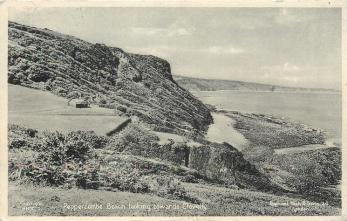
Peppercombe‘Richard’ Wakely is one of the characters in Barefoot on the Cobbles whose christian name had to be altered to avoid confusion. In real life, he was named William and he lived in the hamlet of Peppercombe. Born in 1835, he began his working life as an agricultural labourer and around the time of his marriage to Eliza Found in 1860, he trained as a ship’s carpenter. In order to ply his trade with Waters’ boatbuilders in Appledore, he walked in to town each week, returning to his family at weekends. William was still working in his late seventies even though he would have been eligible for an Old Age Pension.

The Wakelys had a son and five daughters who survived infancy, two others died as babies. William himself died at the age of 95, in 1931.

Her father’s tar-stained holdall was slung across his shoulder and thudded on his back with each successive step. It receded into the distance, as he gained more ground. Richard seemed unaware of his daughter’s presence, let alone her exertions. Lost in thought, he spat a plug of tobacco into the bank and kept his gaze firmly forward, glad that the heat of the day was abating for the journey. Richard contemplated the long walk ahead of him.’

Barefoot on the Cobbles will be published on 17 November 2018. More information about the novel can be found here. Copies will be available at various events in the weeks following the launch or can be pre-ordered from Blue Poppy Publishing or the author.

Day 4 – Skagway

Finally, we seem to have adjusted to the time difference. I attempt to download my photographs from my camera and after a fruitless search, remember that there is no slot for an SD card in this tiny lap top. Do I have the required cable? Of course I do, I just don’t have it here. Fortunately I am able to borrow a slot enabled laptop and back up copies. We sit chatting while we wait for our White Pass Railway and Scenic Skagway tour. There are rumours of Hurricane Florence approaching, forecast to hit the east coast on Friday. That would be the Friday when we are flying home from the east coast. Deep joy, now we are likely to be stranded in Washington airport.

We leave the ship in plenty of time to get our bus and have a quick look at the pier end of Skagway first. The cliff sides are painted with ships’ flags and captains’ names. We later learn that this is a rolling registry of ships that was begun in 1898 and allegedly, the higher the sign, the greater the regard in which the captain was held.

Our driver on bus 109 is Caleb. He warns us that it is a no smoking bus and if anyone smokes, it will be assumed that they are on fire and they will be duly extinguished. After a couple of minutes on the bus we all disembark in order to watch a short video about the area. The Klondike gold rush of 1898 led to the development of Skagway. The trail to the gold fields took an enormous toll on both horses and men. It takes a ridiculously long time for everyone to get back on the bus and two minutes later we are reversing the process yet again as we are at the station.
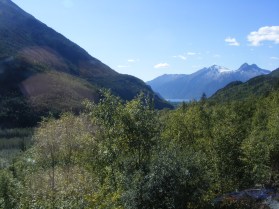
036 10 September 2018 White Pass and Yukon RailwayOur railway carriage, one of 83 in the fleet, is named Lake Klukshu. Skagway means ‘land of the north wind’ but we are fortunate that the weather is glorious, so we have great views of the White Pass and Yukon route. Following the discovery of what was actually very little gold, Captain William Moore, founder of Skagway, together with Skookum Jim, one of the two first nations people who found the initial gold, sought to establish a route to the Klondike that was easier than the existing Chilkoot Pass. Their route, past Lake Bennett, was named White Pass. A sensationalist newspaper headline about the discovery of gold, led tens of thousands of prospectors to take steamers up the inside passage and begin a hazardous 600 mile trek across country to the Klondike. No prospector was allowed to begin the journey without a ton of supplies. The slightly easier White Pass was favoured over the shorter Chilkoot Pass as it was, in theory, possible to take pack animals. Over 3000 horses or donkeys perished on the Pass before the railway on which we are travelling was constructed. They began building this narrow gauge railway in 1898 and reached the summit, 110 miles away in 1899. The route involves steep gradients and tight turns and construction was hampered by temperatures as low as minus 60. By the time the track heading north joined the track coming up from the south, in 1900, over 35,000 men had been employed in building the railroad at some point. The tracks ceased to carry ore after the price slumped in 1982 and the railroad became a tourist destination.

The steam engine that works this route is undergoing maintenance, so we are being pulled by a diesel engine. We travel forty miles through impressive scenery and across scarily rickety looking bridges beyond the White Pass summit, which is 2885 feet above sea level, as far as Fraser, where we disembark. We have now crossed into British Columbia, Canada but not for long. The lakes here freeze in winter and there is sometimes still ice in June, so they are lifeless. After our train ride, Caleb collects us in the coach for our drive back down the Tormented Valley to Skagway. The valley gets forty feet of snow a year. Caleb tells us that no-one has been born in Skagway in twenty seven years. There is no doctor here just two nurse practitioners. As soon as someone is thirty weeks pregnant, they are sent to Juneau. As an aside, the women in front of us are each wearing two baseball caps. This is just plain weird.

We are dropped off in the interesting town of Skagway, in which almost every shop is a tourist trap. There probably aren’t many other employment opportunities for the resident population of 850. Many of the shop owners are standing outside, trying to entice us in and deprive them of their end of season stock.

It is very hot and we spend an enjoyable hour on the deck in the sun once back on board. After a meal of chilli jacket potatoes, the waiter entertains us by balancing three forks on top of cocktail sticks that are in turn balanced in the pepper pot holes – you kind of have to see it. In the evening Dick Eastman talks to us about getting the best out of Google.

#100daysofbfotc Day 44: Captain Thomas Powell

Captain Thomas Folliott Powell was a gift to an author looking for interesting minor characters. He appears only briefly, in chapters 2 and 3 of Barefoot on the Cobbles, yet his behaviour has ramifications that echo through the remainder of the novel. When I first discovered that Polly had been a domestic servant at Chudleigh Villas and that the Powells had advertised for a servant in the local press at the appropriate time, I decided that they made a perfect match. On further investigation, the Powells’ story opened up several opportunities.

The position of troops during the mutiny – wikimedia

Thomas Folliott Powell was born on 3rd August 1834 in Newport Pagnell, Buckinghamshire, the son of William Powell, a solicitor and his wife, Eliza née Miller. The family descended from minor gentry. Thomas bought a commission in the army in 1853 and served in South Africa, the East Indies and India. As a Captain of the 6th regiment of foot, he was involved in the Indian Mutiny of 1857-9. Thomas retired from the army in 1865 and was able to sell his commission for £2500.

There is some confusion about the name of Thomas’ wife, who appears in the novel as Emily but who was in reality Mary Jane Winter (known as Amy), who had been born in the East Indies. They married in London in 1868. Four daughters and a son were born between 1876 and 1882. We can only speculate why there were no children during the first eight years of the marriage. EDIT I have now discovered that there were also two other sons who died in infancy; one was born in 1874 but that still leaves a long gap before the birth of the first child.

The family moved to Chudleigh Villas, Bideford in the late 1880s. Thomas seemed unable to match his lifestyle to his income and he was supported by his widowed mother, who provided the furnishings in their home and made them an allowance of £300 a year. Thomas had first been declared bankrupt in 1883, when he was living in the Plymouth area. He squandered the money he had made from his commission and it seems that a gambling addiction was a major contributor. His father had, perhaps wisely, left Thomas nothing in his will and when we meet him in the novel, Thomas is once again in financial difficulties. The family downsized to Ford Cottages, in New Road, Bideford. His second bankruptcy was annulled in 1898 and Thomas died in Portsea, Hampshire the following year.

‘ Mrs Powell regained her composure and resumed her tirade, ‘Why couldn’t you just have found enough to pay off Mr Tardrew? If you’d only done that, all this might have been avoided. Then there’s that money you owe to Tanton’s Hotel, how could you have run up such a bill? Your mother has been more than generous, we should be able to live comfortably on the three hundred pounds a year that she gives us. What on earth will she think? We cannot expect her to keep making us an allowance if you are such a spendthrift. It is no wonder that your brother has washed his hands of you.’

‘What’s done is done, eh Emily,’ Captain Powell replied. ‘Like as not I shall be declared bankrupt again.’ ’

Barefoot on the Cobbles will be published on 17 November 2018. More information about the novel can be found here. Copies will be available at various events in the weeks following the launch or can be pre-ordered from Blue Poppy Publishing or the author.