Gibraltar – Day 4 of our genealogical cruise adventures

Finally, we make it to a 9am lecture. Rosemary Kopittke is giving a very useful introduction to Scottish records through a thorough case-study of her Laidlaw ancestry. My descendants have Scottish ancestry and I am reminded of the value (pun alert) of the Valuation Rolls.

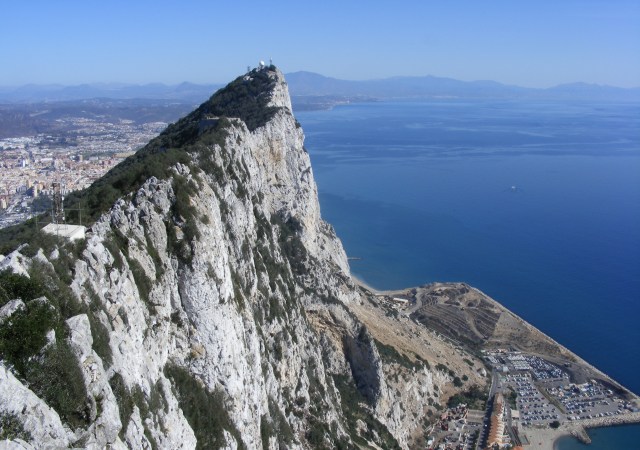
Then it is time for our first excursion, a walking tour of the rock that is Gibraltar. Our guide, Chantal, is hilarious and introduces herself as part Neanderthal and a smuggler. Gibraltar, or The Rock, rises to 426 metres above sea level and we will be ascending to 412 metres. Twenty of us pile into a coach and drive across reclaimed land within view of the site of the Battle of Trafalgar. We pass Morrisons, MacDonalds, all the usual suspects. The population of Gibraltar is 32,000 and apart from tourism, the main economic activities are the gaming industry and the reselling of fuel, which is bought in from Spain. They are very proud to be British and in 1967, voted overwhelmingly to remain so. The island had been under British rule since the Treaty of Utrecht in 1713. Previously, it had belonged briefly to the Dutch, to Spain and prior to that, Morocco. Its importance lies in its strategic position on the mouth of the Mediterranean, hence it being fought over down the centuries.

We ascend in the cable car. The weather is glorious and we have particularly good views of Spain and the north African coast. We see the second Pillar of Hercules, Gibraltar itself being considered to be the other. The Rock is the highest monolith in Europe. Many nationalities are represented in Gibraltar, including those of Maltese descent, who arrived as builders. The border with Spain was closed by Franco after independence, until 1985, allowing no access to Spain. 45,000 years ago, Neanderthals lived on Gibraltar and significant remains have been found.

We walk through the Nature Reserve and see several Barbary macaques, including those with young. The macaques were brought in by Moroccan pirates and there is now a population of about 300. £84 per animal is spent each year on daily feeding from feeding stations, in an attempt to keep them out of the residential area. We are warned not to have water bottles on view or to leave bags open, or our lunch will fall victim to the macaques. There are also many eucalyptus trees, which are also not native.

Then we visit St. Michael’s Cave, which extends 700 feet into the rock and was used as a military hospital in World War 2. It is now a tourist attraction and concert venue. The ancient belief is that the cave system led to Africa. Twenty seven caves have been discovered on The Rock so far; the others are protected. Next stop is the Siege Tunnels. At one time, there were 633 guns mounted on Gibraltar to guard against Spanish invasion. During the American War of Independence, many of the troops normally stationed on Gibraltar were redeployed there. Spain capitalised on this weakness and laid siege to The Rock. ‘The Great Siege’ (there were others) lasted from 1779-1783. The tunnels were constructed as part of a plan to site a downward-facing Koehler gun on The Notch, at the far edge of Gibraltar. Lacking spare gunpowder, the 400 metres of tunnel were dug by the Royal Engineers using alternating fire and cold water to crack the rock. This was overseen by Sir General Elliott in 1782. It took eighteen men six weeks to construct the first part of the tunnel, then the need for ventilation led them to cut an embrasure to the outside. This opening was an opportunity to site another gun and this was done at intervals down the tunnel. ‘Curtains’ of wet rope helped to prevent the fumes from the gunfire blowing back into the tunnel. It was a year before the full length of tunnel was complete, by which time the siege was almost over and the Spanish defeated. A further 52km of tunnels were dug during World War 2.

008 24 September 2019 Top of the Rock.JPGAfter an interesting and warm trip to Gibraltar, we return to the ship. The layer of pollution is evident over the sea but the views are still good. I was particularly interested in Michelle’s talk about ‘Thrulines and Theories of Relativity’. I am eager to get back to the land of the internet so that I can explore mine. It was probably just as well that it was our turn to entertain in the evening, as otherwise we would have struggled to stay awake. I have no idea why we are still so tired. ‘Coffers, Clysters’ is well-received as usual and one of our number receives a seventeenth century make-over.

At Sea – Days 2 and 3 of our genealogical cruise adventures

I wake up at 3.30am. There is a really irritating, periodic, metallic clanging that keeps me awake. I can’t identify its source. At 6.30am I give up any hope of getting any more sleep. A fortnight of this will not be fun. Ah, it turns out that it is probably a wobbly coat-hanger. Empty coat-hangers arranged on wardrobe floor, hopefully problem solved. After breakfast, it is time for my first presentation, this one on women’s occupations. It is a bit of a struggle to stay upright as the ship is rolling in the aftermath of hurricane something or other. Lack of sleep means that we then head for a sun-lounger but it is pretty joy bracing outside, so not as restful as I’d hoped.

After lunch, we listen to Sue Swalwell’s fascinating case study about Elizabeth Swalwell, whose family frequented the eighteenth century chancery courts. Suffering from the after-effects of coat-hanger gate and aware that we have twelve more days to come, in the interests of pacing ourselves, we then go to rest a little, indoors this time. With nine presentations to give, I also have to squeeze in time to run through these. So, no disrespect to the excellent speakers whose sessions I am missing but I need to still be vaguely vertical by day fourteen. Sadly, attempts at sleep were disrupted by what sounded like a heavy trolley running back and forth across the floor of the cabin above, as the ships rolls southwards.

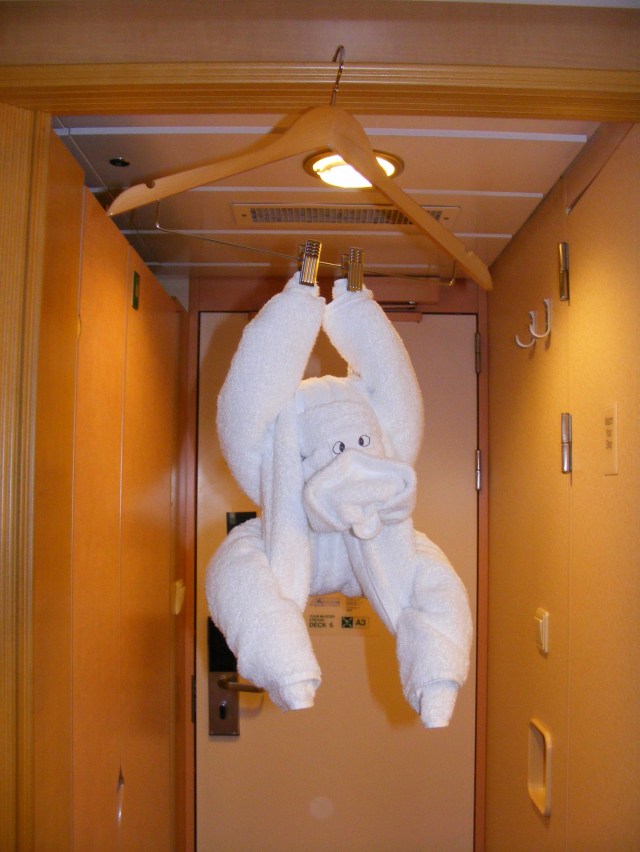
Having eaten too much yet again – pizza for me, more cow for my companion – we listen to Michelle Patient’s excellent presentation, introducing us to DNA testing. We arrive back to the cabin to find a towel sculpture in the form of a monkey suspended from the light fitting, appropriate with Gibraltar as our first port of call.

003 23 September 2019 Towel Monkey.JPG

After a much better night’s sleep, having lost an hour due to the time difference, we take a leisurely breakfast. We are quizzed in depth by the restaurant manager about the food and service. We lavish praise liberally. He has asked for our cabin number. He is welcome to pay us later for our fulsome feedback. We learn more about DNA from Michelle; this time ‘Getting the most out of Ancestry DNA’. We are encouraged to use the, often overlooked, help sections of the website. I now have more ideas to try when I get home.

After lunch, Mia Bennett encourages us to make use of the 300 years’ worth of papers in the British Newspaper Archive. Some of the papers in their care are Indian titles, which was news (oh dear, there’s a pun in there somewhere) to me. I access the archive via Findmypast but a great advantage of a BNA subscription would be the ability to cut and paste the OCRed text. That could save me hours when typing up transcripts.

We play truant from the conference so I can have a swim. It is still a tad breezy on the top deck. I stride purposefully towards a pool, wondering why it is empty. As I begin my descent down the steps, I realise why no one else is swimming here; it is freezing. As I am surrounded by people, I feel obliged to brave this out and act like the sub-zero temperatures were no surprise. I splash about a bit, avoiding the many insects that have met their demise in the pool, just long enough to look convincing, before repairing to the warmth of one of the whirlpool baths.

The next conference session is the help desk but I only have one person who requires my assistance and it is a straightforward and swiftly answered query.

Yet more food in the Windjammer and then our evening session, which is Paul Miner speaking about non-conformists and recusants, explaining the complicated timeline that is the story of British dissent.

Southampton – Day 1 of our genealogical cruise adventures

I never need an alarm clock; I can’t remember the last time I set an alarm and did not wake up before it went off. Equally, it must be months, if not years, since I was not awake before 6am. I have to be ready to leave the house at 6.45am. Initially, I don’t bother to set the alarm, then I decide that this might be the one time that I need it. The redundant alarm clock is already set for 6.10am from earlier in the week. I don’t bother to change it. I wake up at 4.45am, maybe just a little too early. I can’t get back to sleep. Oh, it turns out that I can, at about 5.30am, only to be woken by the alarm at 6.10am! Nonetheless, I am only a couple of minutes late when the taxi, aka Chris, arrives.

An uneventful journey is marginally enlivened by being stuck behind a cesspit-emptying van with the registration letters POO. We arrive at Gate 10 of Southampton Docks, having picked up Chris’ daughter, who is kindly going to drive the car back to her nearby house for the fortnight. Now comes the dreaded procedure that is getting Chris’ large metal box of seventeenth century medical instruments on board. As these include axes, saws and knives, albeit blunt ones, we have not left this to chance. The getting permission process started over a year ago when we spoke, in person, to the security officer on this very ship. Since then it has involved several phone calls to America, even more phone calls to Australia, emails, on-line chats, sending out a detailed inventory complete with photographs and the efforts of seven people. Only this week did we get an email that suggested all might be well. Being an American ship, it might have been easier to bring the musket on board; we could claim the second amendment. We encounter a very rude member of staff at baggage handling, when Chris, admittedly a little curtly, explains we have permission to take the box on. She then refuses to tell us where security is, on the grounds that ‘we obviously knew everything’. This left rather a sour taste. Using our prior knowledge from a previous cruise, we find security without troubling her to do her job, only to be greeted with, ‘Oh, we were expecting this last week’. Have we inadvertently gained permission to take the kit on the wrong cruise?

Chris has to carry the box on board himself. It weighs all of four stone. It is a very long way. He is looking in dire need of medical help. Never fear, there’s a barber surgeon on board. Oh, that would be him then. With several thousand people on The Explorer of the Seas, our home for the next two weeks, it is a happy co-incidence that we find ourselves sharing the lift with friends. It will be an hour before our cabin, sorry ‘stateroom’ (it is a windowless box), is ready. Encumbered as we are with a large metal box containing medical equipment, not for us are the refreshments of the Windjammer Restaurant, or sunning ourselves on the open deck. We need to wait until we can dispose of the kit. We pass the time people watching. A security chap complete with riot helmet walks past, pushing a trolley marked ‘clean laundry’. This appears not to be designed to fool. What is inside does look remarkably like freshly ironed sheets. Pristine bedlinen is obviously at a premium.

Cabin inspected, we head for refreshment. Enormous slices of cake, luridly decorated with a Union Jack, are being served. Why is it that red food colouring never comes out red? Numerous portions of untouched cake are being left on plates. As on previous cruises, I am appalled by the food waste. If you don’t like cake, why take a slice? We have a view over Southampton Boat Show. I am unimpressed by gleaming, luxury yachts. There is however a tall ship that looks much more fascinating.

Next, the obligatory but farcical, safety drill. It seems that some of our fellow passengers do not understand the concept of obligatory. Are we all to be kept here in detention until the miscreants arrive? I wonder if any provision is made for those on board with sensory issues. Bright lights, noise, crowds, having to remain in the room, all the stuff of which nightmares are made. I might just ask how they would ensure that such passengers were accommodated. I have zero intention of bringing a person with sensory issues of my acquaintance on a cruise (the mind boggles) but spreading awareness is no bad thing.

We set sail; is that the correct expression for a vessel with no sails? The Isle of Wight slips past and we wave to invisible friends. Chris has already consumed two ice-creams from the help yourself ice-cream bar. Then a meet and greet for conference goers, over half of whom we know; it is great to get reacquainted. Food next and it is ‘Tex-Mex’ night in the Windjammer. We habitually reject the two sprigs of asparagus and a bit of drizzle on offer in the formal dining area. I’ve gone for sweet chilli chicken and Chris is tucking in to salmon and the first of what I am sure will be many steaks. On our last cruise he ate his way through a whole cow. Another reason for rejecting the formal dining is that I find being waited on discomforting. It is not at all the same as in a British restaurant. The staff act like we are better than them. We aren’t. It should not be a job requirement to be so self-effacing but it is.

002 21 September 2019 Southampton Boat Show.JPGPaul Milner begins the conference with an interesting session on ‘The English Context: history, sources, repositories and processes.’ A veritable minefield for those researching from overseas, as most of the audience are; there are only five Brits at the conference. We debate why some counties are shires and some are not. Could it be the migration patterns? Why is County Durham, the only county to be described in this way? Probably because it is the only non-shire to have a county town (or indeed city) of the same name as the county, so it is a way of distinguishing between the county and the city. And so to bed. On our way past a public area an enthusiastic member of the entertainments’ team is exhorting his audience to believe they are butterflies. Numerous apparently sane adults are waving their arms, sorry wings, about. We don’t linger to find out what all this is about. The ways of cruise ships are unfathomable.

Genealogical Sleuths – Fiction for you to Enjoy

Until recently, I was a columnist for the In-depth Genealogist Magazine and also wrote for their blog. Now the magazine is sadly no more, contributors have been invited to re-post their blog material elsewhere, so that it is preserved. This is another post that I wrote for the magazine; it has been updated since it first appeared in January 2018.

In recent years, several authors of fiction have chosen genealogical sleuths as their main characters. In general, these are crime novels but frequently they have a ‘time-slip’ facet, so that they also contain elements of historical fiction. I have to say that if genealogy was as dangerous a career as some of these books imply, no one would be advised to take it up. The mundane might be more realistic but would not make for very exciting fiction. I thought that I would introduce you to a few of my favourite exponents of this genre. There are others and I hope that readers will share details of those that they have enjoyed. In an effort to be fair, I have listed the authors in alphabetical order.

Nathan Dylan Goodwin writes about ‘forensic genealogist’ Morton Farrier. Two threads run throughout the books that have been published so far. The first relates to Morton’s quest for his own ancestry and the other is his developing relationship with his police officer partner, Juliette. There are five full length novels, plus four shorter adventures in the series. One of the latter, The Asylum, is currently available as free download. In these, Goodwin writes of such things as Edwardian Britain, Suffragettes, the Western Front, The Battle of Britain and his hometown of Hastings. In addition, Ghost Swifts, Blue Poppies and the Red Star is the first in a new series about Harriet McDougall and is set in 1919 as Harriet investigates the story behind the loss of her son in the First World War.

M J Lee introduces us to former detective Jayne Sinclair. So far, there are six books in the series including The Irish Inheritance, which is a case that centres on the Easter Rising, whilst The Somme Legacy covers both the first world war and the suffragette movement. The American Candidate sees Jayne investigate the background of a potential candidate for the American Presidency and takes us back to the 1940s.

The Irish Inheritance Cover LARGE EBOOK.jpg

John Nixon’s genealogist is also female, in the shape of Madeleine Porter. So far, there are eight books in the series and her adventures include, The Cuckoo Clock, Stolen Futures, Family Shadows and Another Summer, which revolves around a First World War mystery. The Cost of Silence begins with the murder of a genealogist. Have they been silenced before they could uncover something inconvenient?

Another Summer (A Madeleine Porter Mystery) by [Nixon, John]


Wendy Percival has also created a female genealogist, in the shape of Esme Quentin. The first book, Blood Tied, begins with the murder of an unidentified victim and unravels a sixty year old family mystery. The Indelible Stain takes us from a dying woman on a North Devon beach, to the story of a young girl’s transportation to Australia. The third book, The Malice of Angels , focuses on the Special Operations Executive in the Second World War. The most recent offering, Legacy of Guilt, is available for free download on Wendy’s website. There is also an Esme novella, Death of a Cuckoo.

BLOOD-TIED  RGB cover image (updated).jp

Steve Robinson’s anti-hero is American genealogist Jefferson Tayte. Many of his cases take him to the UK and his bumbling attempts at relationships echo throughout the seven books. In this series, we have another genealogist who is seeking out his own birth family. The first book, In the Blood, is set in Cornwall; a centuries old murder is solved thanks to his efforts. To the Grave sees Tayte unravelling a secret that has been kept since the days of World War Two. Kindred is also set in the Second World War. In The Last Queen of England, fact and fiction are intertwined as Tayte races against time to solve a puzzle, set by members of The Royal Society, relating to the rightful heir to the throne. The Lost Empress focuses on a 1914 shipwreck that has remained relatively unknown in the shadow of the Titanic and Lusitania.

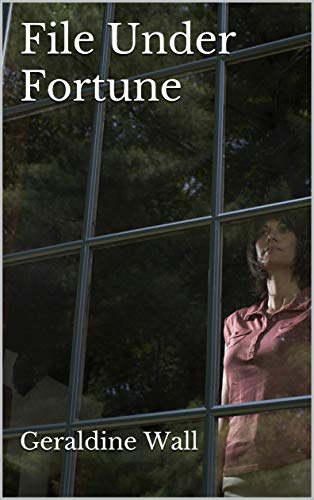
Geraldine Wall’s series of five books feature Anna Ames, a probate genealogist. The continuing thread concerning Anna’s own family, including, in the earlier books, her husband’s developing early onset dementia, is a positive addition to her ‘File under ……’ series. Although there is perhaps a little less genealogy and more family relationships in this series they are deserving of inclusion. The latest in the series, File under Fortune, follows Anna’s research into her own Traveller heritage.

book cover of File Under Fortune

Happy Reading!

Online Family Trees and why I have Succumbed

I have never been a fan of online family trees. Whilst absolutely respecting other people’s right to make whatever choice suits them, it was something that I always vowed, quite vehemently, I would never do. I was wrong. First of all, a word about why I chose to keep my family tree offline. When I started my research, over forty years ago, there was no online. I suspect if I were a new recruit to genealogy now I would make some different choices. When I got fed up with hand-drawing copies of family trees to share with others, I capitalised on the fact that I had a computer and purchased some genealogy software; Family Tree Maker. I can’t remember exactly when this was but it was on floppy disks and I think it was version 3. I still use Family Tree Maker. The trees it produces are not ideal but it suits me better than the alternatives. The fact that my handwriting is an exercise in advanced paleography played no small part in my decision to abandon hand-drawn trees.

Let me be clear, my reluctance to put a family tree online had nothing to do with me not being willing to share my information; I have been doing that since 1977. The surnames that I am interested in have been widely advertised for decades and are listed on this website. Over the years, many distant relatives have benefited from my research and vice versa. Purely because of the length of time I have been researching, I often have more to give than receive but that is fine. I love to share information but I do like it to be a two-way process. I want it to be accompanied by a conversation about the sources I have used and why have I made the connections that I have, or why I have not. I want to share the stories and the contextual detail that I have researched, not just the names and dates. To this end, some narrative accounts about my ancestors are now also available on my website.

This has worked well for me until very recently. Why would I change? I have been vocal about my opinion of many of the genealogies that you find online. Let’s just say I am not impressed by vast, unsourced, ‘grab it all’ trees containing biologically impossible data and scores of unverifiable connections. I do accept that there are well-researched, accurate pedigrees, compiled by proficient genealogists on the www but there is also an overwhelming amount of dross. So much so that extracting the gems has made looking for the proverbial needle in a haystack seem like child’s play.

People have often marvelled that I can do family history research without an Ancestry account, particularly as I do still do some professional research. I have never felt the need. I have subscribed to FindmyPast since before it was called FindmyPast and that suits me because the coverage is better for the counties that I need most often. When I began researching in the years B.C. (before computers), tracing your family history was impossible without going to archives and this is still key to the work I do. In fact, I believe that archival research is still essential for all researchers, as so much is not online.

A few months ago, having had my DNA tested with other companies, I decided that I might as well add Ancestry DNA to my collection of autosomal results. Before I parted with my hard cash, I considered whether having no Ancestry subscription and no online tree would make the test worthless. I realised that it would hamper my chance of encouraging contacts but I decided that it would still be useful, especially at sale price. The results arrived. I was offered a significantly reduced rate for an Ancestry subscription. So, tempted by the data sets, notably the London parish registers and PCC wills, I took out my first ever Ancestry subscription. I still had no intention of ever putting my tree online. I filled in my profile with my ancestral surnames but I resisted the exhortations to start my tree, even one that was private.

I had fun with my DNA matches, as expected, none of them close. I have two 3rd-5th cousins and 284 at 4th-6th cousin level, which I would guess is probably significantly fewer than most people. Some I had made contact with before. I could, I thought, just sit back, with my lack of tree and see if anyone contacted me. I worked out how some of the matches were connected to me using their public trees. I began to colour code them into groups. I was having fun. Everyone was banging on about ThruLines, that sounded fun too but of course I couldn’t connect to anyone with no tree. As I worked through my matches, I realised that I was prioritising those with public trees, of course I was, no real surprise. I contacted a few people, some replied, some didn’t, not unexpected. I found a third cousin in Australia, practically my closest living blood relative. Obviously, I reasoned, people are going to do the same as I did, start with those with public trees, then perhaps consider contacting a few with private trees if the common matches looked promising. With tens of thousands of matches, no one was ever going to get round to contacting poor little treeless me.

I umm and erred a bit and I took the plunge. My original intention was just to add my direct ancestors, not least because of the time it would take to add the results of forty years’ worth of research. The reasoning behind creating this tree meant that there was no point in making it private. My concession to privacy is that I have listed my parents as alive when they aren’t, so they can’t be seen and I would not consider adding my descendants. I still have numerous Cornish direct ancestors to add, some of those were acquired so long ago that they haven’t even made it to Family Tree Maker! I have filled in some siblings, particularly where it clarifies a DNA link and I will gradually add more.

Before I began, I worried if anyone would take an unsourced tree seriously (I wouldn’t) and I couldn’t face the thought of adding a trillion source citations, which I keep on a card index, yes, really, I do know it is 2019. Once I had begun, I realised that Ancestry make it quite easy to add sources, which was a relief. Their hints do contain some serious flights of fancy but these can be ignored. Of course, the sources that are attached to my Ancestry tree are a fraction of those that I have for some of these individuals but at least the tree is not unsourced.

Transferring a Gedcom wasn’t an option as I have multiple files. I could have created a composite tree by merging them but I thought it was quicker to start again. Everyone I have added has been verified using original sources, or images of those sources. I do not rely on indexes, although they are obviously a helpful gateway to the documents.  For this reason, I have not and will not, graft someone else’s tree on to my own. Although I am equally committed to researching them, I have made no attempt to add my children’s ancestors, as the point of this is to understand DNA matches and these are not relevant to that task.

Admitting you are wrong is difficult but I like to think that I am open to altering my opinions and alter them I have. I now have a tree on Ancestry, I am even quite proud of it. It will never be the primary method of keeping my information. There are several reasons for this not least because I want to be able to work on my tree when I am not online but I have ‘come round’ to a certain extent and who knows, maybe my opinion will change again.

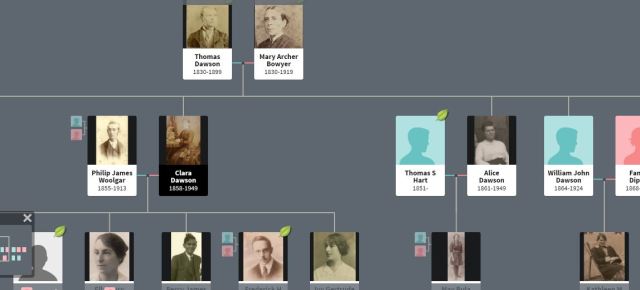
Capture

Part of a tree created at Ancestry.co.uk

Fanny Amelia’s (family history) Story

Strictly of course it is only part of her story, as there is more to be found but if I wait until it is ‘finished’ I may wait forever. So here is my attempt to preserve the memory of a lady who has no living descendants and for whom we have no photograph (yet). She is someone who could so easily be lost to history. In fact, in the past, family members did a very good job of expunging her from the oral record. As her closest living relative (jointly with my six second cousins), I felt it was up to me to investigate her life and record what I discovered, warts and all.

Fanny Amelia was the third daughter of Philip and Mary Woolgar née Cardell and was born at 6.30pm on 5th February 1848.[1] The time of birth on the certificate should indicate that this was a multiple birth but there are no other registrations for the quarter and district who could be the other sibling.[2] The address is indistinct but appears to be Cockers Haven, Finchley.[3] This almost certainly refers to a small settlement on the southern edge of Finchley Common, near the Red Lion, which was formerly named Cuckold’s Haven.[4] Finchley is now considered to be part of north London but in the mid-nineteenth century, was a small, newly-developing, settlement, distinct from the metropolis.

Fanny Amelia was baptised at St. Michael’s, Highgate on the 5th of March 1848. Her father, Philip, was described as a gardener.[5] Fanny was a surprise when I discovered her existence in the 1980s, as part of my investigations into my family history. Tales of this family were woven into my earliest memories. Why had Fanny not taken her place alongside her siblings on the first family tree I devised at the age of seven? My great-aunt, from whom I gained most of my family stories of this branch, would have been an adult when Fanny died. The families lived in close proximity, surely they would have known each other. There were photographs and recollections of Fanny’s parents, her siblings and their families but nothing of Fanny remained. Although Fanny outlived all her brother and sisters, there was no mention of her. The only acknowledgement that there may have been an additional child was the vague suggestion that Philip and Mary might have had a daughter called Sophie, so even Fanny’s name was lost to the family history. Until that is, I began my adventures in the world of archives and microfilms, of ledgers and registers, long before the advent of the internet.

The whole family appear to have escaped enumeration in the 1851 census but there was Fanny, with her parents, in 1861[7] and 1871.[8] Fanny cannot be found in 1881.[9] It has been established that she is not the Amelia Woolgar who, in 1881, was working as the cook in the Alleyn Park,[10] household of hop merchant, Stanford Mountain.[11]

On 15th November 1884, Fanny Amelia married widower, William Ellington, at St. Clement’s, Hastings, Sussex. The witnesses were Maude and H Bedwell and Thomas Covell. At the time of the marriage, William Ellington was a coachman.[12] He is inconsistent about his age and place of birth but the consensus seems to be that he was born about 1823 in Peterborough, Northamptonshire,[13] so he was considerably older than Fanny. William and his first wife, Helen, had been in service in Herne Hill for many years[14] and this is presumably how he and Fanny met.

William and Fanny Ellington’s son, George Frederick, was born in Hastings a year after they married.[15] There was another short-lived child, Richard Collings Stanley Ellington, who was born in 1891 and died the following year.[16] In 1891, the family were living in two rooms in part of 19 Cornfield Terrace, Hastings and William was working as a bath-chair man. Ten years later, the family had gained a room and were living at 100 Bohemia Road; William was still running his bath-chair business in Hastings and George was working as a compositor.[17] Although no death registration has been found for William Ellington,[18] by 1911 Fanny was a widow and can be found in the census visiting the Pierpoint family in Dulwich.[19] By this time, her son George was a boarder in the household of Harriet Blackmar, at 15 Duke Street, Eastbourne, Sussex and was still working as a compositor. [20]

On 2 May 1911, just weeks after the census was taken, Fanny was admitted to the workhouse in Constance Road, East Dulwich[21] because she was ‘temporarily disabled’ and ‘allegedly insane’. She was discharged a week letter, to Horton Asylum and described as being destitute and temporarily disabled.[22] Horton Asylum, in Epsom, Surrey, was to become noted for pyrotheraphy, an experimental treatment for the general paralysis of the insane, which was a manifestation of syphilis. This treatment involved infecting the sufferers with malaria. It was thought that the resulting high fever would destroy the spirochetes involved in syphilis. Horton was deemed suitable as it had an isolation unit, which would prevent the malaria spreading to other patients. It seems that this was pioneered in 1917, so Fanny, had she been suffering from general paralysis of the insane, would have escaped this treatment.[23]

I don’t know how long Fanny spent at Horton but on 30 December 1915, she was readmitted to the workhouse from 18 Hindmans Road. In 1911, this was the home of a younger generation of the Pierpoint family.[24] I can find no family connection with the Pierpoints, so perhaps they were just friends. Once again Fanny was regarded as ‘temporarily disabled’ and ‘allegedly insane’.[25] After just six days she was removed to Cane Hill Pauper Lunatic Asylum in Coulsdon, Surrey.[26] By this time, Horton had been requisitioned for military use.[27]

Fanny Ellington died in the asylum on 12 January 1922 from valvular disease of the heart and congestion of the lungs, both of an indefinite duration, hours after suffering a small cerebral haemorrhage. The death was registered by her son, George, who was then of 2 Grove Road, Chertsey, Surrey.[28] There was no mention of her mental state.

George Ellington married Lily Wade in 1932 in Islington district,[29] she was in her fifties so there were no children. In 1939 they were living in a tobacconist’s shop at 67 Guildford Street, Chertsey, which Lily ran; she was also a hairdresser.[30] George was still working as a compositor. They both died in 1960.[31]

The generosity of the genealogical world is outstanding. With the help of a friend, I have attempted to access the records of Cane Hill Asylum, which were allegedly in Croydon Museum. All they have is the bald statement of her admission. The quest is on for the medical records, which I understand from another helpful family historian, may be with the relevant NHS Trust. There is still the possibility of records for Horton Asylum, which are at the London Metropolitan Archives. I may have to call in another favour here. I also want to find out where she was buried; I have established that it was not at Cane Hill. The asylum was closed in 1992.[32]

So this is Fanny’s story. I do hope that more research will mean that I can add to it. Watch this space! In the absence of a picture of Fanny, I offer you her sisters, Caroline and Mary Ann [Polly], sadly, although Caroline had five daughters, she has no living descendants either. P.S. I am quite glad that I didn’t inherit the ears!
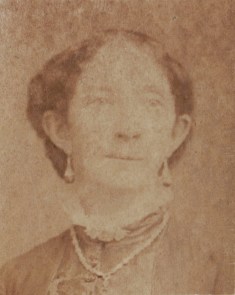
Caroline Leighton née Woolgar 1842-1919.JPGMary Ann (Polly) Hicks née Woolgar 1845-1907.JPG

[1]    The birth certificate of Fanny Amelia Woolgar 1848, from the General Register Office.

[2]    General Registrar’s indexes of birth.

[3]    The birth certificate of Fanny Amelia Woolgar 1848, from the General Register Office.

[4]     A History of the County of Middlesex: Volume 6, Friern Barnet, Finchley, Hornsey With Highgate. Originally published by Victoria County History, London, 1980. Via www.british-history.ac.uk/vch/middx/vol6/pp38-55  accessed 4 September 2019.

[5]    The baptism registers of Highgate, Middlesex, via www.ancestry.co.uk.

[6]    Oral evidence from Gwendoline Catherine Braund née Smith and Ella Mary Bird née Woolgar.

[7]    1861 census for Rosendale Road, Norwood, Surrey RG9 367 folio 56.

[8]    1871 census for 1 Rosendale Road, Norwood, Surrey RG10 692 folio 59.

[9]    Indexes to the 1881 census of England and Wales via www.findmypast.co.uk and www.ancestry.co.uk.

[10]  Alleyn Park is in Dulwich.

[11]  1881 census for Alleyn Park, Westbrook, Camberwell, Surrey RG11 669 folios 35 & 36. General Registrar’s indexes of birth and marriage. 1871 census for Warrior Road, Lambeth, Surrey RG10 679 folio 110.

[12]  The marriage certificate of Fanny Amelia Woolgar and William Ellington 1884, from the local Register Office.

[13]  1871 census for Herne Hill, Lambeth, Surrey RG10 686 folio 43.

[14]  1871 census for Herne Hill, Lambeth, Surrey RG10 686 folio 43.

[15]  General Registrar’s indexes of birth; 1891 census for 19 Cornfield Terrace, Hastings, Sussex RG12 764 folio 83.

[16]  General Registrar’s indexes of birth and death; 1911 census for 2 Upland Road, Dulwich, Surrey RG14 2469 folio 481.

[17]  1901 census for 100 Bohemia Road, Hastings Sussex RG13 869 folio 68.

[18]  General Registrar’s indexes of death.

[19]  1911 census for 2 Upland Road, Dulwich, Surrey RG14 2469 folio 481.

[20]   1911 census for 15 Duke Street, Eastbourne, Sussex RG14 4822 folio 162.

[21]   Constance Road Workhouse http://www.workhouses.org.uk/Camberwell/ accessed 4 September 2019.

[22]   1911 Admissions Register for Workhouse, Constance Road, East Dulwich, Surrey via www.ancestry.co.uk. Originals at London Metropolitan Archives CABG/185/31.

[23]  Horton Asylum www.countyasylums.co.uk/horton-asylum-epsom accessed 3 September 2019. Julius Wagner-Jauregg (1857-1940): Introducing fever therapy in the treatment of neurosyphilis www.ncbi.nlm.nih.gov/pubmed/24185088 accessed 4 September 2019.

[24] 1911 census for 18 Hindmans Road, East Dulwich RG14 2466 folio 401.

[25]  1915-16 Admissions Register for Workhouse, Constance Road, East Dulwich, Surrey via www.ancestry.co.uk.  Originals at London Metropolitan Archives CABG/185/40.

[26]  1915-16 Admissions Register for Workhouse, Constance Road, East Dulwich, Surrey via www.ancestry.co.uk.  Originals at London Metropolitan Archives CABG/185/40.

[27]  Cane Hill Asylum, Coulsdon, Surrey www.countyasylums.co.uk/cane-hill-coulsdon accessed 4 September 2019.

[28] Death certificate (pdf) of Fanny Amelia Ellington, from the General Registrar.

[29] General Registrar’s indexes of marriage.

[30] 1939 Register for 67 Guildford Road Chertsey, Surrey RG101/1876C/006/30 Letter Code: DMCC.

[31] General Registrar’s indexes of death.

[32] https://www.countyasylums.co.uk/cane-hill-coulsdon/ accessed 4 September 2019.
Ancestral Ill-health and a bit about Books

It has been a busy week, with some fascinating family history discoveries. As some of you will know, I have been publicly somewhat scathing about the works of fiction that are strewn across the internet, purporting to be someone’s family tree. Not wishing to delve too deeply into people who die before they are born, have children at the age of two, or are allegedly living in three different countries at one and the same time, I attempt to avoid these. Occasionally there may be a nugget of usefulness of course and my recent foray on to Ancestry.co.uk did lead to a photograph of my great great grandfather’s brother. I have a picture of g-g-grandfather and there is a likeness. I also found two people whose online trees bore some resemblance to reality and I was able to offer the owners copies of family photographs. One even replied, so I guess that is a bonus.


John and Thomas Dawson

My Ancestry DNA test is currently languishing in the lab waiting to be processed. Yes, I am going to join the ranks of those irritating testees who do not have a tree on Ancestry. I have however added my ancestral surnames to my profile back sufficiently far for any fourth cousins to look for a common ancestor.

I am, as anticipated, making use of some of the original documents that can be accessed via Ancestry, notably collections from London Metropolitan Archives. It was via some workhouse admissions’ and discharge registers that I discovered that my great great aunt had been in the county asylum. Coincidentally, my ‘In Sickness and in Death: researching the ill-health and deaths of your ancestors’ students were discussing asylum records this very week and even better, one has kindly volunteered to look up some potential records about great great aunt that are not online – aren’t people lovely? Now, if any kind soul is at the London Metropolitan Archives with a spare five minutes to investigate her stay in another asylum………

The great thing about running online courses is that you learn so much from your students. You may have spotted a Facebook post from me that referred to the list of 1832 cholera epidemic victims in Manchester. The transcription of this dataset is cunningly hidden away on FindmyPast and what a gem! For the benefit of those not on Facebook, here is the entry for 16 year old Elizabeth Aspin ‘No. 177, Elizabeth Aspin, commonly called Crazy Bess, aged 16. Residence Back Parliament-street. Employment: woman of the town. Constitution: stoutish. Natural susceptibility: subject to diarrhoea after drinking. Predisposing cause: alternately starved and drunk, often sleeping in the street. Exciting cause: drunk on the Reform celebration day the day before her attack, cried passionately when Laurence was taken to the hospital. Locality, crowding, filth &c. for the locality see case 181. Dates of attack and event: seized Friday, August 10th, at 11 pm, recovered August 30th. Communication or non-communication: no known communication with Laurence nor any body else.’ Further research suggests that she was baptised in Manchester in 1817, daughter of Thomas and Ellen and that she survived the epidemic, marrying George Townley in Radcliffe, Manchester in 1836 and moving to Salford.

Advance notice of a couple of book signing/buying opportunities. I will be giving a talk about Barefoot on the Cobbles as well as selling and signing books at The Wine Box in Torquay at 2.00pm on Friday 8th November – wine and books – how can you resist? I am especially pleased about this, as part of the novel is set in Torquay. I will also be at Torrington Craft Fair on 7 December with copies of all my books. A few people have asked if they can get copies of my books at RootsTechLondon. I will have a limited number copies of Remember Then, as that is the subject of my talk but I am travelling in on public transport so will only have other titles if you ask in advance. I need to know by 9 October. I could mention that the festive season is only however many weeks away but I won’t.

How Up to Date is Your Family Tree?

Until recently, I was a columnist for the In-depth Genealogist Magazine and also wrote for their blog. Now the magazine is sadly no more, contributors have been invited to re-post their blog material elsewhere so that it is preserved. This is another post that I wrote for the magazine; it first appeared in September 2017.

Just to be clear, I am not asking whether you have added cousin Mary’s latest grandchild born in 2019. What I mean is, how recently have you looked at your pedigrees, files, conclusions, source citations and narrative family histories to see if they are still current? Family history is a never ending hobby, with so many opportunities. You get stuck on one line, no problem, there are others that you can follow. Almost all of us focus on one part of the tree for a while before turning to another. Maybe we have reached a dead end. Or perhaps an enquiry from another researcher, a DNA match, or a chance to visit and ancestral area will prompt us to dig out the Smith family research that has been left in abeyance for a few years. This is when you realise how much things may have changed in the intervening years.

There are likely to be issues with your source citations. There may broken links due to defunct URLS, record repositories may have moved, or have changed their names. For example, I just looked out some UK research that I had not revisited since 2011 and found references to The Public Record Office (Now known as The National Archives) and the Family Records’ Centre, which no longer exists. Other repositories have changed their catalogue referencing system so that the reference numbers I have quoted are no longer meaningful. It is probably still possible to follow my research trail as the records themselves have not changed but I clearly have some updating to do.

Of course, with the abundance of new records that are now available to me online, or have been indexed, making it harder for my family to hide, there will also be scope for me to add to this part of my family history or at least to tie up some loose ends. This is another way in which my family history is not up to date. You may be familiar with Thomas MacEntee’s concept of the ‘Genealogical Do-Over’, which encourages those of us who have been researching for some time to effectively start over again, filling in gaps, citing sources and making sure that our relationship linkages are sound. When we first start on our magical genealogical journey, instinct often encourages us to race back as far as possible, as fast as possible. Indeed the first question a non-genealogist will often ask is ‘how far back have you got?’ Of course, the important question is not ‘how far back are you?’ but ‘how much do you know about the people on your tree?’

A complete do-over, as advocated by Thomas MacEntee, may be too daunting a prospect for some of us. After all, there are all these exciting new ancestors to be found, why would we spend time going back over the old ones? If we can’t face a ‘re-do’, then we should most certainly be revisiting and revising at regular intervals. Is our family information up-to-date? Is there anything we can add in the light of newly available information? And, most importantly, if we were doing this research now, would we still feel that John is father of Richard and so on?

How ever carefully crafted a pedigree might be, with multiple pieces of evidence pointing to a particular relationship, we need to remember a salutary lesson – we can be wrong. Almost everyone who has spent a few years doing genealogy will have found themselves half way up someone else’s family tree at some point. Either that or we aren’t looking hard enough. Do take time to revisit, to revise, to update. Fresh eyes and fresh sources can often break down the brick wall that led you to abandon a particular family line in the past. Good luck.

News from the Cobbles for fans of Barefoot

I hope no one is reading this expecting Coronation Street spoilers. There have been some lovely communications regarding Barefoot on the Cobbles lately. Firstly, two lovely readers, without internet access, took the trouble to write me letters saying how much they had enjoyed it. I also had an email from a reader from New Zealand who not only praised the book but said I had inspired her to write the story of her own family history tragedy. I have also been contacted by two relatives of the minor characters in the novel. One leading to ongoing research into the family, which may turn out to be intriguing.

This has been interspersed with precious time spent with my descendants; there may be more about that later. I have also started another run of my In Sickness and in Death course and the students are wonderfully active, sharing stories of the ailments of their ancestors. One of the best parts about Pharos courses is the interactions between the students. This has all taken my mind off a few recent technical hitches. Yesterday a very forbearing audience sat through a presentation that really did need the accompanying slides, when my laptop (and a backup laptop) failed to communicate with the projector. I am also juggling external hard drives, in an attempt to recover files that have been damaged due to a corrupted memory stick. Fortunately they were backed up and I realised before I overwrote the complete files for another back up. A salutary lesson not to rely on memory sticks/data sticks/flash drives, call them what you will.

In the course of checking files to see if they were damaged, I came across I passage that I wrote for part of Chapter 1 of Barefoot but which was left on the cutting-room floor. I thought you might like to read a little about Polly as a young girl.

1884

Polly Wakely leaned back on the Devon bank that edged the lane leading from Horns Cross to Peppercombe. Her two younger sisters, tired of gathering bluebells, sat beside her. All had severely plaited hair and identical rough, linen smocks. Polly, on the brink of womanhood, had abandoned her bonnet in an act of defiance. She was meant to be shepherding her sisters home from school but the temptation to linger in the spring sunshine, to stretch the time between the agonies of the classroom and the drudgery of chores at home, had got the better of her. Polly did not begrudge having to mind Ada and Ethel, in fact she quite enjoyed it. She hoped that she might have children of her own one day, in an unfathomable future that seemed impossibly far ahead. The role of chaperone to the younger members of the family had, until recently, been the task of her older sister, Jane. Jane, shy and retiring had found it difficult to discipline the two youngest girls but Polly was firmer. Despite their very different personalities, the Wakely sisters had always been self-sufficient, content with each other’s company and united against the taunts of their classmates.

            A small group of children turned the corner and spotted the Wakelys. Here was an easy target.

            ‘Yer ma tellin’ fortunes today then?’

            Polly was not as feisty as her eldest sister, Lydia, now working away in service but she had had years of practice standing up to bullies and defending her own. She knew that the comment was intended to provoke a reaction, perhaps to initiate a fight. She had succumbed to this when she was younger, arrived home with hair pulled, face scratched and pinafore torn. She considered herself too old for such scraps now and she had learned that there was nothing the tormentors hated more than to be ignored. She turned her back and pretended that she had not heard, putting a warning hand on Ada’s arm, to indicate that she should do the same.

            The oldest boy picked up Ethel’s discarded bouquet.

            ‘What’s these ole flowers for then?’ he mocked, tossing the drooping blooms over the hedge. ‘Going to pop them in the pot and make a spell?’

            Polly groaned inwardly, would this stupid tale never cease to dog their lives. Ethel was less resilient than her sisters and was distressed at the loss of her flowers but she knew that she must not give this big boy the satisfaction of seeing her cry.

            One of the girls in the group was regarding them with sympathy but her companions quelled any attempts at compassion.

            ‘Them’s nought better than gypos, don’t you go frettin’ over them. Turn you into a toad as soon as, they would.’

            Polly knew she had to be brave, that her ma would be cross if Ada or Ethel went home in tears and told tales of what was responsible for their distress. As each of her children left toddlerhood behind, Eliza Wakely had urged them to ignore such taunts. She understood their pain, she had suffered the same in her turn. In fact, thought Polly, although there had been no school to endure in those days, it had been worse for ma and her sisters. Their very surname, Found, had marked the family as out of the ordinary. It had all been ages ago, before even ma’s grafer’s time but still the rumours swirled. Going back some, the original Found had been just that, found in the church porch over Morwenstow way and Polly and her sisters were suffering for it still.

Peppercombe

Method Genealogy – standing in the footsteps of your ancestors

Until recently, I was a columnist for the In-depth Genealogist Magazine and also wrote for their blog. Now the magazine is sadly no more, contributors have been invited to re-post their blog material elsewhere so that it is preserved. This is a post that I wrote in October 2016. Comments in {} are new additions.

We are probably all familiar with the concept of Method Acting, where the actor attempts to fully identify with a part by living as their character lived, or sharing experiences but method genealogy? As diligent family historians, it is something that we should all be practising. We need our ancestors to be as fully rounded as possible, to lift them from the two-dimensional pedigree and to understand what their lives would have been like. When I wrote my book Coffers, Clysters, Comfrey and Coifs, about seventeenth century social history, I said, “Our seventeenth century ancestors may be people that we can identify, or they may be lurking, nameless, waiting to be discovered. In either case they existed, therefore we owe it to them to find out more about their way of life.” The same is true of more recent inhabitants of our family tree. {Incidentally, if you would like to contribute to the campaign to make room for me to publish more books – copies can be obtained from me}.

Option 2 - CopyI recently discovered this beautiful photograph of a member of a family that I am researching. It isn’t actually my own ancestry but she will one day I hope be part of a novel based on incidents in her family’s life, so this could be my cover photo. She has bare feet. She lived on a cobbled street. What is it like to walk that street barefoot? I don’t know but I need to. Ok, I’ll be honest, I’m probably going to wait for better weather but I will be trying this. {Yes I wrote the book and yes I tried it – but not for long. And yes – another opportunity to relieve me of book stock and increase the free space in my house}.

Part of my life is spent as an historical interpreter, so I do get to dress in period costume. Have you any idea how difficult it is to go upstairs in a full length skirt? What about household tasks? That bucket you need to fetch from the well could weigh four stone (30kg), oh and you probably need eight bucketfuls of water a day. What is a home like without electricity? I get to try this in my 400 year old cottage when our power fails.

Reality television has often attempted to get people to turn back time. In some cases they go back to their centrally heated homes and twenty-first century luxuries every night. Even if it is a more sustained experiment, the participants know it is only temporary but such experiences are the closest we may get to the lives of our ancestors. What is it like to carve a homestead from virgin forest, to clear, to plough, to plant and to hope for an eventual harvest? How does it feel to set off on a six week sea voyage, knowing  that you will never again see those you have left behind?

If we are physically capable, we need to enter the realms of experimental archaeology to find out what processes were involved in the occupations of an ancestor. If we know they walked a certain route to school, to work, or to migrate, then can we walk it too (if only virtually with the aid of Google Earth)? What was the terrain like? What marks on the natural or built landscape may they have passed?

Family History is not just about following shaky leaves {and believe me, ‘shaky’ is an appropriate description for many} and amassing the largest family tree in the world. It is about getting under the skin of those we have discovered and doing the best we can to gain an insight into their ways of life. {Oooh, opportunity for another advertisement – if you would like to add depth to the deaths of your ancestors, join me on my Pharos Tutors online course ‘In Sickness and in Death: researching the ill-health and deaths of our ancestors’ – starts on Tuesday folks!}.