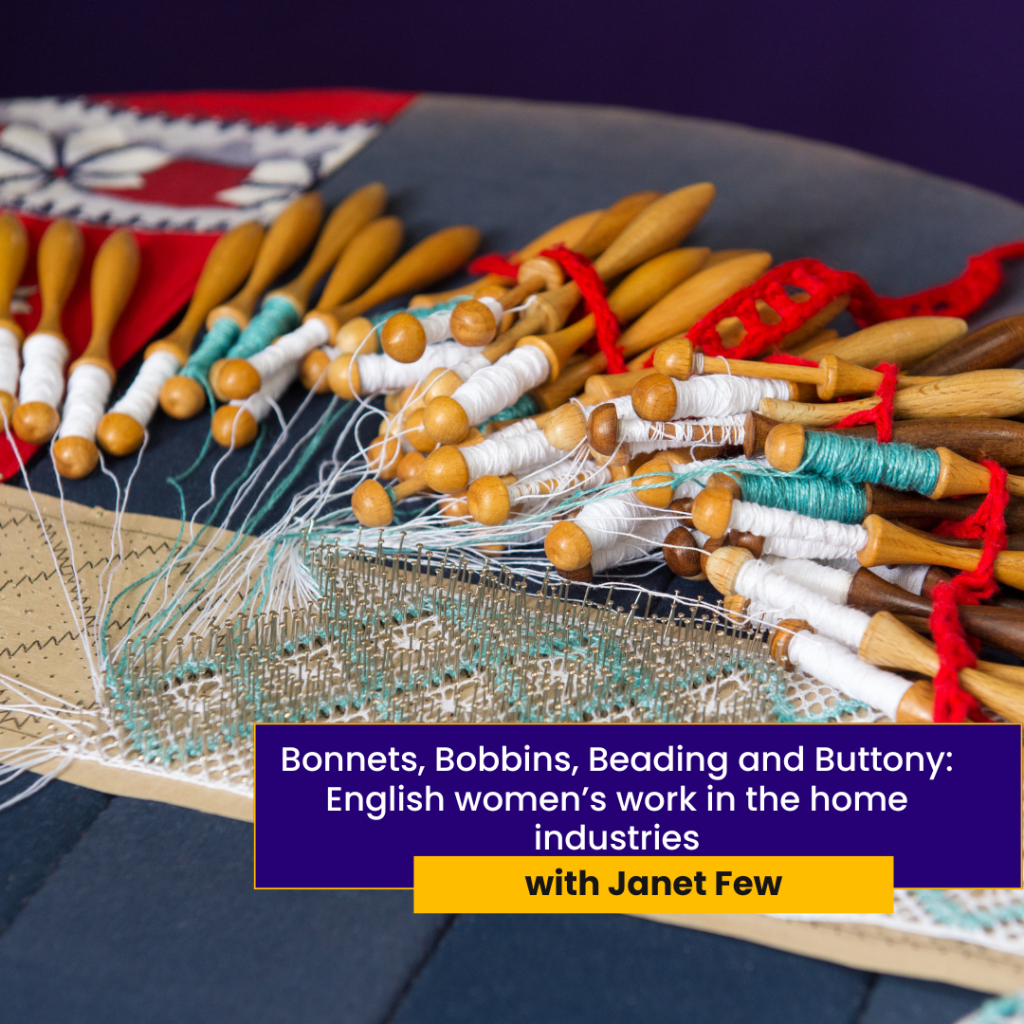
Time to take a deep breath as I launch in to the next few weeks. Not only is the job I must not mention about to hit with a vengeance but at some point long ago, I decided that it would be a good idea to cram the next few weeks full of presentations. So in the calendar for the next two weeks I have, Women’s Life on Farms, the story behind my novel Barefoot on the Cobbles, Mistress Agnes talking about life in the seventeenth century and Researching in the Twentieth Century, swiftly followed by looking at cottage industries. If you want to know more about straw-plaiting, lace-making, glove-making or button-making, as well as home working in general, you can book for that one here. All those topics get chapters of their own in my new book A History of Women’s Work and straw-plaiting and gloving are two of the sections that are accompanied by case studies. It is currently at its introductory price of 20% off, which means you can get a hardback for a paperback price and not have to wait two years for the paperback to be issue. The ebook will follow at the end of next month. I am humbled by the lovely reviews that have been coming in.
Today is also the final Zoom for my Pharos ‘Writing and Telling your Family History’ course. What a lovely cohort of students and such fascinating stories to be told. If you are sorry you missed it, it runs again in April, or you can sign up to research and tell the story of a female ancestor in September.
As this post in in danger of sounding like an advert, on to other things. In the interests of writing and telling my own family history I have been getting my pick axe out and working at my own genealogical brick walls. I have two stories to share with you when I get the time to draw breath and write them up for public consumption. Having decided that Mary Newlands is indeed my 3x great grandmother (see previous post), I am now pushing back to try to confirm that her family are of Scottish origin, as seems almost certain. So one brick wall crumbles and another looms.
News too on the second of my three ‘big’ brick walls. I’ve been working on the family of a different ‘almost certainly my 3x great grandmother’; oh wow, what a story. At the moment the ‘proof’ is based on rigorous documentary research but a missing baptism means two of the jigsaw pieces are DNA matches that are so small even I am reluctant to entertain them and hereditary large ears – yes, best not to ask. In a quest for more evidence, I launched into researching the wider family. I am back to the sixteenth century in Gloucester and Upton on Severn and have had plenty of palaeography practice. I do realise my missing link won’t be found in Tudor times but the rabbit warren (too big to be called a rabbit hole) sucked me in and there I was, head first in the throes of a virtual one-name study. It is an unusual name but beset with spelling variations and the use of contractions to add spice to my journey. There may be a connection to a seventeenth century barber surgeon. An added excitement is that my children also have paternal ancestry in Upton on Severn. I just may have to revisit that branch in search of a link. I am in the area in September. Do I wait patiently, or do I spend a small fortune ordering copies of wills? So many ancestors, so little time.
Sadly now back to the day job and three meetings Monday.
This post should have gone live on 1 June, the 217th anniversary of the death of Mary Hogg née Newlands. It has taken four solid days to put together (much longer than I anticipated), so it is late – sorry Mary but better late than never. For nearly five decades, the earliest ancestor in my grandmother’s Northumbrian paternal line has been great great grandfather John Hogg. For almost as long, I have been fairly sure that I know who John’s parents are but I have been waiting for an additional piece of evidence before ‘inking them in’. All brick walls are annoying but this is definitely in my top three that I really want to crack, not least because I love the area where I believe they came from; so much so that I embarked on a one-place study of the parish.
Here is a brief summary of the in-depth research that I have done to try to confirm John Hogg’s parentage. I should say at the outset, that this is the only branch of the family that come from anywhere near the north of England, next best are the Bulleys from Norfolk.
The story starts with my great grandfather, also John Hogg. I have his original 1885 marriage certificate, to Caroline Howe, naming his father as John Hogg, a gardener. The marriage took place in south London but census returns for my grandmother, Elizabeth Ann Hogg and her parents, confirm that great grandfather John junior was born in Morpeth, Northumberland. Family stories linked the Hoggs to Morpeth and to Russell ‘cousins’. I have a card that Elizabeth Ann wrote but never posted, addressed to Mr B. Russell, 3 Dacre Street, Morpeth. She referred to him as ‘Bertie’ and signed herself ‘Cousin Bessie’.
From census returns, we can deduce that John Hogg knew where he was born (Morpeth) but was a little vague as to when (April 1855 – March 1858). He was 28 when he married in 1885, so that fits within that date range. John’s death certificate shows that he died, in December 1926, at 3 Dacre Street and the informant was Bertie Russell ‘nephew’. John’s age was 71 (so born between December 1854 and December 1855). The births of four John Hoggs were registered in Morpeth registration district between 1853 and 1859 inclusive. There were no ‘male’ (i.e. no forename) Hoggs registered in Morpeth in this period. I followed up all four. Only one fitted the criteria of being born in Morpeth itself, having a father called John and not having a future that precluded him from being my ancestor. In addition, this family had a daughter who was the mother of Bertie Russell of Dacre Street.
Fully satisfied with my proof argument thus far, I turned to my great great grandfather John senior. He made life difficult by providing three different birthplaces in the census returns, being vague about his age and on one occasion, calling himself George instead of John. Over many years, I obtained copies of every document that I could and built up a detailed timeline of this man’s life, his two wives and nine children. It seemed clear that he was called John; there is just one census return where he is George. He was born somewhere between 1799 and 1809, probably in Bavington or adjacent Kirkheaton, which are about twenty miles west of Morpeth; although one census says Kirknewton, which is on the Scottish borders. He was an agricultural labourer, for the most part specifically a shepherd and he made many short-distance moves in the area during his life.
John’s first wife was buried in 1849, although no death certificate has been found. His first, apparently legitimate, child by his second wife Elizabeth Pearson, my great great grandmother, was in 1854. I could find no marriage either side of the English/Scottish border, within or outwith that date span, using every spelling variant of the names. This was particularly frustrating as a certificate would hopefully have included a father’s name. Comparatively recently, a newspaper announcement came to light, which revealed that they married, in 1853, at Lamberton Toll, a venue for clandestine marriages that is less well-known than Gretna Green. No records survive for this date.
I followed up all John and George Hoggs born 1797-1808 in Northumberland who appear in the 1851 census and looked for them in both the 1841 and succeeding censuses, to see which one could be the ‘George’ Hogg in Newgate Street, Morpeth in 1861 and John Hogg of Well Way, Morpeth in 1871. It was clear by the family members that these two were one and the same. After a great deal of careful research, I came to the conclusion that my great great grandfather John Hogg was almost certainly the son of Robert and Mary Hogg of Hallington, St. John’s Lee and that he was born in 1804 and baptised in Thockrington, which was adjacent to St. John’s Lee. This was the only baptism in the area around the birthplaces that John/George gave in the census and I could find no plausible alternative future for the John baptised at Thockrington, unless he became my great great grandfather.
I was so nearly there but still I hesitated to add Robert and Mary to my family tree. I was after that elusive ‘one more piece of evidence’. I investigated Robert and Mary’s families to see if this might support my hypothesis. Initially, the Hogg family were not very forthcoming. Robert and Mary only had three children and two died without issue, so there was no hope of tracing descendants for a possible DNA match. Going back yet one more generation, was a bit of a stretch but I tried anyway. This didn’t seem helpful. This family were rural agricultural labourers. They do not appear in the newspapers (as per the British Newspaper Library index). There are no surviving poor law records for the relevant parishes at the appropriate times. They do not appear to have owned land or left wills (Northumberland Archives, Prerogative Court of York and The National Archives indexes checked, as well as the excellent North East Inheritance Database). They do not feature in electoral rolls, nor did they serve in the army or navy. There is nothing in the catalogue at Northumberland Archives that relates to the family, leaving me with very little to go on.
I turned to the brides. Robert’s wife had been Mary Newlands; was she my 3x great grandmother?
The Newlands family, despite their reluctance to baptise children in churches or chapels whose records survive, had more potential. Robert Hogg died in 1805 and his wife Mary née Newlands, just three years later. This would have left John and his surviving sister, Mary, orphaned at a very young age, which might account for John’s later confusion regarding his place and date of birth. There is no age at burial for Robert or Mary Hogg ‘relict of Robt’. Mary and Robert were married in 1799, in Chollerton about five miles west of where their children were baptised. A family of Newlands emerged in Elsdon, some ten miles to the north. In 1773, a Mary Newlins had been baptised in Falstone, the daughter of John Newlins, or Newlands, whose wife was an Ann, or Nanny, née Corbitt. The Corbitts were a little more obliging, with a couple of useful wills and some gravestones. I began to build up a picture of the Corbett and Newlands families but were they my ancestors?
I was contacted by a descendant of Sarah Milburn née Newlands, believed to be Mary’s sister. I’ll call the contact SS. If our trees were right we would be fifth cousins once removed. I am used to playing with very small DNA matches. Yes, I know all the caveats but to put this in perspective, I only have a total of thirty matches that are 40cM or higher and anything over 20cM is ‘high’ by my standards. I do treat these with extreme caution but it is all I have. As fifth cousins once removed there was no certainty that SS and I would match and we don’t. This led me to look again at the matches that I do have. It turned out that, although we don’t match each other, SS and I had at least four shared, albeit very tiny, matches, all of whom descended from Sarah Milburn née Newlands. Two were my fifth cousins once removed, one a fifth cousin three times removed and I am unsure of the exact relationship of the fourth. The largest of these is a new match that arrived this week, leading to more delay in getting this posted.
Twenty year old Mary Hogg, almost certainly Robert and Mary’s daughter, died at Smiddywell Ridge, in the parish of Bellingham. in 1827. This was the home of SS’s ancestor, Sarah Milburn née Newlands. My John Hogg married in Netherwitton, the home of another Newlands sister. Were John and Mary each brought up by a different aunt?
In addition, I have an almost respectable 22cM match to a Corbitt descendant. She would be my sixth cousin once removed and yes I have checked that we don’t appear to share any other ancestry.
I am now going to claim Mary Newlands as my 3x great grandmother. To be clear, the weight of the evidence lies in my 48 years of exhaustive research. What I have outlined here barely scratches the surface. I am not basing this on DNA connections that all the DNA experts would tell me are too small to be significant. Every genealogist has to make decisions about how much evidence is enough. For me, I was 97% there with the documentary evidence, the DNA was just a final pieces of a very large jigsaw. If you want to read a fifteen page proof argument, describing in detail why I believe Mary Newlands is my three time great grandmother, you can access it through my Granny’s Tales page. All serious family historians should be setting out why x is the parent of y for all generations of their family tree (and no of course I haven’t done this for all lines yet but I can aim – how long do I have?).
Next step, who were the parents of John Newlands? This is particularly exciting as it will take my direct ancestry out of England for the first time and yes there is one of those tiny DNA matches to the Newlands of Kelso, who are almost certainly John’s family – the question is which John is which?
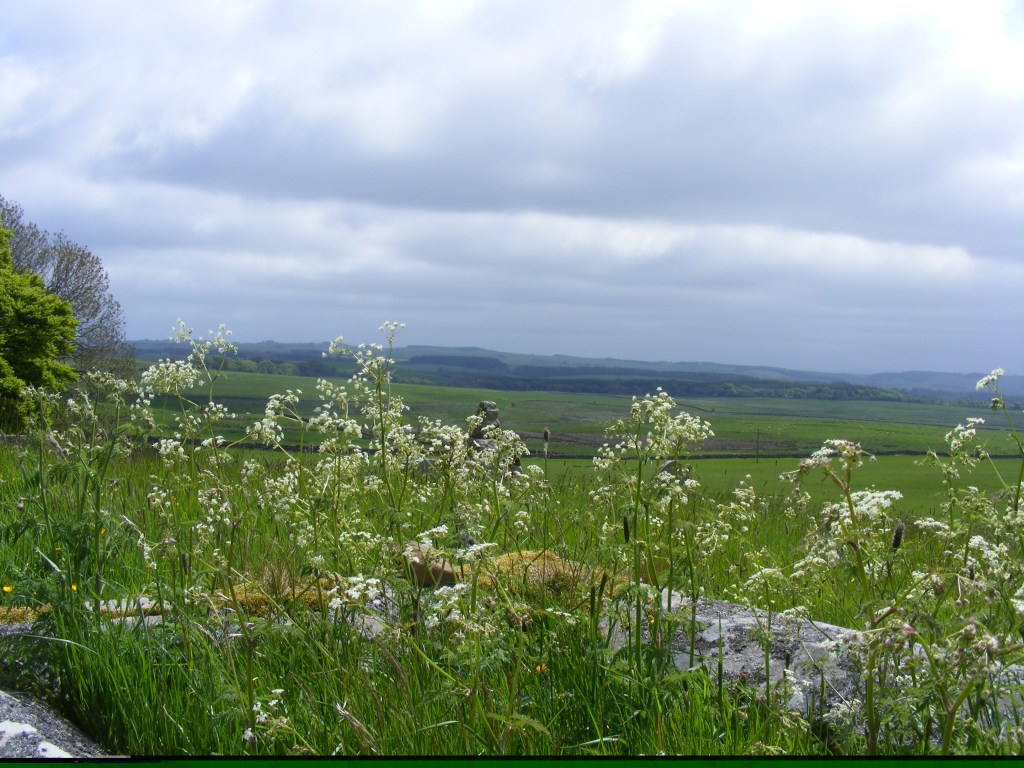
The view from the churchyard where Mary is buried and one of my favourite places in the world
 The History Interpreter - Janet Few