It has been a long time since I wrote about my experimental archaeology adventures, partly because I have been having fun completing the final assignment but also because anything involving technology has been hampered by the long and sorry lack of a laptop saga. I won’t bore you further with that but in summary, after nearly seven weeks of inadequate computing, making everything take twice as long as it should, the issue was finally resolved. This involved buying a replacement machine, which I could have done in the first place, hindsight and all that.
Back to the experimental archaeology. The final trimester of my course was entitled Crafts, Making and Storytelling, which, as the name suggests, involved actually making something. Having received very pleasing and unexpected grades for my second trimester assignments, I began the new module full of enthusiasm. In April, I began to consider what I could make for the assignment. Initially, I had contemplated something fishing related, which would be appropriate for my coastal connections and build on my assignment for module one. Having dismissed the idea of a coracle as being too impractical, I wondered whether a traditional withy lobster-pot might be an alternative. A willow-weaving workshop made me flirt with the idea of basketry.
As a family historian, I wanted to experience an activity that would have been familiar to my ancestors, which led me to straw-plaiting. My great great grandmother, Ann Stratford and many of her immediate family were straw-plaiters. I already had an affinity with this lady, as I spent three years living in her home county of Buckinghamshire in the 1980s, before I knew I had ancestral connections to the area. It was only after I left that I discovered I had been living not just in the county or village of her birth but in the road in which Ann had been born.
I began to research the history and craft of straw-plaiting, discovering that it is on the red list of endangered heritage crafts, with fewer than twenty crafts-persons plaiting on a professional or amateur basis. I wasn’t anticipating becoming an accomplished practitioner but the prospect of trying something unusual appealed. My decision was made.
That was the easy part. Then craftsperson’s block set in. Whilst my colleagues were off casting bronze, building cloam ovens and shooting beavers to make robes (this last in the US I should add), I retreated into my comfort zone and spent ages on the storytelling element, revisiting my research into the life of great great granny and the craft of straw-plaiting, There were a variety of plaiting techniques of differing complexity. I learned about plain, pearl and brilliant designs and read of the possibilities of enhancing the plait with coloured straws, or using two straws together to improve the plait. I found illustrations of satin box, middle, wagon wheel and feather edge plaits. Finally, after a reinvigorating Zoom chat with fellow students, I realised that this was a making project and something needed to be produced. I sourced and ordered some straw, which then sat on my kitchen table for two weeks before I could bring myself to open the package. I moved on to researching straw-plaiting but I still wasn’t making anything. I am not by nature a quitter so eventually I made a start.
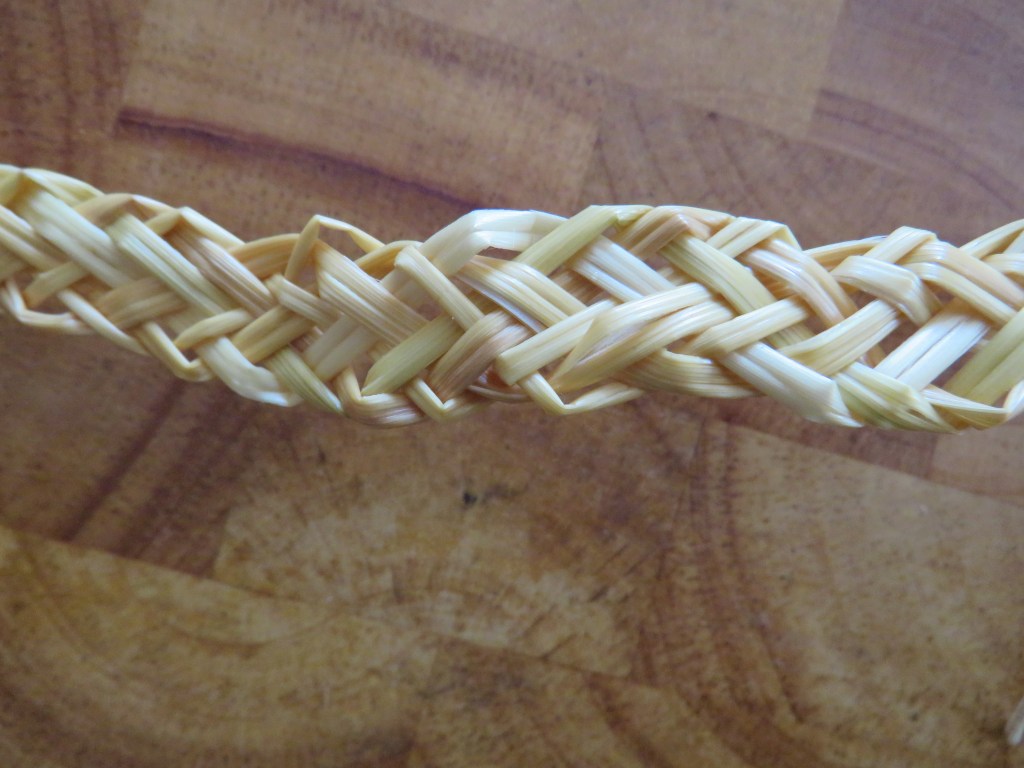
I decided to keep it simple and use a basic seven-strand plait. I had done this before as a child but had no recollection of how it was achieved. Online illustrations revealed that the plaiters’ rhyme, ‘under one, over two, pull it tight and that will do’, told you all that you needed to know. Unwilling to waste straws, I began by practicing with string. It didn’t take long to get into the rhythm but I only managed to avoid confusing the strands by lying them on a flat surface and securing the knotted end at the bottom with Sellotape. If I stopped and walked away, despite carefully laying out the strands, it was difficult to pick up where I left off. It was also very slow. I manage to produce something passable, if short and a little uneven. Even though straw has very different qualities to string it was difficult to imagine how plaiting could be done by holding seven straws in the air, let alone using thumbs and middle fingers, which was the approved technique.
As straw-plaiting was a family activity, with ten-year-olds allegedly being as proficient as adults, I practiced string plaiting with some of my descendants. They all mastered the technique quickly. My adult daughter produced a neat plait. The eight-year-old had trouble pulling it taught but realised her deficiency and declared hers to be widdle-waddle (the plaiters’ term for a child’s unsaleable plait). I don’t think either of the children thought it would be much fun as a long-term activity.
It was time to try using straw. I cut the ends off with a knife and tried splitting the straw but either my straw was thinner than nineteenth century straw or I lacked a sufficiently steady hand, as all I produced were small slivers of straw. I had read that ‘early home-made hats were crude and bulky’ and would have used un-split straw. This sounded like a description of something that I might produce, so I decided that I would use whole straws. I was not going to attempt the bleaching or dying parts of the process, which, in any case, would not have been universal. I ‘milled’ the full length of the straw with my rolling pin. Next came the soaking. The fifteen inch lengths fitted in my sink but straw floats, so I weighted it down with a knife.
I chose seven straws, tied the ends together with yarn and began to plait. The approved method of using my thumbs and middle fingers to plait and my forefingers to turn splits, or in my case, straws, sounded rather like patting one’s head and rubbing ones stomach but I started slowly. I began by laying the straw on a flat surface, as I had with the string. This went well until I reached the end of the straws; all seven ran out at the same time. I made a terrible mess of trying to join in new straws. With hindsight maybe I should have started with straws of different lengths. As I progressed joining new straws became a little easier, as only one or two needed replacing at the same time. I gradually progress from the table to holding the straws in my hands but had to recite the ‘over one under two’ rhyme to keep me in rhythm. After an hour of plaiting, I had produced thirty inches of plait. The literature is contradictory about likely output but opinions ranged from ten to twenty-seven yards per day; I clearly had a long way to go.
My next plaiting session, I tried a different method of joining on new straws, slotting the hollow end of the new straw over the narrow end of the previous one. This wasn’t always successful as sometimes the end of the new straw split but it was an improvement. I was finding the straw more difficult to manage and realised I had forgotten the milling stage. This resulted in a much less neat plait but did mean I had preserved the hollow ends, thus enabling me to join straws using these. I resolved in future to mill but not to continue this to the very end, so that I could still slide one straw over another and avoid so many loose ends. Still chanting the rhyme, I achieved a similar output to the previous session.
By the third attempt, I was getting quicker but certainly not neater. After an hour and a half I had another ninety inches of plait. I had expected to find working the straw rough to the touch but this wasn’t the case. Keeping the straw wet meant that my fingers were continually damp and having plaited for longer, my right arm and shoulder were aching. By now, visions of plaiting were appearing before my eyes when I closed them.
Fortuitously, at this point, BBC2 re-screened a programme about the Luton hat trade. This revealed several useful pieces of information. Firstly, I had been using my straw splitter incorrectly. I was trying to score the straw with the point but it seems that the point needed to be inserted in the end of a straw and pulled down. I tried this technique but the results were little better than those achieved using my method. Alarmingly, I learned that 4000 straws were required to make a hat. I am glad I didn’t know this beforehand as I would not have contemplated investing £240 on straw. More encouragingly, the narrator went on to say that nine yards of plait could make a hat. I already had nearly five yards having used about fifty straws so something wasn’t computing here.
By day four I was getting both fast and neater, achieving 1·5 yards in twenty minutes. Joining in new straws was still not very tidy but in general, the finished plait looked less messy than my first attempts, partly because I wasn’t plaiting to the thinnest end of the straws. I still wasn’t able to use my fingers in the approved manner. The discomfort in my right arm and shoulder continued and I still needed to recite the rhyme as I plaited but it was definitely becoming more instinctive. I did try putting the straws in my mouth, as Victorian plaiters would have done but I failed to see how the whole straw could be kept damp in this way.
At this point, I was excited to discover that great great granny, at the age of twelve, had won a prize for her plaiting. I am not sure those particular skills have passed to me. I began writing the final assignment, concentrating on describing the craft and telling the story.
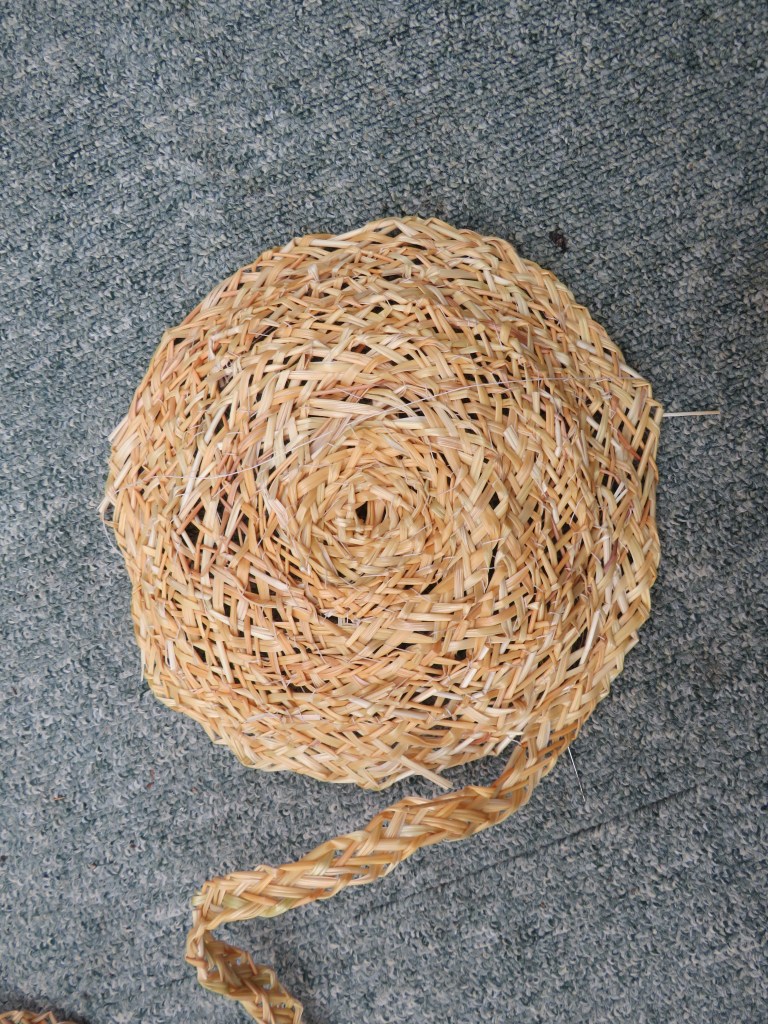
Three more plaiting sessions and I thought I might have enough to make a hat. I started in the centre and began to pull the braid into a spiral, working in an anti-clockwise direction; this may be because I am naturally left-handed. This was a more uncomfortable process, with the rough straw scraping at the skin on the backs of my fingers. It was also difficult to keep the plait damp. I decided not to overlap the braid in the English fashion as that would require more plait. I didn’t really have much idea how to create a hat shape and wondered if I would end up with a flat circle. Professional hat-makers would have used a head-shaped block and steamed the straw into shape. I didn’t have the wherewithal to do this. In the end the shape evolved of its own accord as I continued to sew. I was concerned that it might be difficult to finish off the ends but this was relatively simple as the ends of unplaited straw could be tucked into the weave.
The finished object resembled a pudding basin or lampshade, rather than a hat and certainly wasn’t neat and stylish. The underside of the straw is very scratchy, making it uncomfortable to wear. I did try tying it on as an alternative way to wear it.
Whilst I was pleased to have created a finished product, I was a little disappointed not to have made something that I could actually wear in public, even if only when I am living in the seventeenth century. I am not a natural crafts-person and I am also a perfectionist. What I produced was far from perfect but I enjoyed the process. The repetitive action of the plaiting was therapeutic but I certainly wouldn’t want to spend my working life as a plaiter of straw. I particularly valued the chance to step into my ancestor’s shoes and feel an even closer connection to Ann as a result of this project. Highly recommended for all family historians. Would I try this again? My heart says yes but my head knows that there isn’t room in my life to pursue craft activities with much rigor. I can see myself demonstrating the plaiting technique if the occasion arises. I have revisited my research into Ann’s family, with particular emphasis on the social context and the role that straw-plaiting played in the community and her life; I feel that I can now do so with greater insight. Watch this space for a post about Ann.
The course has been a great experience. I have learned a great deal about experimental archaeology and still more about material culture. I have climbed some technological hills and crafting mountains. I have met some hugely talented, diverse fellow students and we plan to keep in touch. So what next? There are plans. It may be that there will be an online MA on offer, which is tempting, further study does appeal. I am however mindful of how many things I still want to achieve and maybe I need to start prioritising as tempus is fugitting away like mad (it is still May isn’t it?). There is an exciting potential project in the offing with my coven lovely group of ladies. I have a non-fiction book to finish writing. I really want to focus on telling more stories from my own family history and as a result of this course, focussing on some of the family heirlooms and telling their stories before they are lost. I do still hanker after learning Cornish, remember I got as far as buying the books in lockdown?




 The History Interpreter - Janet Few
Hi Janet,
Great blog. Could be a new fashion?! Very entertaining ??. Thank you.
On a more serious note I am writing a blog for BALH about One-Place Studies and wondered if I can use a 10 Steps book cover as an image and if so how how best to cite it? (As it is UK-based I was planning to point them to your website).
I also plan to offer a couple of 10 minute talks for BALH about how to do a OPS which is also strongly based on the 10 step structure and would include the book image. Is that OK? I am happy if you prefer to do that yourself?
Hope the new computer is behaving!
Helen x
That’s all fine Helen. I guess just say it is a book cover (obvious) 🙂
I love your perseverance Janet! You could always use it as a skep to keep your bees or vegetables in.
Yes it does resemble a fruit bowl 🙂
What a brilliant picture! Love it. xx
I think you should be very proud of something so impressive, if ‘rustic’ (‘primitive’?). I wouldn’t wear it in public either though!