We leave the van in the drizzly darkness that is 6.40am. We manage to not look like total rustics and click our debit cards on the yellow button at the station, in imitation of regular commuters. We change to the DLR at Woolwich Arsenal and a kind lady reassures us that we are on the correct train. Not only that but she kindly comes across to us as we are alighting to direct us to the right platform for our on-going train. Prince Regent station leads directly into the Excel, so we have arrived! There are plenty of happy smiley volunteers wearing ‘ask me anything’ tee-shirts. We can certainly ask them anything. It is day 1, they haven’t quite worked out all the answers yet. We are given bags at check-in. This is very kind but does mean that x thousand people now all have identical bags. I try and fail, to make mine look more distinctive.
The expo hall is barely stirring when we enter at 7.40am. I head to the speakers’ lounge and receive a thoughtful gift and handwritten thank you from the organising team. Then I check out the room for my talk later in the day. It is pretty cosy in the Excel. I am dressed for more Arctic climes. I move to the lecture rooms for the 9am session. A phalanx of Guild of One-Name Studies members are sitting in the back of lecture room 12. For this slot, I have chosen to listen to Myko Clelland on ‘Beyond the British Census’, a session that I have picked because I know he is a good speaker. Although I give talks myself on similar topics, I am sure there will be something new to learn and I am not wrong. We are told that the earliest surviving census is for first century China. More usefully, the Parliamentary Archives now allow a map search leading to catalogue numbers for the Protestation Returns. I am also reminded that the Welsh Tithe map is now online. Next, a really interesting discussion with Patricia and Evelyne, who run a family history society for young people in France.
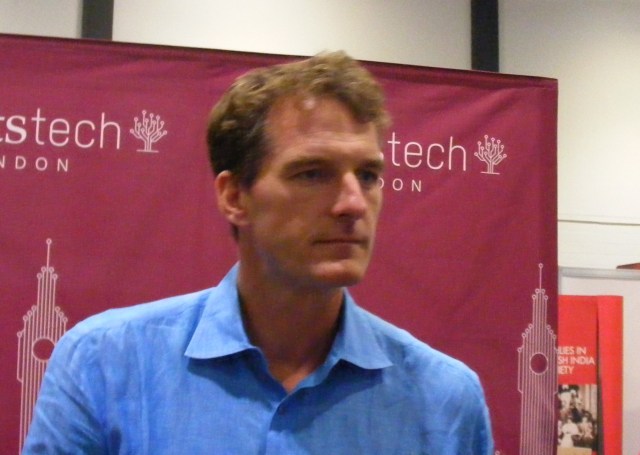
Dan Snow, the first Keynote, is introduced by show compere Nick Barrett. He tells of a wonderful childhood being immersed in history and outlines his descent from Prime Minister Lloyd George and also from a great grandfather whose blundering led to the slaughter of thousands of men on the Somme. Dan encourages us to embrace the unpalatable aspects of our family history and speculates that future generations may view some of our actions, such as our wilful destruction of the environment, with the kind of horror that we reserve for slave-owning ancestors, for example. I was then fortunate to be part of an interview panel with Dan; an opportunity that I nearly missed as it started early. I asked what he felt about history being squeezed from the school curriculum and his view was history can come from the family. I’m not going to argue with that.
For the afternoon, I choose to attend Lesley Anderson’s presentation about emigration to Canada, because this is a topic that I am particularly interested in. She concentrates on sources available at Ancestry. Form 30A, Ocean Arrivals 1919-1924 sound interesting; these are also available on the Library and Archives Canada site. I follow this up with another session chosen for its content. This time, Simon Gibson, talking about ‘Engaging the younger audience through technology’. Having outlined technological advances over past decades, Simon goes on to advocate encouraging young people to use technology to interview older relatives. He then poses the question, ‘Are the traditional processes of genealogical research a hindrance to engagement (by young people)?’ The answer is undoubtably yes.
Next it is my turn to encourage people to record their own memories with my Remember Then talk. Considering I have some stiff competition from high profile speakers in other sessions, I have a good turn out and there are some lovely comments at the end. I even manage to sell a few books, leading to some more interesting conversations.
I am disappointed that the talk about Huguenot research, that I had earmarked, has had to be cancelled. By this time, the busy day is taking its toll but there is more to come as fifty or so Guild of One-Name Studies’ members forgather at The Custom House for food. Mindful of the length of our journey home, we don’t stay too long and arrive back in the van fourteen hours after we left it, longing for sleep. This is somewhat thwarted by a noisy nearby firework display. Tomorrow we get to do it all again.
Disclaimer: As a RootsTech Ambassador I receive complimentary admission to the event and a free registration to give one of my readers. My status as an Ambassador does not entitle me to any financial assistance for accommodation, travel or meals.
 The History Interpreter - Janet Few
Janet – thanks so much for posting each day. I feel like I am along for the ride (sans the drive, the weather, the crowds, and the long hours) – this is the best of both worlds! Would love to read more about family history and youth – Are the traditional processes of genealogical research a hindrance to engagement (by young people)?
Also thrilled to see that the Guild of One-Name Studies is there in force and wondering if the Society for One-Place Studies has a stand or presence? Enjoy the rest of the event and thanks again for sharing!
Thanks Tessa afraid I am probably too tired to do day 2 toady let alone day 3! It will come :). I think the stands were probably too dear for SOPS. GOONS could only manage a single space.
Hi Janet. I am pleased to hear that you heard Lesley Anderson speak. When I first joined my local FH society, BIFHSGO, some years ago, Lesley was our Director of Education and was marvelous at it. More recently I heard her speak about triangulating in on family members using Ancestry DNA, and she offered greatly reduced prices for its tests. I have now sent in tests for two cousins and I am eagerly awaiting the results.
John Reid is there too. If you happen across him, please say hello for me, ok? Cheers, Brenda
Yes ran into John a couple of times 🙂
I really enjoy your daily commentary. Kind of like riding along with you.
Thanks Randy 🙂