Today we are docked in Liverno in Tuscany. By dint of swift walking, we secure seats in the front of the coach. Our guide is Sara as we head for Florence. We see plenty of umbrella pines. Pine nuts are grown and used for pesto. They also give their name to Pinocchio, who was presumably made from pine wood and there are Pinocchioian representations everywhere. Sunflowers and olives are grown for their oil and the vineyards produce Chianti. Leather and gold goods predominate. The area has been famous for gold since the time of the Medici. The gold comes in a variety of colours including black and chocolate.
There is a layer of mist across the plains and we pass villages that are famous for truffles and strawberries. Firenze, or Florence, is the ‘city of flowers’. It has a population of half a million and was briefly the Italian capital in the nineteenth century. It is sited on the River Arno, which also flows through Pisa. The city was under the rule of the powerful Medici family from the fifteenth to eighteenth centuries. Once on our walking tour, which Sara delegates to a local guide, I am run into by a lycra-clad, Italian runner, who smiles sweetly and takes me by the arm. Sadly I am not being abducted.
The Cathedral is white, red and green, colours that represent the trinity. The cathedral was built from the 1290s onwards and Brunelessci’s baptistry dates from 1401. Coincidentally, of the fourteen people on today’s ‘small group’ tour, we have encountered eight on previous tours and two of the others are us! Considering that there are about 3500 passengers on Explorer of the Seas, that is some feat. Many of the Renaissance works on view are replicas including one of Michelangelo’s David. It is possible to see the real thing, just not where we are going. We do see the Medieval Medici Tower, an equestrian statue of Cosimo de Medici from the 1580s and the Ponte Vecchio. The Ponte Vecchio (old bridge) was built in 1345 and is the only Medieval bridge (in Florence presumably) to have survived World War 2 bombing. By doing some reverse picture searching, it turns out that we have seen the Palazzo Vecchio, the Basilica of Santa Croce and the outside of the Uffizi Gallery, possibly not in that order. The quality of my photographs are severely affected by the cords and the fact that most of them were taken whilst hurrying after our guide in order not to be lost.
Even though we are suffering somewhat from information overload, I do like Florence and we have the advantage of cloud cover, so the heat is less of a problem. Today’s included lunch is yet more salad and lasagne, with a strange vanilla concoction for dessert. In the leather and gold shop, where Sara is probably on commission, we are treated to a sales pitch by Anthony (with a H) from Melbourne. We do not succumb. Whilst waiting for our group we are accosted by a Kenyan street seller. He cunningly hands us some bracelets as a ‘gift’. He then shows us a picture of his children and asks for money for the babies. We claim to be penniless and return the bracelets.
We pass Michelangelo square with its panoramic views of the city but there is no time for a photo opportunity. We are on our way to Pisa. Our driver has a unique driving style, which involves a third of the bus being across the white line and periodically he has no hands in the wheel. We survive.
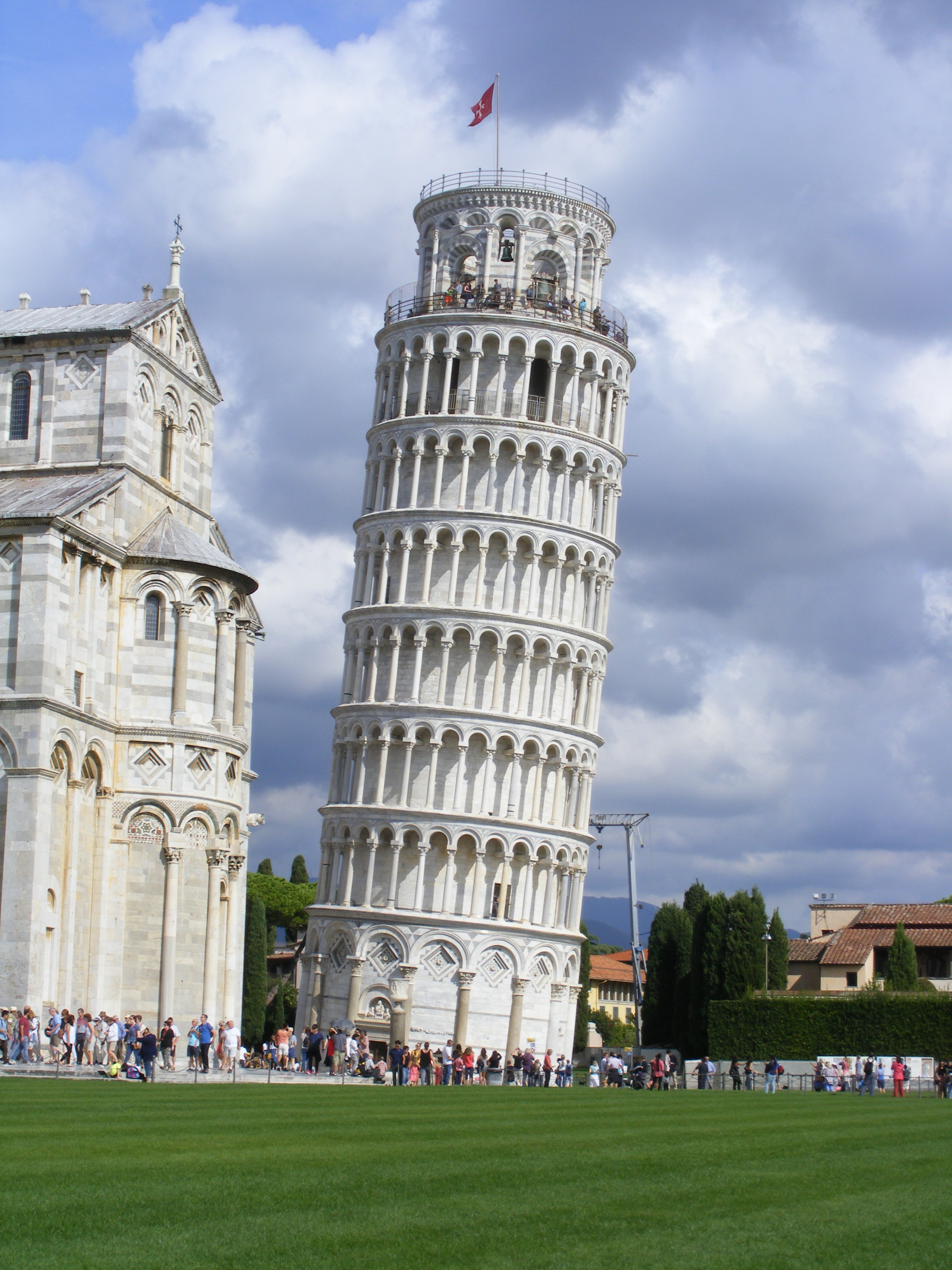
We spend some time in Miracle Square in Pisa. It seems obligatory to take a photo with hand outstretched, so that it appears that you are holding the leaning tower; we don’t bother. The tower was built as the campanile (bell tower) for Pisa Cathedral and leaned from the start due to subsidence. It is between 183 and 186 feet high, depending on which side you measure. It was built between the twelfth and fourteenth centuries and stabilisation work in the 1990s reduced the lean slightly. The Carrera marble was also cleaned at this time. Galileo, who was born in Pisa, allegedly dropped cannon balls from the tower to demonstrate how mass affected the speed of descent.
Also in the square is the Baptistry, begun in 1152 and competed in 1363. It replaced an older building and is the largest Italian baptistry. It combines Romanesque style at the bottom with Gothic on the higher levels. Next to this is Buscheto’s Romanesque cathedral, begun in 1063 and consecrated in 1118. Allegedly it was financed by the spoils of a Sicilian war again the Muslims. Twelfth century enlargements were designed by Rainaldo.
In Pisa we learn that there is a €500 euro penalty for street selling and it is the purchasers as well as the vendors who are fined; a good job we resisted our Kenyan friend. Mind you, despite circulating police cars, there seem to be plenty who are willing to take the risk and their tactics are quite aggressive. There is obviously a secret signal, probably in the form of a text message, as periodically there is a Mexican wave of sellers rapidly gathering their wares into large blue bin bags. I can’t help feeling that having a bin bag over your shoulder is somewhat of a giveaway but perhaps the police turn a bit of a blind eye.
As Sara leads us back to the coach, we have to cross a level crossing. The barriers are down. Several Americans of mature years, not from our group, decide that the train is ‘a long way away’ and duck under the barrier to cross the line. I think some more law-abiding onlookers were hoping the line would be electrified.
Back on board we learn that Hurricane Lorenzo is looming. This is not the hurricane that was causing difficulty earlier in the cruise. This is a new and more serious hurricane that is going to necessitate a change in our itinerary. Sadly, we will lose our stops in Santa Marguerita and Lisbon; I am particularly disappointed about missing Portugal. My travelling companion is suffering from the lurgy that seems common on cruises, so I leave him to nurse his ills whilst I listen to Paul Milner speaking about nineteenth and twentieth century sources.
 The History Interpreter - Janet Few
Wonderful, Janet. In 2011 I took a rental holiday apartment in Florence’s suburbs for three weeks. It was owned by a Texan lady and her Italian husband she had met on holiday. This was their home when they visited friends and family. I spent the whole of the three weeks, except for a short train trip to Venice, in exploring every corner of Florence. It was a wonderful time!