Finally, we make it to a 9am lecture. Rosemary Kopittke is giving a very useful introduction to Scottish records through a thorough case-study of her Laidlaw ancestry. My descendants have Scottish ancestry and I am reminded of the value (pun alert) of the Valuation Rolls.
Then it is time for our first excursion, a walking tour of the rock that is Gibraltar. Our guide, Chantal, is hilarious and introduces herself as part Neanderthal and a smuggler. Gibraltar, or The Rock, rises to 426 metres above sea level and we will be ascending to 412 metres. Twenty of us pile into a coach and drive across reclaimed land within view of the site of the Battle of Trafalgar. We pass Morrisons, MacDonalds, all the usual suspects. The population of Gibraltar is 32,000 and apart from tourism, the main economic activities are the gaming industry and the reselling of fuel, which is bought in from Spain. They are very proud to be British and in 1967, voted overwhelmingly to remain so. The island had been under British rule since the Treaty of Utrecht in 1713. Previously, it had belonged briefly to the Dutch, to Spain and prior to that, Morocco. Its importance lies in its strategic position on the mouth of the Mediterranean, hence it being fought over down the centuries.
We ascend in the cable car. The weather is glorious and we have particularly good views of Spain and the north African coast. We see the second Pillar of Hercules, Gibraltar itself being considered to be the other. The Rock is the highest monolith in Europe. Many nationalities are represented in Gibraltar, including those of Maltese descent, who arrived as builders. The border with Spain was closed by Franco after independence, until 1985, allowing no access to Spain. 45,000 years ago, Neanderthals lived on Gibraltar and significant remains have been found.
We walk through the Nature Reserve and see several Barbary macaques, including those with young. The macaques were brought in by Moroccan pirates and there is now a population of about 300. £84 per animal is spent each year on daily feeding from feeding stations, in an attempt to keep them out of the residential area. We are warned not to have water bottles on view or to leave bags open, or our lunch will fall victim to the macaques. There are also many eucalyptus trees, which are also not native.
Then we visit St. Michael’s Cave, which extends 700 feet into the rock and was used as a military hospital in World War 2. It is now a tourist attraction and concert venue. The ancient belief is that the cave system led to Africa. Twenty seven caves have been discovered on The Rock so far; the others are protected. Next stop is the Siege Tunnels. At one time, there were 633 guns mounted on Gibraltar to guard against Spanish invasion. During the American War of Independence, many of the troops normally stationed on Gibraltar were redeployed there. Spain capitalised on this weakness and laid siege to The Rock. ‘The Great Siege’ (there were others) lasted from 1779-1783. The tunnels were constructed as part of a plan to site a downward-facing Koehler gun on The Notch, at the far edge of Gibraltar. Lacking spare gunpowder, the 400 metres of tunnel were dug by the Royal Engineers using alternating fire and cold water to crack the rock. This was overseen by Sir General Elliott in 1782. It took eighteen men six weeks to construct the first part of the tunnel, then the need for ventilation led them to cut an embrasure to the outside. This opening was an opportunity to site another gun and this was done at intervals down the tunnel. ‘Curtains’ of wet rope helped to prevent the fumes from the gunfire blowing back into the tunnel. It was a year before the full length of tunnel was complete, by which time the siege was almost over and the Spanish defeated. A further 52km of tunnels were dug during World War 2.
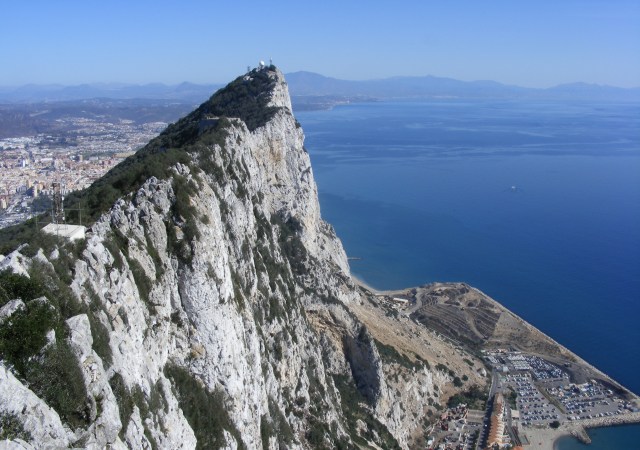 After an interesting and warm trip to Gibraltar, we return to the ship. The layer of pollution is evident over the sea but the views are still good. I was particularly interested in Michelle’s talk about ‘Thrulines and Theories of Relativity’. I am eager to get back to the land of the internet so that I can explore mine. It was probably just as well that it was our turn to entertain in the evening, as otherwise we would have struggled to stay awake. I have no idea why we are still so tired. ‘Coffers, Clysters’ is well-received as usual and one of our number receives a seventeenth century make-over.
 The History Interpreter - Janet Few
Thank you, I am enjoying this cruise without any of the discomforts and seasickness! My Grandfather was posted on Gibraltar during his brief military career in WW2 so it has some personal resonances. Sounds like a very full timetable for all! Perhaps one day I will be able to join you on a similar trip. HelenFinch