Walking Northward

A slight (planned) hiatus in our holiday occurred at the point we have reached in my narration. This required me to use my thirteen year old ‘emergency’ mobile phone in order to summon a lift. We had recently had an issue when such summoning did not work owing to a technical hitch but on this occasion, it seemed my phone and the recipient’s were now communicating. I decide however to send a text message in preference to a call. Simples. I know how to send text messages. It turns out that I can indeed send text messages, I just cannot write them on my phone. My capitalisation is idiosyncratic and I am unable to work out how to create a space between the words. I write the message Ifinishat4wiLLletUkNowifitcHanges and hope the fisherman of my acquaintance can interpret it. Considering that I am reasonably proficient with computers, it is sad but true that mobile phones are another country.

Amongst all this, panda hiding continues. I head out to photograph a hidden panda in the early hours before we are due to move the caravan on to Scotland. I appear to have forgotten to return the SD card to the camera after uploading previous pictures. Fortunately, I don’t have to walk back up the hill and down to the van as there the van is, just the other side of a fence. I call for assistance and my travelling companion retrieves the card and prepares to hand it over the fence to me. Ah. A slight snag, my side of the fence is accompanied by a stinging nettle filled ditch. Hmm. I am terrified that the card will somehow get dropped in the undergrowth but fortunately this danger is averted and the picture is duly taken.

We arrive in Markinch. My children have Scottish ancestry. In fact, all my grandchildren have kilt wearing credentials on both their mother’s and father’s sides. The closest I get is Northumbrian lineage. I pay tribute to Edward’s ancestors, who come from this area. We decide to go for a walk, following a leaflet we have found at the site. It is a five mile walk. We realise that it probably a while since we walked five miles. It may not sound far but we are out of practice and knocking on a bit now. We used to walk regularly until grandchildren visiting seemed like more fun!

The walk instructions are a tad vague. It starts well, with us finding our way through Markinch then on up a footpath. We are to look for a ‘worn stone step style’ (their spelling). We debate whether a couple of steps constitute a ‘style’. They are supposed to be opposite a parish boundary mark. We climb a bank. No sign of said marker. We dismiss these steps and continue. Our first mistake. It turns out that these were the steps we sought. Road signs are conspicuous by their absence but we manage to recover the route, although have walked on road rather than footpath more that we should. I am wearing soft shoes as opposed to walking boots as the latter are slightly narrower than my feet (story of my life). I should have read all the instructions. They are taking us across a peat bog. My shoes are not peat bog proof. Luckily, the recent dry weather means I can safely negotiate the boggy bits. We try to identify the ruins of Kirkforthar Chapel. The guide tells us a former vicar was called Reverend Zong, allegedly a corruption of Yogh/Young – one for the family historians amongst us. We also see the remains of Kirkforthar House and ‘doocot’. Also on the itinerary is Stob Cross, a monolith of uncertain origin but possibly Pictish.

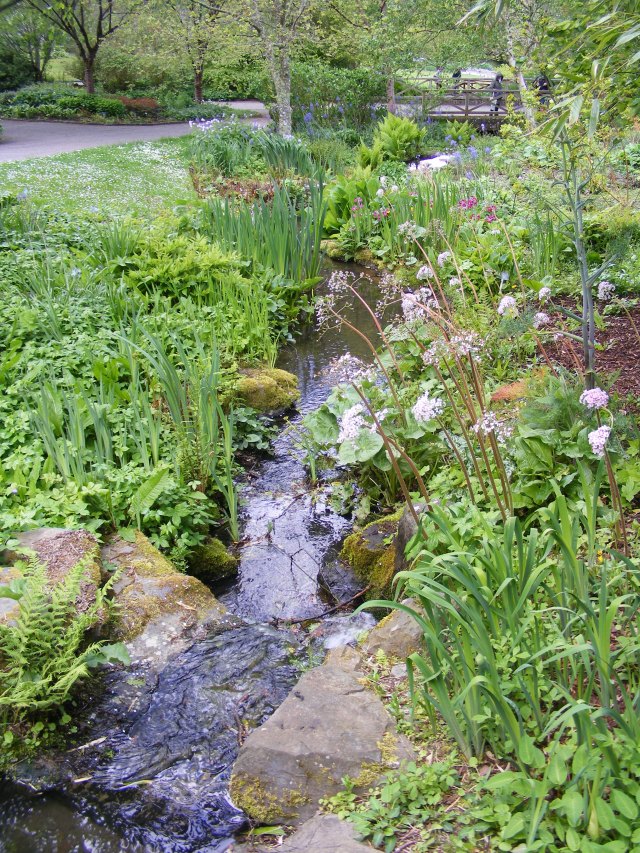
019 14 May 2019 Kirkforthar House and doocot

As a reward for our strenuous exercise, we treat ourselves to an ice-cream. It may be a day or two before we walk again!

Panda Explosion #PDADay #Autismawareness

The day has dawned. It is #PDADay. For our family every day is #PDADay as we support Edward who has a diagnosis of Autism with Pathological Demand Avoidance (PDA). For more about what this means see my post Of Pokemon and Dinosaurs and being Edward and the website Being Edward, where his mum explains a little of the excitement that is life with Edward. In order to raise awareness of this, often overlooked and misunderstood, condition. Martha began to organise a Panda for PDA Day campaign. It began with close family agreeing to hide pandas around the country, which were accompanied by information about PDA. Friends got on board, then it spread to friends of friends. Martha spent a small fortune purchasing and posting pandas to willing volunteers. We began to hide pandas on Sunday and there are many still to be hidden. Worries that panda finders would not enter into the spirit of the thing and feedback news of panda discoveries, were unfounded. We’ve barely begun and already the responses have been overwhelming. We’ve had pandas hidden in many English counties (with more to come) and today I will be hiding what we believe will be the first Scottish panda.

DSCF1225

One (we think it is Frederick Herbert panda #18) started his journey in Manchester, has been found twice and is currently on his way to Clapham Common. Another, Star, was hidden in a station and is now on his third train ride. Pandas have been hidden in shops and libraries, near schools and on footpaths. Panda hiders have told their friends and colleagues about the project and that too has spread awareness. The success, even at this stage, means that we will be continuing this throughout the year. It is obviously not sustainable to keep purchasing pandas, so we will be knitting and crocheting our own and looking to repurpose small charity shop pandas. Alternatively, why not make pandas from Hama beads or Fimo or paint a panda or a stone? – although we need to work out how to attach the information cards to stones! Anyone can join in the fun, anywhere in the world. We can email you the information details for you to print out and attach to your pandas and at the end of the week a printable label will be available on the Being Edward blog. We can also find patterns for you to make your own woolly pandas. We hope that you will then report on where pandas have been hidden, either on Martha’s website or on the Pandas for PDA Facebook Group or by tweeting @Being_Edward.

As well as raising awareness, Martha has set up a go fund me page to enable people to support the invaluable work of The PDA Society. She is also inviting those who make a donation to name a panda. Names vary from ancestral names (for my family historian friends), items from nature, book characters (potential for my authory friends here) and other weird and wonderful inventions – your panda, your name choice.

P.S. If any of my local friends have oddments of black or white wool, please leave them in my porch.

Of Lighthouses and Space Hoppers

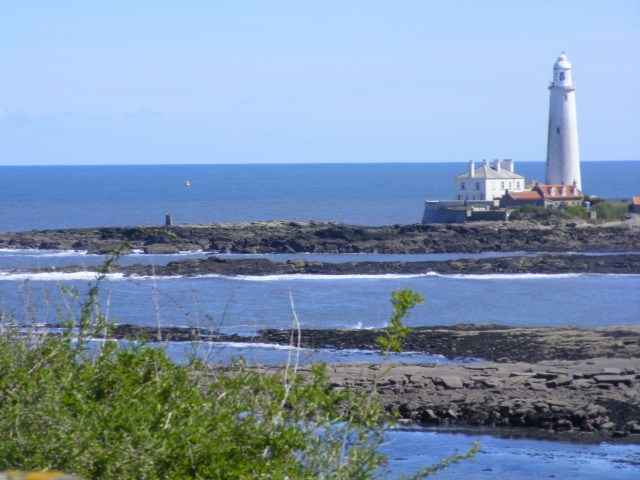
Apologies for not reporting on our holiday adventures in real time but here is the next instalment. We took a short walk along the coast to St Mary’s lighthouse, which is only accessible at low tide. Fortunately, low tide it was. The island on which the lighthouse was built was used as a burial ground by Tynemouth Priory in the C7th. From the C16th it was known as Bates Island after Thomas Bates, the surveyor for Northumberland under Elizabeth I. Interestingly, the island was used to quarantine Russian soldiers who were suffering from cholera in 1799. This was particularly significant as it was 32 years before the first outbreak of cholera in Britain. In 1898, the lighthouse was built on the island to replace one at Tynemouth, as fog meant visibility was poor there. I am sure this should be the cue for a song! The lighthouse is 40m high and was constructed using 750,000 bricks and 654 stone blocks, at a cost of £8000. There are 137 steps to the top. I begin the climb then realise that this is probably not a brilliant idea for someone who suffers from acrophobia – it is making me feel a bit weird just looking up from the ground. I descend to a safer level and send a representative from our party up to the top in my stead. It was still being lit by oil in 1977 and was the last Trinity House lighthouse to be electrified. The lighthouse ceased to be operational in 1984 and is now a nature reserve. Over 50 grey seals are basking on the rocks. The ranger tells us that this is unusual at this time of year. Seals are not a favourite with a fisherman of my acquaintance, so we focus on the eider ducks instead.

012 10 May 2019 View frm the camp site

The next day and it is off to Eureka Children’s Museum at Halifax to meet up with some of my descendants. Some wonderful staff made a small boy very happy by taking the time to talk to him and letting him have a go on the giant space hopper – even though they were about to pack it away for the day. He’d spotted it from an upstairs window and couldn’t get down fast enough but they kindly agreed he could have a turn. The day also involved handing over a very large shrub. Martha had spotted these in a local garden centre when she visited me but did not have room to get it home, so I was deputed to purchase one on her behalf and hand over in Halifax. Unfortunately, what had been qute compact shrubs had assumed triffid-like qualities and grown to the size of small trees in the interim, so our car had been impersonating Burnham Wood. Handover complete, we also hid two pandas ready for the Panda Explosion for PDA Awareness, of which more tomorrow.


Some Family History, Family Reunions and a visit to Seaton Delaval

Our first day in Northumberland and the weather really was a bit much for us soft southerners. We repaired to the archives at Woodhorn, a wonderful facility but in common with many archives, its opening hours have been drastically cut since our last visit. We struggled against the biting wind to cross the car park and began to look for evidence to confirm the parentage of my great great grandfather John Hogg. I am pretty sure I know who his parents are but a bit more evidence would be helpful. Great great grandfather John has done everything he can to be elusive. His censuses entries give different places of birth each time. The birth years calculated from these entries and his death certificate are inconsistent. Not only am I confused about where and when he was born, he even calls himself George in one census! In theory, he ‘marries’ twice. His second ‘marriage’ should be well within the era of civil registration. A marriage certificate could confirm (or refute) the putative father I have pencilled in but marriage certificate is there none. I know, at this point, the antennae of my family history friends will be twitching and they will be keen to see if they can succeed where I have failed. So, if you can find a marriage for a John Hogg and Elizabeth Pearson I would be very grateful. They were not married in 1851, when John was a widower living just outside Morpeth Northumberland. Their first child was registered in 1854 and the certificate implies they are, by then, married. Elizabeth too was born in Northumberland and was in Morpeth in 1851.

The evening was set for a reunion with my second cousin and her husband. We were due to meet in an Indian Restaurant. I have made a note of the address of the restaurant for sat-nav purposes. I have failed to make a note of the name. Surely there can’t be many Indian restaurants in that part of Whitley Bay. Oh! It turns out there can. I have the full address but none of the shops are displaying numbers. I think the restaurant probably begins with S. We hesitantly enter one of two adjacent Indian restaurants beginning with S. Relief; we are being waved at, so either we are all in the wrong place or we have picked the right one. The meal was lovely, it was even bargainous special menu day and the company was great too. We speculate what our mothers and grandmothers might have thought at us meeting up many years down the line and so far from where we grew up.

What a difference a day makes. The sun shines on the righteous and on us as well. We even cast our clouts (well our coats at least) until a sharp wind blows up in the afternoon. We decide to avoid Newcastle as apparently half of it has been cordoned off into a ‘fan zone’ for a rugby match tomorrow. Instead, we travel a couple of miles up the road to Seaton Delaval. This stately home is undergoing serious renovations and learning about these was part of the visitor experience.

Extensive estates and a Saxon church were gifted to Hubert De La Val by William I after the conquest and a member of the family married William’s niece. A fortified dwelling was constructed on the site. Family fortunes declined and in 1717, Admiral George Delaval bought out his impoverished cousin. He commissioned John Vanbrugh to build a home, on a much smaller scale than Castle Howard and Blenheim Palace, for which Vanbrugh is better known. Neither the owner nor architect lived to see the completion of the house. Admiral Delaval was killed falling from a horse in 1723. The work was finished under the ownership of Delaval’s nephew, Captain Francis. He too met an unfortunate end when he fell from a terrace, to be succeeded by his son Sir Francs Blake Delaval. The ‘Gay Delavals’ spent the best part of the eighteenth century hosting flamboyant parties on the estate. They were known to play practical jokes on their guests, including rigging rooms so that the walls disappeared, or the beds could be lowered into baths of cold water, when the unsuspecting guests were asleep.

The Delavals were able to establish successful businesses, exploiting the saltpans at Seaton, founding a bottle and glass manufactury and benefitting from mining interests. They created the sluice at Seaton to enable larger vessels to enter the harbour. By the end of the eighteenth century, their lavish lifestyle became unsustainable and in 1822, a fire gutted the property, destroying the south-east wind entirely. The estate passed through the female line to the Astley family, who held the title of Lord Hastings. Some attempts at restoration were attempted in the 1860s but the property remained largely a shell. The property was requisitioned in both world wars and this left its mark. Some improvements were made in the second half of the twentieth century and the west wing of the house was again lived in before the property was given to the National Trust.

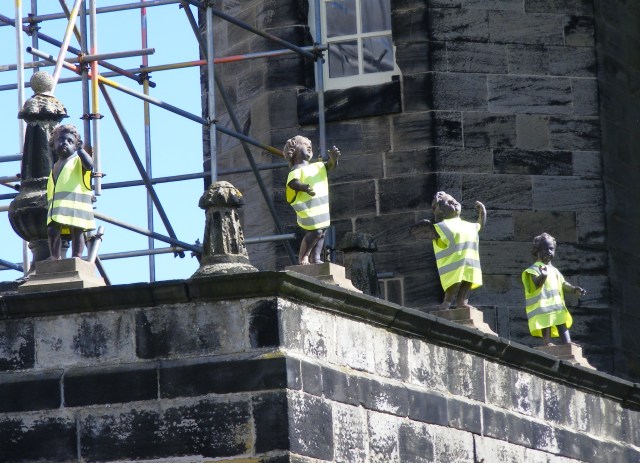
We wander round the beautiful gardens and are guided by Hilary on a ‘Spotlight’ tour. I was particularly taken with the high-viz jackets sported by the cherubs on the roof. We learn about the repairs to the ‘muses’, statues that have been created by plastering over an iron framework. In order to stop the iron rusting, they have had an electric current passed through them using innovative cathodic protection technology.

007 10 May 2019 Repairs at Seaton Delaval

Enthusiastic guides show us round The Church of Our Lady, which was extended by the Delavals and consecrated in 1102. A record survives of the baptism of Henry de Laval in 1343.

A quick look at the sluice itself and then back to the van.

Off Again

Well, we are off on our adventures again. Barely had I recovered from Family Tree Live (let us be truthful I hadn’t recovered), when it was two days Swording and Spindling in the seventeenth century at a nearby school. This involved a first. My colleagues are used to coping with fainting students – it may have something to do with the fact that they are amputating limbs and hanging, drawing and quartering folk. Trying on clothes and armour is quite tame by comparison. This week though, I had my first fainting student whilst they were trying on armour. I almost managed to release them before they crumpled to the floor.

Hot on the heels of this was the annual Braund Society reunion, with 39 members and friends gathering together in North Devon. Although the temperatures were a tad on the low side, we did keep dry for our trips to Rosemoor and Coldharbour Mill. The latter was a first for me and it was very interesting, well worth a visit.

Rosemoor 4 May 2019 (1)

I don’t know what possessed me to decide to arrange to go away on the day immediately following the reunion but it seemed like a good idea at the time. Add to this the fact that I had a meeting with our lovely authors’ group on the morning of our departure and I was giving a talk in the afternoon, it all made for a hectic time. Just to make matters worse, on my final night at home, my hot water solar panels decided they would make a worrying noise at an unearthly hour. Despite turning the panels off, the noise persisted for several hours. I attempted to summon assistance from a fisherman of my acquaintance but inevitably his mobile was on charge and I did not want to ring the land line in the middle of the night as he had guests. I debated getting in the car to fetch help but decided against it. Even when the noise stopped, all that going in the loft in the middle of the night meant that sleep eluded me, so I was functioning (just) on two hours’ sleep. Fortunately, all seemed to be well when I left, so my house-sitters should not be disturbed.

In addition, to avoid having to park in town, I am normally dropped off for my authors’ meeting and then ring to be collected when it is over. On this occasion, time was particularly tight because of the talk in the afternoon. By a quirk of fate, both landline and mobile of my trusty assistant were malfunctioning so I had to power-walk the mile up the hill afterwards. My numerous attempts at making a telephonic connection also cost a small fortune as the malfunction mean that the landline went straight to answerphone, so I was charged. My thirteen-year-old pay-as-you-go phone has a flat rate charge of 35p per call. Multiply that by as many calls as I made and it would have been cheaper to get a taxi.

So, what was meant to be a relaxing holiday did not begin in very relaxing manner! We headed towards Tewkesbury for an uneventful overnight stop. The next day and it was off to the frozen north (I am not joking, there is currently snow where we are due to be next week). The weather was truly awful and the driver amongst us (not me) braved storm, tempest and roadworks as we wended our way to Whitely Bay in Northumberland. Our site has a view of the sea – in theory. We can just make it out through the mist and murk.