It was not a great night for our patient but once up there were signs of improvement. Light exercise is recommended and he was keen to embark on another drive. We had left behind the dramatic Northumbrian landscape but the countryside and far reaching views were beautiful nonetheless. This area seems more suitable to arable faming, with heavy red soil and red stone houses. This week seemed to have been designated as harvesting week and there were many tractors.
The church tour of the day met with some success and took us to places other holidays don’t reach. We ended up on the coast at St Abbs. The EbbCarrs Café provided us with a kipper roll and Biscoff cheesecake. Definitely a recommended location and the bonus of fishing boats for the convalescent to look at.
Then it was time to move on again, this time to Balbirnie Park at Glenrothes. We have left behind the area of my own ancestors and potential ancestors and are now moving through territory known to the ancestors of my children and grandchildren. Some traffic hold-ups on the Edinburgh by-pass but otherwise an uneventful journey. We were now on a wifi hotspot only site but the warden kindly allowed us on a pitch where you could get wifi in the van but which is normally reserved for the staff. This meant I could do some essential work while I was there.
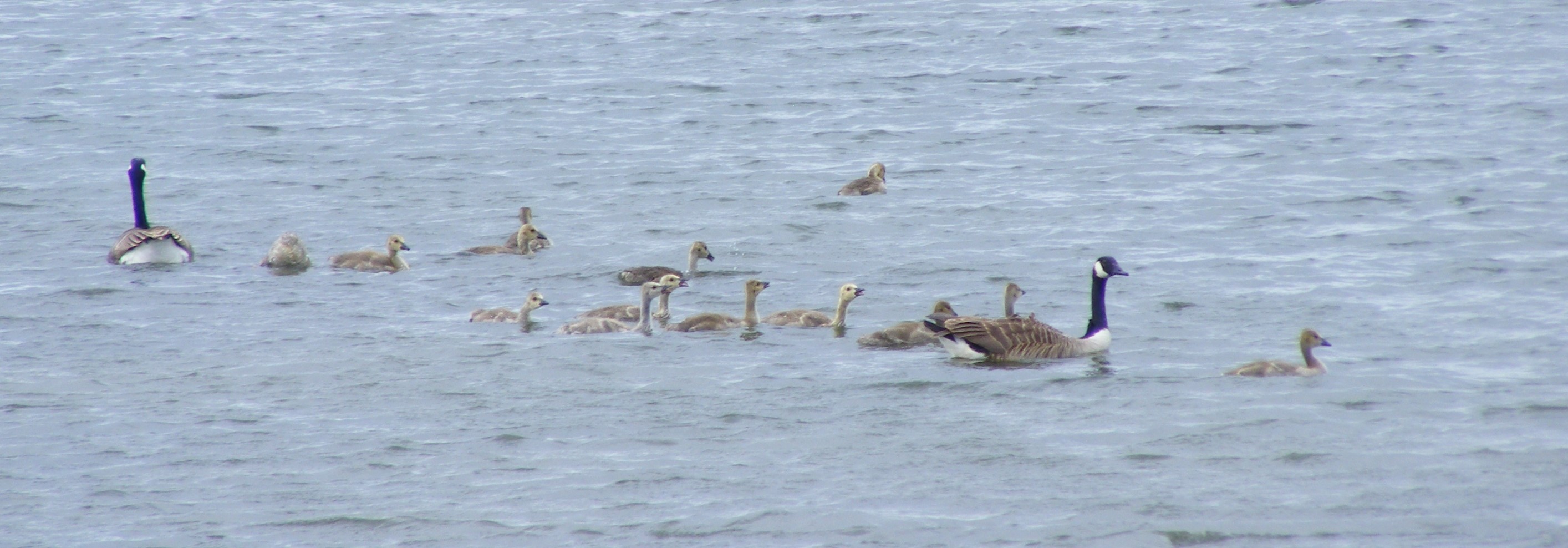
So that we didn’t waste the day, we went for a short walk at Loch Leven RSPB reserve in the afternoon. In the 1830s the loch water was harnessed for use in linen bleaching and in the corn, wool and paper mills. This resulted in the loch’s water level dropping, adversely impacting the wetland habitat. Recent management and restoration has provided homes for a variety of wildlife. About a thousand pink-footed geese had just arrived. More will follow, as usually fifteen thousand over-winter there. I also spotted some green-winged teal. The reserve is the site of the country’s first bee reserve but we saw no bees.
Allegedly the weather was supposed to have improved. True, the bitter wind had gone but so had the sun. We decided to visit the nearby Scottish Deer Centre. Currently, this attraction is waving its admission prices in lieu of donations because of refurbishments but we felt it was fair to pay the normal admission price and it was certainly worth it. As the name suggests, there were deer, lots of deer of different types, some of whom you could feed. We walked round by ourselves and then again under the guidance of Owen, who provided us with deer facts, which I will pass on.
Unlike horns, antlers are pure bone and are surprisingly heavy. Reindeer are the only female deer to have horns and as males shed their horns in winter Santa’s reindeer, at least in the northern hemisphere, are all female. There’s also some weird thing about reindeer being able to ensure that the frozen blood supply below their knees doesn’t reach the rest of their bodies in severe weather. In the wild, reindeer form super herds of up to half a million. As it can be hard to see each other in the snow, the use their UV vision to follow urine trails. Fallow deer, the pretty spotty bambi-like ones, are not native but were introduced by the Romans as a food source. Though, as we discovered at Belton, not all fallow deer are dappled. Sika deer, brought from Japan by the Victorians, are an invasive species as they interbreed with native red deer, making it difficult to ensure the continuance of true red deer. Elk, aka moose, like to swim and are predated on by whales. Pere David deer became extinct in their native China but are now part of a successful captive breeding programme.
Our presence normally makes any self-respecting wildlife, including those in captivity, dive for cover but we were luckier than usual this time. Apart from the deer, we saw other species including a wolf, a brown bear and a Scottish wild cat. I was particularly pleased to see the otters. The are clearly ethical issues surrounding keeping animals in captivity but on balance, anything that can encourage people to take an interest in wildlife is important and captive breeding programmes are essential to the survival of some of species kept here.
We stayed to watch the birds of prey display. You’d think ‘seen one seen them all’ but this was particularly good, with the Eagle Owl landing on the table of the picnic bench where we were sitting. For those visiting with younger family members there was plenty provided in the way of play equipment, so highly recommended as a destination. I did manage to keep the senior member of my party off the zip wire this time.

 The History Interpreter - Janet Few