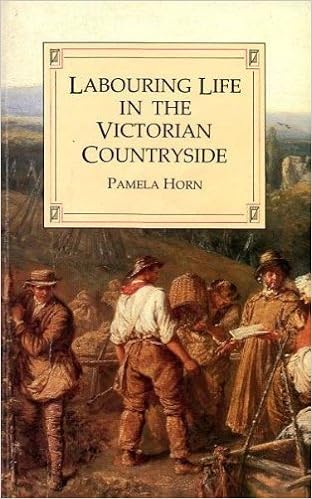
 If anyone is still reading these, congratulations and I refuse to be responsible if you have succumbed to my suggestions and blown your book buying budget. Today I would like to introduce you to Pamela Horn’s Labouring Life in the Victorian Countryside. I have had the pleasure of hearing Pamela Horn speak. In fact, on one memorable and somewhat embarrassing occasion, her 35mm slides slowly melted in the projector we had provided (you can tell this was some time ago!). Her social history books are all valuable reading for anyone trying to understand life in the Victorian era. The clue to the content of this particular volume is in the title and this is an excellent general introduction. The book covers many aspects of rural life in the nineteenth century. Here we can learn about home life, education, religion, leisure and cottage industries. There is a chapter covering the impact of trade unionism and another about crime and punishment. Other chapters look at poverty and at medical care. I particularly like the author’s habit of using named individuals as examples. The fruits of her extensive research in contemporary sources are shared with her readers.
My paperback edition has a few, rather dark, black and white photographs by way of illustrations, which don’t really add anything to the text. The appendices include details of labouring budgets and wages and a contemporary accounts of labouring life. There is also a useful bibliography, as well as end notes. It is another very useful book for those looking for context for the lives of their ancestors.
There was not much progress on Barefoot on the Cobbles yesterday. I am still bogged down with the tricky inquest scene. I took time out to write the next in my series of articles for the In-depth Genealogist Magazine (IDG). My column is about the lives of our female ancestors and this contribution was to be about suffragettes. I rashly included this when I was working on the suffragette chapter of Barefoot but suddenly this seemed like a less than good idea. IDG has an international readership and I needed to take that in to account and actually, once I got started, I really enjoyed researching it and I am now wishing I had time to take this further. I don’t have time. I really don’t. Please keep reminding me of this. I will pass on one gem that I gleaned. There is an online list of suffragists who signed a petition to parliament in 1866. I don’t want to give too much of the article away but there are similar lists of signatories to later petitions in Australia and New Zealand that a whiz of your preferred search engine should lead you to. Was great great granny a suffragette? I am wondering how much of my newly found knowledge I can impart to students of my forthcoming online Discovering Your British Family and Local Community in the early 20th Century course. You know the course, I believe I have mentioned it before and I expect, if there are still spaces, I will mention it again. It would be a great boost to your research as 2018 dawns.
 The History Interpreter - Janet Few