Day 12 #bfotc sources

Day twelve of the ‘advent calendar’ focusing on some of the historical/genealogical sources that I used in the writing of Barefoot on the Cobbles.
Elsie_Howey

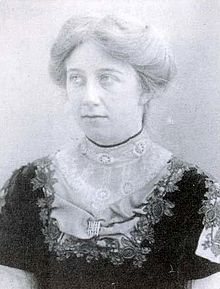
Elsie Howey

No novel set in the early years of the twentieth century should ignore the campaign for women’s suffrage. The incident that took place in Clovelly was a gift and I sought to find out more about the three women who were involved in this militant action. In another one of those co-incidences that peppered my research for this book, it turned out that one of the three, Elsie Howey, was, at the time, leader of the suffragettes in Torquay and Paignton. In reality, I don’t know what led my character, Daisy, to take a job up in Torquay. I toyed with using the suffragettes as the mechanism that accounted for Daisy’s move. In the end, I devised another plausible scenario but I still wonder if she knew and remembered that one of these women had links to Torquay. There is useful online information about Elsie and the Torquay suffragettes that I was able to use.

More information about Barefoot on the Cobbles can be found here. Copies are available at various events and at all my presentations. You can order from Blue Poppy Publishing or directly from me. Kindle editions are available for those in the UK, USA, Australasia and Canada.
#100daysofbfotc Day 86: Elsie Howey

Elsie_Howey

Image from Wikimedia – Used under Creative Commons

Now it is time to meet the third of the suffragettes who appears in Barefoot on the Cobbles, Elsie Howie. Elsie’s full name was Rose Elsie Neville Howie and she was born on 1 December 1884 in Finningley, Nottinghamshire. She was the daughter of Thomas and Emily Gertrude Howey née Oldfield. Her father, the parish rector, died when Elsie was a toddler and the family moved to Malvern. She studied languages at the University of St Andrew and joined the Women’s Social and Political Union in 1907. The following year, along with her sister Mary, she was arrested for the first time. She was renowned as one of the most  militant activists and targeted the Prime Minister, Asquith, on several occasions. The incident in the novel was not the only time that Elsie worked with Vera Wentworth and Jessie Kenney to promote the cause of women’s suffrage. She gained notoriety by dressing as Joan of Arc and leading a WSPU rally on horseback, wearing armour. She reprised the role of Joan of Arc at the funeral of Emily Wilding Davison.

Elsie frequently went on hunger strike during her spells in prison and force feeding damaged her health. She worked for the cause in Plymouth and Torquay but never resumed her militant activities after they were suspended during World War One. She spent the rest of her life in retirement in Malvern, dying there in 1963.

 ‘Elsie Howey, now,’ muttered another. ‘Baint she the one that was in all the papers last month? Dressed as Joan of Arc on some great white ’orse outside a prison up London way she was.’ ’

Barefoot on the Cobbles will be published on 17 November 2018. More information about the novel can be found here. Copies will be available at various events in the weeks following the launch or can be pre-ordered from Blue Poppy Publishing or the author.

#100daysofbfotc Day 52: Jessie Kenny

Jessie Kenney 2Jessie Kenny was one of three suffragettes who played a key role in an incident that is described in Chapter 5 of Barefoot on the Cobbles. Jessie was one of twelve children; she was born on 1st April 1887, in Springhead, near Oldham and she worked in the local cotton mills. Together with her elder sister, Annie, she was inspired to take up the cause of women’s suffrage after hearing Christabel Pankhurst speak in 1905. The sisters joined the Women’s Social and Political Union. At this time Jessie was still in her teens but having learned to type at evening classes, she was soon serving the cause as secretary to Emmeline Pethick-Lawrence. A month in prison in 1908 damaged Jessie’s health, yet she continued to be active within the movement, which is how she came to be in North Devon in 1909, haranguing the Prime Minister, not for the first time.
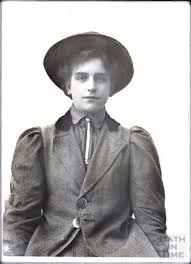
After re-couperating in Switzerland, she reputedly had a lung condition, Jessie spent time in Paris, living with Christabel Pankhurst. She also went to Russia to help Emmeline Pankhurst mobilise Russian women to contribute to the war effort. When the First World War was over, she worked for the American Red Cross in Paris. She went to North Wales Wireless College and qualified as a ship’s radio officer, the first woman to do so however women were not allowed to take up this role. Instead she worked as a steward on cruise liners. Later she took up a post in the office of a school in Battersea. She died in Essex at the age of 98.

‘Suddenly the sharp-eyed police constable noticed the three women. Blowing his whistle and calling to his colleague, he made his way towards the suffragettes at a trot. The young ladies leapt up. With hats falling and hair flying, they headed for the cliffs. As the constable set off in pursuit, the women wisely dispersed in different directions.’

Barefoot on the Cobbles will be published on 17 November 2018. More information about the novel can be found here. Copies will be available at various events in the weeks following the launch or can be pre-ordered from Blue Poppy Publishing or the author.

#100daysofbfotc Day 17: Vera Wentworth

Vera wentworh 2

Wikimedia used under creative commons

Vera Wentworth makes a dramatic appearance in Chapter 5 of Barefoot on the Cobbles. Born Jessie Alice Spink, in 1890, Vera was a member of the Women’s Social and Political Union, the militant arm of the woman’s suffrage movement. She came from a middle-class family; her father was a London chemist. At the time she appears in the novel, although still in her teens, Vera had already spent several spells in Holloway Prison for her beliefs. She was based in the south west and together with Elsie Howey and Jessie Kenney, made the Prime Minister, a particular target. Her militancy was such that she alienated other members of the movement.

Her 1911 census entry shows that she attempted to avoid being enumerated but the entry was later ‘Inserted by instruction of the Registrar General’. After the incident that is narrated in the novel, Vera attended St Andrews University. She continued to campaign actively and went to America to aid the cause there. During the First World War, when the suffragettes agreed to suspend their activities, Vera is reported to have worked as a VAD nurse but she does not appear on the Red Cross database.

In 1939 Vera was living in Argyle Street, St Pancras with her life partner, Daisy Carden and Vera described herself as an authoress. She died in 1957.

‘Now Daisy had a better view of the women, she could see that the speaker was not much older than she was, perhaps still in her teens. Her nose was rather too prominent for her to be considered a beauty but her straight dark brows and striking eyes drew attention.’

Barefoot on the Cobbles will be published on 17 November 2018. More information about the novel can be found here. Copies will be available at various events in the weeks following the launch or can be pre-ordered from Blue Poppy Publishing or the author.

Social History Book Advent Calendar Day 20 – more on rural life and a bit about Suffragettes

If anyone is still reading these, congratulations and I refuse to be responsible if you have succumbed to my suggestions and blown your book buying budget. Today I would like to introduce you to Pamela Horn’s Labouring Life in the Victorian Countryside. I have had the pleasure of hearing Pamela Horn speak. In fact, on one memorable and somewhat embarrassing occasion, her 35mm slides slowly melted in the projector we had provided (you can tell this was some time ago!). Her social history books are all valuable reading for anyone trying to understand life in the Victorian era. The clue to the content of this particular volume is in the title and this is an excellent general introduction. The book covers many aspects of rural life in the nineteenth century. Here we can learn about home life, education, religion, leisure and cottage industries. There is a chapter covering the impact of trade unionism and another about crime and punishment. Other chapters look at poverty and at medical care. I particularly like the author’s habit of using named individuals as examples. The fruits of her extensive research in contemporary sources are shared with her readers.

My paperback edition has a few, rather dark, black and white photographs by way of illustrations, which don’t really add anything to the text. The appendices include details of labouring budgets and wages and a contemporary accounts of labouring life. There is also a useful bibliography, as well as end notes. It is another very useful book for those looking for context for the lives of their ancestors.

There was not much progress on Barefoot on the Cobbles yesterday. I am still bogged down with the tricky inquest scene. I took time out to write the next in my series of articles for the In-depth Genealogist Magazine (IDG). My column is about the lives of our female ancestors and this contribution was to be about suffragettes. I rashly included this when I was working on the suffragette chapter of Barefoot but suddenly this seemed like a less than good idea. IDG has an international readership and I needed to take that in to account and actually, once I got started, I really enjoyed researching it and I am now wishing I had time to take this further. I don’t have time. I really don’t. Please keep reminding me of this. I will pass on one gem that I gleaned. There is an online list of suffragists who signed a petition to parliament in 1866. I don’t want to give too much of the article away but there are similar lists of signatories to later petitions in Australia and New Zealand that a whiz of your preferred search engine should lead you to. Was great great granny a suffragette? I am wondering how much of my newly found knowledge I can impart to students of my forthcoming online Discovering Your British Family and Local Community in the early 20th Century course. You know the course, I believe I have mentioned it before and I expect, if there are still spaces, I will mention it again. It would be a great boost to your research as 2018 dawns.