The Day the Books Came

Two and a half years ago, as the writing of Barefoot on the Cobbles came to an end, I had a glimmer in what passes for my brain of what I would do next. The idea wove, spun and developed, taking itself off in its own direction and then it was now. I have given birth to Sins as Red as Scarlet. Large pantechnicon fails to take note of the ‘on no account use your sat-nav’ directions. It causes chaos negotiating the narrow track to get itself where it should have been in the first place. It blocks the road while a pallet is deposited on the roadside (we don’t have pavements). It unloads 64 boxes. A nice little queue of cars is building up behind. Crowds are gathering. Nothing this exciting has happened in my village all lock-down. Time for the lorry to move off and oh dear, there is a hay-bale laden tractor coming in the opposite direction. Cue pantechnicon .v. tractor stand off. Tractor wins. The lorry and all the cars behind it have to do the reversing thing. Lorry comes very close to reversing into the car immediately behind it. Unfortunately I had put my camera down ready to heft boxes before all the tractoring so there is no photographic evidence.

My settee is now eighteen inches from the wall, I have a teetering pile in the kitchen. I am wondering how many I can ship out before my family visit. I suppose piles of boxes would make a good social distancing barrier. Now it is all systems go for launch day. Take a look at my previous post for details of how to join in. In the meantime, if anyone would like to order a copy or ten, you know where I am.

This Time it is all About the Books (includes offers and free stuff)

So, the excitement is mounting as the publication date (29 August) for my latest novel creeps nearer. Well, let’s be honest here, I am excited; maybe one or two of you are too. As face-to-face marketing opportunities have now dwindled to zero, I am climbing some steep learning curves in order to do some online promotion. You will also see offers for some of my other books flitter across social media. I really do need to make some space.

Firstly, the new book is all set for its cover/title reveal on 15 June. Watch this space and my Facebook and Twitter accounts to join in the fun. I shall also be guesting on some other blogs and will be sharing the links to these. If I can work out how to do it, there will be Facebook Live stuff on the day, so look out for that if you are one of my Facebook friends – and if you aren’t, why not? 😊. Hopefully, if I can work out how to turn myself into a social media influencer (whatever that is), I will be telling you about the book and I may even be reading some teeny tiny extracts. So far, the cover looks like this. And, no, the title is not ‘Redacted’, as one of my friends suggested, although it would have been a cool marketing ploy.

SinsAsRedAsScarlet-REDACTED-2

On the subject of the cover, it has been designed by the incredibly talented Robin Paul from The Branch Line. Robin created an amazing cover from my vague suggestions and scribbles that were the first ‘art’ I had produced since failing art O level not once but twice.

Hopefully, by 15 June, I will have set up a pre-ordering system (another learning curve), even if it only consists of ‘email me and I’ll send details of how to pre-order’. The first 200 people who pay for a copy of **** ** *** ** ******* (see there’s a clue) by midnight on 28 August 2020 (British Summer Time) will get a free copy of Coffers, Clysters, Comfrey and Coifs: the lives of our seventeenth century ancestors (RRP £12.95). These will be sent postage free to a UK address. Please note that this offer is only open to those who pre-order directly from me, or from my publishers Blue Poppy Publishing. Both books will be signed. I am sorry that it is difficult to provide an attractive offer for my overseas readers. In all honesty, I can’t pretend that it is financially sensible for you to order directly from me. If you are outside the UK and really want a signed copy from me I am happy to provide details of postage costs. All purchasers of **** ** *** ** ******* will be able to buy the CD of the same redacted name, at the reduced price of £3 (RRP £4), providing that the CD is pre-ordered at the same time as the book. The CD includes Dan Britton’s evocative companion song to the novel and two other tracks by Dan, on a similar theme. I am working on another goody for all pre-orderers but I need to make sure that what I have in mind is something that I can deliver first.

What else am I able to offer you? Well, if you are very quick, there is still time to register for the free talks at tomorrow’s (6 June) Crediton Literary Festival. See my previous blog post for details. During my talk, I will be revealing out a code, giving UK listeners an opportunity to obtain a discount on my book Remember Then; memories of 1946-1969 and how to write your own, the subject of my talk.

But wait, as my friend Michelle would say, there’s more. I now have my own supply of my new booklet 10 Steps to a One-Place Study. So, if you want a signed copy and to avoid putting money into the hands of the multi-nationals, you know where to come. £5.90 including UK postage.

And yet more. In honour of Mayflower400, whose commemorations are sadly but inevitably, having to be postponed, I have another offer available on Coffers, Clysters, Comfrey and Coifs: the lives of our seventeenth century ancestors. This book is a reflection of life in Britain at the time that the Mayflower left our shores. A copy of this book can be purchased for £2 plus postage and packing. That is a total of just £5 for this book to be sent to a UK address, please get in touch for estimates for postage elsewhere. Alternatively, if you order either Remember Then or Enquire Within directly from me at full price, you can order a copy of Coffers Clysters for just £1 more. These offers are open from 15 June up to and including 3 October 2020, or while stock last. I stress that these offers are only available to those ordering directly from me. Contact me for details of how to pay.

Sorry that this is a bit of an advert. Normal service will be resumed soon.


Come and Meet Mistress Agnes at #FamilyTreeLive – a chance to buy my books at reduced prices on stand 167

Just to say that I will be on duty at Family Tree Live as Mistress Agnes, in company with various disreputable characters, on stand 167 – so do come and experience the lives of your C17th ancestors. See Swords and Spindles website for more details of what is in store. All my books will be on sale on that stand. I don’t want to fiddle with 1ps and 5ps so there will be an opportunity to save a few pennies. Coffers, Clysters, Comfrey and Coifs: the lives of your seventeenth century ancestors will be 15% off with the voucher that will be in your Goody Bag.

CCCC front coverThere is a limit to what you can get in a Landrover (there really is – I was surprised too), so what with armour, instruments of torture, costumes of various sizes, toys and a multitude of household items, I will not have an infinite number of every book title – so if you were hoping to relieve me of one of my publications, let me know and I will save you a copy. I would advertise my workshop and presentation but I am afraid (well, afraid for you, glad for me) that they are fully booked.
Looking forward to seeing you all.

Social History Book Advent Calendar Day 21 Here be Witches, oh and a bit about Writing and Garden Sheds

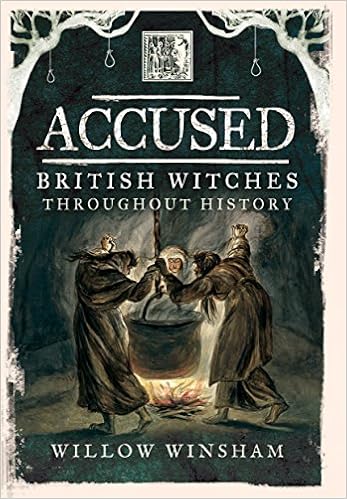
I’ll be honest, today’s offering has just arrived on my book shelf, so I have only had time to skim through it but it looks like a gem. Accused: British witches throughout history, by the prosaically names Willow Winsham, is a little more ‘niche’ than some of my advent book choices. It is not the comprehensive study that the title might suggest but don’t let that put you off. Here we have eleven case studies from across the British Isles. Although most are seventeenth century accusations, the date span is 1324-1944. Through the stories of these women and these examples are all female, the author helps us to understand how individuals came to be the accuser or the accused and tells us of their lives before and in some cases, after, the indictment. At first, I felt that the very brief introduction was inadequate but Winsham’s aim was not to write yet another general study; there are a number of excellent ones already. If you regard this as a companion volume, that tackles the topic rather differently, then it can be viewed as an excellent book. Yes, we learn a great deal about the context through the stories if these eleven women but serious students of the historical witchcraft will need other books to get a fuller understanding of the background and the psychology behind this phenomenon. This is not a criticism of Accused, whose fresh approach adds a new dimension to our understanding. The author has used broadsheets, court reports and other contemporary sources to help us understand how human beings could revile their fellow men, or in this case women, in such an impassioned manner. The book includes extensive end notes, clear black and white illustrations and a bibliography.

Sadly, human nature does not change and although we might be unlikely to accuse our neighbours of witchcraft in twenty first century Britain, other forms of bullying and succumbing to peer pressure haunt our everyday lives. I am fascinated by people’s behaviour and what makes them act in a certain way. I am also keen on women’s history and the seventeenth century. With this combination, how could I not be interested in witchcraft history? I researched the topic carefully when I was writing Coffers, Clysters, Comfrey and Coifs: the lives of our seventeenth century ancestors, which contains a chapter on witchcraft. The topic also forms one of our Swords and Spindles presentations and my own The Burning Time talk about historic witchcraft is one of my favourites to deliver. Living as I do within a few miles of the home of the last (probably) three witches to be hanged in England how can I not be fascinated? And yes, I will come clean, there is a tenacious nagging idea for a second novel in here somewhere. I really need to suppress this until Barefoot is finished but I suspect that it won’t go away!

No writing accomplished yesterday sadly. I was diverted just as I was about to put fingers to keyboard, a process which is usually preceded by re-reading, for the umpteenth time, part of what I have already written. I always read aloud as this slows me down to an acceptable level and I was just declaiming my flowery phrases to an audience that consisted of a Christmas tree, when I was called upon to assist the fisherman of my acquaintance. He is currently moonlighting as the gardener of my acquaintance. Pressures of time mean that we are giving up the allotment. I say ‘we’; it is officially my allotment but all the hard work has been delegated to said gardener/fisherman. The incoming tenant did not want the shed so this week’s task is to relocate a eight foot by ten foot shed to my garden. In a method that does not bear imagining, the shed assumed flat pack mode and single-handedly the gardener, now in his eighth decade, managed to get this on to a trailer and up my drive. Then it was my turn to help bring the panels in to the garden. I promise I was lifting when instructed so to do but I have to say there was not much sign of my end of the structure leaving the ground. Somehow we struggled down the path and negotiated over hanging trees and the washing line in order to bring three panels into the garden before my back clicked in protest. I have no idea how we are going to get the remaining four panels in today. Again this is the royal we, my protesting back means that I can barely put my socks on let alone attempt shed lifting. These occasions make you realise that you lack fit, healthy, dare I say younger, friends.

Social History Book Advent Calendar Day 9 and a bit about me

Product DetailsA much more recently written offering behind today’s advent window: Rebecca Ridal’s 1666: plague, war and hellfire, which was published last year. This might be viewed as a history, rather than a social history but there is so much about everyday life in this volume, that I feel justified in including it. Although the title is 1666, the book starts with an account of the plague of the preceding year. Skillful use of contemporary sources introduces us to a turbulent eighteen months in London’s history and events that reverberated around the country. The account is presented from the viewpoint of key characters, the well-known and the less well-known. We meet Nell Gwynn, Samuel Pepys, Charles II, Christopher Wren and Isaac Newton, all names that evoke the atmosphere of the age. Others who walk across the pages of the book may not be household names, unless you have studied the history of the period. For example: Aphra Behn, playwright and spy; Cornelius Tromp, Dutch naval commander; Nathaniel Hodges, a physician and Thomas Vincent, who provides a Puritan perspective.
Most of us are familiar with plague and fire from our schooldays. The book also covers the Dutch Wars and the dawning of the scientific age. The fears of a still largely suspicious populous as they faced these disasters, disasters that most believed to be punishments from God, are portrayed well. The style is accessible and the book can be read as you would a novel. I could imagine myself walking through London’s streets as I read. Living as I do in the seventeenth century, I found this book fascinating. I wish this had been published when I was researching my own seventeenth century social history, Coffers, Clysters, Comfrey and Coifs, as there is an extensive bibliography, together with the endnotes, providing plenty of leads to follow up. There are also some attractive coloured plates and three maps in the printed version.

Yesterday I spent a slightly chilly day, with other authors, attempting to sell books to the local populace. I did duck out for fifteen minutes to take a look at an early twentieth century Magistrate’s Court record that was written in the most appalling handwriting I have seen – think the stereotypical prescription scrawl. If I say that it made my handwriting seem legible you may get the idea. Sadly the case I was looking for for Barefoot on the Cobbles was not recorded at all. Very strange, considering that it was heavily reported in the press. Today I have my non-conformist history hat on as I am off to address the Exeter group of Devon Family History Society about ‘Toleration or Turmoil?: English non-conformity and our ancestors’. This may not be quite what the audience are expecting but I hope they enjoy it. I am told there will be posh biscuits in honour of the festive season – great!


Social History Book Advent Calendar Day 6 – Going on a Witch Hunt

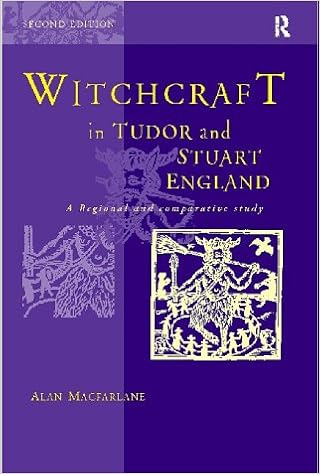
As part of my seventeenth century life, I give presentations on the history of witchcraft. When I was researching the topic for Coffers, Clysters, Comfrey and Coifs: the lives of our seventeenth century ancestors, I read a number of excellent books on the subject. For the purposes of this advent calendar, I have chosen just one of them to share with you, Alan MacFarlane’s Witchcraft in Tudor and Stuart England: a regional and comparative study. If you are a family historian who has not a single example of a witch or a bewitched in your family tree, please don’t think this would not be relevant to you. This was the atmosphere of the time and it is important to understand this. Another author on the subject, Malcolm Gaskill, wrote ‘Witch-hunts involved not just savage persecutors tormenting innocent scapegoats, but ordinary neighbours with a close affinity to one another who also happened to believe in witchcraft powerfully enough to act out their most violent fantasies.’ (Witchfinders: a seventeenth century English tragedy) – see it is buy one get one free day today!

Today though belongs to MacFarlane’s work. This is not just an account of the witchcraft trials of the period. He discusses the sources that can be used, the social background and the conditions that contributed to an increase in accusations. He also looks at the various ways in which people attempted to counter-act witchcraft. The emphasis is on the notorious trials in Essex but these are set in a wider context and the background is applicable elsewhere. I am fascinated by the psychology behind witchcraft accusations and its similarities to today’s culture of bullying. I strive to understand what made people of the past act in a particular way under certain circumstances, so I found the section on the ideology of witchcraft and the anthropological interpretations a particularly valuable addition. There are maps, tables and black and white illustrations throughout the book.

As part of the talk that I give, I include a list of the known indictments for the county in which I am speaking. It was as I was preparing the Devon list, when I first gave this talk, that I spotted a name on the list that also appeared on my family tree. Joanna Elford was baptised in Mary Tavy, Devon in 1612. She was the sister of my 9 x great grandfather. Last week I took the opportunity to try to find out more. In 1671 Johanna or Joan Elford was accused of ‘laming and pining’ Alice Paynter (I presume that Alice was claiming that some form of paralysis and a sensation of being pricked were a result of being bewitched by Johanna). I have to admit that I was a little disappointed that Johanna got off, as this means less documentation. I still can’t be positive that it is the same Johanna/Joan Elford but it is a very unusual name. I am waiting to see if there is any further detail at The National Archives but it may be a long wait as I have no plans to visit in the immediate future. I could be tempted to base a novel round witchcraft accusations but I had better finish the current novel first!

Ailments of various kinds: your ancestors in sickness and death

In the three weeks since my last post (three weeks! – you’ll guess I have been busy) I have spent four wonderful days in schools, swording and spindling away, extolling the virtues of the seventeenth century. Summer hit the west country last week. Temperatures rose to 85 degrees – that’s 30 to some of you and yes, in the UK, that’s hot. Four hours ensconced in crowded classrooms with a bunch of 13 year olds and no air-con – great. Followed by a chance to get outside – hurrah. Or rather not hurrah, as now I am on a scorching sports field for an hour, without a smidgen of shade, banging a drum – as you do. Well as I do. I should perhaps add that I was attired in multiple layers of thick wool at the time. I then went straight on to an evening presentation. Let’s just say that we brought the smells of the seventeenth century with us. I have also been finishing off the job I must not mention and presenting on various topics to adults. Today’s will be the fifth talk in four days – why do I do this?

dscf3202#Daisy is making some progress. Some lovely friends have read a chapter and didn’t hate it, which was encouraging. I am currently immersing myself in suffragette activities, purely in the historical sense, though I am not adverse to a bit of banner waving. Next on the list is research into the wartime experiences of a new character who has forced his way into the narrative. This did lead to that exciting moment when your ‘based on fact’ historical novel requires you to research someone new and you find that he attended a school that has an archivist. Better still, said archivist responds to your email (written after office hours) within minutes with information and a photograph. Ok, so he wasn’t the heart throb I was hoping for but I can get round that with a minor re-write!

I am looking forward to the start of my online course “In sickness and in death: the ill-health and deaths of your ancestors”, next month. I keep finding more and more gems and am resisting the temptation to add them all to the course text or it will become another novel. Did you know that bookbinders are adversely affected “by the smell of the putrid serum of sheep’s blood, which they used as cement.” (C Turner Thackrah 1831)? On the subject of ill health, I manage to move awkwardly and pull a muscle in my back so have been hobbling around all week. Great excuse for not doing any housework; now I just need an excuse for the preceding five weeks. May not try the C18th remedy, which is cow dung and vinegar.

Added to this a new research client has presented me with some fascinating family members to pursue. Despite explaining that I would not be able to start this for some time, it was just too tempting.

I am excited that a webinar I gave earlier in the year on surname studies around the world is now available online. That wasn’t the exciting news I hinted at in my last post; that‘s even more exciting but still under wraps – patience is a virtue and all that.

And for my Tenth Historical Novelist ……

the bitter trade piers alexanderOk, so I am going to cheat a little here. Give me a break it is hard working keeping this up on a daily basis in the season of good cheer pre-Christmas rush. I would like to feature Piers Alexander today. I have already reviewed his excellent book, set in the seventeenth century, so all I need to do is direct you to the link. It is really worth the click – it is an exciting plot accompanied by beautiful writing.

A Week of Historical and other Weirdness

Some of the more bizarre happenings in my recent life include a surreal game of Guess Who (you have to guess the identity of the person depicted on a card) via Skype with my 2½ year old grandson. After the more standard questions ‘Have they got curly hair?’ and ‘Have they got a hat?’ we had ‘Are they an acrobat?’ and ‘Do they like peanut butter?’ Note to self – MUST hurry up and create a family history version of this game using old family photos.

Then I had to renew my driving licence as the picture is ten years old. Good excuse for the DVLA to relieve me of £17. Allegedly I could do this online and they would magically harvest my photograph and signature from that on my passport even if the passport photo is the same as that on the ten year old driving licence????

Next, an email inviting me to look at documents that had been left for me in Dropbox. I didn’t recognise the sender but a quick Google (other search engines are available) of the unusual name revealed the identity of the person who wanted me to see their files. Can anyone think why the American woman’s basket ball coach would possibly want to send me anything via Dropbox?

And in a restaurant chain near me, I view their newly revamped menu. I quite like this chain as they provide nominally ‘free’ salad. My dressing of choice is ‘red devil’. In the absence of this on their new ‘sauce bar’ I opted for ‘Triple H’.  If you are ever tempted to ladle copious amounts (or even a mere dribble) of Triple H sauce on your salad, don’t, just don’t. Don’t get me wrong, I like hot and spicy but this defied description. Hating waste I ploughed my way through half a bowl of Triple H bedecked salad and two litres of water (yes, I know that isn’t the ideal solution) before admitting defeat.

So what else have recent days brought? Firstly, the mystery of the missing gravestones. On rechecking the memorial inscriptions of the local churchyard that we completed three years ago, looking for additions, we found that two large slate stones had disappeared. It seemed that their removal was recent, as the holes in the ground showed no signs of grass mowings or water. No one seemed to know why the stones had disappeared. They were huge and heavy. I provided photographs as ‘evidence’. We began looking for someone with a hernia, broken suspension and a new slate worktop. Bit of an anti-climax, it turned out that they had been legitimately removed by a local stonemason for refurbishing. Strange than they didn’t tell anyone though!

captureThere have been a couple of strange Twitter conversations. Who would have thought that one could follow the course of the Battle of Hastings on Twitter? Then another seventeenth century addict posted a woodcut of the time (censored here) depicting what appeared to be a medical procedure. There followed a discussion as to exactly what was going on: vasectomy? (surely not) circumcision? (probably not at this date) who knows? Note that the patients appeared to be smiling! Answers on a postcard.
Then I have been compiling a full risk assessment of our living history activities ready for our Family Fun Day next week. You have NO IDEA how dangerous it is. Will you trip over a long skirt, inhale glue when creating a plague rat, drop a bucket on your foot or a pike on your head? Will you have a heart attack from the weight of our armour or strangle yourself with our bodice laces? Are you up for all this danger? Join us if you dare.

Witchcraft and School Friends

Hastily, I should explain that he two parts of the title are not connected!

Saturday I got up at the crack of dawn and dawn cracks pretty early in June in the UK, to set off for London. As I heaved a case of books on and off trains I started to realise that a week of moving books and furniture (there will be a forthcoming post about this activity) had taken a toll on my back. Notwithstanding, I arrived at The Society of Genealogists to take part in their Seventeenth Century day seminar. Unfortunately even my ‘first train of the day’ start was not early enough to get me there in time to hear Elsa Churchill but I caught most of Colin Chapman’s informative session, packed with sources for C17th research. Colin and I often turn up on the same bill and it is always a pleasure to listen to him. After the lunch break and some running repairs to the air conditioning, which appeared to allow the room to be cold or hot but nothing in between, it was my turn.

I chatted about the impact of witchcraft on the lives of our C17th ancestors and lightened my load by re-homing some of my books, in return for a perfectly reasonable sum of money. Strangely, after becoming interested in this topic as part of my general foray into the social history of the C17th, I discovered that one of those tried for witchcraft, Joanna Elford, was probably related to me. I was followed by Michael Gandy and was very thankful that it wasn’t the other way round. Michael’s subject was how to read C17th handwriting and I suspect the audience were expecting sight of letter shapes and perhaps collective interpretation of documents. This was not to be. It takes an exceptional speaker to engage an end of the day audience for an hour and a half with not a single visual aid. Unbelievably, Michael held the room in thrall with an entertaining, relevant, tour de force on this topic without actually showing us any C17th writing at all – brilliant.

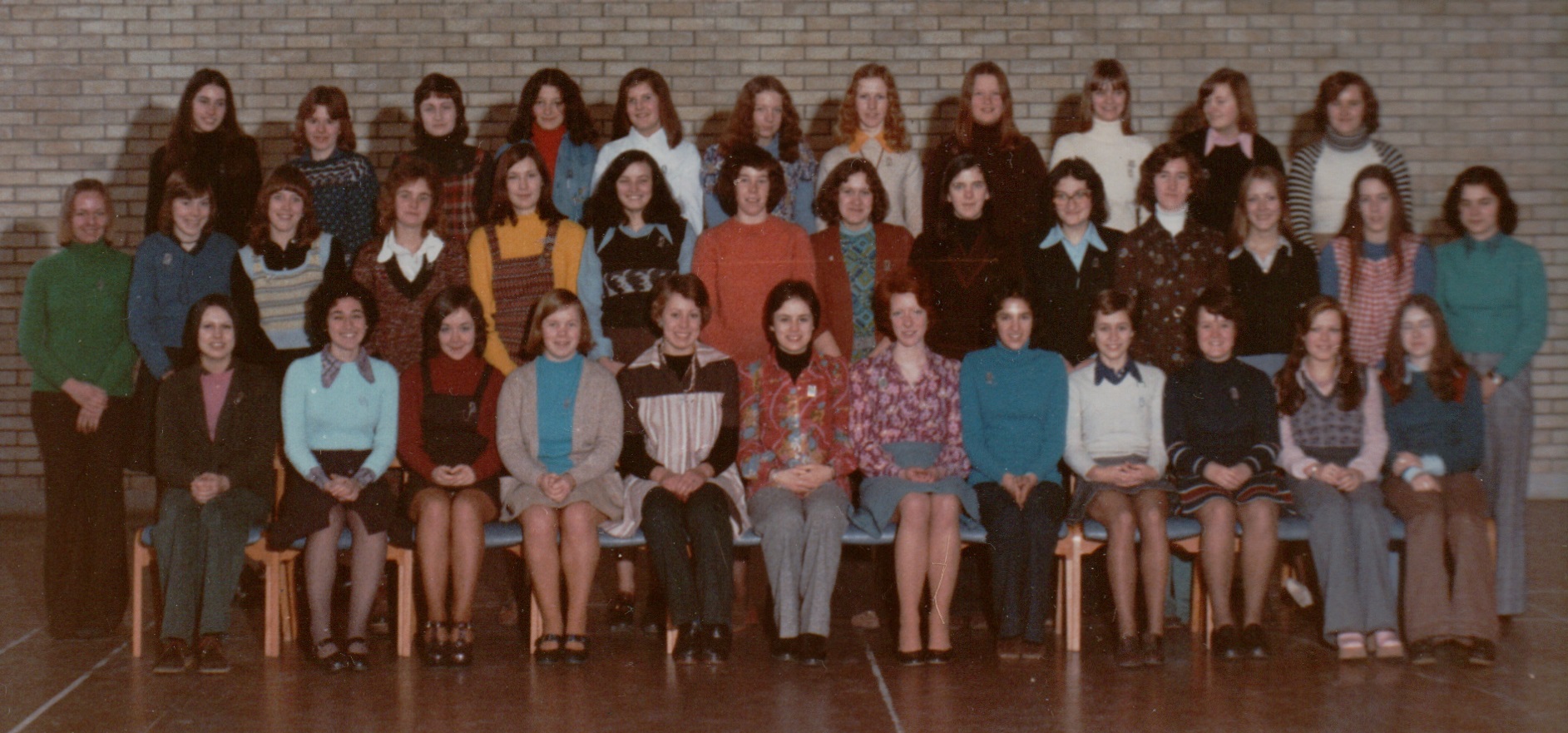
Then it was off to catch up with my school fellows who made up the class of 1974. I had missed the reunion itself but fifteen tail-enders were to spend the night in a nearby hotel and I set off to join them. School reunions can be fraught with anxieties: ‘What shall I wear?’ in my case compounded by the lack of room in the case full of books and the need to make it suitable for the talk as well. ‘Will I recognise anyone?’ ‘Will anyone recognise me?’ and if they do, does this mean I have worn well or that I still look as gawky as I did at school? ‘Have I been sufficiently successful?’ And most importantly, ‘How do my wrinkles/greying hair/middle aged spead compare?’. Of course anyone who voluntarily reconnects with a group of people they haven’t seen for forty years is going to be someone who is comfortable in their own skin, someone who feels they have ‘arrived’, by their own standards if not by anyone else’s.

StitchSCAN0137-SCAN0138

I limp my way as far as East Croydon station and decide that I really can’t face trying to find out where they have hidden the 64 bus stop since I was last here. I therefore elected to spend a high proportion of my book sales money on a taxi to the hotel. Said hotel is ‘posh’ by my standards. Ok, I know most of my hotel going is of the Premier Inn variety but this is four star. Although the surroundings are lovely it turns out that really only the prices are four star. Admittedly our party was accompanied by two sets of wedding guests and a group of England football supporters, who may well have been renegades from one of the wedding receptions but the service was execrable. I was expecting the food to be of the variety where you need a magnifying glass to see anything beyond the drizzle but there were several mouthfuls on each plate. Unfortunately, I somehow managed to choose something that contained two of my least favourite foods but that was my own fault.

My room is situated in the furthest reaches of the building, on the top floor and along an extremely long corridor. I struggle along with my case, which although no longer quite so full of books, was still heavier than my increasingly ‘twinging’ back was comfortable with. I come to terms with the room’s idiosyncrasies. The shower has no visible means of being switched on. I try turning, pushing and pressing various parts of the mechanism and am on the point of giving up when something I do results in water gushing out. Sadly, it took whoever was in the neighbouring room until 2.00am to work out how theirs worked and then they had a noisy and lengthy shower. Then there was the bed. To begin with I had twin beds that had been pushed together. I kept losing things down the narrow gap between the beds. Having retrieved the Kindle for the third time, whilst listening to midnight wedding revellers, I was beginning to despair. The bed was also as hard as ….. I will refrain from making any of the possible obscene similes here and just say it wasn’t very hard, not ideal when one has a bad back.

Of course none of this really mattered because we were there to meet our former school fellows and the chatting and reminiscing was in full force. We all have slightly different perceptions of the rarefied atmosphere that was our alma mater but agreed that we had an excellent grounding for our varied futures. Whether school days were the best or worst days of our lives, if we are historians, we should be recording our memories. Of course it is much easier to recall those memories in the company of those who shared them. If an actual reunion isn’t possible, what about a virtual one? Facebook, Google+, or just plain emails, are all possible vehicles for this. I and my classmates may not being doing this again in another forty years but a good time was had by all.

Then there was the journey home. Now, as I have said on previous occasions, I am no longer fit to be let out on my own. One of my former school fellows had offered to shepherd me back to the station. Where I come from two busses a day is considered a regular service but of course I am now almost in the metropolis so there are plenty of options, despite it being a Sunday. We are going for the tram. Ah, there are no trams. The police have cordoned off the area round our destination due to an illegal rave. I know I and my former classmates were on the rowdy side but to call us an illegal rave seems harsh. A bus driver is planning to go as close as the police will allow to the station and we hop on board. In my case the ‘hopping’ was more of a hauling but we are on our way. Although the road is closed, the station is open and I start the journey home through the engineering works and tube line closures. I manage to get an earlier than planned train out of London but sadly not early enough to get a different train from Exeter onwards. Two hours on a wooden bench at Exeter station puts paid to any remaining mobility in my back. Eventually home safe and sound. Now to edit the ‘year book’ that we are compiling; interesting to see the different paths that we have all taken.