We leave a little later today and are at the station by 7.15am. As someone who lives in a village where there are two buses a week, the frequency of London public transport takes some getting used to. There was nearly an awkward train-related incident when I tried to encourage our party to get on a train bound for Cannon Street, when we are actually heading for Canning Town. Similar though eh?
Again the journey takes about an hour and I begin the day with a long chat with Pam and Paul on the Name and Place stand. This software is going to be so useful to those with One-Place Studies. My first session is Drew Smith on ‘Crowd-Sourcing your Brick Walls’, where he discusses the use of message boards, mailing lists and Facebook Groups, including the helpful Genealogy Squad, of which I am a proud member.
Excitedly, I collect my father’s world war two service records from the MOD stand. What a great idea to give us this quick turn-around opportunity – a highlight of the conference. As my father was in the RAF and the army (long story), I pick up two sets of documents; I guess this counts as BOGOF. By ordering late last night I managed to avoid the queue, which at times was 1½ hours long. Understandably this was a very popular offer.
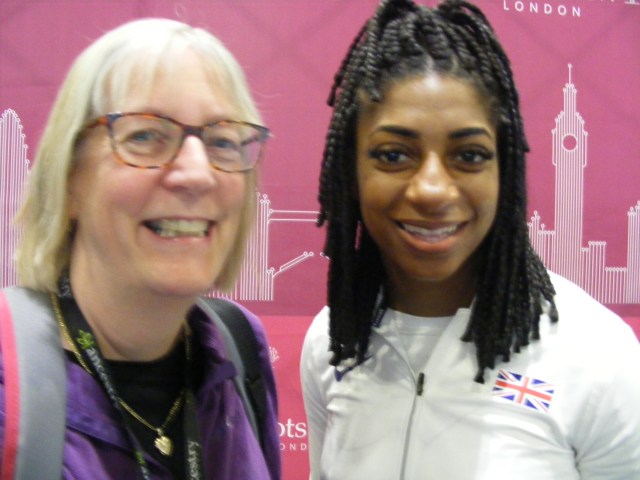
Then the keynote with Paralympian Kadeena Cox. As a follower of para-athletics I was excited to hear her story. The warm-up act was Tamsin Todd, CEO of FindMyPast. I spot that most of the presenters in the auditorium are using auto cue. Kadeena’s story of her Jamaican heritage and her own experiences overcoming her condition is one of strong family bonds and perseverance. Family Search have traced her family for her and also present her with a series of DNA kits. I am excited to have the opportunity to interview Kadeena and as the grandmother of Robot Wars’ biggest fan, I have to ask her about her experience as winner of the celebrity version. I then get to be number two in the queue for a meet and greet and autograph. I hand my camera to someone in the queue behind me; sadly their efforts are a tad fuzzy, at least of me.
My next session is David Annal’s ‘My Ancestor was a Liar’. He stresses the importance of understanding the records we are using and why they were created. Then there is a Tweet-up for those of us who join in #Ancestryhour. I am an occasional attendee, as I usually remember as the hour draws to a close. Next I am able to chat to the FindMyPast officials, Tamsin Todd CEO and Ben Bennett MD. This is a very interesting hour, even though it means that I miss more lecture sessions I had hoped to attend. I comment that, exciting as all the additional records are, they are giving us lists of ‘hits’ that are becoming unmanageable. They are working to refine the search process to help with this. Also a priority is improving source citations. We learn that the 1921 census will include workplace information. We ask about the likely pricing model. They are not yet ready to announce this but it will be ‘similarish’ to that for the 1911 census and the 1939 register. I guess this means that patience will be needed before this becomes part of the subscription. We are reminded that FindMyPast are the only 1939 register provider with an ongoing programme to reveal the redacted entries. Over 5 million new individuals have been opened for view since the launch. Exciting news for Scotland is promised for the near future. We are also asked for our feedback on the event.
A slightly earlier arrival back on site today, which is much needed.
Disclaimer: As a RootsTech Ambassador I receive complimentary admission to the event and a free registration to give one of my readers. My status as an Ambassador does not entitle me to any financial assistance for accommodation, travel or meals.

 This week came the news that I have been accepted as an Ambassador for the first London version of the genealogical extravaganza that is
  The History Interpreter - Janet Few