Things or Heirlooms?

Two things have prompted this post. Firstly, today and tomorrow I have two rather different, yet similar, presentations to give about heirlooms. The first is a 15-20 minute conference paper for the Family Archives and their Afterlives conference. Wednesday is a 90 minute heirlooms workshop for the Society of Genealogists. The clue is in the title. Workshop means that I will be putting the audience to work. The second thing is that I am embarking on the inevitable ‘you might be going to move this year/next year/who knows’ cull of possessions. Incidentally, because I know people don‘t like to ask, the position is that someone is desperate to buy my house but is waiting to sell theirs, so I may be here some time.

I am faced with the accumulated ‘stuff’ that survived my major downsize seventeen years ago, augmented by the additional stuff that I acquired when my mother died. Why are some items more precious than others? What has prompted me, my mother and in some cases preceding generations, to keep x over y and z? What do I keep or discard and why? Many of these things have no aesthetic qualities and serve no practical purpose, yet they ‘need’ to be kept. They have moved beyond the realm of being ‘things’ to be heirlooms. I don’t envisage that I will be disposing of anything that has a family significance. If it has already been treasured for two, three, or more generations, then it is my role to continue to do that, even if I feel that the generations that come after me may not wish to do the same. I hope to persuade them to keep at least some of these treasures. That is part of the aim of the Treasures section of my Granny’s Tales website. It is the stories that turn things into heirlooms, so I need to tell the stories. It will be a long job, I just need to last long enough for all the stories to be told. At least I have made a start.

Then there are the things that have a personal significance for me, important of course but somehow perhaps on a lower rung than the items that stretch back to touch the past. At the moment, I can’t be sure how much space I will have when I move. The aim is not to have less than I do currently, so in theory I could keep everything. In practice, it is a good opportunity to reduce the task that my descendants will face when I go and join the ancestors. I’ve made a start. I’ve done the bathroom. Not much of a challenge there. I did throw away manky looking products that have been around for years. I even threw away a few stiff flannels. My bathroom is officially the second smallest in the world (ironically larger than the one I had in my previous 5 bedroomed house) so there were only two small cupboards to go through.

Slightly more demanding were the two sheds, although the majority of the contents of one contained the possessions of the fisherman of my acquaintances (who has four garages a barn and a shed of his own and those are the ones that he admits to). I decided that I really didn’t need 200 plastic flower pots or a dozen tins of solid paint. Easy this throwing away lark isn’t it? I am actually very pleased with the shed clearance. A trailer load disappeared to the tip and more to the owner’s barn.

Moving inside, the conservatory is also done. Well, it is awaiting visits from my descendants to triage the children’s books. That will be trickier. I know most are now too young for my grandchildren but they have seen two generations and some three. What will stay and what will go? I know we will be keeping some that probably no one will read in my lifetime. I do hope my body will keep working to read them to a fourth generation but realistically, it probably won’t. I don’t see my grandchildren being likely to have children young. So they will sit in a box in a loft, in an as yet to be identified property, until my children have to repeat the triage in the future.

The conservatory also contains many inherited ornaments, some dating from my great-grandfather’s trip to India and China. They stay, waiting to appear as one of Granny’s Treasures; another culling decision deferred.

Today maybe I’ll start on the bedroom. The clothes part is easy. I do an annual cull and in any case, as anyone who has met me will know, I am not a clothes person. But and there’s a huge but the bedroom also contains a china cabinet, itself an heirloom, inherited from my mother’s cousin and we believe, made by my great grandmother’s brother. It holds more ornaments, ornaments that I have known all my life. They have sat in the china cupboards of my mother and grandmother and now they sit in mine. A few of the items reach back to touch my great-grandparents’ lives. Then there are the photograph albums. Many of these are the sticky plastic variety, containing colour photographs from the 1980s. Photographs that are fading into weird and wonderful versions of their former selves. I did have a spell of remounting these and scrapbooking them in new albums. Maybe I will have time to continue that process. Do I now take the opportunity to be selective? Shall I retain the images of people and remove the pictures of random stately homes and scenery? I have yet to decide. In any case that is for that dim and distant time labelled ‘later’. Unless my worst moving nightmares are realised and it takes years rather than months for me to complete a chain, they will move with me in their current state.

With the honour of being the custodian of the family archive, comes the responsibility for its curation and care. I also need to be its interpreter. What I should be doing of course is writing those stories, preserving those memories, making sure that I am not the only person who understands the significance of these items. Some already have partial or damaged stories. There are things that I know belonged to my mother’s grandparents but which grandparents? I am committed to making sure that the items I pass on are real heirlooms, with what is left of their stories intact.

Family Stories, Family Treasures and some Memories: a task for the family archivist

For the past few months, I have been trying to discover that useful commodity ‘spare time’ and use it to create a small website to be the repository of all the family stories that run round my head. This is rather different from the family history accounts that appear on this website. These are mostly uninspiring narratives, designed to record all the facts that I have found for that branch of the family. The new website is for stories rather than accounts and in future, these will vary from long biographies to short paragraphs about particular anecdotes from the past. There is also a section for my own memories, taken from my auto-biography. In particular, I wanted a vehicle for the stories of the family treasures that I am privileged to have in my temporary care. Without the associated narratives, these heirlooms become mere ‘things’; I feel the need to explain their significance and let others know why they are precious. Artefacts also provoke memories; memories of their owners, memories of occasions when they were in use and associated narratives.

All this may this seem self-indulgent and perhaps it is but I am the only person with most of this knowledge; it is my responsibility not to let it be lost. If I were able to see my descendants more often these would be the accounts that they would hear verbally from me but there may be more stories than there is time, so I decided that I would make a start. The website is tiny at the moment. I plan to add more stories on a regular basis but I didn’t want to begin with an overwhelming number. The intention is that my descendants will actually read this and I thought that they might be put off if I inflicted too much on them at once.

I am not expecting hundreds of hits on the site, or anyone outside the immediate family to read it much, although you’d be very welcome to do so. In fact, I may be optimistic thinking that my descendants will read it but at least now they have the option. What I hope may happen, is that others will take a quick look and be inspired to tell their own family stories. So, if you have five minutes, pop across for a brief glance at Granny’s Tales and then go out and do likewise.

Heirlooms and Heritage – Treasures and Things

Regular readers will know that, apart from my descendants, I am singularly lacking in relatives: no siblings, no first cousins, only six second cousins, all on the same side of the family. When I say that people often think I mean those are all the cousins I know about but no, that’s really all there are and they are very important to me. Third cousins and I have met two of those for the first time in the last couple of years, are practically my closest relatives. Actually, that’s not strictly true, one of those third cousins was in my class at school but we didn’t know we were related at the time.

The advantage of having three grandparents who had no siblings that survived babyhood is that I am the inheritor of the heirlooms. On my father’s side, there is very little but on my mother’s there are many photographs, non-valuable jewellery, documents, ornaments and textiles. They have little or no intrinsic value but they are priceless to me. I am very aware of what a privilege it is to be their custodian.

The way I look at heirlooms has been shaped by my recent material culture certificate experience. For an object to become a treasure, rather than just a thing, it needs to have a story, that’s what gives it an emotional dimension. The implications of this Open University article are that an emotional attachment to things is not healthy. The article says ‘Each object is associated with important people, places or experiences and they become incorporated into the self, so that the prospect of getting rid of a possession feels like losing part of oneself. Everyone does this but hoarders see deeper meaning and value in far more items and a much wider variety of items.’ I like to think that I haven’t reached hoarding level, I can still walk across all the rooms in my house. Yes, getting rid of some possessions would be like losing part of myself, although the lockdown clear out of the loft did see me jettison some of the collections that my mother treasured, although I still have many more. You name it, mum collected it, stamps, cheese labels, matchboxes, tea and cigarette cards, the list goes on.

I know I need to tell the stories behind the ‘things’ that are currently in my possession; that way my descendants will at least know what they are discarding, if discard they do, although of course I hope they won’t. This is as important as telling the stories of the family.

I really enjoyed running my heirlooms workshop for the recent Really Useful Show, in which I aimed to encourage others to look at heirlooms in a rather different way and to tell their stories. I don’t get the chance to spend much time with my descendants and rarely are they able to visit me, so I don’t get the opportunity to bombard them with stories of the family treasures that are in my home. I’ve begun working on a website that will ‘house’ both family stories and the meaning behind the objects that I have inherited. Sadly, some of those stories are already lost and I am left with, ‘this has been around for years not sure if it was made by my mum or granny’, or ‘this belonged to the Smith family but I don’t know much more.’ Despite having thought I had asked my mum everything there was to ask, clearly I didn’t. If you still have people in your family you can ask, do it now, Christmas is the season when we connect with family, even if it is only a Christmas card (yes people of my generation do still sometimes send those). Ask. Ask. Ask. If, like me, you are your own oldest relative then the mantra is tell, tell, tell. Don’t wait for your descendants/heirs to ask the questions, make sure you leave the answers for them to find.

For some years I have had an inventory that mentions what things around the house are, along the lines of ‘hideous pink vase on third shelf was Auntie Annie’s’. This does rely on me not moving things. The one I worry about most is, ‘All the Christmas decorations in the turkey box date from the 1960s or earlier’. What happens if I go to join the ancestors when they are on the Christmas tree? So, it is time to tell their stories. I have begin to work on a website that will do just that and I will make sure the information is in another format as well, a photobook would be good. I may be some time. I know the website will be of limited interest to outsiders but it seemed a good format to choose; it isn’t really meant for anyone except my descendants. I could keep it private but I won’t, in the hope that it encourages others to do likewise. It needs a lot more work before there’s enough to make it live but it is a work in progress.

I have also been helping to work on another website that I hope more will appreciate, that goes live next week but that, as they say, is another story.

I leave you with a picture of the (unfinished) patchwork quilt. There is a reason it is unfinished but you will have to wait until I tell its story to find out why. It has been worked on by four generations of my family and now my grandchildren are big enough to hold a needle without too much collateral damage, I plan to get my children and grandchildren to work on it too, so we will have six generations who have played their part.

The Experimental Archaeology Adventure Part 10: the end of the adventure, or just the beginning

It has been a long time since I wrote about my experimental archaeology adventures, partly because I have been having fun completing the final assignment but also because anything involving technology has been hampered by the long and sorry lack of a laptop saga. I won’t bore you further with that but in summary, after nearly seven weeks of inadequate computing, making everything take twice as long as it should, the issue was finally resolved. This involved buying a replacement machine, which I could have done in the first place, hindsight and all that.

Back to the experimental archaeology. The final trimester of my course was entitled Crafts, Making and Storytelling, which, as the name suggests, involved actually making something. Having received very pleasing and unexpected grades for my second trimester assignments, I began the new module full of enthusiasm. In April, I began to consider what I could make for the assignment. Initially, I had contemplated something fishing related, which would be appropriate for my coastal connections and build on my assignment for module one. Having dismissed the idea of a coracle as being too impractical, I wondered whether a traditional withy lobster-pot might be an alternative. A willow-weaving workshop made me flirt with the idea of basketry.

As a family historian, I wanted to experience an activity that would have been familiar to my ancestors, which led me to straw-plaiting. My great great grandmother, Ann Stratford and many of her immediate family were straw-plaiters. I already had an affinity with this lady, as I spent three years living in her home county of Buckinghamshire in the 1980s, before I knew I had ancestral connections to the area. It was only after I left that I discovered I had been living not just in the county or village of her birth but in the road in which Ann had been born.

I began to research the history and craft of straw-plaiting, discovering that it is on the red list of endangered heritage crafts, with fewer than twenty crafts-persons plaiting on a professional or amateur basis. I wasn’t anticipating becoming an accomplished practitioner but the prospect of trying something unusual appealed. My decision was made.

That was the easy part. Then craftsperson’s block set in. Whilst my colleagues were off casting bronze, building cloam ovens and shooting beavers to make robes (this last in the US I should add), I retreated into my comfort zone and spent ages on the storytelling element, revisiting my research into the life of great great granny and the craft of straw-plaiting, There were a variety of plaiting techniques of differing complexity. I learned about plain, pearl and brilliant designs and read of the possibilities of enhancing the plait with coloured straws, or using two straws together to improve the plait. I found illustrations of satin box, middle, wagon wheel and feather edge plaits. Finally, after a reinvigorating Zoom chat with fellow students, I realised that this was a making project and something needed to be produced. I sourced and ordered some straw, which then sat on my kitchen table for two weeks before I could bring myself to open the package. I moved on to researching straw-plaiting but I still wasn’t making anything. I am not by nature a quitter so eventually I made a start.

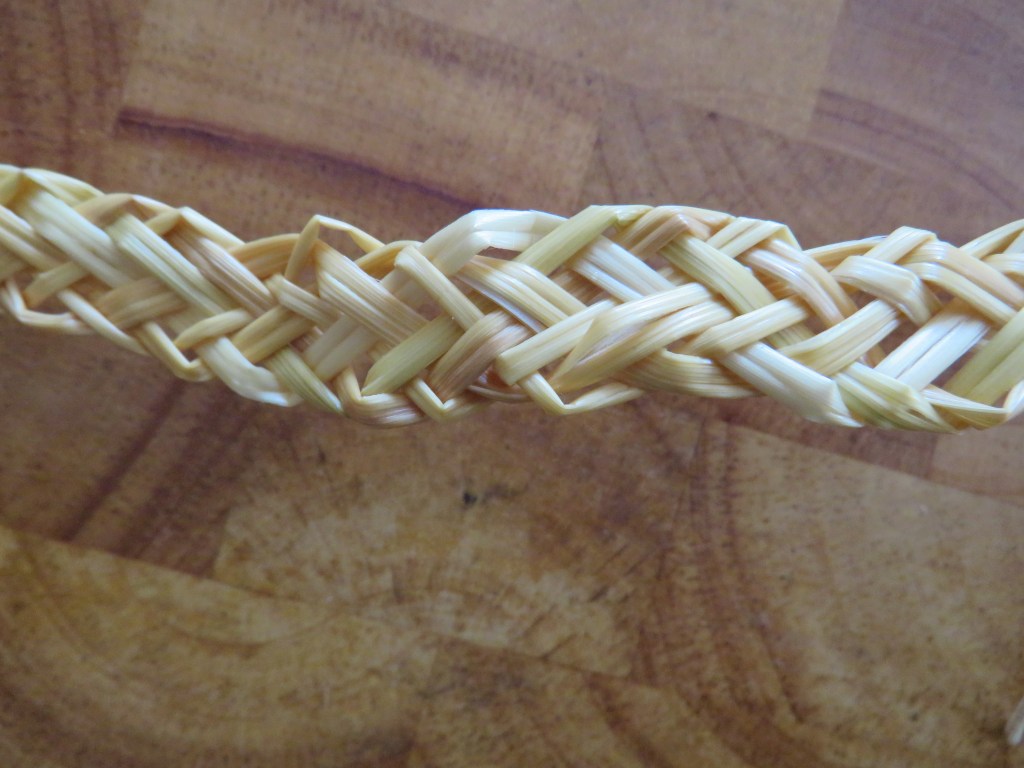
I decided to keep it simple and use a basic seven-strand plait. I had done this before as a child but had no recollection of how it was achieved. Online illustrations revealed that the plaiters’ rhyme, ‘under one, over two, pull it tight and that will do’, told you all that you needed to know. Unwilling to waste straws, I began by practicing with string. It didn’t take long to get into the rhythm but I only managed to avoid confusing the strands by lying them on a flat surface and securing the knotted end at the bottom with Sellotape. If I stopped and walked away, despite carefully laying out the strands, it was difficult to pick up where I left off. It was also very slow. I manage to produce something passable, if short and a little uneven. Even though straw has very different qualities to string it was difficult to imagine how plaiting could be done by holding seven straws in the air, let alone using thumbs and middle fingers, which was the approved technique.

As straw-plaiting was a family activity, with ten-year-olds allegedly being as proficient as adults, I practiced string plaiting with some of my descendants. They all mastered the technique quickly. My adult daughter produced a neat plait. The eight-year-old had trouble pulling it taught but realised her deficiency and declared hers to be widdle-waddle (the plaiters’ term for a child’s unsaleable plait). I don’t think either of the children thought it would be much fun as a long-term activity.

It was time to try using straw. I cut the ends off with a knife and tried splitting the straw but either my straw was thinner than nineteenth century straw or I lacked a sufficiently steady hand, as all I produced were small slivers of straw. I had read that ‘early home-made hats were crude and bulky’ and would have used un-split straw. This sounded like a description of something that I might produce, so I decided that I would use whole straws. I was not going to attempt the bleaching or dying parts of the process, which, in any case, would not have been universal. I ‘milled’ the full length of the straw with my rolling pin. Next came the soaking. The fifteen inch lengths fitted in my sink but straw floats, so I weighted it down with a knife.

I chose seven straws, tied the ends together with yarn and began to plait. The approved method of using my thumbs and middle fingers to plait and my forefingers to turn splits, or in my case, straws, sounded rather like patting one’s head and rubbing ones stomach but I started slowly. I began by laying the straw on a flat surface, as I had with the string. This went well until I reached the end of the straws; all seven ran out at the same time. I made a terrible mess of trying to join in new straws. With hindsight maybe I should have started with straws of different lengths. As I progressed joining new straws became a little easier, as only one or two needed replacing at the same time. I gradually progress from the table to holding the straws in my hands but had to recite the ‘over one under two’ rhyme to keep me in rhythm. After an hour of plaiting, I had produced thirty inches of plait. The literature is contradictory about likely output but opinions ranged from ten to twenty-seven yards per day; I clearly had a long way to go.

My next plaiting session, I tried a different method of joining on new straws, slotting the hollow end of the new straw over the narrow end of the previous one. This wasn’t always successful as sometimes the end of the new straw split but it was an improvement. I was finding the straw more difficult to manage and realised I had forgotten the milling stage. This resulted in a much less neat plait but did mean I had preserved the hollow ends, thus enabling me to join straws using these. I resolved in future to mill but not to continue this to the very end, so that I could still slide one straw over another and avoid so many loose ends. Still chanting the rhyme, I achieved a similar output to the previous session.

By the third attempt, I was getting quicker but certainly not neater. After an hour and a half I had another ninety inches of plait. I had expected to find working the straw rough to the touch but this wasn’t the case. Keeping the straw wet meant that my fingers were continually damp and having plaited for longer, my right arm and shoulder were aching. By now, visions of plaiting were appearing before my eyes when I closed them.

Fortuitously, at this point, BBC2 re-screened a programme about the Luton hat trade. This revealed several useful pieces of information. Firstly, I had been using my straw splitter incorrectly. I was trying to score the straw with the point but it seems that the point needed to be inserted in the end of a straw and pulled down. I tried this technique but the results were little better than those achieved using my method. Alarmingly, I learned that 4000 straws were required to make a hat. I am glad I didn’t know this beforehand as I would not have contemplated investing £240 on straw. More encouragingly, the narrator went on to say that nine yards of plait could make a hat. I already had nearly five yards having used about fifty straws so something wasn’t computing here.

By day four I was getting both fast and neater, achieving 1·5 yards in twenty minutes.  Joining in new straws was still not very tidy but in general, the finished plait looked less messy than my first attempts, partly because I wasn’t plaiting to the thinnest end of the straws. I still wasn’t able to use my fingers in the approved manner. The discomfort in my right arm and shoulder continued and I still needed to recite the rhyme as I plaited but it was definitely becoming more instinctive. I did try putting the straws in my mouth, as Victorian plaiters would have done but I failed to see how the whole straw could be kept damp in this way.

At this point, I was excited to discover that great great granny, at the age of twelve, had won a prize for her plaiting. I am not sure those particular skills have passed to me. I began writing the final assignment, concentrating on describing the craft and telling the story.

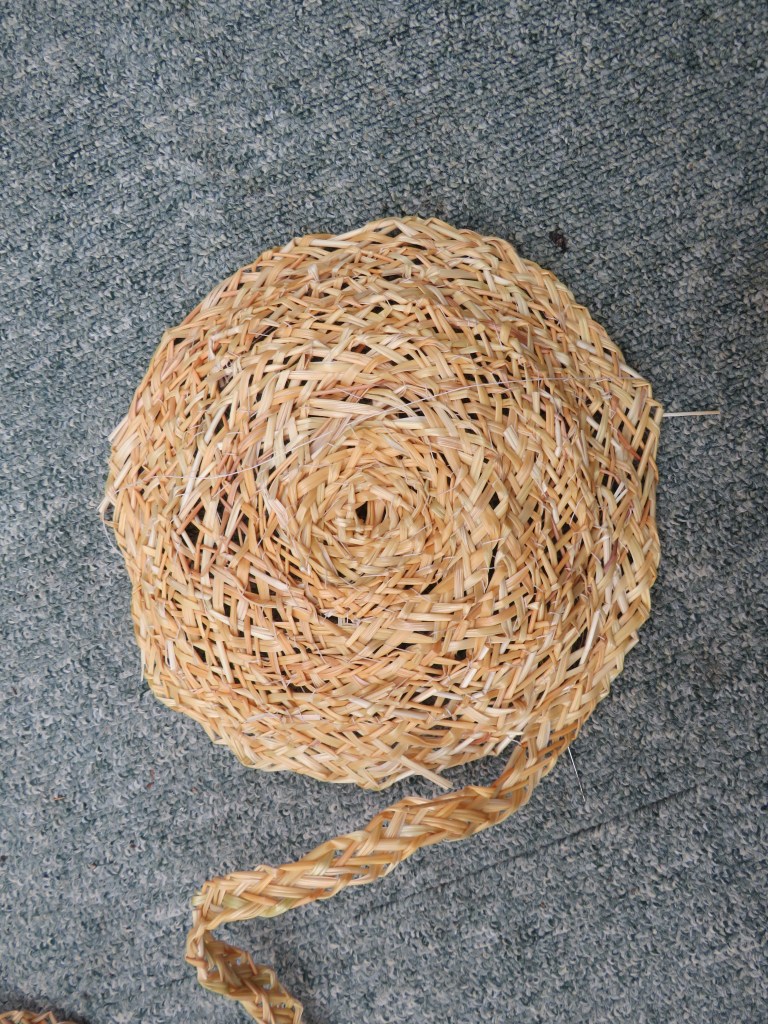
Three more plaiting sessions and I thought I might have enough to make a hat. I started in the centre and began to pull the braid into a spiral, working in an anti-clockwise direction; this may be because I am naturally left-handed. This was a more uncomfortable process, with the rough straw scraping at the skin on the backs of my fingers. It was also difficult to keep the plait damp. I decided not to overlap the braid in the English fashion as that would require more plait. I didn’t really have much idea how to create a hat shape and wondered if I would end up with a flat circle. Professional hat-makers would have used a head-shaped block and steamed the straw into shape. I didn’t have the wherewithal to do this. In the end the shape evolved of its own accord as I continued to sew. I was concerned that it might be difficult to finish off the ends but this was relatively simple as the ends of unplaited straw could be tucked into the weave.

The finished object resembled a pudding basin or lampshade, rather than a hat and certainly wasn’t neat and stylish. The underside of the straw is very scratchy, making it uncomfortable to wear. I did try tying it on as an alternative way to wear it.

Whilst I was pleased to have created a finished product, I was a little disappointed not to have made something that I could actually wear in public, even if only when I am living in the seventeenth century. I am not a natural crafts-person and I am also a perfectionist. What I produced was far from perfect but I enjoyed the process. The repetitive action of the plaiting was therapeutic but I certainly wouldn’t want to spend my working life as a plaiter of straw. I particularly valued the chance to step into my ancestor’s shoes and feel an even closer connection to Ann as a result of this project. Highly recommended for all family historians. Would I try this again? My heart says yes but my head knows that there isn’t room in my life to pursue craft activities with much rigor. I can see myself demonstrating the plaiting technique if the occasion arises. I have revisited my research into Ann’s family, with particular emphasis on the social context and the role that straw-plaiting played in the community and her life; I feel that I can now do so with greater insight. Watch this space for a post about Ann.

The course has been a great experience. I have learned a great deal about experimental archaeology and still more about material culture. I have climbed some technological hills and crafting mountains. I have met some hugely talented, diverse fellow students and we plan to keep in touch. So what next? There are plans. It may be that there will be an online MA on offer, which is tempting, further study does appeal. I am however mindful of how many things I still want to achieve and maybe I need to start prioritising as tempus is fugitting away like mad (it is still May isn’t it?). There is an exciting potential project in the offing with my coven lovely group of ladies. I have a non-fiction book to finish writing. I really want to focus on telling more stories from my own family history and as a result of this course, focussing on some of the family heirlooms and telling their stories before they are lost. I do still hanker after learning Cornish, remember I got as far as buying the books in lockdown?

The Experimental Archaeology Adventure Part 9: from a thing to things

I am now, sadly, halfway through this course. It really does come highly recommended if you are interested in the objects of the past. It is wonderful that it has been made available as an option for distance learning. You have until 3 June to apply for a place on next year’s course. Ideal if you are a traditional craftsperson, historical interpreter or family historian. Although ‘archaeology’ conjures up visions of ancient artefacts and there is, understandably, a good dollop of input about fascinating older ‘stuff’ the flexibility of the course has meant that I can concentrate on a much more recent era. I was sad to miss the opportunity to be in-person at the amazing Centre for Experimental Archaeology and Material Culture (CEAMAC) but it wasn’t to be for me – maybe another time.

The assignment about Jessie’s Locket has been and gone. I created a wonderful powerpoint plus soundtrack before realising that the time limit was ten minutes. I decided that I might not get away with sixteen minutes, so editing was needed. I was in a better position than some of my colleagues whose efforts topped forty minutes but still an issue. I reluctantly axed some of the material and then gabbled away in an unprofessionally speedy fashion to cram what was left into ten minutes and fourteen seconds. I now await the results with trepidation.

Attention has turned to a lengthier assignment, focussing on bringing an archaeological perspective to the examination of a collection of objects. Again, it was difficult to choose but I have decided on the collection of family photographs that pre-date my birth. These photographs are currently housed in a single album. Part one of the assignment is to describe the collection, so I have begun by categorising the images, which are almost all of people, rather than places or events. Having counted them, I was surprised to find that there are 554! They will take a while to catalogue and yes, I do know that I have many still to scan but that is not part of the assignment. The next and most interesting, stage is to write about their significance, their meaning and to think about how I react to these images. I have a horrible feeling that this may become uncharacteristically sentimental if I am not careful. Finally, I have to consider the ongoing future of the collection and look at comparative studies. That’s going to be the difficult bit. If anyone can point me in the direction of papers about the curation and conservation of specific photographic collections, I’d be grateful. So far, I’ve found a book for £198.02 that I might have to give a miss.

I have free rein regarding how I present this assignment and I have decided that one can have too much of chatting to your computer, so this will be an extended, illustrated essay, with plans to put the results on this, or possibly another, website. Watch this (or another) space.

I sometimes think that I have learned as much about social media on this course as I have about Experimental Archaeology. I have scaled the learning curves that are WhatsApp, Discord and now it seems I have found myself on ‘Insta’ (see I am learning the lingo). I did accidentally follow Adele by mistake but I think I am getting the hang. Not yet decided how I might use it but if you want to follow me feel free JanetFewHistory.

Old photograph of a mother and child with a doll's pram
A favourite from my collection 1926