Of Books, Toots, Discoveries and Photographs

It has been a while since my last post but I have not been idle. Buckland Brewer History Group published a book last month and I’ve been frantically wrapping and posting, watching the pile in my kitchen diminish as orders come in from hither and yon. This was a joint project, involving contributions from fifty people and we are very proud of it.

I’ve been really knuckling down to my writing project and now have nearly half the chapters completed, with several others well on their way. I don’t want to give too much away but let’s just say, in line with many of my talks, this book does concentrate in the grittier side of life. It has led me to some wonderful online sources. Following an excellent talk about the Temple Lodge Home for Inebriate Women that was given to Devon Family History Society by Liz Craig this week, I decided it was time to tackle the scheduled chapter on the inebriate. Liz had pointed us to The Birmingham Black Books, what a treasure trove. This is a record of ‘habitual drunkards’, complete with photographs, who were identified in the early years of the twentieth century. The book was issued to local publicans so that they would not serve those who were included. My work-in-progress book includes a series of case studies and I have spent most of this week following the life of one of those black-listers, Sarah Grosvenor, who chalked up over 200 drunk and disorderly charges. I am really frustrated that I can’t identify her during the first forty years of her life as I feel that might shed some light on why she ended up on this path.

There have been exciting family history discoveries of my own too. Access to the 1921 census as part of my FindmyPast subscription means I have been following up the extended family and I have discovered another relative who spent time in a mental hospital, then known as an asylum. I have been able to access the case books and – cue really exciting bit – letters survive between the sister on the patient and the institution. I am able to have copies of these letters, which I hope a lovely researcher will get for me next month – watch this space.

I have also revisited the family history of the fisherman of my acquaintance, looking at a branch that hadn’t been examined for several years. Newly available records did reveal the need for a bit of tree surgery. The branch that was lopped off were his geographically further flung ancestors – they came from a parish seventy miles from where he was born. Now I have identified the correct Elizabeth Nicholls, every one of his direct ancestors, on all lines, was baptised within fifteen miles of where he was born. Is this some kind of record? I also managed to crack a persist brick wall finding, that his 3x great-grandfather invented a surname. You can’t fool me Robert, I know who you really were.

The Cornish Adventure continues – more of that in a post of its own soon. Most of yesterday was spent biting the Mastodon bullet. As people seem to be deserting Twitter in droves, I’ve joined others in the genealogical community who have set up accounts on this social media platform that pretty much no one had heard of three weeks ago. Here one Toots rather than Tweets and it proves that there are new learning curves to be mastered and that every day is a school day. You can find me on Mastodon here.

The other bandwagon on which I have jumped is the new app from MyHeritage, which using AI to turn you into a Viking, a Green Goddess, a Punk Rocker or even a cyborg. This is free to try for a limited period. I do have a few reservations about this, particularly regarding creating ones that lead you down the path of mis-appropriation of ethnic identity and then there is the whole issue of tampering with the evidence that is original photos. I do think it might be something that would be a way of interesting young people in the past, although there is a strict ban on using this with photographs of minors. So how does it work? ‘Upload 10-25 photographs of yourself’. Do I even have 10-25 photographs of myself that don’t go back decades? I managed to scrape together ten by dint of lopping off the other people in them. Then the weird and wonderful images were created. Some are decidedly odd and distorted, probably because I only uploaded the minimum number of photos. In some I look like the late Queen but others have said the same, perhaps this is a default. I leave you with (allegedly) me as a Celt, in the 1950s, the 1970s and the 1980s. I think the 1970s one is my favourite as that does actually look like me in the 1970s. I have spared you the cyborg.

Not actually a Family History Advent Calendar Part 12

Well, I made it to half an advent calendar! This will probably be the last post of the festive season as the descendants are about to descend and I really need to tidy up, or at least make space for them, before they arrive. Interesting incident yesterday when a full carton of fruit juice fell on to one of those metal spiky dish things you use for carving meat. Ok, so I don’t use it for carving meat but the occasional roast animal does get deposited on it before being inelegantly hacked to pieces. You know that thing on medical dramas where they say, don’t remove the knife or they will bleed out? They aren’t wrong. Interesting ‘bleeding-out’ carton of fruit juice incident anyway. Despite all this and the other pre-Christmas merry-go-round, cakes iced, presents still not wrapped etc., I did manage to update the account of one branch of my family history. For those who remember the Mary Cardell saga, I am a teeny bit closer to making progress but I am still not confident enough to ink it in.

Anyway, enough of this trivia. The favourite family history website of the day is: V is for Vision of Britain Through Time. The website provides links to maps, historical travel writings and old photographs. It also includes the census reports and statistics and there are some statistics of church attendance from the ecclesiastical census.. It is effectively a gazetteer of place names, including those from the 19th  century. Inevitably, there is more information for some places than others. So have fun exploring your ancestral areas.

Thank you for your support and have a wonderful Christmas. For those who find this time of year difficult, reach out, there are people there for you. If you are happiest in your own space that’s fine too, you don’t have to feel guilty for not celebrating in a conventional manner. Be kind to each other folks.

DSCF0993

1950s vintage – slightly ruined by a particularly resinous tree one year

Many of the entries in this year’s advent calendar are based on my book Family Historian’s Enquire Within. I would be very grateful if anyone in the UK wanting to buy a copy would get in touch with me directly (there will be no charge for UK postage).

Day 21 #bfotc sources

Day twenty-one of the ‘advent calendar’ focusing on some of the historical/genealogical sources that I used in the writing of Barefoot on the Cobbles.

CaptureI would like to mention another local archive today: The Bideford and District Community Archive. The Bideford Archive was established in 1983 and has premises in Northam, where its holdings can be consulted. There is also an excellent website, which can be searched by place, personal name or topic. I used the archive principally in order to consult original copies of the local newspaper, the Gazette, which I could not access online. The archive is a treasure trove of local information, some of which is not available elsewhere. If you want to delve into the history of Bideford and the surrounding rural hinterland do pay them a virtual or actual visit.
More information about Barefoot on the Cobbles can be found here. Copies are available at various events and at all my presentations. You can order from Blue Poppy Publishing or directly from me. Kindle editions are available for those in the UK, USA, Australasia and Canada.

Social History Book Advent Calendar Day 14 – Farming Surveys

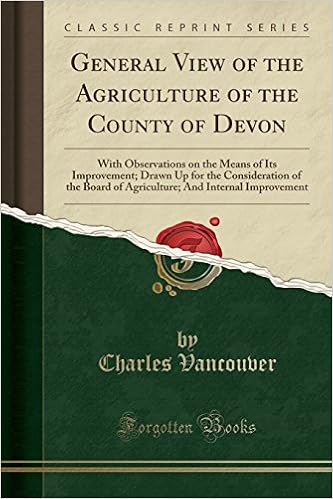
Another one for those interested in agricultural history today and it is a whole series of books, rather than just one. Most family historians I speak to have agricultural labourers hidden somewhere in the boughs of their family tree. What we need to realise is that these are not some amorphous group whose experiences were all very similar. Farming practices differ according to soil, terrain and climate. The Book of the Farm, that I mentioned earlier in the month, is a general account; you also need something more specific. To find out what life would have been like for a farm labourer in a particular part of the country you cannot do better than consult the appropriate volume of the General View of Agriculture. These county volumes were commissioned by the Board of Agriculture and were produced on the cusp of the agricultural revolution, in the 1790s, although some ran to more than one edition. I have a facsimile edition of Charles Vancouver’s General View of the Agriculture of Devon with observations on means of its improvement. Vancouver wrote the second edition for Devon and was also responsible for some other counties. I can only write about the Devon volume but I suspect that the others are similar, as they were part of a national survey.

The coverage is comprehensive and in the case of Devon, is broken down in to six regions, so the characteristics of a fairly small area can be discovered. The topics cover: soil, climate, crops, livestock, tools, terms of service for labourers, buildings, roads, markets and ways in which productivity could be improved. My edition had line drawings, a map and tables covering such things as parish by parish lists of population, amounts paid in poor relief, occupational structure, number of houses in the parish and other valuable goodies such as the menu for Exeter House of Industry (the forerunner of the workhouse) and the characteristics of different breeds of sheep. There are line drawings illustrating farm implements and livestock.

In short, if you only read one book to help you understanding the farming practices of your ancestors, or your locality in the past, then it should be the appropriate county volume of this series. The full list can be found here. If all this sounds a bit too good to be true, it is because there is a downside. Although some of volumes are available as internet downloads, others have to be purchased in hard copy and are not always cheap. My advice is to shop around because you and your agricultural labouring ancestors, need these books.

On the subject of agricultural labourers, for some strange reason, one of the most popular posts on my blog is one that I wrote about agricultural labourers. Every year there is a sudden spike in hits on this page via the site of an Australian University. I can’t see the actual page containing the link as it is in a ‘students only’ area but apparently they have been directed to me. I would have thought that there were far more in-depth accounts that they could go to but there it is.

Social History Book Advent Calendar Day 11 Women and Work and a bit about the History of the early Twentieth Century

The Working Life of Women in the Seventeenth Century (e-Book) book coverThis comprehensive account was first published in 1919 and was written by Alice Clark, of the Quaker shoemaking family. Clark (1874-1934) herself is an interesting character, rising to become a director of the family firm in an era when this would have been very unusual. Her Working Life of Women in the Seventeenth Century is, justifiably, still regarded as a key work on this topic. Sadly it is not currently in print, although the publishers, Routledge, do offer a Kindle edition. You can get copies on online auction sites and various facsimile reprints are available.
The book considers the vital role of women in the family economy, in a century when we tend to imagine that all women were downtrodden housewives. Women’s roles in business, in agriculture, textiles, crafts and the professions are all considered. Clark’s stance is that seventeenth century women enjoyed an equality with men, that their role was complementary, rather than identical and that they played an invaluable part in the family economy. She has used account books, diaries, letters and other sources to illustrate the central role that some women played. She goes on to argue that women began to lose their place in the economic world with the rise of capitalism. By the end of the seventeenth century, she feels, women were increasingly constrained by household duties. The author’s feminist stance and her interest in economics and I suspect socialism, is in evidence but does not detract from the narrative. My Routledge edition has an valuable introduction and bibliography, contributed by Amy Louise Erickson. These enhance Clark’s own list of contemporary and secondary sources.

I enjoyed this book because it provides information about my favourite (well one of my favourites) century. Although this book is about the seventeenth century, it does also give us an understanding of aspects of the early twentieth century too. Clark was actively involved in the women’s suffrage movement and unusually, was a mature student at the London School of Economics. That a woman could write a book like this at this time is insightful.

A couple of things about the early twentieth century while I am here. First of all, it seem likes a long way away because of the seasonal celebrations in between but it is just five weeks before my online course about researching your family and/or locality in the early twentieth century begins. To save you clicking through to the blurb I will copy it here (see how I look after you). “Family historians often neglect the twentieth century as being ‘not really history’ but there is plenty to be discovered about individuals and the communities in which they lived between 1900 and 1945. Twentieth century research brings with it the difficulties of larger and more mobile populations as well as records that are closed to view. This course sets out to provide advice for finding out about our more recent ancestors and the context for their lives. This course would be of interest to those undertaking one-place studies as well as family historians.” It may surprise you how much there is still to be found about a comparatively recent period and the course contains plenty of hints for investigating the social history of the time. What ever time period you choose, focusing on just a few years really pays dividends, whether you are a family historian or a local historian. Sign up, you know you want to. Put a course on your Christmas list.

The early twentieth century is of course when Barefoot on the Cobbles is set. In between writing these blogs, which take more time than you might think, I am of course writing further chapters (I put that in in case my publisher is reading this). No, I really am writing. This week it is the harrowing death scene of one of the main characters. I am also trying to compose something that I can add to my Barefoot page on this website, to give you more information about what you can expect. The first attempt may even be there by the time you read this.


Awards, Book Sales and Young People and Family History

IMG_20170328_132302_467Well, what a busy week it has been. Firstly, preparing my presentations for the Guild of One-Name Studies conference and Who Do You Think You Are? Live. I have come across some great websites whilst working on the former, which is entitled Ship to Shore: sources for researching coastal communities and their inhabitants but no spoilers. For those who aren’t at the conference, all will be revealed next week. Then the really exciting news that I have been allocated an additional presentation slot at Who Do You Think You Are? Live. So at 2.15pm on Thursday 6 April I shall be in the Education Zone talking about Give me a child until they are seven: young children and family history. This is a subject that is very dear to my heart and Edward has been helping me with some of the slides. This is a free, no need to book session but it hasn’t been publicised so please spread the word. It is such an important subject and I don’t want an audience of one. I have the large hall to fill for my second session at 3.15pm The Ones that got Away: tracing elusive English ancestors. There are still some spaces for that one, says she, shamelessly seeking support. Most importantly, if you are there, do come and say hello. I shall be there on all three days.
Then I’ve been writing an article for The In-depth Genealogist about the history of prostitution, well the column is about working women. It has made my internet search history look a bit dodgy. I have learned the hard way that it is best to go for ‘Prostitution in Victorian times’, rather than ‘Victorian Prostitution’. I could but won’t, give you some interesting information about shady goings on in Victoria Australia and Victoria Canada. I managed to restrain myself before searching for ‘copyright free images of prostitutes’.

Next, I attended the excellent book launch event for Liz Shakespeare’s Postman Poet and the accompanying CD by Nick and Becki (with a small contribution from a fisherman of my acquaintance). It was a brilliant evening and I have already started the log-awaited book. I even got VIP treatment and an honourable mention on the strength of providing my kitchen.

Then it was off to the ENT department for the next instalment in what has now become the ‘what Janet hasn’t got wrong with her’ saga. This time it was to determine why my voice periodically sound like a frog on steroids (one drug that has not yet been suggested). Turns out my knowledge of anatomy is more rudimentary than I thought. In order to look at my voice-box, I had a camera shoved up my nose. This is a strange sensation and not to be tried at home, particularly not if you use a Canon G7X. Allegedly all looked fine and the verdict was that I seem to have somehow learned to talk using the wrong muscles (but weirdly not all the time). Nope, I don’t understand it either. I am now being sent for speech therapy. I am viewing this as Continuing Professional Development and wondering if the travel costs to the hospital are tax deductable.

On the good news front, copies of Putting your Ancestors in their Place: a guide to one place studies are now in short supply. It must be the recent publicity. At least, I think this is good  news. I hadn’t really factored working on a revised edition in to the diary. Then even more excitement as I receive a letter to say that an article that I wrote so long ago that I barely remember has been short listed for a British Association for Local History Award. I feel like I’ve been nominated for, if not quite an Oscar, at least a Brit Award. So The Impact of the Bible Christians in Rural North-West Devon: a force for unity or division? must have gone down well. Devon History Society is well represented as another article in the same edition of their journal was also nominated. There are usually about eight nominees chosen from hundreds of local history articles. Now I am just working out if I can possibly get to London to collect the certificate that all nominees are awarded. Fortunately I don’t think I need to prepare a speech that thanks my agent, my family and my dog and makes telling comments about the current political situation.

The Midnight Adventures of an Historian. Latest DNA news and the contents of my second advent box are revealed

You may remember that, last year, I inadvertently applied to present webinars for Ontario Genealogy Society and failed to correctly assess the impact of the time difference. This saw me – yes, the me who is normally asleep by 10pm and never sees midnight, even on New Year’s Eve, presenting to a Canadian audience beginning at what was midnight my time. Last night I got to do this again. This time, not only was it midnight but the temperatures outside were doing a good job of replicating those experienced by my audience. In order to get the maximum bandwidth I am not in my cosy wood-burner heated living room, nor still in my relatively balmy bedroom but in the arctic spare bedroom. I suppose the upside of this was that the temperature helped to keep me awake. My session on historic causes of death seemed to go well – if you can judge how well you are doing when you can neither hear nor see your audience. At any rate, there were plenty of questions and some lovely comments at the end. In a peculiar brand of masochism I have agreed to present a webinar for next year’s series too!

Yesterday I posted my DNA kit. Thanks to a helpful suggestion, I opted for ‘genealogy kit’ on the customs form. It turns out, had I listened to the instructional video, that would have made a similar suggestion. Instructional video? I thought I had done well getting someone else to check the written instructions. I had to persuade the young man in our Greendalesque mobile post van that I actually needed a customs form. ‘It is quite small you won’t need one’. Really? No way was I having my DNA end up on one of those border force TV programmes, so I insisted on having a form, which he struggled to locate. Perhaps that was why he had suggested not bothering.

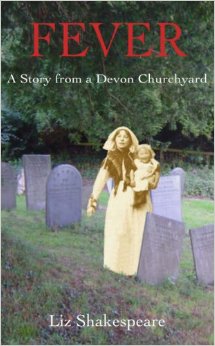
51amm97hjtl-_sy344_bo1204203200_The historical novels out of my advent box today are the books of my friend, local author Liz Shakespeare. Liz writes evocative stories set in Victorian North Devon. These take their inspiration from real characters and are meticulously researched. Fever: a story from a Devon churchyard recounts the anguish of the families in my neighbouring parish of Littleham, as the community is overwhelmed by an epidemic. A gripping story and plenty of social historical context, with a health history aspect that appeals to my interests. Another novel that recreates the era and the locality in striking detail is The Turning of the Tide, which is set in Clovelly and Bideford. It follows the life of Selina Burman who is rescued from the workhouse by a local doctor with an unusually modern outlook. Liz has also written a beautiful set of short stories All Around the Year, inspired by the Devon landscape. Her oral history of Littleham The Memory be Green was garnered whilst she had the opportunity to speak to those who remembered the early years of the twentieth century in her home parish. Not only is this a fascinating account but it could be replicated in other communities. Liz is currently taking pre-publication orders for her forthcoming novel The Postman Poet. This tells the story of Edward Capern, who walked from Bideford to Buckland Brewer on his daily round, resting in my house before making the return journey and penning poetry whilst he did so. My account of Liz’s re-enactment of Capern’s journey can be found here.

Of Diaries, Domestic Issues and a little about Rock Stars

DSCF1701I am still playing catch up after my summer away, hence the lack of blog posts. Things have been taking off on the local history front and it has been very satisfying to unite more than one set of distant relatives who have origins in my village. I also now have on loan, just over there, a diary written by a farmer from my parish between 1830 and 1864. I am hugely grateful to the owner for entrusting me, a complete stranger, with such a treasure. I can’t wait to examine it in more detail. There are one line entries for each day commenting on farming duties, the weather, local funeral, emigrations and chapel activities. Some girls like diamonds, me I would chose this over jewels any day. Happy smiley one-place studier here! Similarly, yesterday my inbox offered me two invitations for Saturday, one a free pampering day at the local outlet village and two, a change to survey a local hill fort – no contest!

The society for one-place studies has been shortlisted for a grant to develop a community mapping project and we would be really grateful for your votes. More details can be found here and voting takes place via this link.

While you have your voting fingers at the ready, there are still twenty four hours or so in which to vote for your favourite genealogical rockstars. This is an annual opportunity to acknowledge those from the English speaking genealogical world whom you think deserve recognition. I was amazed and flattered to find my name included as one of 150 nominees who were considered worthy of consideration. There are some seriously big names on there, so I am humbled to be listed in the same breath as some of these genealogical heavyweights; do vote for your favourites. First of course you have to decide what you think warrants rock-stardom, there are some hints on the voting instructions. Is it someone who delivers inspiring, entertaining and informative presentations? Someone who works tirelessly and often inconspicuously, to further the cause of family history? Maybe your rockstar has written a ‘must have’ book or maintains an informative web-presence. Often more than one of these criteria will apply. I voted for those who I feel help to enthuse others about matters historical. It is all quite light-hearted, at least as far as I am concerned but it is a chance to show your support for anyone who you think has made a noteworthy contributing to the genealogical world over the past year.

Now to matters domestic. There have been some strange household incidents lately. Firstly a new item of furniture is to be ‘delivered to my kerbside’. ‘Good luck with that one’ I thought – living where I do behind another house and up a footpath, I do not have a kerbside. Then there was trying to track down the dongle that was, according to the instruction ‘supplied’ with the not yet smart enabled TV. The conversation went something like:-

Representative of a well known electrical retailer: ‘we don’t supply those’

Us: ‘but it says ‘insert dongle open bracket, supplied, close bracket’ in the instructions’.

Representative of a well known electrical retailer ‘but we don’t supply them. You will have to pop into your local store’

All very well representative of a well known electrical retailer but ‘popping’ involves a 32 mile round trip. Still not resolved this one.

Then there are the spam emails that have been arriving at a local history archive alias that re routes to me. Am I gullible enough to think that a local history archive will have purchased nine tickets to see Peter Pan in Bournemouth?


X his mark

How often do we think about levels of literacy in the past? And what indeed is ‘literate’? Before compulsory schooling, which incidentally arrived on the Isles of Scilly some 50 year before the rest of England (don’t say you don’t learn anything useful reading my ramblings), there was far greater emphasis on the ability to read. Writing was dangerous. Give the hoi polloi the ability to write and they may write something subversive. You are giving them the power to spread sedition. Reading on the other hand enables them to read the Bible and thus improve themselves. There have been many academic studies on literacy levels at different points in time. Often these are based on the ability to sign one’s name in a marriage register. There is of course a very large gap between making an approximation of one’s name and fully functioning literacy but it is difficult to find a better measure. There are instances of those who are perfectly capable of writing signing with an X instead – who knows why? We could use other lists of signatures, such as tax lists as an indicator of literacy levels. Some records specifically mention whether or not an individual can read or write. For example, I have seen this on some lists of prisoners and emigrants.

DSCF1597Just because the measures of literacy are crude, it does not mean that it is not worthy of examination. For local historians it can be fascinating to study how literacy levels appear to change over the decades. If you are interested in a rural area, how does this compare to a town, or to another village in a different part of the country? Family historians too may like to consider how recently different branches of the family were able to read and write. What about book ownership in your family? Do you come from a long line of bibliophiles? Do you still have any books owned by your ancestors? These are often useful if they are inscribed as prizes or gifts. Books gained in this way may not however be representative of their literary taste! Have you made a list of books you enjoy? Have your favourites changed over the years? This is part of the life story that you starting writing yesterday having read my ‘W is for Writing it up’ blog (you did start didn’t you?).

A final thought on ‘X’ as a signature substitute – have you considered why people’s marks may be other than an ‘X’? I have an ancestor called William whose ‘mark’ was an ‘M’. This makes perfect sense when you think of situations in which this individual may have seen his name written down. He would be the opposite side of a desk from an ‘official’ writing ‘William’, The first character William therefore saw, from his side of the desk, looked like an ‘M’.

W is for Writing it up – get that history recorded

We all plan to do it don’t we – write our memories, write that local history book, write up our family history. It is all so easy to put it off, ‘I will do it when I retire’, ‘I will just finish the research first’. Well, don’t be deluded, you will never ‘finish’ and as for more time in retirement – any retiree will tell you it just doesn’t work that way.

Writing up your research into a coherent narrative helps it to become appealing to your nearest and dearest. You know, those close to you who adopt a glazed visage when you enthuse about great great grandad’s first cousin once removed. Writing up aspects of local history enables you to share with others who are also interested. You may know it is a ‘good thing’ but the mechanics worry you. ‘I was never any good at writing’, ‘I don’t know where to start’. There is help out there. Take a creative writing course, or better still a writing up your history course – I run face to face courses for local and family historians and others do the same in different regions. There are also similar online courses available. There are books on how to write family and local history (see below). There are groups that can help and encourage you. Read what others have done to get ideas of what you do and do not, want to emulate. Use the spelling and grammar checkers on your computer, use the Thesaurus.

You are not writing a three volume novel – start small. Begin with the history of your house, not the whole town. Write about granddad’s war experiences, not the history of the whole family since Tudor times. Don’t just think in terms of writing a ‘book’. You could create a blog, a short article, a video, a presentation or an exhibition instead. Give yourself a deadline, maybe an anniversary that needs to be celebrated. Do it, not next year not next month but NOW. Make a start – you don’t even have to start at the beginning. Once you put fingers to keyboard you will be surprised how easy it is.

Beckett, John Writing Local History (Manchester University Press 2007)
Curthoys, Ann and McGrath, Ann How to Write History that People Want to Read (Palgrave Macmillan 2011)
Dymond, David (ed.) Researching and Writing History: a guide for local historians (Carnegie Publishing Ltd 2009)
Titford, John Writing up your Family History: a do-it-yourself guide (Countryside Books 2011)