Excited to report that my DNA sample is now residing in a lab in America awaiting processing. The results are due in a month’s time. My blog post that I wrote for the In-depth Genealogist, that I mentioned yesterday, led Morag from the Shetland Island of Unst to take up the twentieth century ancestors challenge that I set. It will be a task for students on my Twentieth Century Family History course too.
My pre-DNA results investigations, to make sure I have done my best to document all my third cousins, continues with a recent break through on one line. This quest does involve plenty of twentieth century research so ties in nicely with my course writing activities. On the potential third cousins front, I have looked again at the descendants of my great great grandparents Thomas and Mary Archer Dawson née Bowyer of Essex. They had six children, three of whom I am certain have no living descendants and therefore no third cousins for me. One of the others is my own great grandmother and I am in contact with my only second cousins (six) who descend from her. This left me with two possible sources of third cousins on this line. One of these stems I have investigated fully and I know that this produced five and only five, third cousins. I have tried to make contact but they did not respond; I may give it another go. Coincidentally, although both families had moved a few miles from the ancestral area by then, I was in the same primary school class as one of these third cousins; we had no idea that we were related at the time.
The final child of Thomas and Mary Archer Dawson gave me more third cousin potential as she had seven children. I have made extensive efforts to extend her descendants down to my own generation and only by revisiting this branch of the family have I made progress on one that I know emigrated to Canada in 1912. New online searches showed that they lived in the same Toronto suburbs as some friends of mine. This led to a series of very helpful people identifying a third cousin and I am hoping to be put in contact. With my paucity of relatives, third cousins count as close family for me, so this is especially exciting. There is still more work to do on this stem but I have already encountered a casualty of the Somme and and American architect who may still be alive. I will report back with news of any progress.
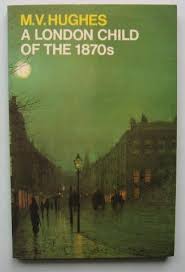 Today I offer you M V Hughes as my historical novelist. I am stretching the definition of the genre a little here as the books in her London series (yes, another series) are semi-autobiographical, despite the preface which claims that the characters are fictional. This tell the story of a late Victorian middle class family, who nonetheless have struggles of their own. Through A London Child of the 1870s, A London Girl of the 1880s, A London Home in the 1890s and finally, A London Family between the Wars, we become immersed in the life of the fictionalised recreation of Hughes’ own family. Molly Hughes was herself well educated, having attended Miss Buss’ North London Collegiate School, trained as a teacher and been awarded a BA, at a time when serious education for women was unusual. London Girl, in particular, provides a very interesting insight into girls’ education of the time. I read this series of four books, which were first published in the 1930s but were reprinted in the 1970s, before becoming aware that there was an earlier book Vivians. This was re-printed after the other four, so for me it was a prequel, even though it was originally published first. I actually think that reading it after the other four is the best order. This tells the story of Molly’s mother’s Cornish mining family and explains the background to the London novels, the first three of which are available as an omnibus volume. I found this excellent commentary about her work, which tells you more. By now you will probably have realised that I enjoy books that have carefully recreated settings, in this case London and Cornwall and well researched history. There was no need for Hughes to research her history as she was writing from personal experience, bringing a veracity to her stories. These books are of their time and are simply but well written. Do not expect sex, violence or adventure, respectable romance does feature but it is the account of everyday life that is the strength of these novels.
 Another day, another historical novelist and again a writer based in Devon.
 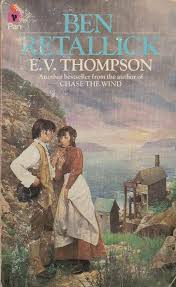 Today’s historical novelist is one who held the rank of ‘favourite’ for many years and I eagerly awaited each new offering. E V Thompson released at least one book every year from his first Chase the Wind, in 1977 until his death in 2012 and I have all but the final half a dozen. Most of his books are set in Cornwall, although he does make use of his experiences in Africa to move to that continent for some of his books, notably those of his most famous Retallick saga. I can’t understand how this series has been overlooked by the makers of costume dramas. My liking for these books stems more from their geographical context than their historical background, which is predominantly Victorian. The reason that I abandoned the later books is because they were becoming a little formulaic with boy choosing between rich girl and poor girl in many of them. This makes them sound like romances and I don’t think that is a fair description. Some are fast paced adventure stories with a love interest thrown in.
 Another Devonian author for today’s offering and this time we are in the first century BC as history and fantasy combine in
  Another genealogical mystery writer out of the advent box today. Again of course the books are set in the present but hark back to the past. So, let me introduce
 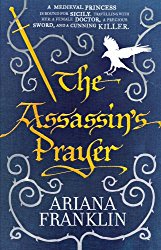 I need to be brief, lofts to empty, writing deadlines looming but I need to do justice to today’s historical novelist – Ariana Franklin and her Mistress of the Art of Death series. The heroine is Medieval anatomist Adelia Aguilar so another history/crime combination. To be an anatomist in the 1100s is unusual, to also be a female, adopted into a particularly free thinking family and hobnobbing with royalty does require a stretch of the imagination but not one that detracted from my enjoyment. Some anachronisms do creep into the twelfth century setting. This would normally annoy me beyond measure. The fact that it does not is a reflection of the other qualities of the writing. In The Death Maze Adelia becomes embroiled in royal intrigue as she investigates the poisoning of Henry II’s mistress Rosamund Clifford. The Assassin’s Prayer recounts another royal commission as she accompanies Princess Joanna on her way to a dynastic marriage in Sicily. Relics of the Dead sees Adelia trying to establish whether human remains are indeed those of King Arthur There are four books in the series, the last published posthumously and I am sad that there will be no more.
 Ok, so I am going to cheat a little here. Give me a break it is hard working keeping this up on a daily basis in the season of
  Today I should be making a guest appearance on
  The History Interpreter - Janet Few