#100daysofbfotc Day 43: Clovelly, Rat’s Castle

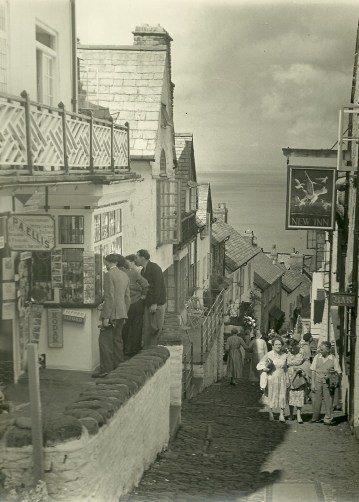
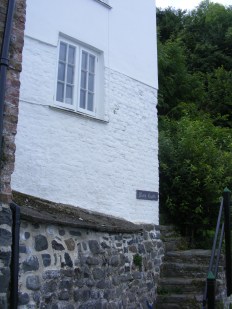
DSCF0708Rat’s Castle, a tiny two-roomed property near Clovelly Quay, makes a brief appearance in Barefoot on the Cobbles as it was Albert and Polly’s first marital home. This cottage was frequently allocated to Clovelly newly-weds, two rooms being all that they required. Tenancies were often short; as soon as the family began to arrive they would be moved on to a larger home. The origins of its name are unknown but presumably the cellars attracted rodents.

‘They had been granted the opportunity of renting the two-roomed cottage known as Rat’s Castle. This tiny dwelling near the quay was reserved for newly-weds and it had suited them well for the past year.’

Barefoot on the Cobbles will be published on 17 November 2018. More information about the novel can be found here. Copies will be available at various events in the weeks following the launch or can be pre-ordered from Blue Poppy Publishing or the author.
 

#100daysofbfotc Day 42: Mr Ellis

scan0002Mr Ellis does not appear in Barefoot on the Cobbles in person but his shop is part of the Clovelly village streetscape. John Ellis was born in Peterborough in 1854 and began his working life as an apprentice to a printer and stationer. In his twenties he described himself as an artist but it seems that he could not make a living from this and later, he worked for a woollen drapery in the town. It is not known how he met his wife, Alice Jewell from Clovelly. It is likely that John joined other visiting artists who were attracted by Clovelly’s picturesque street. He and Alice settled in Clovelly after their marriage in 1900 and they had one son, Paul. Although he preferred to be out in the street painting, John Ellis ran a High Street shop, selling artists’ materials and photography equipment, amongst more general items. His son later took over the shop and became a well-known photographer, being responsible for many of the scenes depicted in north Devon postcards.

‘ ‘Ellis’ shop is just down there on the left,’ Daisy said, more confident now. No one could be angry at her politely giving directions to trippers. ‘Mr Ellis is a bit of an artist himself, I am sure he would have what you need.’ ’

Barefoot on the Cobbles will be published on 17 November 2018. More information about the novel can be found here. Copies will be available at various events in the weeks following the launch or can be pre-ordered from Blue Poppy Publishing or the author.

#100daysofbfotc Day 41: Mrs Hamlyn

Christine Hamlyn

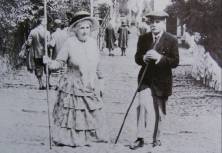
Mrs Hamlyn is the owner of Clovelly at the time in which Barefoot on the Cobbles is set. She is there in the background, impacting upon the lives of those who live on the cobbles. She is both a generous benefactoress and an intimidating member of the upper class, with family connections amongst the social elite of the day.

Christine Louisa Hamlyn Fane was born in 1855, the daughter of Lt. Col. Henry Hamlyn Fane and his wife Susan. She inherited the Clovelly estate in 1884 and married Frederick Gosling five years later; they both took the surname Hamlyn. She was an iconic Lady of the Manor and was responsible for major renovations of the Clovelly cottages. Her annual Christmas gifts to her tenants are mentioned in the local press; haunches of venison were frequently given. It is said that, if she found rubbish on the cobbled street, she would push the offending item with her cane until it reached the nearest door. She would then open the door and tap the litter inside. When she died in 1936, the villagers mourned her passing. As she was childless, the estate passed to her niece Betty.

‘The diminutive figure of Mrs Hamlyn appeared, her ebony cane scratching on the gravel path as she led her guests towards the ivy-clad church.’

Barefoot on the Cobbles will be published on 17 November 2018. More information about the novel can be found here. Copies will be available at various events in the weeks following the launch or can be pre-ordered from Blue Poppy Publishing or the author.

#100daysofbfotc Day 40: Bertie

Bert Braund taken by Jim Willis

Taken by Jim Willis

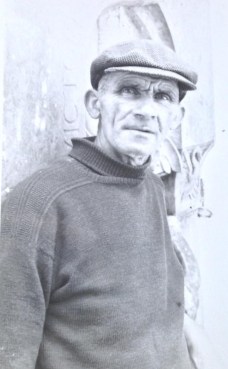
Bertie’s presence in Barefoot in the Cobbles provides an opportunity to examine yet more facets of Albert and Polly’s brand of parenthood. Their second son, Bertie was born in 1900 and he spent much of his life in Clovelly, working on his father’s fishing boat. In today’s world, Bertie might have been labelled as having mild learning difficulties. A family story tells of how, as a schoolboy, he used to hold the donkeys and walk the unladen beasts up and down the street, when the visitors had finished their rides. Any silver coins he received as tips had to be handed to  his parents but bronze and copper were his to keep. After the deaths of his parents, Bertie went to live with his sister Violet in Bideford. He died in 1969.

‘The doctor looked at Bertie appraisingly.

‘Hello young man,’ he said. ‘You look just the age for my Scout Patrol. Have you heard of the Boy Scouts? I am sure you would enjoy the jolly times we have. We are off to camp in a week or two. What do you think of that?’

Bertie looked desperately at his mother for guidance. How on earth should he respond to this gentleman? He might have been speaking a foreign language for all Bertie understood of the words.

‘Oh no, sir,’ exclaimed Polly in horror. ‘Not Bertie sir, he’s well…. He’s not the sort for being away from home, camps and the like, no, no, no it would never do for Bertie.’ ’

Barefoot on the Cobbles will be published on 17 November 2018. More information about the novel can be found here. Copies will be available at various events in the weeks following the launch or can be pre-ordered from Blue Poppy Publishing or the author.

#100daysofbfotc Day 39: King’s Cottage, Bucks Mills

King's Cottage coloured postcard

King’s Cottage, Bucks Mills is the home of Albert and Eadie’s grandparents. We get a glimpse inside in the first chapter of Barefoot on the Cobbles.

On 27 January 1845, Reverend John Thomas Pine Coffin, the landowner, had entered into an agreement with Albert’s grandfather, James, giving him permission to build ‘a house over the watercourse at the machine platform at Buckish, Parkham’. This land was adjacent to James’ father’s home. The new house was to become King’s Cottage and the rent was one shilling a year. By the time we open the front door of King’s Cottage in the novel, the family have lived there for forty five years. They were to remain there for a further twenty years. It was a substantial cottage, with a view over the bay and unique plumbing arrangements, which are mentioned in the book. Kings Cottage was described in the North Devon Journal in 1855, the house ‘at the lower extremity of Bucks, on a towering height above the beach, is a real curiosity. The rivulet that comes down between the hills, by and under part of his eagle’s nest premises, discharges itself in a cataract on the beach where it flows into the Atlantic.’

After the family left, it was tenanted by a relative of Clementine Churchill.

‘Even the gate was exciting, having, as it did, a ship’s wheel at the centre. Eadie’s small fingers would proudly trace the name that was engraved in the wooden frame: King’s Cottage. She smiled; her granfer was a king.’

More information about Bucks Mills can be found here.

Barefoot on the Cobbles will be published on 17 November 2018. More information about the novel can be found here. Copies will be available at various events in the weeks following the launch or can be pre-ordered from Blue Poppy Publishing or the author.

#100daysofbfotc Day 38: Oscar Abbott

DSCF0706

Oscar and his sister Emily

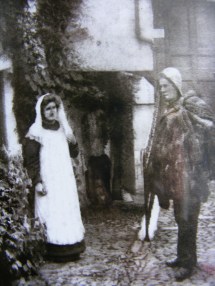
Oscar Abbott appears only fleetingly in Barefoot on the Cobbles yet he was a well known person in the Clovelly fishing community. Born in the village in 1887, son of Sydney and Mary Elizabeth Abbott nee Burnard Oscar grew up in Chapel Street. He married Mary Moss in 1917 and they had seven children, six of them within the first seven years of marriage. As a fisherman, Oscar had a reserved occupation during the First World War, as he was providing essential food. The Abbotts later moved to 12 High Street, Clovelly and Oscar served as a special constable in World War 2. He died in 1976.

‘With the keen sight and instinct of a fisherman, Oscar was the first to spot the speck on the lurching waves.

‘Oh, God,’ he groaned, the rare blasphemy a sign of his anguish. ‘’Tis the Annie Salome.’ ’

Barefoot on the Cobbles will be published on 17 November 2018. More information about the novel can be found here. Copies will be available at various events in the weeks following the launch or can be pre-ordered from Blue Poppy Publishing or the author.


#100daysofbfotc Day 37: Mark

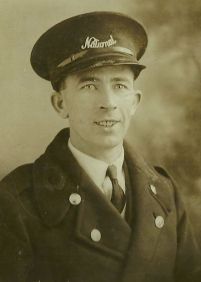
Mark Braund bus conductorGrowing up in Clovelly, Mark was the fifth child in a family of eight. With so many other characters to write about, I did consider leaving Mark out of Barefoot on the Cobbles, yet I found that he needed to be there. Not only would his absence have left an unexplained gap in a run of evenly spaced children but what happened to Mark provided yet another strand that explained the subsequent behaviour of his mother, Polly.
Born in 1906, Mark resisted the lure of the sea and worked for the National Bus Company as a conductor and then a driver. In 1931, he was the conductor on a bus travelling through Horns Cross, when one of the passengers, Joseph Daniels, was killed as he alighted from the bus. No blame was attached to the driver, who was a distant cousin of Mark’s.

In 1935, Mark married Dorothy Good but he fell ill shortly afterwards and died in 1941. The couple had no children. Dorothy outlived him by over sixty years.

 ‘Polly pushed open the door to the bedroom where the boys slept. It always smelled musty, as only a boys’ room can. The clothes Mark had discarded the previous night were pooled on the floor next to the bed that he shared with Nelson. Polly passed her hand across the lad’s forehead. It felt clammy to the touch.’

Barefoot on the Cobbles will be published on 17 November 2018. More information about the novel can be found here. Copies will be available at various events in the weeks following the launch or can be pre-ordered from Blue Poppy Publishing or the author.

#100daysofbfotc Day 36: Independent Street, Clovelly

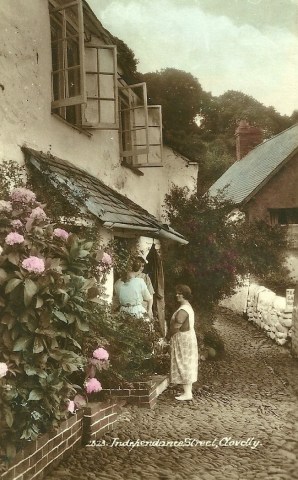
Independent Street Flossie Harris on rightIndependent Street, one of Clovelly’s few side streets, first appears in the pages of Barefoot on the Cobbles when Mrs and Mrs Collins arrive as paying guests in the home of Mrs Stanbury.
There isnt much to be said about a single street, an ordinary street, yet the incidents that took place there are the inspiration for the novel. Those houses, those inhabitants and a particular set of circumstances, all contributed to an appalling tragedy.

‘The path divided; Jack and his sledge swung to the right. Amelia was roused from her musings as they drew up at the far end of a row of cottages. Bright hollyhocks framed the newly painted door and the brass knocker shone.

 ‘You there Mrs Stanbury?’ bellowed Jack, rapping vigorously with the knocker. ‘Your guests be ’ere.’ ’

Barefoot on the Cobbles will be published on 17 November 2018. More information about the novel can be found here. Copies will be available at various events in the weeks following the launch or can be pre-ordered from Blue Poppy Publishing or the author.

#100daysofbfotc Day 35: The Western Front

Fromelles German Federal Archives This file is licensed under the Creative Commons Attribution-Share Alike 3.0 Germany license.

German Federal Archive Used under Creative Commons Attribution-Share Alike 3.0 Germany license

As a significant proportion of Barefoot on the Cobbles is set during the First World War, it needed to contain a scene from the Western Front. This was a challenge. I write by researching my characters’ geographical and emotional backgrounds, not in a vacuum. For the rest of the book, which all takes place in Devon, understanding the physical landscape, albeit with a twenty first century slant, was straightforward. Many of Barefoot’s main characters are female and although I am not a young female, I was once, so I can get inside their heads. I have never visited the battlefields, I have no experience of being on active service and I am not a young male. The thought of composing the battle scene was daunting.

I had already chosen the character, Abraham, that I would use for this part of the book and was interested to discover that he lost his life in one of the lesser known battles, a least from a British perspective (this particular battle has much higher prominence in Australian history). I had already formed an impression of Abraham’s personality but how would he respond to a war zone? I was unable to go to France while I was writing this novel but I read diaries, letters and memoirs written by those who took part in the battle. This gave me a much greater understanding of the landscape and help me to empathise with Abraham. I hope that I have created a believable character and a realistic environment. Despite having serious misgivings about my ability to think and therefore write, from the point of view of a First World War soldier, this is the chapter that I am most pleased with.

There are so many, oft used, words and phrases to describe the Western Front: horrific, damaged, muddy, bloody, terrifying, boring, a tragedy, ravaged; all those things. I think I will leave you with some words from chapter 8. ‘Across the plain where the purple clover once bloomed and the swallows used to dive, men prepared for death in a blood-stained ditch. The lurking mist that accompanied the persistent drizzle obscured the view but the deathly crumps of falling shells resounded as the wire-cutting party were sent into the abyss. From the vantage point of the higher ground, the Germans were set to defend the salient without thought for the cost in human pain.’

Barefoot on the Cobbles will be published on 17 November 2018. More information about the novel can be found here. Copies will be available at various events in the weeks following the launch or can be pre-ordered from Blue Poppy Publishing or the author.

#100daysofbfotc Day 34: Uncle John

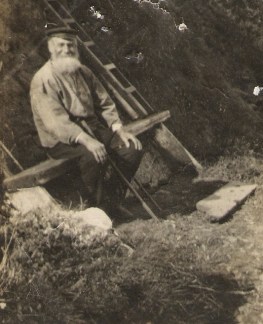
John (Kivell) BraundThere is a passing reference to Uncle John in chapter 4 of Barefoot on the Cobbles, when he assumes the responsibility for his sister, Matilda. Born on 6 October in Bucks Mills, John was the eldest of Albert’s surviving uncles. Like his father, grandfather and brothers, John was a fisherman. In order to distinguish him from the other Johns in the same family, who also lived in the village, he was known as ‘Johnny Kivell’. He took his wife’s maiden surname as a nickname, as opposed to her christian name, which was the method adopted by the other Johns. He was also called ‘Big Johnny Kivell’ and he was renowned for his strength. He allegedly carried a hundredweight of limestone up the street. This is undoubtably an exaggeration but nonetheless, a lifetime of hauling lobster pots obviously required plenty of muscle.

Johnny Kivell and his wife Susan had eight children and they also brought up a granddaughter. He lived all his life in Bucks Mills. After he married, John made his home at number 9, now known as ‘George’s’. In the 1890s he and his growing family moved next door, to number 10, which has now been amalgamated with the adjacent cottages. The family were devout Methodists and John was instrumental in the building of the new Methodist Chapel in the village in 1907. John died on his 91st birthday, in 1930.

 ‘Uncle John says her [Matilda’s] language is something shocking. Her excuse is the devil’s got her tongue. Sounds like she’s gone proper mazed. She used to go to chapel regular, now she’s saying she’s going to hell. Uncle John’s been having a right time of it.’

 Barefoot on the Cobbles will be published on 17 November 2018. More information about the novel can be found here. Copies will be available at various events in the weeks following the launch or can be pre-ordered from Blue Poppy Publishing or the author.