It’s Only Words – more about writing

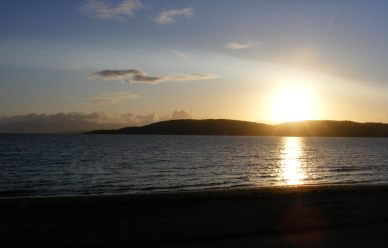
178-9-august-2014-sunset-at-north-ledaigAs the Bee Gees’ lyric continues ‘and words are all I have’. In a week when many around the world are feeling impotent, frustrated, angry, riddled with hatred – so many emotions – I feel the need to adjust the focus. I put my faith in the ripple effect, if I can change the fragment of the universe that surrounds me perhaps it will, by osmosis, have a wider impact. In the interests of realignment, this is not going to be one of my rare political posts, I have said all there is to say before. My post that I wrote during the aftermath of the EU referendum is equally appropriate to the debacle that is the US election.

Today’s post is about progress and positivity but about conflict nonetheless. What weapons do I have to take into battle? What am I able to do and hopefully do well? I write, I stand up and talk to large audiences without a qualm. Sometimes I dress in strange outfits so to do. Mostly, I talk and write about history; how is that relevant to the present, let alone the future? How can I be a warrior for change when I am so rooted in the past? When I applied for college, part of the interview process was to write an essay entitled ‘Why Study History?’ I have largely forgotten the words I used then but they obviously struck home as I was accepted. It was the 1970s, I know that the Irish Troubles and their echoes and reflections of earlier events were part of my response; the details no longer matter. The value of history has not changed. Those who study history are not slightly strange individuals whose work is mere self-indulgence. An understanding of what has gone before is essential to our current well being. That is why those particularly personal branches of history, family and local history are so relevant. By learning where we have come from we become more firmly grounded, we have a sense of belonging, of well-being, we can better comprehend where we are going. We really do need to take heed of George Santayana’s telling statement that heads the home page of my website: “Those who cannot remember the past are condemned to fulfil it”. An understanding of the past informs our actions in the future. It teaches us to analyse, to think critically, to be aware of the need for proof and to be wary of propaganda. The universal lack of these skills has been blatantly self-evident this year.

Well crafted words provoke reactions, emotions, they are powerful weapons for good or evil, they need to be well chosen. So, what have I been writing lately? Most of my output has not been of national import, although I like to think that the way in which I expressed my opinion in a letter to BBC’s Newswatch, was one of the reasons that an extract from it was read. My first two articles for The In-Depth Genealogist’s Magazine have been submitted. The column is about women’s work and will be an eclectic mix of descriptions of household tasks and paid work. So far I have written about making clothes and munutionettes; next stop laundry.

I have been encouraging others to write too. My ‘Writing and Telling your Family’s Story’ course for Pharos has come to an end and I was privileged to have an enthusiastic band of students. The course is being repeated in February; bear this in mind if your New Year’s Resolution is to finally put fingers to keyboard. I have also been writing another course for Pharos, this one is about researching families and communities in the first part of the twentieth century. It starts in January and you can sign up now. These are online courses so can be taken from any location.

Oh and words also have to be accurate. I am pleased to have been chosen as a speaker at Who Do You Think You Are? Live again in 2017. Tickets for workshops (including mine on Tracing your Elusive English Ancestors) can now be booked. Currently, the description of my session does not match the title! I am trying to work out if this is better or worse than two years ago when my ‘Creating your Family’s Story’ was billed as ‘Creating Your Family’ – it did sell out though!

What else have I let myself in for? Our little group of North Devon authors are trialing ‘writers in residence’ sessions in a local café and I’ve volunteered to be the first victim. So I will be in Latte and Lunch café on Bideford Quay on Wednesday 16 November between 10.30 and 12.00 chatting about what I have written and what I am creating now. I will also have details of the output of others from our group. I really don’t want to look like Billy no mates so, if you are local, do come and grab a coffee and make it look like a crowd. As an incentive, the cake is yummy too!

And finally….. The news has just broken that one of my all time favourite artists, Leonard Cohen, has died. There was a man who knew how to weave magic with his words. Even if his musical style is not to your taste his compelling lyrics need to be read as the poetry that they are. Halleluya may be the most well known and it one of my favourites but for today, The Guests seems appropriate.

Armour and Authors in the Kitchen, a Plague Rat in the Hall and a Rock Star in the Corner (warning also contains political comment)

History first but I hope you will read to the end. Yet again I am aware of just how weird my life can be. How many people have a kitchen full of armour and plague rats in the living room? So far during this weird historical week I have watched a fisherman of my acquaintance walk round one of my ‘one-places’ on Channel 4 TV’s Great Canal Journeys. He did a great job and as a direct result there was a noticeable spike in the hits on the Bucks Mills page of my website.

Then there was our Swords and Spindles seventeenth century fun day. Part of the activities involved making cardboard plague rats, so I had to do a trial run first. As I commented on the Swords and Spindles blog, ‘safety glue’ is a description that is only 50% accurate. Safe it may be, glue it is not. Hence eyeless, noseless rats abounded – no chance with the tails and whiskers, I used a reputable brand of adhesive tape to affix those. Our team was out in force to entertain the hordes, well to be honest hordes might be a tad of an exaggeration but those who came stayed for hours and were very enthusiastic. Now the armour lies in the kitchen ready for its annual oiling by my non-resident armourer.

As for the author in the kitchen – my friend and local historical novelist, Liz Shakespeare, has written a novel about the life of Edward Capern, postman poet, who used to walk from Bideford to Buckland Brewer and back on a daily basis delivering the mail. He would wait in the village, writing poetry, before his return journey. Liz’s meticulous research has discovered that it was my cottage where he rested. Liz decided to follow his route and undertake the walk herself. I was proud and pleased to be able to offer her hospitality, reflecting the actions of my predecessor in this house, Mrs Ley. I have to report that no poetry was penned whilst she was here. Her report of the walk is on her website and makes me sound like some sort of domestic goddess. I wish to put on record that I cook twice a year, chutney and Christmas pudding/cake, she just happened to call in on one of these two days. Now to look forward to her book launch in March. What of my own novel writing efforts? Well, some progress is being made. November is allegedly novel writing month and some people are attempting to write 50,000 word novels in thirty days. I won’t be joining them but I do plan to increase my output if I can.

In September, John Reid of Anglo-Celtic Connections announced the results of the annual international competition to find genealogical ‘rocks stars’. I recorded my thoughts on the competition at the time and I was honoured to be listed fourth amongst British and Commonwealth nominees and fifth in Europe. Given that I have never spoken to a US audience and more than 50% of the votes come from the US I was very pleased with this. This year the voting system changed; to feature in the British list you needed to live in Britain and the nationality of the voter was not relevant. This week John issued ‘Rockstar Extra’ lists, showing who would have won under the old system. This was based on the nationality of the voter. Thus those on the British list might live anywhere in the world but were voted for by British voters. Amazingly, this placed me in gold medal position for Britain. I am stunned and hugely grateful to all who voted, thank you.

46333_10150271881405182_2126896_nI normally subscribe to the view that politics has no place on this blog, or on my social media feeds. That has never been their purpose. They are though also a reflection of my life and for the second time this year, I find myself moved to express my profound sadness at the hatred, invective and xenophobia, along with downright ignorance, that I have seen or heard expressed over the last few days. Tolerance and empathy are words that appear to have dropped from the lexicon. I fear for my descendants growing up in a world of hate. If you are reading this, I would ask you to stop and think, show compassion, treat people as individuals not as an amorphous representative of a particular race or religion. Do not believe the un-attributed, unsubstantiated media-fuelled drivel that is being circulated. Peace begins with ourselves and we need it to ripple outwards to those with whom we come in to contact. Fortunately I know that most of my friends feel as I do. If, on the other hand, you are unable to love your neighbour, when ‘neighbour’ extends to all in despair or need, wherever they happen to be, please don’t leave a comment, just quietly take yourself to a different sphere, virtual or literal, from mine because there is no room for you here.. The picture that accompanies this blog is illustrative of peace, love and beauty. Please share the emotions and the picture with those whose lives touch yours. If that makes me sound like a hippie, then guilty as charged and proud to be so.

More Writing, Nature’s Wonders and Family History Events

dscf3381So what has this week brought? A hedgehog joining the two frogs who are crazy enough to inhabit the scummy indentation that passes for a pond in my garden. Luckily this hedgehog was not actually in the pond, though others of its species passed that way, with unfortunate results, before I inserted an escape route. The garden revamp is progressing slowly. I have (that would be the royal I) reclaimed three foot of garden by decimating the privet hedge. I have also had fun creating a nature book for my descendants. I seem to have photographs of quite a number of unidentifiable plants and birds. The latter are mostly waterfowl that do not feature in my not-so-comprehensive ‘Birds of Britain and Europe’ book. Do the authors not know how inconvenient this is?

Writing, of various kinds, has been featuring highly on the agenda. I have been introduced as a forthcoming columnist for the In-Depth Genealogist. Do take a look at what they have to offer. I’ve drafted the first article for my column, which will focus on the work (paid and unpaid) of women. The plan is to alternate between household tasks, home-working and work outside the home; I’m looking forward to it. My Telling Your Family’s Story course for Pharos is into its second week and I’ve already had one online ‘chat’ with an enthusiastic band of participants. Just wish I had time to write up more of my own family history! The course is being re-run in February and Pharos are already taking bookings. They have also begun to advertise another of my courses Discovering Your British Family and Local Community in the Early Twentieth Century. You can sign up for this from anywhere in the world, although the focus will be on British research. If you are local there are still places on Devon History Society’s Nineteenth and Twentieth Century One-place Studies course that I am leading on 18th October. What else can I get you to sign up for? Oh yes, a trip back in time to the 1600s on October 24th. This is ideal for family historians wanting to know more about seventeenth century social history and for families. It will be a great chance to encourage your descendants to engage with history and heritage – there will be armour to try on, pikes to wield, Master Christopher’s treatments to avoid…… A number of you out there (unbelievably, more than one person and a dog read this blog) have said you’d like to come but you do need to register or the organisers will think no one is interested.

Thanks to Exeter Authors’ Association pointing out that my books are available on Amazon.com, as well as Amazon.co.uk, I decided that I needed to create an Amazon.com author profile. Annoyingly you can’t just transfer the one from .co.uk. More technological challenges, especially trying to make my RSS feed (had to look that one up) appear on .com, which you can’t do on .co.uk. By the time I’d done this there was little time left for actually writing anything. #Daisy is expanding but I will give details of that another time.

I must also mention the excellent Devon Family History Society conference last weekend. There was music, there was cake – always a good combination – there were chances to meet friends and browse the many displays. The speakers, Nick Barrett and Dick Eastman, were excellent and really made us think about the future of family history. The future is bringing your family to our event on 24th October!

Clipboards, Cruises and Challenges of the Technological Kind (yes again) and books – always books!

A variety of activities this week. Firstly, I was lucky enough to win a free electronic copy of  Saving Sophie by Sam Carrington. This had to be emailed to me for me to email to my Kindle errr ummmm. This sounded like a technical challenge too far. After diligent research (I Googled for instructions) I was ridiculously pleased to discover that my Kindle does indeed have an email address – well who knew? Not me, obviously. Mission accomplished and I am looking forward to reading my prize.

More peculiarities on the telephone. During a boring car journey I decided to have a conversation with someone who wanted me to change my electricity supplier. Actually he wanted the phone’s owner to change their electricity supplier but was happy to talk to me when I explained that said owner was driving. After moments of incredulity on his part when I confirmed that there really was no gas supply to the property, the next question was ‘do you have your latest bill with you?’ Hands up who carries their electricity bill with them in the car at all times. Then not an unsolicited call but an attempt on my part to find out who could verify my identity for prevention of money laundering purposes, not many people apparently. This needed to be done in a hurry during the day, when those of my neighbours who might qualify were at work. I telephoned to enquire whether a retired accountant/doctor/teacher etc. might be acceptable (the village is stuffed full of those of a certain age). It seemed it had to be someone in office, presumably so that their identity could be checked on a professional register. The person on the other end suggested I popped in to the local bank. I had already explained that I lived in a small rural village. ‘Popping’ involves a six mile drive, many circuits of the block in search of a parking place and a six mile drive home. Oh of course, I could get a bus but not on a Wednesday. Did he have any other ideas? I could use my ‘local’ post office’s checking service. Ah my local post office was, thanks to the wisdom of someone who has never lived here, closed. The man is now sounding desperate, ‘Did I have a church?’ Oh yes, I have one of those just over there, a vicar though is a different matter. One and a half vicars for seven parishes and neither lives here. At this point I gave up, planning to  accost a teacher outside a school, or wait until later in the day. The urban/rural divide never seemed so wide, the chap on the phone clearly had no clue how the other half lived.

Want to know how to arouse fear and suspicion amongst your neighbours? Wander round in pairs carrying a clipboard, pausing now and again to stare meaningfully at a property. In fact, my friend and I were preparing a village trail but I am sure there are now rumours of extensive development or criminal activity.

UTP0263-2TMy Harnessing the Facebook Generation booklet, with ideas for inspiring young people with a love of history and heritage, is finally available in Canada (as well as the UK, Australia and as an ebook). Unlock the Past, for whom the booklet was written, have announced their genealogical cruising plan for 2017-18. If you are thinking about booking, don’t hesitate, you’ll love it.

The season of evening presentations is well and truly upon me. Quite apart from any school Swording and Spindling, did I really agree to do seven presentations to adults (I put ‘adult presentations’ there at first but it sounded a bit dodgy) in one month (one down six to go)? In addition, that is to finishing tutoring one Pharos course and starting another. Incidentally, there is still time to book for the online course  Writing and Telling your Family History, which starts on 28th September. It is lovely to see some familiar names amongst those who are signed up already. One day I will get time to write up more of my own family history!

Rockstars and Unsung Heroes

It is that time of year again when John Reid of Anglo Celtic Connections has the unenviable task of running a poll to find the ‘rockstars’ of the genealogical world. Every year a few people mutter about it being inappropriate or it being unfair because those who are most active on social media usually do best. Let us think about this. Yes, I suppose it does strike a little of reality TV shows but the poll was started to help societies and conference organisers find good speakers and I would challenge the critics to think of a better way to do this. I know of and indeed in the past have been instrumental in compiling, lists of speakers. Sometimes these require nominations before you can be included. Imagine the scenario: it is the committee meeting of the Blankshire family history society Mr Most Boring Speaker in the World has been chairman since 19hundred and frozen to death, basically because no-one wants to stand against him. ‘Oh,’ he slips in under AOB when everyone wants to go home, ‘it is ok for you to nominate me for this speakers’ list again this year isn’t it’. There is no question mark there because this isn’t actually a question. No one dares to demure. His nomination goes through and he is there on the list again. ‘Rockstars’ may not be beyond reproach but it is effective and it does what it is meant to do.

Yes, people who are active on social media do tend to do well but perhaps this is because today’s ‘rockstars’ need to be able to enter this world and it could be argued that social media is part of being active and helpful and a star in the modern genealogical firmament. I always encourage people to vote, which is embarrassing as my name is on the list and I am really rubbish at self-promotion. Of course I do this because I hope people will vote for me, it wouldn’t be honest to say otherwise – I am after all just the tinsiest but competitive. Primarily though, I do it because I want people to vote (whoever they vote for), that way the competition is more valid. There is no kudos in coming first if you win with five votes, three of which are from your parents and your cat (NB especially with this year’s tightening up to prevent multiple voting, cats are not eligible to vote). Most importantly, I want people who actually understand the family history world to be the ones doing the voting. I wish there was a way of excluding votes from mates down the pub and only allowing these who are members of genealogical or historical societies, or at least involved in family history to vote but there isn’t. The only way to counter the votes from the uninformed ‘mates’ to is encourage the genuinely knowledgable to vote, people who have heard the nominees speak, have read their books, who follow their blogs and so on. If people vote for me I want it to be because they genuinely feel I have made a valuable contribution not because I’ve asked them to and they have no clue about what a family historian actually does.

The names on the list are for the most part, internationally known. Each year I like to also pay tribute to the less well known. Those who keep small genealogical societies going. Those who give freely of their time to someone who comes wandering round their local graveyard looking for ancestors. Those whose telephone rings when a speaker has dropped out at the last minute and yes, they will go and talk to a dozen people for very little reward. Of course some of the ‘big name’ nominees do this too but there are many whose names will never reach this list but without whom the family and local history worlds would be the poorer. You can only have people at the top of the mountain if there is a solid base underneath. If you are part of that solid base then I thank you.

So yes please vote and encourage others to do the same but vote for those who you feel genuinely deserve it. Those whose writing make you feel informed or entertained or both. Those whose talks you will go to just because it is X speaking and you know you will enjoy it, even though you have no interest in the topic. Those who are generous with their time and expertise and not just after the financial rewards. Vote because you understand what these people have given to the family history world. If that means you vote for me, well thank you but if you are involved in family or local history, or history per se, please vote for someone (or several someones) and help to make this competition valid and vote to make your genealogical rockstars the ones who do well.

Thank you John for organising this once again. As ever, I am honoured and humbled to be on the list.

Maps, Surveys, Displays and Other Historical Randomness

I’ve been here, there and almost everywhere over the last few weeks. Trying to find various far flung places is not always easy and sometimes our not so trusty sat-nav fails us (see below for some of the gory details). Mapping our ancestors and the communities of the past is just as important as knowing where we are going in the present. Although it is not a course of my own devising, I am pleased to be tutoring the ‘Maps and Surveys – Locating your Ancestors’ course for Pharos Tutors, starting on 9th August. There may still be spaces, so please do book. The course is primarily about British sources but it is all online, so those of you with British ancestors can study it wherever you are in the world. Apart from a general overview, we shall be looking in detail at one of my favourite sources – the 1910 Valuation Office Survey, as well as the tithe maps and apportionments and enclosure maps. Do join me!

I certainly needed a map on several occasions recently. When we go out swording and spindling, which we’ve been doing a great deal lately, we take a vehicle of suitable dimensions – you try getting eighteen pikes (no not the fish) into a Nissan Micra. So not in the Nissan Micra then but for reasons we won’t go in to, in a vehicle with no way of charging the sat-nav. This means that, in fear of the battery running out, we delay turning on the sat-nav until we get to the point where we are almost lost. Sat-nav set for a school in south east Devon, via Crediton, to avoid as much rush hour traffic as possible and we are on our way. We get well beyond Crediton before we feel the need to turn on the sat-nav for advice. We follow Sally sat-nav’s exhortations to go right, left and ‘turn around where possible’ with only a few slight hiccups when we reach roads that have been built since she was last updated. Suddenly we appear to be miles away from where we should be. I resort to a map (once a girl guide …..) and we arrive with minutes to spare – good job I am genetically programmed to leave what is normally ridiculously early for any event. Later we realise the problem. Even though we were well past Crediton, we had asked to go via Crediton and that is what the sat–nav was trying to make us do – lesson learned.

Amongst all the school bookings have been talks to grown-ups. One was at Devon Rural Archive. We needed a map to find that one too but what a gem. A really great set up, a full house and a very appreciative audience for my seventeenth century gardens presentation. A visit is definitely recommended. Then there was a talk to a Somerset WI who were celebrating their 85th birthday, a yummy birthday tea as well on this occasion! We decided to combine this trip with picking up a ‘collection only’ chest of drawers that I had purchased on eBay. Again we have the large pike-carrying non sat-nav charging vehicle. First finding the industrial estate where the chest of drawers is hiding, comparatively straight forward. Next, getting the chest of drawers into said vehicle – Ah. I had sensibly measured the space at home where it was to go and it fitted. Had I measured the vehicle. Err…. that would be a No. Well, in the end, with much manouvering, we inserted said chest of drawers into said vehicle. Had it been a centimetre larger in any direction we would have been in trouble.

Our local history society has been on display at various events in the village and beyond lately. A few days ago we were part of an open day at a nearby iron age hill fort. Actually getting to the display area by the fort was a logistical nightmare. We needed to get a table, display boards and various books and papers to what was effectively the middle of nowhere. You will note also that this was a hill fort, the clue is in the name. Our Iron Age forebears liked to have a commanding view. We did find the nearest point on the road with the aid of maps, directions and signs erected by the organisers. Sat-navs are no use for hill forts surrounded by woods. We then had to get our equipment along the footpaths to the hill fort. Chris manfully agreed to risk life and vehicle by driving along a bridleway but it was still a jolly long way to transport our belongings. I can verify that I am just too short to comfortably carry a pasting table half a mile without it banging on the uneven ground. Having been blown away at the recent Buckland fete, on this occasion, we were adamant that our display needed to be under cover and out of the wind. Sure enough, we were provided with a large tent, with jolly, retro curtains. Unfortunately, this was a hot day with no sign of wind or rain, so any perusal of our display was limited by how long the public could endure the heat and humidity in the tent! Luckily, we were helped by landrover transport on the way back to civilisation.

We now seem to have summer at last, just as I planned to do things to the house and garden that require temperatures of under 30 degrees, not that I am complaining. I also have visits from small persons to look forward to over the next couple of weeks – hurrah!

Harnessing the Facebook Generation: ideas for involving young people in family history and heritage and other news

Busy, busy, busy. What with the job I must not mention, now almost completed and Swording and Spindling like mad it has all been very hectic. It is especially satisfying to have spent five days in schools in the last fortnight and to have been so well received by staff and students (they all asked us back next year – what more could we ask for?). In the same fortnight, two talks for adults as well, so much for ‘retirement’.

TDSCF3191hings have taken a bit of an Australian turn lately. I spoke to the Society of Australian Genealogists about causes of death. Sadly this was not an all expenses paid trip; my presence was merely virtual. In addition, the Australian company Unlock the Past have published another of my booklets Harnessing the Facebook Generation: ideas for involving young people in family history and heritage, something I feel very strongly about. It can be purchased from the publishers.  It is also available as an ebook and it should soon be on sale in print form from UK and Canadian outlets. It is always exciting to hold the actual copies in your hand, even though you know what is inside! Australia are going to have their own Family History Expo in October; the down under equivalent of RootsTech or Who Do You Think You Are? Live. Unfortunately I won’t be going but if you are in the right hemisphere, do give it some thought.
I have also been ‘Racing’ for Life in aid of Cancer Research. Despite the temperature suddenly soaring to 10 degrees above anything I had encountered so far in what has laughingly passed for our summer, I survived. I was under strict instructions not to ‘race’; really difficult when you are as competitive as I am. So no trying to come in under 40 minutes as I usually do. Still I did get round the 5km in under three-quarters of an hour, so I guess I just have to grow old gracefully and be content with that. There is still time to sponsor me.

Rubbing Shoulders with Authors and some Technological Challenges

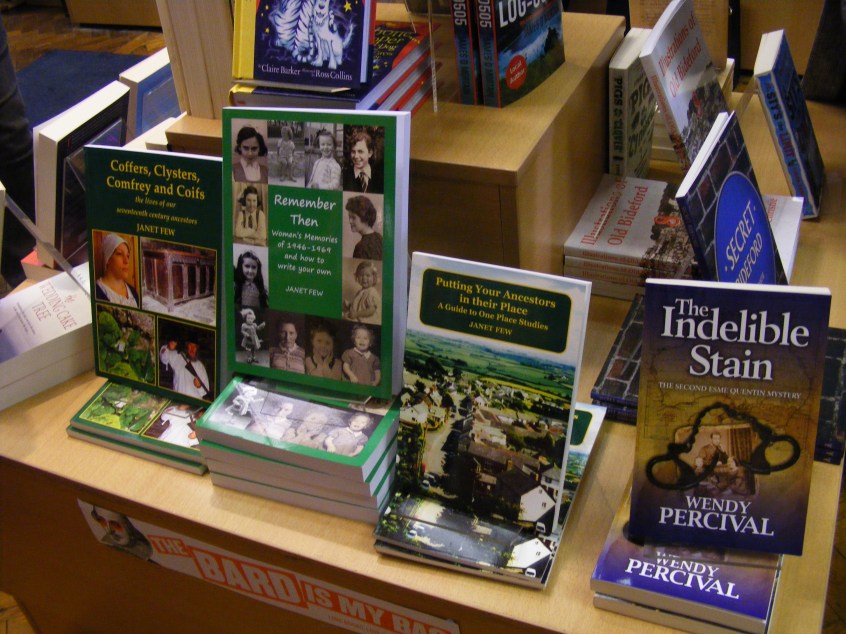
DSCF2644.JPGTo commemorate the 400th anniversary of Shakespeare’s death (allegedly) and also World Book Day, I spent an afternoon in our local independent book shop, Walter Henry’s of Bideford, in the company of other local authors. Putting an author in a bookshop really does need some kind of government health warning, especially as they also sell rather lovely wooden toys. I just wanted to rush out and buy copies of everything all the other authors had written. You can see the one I did buy in the picture alongside some of my own but there are several more on my wanted list.  It was lovely to see our books on display. Thanks to fellow author Ruth Downie for the honourable mention in her blog about the afternoon. This week I have been in author mode, working on my forthcoming online ‘writing up your family history’ course for Pharos Tutors and putting the finishing touches to my booklet about how to inspire young people to get involved in family and local history. You would not believe how many historical novels there are for children and I could only include a selection.
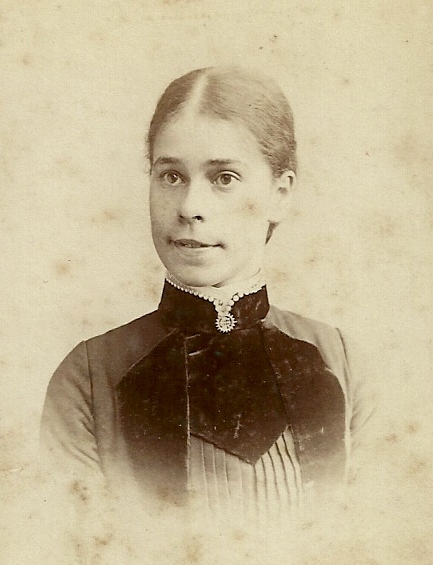
I have also, possibly, been inspired by my fiction writing colleagues to branch into the world of novel writing. It was either write a book or do an MA in experimental archaeology. I decided the latter may have to wait as it a) costs money and b) might be too restricting a time commitment. So research has begun, watch this space but probably not for a very long time.

Then there have been some technological challenges. I was invited to make a short video for World Book Day and to mark the launch of Libraries Unlimited. This was a bit of a performance, not least because I was in seventeenth century clothing and wanted a background that lacked things like light switches. I was born in the wrong decade for video taking to be an everyday occurrence and I don’t have a mobile phone. That’s a lie, I have an ‘emergency phone’ that does just that, makes phone calls and inevitably is never about my person in an emergency. It is pay as you go and I think I have put £15 of credit on it since I moved 10 years ago. Anyway lacking a phone or tablet, I enlisted my partner in crime to take the video using my camera. The first take was quite good but we had turned the camera sideways and I had no idea how to turn the resulting video back the right way round (I later learned that this can be done). Not wanting to give my adoring public cricks in the neck we did take 2. Not quite a good as take 1 but take 2 it had to be as by then I was near the deadline and I still had to work out how to send it to the person who was collating them. That took two attempts too.

Then finally finding the frustration of my internet dropping out at vital moments (which it has been doing for the past few months) I telephoned my provider and spent half an hour allegedly ‘fixing’ this. This involved a great deal of turning the router on and off, watching for lights on the router and reporting back to the person on the other end of the phone. Imagine the scenario, no mobile phone remember so I am on the landline in bedroom one. ‘Please turn off your router’, I am asked. I leap off the bed run along the landing corridor, launch myself at the spare bed in bedroom three. Stand on my head to get under the bed (which is heavily populated by my book stock), turn off said router, rush back down the corridor to report that mission is accomplished. ‘Have the lights gone out?’. Back down the corridor, launch self at bed, stand on head, etc. etc. This scenario was repeated numerous time over the course of the next half hour. At the end, some improvement in internet consistency but it has been decided that I need a new ‘super fast’ (that will be a relative term) router so the whole procedure was a waste of time.

Is the Twentieth Century History?

The obvious answer is ‘of course it is’; yesterday is already history. Certainly anyone who knows anything about current UK secondary school history teaching would be forgiven for thinking that the twentieth century is the only history. Students seem to leap from conflict to conflict – the second world war, the cold war, the Arab-Israeli conflict, the Irish troubles and if they are really lucky, that dim and distant event, the first world war. For community historians, the twentieth century has an appeal because it is within living memory; oral history projects abound. Why then do family historians seem reluctant to venture further forward than the 1911 census? Some adhere to the concept that the twentieth century is somehow ‘too recent’ and therefore not worthy of investigation. Perhaps this is partly because we often already know the names of our twentieth century ancestors, without the need for research. Are some put off by the difficulties of researching in the twentieth century? Records are subject to closure, people migrate or emigrate more frequently, there are just more people. Then what do you do with any information that you might find? Plastering the names of living second cousins twice removed, whom you have never met, all over family trees is, for most, an unacceptable invasion of privacy.

So do we just go back to the comfort of the nineteenth century and beyond? No; your twentieth century ancestors are every bit as much part of your family tree. Perhaps begin with your direct ancestors who are no longer living. Try this exercise:- Make a list of all parents, grandparents, great-grandparents and so on, who were alive between 1900 and 1940 but who have since died. If they were born during this period, make a note of when, otherwise write their age in 1900 next to their name, so you can appreciate their life stage at the time. You will probably be surprised by how many names are on this list. If you have photographs of any of these ancestors you may like to create a montage, otherwise keep the list of names handy. These are important links in your chain of ancestry. You owe it to them to find out more about their lives, their communities and what they experienced.

So here are my direct ancestors who were alive between 1900 and 1940 – no great aunts, great great uncles or cousins – just my direct line.

Cyril Albany Braund 1915

Gwendoline Catherine Smith 1925

Albany Braund 12

Clara Dawson 1858-1949 possibly taken 1886

Clara Dawson

Elizabeth Ann Hogg 14

Frederick Herbert Smith 6

Ivy Gertrude Woolgar 7

Fanny Thomasine Bishop 31

John Hogg 45

Herbert Havet Smith 34

Catherine Seear 34

Philip James Woolgar 45

Clara Dawson 42

Elizabeth Buckingham 67

Elizabeth Pearson 72

William Howe 69

Anne Stratford 66

Mary Archer Bowyer 69

Eliza Seear 77 – she only just makes it, Eliza died on 1 January 1900

Anne Balls Bulley 65

Writing that felt a little like reading the Roll of Honour on Remembrance Day. Perhaps that is how it should be. These nineteen individuals are my personal role of honour, as are all those who died before 1900. I shall be holding them in my mind as I begin my online course on Tuesday ‘Discovering Your Ancestors’ Communities in the early Twentieth Century’. I still have a couple more spaces in the ‘room’ if you would like to join in and feel you can cope with Google+.