Being Ambassadorial and Finding Lost Cousins

LondonBadges_640x640pxAmbassadorThis week came the news that I have been accepted as an Ambassador for the first London version of the genealogical extravaganza that is RootsTech. This major genealogy show has been a staple of the world’s genealogical calendar for nine years but in October, it will be coming to the UK for the first time. Now the US version of the show is over for 2019, details of what the UK event will offer are starting to be revealed. So far, some of the speakers have been announced and British family historians will recognise several people who have been prominent on the family history speaking circuit for many years. Early Bird pricing is on offer until 9 April, so don’t leave it too late to book. Shortly, I will be running a competition to win a three day pass, so keep an eye out on this blog and my Facebook and Twitter platforms for details.

Although I had recently managed to stop myself compulsively checking my Kindle sales figures for Barefoot on the Cobbles on a daily basis, I did notice a distinct spike in sales this week and I reached the dizzy height of #8 in the biographical fiction category. For an independently published first novel, which is not being given away or offered at a drastically reduced price, this is big – well I was excited anyway. The downside is that I have now returned to the hourly refreshing of my page to see what is happening to my sales figures. These new readers have found their way to Barefoot thanks to a review in the Lost Cousins newsletter, which is run by Peter Calver. Peter does not normally review historical fiction and indeed professes not to like it, so I am particularly grateful to him for bending his rules for me, on the grounds that the story emerged from genealogical research and is about real people. It is interesting that his review has had a particular impact on my sales in Australia. I am now hoping that one or two of these new readers will leave a review (please – I have been known to grovel). Sadly these sales do not deplete my large stash of paper copies, currently residing in my living room. Still, I am hoping that I may reduce the pile a little when I am signing copies in Barnstaple W H Smiths on Saturday.

Peter suggested that, in return for reviewing my book, I might upload my ancestors to his Lost Cousins database. As someone who tries to keep abreast of developments in the family history world, I was aware of Peter’s regular Lost Cousins newsletter but to be honest, I hadn’t considered adding my ancestors to his database. Like the newsletter, contributing to the database is free, although you make a small contribution if you wish to contact those whose ancestry you share (paid up members can however contact you, even if you don’t contribute). It works like this. You upload the details of your ancestors, as they appear in the 1881 census (or 1880 for those in the US). Then you can search for others who have listed the same people. You can also add details from the 1841 and 1911 censuses, although it is advised that you start with 1881. So far, I have only uploaded the details of my own direct ancestors, although there are options to add other individuals you might be interested in. If you do decide to upload, please use the link in this blog there is no prize for me if you do but your entry will be credited to my recommendation.

Regular readers of this blog will be aware of my distinct lack of cousins, so I was a little sceptical of finding matches but it has been an interesting exercise and already one match is showing. It only took me about half an hour to upload all my direct ancestors who appear in the 1881 census, although, to be fair, I had previously done all the searching and had copies of the census entries already. 1881 is too early for any of my grandparents but all eight great grandparents, fourteen of the sixteen great great grandparents and three 3x great grandparents were alive at the time. I know all the descendants of the great grandparents (all six of them!). I have a pretty complete picture of the descendants of the sixteen great great grandparents (my 3rd cousins), although I think a few of the Smiths may have slipped through. My knowledge of the descendants of my 3x great grandparents is less complete, so the three alive in 1881 may well bear fruit and this is where the match I have comes from. I plan to add my entries from the other censuses and also the details of my children’s ancestors.

With the rapidly increasing popularity of DNA testing, the need to trace our family history forwards, as well as backwards, has never been more important, yet so many of us do not focus on more recent research. Uploading to Lost Cousins may well help with this. I have just finished guiding the latest cohort of students through my online Tracing your Twentieth Century Ancestors and their Community course for Pharos Teaching and Tutoring. I am afraid you will have to wait until next year for this one to run again, although places are filling up fast for the Writing and Telling your Family Story course that starts in April. I am also speaking about Twentieth Century Research at Family Tree Live and bookings are now open for this event. Once booked, you can reserve places at the lectures of your choice. Also on the subject of Twentieth Century research, in case you missed the announcement, we now know that FindmyPast will be releasing the English and Welsh 1921 census in three years’ time. As someone who remembers waiting for the 1881 census to be released, I suddenly feel very old.

I am still adding to the write ups of my own ancestral research. I should stress that these are very much works in progress and summaries of research, not necessarily fascinating stories. This week I have uploaded the Woolgars of Sussex.

Thank you to those who have asked about our BeingEdward story. We have been busy with family visits and Martha will be blogging again shortly. This week’s campaign is to encourage the government to stop the inappropriate detention, segregation and seclusion of those with autism and learning difficulties in mental heath units, institutions that are patently not designed to meet their needs. For those who have the time to explore our BeingEdward world further, take a look at this webinar, which introduces you to PDA, which is Edward’s condition.

Of Death Certificates, DNA and other Updates

The arrival of the huge pile small number of death certificates following my ‘beat the price rise’ ordering fest has focussed my mind on various branches of my family tree. I had fun investigating the ‘crushed by a train’ death. Safe to say, considerably more fun than was had by the poor victim at any rate. I have, after more than four decades of researching, begun to put some of my family history narratives online. I have to stress from the outset that these are not beautifully written stories. Instead, they are working documents, intended to set out all the known facts on a particular family, together with the sources for each piece of information. Some do have smatterings of local and social historical context added. So, if you are related to the Dawsons of Essex, the Bulleys of Norfolk, The Oughs of Cornwall, the Pepperells of Devon, the Hoggs of Northumberland, the Meads of Yorkshire, the Seears of London or several other related families, there is something there for you and more will, eventually, follow. Do take a look at the many other surnames of interest that are listed, who knows, we may be related.


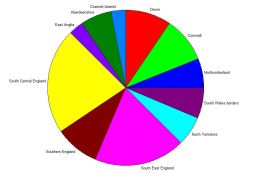
My DNA estimates June 2017

My regional breakdown based on the documentary evidence

At Christmas, I persuaded Martha to take a DNA test. I was pretty convinced she hadn’t been swapped at birth, so I was certain who her parents were but I was interested in the profile for the ancestry that we do not share. We chose to go for Living DNA as I had been impressed by how accurately my own regional breakdown that they had provided matched the documentary evidence. I wrote about this here. Finding matches was not a priority. I must stress that I am a DNA dabbler and am by no means an expert. I do however understand a few basic principles (I think). I know that we inherit exactly half our DNA from each of our parents (except when it seems we don’t – see below). It is a random half, which is why siblings differ (unless they are identical twins) so in theory it would be possible to inherit nothing from one grandparent (although this would be very unlikely) and the further back you go, the likelihood that no DNA has come down from a particular ancestor increases greatly. I also know that if I am 20% Cornish, Martha will not necessarily be 10% Cornish. She may have inherited more or less than 10% of my Cornish DNA, or indeed none at all. I also understand a little about migration and population movements. You often see posts on online forums complaining that such and such a DNA company hasn’t shown any of granny’s Irish ancestry. This is ignoring the fact that many Irish families were Scottish or English in the sixteenth and seventeenth centuries. It also ignores the fact that these ethnicity estimates are just that, estimates. This is an emerging science and should really only be regarded as a bit of fun.


Martha Living DNA regipnal breakdown actual

Martha’s Living DNA regional breakdown

Nonetheless, when Martha’s regional breakdown arrived it was, to put it mildly, weird. She is now wearing lederhosen and eating sauerkraut. These are my thoughts, maybe my DNA expert friends will chip in and find holes in this argument. If half Martha’s DNA is mine, I am interested in the other half. It has been very easy to identify the majority of this. Martha shows as being 34.6% Germanic; I have none. She also has 5% more Scandinavian ancestry than I have, 4.5% more from South Central England and 0.2% more from Northumberland. That adds up to a whopping 44.3% that we do not share, which, as I understand it must represent what she inherits from her father. From whom, I am reasoning, she has also inherited 5.7% of something I can’t identify because it overlaps with mine. I have been following the documentary trail since before Martha was born and I am a reasonable way back on all lines.

Martha documentary

Martha’a regional breakdown based on the documentary evidence

This ethnicity profile in no way reflects what I know of her father’s ancestry, which I would expect to reflect elements from the Channel Islands and Scotland as well as a significant portion from Gloucestershire. The latter came from the Forest of Dean, which is known as historically being a remote community, very unlikely to have been influenced by European in-migration within the genealogical time-frame and beyond. Martha’s paternal aunt has tested with Ancestry and her ethnicity estimate more closely reflects the documentary trail, with nothing Germanic at all.


We have been eagerly awaiting Martha’s matches to appear and today they arrived. It may be a relief for her to know that she is who she thinks she is as she matches both me and her aunt, who uploaded her Ancestry results to Living DNA, with the expected relationship. I still don’t understand why, according to Living DNA Martha and I share 47.72% of our DNA and not 50% but I have a great deal to learn about DNA.

For those of you who have taken an interest in our BeingEdward story. I am pleased to report that the number who have read my original post has now reached four figures; so thank you so much to all who read and shared. This week, Martha has posted some insights into what life with BeingEdward means.

Oh and if you were wondering about the progress of the ‘spring’ cleaning, it may be better not to enquire. I have however now discovered that I have enough candles to survive any post-apocalyptic catastrophe, providing I can work out how to run the laptop using candle power.

A Page from the Genealogical Birthday Book: Catherine’s Story

As promised, back to the family history today. Like most genealogists with UK ancestry, I have spent the last few weeks revisiting various branches of my family tree, making sure that I didn’t feel the need to purchase any more birth marriage and death certificates before the price rise. Inevitably, despite having a pretty comprehensive collection, there were a number that just fell into my virtual basket. I am not prepared to disclose precisely how many I am awaiting. I am consoling myself with how much I have saved, not how much I have spent. You know how it is – oh, I could just find out what that baby died from – click here. Annoyingly, I appear to have ordered at least one that I already have but that’s the fault of my inadequate filing system. Whilst I was compiling my very long modest certificate shopping list, I decided to make a note of all the anniversaries of my children’s direct ancestors in the form of a birthday book. I have only started from 1837 (the period of civil registration) and inevitably, there are far more births than deaths or marriages but it is interesting reading. Not much goes on in April or June. 23rd January looks like a dodgy day for our family, with no fewer than five deaths, including Catherine, who is the subject of this post.

Catherine’s birthday is today. I know that from the birthday book that I have created. Apart from my children and grandchildren, I am her only descendant. From my mother’s stories, she was not the most approachable person in the world, certainly not the archetypal cuddly granny. This is not a beautifully crafted story, it is merely my attempt to record the facts. I wish I had a more rounded picture of her life but this is the best I can do.

Catherine Seear 

Catherine Seear

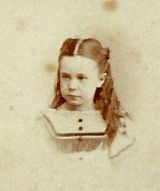
Catherine Seear c. 1871

My great grandmother, Catherine was born on the 2nd of February 1866 to Frederick and Ann Balls Seear née Bulley. The family called her Katie, or Kate. She was their second child; her elder sister, Annie Ellen, lived just a few weeks in 1864. Catherine also had a half-brother, Frederick Rickard Seear, who was nine years old when Catherine was born. Three older half-sisters had also died in infancy. As the only daughter of five to survive, I wonder how her father treated her. The address that is given on Catherine’s birth certificate is 3 Market Terrace, Bridge Road, Bethnal Green, Middlesex.[1] This address does not appear to have existed and may be 3 Newmarket Terrace, Cambridge Road. Catherine’s family were comfortably off; her father was a master grocer with a shop in Hackney High Street, East London. Catherine’s younger brother, Richard, was born when she was thirteen months old.

Catherine Seear c. 1874

Catherine Seear c. 1876

By 1871, the family were living at 105 Grafton Street in Mile End. Her father’s business had expanded; he was a tea dealer employing eighteen men and there were two live-in domestic servants.[2] The family moved again fairly quickly because when Frederick made his will on the 4th of October 1875, he gave his address as 36 Cawley Road, Hackney.[3] In 1881, Catherine and her family were living at 11 Albany Road, Lea Bridge Road, Leyton, Essex.[4] Nothing is known of her education and she may have had private tuition; she spoke very good French.[5]

On the 22nd of February 1884, Catherine’s father, Frederick, died of angina, presumably a stroke, at 11 Albany Road. Despite imaginative searching, his widow, Anne and children Catherine and Richard cannot be found in the 1891 census.[6] When Catherine married the following year, she gave her address as 24 Eastbank, Stamford Hill, Hackney and this address is occupied only by a servant in 1891,[7] so the family may have been away from home. They apparently did enjoy cruises and pictures survive of someone purporting to be Catherine that were taken in Berlin, so they could have been on an overseas trip.[8]


Believed to be Catherine Seear. The right hand photograph was taken in Berlin.

On the 7th of June 1892 Catherine Seear married her first cousin, Herbert Havet Smith at St. Thomas’, Hackney. The witnesses were her brother, Richard and Eliza Smith, who was either Herbert’s mother or sister.[9] Their daughter, Edith Katie was born on the 8th of April 1893 and lived for just three days. The number of short-lived girls in the family might suggest some genetic problem. Edith Katie died from marasmus, which is a failure to thrive, akin to malnutrition.[10] She was buried at Abney Park Cemetery.[11] Their son, Frederick Herbert, my grandfather, was born on the 2nd of December 1894 at 32 Braydon Road, Stamford Hill, Middlesex. At the time, Herbert Havet was described as a corn salesman.[12] Frederick was apparently sickly as a child[13] and was not baptised until the 17th of October 1897.[14] The baptism took place at Stamford Hill Congregational Church[15] so it is likely that the family were still connected with the area at this date. This alliance with non-conformity is unusual in the Smith and Seear families and indeed Catherine Smith née Seear is reported to have become a Catholic in later life.[16]

In 1901, together with their young son, my grandfather Frederick Herbert (Eric) and Catherine’s mother, Anne Seear née Bulley, Catherine and Herbert were living at 159 Osbaldston Road, Hackney.[17] Despite having her mother to live with her, Catherine never spoke of her.[18] Anne was to leave this property to Catherine, along with furniture, plate and jewellery, in her will.[19] Herbert Havet was a cornbroker[20] and is thought to have travelled to India and China on business.[21] Several oriental artefacts remain in family possession. About 1908 Herbert and Catherine moved to ‘Lureka’, Westcliffe-on-Sea, Essex.[22] They later moved to Cambridge Road, Westbourne, Bournemouth, Dorset. Despite the ‘servant problem’ of the 1930s, they kept a butler, Basil and their granddaughter particularly remembered the red tulips in the garden.[23] By 1935 were at ‘St. Ann’s’, Bournemouth; this property had been converted into flats before they lived there.[24]

Catherine Smith nee Seear and Gwen Aug 1925

Catherine Smith née Seear and her granddaughter, Gwen

Catherine was described as being standoffish and undemonstrative, very ‘upper crust’ and a little like Queen Mary. She always sat on an upright dining chair with her crochet or knitting, with its steel needles on her lap. [25] The family were comparatively well off and owned other property in the Bournemouth area,[26] apart from the house in which they lived.[27] Apparently, Herbert put their properties into Catherine’s name to save death duties, thus she was able to give away much of their wealth to the Catholic church. Allegedly, they were left with nothing but mortgages, an eiderdown, two cushions and an orange box for a table. If this is the case, then Herbert re-couped some of the money before his own death, twelve year’s after Catherine died. [28]

When Catherine died of a heart attack,[29] reportedly whilst replacing a light bulb,[30] on the 23rd of January 1938, they were living at 5 Branksome Gate, Western Road, Bournemouth.[31]


[1]    The birth certificate of Catherine Seear, 1866, from the General Register Office.

[2]    1871 census for 105 Grafton Street, Mile End, Middlesex RG10 568 folio 68.

[3]    The will of Frederick Seear proved 1884, held at The Principal Probate Registry.

[4]    1881 census for 11 Albany Road, Leabridge Road, Leyton, Essex RG11 1726 folio 5.

[5]   Information from the late Gwendoline Catherine Braund née Smith, granddaughter of Catherine Smith née Seear.

[6]    Census indexes for England and Wales at http://www.findmypast.co.uk.

[7]    1891 census for 24 Eastbank, Stamford Hill, Hackney, Middlesex RG12 183 folio 46.

[8]    Information from the late Gwendoline Catherine Braund née Smith, granddaughter of Catherine Smith née Seear. Photographs in the possession of the late Alan Seear.

[9]    The marriage certificate of Herbert Havet Smith and Catherine Seear, 1892 in family possession.

[10]  Death certificate of Edith Katie Smith 1893 from the General Register Office.

[11]    Abney Park Cemetery burials index website                           http://freepages.genealogy.rootsweb.com/~abneypark/abneyy.html

[12]  The birth certificate of Frederick Herbert Smith 1894 from the General Register Office.

[13]   Information from the late Gwendoline Catherine Braund née Smith, granddaughter of Catherine Smith née Seear.

[14]   Baptismal certificate of Frederick Herbert Smith, in family possession.

[15]    Baptismal certificate of Frederick Herbert Smith, in family possession.

[16]    Information from the late Gwendoline Catherine Braund née Smith, granddaughter of Catherine Smith née Seear.

[17]    1901 census for 159 Osbaldston Road, Hackney Middlesex RG13 213 folio 87.

[18]    Information from the late Gwendoline Catherine Braund nee Smith, granddaughter of Catherine Smith née Seear.

[19]    The will of Ann Balls Seear proved 1918, held at the Principal Probate Registry.

[20]    The marriage certificate of Herbert Havet Smith and Catherine Seear 1892, in family possession.

[21]    Information from the late Gwendoline Catherine Braund née Smith, granddaughter of Catherine Smith née Seear.

[22]    Information from the late Gwendoline Catherine Braund née Smith, granddaughter of Catherine Smith née Seear.

[23]    Information from the late Gwendoline Catherine Braund nee Smith, granddaughter of Catherine Smith née Seear.

[24]    Information from the late Gwendoline Catherine Braund née Smith, granddaughter of Catherine Smith née Seear.

[25]    Information from the late Gwendoline Catherine Braund née Smith, granddaughter of Catherine Smith née Seear.

[26]    29 Surrey Road and ‘Hawthorn’ 40 Alumhurst Road.

[27]    Probate account in association with the will of Frederick Herbert Smith, proved 1957, in family possession.

[28]    Information from the late Gwendoline Catherine Braund née Smith, granddaughter of Catherine Smith née  Seear. Probate account in association with the will of Frederick Herbert Smith, proved 1957, in family possession.

[29]    The death certificate of Catherine Smith née Seear 1938, in family possession.

[30]    Information from the late Gwendoline Catherine Braund née Smith, granddaughter of Catherine Smith née Seear.

[31]   The death certificate of Catherine Smith née Seear 1938, in family possession.

Of Oven Cleaner, Ancestor Chasing, Genealogy Courses and Procrastinating

Well I guess this is where I say Happy New Year. New starts, new resolutions new things to look forward to. For those of you for whom life can be a struggle, I wish an easier time for you in 2019. I hope it can be a year when the world is more compassionate and more tolerant of others’ differences. We can be polite and forbearing, even if we do not always agree.

I was lucky enough to do some wonderful things in 2018 and there are some excitements on my 2019 horizon, although I am hoping to find time to relax more and actually see my house occasionally. So what’s been happening chez moi? Firstly, the inevitable seasonal lurgy has left me lacking in energy and sounding very deep and interesting, or as we say, croaky. Notwithstanding, I have begun the spring cleaning. Ok, so this is probably spring cleaning 2010 but spring cleaning nonetheless. With the assistance of the fisherman of my acquaintance, to whom grateful thanks are extended, I have embarked on the kitchen. The lack of energy thing (and I’ll be honest, the fact that cleaning isn’t exactly my number one favourite activity) means that it has taken several days but the end is in sight. Cupboards have been emptied and de-cobwebbed – I live in a house made of mud, of course there are cobwebs. I have unpacked two boxes that hadn’t seen the light of day since I moved in in 2006. These have now been rationalised into one box. Said box is probably still full of stuff I neither need nor am likely to use but hey, it is one less box for my descendants to dispose of when I go to meet the ancestors. I have discovered that I have a lifetime’s supply of oven cleaner. Who am I kidding? At the frequency that my oven gets cleaned it will probably last until 2130.

martha regional breakdwon from documentary evidenceAfter a lovely time with two fifths of my descendants, I used the lacunae between Christmas and New Year to cough a great deal and revisit some family history. This was partly inspired by a recent meeting with the full range of my second cousins at the funeral of the last of my mother’s cousins. This officially makes me the oldest generation now, that is a sobering thought. I was also motivated to look at my daughters’ ancestors, in preparation for LivingDNA results for one of them. I found my own regional profile that I received from LivingDNA closely matched the documentary evidence and I have already written about this. This is the prediction for my daughter and we will see how that compares with the actual results in a few months’ time.

numbers of ancestorsIn the course of working out what I was expecting, I also calculated how many of my direct ancestors I have discovered in forty two years of research. Not a bad haul for someone whose grandparents were born in the 1880s and 1890s, especially as I am 95% sure who the missing 3 3x great-grandparents are, which has a knock on effect on the totals in earlier generations. Whether I shall ever be confident enough to ‘ink these in’ is another matter.

I’ve had fun revising a couple of courses. Firstly, the next presentation of my five week online course for Pharos Teaching and TutoringDiscovering your British Family and the Local Community in the early C20th’, which begins in a couple of weeks. There are still a few places left. What a great start to your family history new year, to revisit your more recent ancestry and look at their lives in context. I am also going to be leading an ‘Introduction to Family History’ day course at Crediton Library on January. It has been a few years since I last did this and plenty has changed, underlining how fast-moving our hobby is. Contact the library directly if you are interested in this one.

And what of the writing? I hear you ask. Well, if you aren’t asking, why not? Firstly, I have made a significant dent in my pile of Barefoot in the Cobbles boxes and sales online are going well. Please can I reiterate my plea for you to buy paper copies directly from me, from my lovely publisher or from an independent bookshop near you, rather than pressing that tempting little ‘buy it now’ button. Obviously, if you are outside the UK, or want a copy for your e-reader, please do press away. Some lovely reviews are coming in – more are always welcome  and I have been re-energised to get back to work on book two. This was abandoned during the frenetic Barefoot marketing phase but I have picked up the threads of this work-in-progress. The researching is proving fascinating. I don’t want to give too much away at present but I’ve been delving into the records of Westminster School and looking at seventeenth century licenses to pass beyond the seas amongst other things. Actual writing though has stalled. I have sharpened my pencils in preparation (I don’t write text in pencil – although I do use pencil for my notes). I have put a pile of reference books in a box but procrastination abounds. I am even tempted to spring-clean another room to put off the moment when I have to produce something that resembles narrative – maybe next week.

Day 24 #bfotc sources

The final day of the ‘advent calendar’ focusing on some of the historical/genealogical sources that I used in the writing of Barefoot on the Cobbles.

Exminster aslylum

Several of the characters in the novel experience periods of mental ill-health and some of them spent time in the county asylum. I went to the Heritage Centre in Exeter where the admissions’ registers are held. The amount of information that is given varies with date but I was able to view details of my characters’ diagnoses, home life, treatment and progress whilst they were in the asylum. There were lengthy accounts of their behaviour and the symptoms that had led to their commital. Many of the personal records also give detailed physical descriptions. No photographs of Aunt Matilda survive. Everything that the reader learns of her appearance is based on what I could glean from her asylum register entry. Although I didn’t use this for the novel, an excellent website on the history of mental health is the Museum of the Mind, which focuses on Bethlem Hospital. These records are both fascinating and tragic; they are high up on my list of favourite sources.

More information about Barefoot on the Cobbles can be found here. Copies are available at various events and at all my presentations. You can order from Blue Poppy Publishing or directly from me. Kindle editions are available for those in the UK, USA, Australasia and Canada.

Day 23 #bfotc sources

Day twenty-three of the ‘advent calendar’ focusing on some of the historical/genealogical sources that I used in the writing of Barefoot on the Cobbles.

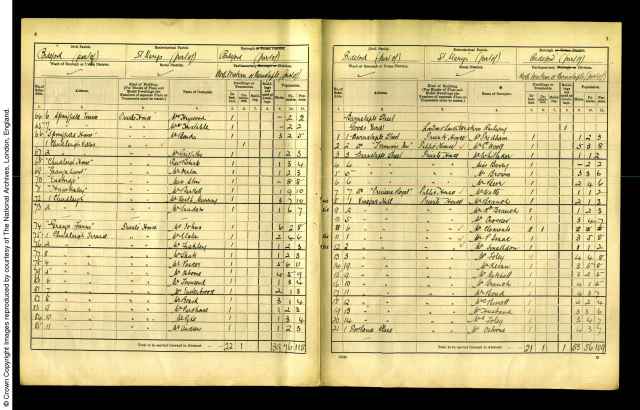
GBC_1911_RG78_00781_0155

An Enumerator’s Book List

When trying to work out precisely where my characters lived, I made use of the census returns, particularly the 1911 census. This is a key resource for family historians but many do not venture beyond the household schedules. The key data providers, that most people use in order to access these records, allow us another opportunity. Having found a return for a single household, in the usual manner, it is possible to opt to view ‘related images’. Of these, I find the one described ‘enumerator’s book list’ very useful. This is pretty much what its name suggests. It is a list of the properties on that enumerator’s route. Not only are these lists normally in a logical order, with properties in close proximity next to each other on the list but occasionally the lists give the name of a property that is merely described as ‘village’ on the household schedule. The ways of accessing these lists differ between data providers. I use FindmyPast but I understand these lists can also be viewed on other sites.

I spent hours agonising over a series of census returns, the 1939 register and street directories, in an attempt to identify exactly which house the Powells inhabited in Bideford. This was made more difficult because, historically, several properties bore the same name. In fact, chapter 2 stalled for many months during a period of frustration because I could not associate the family with a particular property. In the end, I am fairly confident that I have selected the correct one. It was probably a good job that I did not write the novel in the right order and I was able to work on later chapters whilst I was waiting to feel comfortable with chapter 2.

More information about Barefoot on the Cobbles can be found here. Copies are available at various events and at all my presentations. You can order from Blue Poppy Publishing or directly from me. Kindle editions are available for those in the UK, USA, Australasia and Canada.

Day 19 #bfotc sources

Day nineteen of the ‘advent calendar’ focusing on some of the historical/genealogical sources that I used in the writing of Barefoot on the Cobbles.

CapturePrevious advent posts have mentioned the importance of local archives, local history books and relevant websites, when an author is trying to recreate the geographical context for a novel that is set in the past. When my character, Polly, moved to East-the-Water, Bideford, to take up her position with the Powell family, I needed information about the area. An excellent summary of life on the eastern bank of the Torridge appears on the Human History pages of the East-the-Water website. Page 8 was the most relevant to my story but the other pages also provided interesting background.
More information about Barefoot on the Cobbles can be found here. Copies are available at various events and at all my presentations. You can order from Blue Poppy Publishing or directly from me. Kindle editions are available for those in the UK, USA, Australasia and Canada.

Day 16 #bfotc sources

Day sixteen of the ‘advent calendar’ focusing on some of the historical/genealogical sources that I used in the writing of Barefoot on the Cobbles.

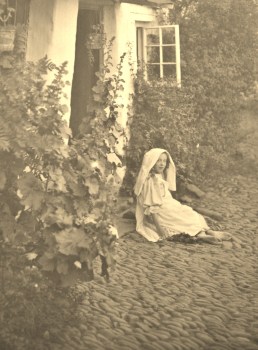
Option 2 - CopyWhen a novel is firmly set in a recognisable geographical location, it is important to exploit the resources of the experts. By using Clovelly as the backdrop for much of the book, I was placing my characters in an iconic village that, is well-known far beyond the immediate area. I was fortunate to be able to have access to the expertise and archive material of Clovelly Archive and History Group. Their Facebook group answered an eclectic range of queries from me. It was a real benefit to be able to ask such things as ‘Who was in charge of the post office?’ and get an almost instant response. I was able to see one of the paper discs, with its political slogan, that had been left on the lawns of Clovelly Court by the militant suffragettes. I was granted permission to use one of the archive’s evocative photographs of Daisy, barefoot on the cobbles, on my cover.
I would encourage all those who are trying to recreate a real place in a past era to approach local history groups and archives. They will be your harshest critics if you get it wrong but will be generous with their time and knowledge in order to help you to get it right.

More information about Barefoot on the Cobbles can be found here. Copies are available at various events and at all my presentations. You can order from Blue Poppy Publishing or directly from me. Kindle editions are available for those in the UK, USA, Australasia and Canada.

Day 15 #bfotc sources

Day fifteen of the ‘advent calendar’ focusing on some of the historical/genealogical sources that I used in the writing of Barefoot on the Cobbles.

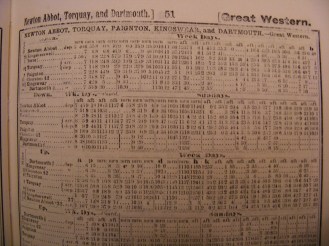
DSCF1035On day three I mentioned one of the ways in which I researched the railway journeys taken by my characters when traveling between Clovelly and Torquay. Not only did I need to investigate likely routes but also the timetable that might have applied at the time. Fortunately, my library includes facsimile copies of Bradshaw’s Railway Guides. My copies are for 1922, 1923 and 1938 and I suspect that there may have been an adapted timetable during the war but I felt that these were close enough and at least this gave me an indication of how long each leg of the journey may have taken. My copies were reprinted in 1985 by Guild Publishing and there are some available on the second-hand market.
More information about Barefoot on the Cobbles can be found here. Copies are available at various events and at all my presentations. You can order from Blue Poppy Publishing or directly from me. Kindle editions are available for those in the UK, USA, Australasia and Canada.

Day 14 #bfotc sources

Day fourteen of the ‘advent calendar’ focusing on some of the historical/genealogical sources that I used in the writing of Barefoot on the Cobbles.

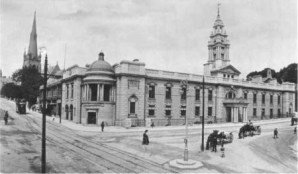
Torquay Town Hall HospitalTwo of the longest chapters in the novel are set in war-time Torquay. Torquay was the home-town of the crime writer Agatha Christie. She does make an appearance in the book, although you might not recognise her. Like my character, Winnie, Agatha worked at the Town Hospital in Torquay, nursing convalescent servicemen. The BBC website includes a recording, in which Agatha reminisces about Torquay during the First World War. There are additional links that give further information about life in Torquay at the time.

More information about Barefoot on the Cobbles can be found here. Copies are available at various events and at all my presentations. You can order from Blue Poppy Publishing or directly from me. Kindle editions are available for those in the UK, USA, Australasia and Canada.