The United Kingdom and our Ancestors

Ok, so I am almost as far away from Scotland as I could be, given that I am in the UK. Nonetheless I have taken quite an interest in the history-making Scottish independence referendum; fuelled perhaps by my recent visit to Scotland. Media of all kinds have brought this campaign to a world-wide audience and anyone who considered this issue realised that the impact of the result, whatever the result might have been, would stretch way beyond Scotland itself.

Of course being an historian, especially one with an interest in the seventeenth century, I can’t help wondering how the bringing together of England and Scotland might have affected our ancestors. It was of course a two stage process. The accession of James I/VI in 1603 created the Union of the Crowns of England and Scotland; from then on we shared a monarch, almost by default. On that occasion it was England who were reluctant for their parliament to be subsumed in that of Scotland, rather than vice versa. Had, as King James no doubt expected, the union of the crowns been also an immediate union of parliaments, would Edinburgh rather than London have been the seat of the united government?

Despite abortive attempts during the seventeenth century (1606, 1610, 1667 after the Restoration and 1689 under William and Mary), it was to be a century down the line before the parliaments of the two countries were united. An Act for a Union of the Two Kingdoms of England and Scotland was finally passed in 1706 and came into effect on 1 May the following year. This was in part prompted by the potential constitutional crisis that was on the horizon, as a less then healthy Queen Anne, who had singularly failed to provide an unequivocal heir, neared the end of her life. In 1706 the decision was in the hands of a few. In 2014 a huge majority of the population of Scotland, male and female, of all income brackets had their say.

113 4 August 2014 Wallace Monument from Stirling Castle

View of the monument to William Wallace, hero of an earlier attempt at Scottish independence

I think of the ancestors that I can name, who would have been alive at the time. A young John Braund, living in Devon (wish I knew where). His future wife Florence (I am not even sure of her surname). The Madicks and the Elfords, also of Devon and the Oughs of Cornwall. How would the new regime have affected them? Well I strongly suspect that they were blissfully unaware of what was going on. It may have been days before they were aware of a change of monarch, let alone a change of regime. Would the Act of Union eventually have been announced from the pulpit or on a news sheet? John Braund and Peter Elford may have been able to read, the latter was an overseer of the poor but I think it is unlikely that they had much understanding of the workings of parliament, united or otherwise. I doubt that any of my ancestors had the vote until 1832 at the earliest.

I do also have ancestors from Northumberland. I don’t know the names of those who lived there in the seventeenth and early eighteenth century but they are every bit as much my ancestors as those who I can name. I feel that this may have had more of an impact on their lives. To me, putting our ancestors in the context of the national events of their time is an integral part of being a family historian. So how did the Union of the Crowns or Parliaments effect my ancestors? I don’t know but it is right that those questions should be asked.


Of Diaries, Domestic Issues and a little about Rock Stars

DSCF1701I am still playing catch up after my summer away, hence the lack of blog posts. Things have been taking off on the local history front and it has been very satisfying to unite more than one set of distant relatives who have origins in my village. I also now have on loan, just over there, a diary written by a farmer from my parish between 1830 and 1864. I am hugely grateful to the owner for entrusting me, a complete stranger, with such a treasure. I can’t wait to examine it in more detail. There are one line entries for each day commenting on farming duties, the weather, local funeral, emigrations and chapel activities. Some girls like diamonds, me I would chose this over jewels any day. Happy smiley one-place studier here! Similarly, yesterday my inbox offered me two invitations for Saturday, one a free pampering day at the local outlet village and two, a change to survey a local hill fort – no contest!

The society for one-place studies has been shortlisted for a grant to develop a community mapping project and we would be really grateful for your votes. More details can be found here and voting takes place via this link.

While you have your voting fingers at the ready, there are still twenty four hours or so in which to vote for your favourite genealogical rockstars. This is an annual opportunity to acknowledge those from the English speaking genealogical world whom you think deserve recognition. I was amazed and flattered to find my name included as one of 150 nominees who were considered worthy of consideration. There are some seriously big names on there, so I am humbled to be listed in the same breath as some of these genealogical heavyweights; do vote for your favourites. First of course you have to decide what you think warrants rock-stardom, there are some hints on the voting instructions. Is it someone who delivers inspiring, entertaining and informative presentations? Someone who works tirelessly and often inconspicuously, to further the cause of family history? Maybe your rockstar has written a ‘must have’ book or maintains an informative web-presence. Often more than one of these criteria will apply. I voted for those who I feel help to enthuse others about matters historical. It is all quite light-hearted, at least as far as I am concerned but it is a chance to show your support for anyone who you think has made a noteworthy contributing to the genealogical world over the past year.

Now to matters domestic. There have been some strange household incidents lately. Firstly a new item of furniture is to be ‘delivered to my kerbside’. ‘Good luck with that one’ I thought – living where I do behind another house and up a footpath, I do not have a kerbside. Then there was trying to track down the dongle that was, according to the instruction ‘supplied’ with the not yet smart enabled TV. The conversation went something like:-

Representative of a well known electrical retailer: ‘we don’t supply those’

Us: ‘but it says ‘insert dongle open bracket, supplied, close bracket’ in the instructions’.

Representative of a well known electrical retailer ‘but we don’t supply them. You will have to pop into your local store’

All very well representative of a well known electrical retailer but ‘popping’ involves a 32 mile round trip. Still not resolved this one.

Then there are the spam emails that have been arriving at a local history archive alias that re routes to me. Am I gullible enough to think that a local history archive will have purchased nine tickets to see Peter Pan in Bournemouth?


Solving a C20th Historical Mystery

Regular readers will know that I am being ably assisted by a group of lovely ladies who are writing about their experiences of the period 1946-1969. This month’s topic is schooling and as I can’t expect them to do something that I wouldn’t do myself, I have been waxing lyrical about ‘the best days of my life’. This has been made easier by membership of Facebook groups for my cohorts at both primary and secondary school. One of my lasting primary school memories was of being chosen to read part of the commentary for a film that we were making about our school and its surroundings. My portion was about the local lollipop man and the resulting 35mm film was being sent to a school in New Zealand. Wouldn’t it be great, I thought, to trace the film fifty one years later. None of my contemporaries recalled this at all and I began to think I had imagined it. In any case New Zealand has many school and I had no idea which one.

Then, as part of my writing, I raided the souvenirs’ box. Something that I had retained was a letter to parents from the headmaster, written three years after the film was made. Amongst other things, it referred to Mr Head who had taught at my school for a year in 1961 before returning to New Zealand. Now I at least had a teacher’s name. It also mentioned that Mr Head was then in the Pacific Island of Niue. Googling ‘Mr Head teacher New Zealand’ and the like is not awfully successful as up come all the head teachers in the world, or at least in New Zealand. Niue however is a different matter and it turned out that Mr Head was not only a teacher but an active campaigner against landmines and had been awarded for his work. Wikipedia even provided me with a list of schools at which he’d served, of which there were a great many. Unfortunately no dates were mentioned and I needed to know where he was in 1963. None of the schools’ websites had a ‘past staff’ section or indeed any kind of ‘history of the school’ page. I was close but not close enough.

By this time I had identified some of Mr Head’s descendants on Facebook but I was unable to send them a message as they weren’t my friends. Next I sent out a plea to family historian friends in New Zealand. Amongst other information, one was able to use the New Zealand equivalent of ‘Friends Reunited’ and find that a profile had been created for the late Mr Head. This time I was able to identify the appropriate school. It just shows where the right contacts and a little detective work can get you. I would like to be able to say that a copy of the film is now on its way to me but things aren’t that good. I have used the school’s website to send a message asking if they have a reel of 35mm film lurking in the back of a cupboard. No response so far but maybe it will depend on whether on not the person who sees the message is history minded. Watch this space.

And on the subject of school I am now off to a school reunion. I am going via a talk about seventeenth century witchcraft (best not to enquire) at The Society of Genealogist. More of this later.


X his mark

How often do we think about levels of literacy in the past? And what indeed is ‘literate’? Before compulsory schooling, which incidentally arrived on the Isles of Scilly some 50 year before the rest of England (don’t say you don’t learn anything useful reading my ramblings), there was far greater emphasis on the ability to read. Writing was dangerous. Give the hoi polloi the ability to write and they may write something subversive. You are giving them the power to spread sedition. Reading on the other hand enables them to read the Bible and thus improve themselves. There have been many academic studies on literacy levels at different points in time. Often these are based on the ability to sign one’s name in a marriage register. There is of course a very large gap between making an approximation of one’s name and fully functioning literacy but it is difficult to find a better measure. There are instances of those who are perfectly capable of writing signing with an X instead – who knows why? We could use other lists of signatures, such as tax lists as an indicator of literacy levels. Some records specifically mention whether or not an individual can read or write. For example, I have seen this on some lists of prisoners and emigrants.

DSCF1597Just because the measures of literacy are crude, it does not mean that it is not worthy of examination. For local historians it can be fascinating to study how literacy levels appear to change over the decades. If you are interested in a rural area, how does this compare to a town, or to another village in a different part of the country? Family historians too may like to consider how recently different branches of the family were able to read and write. What about book ownership in your family? Do you come from a long line of bibliophiles? Do you still have any books owned by your ancestors? These are often useful if they are inscribed as prizes or gifts. Books gained in this way may not however be representative of their literary taste! Have you made a list of books you enjoy? Have your favourites changed over the years? This is part of the life story that you starting writing yesterday having read my ‘W is for Writing it up’ blog (you did start didn’t you?).

A final thought on ‘X’ as a signature substitute – have you considered why people’s marks may be other than an ‘X’? I have an ancestor called William whose ‘mark’ was an ‘M’. This makes perfect sense when you think of situations in which this individual may have seen his name written down. He would be the opposite side of a desk from an ‘official’ writing ‘William’, The first character William therefore saw, from his side of the desk, looked like an ‘M’.

W is for Writing it up – get that history recorded

We all plan to do it don’t we – write our memories, write that local history book, write up our family history. It is all so easy to put it off, ‘I will do it when I retire’, ‘I will just finish the research first’. Well, don’t be deluded, you will never ‘finish’ and as for more time in retirement – any retiree will tell you it just doesn’t work that way.

Writing up your research into a coherent narrative helps it to become appealing to your nearest and dearest. You know, those close to you who adopt a glazed visage when you enthuse about great great grandad’s first cousin once removed. Writing up aspects of local history enables you to share with others who are also interested. You may know it is a ‘good thing’ but the mechanics worry you. ‘I was never any good at writing’, ‘I don’t know where to start’. There is help out there. Take a creative writing course, or better still a writing up your history course – I run face to face courses for local and family historians and others do the same in different regions. There are also similar online courses available. There are books on how to write family and local history (see below). There are groups that can help and encourage you. Read what others have done to get ideas of what you do and do not, want to emulate. Use the spelling and grammar checkers on your computer, use the Thesaurus.

You are not writing a three volume novel – start small. Begin with the history of your house, not the whole town. Write about granddad’s war experiences, not the history of the whole family since Tudor times. Don’t just think in terms of writing a ‘book’. You could create a blog, a short article, a video, a presentation or an exhibition instead. Give yourself a deadline, maybe an anniversary that needs to be celebrated. Do it, not next year not next month but NOW. Make a start – you don’t even have to start at the beginning. Once you put fingers to keyboard you will be surprised how easy it is.

Beckett, John Writing Local History (Manchester University Press 2007)
Curthoys, Ann and McGrath, Ann How to Write History that People Want to Read (Palgrave Macmillan 2011)
Dymond, David (ed.) Researching and Writing History: a guide for local historians (Carnegie Publishing Ltd 2009)
Titford, John Writing up your Family History: a do-it-yourself guide (Countryside Books 2011)

S is for Smith’s Crisps and the Spanish Armada – family rumours – are they true? #atozchallenge

Those rumours – every family has them. Frequently they seem to relate to money in Chancery or Coats of Arms (almost certainly, if you are entitled to these you would know about it). Then there is the three brothers story. This one usually involves them all adopting slightly different spellings of the same surname. Well it happens but rarely as the result of a conscious decision by the individuals involved. Oh and the ‘came over with the Conqueror’ story. Maybe your ancestors did. Are you likely to be able to prove it? – No. When manning (or womanning) a family history stall you can pretty much guarantee that you will get at least one claim of descent from the Normans who arrived with William I. A late dear friend even had a sweatshirt made with the slogan ‘I have Norman Ancestors’ on it. In his case I had no grounds to disagree – his surname was Norman!

Smiths advert c 1920sTwo of the stories in my own family both begin with S. Firstly, my great grandfather, or maybe his father, was supposedly offered a half share in Smith’s Crisps for £50 and turned it down saying it wouldn’t catch on. Likely to be true? Well the surname was Smith – that’s a start. We certainly didn’t inherit Smith’s Crisps millions and in any case they long since sold out to a conglomerate. The Smiths were corn factors, grocers and tea dealers, sounds promising. For years I traced my own Smith ancestry. I discovered who founded Smith’s Crisps and I traced his ancestry too, as best I could. Geographically the families were close but I could not nail the link. I turned to other lines. Then when my daughter, at the time aged twelve, was in hospital she wanted to do some family history so together we revived the Smith research. It was at this point that I had another conversation with the friend I mentioned under ‘K is for Kinship’. Instead of saying ‘I am related to the Smith’s of London’, this time I added the Smith’s Crisps connection. Back came the reply ‘That is my Smith line.’ One of her relations, who fortunately had an unusual surname, was married to the Smiths of Smith’s Crisps and she had the vital piece of documentation that allowed me to make the connection. I can’t actually prove the £50 part of the story but my great grandfather and the founder of Smith’s Crisps were first cousins.

The other rumour is one that has been perpetuated in many branches of the Braund family. Allegedly the Braunds were of Spanish descent and arrived in Devon following the wreck of a Spanish Armada ship. This story appeared in the Evening Standard in 1928 and is dragged out by the media every silly season. It is even mentioned on interpetation boards in the North Devon village of Bucks Mills, home to many Braunds. True? No, total bunkum. There were no Braunds in Bucks Mills until the nineteenth century. ‘But’, say those who rather like the sound of this story, ‘The Braunds are quite swarthy and Spanish looking.’ Well, perhaps Braunds from elsewhere then? Nope. Braunds can be found in North Devon more than a hundred year before the Spanish Armada and in Lincolnshire for 300 years before that. Added to this, no Armada ship was wrecked of that part of the coast, despite ‘Armada’ cannon (that look distinctly Napoleonic in date) in a local park.

Do you have family stories? Often there is a grain of truth in these. They are certainly worth investigating, as long as you do not have great expectations of them being accurate in every particular. The fun is in the chase not the outcome. I greatly enjoyed unearthing the truth behind a friend’s family rumour that she was connected to the chocolate making, prison reforming Quaker Frys. If you want to hear that story you will have to wait until I am giving my ‘From Darlington to Wellington: the sad story of Isabella Fry’ talk!

R is for Referencing #familyhistory #forensicgenealogy

Under ‘E is for evidence’ I wrote about the importance of evidence for historians. Diligent historians not only seek sources that will provide corroborating evidence for statements that they make but they will cite those sources equally diligently. In the world of family history there should be no vital event on a pedigree, or statement in a family story, that is un-attributed. You may know where a piece of evidence came from but does anyone else? When you are no longer the custodian of your family history, someone else should be able to follow your research trail. References serve to authenticate your work and enable others to understand how you reached your conclusions. Without references you might as well write a work of fiction. Without evidence you probably are writing a work of fiction!

Lately there has been a upsurge in courses and articles stressing the need for genealogical proof and this is laudable. The phrase ‘forensic genealogy’ has being bandied about, as if this were some form of elite genealogy. There is even a Council for the Advancement of Forensic Genealogy. What is forensic genealogy? It appears to mean the creation of a pedigree backed up by evidence and cited references. I certainly have no argument with this methodology, which is one I both advocate and adopt. In 2010 Colleen Fitzpatrick wrote ‘Forensic genealogy has established itself as the modern approach to family research, for hobbyists, for the legal profession, and for law enforcement.’ This approach is not new, it is not ‘modern’, it is merely common sense. Forensic genealogy is in fact just good genealogy and many of us have been practising it for decades. Surely forensic genealogy should be the only form of genealogy – we are back to John Titford’s ‘genealogy for grown-ups’ (see ‘I is for Internet Genealogy’). Why would anyone want a pedigree that is based on guesswork?

There are those who say that all this obsession with evidence and with original sources and their citation makes a hobby seem like a great deal of hard work. Thoroughness is a necessary part of the process. Anyone who sets out to trace their family tree surely wants just that – their family tree, not someone else’s, not one that is inaccurate or cobbled together.

The sad thing about the advocacy of forensic genealogy and the provision of courses about genealogical proof is the accompanying suggestion that there is another sort of genealogy. ‘Hey, I’m only an amateur, I’m not one of these forensic guys, I don’t need to worry about evidence/sources/citations/proof.’ Well sorry but yes you do. If you want a pretty chart or that work of fiction I mentioned, go ahead, create your pedigree without reference to your sources, write a family history lacking in citations but this is not genealogy, forensic or otherwise.

P is for Patchwork and other Heirlooms #family history #atozchallenge

The history of our families comes down to us through documents that we may need to seek out, through memories (our own and those of others), through places and through objects. Many of these artefacts are only significant if their stories are known, preserved and perpetuated. You may be aware of the significance of various ‘heirlooms’ but do your nearest and dearest? Items that may seem of no value, financially or aesthetically, become precious if their background is recorded. Do therefore take time to make a note of why objects in your possession have a family significance. At least then, when you are no longer their custodian, your descendants will be conscious of what they have inherited. Any decision that they then make to keep or discard items will be an informed one.

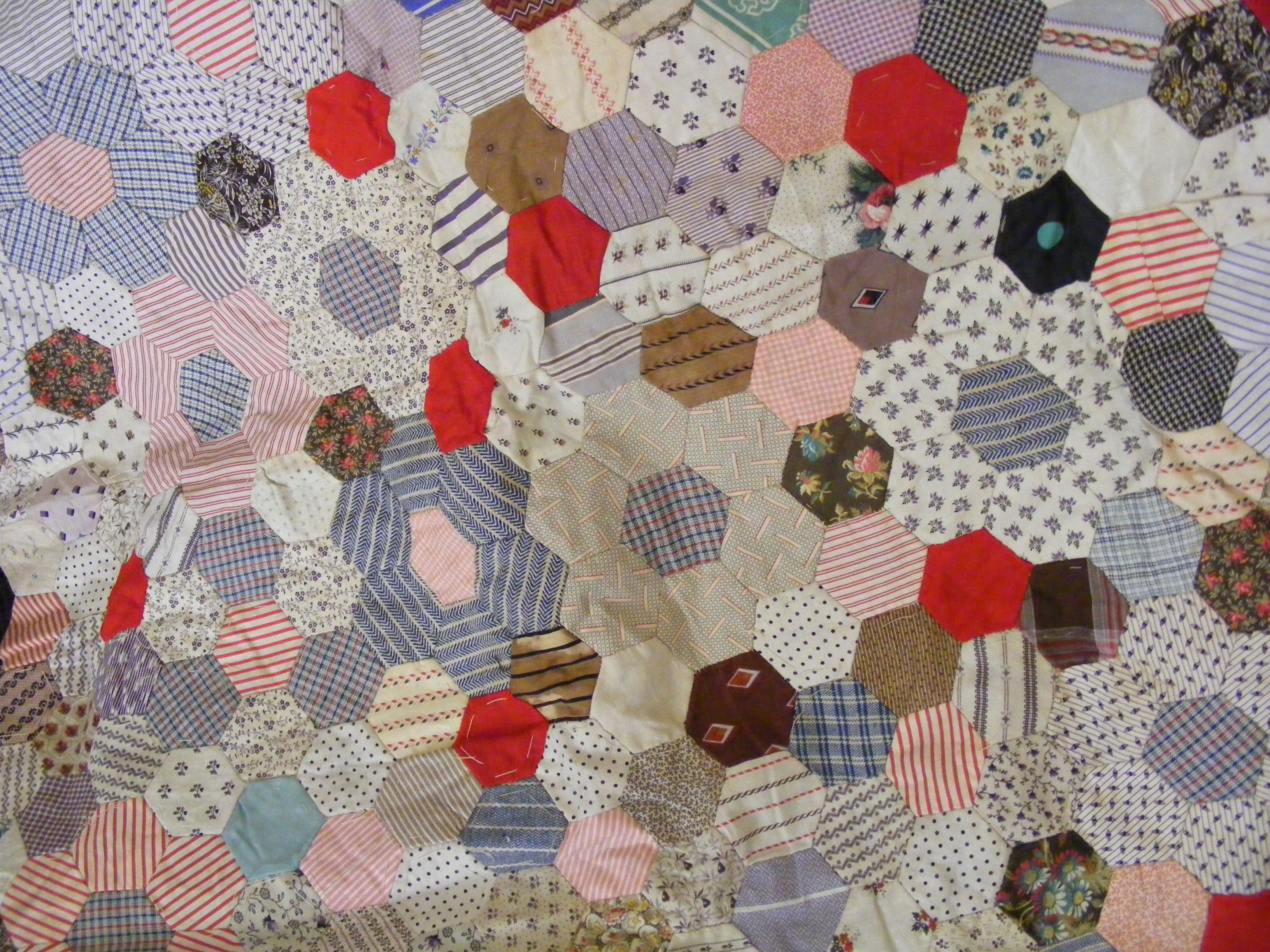
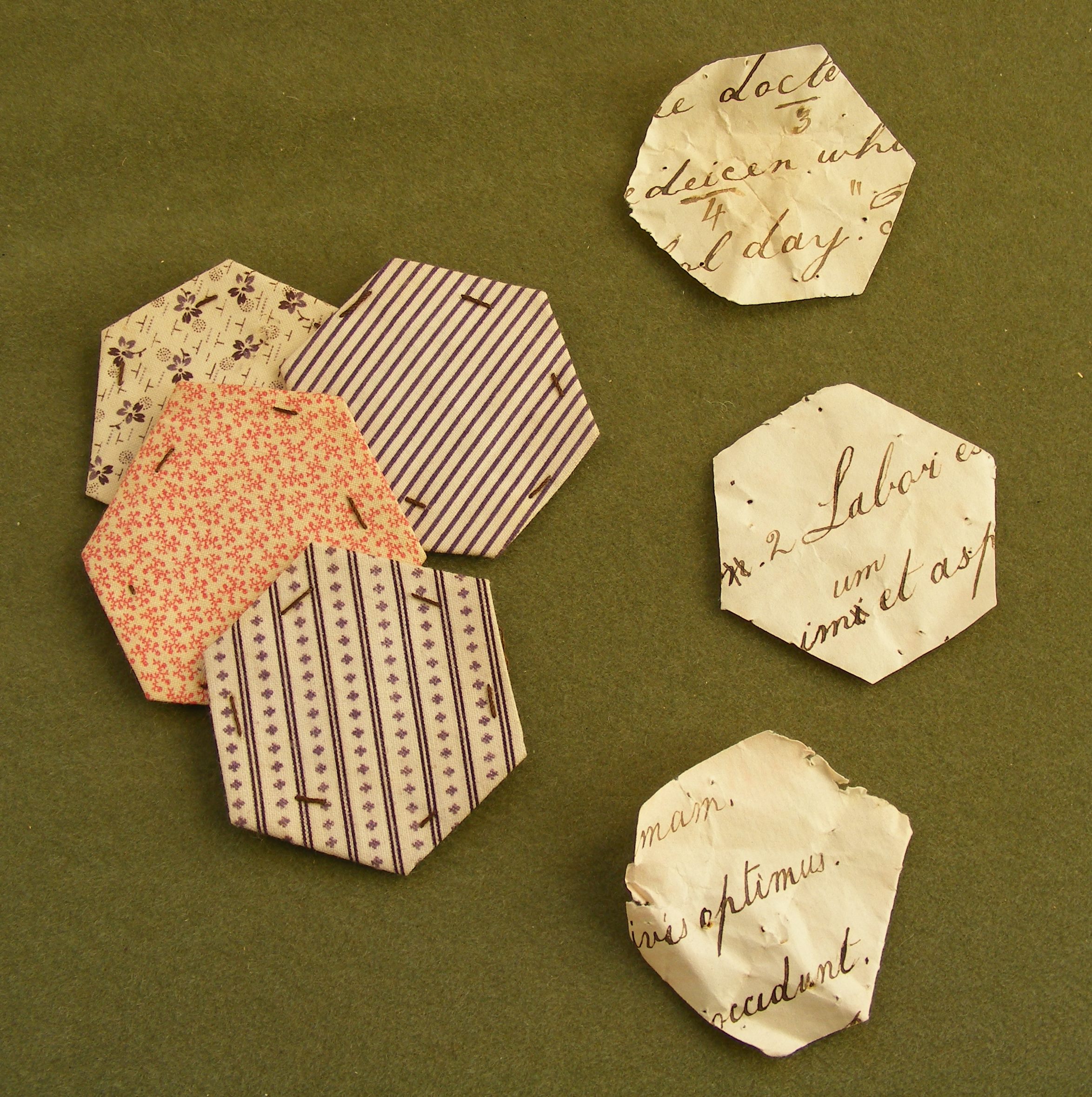
DSCF1583I am fortunate enough to have inherited two patchwork quilts, neither of which is quite complete. One was made by my mother in the early 1960s. It contains many materials that I remember from my early childhood. The other is much older, begun by my great grandmother in the 1880s. Most of the fabrics are tiny, floral, Victorian prints. Some of the papers are still within the hexagons; these have been cut from an exercise book of a similar era. My grandmother and mother also contributed to this quilt and I have begun to finish it by hemming round the edges. DSCF1588I shall deliberately leave a little undone, allowing my children and grandchildren (okay so the grandchildren have to get a little older before we trust them with a needle!) to work on the quilt too. That will make six generations working on one object and providing I record its story, it will be a true heirloom.

K is for Kinship #familyhistory #atozchallenge

Having dealt with journeys and migration yesterday ‘K’ gives me the opportunity to write about another of the themes underpinning my ‘emigrants’ research – kinship. What role does kinship play in migration choices? Certainly there is plenty of evidence for chains of migration, where one family member goes overseas and is followed by siblings, cousins or other relatives. This leads us on to wonder how strong family ties were for our predecessors. Particularly in a small rural community, where many inhabitants were related in some way, how aware would our ancestors have been of those relationships? Unless they are family historians, many people in today’s world would struggle to name all their first cousins, let alone be in contact with them. How much is this due to the fact that many families are now widely geographically dispersed, whereas a century ago they might still be living in close proximity? In the days when families were larger, did cousins become insignificant because siblings were numerous?

Many celebrity tree hunters are keen to link two disparate celebrities on the same pedigree. If we try hard enough and follow many ancestral lines we can probably link ourselves to someone famous, to royalty, or to a number of our friends and acquaintances. There was a dear family history friend whom I had known for many years. We had long since had the conversation ‘I am descended from the Smiths of London’. ‘So am I! Ha! We must be related!’ A considerable while later it turned out that we were indeed related (more of that story when we get to S).

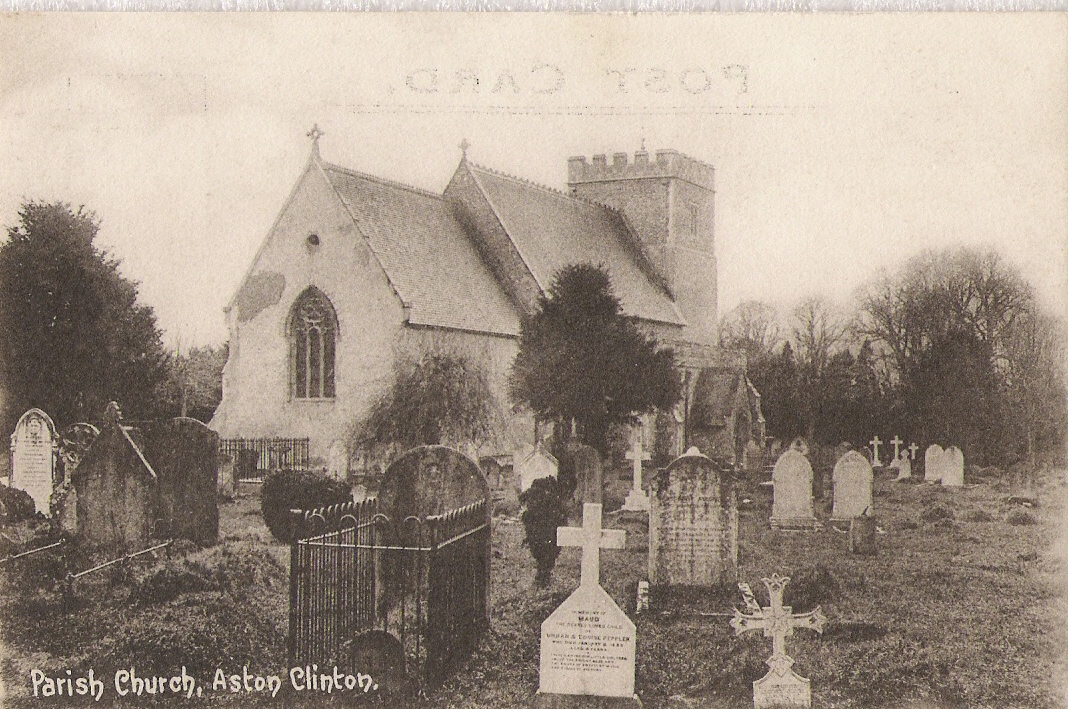
Aston Clinton Church

The Church where my great great grandmother and also my daughter were baptised

Equally we can probably connect ourselves to many places through our distant kin. So, for example, my four times great grandfather, William Braund, had a sister called Betty. Betty’s husband was Gamaliel Bartlett, whose father was, in 1735, baptised in the parish where I now live. Convoluted I know but the connection is there. More eerily, I moved to Buckinghamshire in 1982, believing myself to have no ancestral connections in the county. After I moved away I discovered that not only had my grandmother been born in Buckinghamshire, despite her family living in London but that my great great grandmother had lived in the same road in which I was make my home.


I is for Internet Genealogy – is this Progress?

Although I now have to be surgically removed from my laptop, I am someone who started my family history in the years B.C. (before computers). I thought therefore that I would just mention some of the pros and cons of the changes I have seen over 37 years of seriously pursuing my ancestors. By the way I did start very young (wait for Y for more on that topic).

In the old days, finding our family was a much slower process and involved travelling to various record repositories. You went to London, ordered a birth certificate, waited for it to arrive and then waited again for your next trip to London in order to search for the marriage certificate of the parents of that individual. This can now all be done from home and the turn around time is much quicker, so a big tick for the internet on this one.

In order to find someone in a census return a visit to London or the relevant county record office was required. Then you peered at reels of microfilm as you spent two hours winding your way through the whole of Hackney in pursuit of your ancestors. Alternatively you could hope that there was a paper index for the area and decade that you were searching. These indexes were carefully and accurately compiled by family historians whose motivation was to assist their fellow researchers, with no hint of financial benefits. Today’s countrywide indexes are a huge bonus, especially if searches can be made using fields such as occupation and birthplace, instead of by name, thus opening up these records for use by social and local historians. The quality of these indexes is however mixed. Many of them have been created by those with no interest in the work, by those who have no knowledge of British place or personal names and by those whose prime motivation is financial. In Peter Christians The Genealogists Internet, he looks at transcription errors in the 1891 census indexes that appear on the main subscription websites. In 2009, when the survey was done, 43.5% of the surnames in the Ancestry transcription were incorrect. Hopefully many of these have been corrected in the intervening five years but this is a very high error rate. Don’t get me wrong these indexes are valuable and I know that if their production was left to philanthropic family historians, with the skills and motivation to get it right, we would still be waiting but it is not all good news.

I applaud and welcome the opportunity to download digital images of original documents from my arm chair. Sadly most of these images are accessed via a transcript and many internet genealogists rely on those transcriptions, never progressing to the originals. At a conference last year, lecturer and author John Titford coined the phrase ‘genealogy for grown-ups’. By this he meant the sort of genealogy where original sources are consulted and referenced. He was referring to research that encompasses recreating the lives of our ancestors, not just collecting names and dates and the use of more than just the mainstream sources that are available on subscription websites. The internet helps ‘grown-up’ genealogists beyond measure but to come of age in the genealogical world you do still need to leave your keyboard behind on occasions.

Now family trees can be downloaded at the press of a button (the result may not be an accurate family tree but a family tree emerges none the less) there is the opportunity to acquire a pedigree without foundations. More people can open a computer file labelled ‘family tree’ but they lack basic knowledge about the lives of those individuals or the sources that have been used to create that pedigree. Does this actually matter? It is surely a good thing that more people are beginning to engage with their past, particularly as this has resulted in a dramatic lowering of the average age of the family historian. Am I concerned that these people are barely scratching the surface and are not doing things ‘properly’? At the risk if being labelled a genealogy snob, well yes I am. Surely the satisfaction comes from ensuring that your pedigree is as accurate as possible. Trying to recreate the context for our ancestors’ lives is truly paying them the respect they deserve. Yes, everyone should be able to pursue their ancestry in their own way and with a degree of rigor of their choosing but I still lament the trend towards ‘grab it quick’ pedigree hunting. Along with the internet has come instant access genealogy but have we compromised thoroughness in the pursuit of speed?

We are now in thrall to the large subscription websites. Yes, there is a choice but currently it is a frying pan – fire choice. In the last few weeks there has, rightly, been an avalanche of complaints about the ‘improvements’ made by more than one genealogical service provider. Suffice it to say that these changes appear to lack any single benefit for the serious researcher. The impression is that ‘improvements’ have been motivated by profit and carried out by those who have no idea what researchers require. At the moment the family history world is holding its breath, hoping fervently that the providers will actually listen to the needs of their customers. The provision of online resources is only progress if the system allows researchers to find the record that they need in a manner that is neither convoluted nor cumbersome.

The sad loss for the new generation of internet genealogists is the lack of interaction. True there are forums, chat rooms and opportunities for discussions via Hangouts on Air but are these really a substitute for a cosy chat over a genealogical brick wall with a group of fellow enthusiasts? I am not an unalleviated Luddite. I do appreciate that internet genealogy is not only here to stay but has a great deal to offer researchers. I am however aware that we maybe in danger of throwing out the proverbial baby with the bath water.