At Sea and Mijas, Spain – Days 9 & 10 of our genealogical cruise adventures

I play truant from the first two lectures and persuade my companion to rise from his sick-bed to get some air. We go up on deck where I am the sole occupant of the hot tub. Ok so I am sharing it with some slices of lime left over from last night’s revels but hey! I am frantically trying to keep up with photograph labelling and the holiday diary but it is a losing battle. Already I have numerous unidentified pictures that will have to be generically designated ‘Rome’ or ‘Florence’. We also rearrange our excursions in the light of Hurricane Lorenzo. Much as I feel that I ought to see Paris, having not been, I can’t face a three hour trip each way in order to spend four hours there, so we opt for shorter trips to Rouen and Honfleur. We also have a walk booked in Spain for tomorrow.

Michelle provides us with more tips and tools for DNA, advising us to create broad and deep online trees covering six generations and including siblings. Shared matches are the key to interpreting our DNA results. I just need several free hours a week that I don’t have. Sue shares another Swalwell case study, this time about a Georgian lady who was declared bankrupt. I don’t think that I was aware that there was an important distinction between debtors and bankrupts. Mia then outlines some online sources that are often overlooked, extolling the virtues of the Online Parish Clerks,of which I am proud to be one (or three actually).

I finish the day with the new and improved version of Remember Then, encouraging people to tell their own stories. This was the practice run for Rootstech and something decidedly weird has happened to the formatting of my presentation, which I need to fix. Nonetheless, the content is very well received and people are still fired up and chatting 45 minutes after I finish.

We are up in time to hear Eric Kopittke’s interesting presentation, ‘In the Steps of my Ancestors’, about genealogical journeys. Michelle kindly helps me look at my DNA matches; I am more eager than ever to get home to work on them some more. We dock in Malaga and our rearranged, afternoon trip, due to the reduced time in port, is to the village of Mijas. We are instructed to meet at the end of the pier and I am a little concerned that we may be in the wrong place but no. Sergio is in charge of trip number twelve and he tells us how fortunate we are to not have opted for Malaga as it is siesta time and all the shops will be closed. The Spanish are not stupid. It is 31 degrees; a siesta seems eminently sensible but here we are, mad dogs and English tourists, out in the heat of the day. Apparently temperatures are higher than average for the time of year. There is no sign of the forecast cloud. Malaga was founded in 830BC by the Phoenicians. It is the capital of the Costa del Sol in the Andalusian region. It typically has 300-320 days of sun a year and 21-22 days with rain. There is a drought at present and limitations on water usage are expected.

We drive past Malaga Cathedral, nicknamed the One-armed Lady, as only one of two proposed towers was built. An artificial beach near the port was constructed in 1990 and looks to be popular. We get stuck behind a bin lorry for a while but are soon able to recommence our journey. We see the botanical gardens that were to have been part of our destination on the trip that we chose originally.

Mijas is a typical Andalusian village that is famous for its donkeys, or burros, which are available for riding or to pull carts. They were the typical form of transport until the 1960s. There are also a number of horse-drawn vehicles for hire. Especially given the heat, I would not part with money to put animals through this, quite apart from the fact that one of the donkeys is aiming vicious kicks at its neighbour. Car parking in Mijas is set a €1 a day to encourage tourism.  Beginning at the Plaza Virgen de la Pena, we walk up past the shopping area, where leather goods and Moorish influenced ceramics predominate. We can hear crickets chirruping as we climb the steep streets. We are also taken into a typical courtyard at the back of a shop. This is very attractive but fails in its undoubted aim of guilt-tripping us into making purchases. Courtyard living is the norm for most of the year and in the winter, fires are fuelled by olive wood. There are more than 420,000 olive trees in Spain. They also grow avocadoes but these trees need 100 litres of water each per day in summer and the current drought has caused severe problems.

We see Constitution Square, which is attractively laid out with a fountain and benches that were carved from the marble rocks that were left by the landslide following a flood in 1884. Despite the lack of rain in the area, this flood reached upper-storey windows. The Medieval fortress was built on top of a former defensive building that dates back to Phoenician times. The Church of Immaculate Conception was completed in 1631 and incorporates a Moorish bell-tower. We cannot escape from genealogy, as our guide tells us that 30% of Spanish DNA is Berber.

The Bullring was built in 1990 and is unique because it is oval. It has a capacity for 600, so is small by Spanish standards. Seats in the shade are more expensive than those in the sun. Animal fights only take place in early September.

We look at the Virgin of the Rock chapel that was hewn out of the rock by a Carmelite monk in the seventeenth century. Allegedly, the image of the Virgin inside the chapel was found by two child shepherds in 1586, having been led to the spot by a dove. It was a slightly less strenuous excursion than others we have been on and very enjoyable.

164 30 September 2019 Courtyard, Mijas, Andulucia, Spain.JPGA group of Guild on One-name Studies’ members foregather in the Windjammer in the evening and we consume yet more copious amounts of food.
Florence and Pisa – Day 8 of our genealogical cruise adventures

Today we are docked in Liverno in Tuscany. By dint of swift walking, we secure seats in the front of the coach. Our guide is Sara as we head for Florence. We see plenty of umbrella pines. Pine nuts are grown and used for pesto. They also give their name to Pinocchio, who was presumably made from pine wood and there are Pinocchioian representations everywhere. Sunflowers and olives are grown for their oil and the vineyards produce Chianti. Leather and gold goods predominate. The area has been famous for gold since the time of the Medici. The gold comes in a variety of colours including black and chocolate.

There is a layer of mist across the plains and we pass villages that are famous for truffles and strawberries. Firenze, or Florence, is the ‘city of flowers’. It has a population of half a million and was briefly the Italian capital in the nineteenth century. It is sited on the River Arno, which also flows through Pisa. The city was under the rule of the powerful Medici family from the fifteenth to eighteenth centuries. Once on our walking tour, which Sara delegates to a local guide, I am run into by a lycra-clad, Italian runner, who smiles sweetly and takes me by the arm. Sadly I am not being abducted.

The Cathedral is white, red and green, colours that represent the trinity. The cathedral was built from the 1290s onwards and Brunelessci’s baptistry dates from 1401. Coincidentally, of the fourteen people on today’s ‘small group’ tour, we have encountered eight on previous tours and two of the others are us! Considering that there are about 3500 passengers on Explorer of the Seas, that is some feat. Many of the Renaissance works on view are replicas including one of Michelangelo’s David. It is possible to see the real thing, just not where we are going. We do see the Medieval Medici Tower, an equestrian statue of Cosimo de Medici from the 1580s and the Ponte Vecchio. The Ponte Vecchio (old bridge) was built in 1345 and is the only Medieval bridge (in Florence presumably) to have survived World War 2 bombing. By doing some reverse picture searching, it turns out that we have seen the Palazzo Vecchio, the Basilica of Santa Croce and the outside of the Uffizi Gallery, possibly not in that order. The quality of my photographs are severely affected by the cords and the fact that most of them were taken whilst hurrying after our guide in order not to be lost.

Even though we are suffering somewhat from information overload, I do like Florence and we have the advantage of cloud cover, so the heat is less of a problem. Today’s included lunch is yet more salad and lasagne, with a strange vanilla concoction for dessert. In the leather and gold shop, where Sara is probably on commission, we are treated to a sales pitch by Anthony (with a H) from Melbourne. We do not succumb. Whilst waiting for our group we are accosted by a Kenyan street seller. He cunningly hands us some bracelets as a ‘gift’. He then shows us a picture of his children and asks for money for the babies. We claim to be penniless and return the bracelets.

We pass Michelangelo square with its panoramic views of the city but there is no time for a photo opportunity. We are on our way to Pisa. Our driver has a unique driving style, which involves a third of the bus being across the white line and periodically he has no hands in the wheel. We survive.

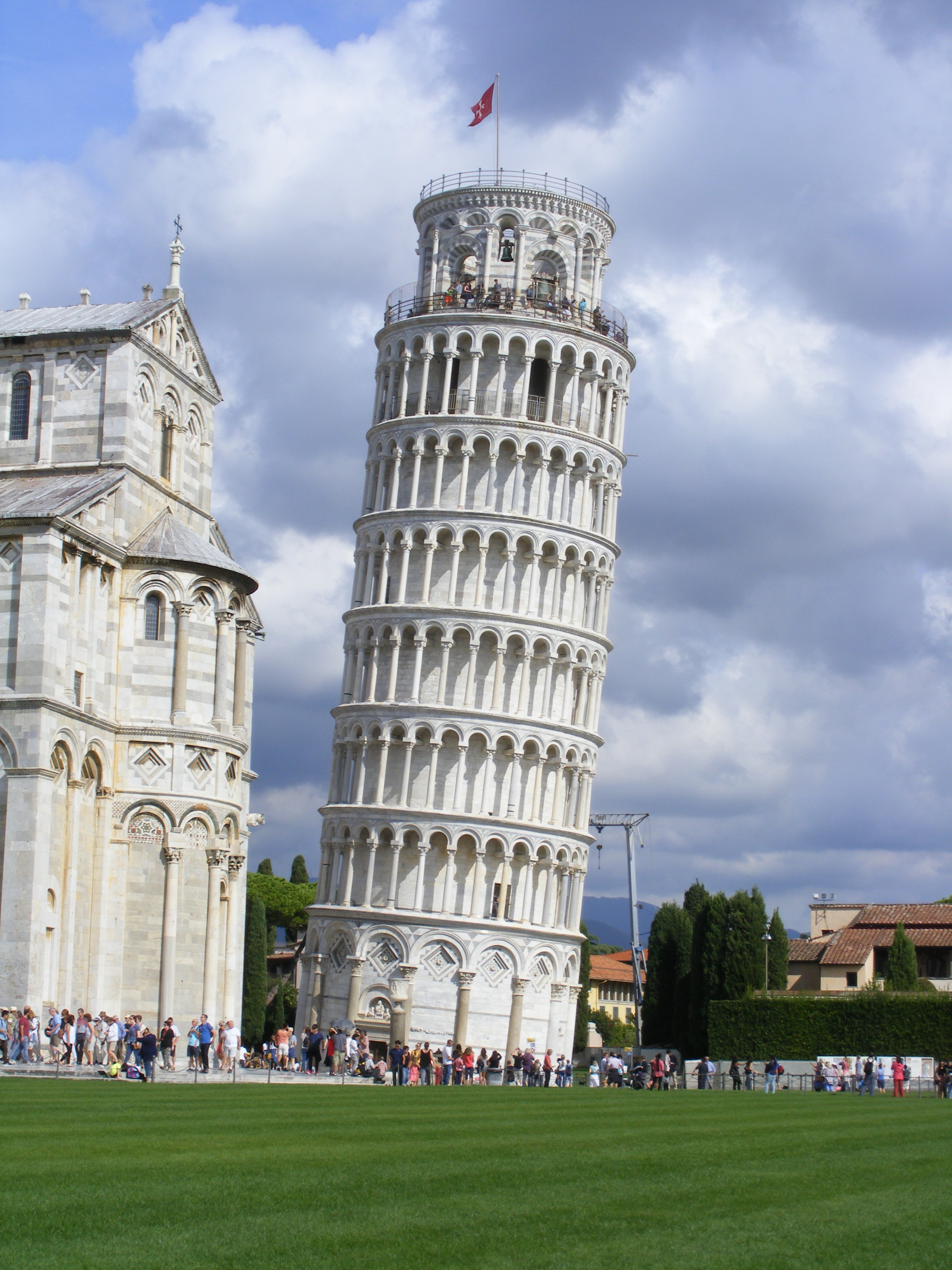
We spend some time in Miracle Square in Pisa. It seems obligatory to take a photo with hand outstretched, so that it appears that you are holding the leaning tower; we don’t bother. The tower was built as the campanile (bell tower) for Pisa Cathedral and leaned from the start due to subsidence. It is between 183 and 186 feet high, depending on which side you measure. It was built between the twelfth and fourteenth centuries and stabilisation work in the 1990s reduced the lean slightly. The Carrera marble was also cleaned at this time. Galileo, who was born in Pisa, allegedly dropped cannon balls from the tower to demonstrate how mass affected the speed of descent.

146 28 September 2019 The Leaning Tower of Pisa.JPG

Also in the square is the Baptistry, begun in 1152 and competed in 1363. It replaced an older building and is the largest Italian baptistry. It combines Romanesque style at the bottom with Gothic on the higher levels. Next to this is Buscheto’s Romanesque cathedral, begun in 1063 and consecrated in 1118. Allegedly it was financed by the spoils of a Sicilian war again the Muslims. Twelfth century enlargements were designed by Rainaldo.

In Pisa we learn that there is a €500 euro penalty for street selling and it is the purchasers as well as the vendors who are fined; a good job we resisted our Kenyan friend. Mind you, despite circulating police cars, there seem to be plenty who are willing to take the risk and their tactics are quite aggressive. There is obviously a secret signal, probably in the form of a text message, as periodically there is a Mexican wave of sellers rapidly gathering their wares into large blue bin bags. I can’t help feeling that having a bin bag over your shoulder is somewhat of a giveaway but perhaps the police turn a bit of a blind eye.

As Sara leads us back to the coach, we have to cross a level crossing. The barriers are down. Several Americans of mature years, not from our group, decide that the train is ‘a long way away’ and duck under the barrier to cross the line. I think some more law-abiding onlookers were hoping the line would be electrified.

Back on board we learn that Hurricane Lorenzo is looming. This is not the hurricane that was causing difficulty earlier in the cruise. This is a new and more serious hurricane that is going to necessitate a change in our itinerary. Sadly, we will lose our stops in Santa Marguerita and Lisbon; I am particularly disappointed about missing Portugal. My travelling companion is suffering from the lurgy that seems common on cruises, so I leave him to nurse his ills whilst I listen to Paul Milner speaking about nineteenth and twentieth century sources.

Rome and Vatican City – Day 7 of our genealogical cruise adventures

Another early start. Having collected our stickers, we sit and wait for dispatch. The chap is mentioning a dress code for those visiting the Vatican. Dress code? I booked our tour so long ago that I can’t even remember if it includes the Vatican. Knees must be covered. My companion is wearing shorts. There is no time to go back to remedy this. We resolve to wait and see what happens. I may have to abandon him by the side of the road. On leaving the ship, I get caught by the ever-present cruise photographers and end up forcibly posed with a Roman soldier. A waste of time as there is no way I am going to pay the ridiculous prices charged for cruise photos.

We are moored at Civitavecchia, which means ‘old town’ and is the port that serves Rome. It consists of a Medieval fortress commissioned by Pope Julius II and for which Michelangelo (he gets everywhere) was partly responsible. Today’s guide is Sabina. We point out our failure to be aware of a dress code. Our tickets warn us we need to be able to walk on cobbles, you’d think there would have been some kind of reminder about appropriate attire but no. Apparently it was in the small print in the cruise brochure that I had uncharacteristically failed to read. I was expecting to have to have my head covered in Catholic churches but this no longer seems to be a requirement. I had not factored in the possible offence caused by my companion’s knees. We briefly consider and dismiss, the idea of swapping trousers. By dint of lowering the waistband of his shorts to mid-buttock level, in a manner much beloved of today’s youth, the knees are hidden. Sabina thinks we will pass muster.

We drive towards Rome. They have a problem with graffiti and like any other major city, there are rough sleepers and beggars. The twelve mile long city wall contains fourteen gates; 80% of the walls remain. Once on foot, Sabina sets off at a cracking pace towards the Circus Maximus and the Constantine Arch, erected in 315 following the battle of Milvain Bridge to commemorate the slaying of 5000 enemies; one wonders who counted. We see the Colosseum, which is a nickname for the Flavian amphitheatre and which originally consisted of three concentric rings. There are many holes in the stonework, where, over the centuries, metal supports have been removed for ‘recycling’. Spectators were assigned a tier according to their social class, with women often being relegated to the top tier, unless they were accompanying their senator husbands. The entrance arches or fornix, were where ladies of the night lingered, seeking customers, giving us our word fornication.

Entertainments, or ‘munera’ were an all-day affair with parades, the public execution of criminals, games and finally gladiatorial combat. These spectacles were free, with the intention of securing the support of the population for the current emperor and to emphasise his status. The working life of a gladiator was about five years, during which time they might only perform ten times. After this, successful fighters could gain their liberty. The idea that the audience put their thumbs up or down, to indicate whether a losing combatant should be saved, is a myth. The fist is raised, either with the thumb hidden, or the thumb stuck out to the side, the latter indicating the executioner’s knife blade. The last human combat was in 401 and the final animal fight in 521.

We hurtle off to the Basilica di San Pietro in Vinocoli – St Peter in Chains, where what purport to be the original chains that held St. Peter are kept. Also known as Basilica Eudoxiana, it was built in the fifth century. It had many restorations, Pope Julius II again. Michelangelo’s Illumination of Moses is here. There are a number of buskers. I am taken with the accordion player who switches from Funiculi Funicula (a tune reminiscent of my childhood as it featured on an oft-played LP) to Jingle Bells as we pass, possibly in honour of Chris. There is also someone with a three stringed double-bass and a didgeridoo player, which is impressive, if culturally incongruous.

Our next stop is the Forum, where we encounter many young climate change protestors. They don’t get the best of press but personally, I am grateful that so many young people are passionate and engaged. The six vestal virgins were tasked to keep the eternal flame burning in the Temple of Vesta, which is part of the Forum. We see the Temple of Saturn and the Red or Burnished Palace where Mussolini gave his famous speech. On this tour, lunch is provided, which has the advantage that we also get free toilet facilities. We are given salad, lasagne and a filo pastry dessert.

069 27 September 2019 The Forum.JPG

The afternoon is spent in the Vatican and no problems are created by the shorts-length of my travelling companion. The Vatican covers 120 acres, making it the smallest independent state in the world. Its sixteenth century walls were constructed to withstand gunpowder. It was given the status of a separate state in 1929. The Vatican is home to the Pope and 400 cardinals and the official language is Latin. Even the instructions on the ATM are in Latin. Unfortunately I could not find this in order to photograph it. The Vatican Museum, with 2000 rooms, is the second largest in Europe and gets 30,000 visitors a day. They are not wrong; it is certainly hot and crowded. We are whisked round some of the Museum at break-neck speed, in the tourist sausage machine that is characteristic of cruise ship excursions. Unbelievably, we are walking on original Roman mosaics on occasion. There are wonderful painted ceilings and plenty of statuary, as well as fifteenth century Flemish tapestries that were completed at a speed of one square metre per person per year. How does anyone know this?

The world-famous Sistine Chapel was commissioned by Pope Sixtus IV in 1278. It underwent extensive repairs when the walls began to crumble shortly afterwards. The walls were painted to show the story of Moses and of Jesus in 1481-3. It took Mr Buonarroti aka Michelangelo four years, working alone, to paint the frescos on the ceiling. No photographs are allowed because, in return for the funds for the recent cleaning, using distilled water, of Michelangelo’s work, Fuji required the copyright on the images. Nevertheless I observe at least four people shamelessly photographing. Even more astoundingly, a family are handing round chocolate bars to their offspring. The renovation took fourteen years and was finished in 1994. The discolouration over the centuries was largely due to candle smoke. A few squares have been left uncleaned and you can certainly see the contrast. Interestingly, his panel of the Fall of Man shows Eve tempting Adam not with an apple but with a fig. We learn about the use of the Sistine Chapel for the papal enclave, when a new pope is being elected.

There is a general press of the great unwashed as we tour the Vatican. There are also plenty of illegal street sellers and manic moped riders. We visit St. Peter’s Basilica, which took 122 years to build, being completed in 1626. All churches in Italy are free to enter, unlike our English Cathedrals. Only the Pope can celebrate mass at the High Altar. Here we see Michelangelo’s Pieta, his only signed work. It is protected by bullet-proof glass following damage in a hammer attack in the 1970s. There is also a fourteenth century statue of St Peter and the last Stuart tomb. There are no paintings but instead 10,000 square metres of mosaics. The Swiss Guard, in rather flamboyant uniforms, are responsible for guarding the Vatican as they have no army of their own.

Our evening talk is Michelle on the exodus to the Southern seas, which I have heard before but which is just as good at second hearing.

At Sea, Nice, Eze and Monaco – Days 5 and 6 of our genealogical cruise adventures

In a vain attempt to boost our energy levels, we miss the first two lectures and sit on deck for a short while. This is followed by the second of my writing workshops, this one on finding national and local context. I manage to persuade people to part with money for most of the books I have bought on board. After lunch Michelle talks about surnames and then Sue’s presentation, ‘Do as I say, not as I did’ is an interesting story of her mistakes and encourages us to focus. Rosemary’s second Scottish session gives me some new avenues to explore and some ideas that I can add to various presentations. Paul follows this with a presentation on sources for landed and titled people.

Our usual Windjammer evening meal has become a pattern, with many from our group gathering in the stern to watch the sunset. Most of my menu choices seem to involve rather nice French fries and roasted vegetables but today I opt for curry. As usual, there are numerous desserts on offer and it seems rude to only pick one. Chris is working his way through crumble of the day. The evening lecture is a case-study from Mia. I am a fan of case-study talks, this one about using DNA to find the father of an illegitimate ancestor. Then straight to bed as we have an early start tomorrow.

We resolve to be at breakfast for 6.30am and indeed we are but are foiled by the Windjammer not being open until 7.00am. The regular gluten free toast toasting guy is not on duty and the replacement inadvertently puts it through the non-gluten free toaster. In fact this wouldn’t kill me but he feels obliged to do it again whilst I wait impatiently. I do notice that they handle the ‘gluten free’ toast with the same gloves as regular bread, so I don’t know how they ensure that no crumbs are transferred. We are nonetheless ready for dispatch by the allotted time of 7.45am. We are in group 1 and the first tender from the ship, which cunningly doubles as one of the lifeboats. We arrive in Villefranche and find our coach. Today’s guide is Otillie, who is not a patch on Chantal. Her very heavily accented English and fairly monotonous tone makes her hard to follow.

I am enjoying seeing how much of the signage my school-girl French will allow me to translate. We drive to Nice, which has a population of 350,000. Nice was founded by the Greeks in 600 B.C. and from 1388-1860 was part of the Duchy of Savoy, not France. We visit the flower market. The shelter provided by the French Alps helps with flower production. The other stalls are displaying local produce, notably lavender, olives, herbs and spices. At least it isn’t all bits of plastic tourist tat. We also visit the ‘rest room’, where we have to pay 50c. for the privilege, which seems a trifle extortionate. Before the beginnings of tourism, in the mid-nineteenth century, this area was very poor and it is not ideal for fishing or agriculture.

There is much evidence of ‘The Grand Epoch’ in the architecture; a style that was prominent from 1880-1914 and many of the houses are red and green. We visit the Garibaldi Royal Square; Garibaldi was born in Nice. Next is Massena Square and we also see Le Negresco Hotel, which is a mere €1500 a night. During our free time in Nice we discover that traffic is not obliged to stop when there are pedestrians on a crossing. Well, if they are obliged to, they don’t. We found this out the hard way. There are plenty of mopeds here. One drives past with two unsecured 50 inch televisions, in boxes, on the pillion.

Next, a short ride to the old village of Eze, which is 470 metres above sea level and was founded in 800 B.C.. It seems that all tourist guides are trained to tell you how high up you are. It is possible that its name is a corruption of the Egyptian goddess Isis. Until 1927, when the road was constructed, it was reached only by a pathway. It has narrow, twisty streets and is a French version of Clovelly. We visit the Baroque style, eighteenth century church. There is much talk of the celebrity residents of the area. I am singularly unenthused by the sight of Elton John’s roof. This is certainly the playground of the rich and famous and it is far too glitzy for our taste.

On to Monaco, the second smallest independent country in the world (tomorrow we visit the smallest). It became a country in 1297. Today, much of it is built on reclaimed land. It has 38,000 inhabitants, 30,000 of whom are ex-pats from 140 different countries. There is one policeman for every 66 inhabitants, compared to a ratio of 1:1000 in France. Unsurprisingly, there is little crime in Monaco. We see Princess Caroline’s home, the house owned by Princess Stephanie and the former home of Jacques Cousteau.

There are various lifts and escalators on our tour and there is plenty of getting lost potential, as Otillie’s technique is to take us somewhere, usually up a hill and then leave us to find our own way back – or not. Having barely slept last night, I am struggling a bit with the heat and the exertion required. I have also, rashly, believed the on-board newsletter, which stated that it was expected to be 64 degrees today. I think they meant 74 and it is still an under-estimate. I have far too many clothes on. We visit the St. Nicholas’ Cathedral (aka the Cathedral of Our Lady Immaculate) and see Grace Kelly’s tomb. The cathedral is comparatively modern having been consecrated in 1911 following the demolition of the thirteenth century version in 1874. We decide to wait in a shady park but there is a distinct lack of seats. Fortunately we don’t sit on the grass as it seems, despite the absence of any signs, the grass is sacrosanct. A man has dared to set foot on the un-fenced grass. A policeman is ten feet away. Does he quietly suggest that the gentleman moves? No. He blows his raucous whistle and gesticulates wildly; a lucky escape for us. It does seem that we can sit on the steps of the Oceanarium without fear of censure.

On the way back up the lifts and escalators, we end up with tour group 11. We are not sure their guide will be happy with this, as she regards this lift as being for the sole use of her party. We judiciously place a finger on our stickers, marked 1, so they resemble 11. Our coach is idling for 20 minutes, while we wait for everyone to arrive. Much as we appreciate the air conditioning, the environmental impact of this and indeed our whole trip, is sobering.

On to Monte Carlo, one of Monaco’s four quarters, where the yacht show is in full swing. It is €300 a day for entrance; sadly that does not include a yacht. The first casino in Monaco was built in the 1860s. Nowadays, only 5% of the economic activity in Monaco is related to the five casinos. Most of the wealth is generated from banking and real estate. Property ranges from €35,000-€70,000 per square foot. They also produce computers, cosmetics and jewellery. We walk up yet another steep hill in the heat to see the casino. We don’t attempt to break the bank. Also on view is the dangerous bend in the Monaco Grand Prix circuit. We manage to rescue two refugees from tour group 2 who have been left behind.

Then, an interesting evening talk from Paul on C17th and C18th sources before it is time to collapse.

047 26 September 2019 Monaco.JPG

Gibraltar – Day 4 of our genealogical cruise adventures

Finally, we make it to a 9am lecture. Rosemary Kopittke is giving a very useful introduction to Scottish records through a thorough case-study of her Laidlaw ancestry. My descendants have Scottish ancestry and I am reminded of the value (pun alert) of the Valuation Rolls.

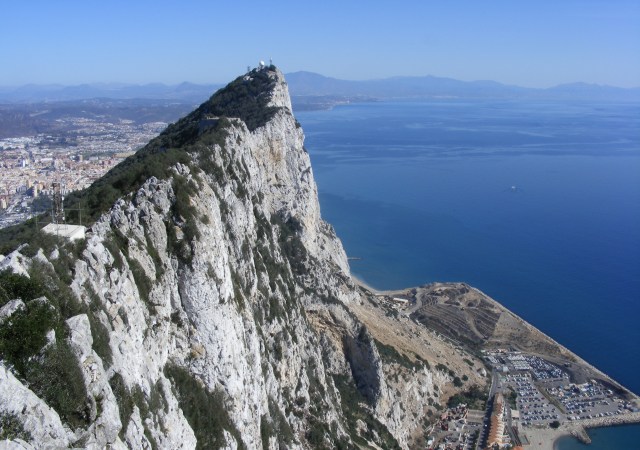
Then it is time for our first excursion, a walking tour of the rock that is Gibraltar. Our guide, Chantal, is hilarious and introduces herself as part Neanderthal and a smuggler. Gibraltar, or The Rock, rises to 426 metres above sea level and we will be ascending to 412 metres. Twenty of us pile into a coach and drive across reclaimed land within view of the site of the Battle of Trafalgar. We pass Morrisons, MacDonalds, all the usual suspects. The population of Gibraltar is 32,000 and apart from tourism, the main economic activities are the gaming industry and the reselling of fuel, which is bought in from Spain. They are very proud to be British and in 1967, voted overwhelmingly to remain so. The island had been under British rule since the Treaty of Utrecht in 1713. Previously, it had belonged briefly to the Dutch, to Spain and prior to that, Morocco. Its importance lies in its strategic position on the mouth of the Mediterranean, hence it being fought over down the centuries.

We ascend in the cable car. The weather is glorious and we have particularly good views of Spain and the north African coast. We see the second Pillar of Hercules, Gibraltar itself being considered to be the other. The Rock is the highest monolith in Europe. Many nationalities are represented in Gibraltar, including those of Maltese descent, who arrived as builders. The border with Spain was closed by Franco after independence, until 1985, allowing no access to Spain. 45,000 years ago, Neanderthals lived on Gibraltar and significant remains have been found.

We walk through the Nature Reserve and see several Barbary macaques, including those with young. The macaques were brought in by Moroccan pirates and there is now a population of about 300. £84 per animal is spent each year on daily feeding from feeding stations, in an attempt to keep them out of the residential area. We are warned not to have water bottles on view or to leave bags open, or our lunch will fall victim to the macaques. There are also many eucalyptus trees, which are also not native.

Then we visit St. Michael’s Cave, which extends 700 feet into the rock and was used as a military hospital in World War 2. It is now a tourist attraction and concert venue. The ancient belief is that the cave system led to Africa. Twenty seven caves have been discovered on The Rock so far; the others are protected. Next stop is the Siege Tunnels. At one time, there were 633 guns mounted on Gibraltar to guard against Spanish invasion. During the American War of Independence, many of the troops normally stationed on Gibraltar were redeployed there. Spain capitalised on this weakness and laid siege to The Rock. ‘The Great Siege’ (there were others) lasted from 1779-1783. The tunnels were constructed as part of a plan to site a downward-facing Koehler gun on The Notch, at the far edge of Gibraltar. Lacking spare gunpowder, the 400 metres of tunnel were dug by the Royal Engineers using alternating fire and cold water to crack the rock. This was overseen by Sir General Elliott in 1782. It took eighteen men six weeks to construct the first part of the tunnel, then the need for ventilation led them to cut an embrasure to the outside. This opening was an opportunity to site another gun and this was done at intervals down the tunnel. ‘Curtains’ of wet rope helped to prevent the fumes from the gunfire blowing back into the tunnel. It was a year before the full length of tunnel was complete, by which time the siege was almost over and the Spanish defeated. A further 52km of tunnels were dug during World War 2.

008 24 September 2019 Top of the Rock.JPGAfter an interesting and warm trip to Gibraltar, we return to the ship. The layer of pollution is evident over the sea but the views are still good. I was particularly interested in Michelle’s talk about ‘Thrulines and Theories of Relativity’. I am eager to get back to the land of the internet so that I can explore mine. It was probably just as well that it was our turn to entertain in the evening, as otherwise we would have struggled to stay awake. I have no idea why we are still so tired. ‘Coffers, Clysters’ is well-received as usual and one of our number receives a seventeenth century make-over.
At Sea – Days 2 and 3 of our genealogical cruise adventures

I wake up at 3.30am. There is a really irritating, periodic, metallic clanging that keeps me awake. I can’t identify its source. At 6.30am I give up any hope of getting any more sleep. A fortnight of this will not be fun. Ah, it turns out that it is probably a wobbly coat-hanger. Empty coat-hangers arranged on wardrobe floor, hopefully problem solved. After breakfast, it is time for my first presentation, this one on women’s occupations. It is a bit of a struggle to stay upright as the ship is rolling in the aftermath of hurricane something or other. Lack of sleep means that we then head for a sun-lounger but it is pretty joy bracing outside, so not as restful as I’d hoped.

After lunch, we listen to Sue Swalwell’s fascinating case study about Elizabeth Swalwell, whose family frequented the eighteenth century chancery courts. Suffering from the after-effects of coat-hanger gate and aware that we have twelve more days to come, in the interests of pacing ourselves, we then go to rest a little, indoors this time. With nine presentations to give, I also have to squeeze in time to run through these. So, no disrespect to the excellent speakers whose sessions I am missing but I need to still be vaguely vertical by day fourteen. Sadly, attempts at sleep were disrupted by what sounded like a heavy trolley running back and forth across the floor of the cabin above, as the ships rolls southwards.

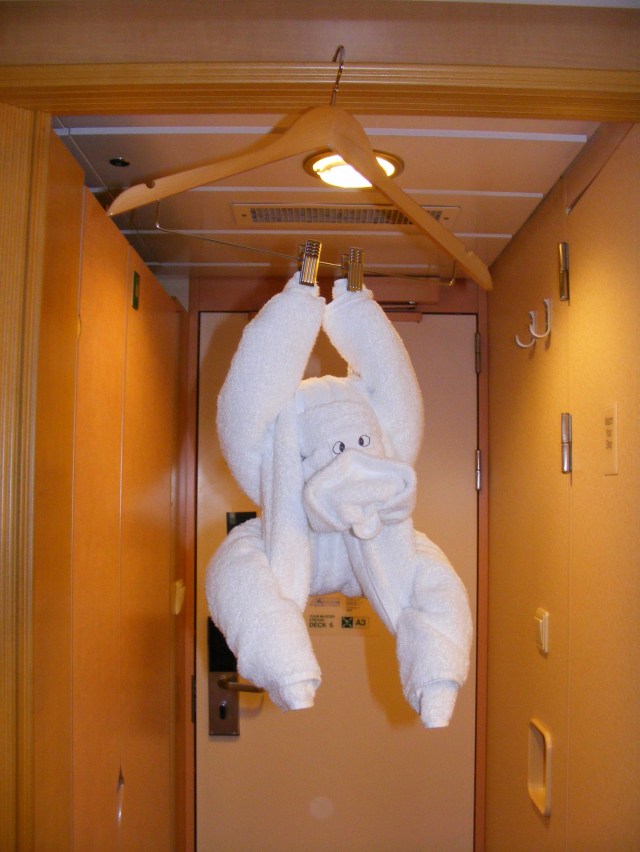
Having eaten too much yet again – pizza for me, more cow for my companion – we listen to Michelle Patient’s excellent presentation, introducing us to DNA testing. We arrive back to the cabin to find a towel sculpture in the form of a monkey suspended from the light fitting, appropriate with Gibraltar as our first port of call.

003 23 September 2019 Towel Monkey.JPG

After a much better night’s sleep, having lost an hour due to the time difference, we take a leisurely breakfast. We are quizzed in depth by the restaurant manager about the food and service. We lavish praise liberally. He has asked for our cabin number. He is welcome to pay us later for our fulsome feedback. We learn more about DNA from Michelle; this time ‘Getting the most out of Ancestry DNA’. We are encouraged to use the, often overlooked, help sections of the website. I now have more ideas to try when I get home.

After lunch, Mia Bennett encourages us to make use of the 300 years’ worth of papers in the British Newspaper Archive. Some of the papers in their care are Indian titles, which was news (oh dear, there’s a pun in there somewhere) to me. I access the archive via Findmypast but a great advantage of a BNA subscription would be the ability to cut and paste the OCRed text. That could save me hours when typing up transcripts.

We play truant from the conference so I can have a swim. It is still a tad breezy on the top deck. I stride purposefully towards a pool, wondering why it is empty. As I begin my descent down the steps, I realise why no one else is swimming here; it is freezing. As I am surrounded by people, I feel obliged to brave this out and act like the sub-zero temperatures were no surprise. I splash about a bit, avoiding the many insects that have met their demise in the pool, just long enough to look convincing, before repairing to the warmth of one of the whirlpool baths.

The next conference session is the help desk but I only have one person who requires my assistance and it is a straightforward and swiftly answered query.

Yet more food in the Windjammer and then our evening session, which is Paul Miner speaking about non-conformists and recusants, explaining the complicated timeline that is the story of British dissent.

Southampton – Day 1 of our genealogical cruise adventures

I never need an alarm clock; I can’t remember the last time I set an alarm and did not wake up before it went off. Equally, it must be months, if not years, since I was not awake before 6am. I have to be ready to leave the house at 6.45am. Initially, I don’t bother to set the alarm, then I decide that this might be the one time that I need it. The redundant alarm clock is already set for 6.10am from earlier in the week. I don’t bother to change it. I wake up at 4.45am, maybe just a little too early. I can’t get back to sleep. Oh, it turns out that I can, at about 5.30am, only to be woken by the alarm at 6.10am! Nonetheless, I am only a couple of minutes late when the taxi, aka Chris, arrives.

An uneventful journey is marginally enlivened by being stuck behind a cesspit-emptying van with the registration letters POO. We arrive at Gate 10 of Southampton Docks, having picked up Chris’ daughter, who is kindly going to drive the car back to her nearby house for the fortnight. Now comes the dreaded procedure that is getting Chris’ large metal box of seventeenth century medical instruments on board. As these include axes, saws and knives, albeit blunt ones, we have not left this to chance. The getting permission process started over a year ago when we spoke, in person, to the security officer on this very ship. Since then it has involved several phone calls to America, even more phone calls to Australia, emails, on-line chats, sending out a detailed inventory complete with photographs and the efforts of seven people. Only this week did we get an email that suggested all might be well. Being an American ship, it might have been easier to bring the musket on board; we could claim the second amendment. We encounter a very rude member of staff at baggage handling, when Chris, admittedly a little curtly, explains we have permission to take the box on. She then refuses to tell us where security is, on the grounds that ‘we obviously knew everything’. This left rather a sour taste. Using our prior knowledge from a previous cruise, we find security without troubling her to do her job, only to be greeted with, ‘Oh, we were expecting this last week’. Have we inadvertently gained permission to take the kit on the wrong cruise?

Chris has to carry the box on board himself. It weighs all of four stone. It is a very long way. He is looking in dire need of medical help. Never fear, there’s a barber surgeon on board. Oh, that would be him then. With several thousand people on The Explorer of the Seas, our home for the next two weeks, it is a happy co-incidence that we find ourselves sharing the lift with friends. It will be an hour before our cabin, sorry ‘stateroom’ (it is a windowless box), is ready. Encumbered as we are with a large metal box containing medical equipment, not for us are the refreshments of the Windjammer Restaurant, or sunning ourselves on the open deck. We need to wait until we can dispose of the kit. We pass the time people watching. A security chap complete with riot helmet walks past, pushing a trolley marked ‘clean laundry’. This appears not to be designed to fool. What is inside does look remarkably like freshly ironed sheets. Pristine bedlinen is obviously at a premium.

Cabin inspected, we head for refreshment. Enormous slices of cake, luridly decorated with a Union Jack, are being served. Why is it that red food colouring never comes out red? Numerous portions of untouched cake are being left on plates. As on previous cruises, I am appalled by the food waste. If you don’t like cake, why take a slice? We have a view over Southampton Boat Show. I am unimpressed by gleaming, luxury yachts. There is however a tall ship that looks much more fascinating.

Next, the obligatory but farcical, safety drill. It seems that some of our fellow passengers do not understand the concept of obligatory. Are we all to be kept here in detention until the miscreants arrive? I wonder if any provision is made for those on board with sensory issues. Bright lights, noise, crowds, having to remain in the room, all the stuff of which nightmares are made. I might just ask how they would ensure that such passengers were accommodated. I have zero intention of bringing a person with sensory issues of my acquaintance on a cruise (the mind boggles) but spreading awareness is no bad thing.

We set sail; is that the correct expression for a vessel with no sails? The Isle of Wight slips past and we wave to invisible friends. Chris has already consumed two ice-creams from the help yourself ice-cream bar. Then a meet and greet for conference goers, over half of whom we know; it is great to get reacquainted. Food next and it is ‘Tex-Mex’ night in the Windjammer. We habitually reject the two sprigs of asparagus and a bit of drizzle on offer in the formal dining area. I’ve gone for sweet chilli chicken and Chris is tucking in to salmon and the first of what I am sure will be many steaks. On our last cruise he ate his way through a whole cow. Another reason for rejecting the formal dining is that I find being waited on discomforting. It is not at all the same as in a British restaurant. The staff act like we are better than them. We aren’t. It should not be a job requirement to be so self-effacing but it is.

002 21 September 2019 Southampton Boat Show.JPGPaul Milner begins the conference with an interesting session on ‘The English Context: history, sources, repositories and processes.’ A veritable minefield for those researching from overseas, as most of the audience are; there are only five Brits at the conference. We debate why some counties are shires and some are not. Could it be the migration patterns? Why is County Durham, the only county to be described in this way? Probably because it is the only non-shire to have a county town (or indeed city) of the same name as the county, so it is a way of distinguishing between the county and the city. And so to bed. On our way past a public area an enthusiastic member of the entertainments’ team is exhorting his audience to believe they are butterflies. Numerous apparently sane adults are waving their arms, sorry wings, about. We don’t linger to find out what all this is about. The ways of cruise ships are unfathomable.

Genealogical Sleuths – Fiction for you to Enjoy

Until recently, I was a columnist for the In-depth Genealogist Magazine and also wrote for their blog. Now the magazine is sadly no more, contributors have been invited to re-post their blog material elsewhere, so that it is preserved. This is another post that I wrote for the magazine; it has been updated since it first appeared in January 2018.

In recent years, several authors of fiction have chosen genealogical sleuths as their main characters. In general, these are crime novels but frequently they have a ‘time-slip’ facet, so that they also contain elements of historical fiction. I have to say that if genealogy was as dangerous a career as some of these books imply, no one would be advised to take it up. The mundane might be more realistic but would not make for very exciting fiction. I thought that I would introduce you to a few of my favourite exponents of this genre. There are others and I hope that readers will share details of those that they have enjoyed. In an effort to be fair, I have listed the authors in alphabetical order.

Nathan Dylan Goodwin writes about ‘forensic genealogist’ Morton Farrier. Two threads run throughout the books that have been published so far. The first relates to Morton’s quest for his own ancestry and the other is his developing relationship with his police officer partner, Juliette. There are five full length novels, plus four shorter adventures in the series. One of the latter, The Asylum, is currently available as free download. In these, Goodwin writes of such things as Edwardian Britain, Suffragettes, the Western Front, The Battle of Britain and his hometown of Hastings. In addition, Ghost Swifts, Blue Poppies and the Red Star is the first in a new series about Harriet McDougall and is set in 1919 as Harriet investigates the story behind the loss of her son in the First World War.

M J Lee introduces us to former detective Jayne Sinclair. So far, there are six books in the series including The Irish Inheritance, which is a case that centres on the Easter Rising, whilst The Somme Legacy covers both the first world war and the suffragette movement. The American Candidate sees Jayne investigate the background of a potential candidate for the American Presidency and takes us back to the 1940s.

The Irish Inheritance Cover LARGE EBOOK.jpg

John Nixon’s genealogist is also female, in the shape of Madeleine Porter. So far, there are eight books in the series and her adventures include, The Cuckoo Clock, Stolen Futures, Family Shadows and Another Summer, which revolves around a First World War mystery. The Cost of Silence begins with the murder of a genealogist. Have they been silenced before they could uncover something inconvenient?

Another Summer (A Madeleine Porter Mystery) by [Nixon, John]


Wendy Percival has also created a female genealogist, in the shape of Esme Quentin. The first book, Blood Tied, begins with the murder of an unidentified victim and unravels a sixty year old family mystery. The Indelible Stain takes us from a dying woman on a North Devon beach, to the story of a young girl’s transportation to Australia. The third book, The Malice of Angels , focuses on the Special Operations Executive in the Second World War. The most recent offering, Legacy of Guilt, is available for free download on Wendy’s website. There is also an Esme novella, Death of a Cuckoo.

BLOOD-TIED  RGB cover image (updated).jp

Steve Robinson’s anti-hero is American genealogist Jefferson Tayte. Many of his cases take him to the UK and his bumbling attempts at relationships echo throughout the seven books. In this series, we have another genealogist who is seeking out his own birth family. The first book, In the Blood, is set in Cornwall; a centuries old murder is solved thanks to his efforts. To the Grave sees Tayte unravelling a secret that has been kept since the days of World War Two. Kindred is also set in the Second World War. In The Last Queen of England, fact and fiction are intertwined as Tayte races against time to solve a puzzle, set by members of The Royal Society, relating to the rightful heir to the throne. The Lost Empress focuses on a 1914 shipwreck that has remained relatively unknown in the shadow of the Titanic and Lusitania.

Geraldine Wall’s series of five books feature Anna Ames, a probate genealogist. The continuing thread concerning Anna’s own family, including, in the earlier books, her husband’s developing early onset dementia, is a positive addition to her ‘File under ……’ series. Although there is perhaps a little less genealogy and more family relationships in this series they are deserving of inclusion. The latest in the series, File under Fortune, follows Anna’s research into her own Traveller heritage.

book cover of File Under Fortune

Happy Reading!

Online Family Trees and why I have Succumbed

I have never been a fan of online family trees. Whilst absolutely respecting other people’s right to make whatever choice suits them, it was something that I always vowed, quite vehemently, I would never do. I was wrong. First of all, a word about why I chose to keep my family tree offline. When I started my research, over forty years ago, there was no online. I suspect if I were a new recruit to genealogy now I would make some different choices. When I got fed up with hand-drawing copies of family trees to share with others, I capitalised on the fact that I had a computer and purchased some genealogy software; Family Tree Maker. I can’t remember exactly when this was but it was on floppy disks and I think it was version 3. I still use Family Tree Maker. The trees it produces are not ideal but it suits me better than the alternatives. The fact that my handwriting is an exercise in advanced paleography played no small part in my decision to abandon hand-drawn trees.

Let me be clear, my reluctance to put a family tree online had nothing to do with me not being willing to share my information; I have been doing that since 1977. The surnames that I am interested in have been widely advertised for decades and are listed on this website. Over the years, many distant relatives have benefited from my research and vice versa. Purely because of the length of time I have been researching, I often have more to give than receive but that is fine. I love to share information but I do like it to be a two-way process. I want it to be accompanied by a conversation about the sources I have used and why have I made the connections that I have, or why I have not. I want to share the stories and the contextual detail that I have researched, not just the names and dates. To this end, some narrative accounts about my ancestors are now also available on my website.

This has worked well for me until very recently. Why would I change? I have been vocal about my opinion of many of the genealogies that you find online. Let’s just say I am not impressed by vast, unsourced, ‘grab it all’ trees containing biologically impossible data and scores of unverifiable connections. I do accept that there are well-researched, accurate pedigrees, compiled by proficient genealogists on the www but there is also an overwhelming amount of dross. So much so that extracting the gems has made looking for the proverbial needle in a haystack seem like child’s play.

People have often marvelled that I can do family history research without an Ancestry account, particularly as I do still do some professional research. I have never felt the need. I have subscribed to FindmyPast since before it was called FindmyPast and that suits me because the coverage is better for the counties that I need most often. When I began researching in the years B.C. (before computers), tracing your family history was impossible without going to archives and this is still key to the work I do. In fact, I believe that archival research is still essential for all researchers, as so much is not online.

A few months ago, having had my DNA tested with other companies, I decided that I might as well add Ancestry DNA to my collection of autosomal results. Before I parted with my hard cash, I considered whether having no Ancestry subscription and no online tree would make the test worthless. I realised that it would hamper my chance of encouraging contacts but I decided that it would still be useful, especially at sale price. The results arrived. I was offered a significantly reduced rate for an Ancestry subscription. So, tempted by the data sets, notably the London parish registers and PCC wills, I took out my first ever Ancestry subscription. I still had no intention of ever putting my tree online. I filled in my profile with my ancestral surnames but I resisted the exhortations to start my tree, even one that was private.

I had fun with my DNA matches, as expected, none of them close. I have two 3rd-5th cousins and 284 at 4th-6th cousin level, which I would guess is probably significantly fewer than most people. Some I had made contact with before. I could, I thought, just sit back, with my lack of tree and see if anyone contacted me. I worked out how some of the matches were connected to me using their public trees. I began to colour code them into groups. I was having fun. Everyone was banging on about ThruLines, that sounded fun too but of course I couldn’t connect to anyone with no tree. As I worked through my matches, I realised that I was prioritising those with public trees, of course I was, no real surprise. I contacted a few people, some replied, some didn’t, not unexpected. I found a third cousin in Australia, practically my closest living blood relative. Obviously, I reasoned, people are going to do the same as I did, start with those with public trees, then perhaps consider contacting a few with private trees if the common matches looked promising. With tens of thousands of matches, no one was ever going to get round to contacting poor little treeless me.

I umm and erred a bit and I took the plunge. My original intention was just to add my direct ancestors, not least because of the time it would take to add the results of forty years’ worth of research. The reasoning behind creating this tree meant that there was no point in making it private. My concession to privacy is that I have listed my parents as alive when they aren’t, so they can’t be seen and I would not consider adding my descendants. I still have numerous Cornish direct ancestors to add, some of those were acquired so long ago that they haven’t even made it to Family Tree Maker! I have filled in some siblings, particularly where it clarifies a DNA link and I will gradually add more.

Before I began, I worried if anyone would take an unsourced tree seriously (I wouldn’t) and I couldn’t face the thought of adding a trillion source citations, which I keep on a card index, yes, really, I do know it is 2019. Once I had begun, I realised that Ancestry make it quite easy to add sources, which was a relief. Their hints do contain some serious flights of fancy but these can be ignored. Of course, the sources that are attached to my Ancestry tree are a fraction of those that I have for some of these individuals but at least the tree is not unsourced.

Transferring a Gedcom wasn’t an option as I have multiple files. I could have created a composite tree by merging them but I thought it was quicker to start again. Everyone I have added has been verified using original sources, or images of those sources. I do not rely on indexes, although they are obviously a helpful gateway to the documents.  For this reason, I have not and will not, graft someone else’s tree on to my own. Although I am equally committed to researching them, I have made no attempt to add my children’s ancestors, as the point of this is to understand DNA matches and these are not relevant to that task.

Admitting you are wrong is difficult but I like to think that I am open to altering my opinions and alter them I have. I now have a tree on Ancestry, I am even quite proud of it. It will never be the primary method of keeping my information. There are several reasons for this not least because I want to be able to work on my tree when I am not online but I have ‘come round’ to a certain extent and who knows, maybe my opinion will change again.

Capture

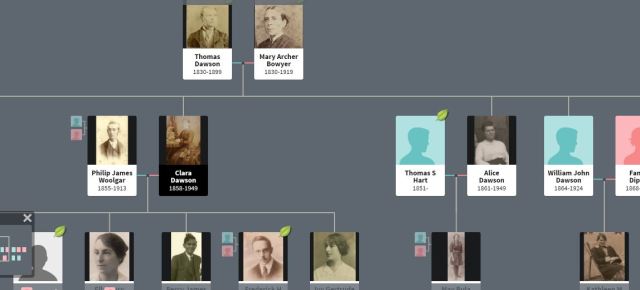
Part of a tree created at Ancestry.co.uk

Fanny Amelia’s (family history) Story

Strictly of course it is only part of her story, as there is more to be found but if I wait until it is ‘finished’ I may wait forever. So here is my attempt to preserve the memory of a lady who has no living descendants and for whom we have no photograph (yet). She is someone who could so easily be lost to history. In fact, in the past, family members did a very good job of expunging her from the oral record. As her closest living relative (jointly with my six second cousins), I felt it was up to me to investigate her life and record what I discovered, warts and all.

Fanny Amelia was the third daughter of Philip and Mary Woolgar née Cardell and was born at 6.30pm on 5th February 1848.[1] The time of birth on the certificate should indicate that this was a multiple birth but there are no other registrations for the quarter and district who could be the other sibling.[2] The address is indistinct but appears to be Cockers Haven, Finchley.[3] This almost certainly refers to a small settlement on the southern edge of Finchley Common, near the Red Lion, which was formerly named Cuckold’s Haven.[4] Finchley is now considered to be part of north London but in the mid-nineteenth century, was a small, newly-developing, settlement, distinct from the metropolis.

Fanny Amelia was baptised at St. Michael’s, Highgate on the 5th of March 1848. Her father, Philip, was described as a gardener.[5] Fanny was a surprise when I discovered her existence in the 1980s, as part of my investigations into my family history. Tales of this family were woven into my earliest memories. Why had Fanny not taken her place alongside her siblings on the first family tree I devised at the age of seven? My great-aunt, from whom I gained most of my family stories of this branch, would have been an adult when Fanny died. The families lived in close proximity, surely they would have known each other. There were photographs and recollections of Fanny’s parents, her siblings and their families but nothing of Fanny remained. Although Fanny outlived all her brother and sisters, there was no mention of her. The only acknowledgement that there may have been an additional child was the vague suggestion that Philip and Mary might have had a daughter called Sophie, so even Fanny’s name was lost to the family history. Until that is, I began my adventures in the world of archives and microfilms, of ledgers and registers, long before the advent of the internet.

The whole family appear to have escaped enumeration in the 1851 census but there was Fanny, with her parents, in 1861[7] and 1871.[8] Fanny cannot be found in 1881.[9] It has been established that she is not the Amelia Woolgar who, in 1881, was working as the cook in the Alleyn Park,[10] household of hop merchant, Stanford Mountain.[11]

On 15th November 1884, Fanny Amelia married widower, William Ellington, at St. Clement’s, Hastings, Sussex. The witnesses were Maude and H Bedwell and Thomas Covell. At the time of the marriage, William Ellington was a coachman.[12] He is inconsistent about his age and place of birth but the consensus seems to be that he was born about 1823 in Peterborough, Northamptonshire,[13] so he was considerably older than Fanny. William and his first wife, Helen, had been in service in Herne Hill for many years[14] and this is presumably how he and Fanny met.

William and Fanny Ellington’s son, George Frederick, was born in Hastings a year after they married.[15] There was another short-lived child, Richard Collings Stanley Ellington, who was born in 1891 and died the following year.[16] In 1891, the family were living in two rooms in part of 19 Cornfield Terrace, Hastings and William was working as a bath-chair man. Ten years later, the family had gained a room and were living at 100 Bohemia Road; William was still running his bath-chair business in Hastings and George was working as a compositor.[17] Although no death registration has been found for William Ellington,[18] by 1911 Fanny was a widow and can be found in the census visiting the Pierpoint family in Dulwich.[19] By this time, her son George was a boarder in the household of Harriet Blackmar, at 15 Duke Street, Eastbourne, Sussex and was still working as a compositor. [20]

On 2 May 1911, just weeks after the census was taken, Fanny was admitted to the workhouse in Constance Road, East Dulwich[21] because she was ‘temporarily disabled’ and ‘allegedly insane’. She was discharged a week letter, to Horton Asylum and described as being destitute and temporarily disabled.[22] Horton Asylum, in Epsom, Surrey, was to become noted for pyrotheraphy, an experimental treatment for the general paralysis of the insane, which was a manifestation of syphilis. This treatment involved infecting the sufferers with malaria. It was thought that the resulting high fever would destroy the spirochetes involved in syphilis. Horton was deemed suitable as it had an isolation unit, which would prevent the malaria spreading to other patients. It seems that this was pioneered in 1917, so Fanny, had she been suffering from general paralysis of the insane, would have escaped this treatment.[23]

I don’t know how long Fanny spent at Horton but on 30 December 1915, she was readmitted to the workhouse from 18 Hindmans Road. In 1911, this was the home of a younger generation of the Pierpoint family.[24] I can find no family connection with the Pierpoints, so perhaps they were just friends. Once again Fanny was regarded as ‘temporarily disabled’ and ‘allegedly insane’.[25] After just six days she was removed to Cane Hill Pauper Lunatic Asylum in Coulsdon, Surrey.[26] By this time, Horton had been requisitioned for military use.[27]

Fanny Ellington died in the asylum on 12 January 1922 from valvular disease of the heart and congestion of the lungs, both of an indefinite duration, hours after suffering a small cerebral haemorrhage. The death was registered by her son, George, who was then of 2 Grove Road, Chertsey, Surrey.[28] There was no mention of her mental state.

George Ellington married Lily Wade in 1932 in Islington district,[29] she was in her fifties so there were no children. In 1939 they were living in a tobacconist’s shop at 67 Guildford Street, Chertsey, which Lily ran; she was also a hairdresser.[30] George was still working as a compositor. They both died in 1960.[31]

The generosity of the genealogical world is outstanding. With the help of a friend, I have attempted to access the records of Cane Hill Asylum, which were allegedly in Croydon Museum. All they have is the bald statement of her admission. The quest is on for the medical records, which I understand from another helpful family historian, may be with the relevant NHS Trust. There is still the possibility of records for Horton Asylum, which are at the London Metropolitan Archives. I may have to call in another favour here. I also want to find out where she was buried; I have established that it was not at Cane Hill. The asylum was closed in 1992.[32]

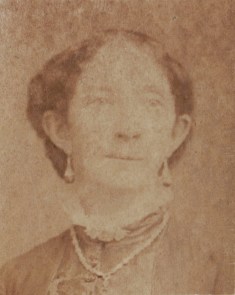
So this is Fanny’s story. I do hope that more research will mean that I can add to it. Watch this space! In the absence of a picture of Fanny, I offer you her sisters, Caroline and Mary Ann [Polly], sadly, although Caroline had five daughters, she has no living descendants either. P.S. I am quite glad that I didn’t inherit the ears!

Caroline Leighton née Woolgar 1842-1919.JPGMary Ann (Polly) Hicks née Woolgar 1845-1907.JPG

[1]    The birth certificate of Fanny Amelia Woolgar 1848, from the General Register Office.

[2]    General Registrar’s indexes of birth.

[3]    The birth certificate of Fanny Amelia Woolgar 1848, from the General Register Office.

[4]     A History of the County of Middlesex: Volume 6, Friern Barnet, Finchley, Hornsey With Highgate. Originally published by Victoria County History, London, 1980. Via www.british-history.ac.uk/vch/middx/vol6/pp38-55  accessed 4 September 2019.

[5]    The baptism registers of Highgate, Middlesex, via www.ancestry.co.uk.

[6]    Oral evidence from Gwendoline Catherine Braund née Smith and Ella Mary Bird née Woolgar.

[7]    1861 census for Rosendale Road, Norwood, Surrey RG9 367 folio 56.

[8]    1871 census for 1 Rosendale Road, Norwood, Surrey RG10 692 folio 59.

[9]    Indexes to the 1881 census of England and Wales via www.findmypast.co.uk and www.ancestry.co.uk.

[10]  Alleyn Park is in Dulwich.

[11]  1881 census for Alleyn Park, Westbrook, Camberwell, Surrey RG11 669 folios 35 & 36. General Registrar’s indexes of birth and marriage. 1871 census for Warrior Road, Lambeth, Surrey RG10 679 folio 110.

[12]  The marriage certificate of Fanny Amelia Woolgar and William Ellington 1884, from the local Register Office.

[13]  1871 census for Herne Hill, Lambeth, Surrey RG10 686 folio 43.

[14]  1871 census for Herne Hill, Lambeth, Surrey RG10 686 folio 43.

[15]  General Registrar’s indexes of birth; 1891 census for 19 Cornfield Terrace, Hastings, Sussex RG12 764 folio 83.

[16]  General Registrar’s indexes of birth and death; 1911 census for 2 Upland Road, Dulwich, Surrey RG14 2469 folio 481.

[17]  1901 census for 100 Bohemia Road, Hastings Sussex RG13 869 folio 68.

[18]  General Registrar’s indexes of death.

[19]  1911 census for 2 Upland Road, Dulwich, Surrey RG14 2469 folio 481.

[20]   1911 census for 15 Duke Street, Eastbourne, Sussex RG14 4822 folio 162.

[21]   Constance Road Workhouse http://www.workhouses.org.uk/Camberwell/ accessed 4 September 2019.

[22]   1911 Admissions Register for Workhouse, Constance Road, East Dulwich, Surrey via www.ancestry.co.uk. Originals at London Metropolitan Archives CABG/185/31.

[23]  Horton Asylum www.countyasylums.co.uk/horton-asylum-epsom accessed 3 September 2019. Julius Wagner-Jauregg (1857-1940): Introducing fever therapy in the treatment of neurosyphilis www.ncbi.nlm.nih.gov/pubmed/24185088 accessed 4 September 2019.

[24] 1911 census for 18 Hindmans Road, East Dulwich RG14 2466 folio 401.

[25]  1915-16 Admissions Register for Workhouse, Constance Road, East Dulwich, Surrey via www.ancestry.co.uk.  Originals at London Metropolitan Archives CABG/185/40.

[26]  1915-16 Admissions Register for Workhouse, Constance Road, East Dulwich, Surrey via www.ancestry.co.uk.  Originals at London Metropolitan Archives CABG/185/40.

[27]  Cane Hill Asylum, Coulsdon, Surrey www.countyasylums.co.uk/cane-hill-coulsdon accessed 4 September 2019.

[28] Death certificate (pdf) of Fanny Amelia Ellington, from the General Registrar.

[29] General Registrar’s indexes of marriage.

[30] 1939 Register for 67 Guildford Road Chertsey, Surrey RG101/1876C/006/30 Letter Code: DMCC.

[31] General Registrar’s indexes of death.

[32] https://www.countyasylums.co.uk/cane-hill-coulsdon/ accessed 4 September 2019.