The Words and Voices of our Ancestors

Until recently, I was a columnist for the In-depth Genealogist Magazine and also wrote for their blog. Now the magazine is sadly no more, contributors have been invited to re-post their blog material elsewhere, so that it is preserved. This is another post that I wrote for them.

As genealogists, we spend our time trying to recreate our ancestors’ lives. As we make progress, most of us move from collecting bare facts about vital events, to looking at the social historical context. If we are lucky, we may have photographs of our more recent ancestors, to help us to visualise what they looked like. Failing that, we may have physical descriptions from service records, prison records or asylum admissions’ books. Have you ever considered what your ancestors may have sounded like, what words they may have spoken?

Firstly, are there any examples of your ancestors’ actual words? If you are fortunate enough to have letters or diaries, these convey an impression of the writer’s turn of phrase. We don’t usually write how we speak of course but it helps us to get a feel for that person’s vocabulary and use of grammar. There are occasions when an ancestor’s verbatim speech may have been recorded, if they came up in court as a witness for example. Often the most accessible route to these words is through newspaper reports.

How about accent and dialect or even language? If you descend from those who emigrated, then their language may not be your own. Even if the language has not changed, the accent and inflection is not necessarily the same and neither is the meaning. You only have to consider the difference between American English and English English to understand how things have altered over time and distance. This does not just apply to emigrants. I grew up in south London, England. I have grandparents who were born in Cornwall, in the far south-west and Northumberland, on the Scottish border, both of these areas have very distinctive regional accents. Sadly, I was too young when these grandparents died to remember the way that they spoke. Regional accents are slowly being eradicated but there is still time to catch a flavour of your ancestors’ regional speech. Look for recordings in sound archives or online.

Dialect is distinct from accent and relates to words that are only in use in a particular district, often quite a small area. Dialect dictionaries are readily available and can help us to understand words that are local in origin and which may have been used by our forebears.

Think too about the use of individual words and idioms. Our vocabularies are changing. Some words, phrases and expressions would not have been used by our ancestors. Slang dates us and would have been very different in times past. If you decide to write up your family history and put words into your ancestors’ mouths, you need to get this right. Good dictionaries provide you with information about the earliest use of certain words and phrases but obviously you can’t look up every word. Reading books and auto-biographies, from the appropriate era, gives you a flavour of how words would have been used.

093 Forces War Records sleeve February 1946Don’t forget that our ancestors’ language was modified by their surroundings. A few years ago I inherited a Forces Record that my father had recorded for my mother during the Second World War. He died when I was nine; I had no recollection of his voice. I was able to get this record converted to a format that I could listen to. I was astonished to hear my father speaking in immaculate BBC English, despite the fact that he grew up in London poverty. Of course he would be using his ‘telephone voice’ for the recording but this was still a shock. Then I realised that his peacetime occupation was as a cinema projectionist and that he was continually exposed to the refined tones of the film stars of the 1930s and 1940s; he sounded exactly like them.

How do you Solve a Problem Like Maria?: a family history conundrum

Regular readers may remember the sad and sorry saga of my 43 year search for the mother of my 2 x great grandmother Mary Cardell. There have been a couple of posts about it already here and here. With all the zest of new year/new decade (arguably), I pursued the search yet again. To summarise and update slightly: Mary Cardell was born in Highgate, Middlesex between 1816 and 1818. Her father James was a gardener. She had a sister Catherine, born c. 1813 in Highgate and possibly a short-lived sister Eliza (c.1820-1824). I have already ruled out likely looking potential parents James Cadwell and Mary Ann Guteridge, who married in 1813 in Hornsey.

I then turned to a possible marriage of a James Cardall and Maria Withenbury at St. Alban, Worcester, Worcestershire on the 12th February 1798, both claiming to be ‘of this parish’. Worcester might seem a bit far away from Highgate but there was a widowed Maria Cardell who was in St. Pancras workhouse in the 1841 and 1851 censuses who claimed to have been born in Dudley, Worcestershire and who warranted further attention. Maria has not been found in the 1861 census. I have searched under all variants, under M.C. and also with no name but just using her age and the birthplace Worcestershire. I have not been able to find the workhouse in an address search.

There is a Maria Withenbury baptised in Worcestershire 2 August 1780, daughter of James and Elizabeth née Harris but Dudley is 30 miles from Worcester. I have checked the all the Marias baptised in Dudley 1776-1780, regardless of surname, none marry a Cardell. For a long time, I agonised over a burial of a Maria Cordle on 11 May 1834 at St. Nicholas, Worcester, age 54, who seemed like a rather too convenient fit for Maria née Withenbury. I now believe that this Maria is the wife of a William Cordle. They had several children in Worcester between 1803 and 1820, on one baptism Maria appears as Celia Maria. I cannot find a marriage for William and Maria/Celia but I am happy that this burial is not Maria née Withenbury.

A Samuel Cardel was baptised in February 1802 in Worcester, son of James and Maria. Samuel cannot be found in the census returns. A Samuel Cardall of St. Pancras (no parents mentioned) was buried in September 1805 aged 3 years 8 months at Whitefields (non-conformist) Memorial Church in Camden. If Samuel was about a month old at baptism, as was typical, this fits exactly. If this is the same Samuel, it suggests that the family moved to London between 1802 and 1805.

There is also Sarah Cardall, born 22 Jan 1811, baptised 10 Feb 1811, to James and Maria at St Margaret’s Westminster. She married as a minor in 1829 at St, Mary’s Lambeth, to William Thornton, with the consent of Maria Cardall, who also signed as a witness, implying that James was dead by this time. There is a potential burial for James in 1824 in Southwark, this is only eight miles from Highgate but it is south of the river, it remains speculative. Crucially, Maria signed her name on her daughter’s marriage record and I have been able to compare this with Maria Withenbury’s signature on her own marriage thirty years early. I believe that these are not incompatible.

Maria was admitted to St. Pancras workhouse in 1836 and died there in December 1861. She is listed on the 1861 census of long term workhouse residents (available on Ancestry). Although workhouse records state that she was a widow, there is no mention of a husband on her death certificate. The informant, S Deane, is probably a workhouse employee. I have not be able to track them down. St. Pancras workhouse would have covered Highgate. There is some fascinating information about the workhouse on Peter Higginbotham’s excellent workhouses site. Thanks to this site, I know that, in 1857, the Illustrated London News reported on the innovative steam laundry that had been installed in the workhouse. As there were, according to the article, 1500-1900 inmates, 8000 items had to be washed each week and the machinery could accomplish this in four days. This is particularly significant as Maria is recorded as a laundress on her death certificate. Earlier she had been listed as a glover but perhaps by this time her eyesight no longer allowed her to sew. It may be significant that James Withenbury was also a glover.

This sounds very progressive but the previous year had found serious deficiencies at the workhouse. This too is reported on the workhouses website. The workhouse was found to be “severely overcrowded with patients in the infirmary having to be placed on the floor. Ventilation throughout the building was deficient, with fetid air from privies, sinks, drains, urinals and foul patients permeating many of the wards and producing sickness, headaches and dysentery amongst the inmates. The staff also complained of nausea, giddiness, sickness and loss of appetite. A lying-in room, also used as a sleeping room by night nurses, had a smell that was ‘enough to knock you down’. In the women’s receiving wards, more than eighty women and children slept in two rooms which provided a mere 164 cubic feet of space per adult.” Incredibly, Maria spent twenty five years living here.

So where does that leave me? I believe that James and Maria née Withenbury had a son Samuel in 1802, moved to London and had a daughter Sarah in 1811, who subsequently married William Thornton. (This despite the world and his wife on Ancestry having Sarah as the daughter of a William Cardell – the baptism and marriage records taken together are quite clear – the father is definitely James). There is obviously a large gap between Samuel and Sarah. Given that there are no baptism for great great granny Mary or her sister Catherine, if this is the same family, this could be an explanation. Samuel’s non-conformist burial may also be significant. Alternatively, James could have been away fighting in the Napoleonic Wars, he could have been in prison, there may have been a series of miscarriages, or any number of other explanations for the apparent nine year gap. The 1851 census for Cardells and variants, born in Highgate, Finchley, Westminster or Southwark reveal only a William, born c 1815/6 in Southwark, as a possible additional sibling (and then this does not fill the gap) – no baptism has been found for William but coming as he would between the two girls born in Highgate, it seems less likely that he belongs to this family.

I also believe that Maria Cardell née Withenbury, mother of Samuel and Sarah, is the Maria who spent twenty five years in St. Pancras Workhouse. The million dollar question is, is she also the mother of great great granny Mary, Catherine and probably Eliza? Can I  add her to the family tree? I don’t know if there are further relevant workhouse records that the London Metropolitan Archives have not put online, if so, that is an obvious place to start. Maria’s father, James Withenbury, left a will but unfortunately, he died before Maria married, so there is no hope of Cardell grandchildren being mentioned. I do have a DNA match with a descendant of Sarah Thornton née Cardell, which is encouraging but I also have a match with a descendant of the sister of Mary Guteridge, who married the wrong James Cawdell. I have contacted the descendant of Sarah and another who does not appear to have done a DNA test – no replies. I am almost out of ideas. Suggestions on a postcard ……..

Oh, you would like another novel hint (8/11 chapters now written) – well here is #2:- like Barefoot it is not exactly all sweetness and light. Another tragic incident underpins the story.

DNA Dilemmas

The following post was another that I wrote for The In-depth Genealogist’s blog. I am writing it from the perspective of someone who has done DNA tests with three different companies and who runs a Y-DNA surname project.

DNA testing for genealogical purposes has never been more popular but it is not without its drawbacks. All too often, people bemoan the fact that potential DNA connections have provided no family information to their testing company of choice, or that they fail to respond to emails. There is however a more serious issue. Somewhere in the fairly small print most, if not all, the testing companies warn that those taking a test should be prepared for the results not being what they are expecting. In our excitement, how many of us read, mark and inwardly digest the implications of these caveats? What can possibly go wrong?

Nowadays, for many, it is a DNA test that sparks the research trail but others are experienced genealogists. For those serious researchers, before that test is taken, there has been time, money and most importantly, emotion invested in a particular family line. What happens then when the DNA results suggest that there is no genetic connection to that family at all? If we think, as we scrape our cheeks or spit in our tubes, about the possible outcome at all, have we really come to terms with how we would feel to no longer be a Smith but a Jones? Even if we are intrigued or excited about the thought that, somewhere in our ancestry, a Mrs Smith has had a child by someone who is not Mr Smith (Mr Jones perhaps) this will not just affect us. How will our siblings, parents, cousins, others who share this hiccup, feel? These relatives may or may not have been particularly interested in our genealogical delvings, they may even have been discouraging. Do we tell them and if so how? Will they be interested or appalled? Remember that it may be very difficult to pinpoint the precise point in our ancestry where the genetic pedigree deviates from the documentary. It could be 60 years ago or 600. It might be easier to accept a 6 x great grandmother going astray than a grandmother but in either case, we have lost that genetic link to a family that may have been ‘ours’ for decades.

What about those of us who run surname DNA projects, perhaps with the aim of proving that documentary family trees for a rare, potentially single origin, surname are genetically linked? Hopefully we explain to those who test that they may not match the normal profile for that surname but I suspect those testees all go ahead without really expecting it to apply to them. When non-matching results come back how do we break the news that they do not have a genetic link to that surname at all? To have tested in the first place they presumably feel some sense of belonging to the genetic line. I guess we can approach this in a similar way to those who have been adopted into the family but then it is not usually the family genealogist who has to break the news that someone is adopted and in most cases, there are now options for adoptees to identify their birth parents. Unless our non-matching DNA reveals a connection to a very unusual surname, the chance of finding the birth father of the product of Mrs X’s indiscretion is remote – even supposing that we can narrow down which Mrs X went astray.

When I took my first test, my head was prepared for a non-match, I am not sure that my heart was equally prepared. Fortunately for me, my slightly dodgy documentary direct paternal line was confirmed by DNA. How would I have felt if it was not? If I am honest, I really don’t know. I would be very interested to hear how others cope with DNA dilemmas.

This image is a work of the National Institutes of Health, part of the United States Department of Health and Human Services. As a work of the U.S. federal government, the image is in the public domain.

Of all Things New: presentations, courses, books and more

New year, new things on the horizon. Here is just a selection. Last week I spent a very interesting day at the headquarters of Family Tree Magazine, filming two presentations for their downloadable content. Despite the fact that I am used to presenting, it is actually very difficult to talk for nearly an hour (x2) with no audience participation, no hesitation, deviation, umms and ahhs, coughs, pauses to swig gin etc.. The presentations will be available in a month or two. One is on tracing twentieth century English ancestry and the other on pauper ancestors.

Whilst on the subject of Twentieth Century ancestry, my online course for Pharos begins in a couple of weeks and is filling up fast, book now to avoid disappointment and all that. I am also preparing two new online courses, which will be available through Pharos. There will be an introductory one-place studies course, which will begin in September (ok, so that isn’t written yet either). The previous course, run by Celia Heritage, is no longer available, as Celia has other commitments. This one will be a brand new; I have deliberately not looked at Celia’s version. A course to help those tracing Agricultural Labouring Ancestors is planned for 2021. I also have a new presentation on the same topic, Sons of the Soil, which will premiere at Dorset Family History Day  in March. Err, no, that isn’t written yet either.

Back to one-place studies for a minute. Putting your Ancestors in their Place is now very nearly out of print. I am preparing a new booklet, which will have a rather different approach and a more international feel. It will also be available for Kindle, which I hope will be popular. With luck, that may be ready for THE Genealogy Show in June and yes, you’ve guessed it, not actually written yet. Add to this the book that I may need to write in connection with the job I must not mention and there are no prizes for guessing what I shall be doing over the next few months.

Deepest Darkest Devon

And now for something completely different, something that is actually written! Hurrah! Exeter Authors Association of which I am very much an inactive member, have produced an anthology of short stories with a Devonian slant, Tales of Deepest Darkest Devon. I am not by nature a short story writer but one of mine (ok the only one of mine) Brought to Book is in that collection. If you enjoyed Barefoot it is similar in style and based on a true story that took place in Devon in the 1820s and 1830s. You also get to read all the varied and fascinating contributions by other local authors. Priced at £4.99, it is due for publication on 31 March and is currently available in Kindle format only. It can be pre-ordered now here. Part of the proceeds will be donated to Devon Air Ambulance Trust.

My next novel is due to be launched on 29th August, ok, so there is the small matter of a third of it still to be written (have you spotted a theme here?) – that’s a mere detail. Advance notice that I will not be creating a millstone round my neck and writing 100 blog entries about the characters and locations as I did for Barefoot but I will be drip-feeding some hints and teasers in my blog posts in the meantime. #1 It is, like Barefoot, based on a true story. So, stand by, there will be more and a title reveal is imminent (when I have decided what it is to be that is!).

Whilst I look forward to these excitements, my thoughts are with my many Australian friends and the appalling fires that are currently threatening their homes and families. On a more positive note, it is exciting to see that several of my favourite genealogy presenters will be participating in Family History Down-under in March 2021. I think that it is very unlikely that I will be able to attend but if you live nearer than half a world away (or even if you don’t) this is going to be a major event on the genealogy calendar.

Happy Birthday Granny

Today would have been my grandmother’s 127th birthday. Here is a little about her.

My grandmother, Ivy Gertrude Woolgar was the youngest of four children of Philip James and Clara Woolgar née Dawson. She was born at the family home, 7 Chalford Road, Dulwich, South London on the 4th of January 1893.[1] Whilst Ivy was a child, her father gave up his job as a milkman and became a gardener.[2]  The family were regular church goers, usually attending nearby Emmanuel Church,[3] unless they went to hear Ivy’s brother, Percy, sing in a choir elsewhere.[4]

Ivy was entered into Salter’s Hill School, Gipsy Road on the 1st of July 1897, she transferred to another school, possibly the junior department of Salter’s Hill, on the 2nd of July 1900.[5] She became an office clerk,[6] working for John Gardner & co.[7] She was reported to have been her father’s favourite and he accompanied her to work on her first day at Smithfield Meat Market.[8] On the 8th of April 1922 she married Frederick Herbert Smith, after banns, at St. Clement Danes in the Strand, London. The witnesses were Ivy’s mother and brother, Clara and Percy, Herbert H Smith, Frederick’s father and Muriel Chown Bird who was the sister of Ivy’s brother in law William Bird.[9]

In 1924, Frederick and Ivy went to live at 159 Albert Road (later renamed Davidson Road)[10] where they lived for the rest of their lives. Their daughter, Gwendoline Catherine, was born on the 27th of February 1925.[11] She was baptised on the 31st of May 1925 at Emmanuel Church, Dulwich, Surrey.[12] Frederick died on the 13th of September 1957 at 159 Davidson Road, of heart failure, bronchitis and emphysema.[13] Ivy Gertrude died of lung cancer at her daughter’s home, 28 Sundridge Road, Addiscombe, Croydon, Surrey, on the 25th of April 1963. She was 70 years old.[14]

‘Granny’ was 63 when I was born (my age now) and died a month after my seventh birthday. She was a wonderful lady and the archetypal granny in everything except build. We played together regularly, she taught me to knit, recited nursery rhymes and did all the things grannies are meant to do. My first family holidays were on the Isle of Wight and Granny came too. My memories of Granny are a role model for my own grandparenting. Although I lack her dainty size, physically I have inherited most from this grandparent. In fact I wonder why, when I look in the mirror, she looks back.

Ivy Gertude Woolgar 1893-1963 6.jpg

[1] The short birth certificate of Ivy Gertrude Woolgar 1893, in family possession.

[2] Oral evidence from Gwendoline Catherine Braund née Smith.

[3] This is no longer standing.

[4] Oral evidence from Gwendoline Catherine Braund née Smith.

[5] Admissions’ Register for Salter’s Hill School, held at The London Metropolitan Archives.

[6] 1911 census for 7 Chalford Road, Norwood, Surrey RG14 2134 folio 190.

[7] Oral evidence from Gwendoline Catherine Braund née Smith.

[8] Oral evidence from Gwendoline Catherine Braund née Smith.

[9] The marriage certificate of Frederick Herbert Smith and Ivy Gertrude Woolgar 1922, in family possession.

[10]  Information from Gwendoline Catherine Braund née Smith, daughter of  Frederick Herbert Smith.

[11]  The birth certificate of Gwendoline Catherine Smith 1925, in family possession.

[12]  The baptismal certificate of Gwendoline Catherine Smith 1925, in family possession.

[13] The death certificate of Frederick Herbert Smith 1957, in family possession.

[14] The death certificate of Ivy Gertrude Smith née Woolgar 1963, in family possession.

What the 2010s Have Done for Me – and What the 2020s Might Bring

Warning – self-indulgent post alert.

N.B. I do know that the decade can and perhaps should, be regarded as ending at the end of 2020, not 2019, as there was no year 0 but I am going with the popular conception here.

This post is mainly for my own benefit but you are welcome to share in my memories and plans. Maybe you’d like to compose something similar for yourself. It is insightful to look back and fun to make predictions for the next decade.

It is only as I sit and write this, that I realise quite what an amazing decade the 2010s have been on a personal level. If the 2010s have not been good to you, I sincerely hope that the 2020s will bring you all the good things that you deserve. May the 2020s do for you what the 2010s did for me. If I had written a post like this ten years ago, I could not have imagined that my life would be as it now is. I am conscious that, given my age, the 2020s may be the last full decade during which I can do many things, so I have many hopes and dreams to fulfill in the next ten years.

Of course, although things have gone well for me, the national and international situation can scarcely be described as positive. I cannot pretend to like the complexion that the country and the world has developed in the past ten years. We need to take care of each other, to be considerate and tolerant and to respect difference, whether that be race, creed, sexual orientation or political views. It is fine to have different opinions, it is healthy to discuss these but it should be possible to calmly agree to disagree. We need to look after our planet, for ourselves, for our children and for our children’s children. This is not something we can ignore.

Family: With the deaths of my mother and her cousins in the 2010s, I am now the oldest generation, which is sobering. The past decade saw the marriage of one daughter (the other was already married) and the arrival of three wonderful grandchildren.

I do not anticipate the addition of any more family members in the 2020s but I look forward to watching my grandchildren blossom into young adults. I also hope that, early in the new decade, one set of descendants will be living nearer to me. Obviously, spending more time with those that I am closest to is a priority for the next ten years.
DSCF0929

Home and Community: In 2010, I was already living in this house and involved in the local community.

I would expect this to be something that changes little in the next decade, although the projects that I engage in may vary. I really do want to get my house ‘up together’ but that is a never-ending task.

Church Graeme's edit

Work: In 2010 I was already employed in a version of the job I must not mention. The decade brought three promotions but ironically less work and less money. On the plus side, it is now less time-consuming. A very recent development on this front should allow me to use my writing skills as an adjunct to this role. I was also already working as an historical interpreter ten years ago but now I am running a team of interpreters, rather than being an employee. In 2010, I was a speaker in genealogical circles but only well known in my home, or former home, counties. During the 2010s, I have had the privilege of speaking at many premier national and international events and was twice voted British gold medallist in the ‘Rockstar Genealogist’ poll.

If the goalposts are not moved again, I will reach official retirement age in the 2020s (something that should have happened in the 2010s). I would like to say that my work will lessen in the next ten years but I am a realist and I love what I do.  I hope to take the job I must not mention through, at least, to the next big upheaval, which may be in the mid-2020s. I’d like to think that I could carry on until the end of the new decade but who knows. I anticipate that my days of heaving suits of armour about may be limited and that getting up at 5am and doing full days in schools might not be appealing by 2029 but we soldier on for now and I hope that I will still be able to give individual presentations for another ten years. This will be chauffeur dependent, I am not the only one who will be ten years older! I predict that I will do more presenting and teaching online. I have two new online courses in the pipeline already.

Jo Rutherford Photography_-18.jpg

Jo Rutherford Photography

Travel: In 2010 I had been abroad six times and one of those occasions was a day trip to Calais when I was eleven. I had already begun my international travel with my first trip to New Zealand in 2009 but in the last ten years I have visited Canada, Australia, Peru, US, Russia, eleven European countries and returned to New Zealand. I have also travelled through many beautiful parts of Britain, including the Channel Isles and three trips to Scotland.

My predictions for the 2020s are that I will go abroad less, long-haul really has lost its appeal but that I will continue to explore closer to home. A holiday in Ireland is already booked. I still want to finish my project to spend a few nights in every British county. I am secretly (oh, not so secretly now) tempted by Norway, Iceland and Madagascar though.

106 23 May 2019 Puffin Farne Islands

Writing: In 2010 I had just finished my PhD, which was a writing marathon and I was a regular contributor to family history magazines. The 2010s was the decade of book publication, with several non-fiction books hitting the shelves as well as my novel. I did not have a website or a blog ten years ago, which is a shame, or I might have been able to compare my predictions with reality.

Apart from the planned publication of a second novel and two booklets in 2020, it is difficult to foresee what turn this may take during the next ten years. If the idea for a third novel presents itself, there may be one. Storage space dictates that I may turn to digital book production, at least for any non-fiction that I may write; again there are no plans. Alternatively, I may concentrate on writing up family history stories and finish my biography.
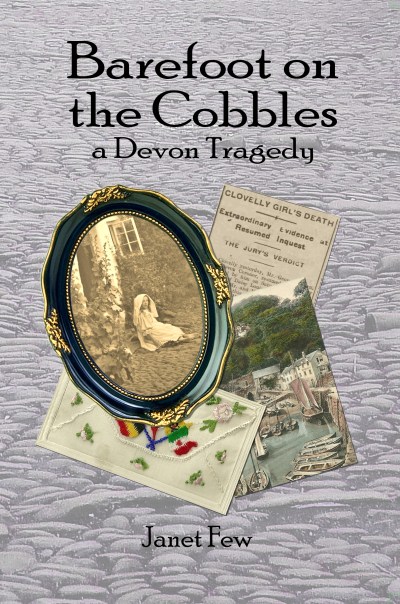
 

Barefoot on the Cobbles Front cover jpg

Health: It is never all good news. In the past decade, inevitably, my body has started to misbehave in a few ways. Sadly, it is probably all downhill from now on but I shall do my best to still be reasonably fully-functioning by 2029.

Leisure: What’s that? Family history has a separate category, that’s an obsession, different entirely. I do want to take more time to ‘smell the roses’ in the 2020s. I’d like to get back to my spinning for example. I still have ambitions to pass a grade 1 piano exam. Maybe I can beat my granddaughter to it but I doubt it. I am really tempted to teach myself Cornish but my track record with languages is appalling and I am too far from any face-to-face classes. I would like to finish the remainder of the south-west coastal footpath, which has made no progress in the last six years; I think I could still just about manage it.

Family History: In 2010, I had not taken a DNA test, I had not put my family history online and I had composed narratives about only a few of my ancestral branches. Ten years on, I have made a major break-through on my direct paternal line, a few other lines have also progressed, notably those in Cornwall, which had been untouched for over thirty years. I am close to a ‘gateway’ ancestor, that will link me to nobility (not something I am particularly bothered about but interesting nonetheless). I have an online tree, DNA results from three companies and more of my research is in a state that others can access. I still have three major brick walls. I have made some progress on these but there they remain.

In the next ten years I plan to reassess and ‘write up’ more branches of the tree. It would be lovely to demolish at least one of the brick walls. I would also like to immerse myself in the Cornish portion of the family once again. I want to continue to inspire my descendants with a sense of the past.

If this sounds like everything in the past ten years has been wonderful, that is because I am a glass half-full sort of a person. I am very fortunate that the 2010s have been particularly good to me but I don’t want to give the impression that everything is perfect, that would be impossible. There have been challenges and difficulties, not everything is ideal, that is reality. I know that I have been lucky and I am very much aware that many have gone through awful things during a decade during which matters have, for the most part, gone well for me. If looking back is painful, then please look forward. I wish you all a 2020 in which you can be at ease with yourself and at peace with others. See you in the new decade!


New Year – New Resolutions: telling your family’s story

As one year comes to an end and another looms on the horizon we often have wonderful intentions about where the next year will take us. Sometimes we make commitments that relate to our health or long overdue tasks. As genealogists, we might make research plans for the forthcoming twelve months. Meeting with relatives over the holiday season might have reawakened enthusiasm for investigating a particular branch of the family. One thing that all too many of us continually put off is the task that we label ‘writing it up’. One day we will put all this in some sort of coherent order for our nearest and dearest. We just want to kill off auntie Annie/get back one more generation/prove that family rumour first. In short, we want to ‘finish’ our research but as all but the most naïve genealogists know, the day that we finish our research never comes.

Why then are we putting off the dreaded ‘writing it up’? Some feel that their online tree, plus rigorous source citations, is a finished product in itself. Ask yourself though how appealing this is to non-genealogist family members. You are much more likely to spark their interest with stories, with context. To make your family into three dimensional characters, you need to think about the local and social historical background to their lives.

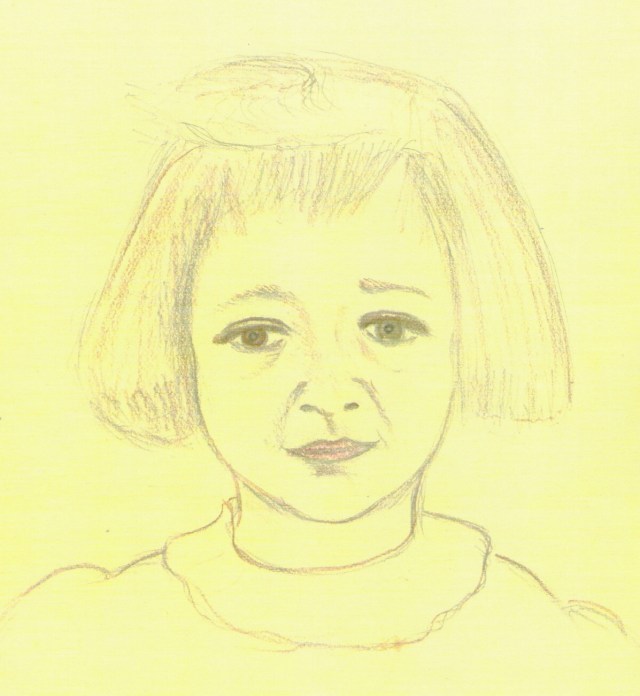
Drawing of Janet

My father’s portrait of me, aged about 4

Many of us, especially if we have been researching for years, just put ‘writing it up’ very firmly in the ‘too hard’ basket and screw down the lid. It is true that it can be a daunting task but it is one that should be tackled, sooner rather than later. To begin with, ‘writing it up’ doesn’t have to mean a book. There are many other formats, both traditional and more unusual, that can be a vehicle for telling your family’s story. Some of these are much less scary than a book and may suit your own particular strengths. Perhaps you feel that your literary skills are lacking. Don’t worry, if you can read this you will be fine.

You do not have to do it all at once. Concentrate on a small twig at a time, not the whole tree. Set yourself a realistic deadline; perhaps there is a family reunion or an anniversary coming up that could be a target. The most important thing is to stop procrastinating and put fingers to keyboard. Yes, you will find loose ends on the way; extra pieces of research that need doing but don’t let these divert you for too long – there can always be volume two! Think about your potential audience and what might appeal to them. In the end, this impossible task can become enjoyable rather than a millstone round your neck.

If your New Year’s resolution was to lose weight or to give up smoking, you might well seek help from a group who were embarking on the same journey. Researching and writing can be solitary activities, so mutual support and encouragement is important here too. If you publicly announce your intention to do something, be it taking more exercise or telling your family’s story, that public declaration is in itself a motivator. Can you get together as a small group and meet to share your progress and problems? Can you find a course that might offer both guidance and encouragement? Whatever route you decide to take, please don’t let 2020 be yet another year when you don’t start to ‘write it up’. Good luck. I am sure you will get satisfaction from your creation.

Janet Few runs ‘Writing and Telling your Family History’ courses for Pharos Teaching and Tutoring.  The next one starts on 31 March 2020,. These are online courses, which can be taken from anywhere in the world. This one is particularly appropriate for those with British ancestry.

Extending your Family Tree – some tips for climbing over (or round) those brick walls

As many of my genealogy friends will be spending the days between Christmas and New Year frantically seeking the next generation of their family tree, I thought it was a good time to re-post this, which I originally from for the In-depth Genealogist blog.

We all have them, those pesky ancestors who’ve been lurking at the top of a branch of our family tree for years, or even decades. They seem to have come from nowhere. We are desperately searching for their parents so we can extend the line but the necessary records elude us.

The first step is to revisit the life of that ancestor to ensure that you haven’t missed a clue. If they live into the period of the census returns, track them in every census, not just one (apologies to those with Australian ancestry, I know this one is not for you). Look for deaths, burials, obituaries and gravestones. Some of these records will give a clue as to a date of birth, even if they do not suggest a place. Sometimes the results will be inconsistent. Use as many records as possible to establish when the ancestor was born and then accept that they all may be wrong!

When calculating a date of birth remember that you do not just subtract the age in the document from the year of the record, which is what the data providers do when compiling their indexes. For example, most UK censuses were taken in late March or early April. At that point ¾ of the population will not have had their birthday in that year. It is more accurate therefore to take away the age in the census+1 when estimating a birth year. In any case, you want to narrow the date span as much as possible.

If an individual claims to be 27 when they married on 20 December 1874, then they were born between 21 December 1846 and 20 December 1847. If that same individual was aged 43 in the 1891 UK census, which was taken on 30 March, then their date of birth was between 31 March 1847 and 30 March 1848. If they were 73 when they died on 15 July 1921, then their birth date was between 16 July 1847 and 15 July 1848. Taking these three pieces of information together, you now have a birth date between 16 July 1847 and 20 December 1847 providing all these ages are accurate. You may need to widen your date search. Remember the legal ages for marriage. In the UK these remained at 12 for girls and 14 for boys until as late as 1929. For female ancestors their child-bearing years will give some clue as to possible birth years.

There are various reasons for failing to find the much-needed birth or baptism entry. Are you looking under the wrong version of the surname? Names are misheard, mis-read and mis-transcribed. Mis-hearing and mis-reading lead to different variations. Ask others to write the spoken surname to see what mis-hearing might lead to; remember regional accents will make a difference. Note commonly confused capital letters: I & J or L, S T & F, for example. Use wildcards in your searches.

Some people change their surnames altogether, for a number of reasons. In some cases, it may be possible to search using just a forename, date and place of birth, then the resulting possibilities can be investigated to see if they might have become your ancestor.

Is the forename wrong? If you have John Henry, try Henry John. Consider nicknames: Jack and John, Polly and Mary Ann, Jenny and Jane. Remember that UK birth registrations were sometimes done before a name was decided upon, so they may appear as Male or Female —-.

Are you looking in the right place? People often believe they were born in the place where they spent their early childhood but this is not always so. Might they have been born further afield? Perhaps the family was away from home at the time, or even overseas.

Sometimes, sadly, the record we are seeking never existed, or has not survived. In this case we have to turn to alternative sources and rely on luck to take us further.

Good Luck!

Catherine Seear

Clara Seear (not a brick wall!)

Christmas Memories

Until recently, I was a columnist for the In-depth Genealogist Magazine and also wrote for their blog. Now the magazine is sadly no more, contributors have been invited to re-post their blog material elsewhere, so that it is preserved. This is another post that I wrote for the magazine, which I have edited to bring it up to date.

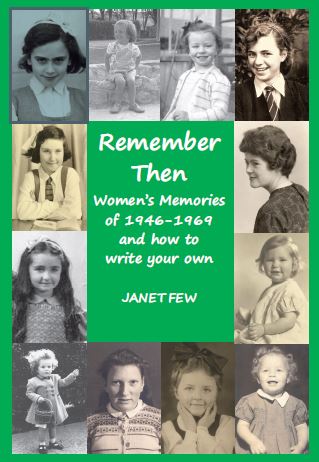
This four years ago I was taking delivery of my latest creation; a whole pallet full of poorly wrapped books were deposited near my driveway in the rain. I say my creation but that wasn’t really true. Eighty ladies had spent the preceding eighteen months writing their memories of various aspects of their lives in the decades following the second world war. I then wove these together into what was to become the book Remember Then: women’s memories of 1946-1969 and how to write your own. These ladies wanted copies of the book to give as seasonal gifts and I had very few days in which to package and post numerous copies. So that is a memory of 2015 but what about earlier December memories?

The previous year, my ladies had been writing the section of the book that related to celebrations. We wrote about food, gifts, gatherings, religious ceremonies, decorations and family rituals and traditions. Along with them, I too recorded what I remembered of this special time of year. These memories appeared on a blog post at the time. Many of the traditions of my childhood have been perpetuated by my descendants, other have been lost over the decades, making it important for me to preserve them for posterity. Are your descendants aware of how the holiday season was spent in your youth? Do you have older relatives who you could question about the customs of past decades? These memories are part of your family’s history and should be recorded.

Remember Then cover

To give you a flavour, what follows are just a few of the memories that my ladies shared. I would encourage you to preserve similar recollections for your own family.

“There was one year when the roast potatoes found themselves on the floor. I don’t think the five second rule had been heard of then but the potatoes were eaten, we survived and none the wiser. Then there was catering for Uncle Percy, who emphatically didn’t eat turkey – except of course when we convinced him that it was chicken! Christmas mornings meant cheeselets and ginger ale, later replaced by Benedictine or Southern Comfort.”

“When we were young, we always tried to give my parents a hand-made gift, made and wrapped in great secrecy. I remember string pot cloths, drawn-thread tray cloths, embroidered hankies, frilled aprons, home produced bath salts in decorated bottles, knitted tea cosies, gloves and ties.”

Many of our decorations were hand-made and we spent hours cutting coloured paper into strips and gluing them into chains. We also bought home Chinese paper lanterns made at school and made crepe paper streamers to decorate the ceilings. In later years, I made Christmas bells out of Teacher’s whisky bottle tops, painting them white and dipping the bottom edges in silver or gold glitter, then drilling a hole in the top to hang a bead clapper and a loop to put them on the tree.”

““We always went to the pantomime shortly after Christmas. We usually had good seats at the front on the left as you faced the stage. I have no idea how early mum had to book, or how much she had to pay, to get these premium seats. Being at the front was very important as, at some point, children would be invited to go up on stage and it was whoever could get there quickest. I don’t remember being disappointed. The lucky children would then help with the audience participation song and I think, were given a small gift.”

Glimpses then of past celebrations. Now is the time to grasp your own memories and commit them to paper before they fade into oblivion. By the way should you want a copy of the book, please contact me for details (still on a mission to reduce the book stock 🙂 )


Not actually a Family History Advent Calendar Part 12

Well, I made it to half an advent calendar! This will probably be the last post of the festive season as the descendants are about to descend and I really need to tidy up, or at least make space for them, before they arrive. Interesting incident yesterday when a full carton of fruit juice fell on to one of those metal spiky dish things you use for carving meat. Ok, so I don’t use it for carving meat but the occasional roast animal does get deposited on it before being inelegantly hacked to pieces. You know that thing on medical dramas where they say, don’t remove the knife or they will bleed out? They aren’t wrong. Interesting ‘bleeding-out’ carton of fruit juice incident anyway. Despite all this and the other pre-Christmas merry-go-round, cakes iced, presents still not wrapped etc., I did manage to update the account of one branch of my family history. For those who remember the Mary Cardell saga, I am a teeny bit closer to making progress but I am still not confident enough to ink it in.

Anyway, enough of this trivia. The favourite family history website of the day is: V is for Vision of Britain Through Time. The website provides links to maps, historical travel writings and old photographs. It also includes the census reports and statistics and there are some statistics of church attendance from the ecclesiastical census.. It is effectively a gazetteer of place names, including those from the 19th  century. Inevitably, there is more information for some places than others. So have fun exploring your ancestral areas.

Thank you for your support and have a wonderful Christmas. For those who find this time of year difficult, reach out, there are people there for you. If you are happiest in your own space that’s fine too, you don’t have to feel guilty for not celebrating in a conventional manner. Be kind to each other folks.

DSCF0993

1950s vintage – slightly ruined by a particularly resinous tree one year

Many of the entries in this year’s advent calendar are based on my book Family Historian’s Enquire Within. I would be very grateful if anyone in the UK wanting to buy a copy would get in touch with me directly (there will be no charge for UK postage).