The Year so Far – a Family History Whirlwind

The year began with family visitors, which is always very special. As a bonus, this year they didn’t include any lurgies amongst their seasonal gifts. The new year also means paying the tax bill. This wasn’t a surprise and the money was put aside but it is always a bit of a shock to see the bank balance suddenly depleted by what seems to be an eye-watering amount. Added to this, it seemed I needed to pay a different HMRC bank account, which meant setting up a new payee. I have one of those little card reader things that gives you a secret code to verify that you are not a fraudster. I’ve had the thing for ages, which is probably why it chose this moment to decide that its batteries had had enough. Before these obscure-sized and expensive batteries died a final death, they gave me a partial glimpse of the vital number. Could I guess what figures they were striving to reveal? It turns out that I could. Hurrah.

It has been full on family history on many fronts since the visitors departed. I’ve finished a magazine article. My new book is signed off and is due out in May, pre-orders should be opening up soon. I love they cover that Pen and Sword have chosen. I’ve also, rashly, signed a contract for another one. Will I ever learn? Not totally unrelated, is the work I’ve been doing towards the next Forgotten Women Friday collaborative research day for the A Few Forgotten Women project. This one is to be about women associated with Dorchester Prison.

My Pharos Agricultural Labourers online course has started again this week with a full, enthusiastic cohort. Next up on the Pharos front will be the first presentation of ‘Putting your Female Ancestors into Context’ in March. This filled up so quickly, that I agreed to take more students than usual. This means that there are still just two spaces left, if you want to come along for the ride.

I’ve have been giving talks like, well, like someone who gives an awful lot of talks I suppose. I’ve been out and about in person chatting about herbs and plague and online with the history of prostitution, marginalised ancestors and writing your family history amongst other things. This has taken me to Northern Ireland, to Surrey to Lincoln and other points in between. I have also recorded talks for future broadcasts. Rootstech is on the horizon. The pre-recorded talks have not yet been announced but there will be a short session from me in there, when I will be talking about British administrative units, do you know your townland from your wapentake, or your riding from your peculiar? If not, seek out my ten minute chat when Rootstech opens next month. Even better, online attendance is free. Legacy Family Tree Webinars have announced this year’s programme and I will be popping up there too later in the year. It is a fascinating programme, well worth the subscription.

The volume of talks in a sort space of time has obviously been getting to me, as on the night before two talks Monday I had a bizarre dream in which I had double booked myself and my mother was going to deputise for me. A couple of issues with this. She isn’t actually alive and she’d decided she was going to talk about red wine, a subject about which she knew nothing in life.

A little late to the party, I’ve been playing with Family Search’s full text search facility, which is in experimental mode and can be accessed at https://www.familysearch.org/en/labs/ once you are signed in to Family Search, which is free. This allows you to use AI generated transcriptions to search for names within the body of a document, such as the beneficiaries in a will for example. My take on this is that there is loads of good stuff on there and this has the potential to be brilliant but as yet there are still some drawbacks, which is understandable, as this is still being trialled. AI’s palaeography skills are pretty basic and mistakes are made that would not be made by a human, such as ‘Michael wears’ for Michaelmas,, rendering the sentence nonsensical. Searching is clumsy. It is very difficult to narrow down the results. You need to ignore the headings, which are often very misleading. Documents labelled Warwickshire, for example, turn out to also include many other counties. Having said that, it is definitely worth a play but make sure you have a few hours to spare first.

I’ve even found time for some of my own research and am deep down a rabbit hole following the story of a several greats uncle who was transported. It will be coming to a Granny’s Tales site near you shortly.
Dinosaur Poo, Milking Pigs and Being Me

I apologise for yet another post with poo in the title. This stems from the great discussions I’ve been having with my current cohort of Pharos students on the Discovering more about your Agricultural Labourering Ancestors course. They are a brilliant bunch and our chats range far and wide, including, yesterday, investigations into the use of coprolite (that’s the dinosaur poo) for fertilizer and whether it is possible to milk a pig. The jury is kind of out on that one. Obviously pigs do produce milk but milking them is not generally advised, although there are some ‘interesting’ YouTube videos. Don’t be distracted by the possibilities of milking Minecraft pigs however, that’s another thing entirely.

So someone has decided they’d like to be me. Well, I know I am pretty cool and all that but seriously, although I enjoy being me, it is a bit of an acquired taste. What appears to be (and hopefully is) a very restricted portion of my friends and colleagues have received emails from a spurious email address that does not include my name but is signed with by me with the title of one of my volunteer roles. After a full investigation it has been confirmed that this is not hacking or a virus but identity theft and there’s not a lot I can do. If you get one of these weird emails, check with me on an email address you know is mine and then, if it isn’t me, forward the offending message to report @ phishing.gov.uk. On the upside, as I am now two people, I will race through the to do list at the speed of light. The other me is a little tardy doing the washing-up though.

Excitingly, the first proofs of Marginalised Ancestors have arrived. Less excitingly, that means the dreading black hole that is indexing is looming. Hey, maybe the other me could do that part.

New Book, New Ventures and a Random Shopping Order

Firstly, I am now allowed to tell the world the exciting news that my next book is at the publishers. This is a non-fiction volume, commissioned by Pen and Sword, about tracing Marginalised Ancestors. So, my usual fare of tragedy and trauma, with chapters on Poverty, Criminality, Illegitimacy, Mental Health, Sickness, Prostitution, Witchcraft and more. Each chapter includes a case study and they were such fun to research. I can’t wait to introduce you to Sarah and Joseph and Charity and Harriet and Frederick and co.. Don’t hold your breath though. I am hoping that this may be out by the end of the year, so in your Christmas stockings but it could be 2024. This isn’t exactly a cover reveal as it is still provisional but I have been given the green light to share.

Then two new ventures that will also involve writing. I am to join The History Girls as a reserve blogger. This blog contains a fascinating range of posts on all things historical and is billed as ‘A blog from great writers of historical fiction’. I am having a serious bout of imposter syndrome but it should be fun. As I clearly don’t have enough to do, I applied for and have been accepted as a contributor to the Mass Observation Project. This is particularly exciting as my mother was a contributor in the early 1960s. The website does say that the original project ran from 1937 to the early 1950s but does also mention some material from the 1960s and I distinctly remember my mother having to write down what was on her shopping list. They have asked for a biography ‘it can be as long or as short as you like’. Do they realise that I have an 80,000 word, as yet unfinished, auto-biography stashed away? I am assuming they don’t want all of that. On the other hand ……….

Last week, I encountered that thing when you accidentally click on the wrong day for your T****s order without realising (meant to be next week) and just bung all the favourites in the basket regardless to hold the order, thinking you’ll sort it out and delete stuff a couple of days before. Then you get an email confirming that goods to the value of twice your normal shop are on their way and you have no space in the freezer, because obviously the order is the following week and you daren’t even look at what you’ve ordered, as probably it includes stuff that your daughter, who eats funny modern stuff, ordered when she was here and a load of random things you don’t want. I never did look at the order, so Mr T****’s delivery man turned up with quite a lot of trays of stuff. Well, it could have been worse. Not too much frozen stuff, no weird modern stuff but I have all the ingredients ready for next year’s Christmas cake and puddings!

Twentieth Century Family History

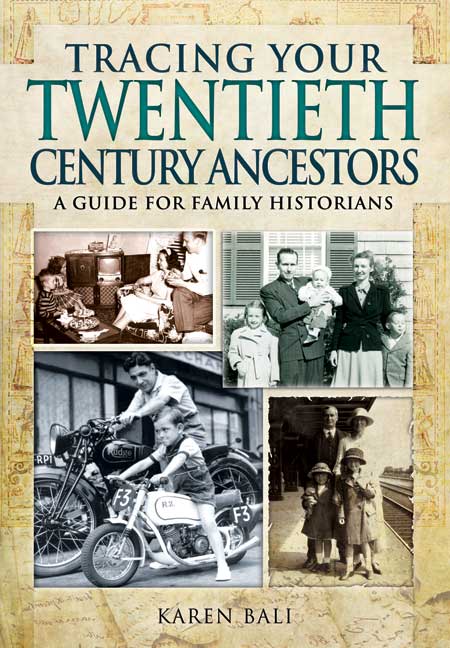
105372A copy of Karen Bali’s Tracing your Twentieth Century Ancestors (Pen and Sword 2016) has just arrived on my door mat for review. In the light of my recent blog post for the In-Depth Genealogist and as my ‘Discovering your British Family and the Local Community in the early C20th’ course for Pharos has just commenced, this was very timely. As someone who not only teaches courses that focus on the recent past but also as the author of a book on C20th social history [Remember Then: women’s memories of 1946-1969 and how to write your own] Karen’s book was bound to appeal. Like me, she stresses the importance of capturing our own personal history and memories; these are part of our family’s history.

Chapter one looks briefly at the social history of the twentieth century, providing a springboard for discovering the context for the lives of our nearest ancestors. The next five chapters describe different types of record that can be used in the process of C20th research: civil records, censuses, directories, wills and newspapers. The latter chapter also covers photographs and film. These are clear accounts of the sources and their use, helpful for those who are just starting on their family history journey and for more experienced researchers who have decided that now is the time to re-examine the generations closest to them. Family history is a fast-changing world, so although this book was only published in 2016, the scope for C20th research has expanded since then. This means, for example, that the very useful C20th source, the 1939 Register, which was newly released at the time the book was written, is covered only briefly.

Chapter 7 examines the theme of conflict and defence, considering sources that will help with discovering more about those who fought in wars from the Boer War to the Kosovo War and all the conflicts that occurred between these two wars that provide bookends for the C20th. A variety of trades and occupations form the content of Chapter 8 including: railwaymen, policemen, merchant seamen and publicans. In another important chapter, Karen encourages us to research the homes and communities in which our ancestors lived; something that I would certainly advocate. Here you will find information about one of my all time favourite sources, the Valuation Office records, as well as school records. It was a shame that one of my other favourites, the National Farm Survey was not covered. Karen then moves on to helping the reader through the maze of records that have resulted from the wave of C20th emigrations, primarily to the colonies. There is also an emphasis on tracing living relatives, a topic on which the author has written in greater depth elsewhere [New Cousins: How to Trace the Living Descendants of your Ancestors (Family History Partnership 2nd edition 2012) and The People Finder: reuniting relatives, finding friends (Nicholas Brealey 2007)]. Always a key part of family history research, this aspect has assumed a new significance as genealogists seek to establish how they are related to potential DNA matches.

Case studies, which are scattered throughout the book, help the reader to see how the information given could be applied. There is a handy chart that helps to sort third cousins once removed, from second cousins twice removed. The book finishes with suggestions of ways of preserving family printed and photographic ephemera. All in all this is an excellent book, which encourages researchers to examine a period in their family’s past that is often neglected. Even better, it is currently being offered at 20% off the cover price.