The Experimental Archaeology Adventure Part 10: the end of the adventure, or just the beginning

It has been a long time since I wrote about my experimental archaeology adventures, partly because I have been having fun completing the final assignment but also because anything involving technology has been hampered by the long and sorry lack of a laptop saga. I won’t bore you further with that but in summary, after nearly seven weeks of inadequate computing, making everything take twice as long as it should, the issue was finally resolved. This involved buying a replacement machine, which I could have done in the first place, hindsight and all that.

Back to the experimental archaeology. The final trimester of my course was entitled Crafts, Making and Storytelling, which, as the name suggests, involved actually making something. Having received very pleasing and unexpected grades for my second trimester assignments, I began the new module full of enthusiasm. In April, I began to consider what I could make for the assignment. Initially, I had contemplated something fishing related, which would be appropriate for my coastal connections and build on my assignment for module one. Having dismissed the idea of a coracle as being too impractical, I wondered whether a traditional withy lobster-pot might be an alternative. A willow-weaving workshop made me flirt with the idea of basketry.

As a family historian, I wanted to experience an activity that would have been familiar to my ancestors, which led me to straw-plaiting. My great great grandmother, Ann Stratford and many of her immediate family were straw-plaiters. I already had an affinity with this lady, as I spent three years living in her home county of Buckinghamshire in the 1980s, before I knew I had ancestral connections to the area. It was only after I left that I discovered I had been living not just in the county or village of her birth but in the road in which Ann had been born.

I began to research the history and craft of straw-plaiting, discovering that it is on the red list of endangered heritage crafts, with fewer than twenty crafts-persons plaiting on a professional or amateur basis. I wasn’t anticipating becoming an accomplished practitioner but the prospect of trying something unusual appealed. My decision was made.

That was the easy part. Then craftsperson’s block set in. Whilst my colleagues were off casting bronze, building cloam ovens and shooting beavers to make robes (this last in the US I should add), I retreated into my comfort zone and spent ages on the storytelling element, revisiting my research into the life of great great granny and the craft of straw-plaiting, There were a variety of plaiting techniques of differing complexity. I learned about plain, pearl and brilliant designs and read of the possibilities of enhancing the plait with coloured straws, or using two straws together to improve the plait. I found illustrations of satin box, middle, wagon wheel and feather edge plaits. Finally, after a reinvigorating Zoom chat with fellow students, I realised that this was a making project and something needed to be produced. I sourced and ordered some straw, which then sat on my kitchen table for two weeks before I could bring myself to open the package. I moved on to researching straw-plaiting but I still wasn’t making anything. I am not by nature a quitter so eventually I made a start.

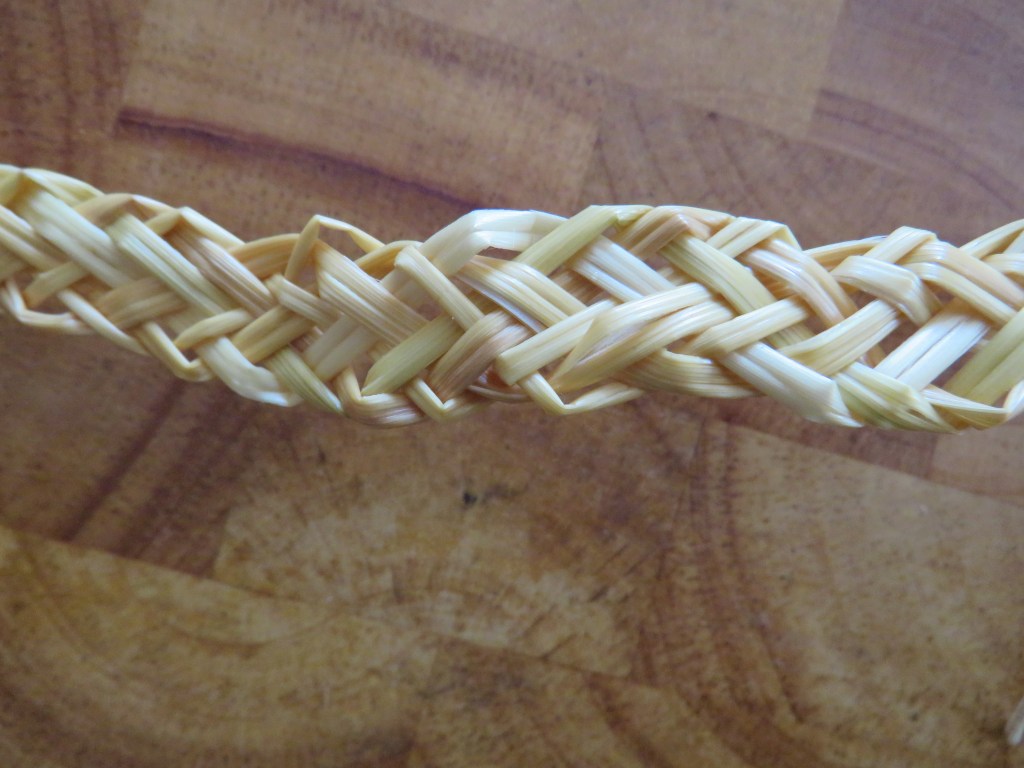
I decided to keep it simple and use a basic seven-strand plait. I had done this before as a child but had no recollection of how it was achieved. Online illustrations revealed that the plaiters’ rhyme, ‘under one, over two, pull it tight and that will do’, told you all that you needed to know. Unwilling to waste straws, I began by practicing with string. It didn’t take long to get into the rhythm but I only managed to avoid confusing the strands by lying them on a flat surface and securing the knotted end at the bottom with Sellotape. If I stopped and walked away, despite carefully laying out the strands, it was difficult to pick up where I left off. It was also very slow. I manage to produce something passable, if short and a little uneven. Even though straw has very different qualities to string it was difficult to imagine how plaiting could be done by holding seven straws in the air, let alone using thumbs and middle fingers, which was the approved technique.

As straw-plaiting was a family activity, with ten-year-olds allegedly being as proficient as adults, I practiced string plaiting with some of my descendants. They all mastered the technique quickly. My adult daughter produced a neat plait. The eight-year-old had trouble pulling it taught but realised her deficiency and declared hers to be widdle-waddle (the plaiters’ term for a child’s unsaleable plait). I don’t think either of the children thought it would be much fun as a long-term activity.

It was time to try using straw. I cut the ends off with a knife and tried splitting the straw but either my straw was thinner than nineteenth century straw or I lacked a sufficiently steady hand, as all I produced were small slivers of straw. I had read that ‘early home-made hats were crude and bulky’ and would have used un-split straw. This sounded like a description of something that I might produce, so I decided that I would use whole straws. I was not going to attempt the bleaching or dying parts of the process, which, in any case, would not have been universal. I ‘milled’ the full length of the straw with my rolling pin. Next came the soaking. The fifteen inch lengths fitted in my sink but straw floats, so I weighted it down with a knife.

I chose seven straws, tied the ends together with yarn and began to plait. The approved method of using my thumbs and middle fingers to plait and my forefingers to turn splits, or in my case, straws, sounded rather like patting one’s head and rubbing ones stomach but I started slowly. I began by laying the straw on a flat surface, as I had with the string. This went well until I reached the end of the straws; all seven ran out at the same time. I made a terrible mess of trying to join in new straws. With hindsight maybe I should have started with straws of different lengths. As I progressed joining new straws became a little easier, as only one or two needed replacing at the same time. I gradually progress from the table to holding the straws in my hands but had to recite the ‘over one under two’ rhyme to keep me in rhythm. After an hour of plaiting, I had produced thirty inches of plait. The literature is contradictory about likely output but opinions ranged from ten to twenty-seven yards per day; I clearly had a long way to go.

My next plaiting session, I tried a different method of joining on new straws, slotting the hollow end of the new straw over the narrow end of the previous one. This wasn’t always successful as sometimes the end of the new straw split but it was an improvement. I was finding the straw more difficult to manage and realised I had forgotten the milling stage. This resulted in a much less neat plait but did mean I had preserved the hollow ends, thus enabling me to join straws using these. I resolved in future to mill but not to continue this to the very end, so that I could still slide one straw over another and avoid so many loose ends. Still chanting the rhyme, I achieved a similar output to the previous session.

By the third attempt, I was getting quicker but certainly not neater. After an hour and a half I had another ninety inches of plait. I had expected to find working the straw rough to the touch but this wasn’t the case. Keeping the straw wet meant that my fingers were continually damp and having plaited for longer, my right arm and shoulder were aching. By now, visions of plaiting were appearing before my eyes when I closed them.

Fortuitously, at this point, BBC2 re-screened a programme about the Luton hat trade. This revealed several useful pieces of information. Firstly, I had been using my straw splitter incorrectly. I was trying to score the straw with the point but it seems that the point needed to be inserted in the end of a straw and pulled down. I tried this technique but the results were little better than those achieved using my method. Alarmingly, I learned that 4000 straws were required to make a hat. I am glad I didn’t know this beforehand as I would not have contemplated investing £240 on straw. More encouragingly, the narrator went on to say that nine yards of plait could make a hat. I already had nearly five yards having used about fifty straws so something wasn’t computing here.

By day four I was getting both fast and neater, achieving 1·5 yards in twenty minutes.  Joining in new straws was still not very tidy but in general, the finished plait looked less messy than my first attempts, partly because I wasn’t plaiting to the thinnest end of the straws. I still wasn’t able to use my fingers in the approved manner. The discomfort in my right arm and shoulder continued and I still needed to recite the rhyme as I plaited but it was definitely becoming more instinctive. I did try putting the straws in my mouth, as Victorian plaiters would have done but I failed to see how the whole straw could be kept damp in this way.

At this point, I was excited to discover that great great granny, at the age of twelve, had won a prize for her plaiting. I am not sure those particular skills have passed to me. I began writing the final assignment, concentrating on describing the craft and telling the story.

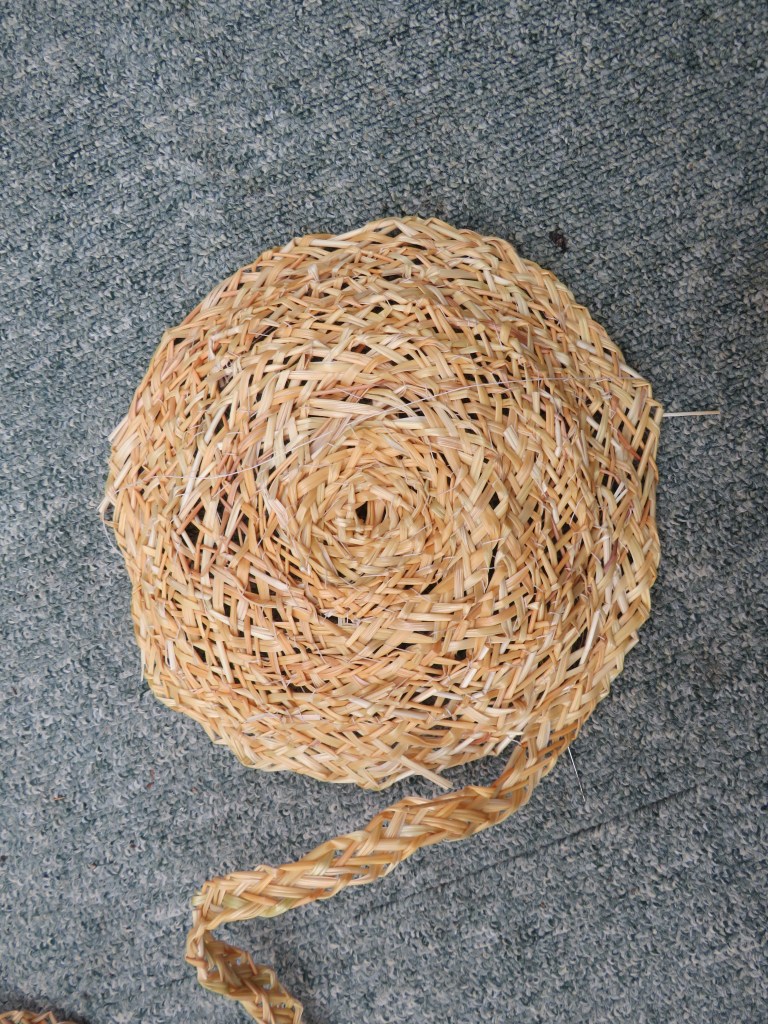
Three more plaiting sessions and I thought I might have enough to make a hat. I started in the centre and began to pull the braid into a spiral, working in an anti-clockwise direction; this may be because I am naturally left-handed. This was a more uncomfortable process, with the rough straw scraping at the skin on the backs of my fingers. It was also difficult to keep the plait damp. I decided not to overlap the braid in the English fashion as that would require more plait. I didn’t really have much idea how to create a hat shape and wondered if I would end up with a flat circle. Professional hat-makers would have used a head-shaped block and steamed the straw into shape. I didn’t have the wherewithal to do this. In the end the shape evolved of its own accord as I continued to sew. I was concerned that it might be difficult to finish off the ends but this was relatively simple as the ends of unplaited straw could be tucked into the weave.

The finished object resembled a pudding basin or lampshade, rather than a hat and certainly wasn’t neat and stylish. The underside of the straw is very scratchy, making it uncomfortable to wear. I did try tying it on as an alternative way to wear it.

Whilst I was pleased to have created a finished product, I was a little disappointed not to have made something that I could actually wear in public, even if only when I am living in the seventeenth century. I am not a natural crafts-person and I am also a perfectionist. What I produced was far from perfect but I enjoyed the process. The repetitive action of the plaiting was therapeutic but I certainly wouldn’t want to spend my working life as a plaiter of straw. I particularly valued the chance to step into my ancestor’s shoes and feel an even closer connection to Ann as a result of this project. Highly recommended for all family historians. Would I try this again? My heart says yes but my head knows that there isn’t room in my life to pursue craft activities with much rigor. I can see myself demonstrating the plaiting technique if the occasion arises. I have revisited my research into Ann’s family, with particular emphasis on the social context and the role that straw-plaiting played in the community and her life; I feel that I can now do so with greater insight. Watch this space for a post about Ann.

The course has been a great experience. I have learned a great deal about experimental archaeology and still more about material culture. I have climbed some technological hills and crafting mountains. I have met some hugely talented, diverse fellow students and we plan to keep in touch. So what next? There are plans. It may be that there will be an online MA on offer, which is tempting, further study does appeal. I am however mindful of how many things I still want to achieve and maybe I need to start prioritising as tempus is fugitting away like mad (it is still May isn’t it?). There is an exciting potential project in the offing with my coven lovely group of ladies. I have a non-fiction book to finish writing. I really want to focus on telling more stories from my own family history and as a result of this course, focussing on some of the family heirlooms and telling their stories before they are lost. I do still hanker after learning Cornish, remember I got as far as buying the books in lockdown?

The Experimental Archaeology Adventure Part 9: from a thing to things

I am now, sadly, halfway through this course. It really does come highly recommended if you are interested in the objects of the past. It is wonderful that it has been made available as an option for distance learning. You have until 3 June to apply for a place on next year’s course. Ideal if you are a traditional craftsperson, historical interpreter or family historian. Although ‘archaeology’ conjures up visions of ancient artefacts and there is, understandably, a good dollop of input about fascinating older ‘stuff’ the flexibility of the course has meant that I can concentrate on a much more recent era. I was sad to miss the opportunity to be in-person at the amazing Centre for Experimental Archaeology and Material Culture (CEAMAC) but it wasn’t to be for me – maybe another time.

The assignment about Jessie’s Locket has been and gone. I created a wonderful powerpoint plus soundtrack before realising that the time limit was ten minutes. I decided that I might not get away with sixteen minutes, so editing was needed. I was in a better position than some of my colleagues whose efforts topped forty minutes but still an issue. I reluctantly axed some of the material and then gabbled away in an unprofessionally speedy fashion to cram what was left into ten minutes and fourteen seconds. I now await the results with trepidation.

Attention has turned to a lengthier assignment, focussing on bringing an archaeological perspective to the examination of a collection of objects. Again, it was difficult to choose but I have decided on the collection of family photographs that pre-date my birth. These photographs are currently housed in a single album. Part one of the assignment is to describe the collection, so I have begun by categorising the images, which are almost all of people, rather than places or events. Having counted them, I was surprised to find that there are 554! They will take a while to catalogue and yes, I do know that I have many still to scan but that is not part of the assignment. The next and most interesting, stage is to write about their significance, their meaning and to think about how I react to these images. I have a horrible feeling that this may become uncharacteristically sentimental if I am not careful. Finally, I have to consider the ongoing future of the collection and look at comparative studies. That’s going to be the difficult bit. If anyone can point me in the direction of papers about the curation and conservation of specific photographic collections, I’d be grateful. So far, I’ve found a book for £198.02 that I might have to give a miss.

I have free rein regarding how I present this assignment and I have decided that one can have too much of chatting to your computer, so this will be an extended, illustrated essay, with plans to put the results on this, or possibly another, website. Watch this (or another) space.

I sometimes think that I have learned as much about social media on this course as I have about Experimental Archaeology. I have scaled the learning curves that are WhatsApp, Discord and now it seems I have found myself on ‘Insta’ (see I am learning the lingo). I did accidentally follow Adele by mistake but I think I am getting the hang. Not yet decided how I might use it but if you want to follow me feel free JanetFewHistory.

Old photograph of a mother and child with a doll's pram
A favourite from my collection 1926

Stripping the Willow – or How Much can you Fit in the Boot of a Volvo?

I am not sure if this should have been one of my experimental archaeology posts. It certainly qualified as an experiment! We headed round the many roundabouts to the Weald and Downland Museum (home of the Repair Shop) for a living willow chair making workshop. There was some confusion over the start time, with the tickets saying 9.30am and the email sent earlier in the week saying 10am ‘but please arrive fifteen minutes early’. We went for arriving at 9.25am – late by my standards. It turned out that it was supposed to be 9.30am but we were the only ones who didn’t think it was 10am, so there was a bit of a delay. We helped with the setting up and I got the initiative test that was assembling the stand to be used as a base to assemble the chair. That achieved, we waited for the others to arrive. A word about the toilet, which randomly had a floor length window. Ok, so it was frosted glass but still a bit disconcerting.

Lead by Ganesh Kings of Creative Willow, eight of us began our weaving. This was physically a little less demanding than the boat riveting of last December but still quite hard on the thumbs and arms. Apparently, there are a whopping 328 species of willow grown in Britain and we had several to choose from of different thicknesses and colours. There is a folkloric aspect to how some of the varieties acquired their names, such as Dicky Meadows Green and. We wove away. I instinctively worked lefthandedly. It seems not all my natural left-handedness has been eroded by a combination of an infants’ school who thought it was a sign of moral weakness and a badly broken left wrist in my teens. My brain still thinks I am lefthanded.

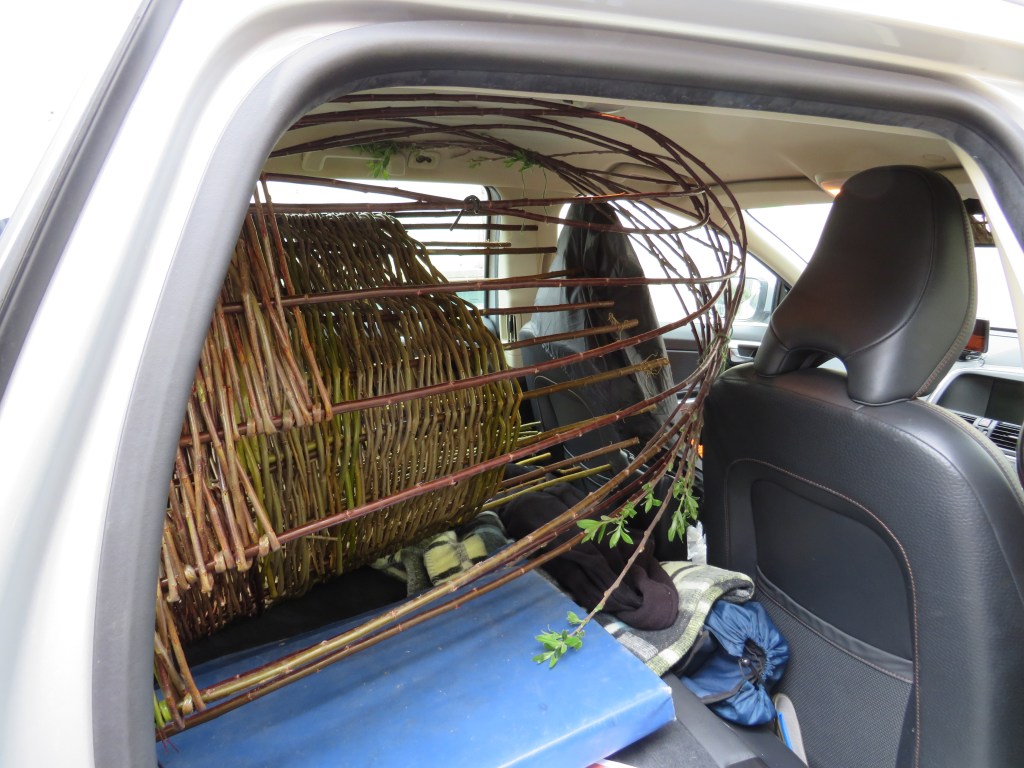
My chair wasn’t the neatest in the world but I was proud of it. I was concerned that spending all day inside would make it difficult to keep up my step count but no. I clocked up six miles walking round and round my chair, weaving as I went. Next came the challenge of getting not one but two completed chairs in the car. It is a Volvo XC60. If like me, your knowledge of makes of car is limited to ‘it has four wheels’, that’s a pretty big car. Back seats down, a bit of pushing and shoving and by agreeing to sit with our knees under our chins, the chairs were in. Sort of. We chopped a bit off a few legs (the chairs’ legs, not our own). In many cars this would have been sufficient. You’d slam the boot lid and the contents would have squished up satisfactorily. Unfortunately, the fisherman of my acquaintance has a relatively posh car with a self-close boot that you can’t override. The boot lid descends automatically. It senses a minute particle in the way and it rises again. Mission eventually accomplished, we realised that it would not be practical to drive round sightseeing with a car full of chairs the following day, so we decided to return home a day early.

The ordeal was not yet over. The chairs had to be planted. Each one has nineteen ‘legs’, fourteen of which will hopefully grow. Not a lot of choice of planting position in my teeny tiny garden and the soil is rock hard. The emphasis is on rock, as much of the garden is a spoil tip from when the chapel next door was rebuilt. Add to that substantial cherry tree roots and creating the required ‘donut’ shapes for two sets of chair legs was a challenge. We had to cut more off the legs than was probably wise but the chairs were finally in situ. Let’s just say, no murderers could dispose of a dead body in my garden without considerable effort.

There was a bit of an elephant in the room as we wove our chairs. Chairs, by definition, are for sitting on. These chairs are hollow structure and have no seats. It seems that the solution is to fill the space with earth and grow a grassy seat. This requires more spare earth than I have, so no sitting on the chairs yet but they look impressive. I also have to decide how I want to arrange the living trees, which can be tied to form a bower if I wish. It will be interesting to see how they grow.

The downside of the workshop was that I was only able to catch up with a few of the amazing History for Ukraine talks, contributed by many of my friends and colleagues over the weekend. What an incredible event organised by Natalie and her team; congratulations to all involved and to all those who helped to raise such a stupendous total. I really hope I get the chance to participate in some satellite events in the future.

The Experimental Archaeology Adventure Part 8: Choosing a ‘Thing’

Semester two is now well underway and the focus has turned from incomprehensible reading to the first assignment of this module. Writing an essay was so last term; now we are creating presentations. I have to choose a ‘thing’ and tell its story. There’s a bit more to it than that but broadly that’s it. Given that I can pick absolutely anything, the choice is not easy. It was always going to be something of family significance but I am fortunate that I have several things to choose from, so decisions had to be made.

Should it be the patchwork quilt begun by my great grand-mother in the 1880s and worked on by three further generations since? Given that each patch has its own story that would be too complex. I have a slide limit of five for this and one of those has to be the title. What about one of two Victorian christening gowns, or my mother’s wedding dress, made by hand from a parachute? As I write this, I am so tempted to change my mind! Then there’s my grandfather’s long service watch, great granny’s christening mug or one of the artefacts brought back by my great-grandfather from a tea-buying trip to China and India. Maybe once the assignment is done, I will tell all these stories too.

For now though, I have decided to tell the story of Caroline Jessie’s locket. I met Caroline Jessie, possibly only once but I can clearly remember her sitting in a chair in her parlour, alongside two of her sisters. I would have been seven or eight at the time. I have several reasons for finally opting for this particular heirloom. To begin with, Caroline Jessie has no descendants. Her closest living relatives* are seven first cousins twice removed, of which I am one. If one of us doesn’t tell her story who will? This particular item didn’t just belong to a family member, it was made by one. Caroline Jessie’s father was a silversmith and made each of his five daughters a similar locket. The fact that this is one of a collection of five, is another fascinating part of its story.

So far, I have learnt how to tell if something is silver. In this case there is no hallmark to help as it wasn’t sold on the open market, or indeed at all. One suggestion involves putting ice cubes on it, which seems a little bizarre. I am glossing over the fact that I don’t know where the silver was mined, or what processes are involved turning what comes out of the ground into the object I now have. I have got gloriously side-tracked researching the silversmiths’ company for whom Caroline Jessie’s father worked. It seems it was very well-known and co-incidentally, the founder shares a name with one of my grandsons.

I shall now be encouraging people to tell their own stories, tell the stories of their ancestors AND to tell the stories of family heirlooms. I will need several lifetimes.

* In the interests of genealogical accuracy, I should add that there could be great great half nieces and nephews in America, who might be regarded as being closer living relatives but I am not in contact with any of them and the English and American branches of the family seem to have lost contact in the 1920s.

The Experimental Archaeology Adventure Part 7: Thinking about Things

I am now in my second trimester. No, this is not some miracle of science; semesters, or terms, are called trimesters in Ireland. Having somehow achieved pleasing grades for my first two assignments (that probably is a miracle of science), I am raring to go, This module is called ‘Thinking about Things’, or as the southern Irish call it, ‘Tinking about Tings’. It certainly makes you think. Thing Theory involves many abstract concepts and has overlaps with philosophy (I think). I made the mistake of beginning the reading with a book that is either incredibly erudite or total garbage (the jury is still out). I thought I liked long words and complex sentences but I am clearly a mere beginner. The average sentence length in this worthy tome is about forty words. Counting the length of the sentences is probably about as good as it gets. I always thought that the definition of a sentence was that it made sense. I may have to revise that definition. Although I understood most of the words individually, my brain was getting little sense out of them collectively. I did wade my way diligently through to chapter six, which was almost comprehensible but I was thankful to get to the end. This academically expensive treatise may be finding its way onto an online auction site near you shortly. I was going to treat you to a gem from this book but out of respect for the author, I have decided not to. Believe me, anyone who can persuade a publisher to take on this manuscript deserves utmost respect. Pretty much the sum total of what I got from ploughing through all 173 pages (very slowly, I really couldn’t take more than one chapter at a time) was that the essence of a thing is altered by the interaction of humans with it (possibly). Hopefully all will become clearer when tutorials start next week, having been delayed a week by COVID.

Free Image on Pixabay - White Male, 3D Man, Isolated, 3D | 3d man,  Sculpture lessons, Teaching child to read
Image by Pixabay

On a positive note, I have since read some much more interesting and intelligible articles and I think I am going to enjoy this module, especially as the assignment options are very broad. I am very excited about how I might develop this and I am hoping that there will be some overlap with the rest if my life this time. I definitely do want to use this course to move outside of my comfort zone and last term’s assignments certainly did that but the more I read the more I see how what I am learning might be applied to family heirlooms and photographs. There are definite commonalities with one of the sessions, Family Photographs and a Sense of Belonging, that I have prepared for Rootstech. Incidentally, you can register for Rootstech free of charge and listen to as many sessions as you like, mine included. The event takes place from 3-5 March but recordings will be available after those dates as well.

In the meaning time, I’ve been engaged in an experimental archaeology project entitled, ‘What is it like to live in a seventeenth century cottage without the benefit of central heating?’ This was a result of the failure of the oil delivery company to be able to count. They are supposed to top up the tank every three months in winter. They last came in June and claimed that the next visit was due in February. I am still working out how that constitutes three months. Anyway, after 2½ days, the experiment was beginning to lose its appeal, despite the benefits of the wood-burner. Fortunately, the cavalry arrived today and I am now cosy again.

The Experimental Archaeology Adventure Part 6: Disappearing Lines and a Riveting Time

It has been all go on the Experimental Archaeology front. Assignment two is pretty much done. It was already way too long when I came across a key article. Said article turned out to be 247 pages of great stuff – now, what to cut out?

I thought I’d grabbed a bargain and got a really interesting sounding book, which usually retails for £180+, for £30. You know that ‘If it sounds too good to be true …..’ thing? Sadly, when it arrived I realised that instead of the hugely expensive Handbook of Sensory Archaeology, I had inadvertently ordered a Handbook of Collective Intentionality – not a clue – Sensory Archaeology was going to be challenging enough. If anyone wants to find out about Collective Intentionality there will be a copy for sale on an internet auction site near you shortly.

The real excitement though is that I skipped this week’s lecture to take part in some experiential, if not experimental, archaeology. A fisherman (and boat restorer) of my acquaintance and I set off at silly o’clock to watch the sunrise over Bodmin Moor and drive to the National Maritime Museum in Falmouth for a Ghost Ship Building workshop. Regular readers will know that I’ve been steering clear of peopley places. This is only the fourth time I’ve been indoors with a static group of people apart from my immediate family since February 2020 but it was so worth it. I was also taking comfort from the fact that there were only eleven mask-wearing people in the room and I am probably as protected as I will ever be, having just been boostered.

The hugely talented Gail McGarva, who was conducting the Disappearing Lines workshop, builds traditional working boats, to try to preserve historic local boat-building styles. She uses the term ‘daughter ships’, rather than replicas, as they represent a new generation of the endangered boats. I am familiar with the Clovelly Picarooners and the neighbouring Bucks Ledge Boats, both of which were designed to suit the beach from which they were worked. The ghost ship we were to build was based on the Dorset Lerret, a beamy boat, ideal for working on the pebbles of Chesil Beach.

The ‘one I made earlier’ looked pretty simple, surely this wasn’t going to take six hours? Oh it so was. First, we steamed and bent oak strips and laid them in place in a pre-prepared frame. I learned that making even quite thin strips of wood do what you want them to is not easy. Then came the copper riveting. This involved my partner in crime holding the oak strips steady and me drilling very close to his fingers. I waited until afterwards to tell him I’d never used an electric drill before. I am not sure why; spending most of my life in all female households, I’ve done DIY since I was a child but only ever with a hand drill.

Next, time to insert the rivets. There were only thirteen of them, plus the few that had to be redone because they bent but each one involved plenty of hammering. You have to drive through the rivet and then seal it with a series of taps. This was all fine at the time but two days later my arm still feels like it has just had a Covid vaccination. I have decided against a change of career. I do not want to be a riveter and historically, I can see that the repetitive strain and the noise would have been serious occupational hazards. It is inciteful to try these things to gain a better understanding of what is involved.

In between the riveting there was plenty of adjusting, to create pleasing lines. At one stage I was channelling my Norfolk ancestry and my gunnels developed what is apparently known as a Yarmouth Hump. I managed to minimise this and I am pleased with my resulting ghost ship, although I am not quite sure what I am going to do with it. All in all, this rates right up there with the best things I’ve done this year.

The Experimental Archaeology Adventure Part 4: Boat building, WhatsApping and Stinging Nettles

Well assignment one is submitted, not without incident owing to the rat-induced wifilessness and with thoughts turning to assignment two I am immersing myself in tales of boat reconstructions. In a completely different context (I was looking for potential speakers about Cornish fishing) I happened across an exciting boat-building workshop in Falmouth. It was even free! There were only twelve places and I thought, no way will there be any vacancies but I applied and am super excited to announce that a boat restorer of my acquaintance and I will duly be getting up at very silly o’clock to spend a day in Falmouth. We had to provide names of next of kin on the booking form; should I be worried about this?

My fellow students and I decided we wanted a space to chat and moan and I stupidly suggested WhatsApp, as some weren’t keen on Facebook. Somehow this meant that I had ‘volunteered’ to set the group up. What I know about WhatsApp would fit on an extremely small postage stamp. I am the person with only seven contacts on my phone, two of whom I have never contacted. After a steep learning curve and with help from Martha, the group was established and there’s a lot of sharing of baking triumphs going on. As regular readers will know, I am genetically programmed to be a non-baker, so I can’t contribute to this, although it will soon be time for my once yearly baking foray as I make the Christmas cake.

We were also asked to pay the balance for our course. I think that worked but there is a great kerfuffle about the accompanying request for particular format pdf confirmation of previous qualifications, which none of us seem to be able to obtain. The alternative is ‘bring your certificates in in person’ (like that’s going to work), or to use a verification service that costs £40, which we are trying to avoid.

Having decided that growing, or even purchasing, hemp from which to make rope might be a bit dodgy and being right out of lime bast (no I didn’t know what that was either), I have been watching videos of using stinging nettles to make string. This does not seem to be without hazard but may be worth a go – easier than baking anyhow.

Now to seek out some sufficiently tall stinging nettles and wait with trepidation for the assignment feedback.

The Experimental Archaeology Adventure Part 3: Book Buying and Making Plans

I have been so busy actually doing my experimental archaeology course that there hasn’t been time to wite about it. It is fascinating and I am having great fun with a group of mostly matureish students from seven different countries, with an intriguing range of backgrounds and experiences. So far (this is week 3), we have introduced ourselves and the course, looked at the changing definitions of experimental archaeology and thought about reconstructing houses. Interesting that when an Iron Age house burns down the roof falls in and then the walls collapse on top, meaning that future archaeologists will excavate the structure walls first and then roof. Never say you don’t learn anything from reading my ramblings. Next stop pottery.

A few technical issues, such as repeated emails urging me to collect my student ID card from  room whatever, which is in …..… Dublin. Wondering how my fellow students from Australia and the US will go about this. Then, having ordered a book in time to take on holiday, randomly I get an email from the dreaded online bookseller saying there had been a problem with delivery and it was being returned. I am roughly translating this as ‘we couldn’t find your house and couldn’t be bothered to ask’. Or even ‘I wanted to be home early and couldn’t be bothered to drive to the wilds of nowhere on a wet afternoon.’ Annoying but I implemented plan B and have now got the book and a message thanking me for returning the book I didn’t want to return and assuring me that I will be refunded in the next week. Most of the reading is available to us electronically, although I do prefer paper and I have the beginnings of a library appearing now.

I am currently immersed in the first assignment, a study of the different definitions of experimental archaeology. Essay writing seems to take much longer than it did in the 1970s, maybe because I am more of a perfectionist now. Ok – or maybe just because I am old. I am also already looking ahead to assignment two which requires us to critique experimental archaeology projects on a similar theme. It is suggested that we might like to link this to our work in the final term, when we have to make something. Thinking of my own interests, I have ruled out experimenting with bewitching people – not sure that would get past the ethics committee. I could make some herbal remedies but the fun would be in testing them and I am not sure that would go down well either. So, do I do something girly and get my spinning wheel out (I really must do some spinning when I have time – try about 2024)? In a continuation of my post mid-life crisis, I am now going rogue. I have suggested to a fisherman (and boat-restorer) of my acquaintance that we might like to build a coracle in the garden. He has long been trying to persuade me to build a garage (people who know my house and garden are now questioning how on earth that would work – it wouldn’t) and I think he was keen on the boat idea thinking it might require a garage to put it in. Ok, so a boat could be a tad ambitious, it seems to involve lots of animal skins that might be difficult, not to say expensive, to acquire. Maybe fishing nets or fish traps though….. My search history now contains some slightly dodgy sites as a result of me searching for ‘where to buy hemp’.

The Experimental Archaeology Adventure Part 2: the technological challenges

Following on from my previous account, for once it seemed that my passport photo passed muster, so that was one hoop successfully negotiated. Then, last week, the excitement of registering for my modules. Randomly I do seem to be registered for something entirely different as well but that is a bridge to be crossed, probably if I seem to be expected to pay for it. I am sure that a graduate certificate in world heritage conservation is all very interesting but ……..

Yesterday I conquered, at the third attempt, applying for Commonwealth Games tickets. I thought I was all prepared for this, having registered as soon as it was possible about two years ago. It seems I failed then to click on the ‘confirm your registration’ link in an email I never received and certainly don’t have now, so I am not registered at all and my application kept stalling as I was told that I needed to verify my account. Never fear, thinks I, I’ll just reregister with one of my many other email addresses – there are advantages to having several. But no, it seems, as you have to give your name, address, date of birth and probably your inside leg measurement, so they think I am already in the system. I reapply as a fisherman of my acquaintance, hoping that my using my own card details but his address won’t mess things up. He will only attend under sufferance; I can hardly expect him to pay. At regular intervals throughout the whole debacle, I was exhorted to ‘click on the (ridiculously blurred) images with traffic lights/stairs etc.’, to ensure that I am not a robot. Maybe a robot could make a better fist of navigating the system.

Anyway, after all that, I’d had my fill of technological challenges for one week but embarking on an online university course comes with a whole set of challenges all of its own, before you even get to the actual studying. Yesterday I clicked on various links I’d been sent and discovered that course material was available. With a holiday in the offing, I gleefully began looking at this, thinking that I might be able to get ahead. There is in any case a debate about whether the course started yesterday, next Monday or next Tuesday – take your pick from advertised dates. It was a tad confusing, as this material seemed to refer to a similar, in-person course that ran last year. Despite the excitement, I was reluctant to go too far down this route in case I was spending time on the wrong course. Today I seem to have got the correct material, so that is a relief and also slightly scary, well, okay, very scary.

I filled in my student profile, choosing to upload my Mistress Agnes picture for this. They might as well know from the outset that I am weird. I added some biographical information as requested, confirming my weirdness status. This involved changing my Facebook username to something that actually was my name, before sharing the link, tick in that box. What the heck is my Google URL? Nope, no idea – I tried several likely combinations but all just lead back to a Google advert. I decided to leave that box blank.

I read the module handbook and ordered two very expensive books. One even might arrive before I go away if the mighty Amazon do as they claim. Other suggested books can be downloaded. I much prefer actual books to reading online but in the interests of economy, I downloaded some more. One helpfully tells me that it will take me 594 minutes to read. That seems awfully precise; if I had nothing better to do I’d time myself. I am quite thankful that I am a speed reader. I am also increasingly aware that I haven’t done any proper taught courses since the mid 1990s. I don’t count the PhD where you basically make it up as you go alone and devise your own questions.

There are weekly Zoom tutorials. Thankfully, only one of these clashes with a pre-existing engagement but I am concerned that I will be in the middle of a field with questionable wifi for the first ones. The first assignment is due in six weeks. I am starting to wonder if Ireland has a different calendar to us as in one place a least, the due date is a day/date combination that don’t exist. I am a submit early person, so hopefully this won’t matter anyway.

So I am off to read for 594 minutes, or maybe 593 if I am lucky.

It is difficult to find illustrations for these blog posts, so you will have to put up with a gratuitous ‘practicing with the new camera’ picture – so far the most significant challenge with that has been trying to thread the strap through a teeny tiny slit.