Counting Cousins and Descendants and Looking for Lockets

Warning – this post contains something resembling maths but does include jewellery if you persevere. As regular readers will know, I have recently been following the documentary evidence and seeking out my third cousins, in the wake of receiving my autosomal DNA results. This was thrown into particular focus last week when I met with my full complement of second cousins (6) for the first time in seventeen years. Although, inevitably, we were meeting for a sad occasion, a funeral, this was exciting for me as these are my only relatives in my own generation. But back to the third cousins (people with whom you share a great great grandparent).

I was surprised to find that 7 of my 8 sets of great great grandparents married within a thirteen year window 1852-1864; the final set married a little earlier in 1841. Ok, I’ll be honest, one set don’t seem to have married at all but I can estimate a ‘marriage’ date as falling between gg granny having a child by someone else and having a child by gg grandad. What I therefore wanted to know was how many, on average, great great grandchildren might a couple who married in the UK in the mid nineteenth century be expected to have.

I had already found that wiser folk than I estimate that the ‘average’ person has 175 third cousins (people with whom you share a great great grandparent) but nowhere amongst my Googling (other search engines are available) can I find data about the likely numbers of great great grandchildren. We are obviously dealing in averages here and clearly there will be wide deviations from the average; different cultures will have very different experiences. Maybe this is why this is a discussion that does not seem to have been aired very often in family history circles but it is interesting nonetheless. Yes, our families will not be ‘average’ but you would think that, if we look at all eight sets of our great great grandparents, prolific families would be counterbalanced by those with few children and things would even themselves out.

If I am expected to have 175 third cousins, on average, each pair of great great grandparents will have produced roughly 22 of them and me of course. If you have complete data for descendants of any of your great great grandparents I would be really interested to know how many people there are in your own generation, alive and dead, (not the total number of descendants) who are the great great grandchildren of one couple, especially if they married in the mid-nineteenth century. How close is it to 22? Do we have a vaguely accurate figure for first world countries here? How much difference does it make if you are a different generation to me, so your great great grandparents married in the 1820s or the 1890s?

I am confident that I have identified all the descendants of three of my eight sets of great great grandparents. My results for the number of people in my own generation (remembering to include myself in each case) are 5, 7 and 10, far short of the figure I have come up with of 22. So, how do you compare?

caroline-jessie-leighton-1874-1965

Caroline Jessie Leighton 1874-1965

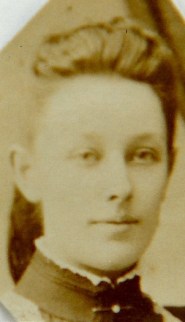
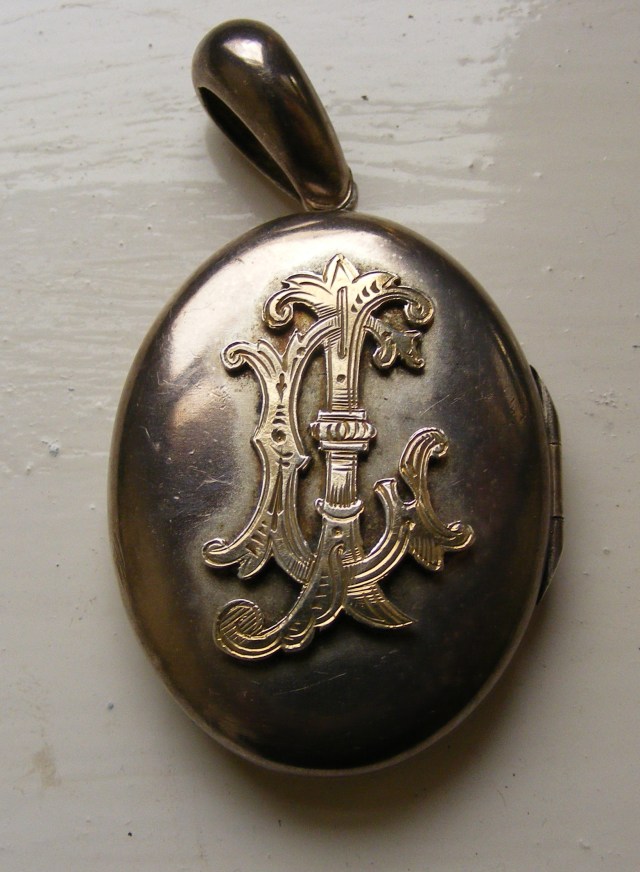
Now the pretty jewellery bit, which also involves cousins. My grandmother had five cousins on her father’s side, sisters whose father was a silversmith. Each girl was given a heavy silver locket that their father made, which was inscribed with their initials. Only one of the girls married and she had no children. The family story was that the five lockets passed to the five girls in the next generation (my mother and her four cousins). The tale of who was given which locket has proved to be incorrect but as a result of last week’s funeral, we are currently investigating where the lockets are now. Two down, three to go! This is important to me. The original recipients have all been dead for fifty years or so. They have no one but us to keep their memories alive. So here is Caroline Jessie and here is her locket. Now you can get back to counting cousins.

dscf3604

New Year, New Discoveries, New DNA Results

Well, here we are, 2017. Who knows what the year will bring? This time last year I am sure few could have predicted the seriously scary political machinations and plethora of celebrity deaths that accompanied 2016. So far this year I have learned that it is possible for a memory stick to survive being vacuumed up along with Christmas tree prickles.

I would also like to share an incident from the lacuna that is that gap between Christmas and New Year during which the descendants descend. The phone rings at 7am. A phone call at this time of day normally means bad news – or that your daughter has arranged for T****s to deliver food to your house later in the day. I am a T****s delivery virgin; I know not how these things work. Having the food delivered was deemed easier than having my personal shopper struggling to identify various ‘modern’ ingredients on the list. We do not know our humus from our quinoa sadly – even spell checker doesn’t recognise quinoa, so we are not alone. The main challenge for the T****s delivery driver will be finding the house. If he uses his satnav he is doomed. It turns out, for some reason that he tried to justify, he was expecting to be delivering to a building site. The justification involved my house name – any suggestions anyone? He had a list of what had been ordered. What would a building site do with several dozen nappies of a suitable size for a two year old?

The DNA results arrived sneakily early, before I had finished restoring the house to a semblance of normality and before I had made any discernable impression in the mountainous pile of post-Christmas laundry. This means that I still haven’t completed my documentary trail hunt for third cousins, so more on that when I get the chance. What have I learned from my results? To be honest, not a lot. Sadly, no previously unknown half-siblings have climbed out of the woodwork. I have 788 matches. Big deal, or not, actually. Eleven people are predicted to be related in the range 2nd-4th cousins. Sorry FTDNA, unlikely I think. I know these people are not my second cousins (or second cousins with a few removes). I think it is very unlikely that they are my third cousins, so that leaves fourth cousins. Three of these matchees (it’s ok, I just invented that word) do not provide any surnames apart from the one they now carry. To be honest I don’t blame them. It was a bit of a learning curve working out how to add these. I have included the surnames of all my great great grandparents and will be adding those for the previous generation when I get a minute (like in about 2031).

As expected, most of the testees have families trees that seem to still be rooted in the US and the only surname that is common with any of my ancestors is Smith and I really don’t think this is the same Smith. What is slightly worrying is that there appears to be no commonality with members of the Braund family who have done this test, although, to be fair, our likely relationship is more distant than 5th cousins. This didn’t stop me from hoping for a remote cousin match. Two of the eleven 2nd-4th cousin matches have uploaded a family tree. I guess that this is the next challenge for me to tackle. No areas of commonality here either. There is one match that looks possible, although it wouldn’t be at 4th cousin level. He does at least have Cornish ancestry and a surname that appears on my family tree, although not amongst my direct ancestors. I know I am supposed to do something with my centimorgans. Maybe we don’t share enough of them. I will await instruction. I had a play with the chromosome browser. The most likely match and I share seven segments. I am not sure why therefore they are identified as a closer relative than someone with whom I share 18. I clearly need someone to explain the significance of this in words of half a syllable.

What other fun can I have with these results? I am 99% European, no surprises there then. This is allegedly Britain, Scandinavia and Western Europe, although not Iberia. As regards my ancient origins, I am 10% a Metal Age Invader. What does that even mean? I am 40% Farmer, which seems to mean I may have origins in Aleppo. Excuse me, I’m just off for a bit of hunter gathering, in line with 50% of my ancient origins.

C20th Research, Third Cousins, DNA and another Writer

Well, today has been exhausting. Slightly delayed start (still in my pyjamas at 9.30am) because I got carried away with the hunt for third cousins. The more I do of this the more I am convinced that anyone who takes an autosomal (family finder) DNA test should be doing the same. Without verifying our documented trees down to at least our own generation, what use are all those suggested cousins going to be? I should make it clear I am being pretty thorough (ok, so I am a perfectionist – very thorough) about this and adopting the sorts of techniques used by probate researchers/heir hunters to trace living people. Actually, that is not quite true as I am doing it on a zero budget, so can’t order eleventy million certificates to prove or disprove theories. Apparently Ancestry estimate that the average person has 175 third cousins (Thanks to Debbie Kennett for that information). Obviously there are huge variations either side of that number and it looks like I am going to be at an extreme end of the scale. It was probably fitting that real ‘work’, when I got round to it, was finally finishing off the course that I’ve been preparing about C20th family and local history. I am now going to market it to anyone who has taken an autosomal DNA test!

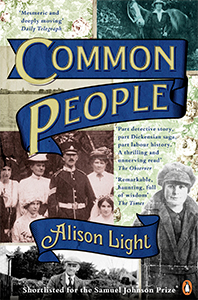
common-people-book-cover-usa1Now for the advent calendar. This is a book I haven’t actually read yet but it looks so good that I am going to include it – shamelessly relying heavily on the blurb and other people’s reviews. It isn’t actually a novel either but the story of a family. The author has done exceptionally well to find a publisher for her family’s story in the days of the hobby’s boom. I remember when I first started, reading Marjorie Reeves Sheepbell and Plougshare – don’t read that unless you want to be seriously envious about the amount of family documents and memorabilia that she inherited. Others from that era were John Peters’ A Family from Flanders. Must also mention John Titford’s Come Wind, Come Weather but all these date from the 1970s and 1980s. Now the world and his wife are writing up their family stories getting one commercially published is next to impossible, which is why I think Alison Light’s Common People: the history of an English family is going to be something special. As the title suggests, Alison has woven and interesting story around the lives of ordinary people.
It is an opportunity to find out more about Victorian England in the throes of its industrial heyday and it is by setting her own family’s experiences into the broader context of their time that Alison has produced such a successful book. Now all I need is time to read it. I shall be recommending it to students on my Writing and Telling Your Family Story course – advert alert – you can register now for this – it starts at the end of February and it is online, so no excuses for those of you overseas.

On the Hunt for Third Cousins and the Nineteenth Historical Novelist

I’ve been continuing to recheck the paper trail to identify as many of my third cousins as possible (people with whom I share a great great grandparent), prior to receiving my Family Finder DNA results in January. When a couple marry in 1863 and have eight children, you would expect that, more than 150 years later, there would be descendants scattered far and wide, well I would. This is my family we are talking about – not so. Today’s third cousin hunt centres on the descendants of my direct male line, great great grandparents William Braund aka Jeffery and Isabella Jane née Nicholls. They had six sons and two daughters. I concentrated on trying to establish how many of these siblings produced descendants in my generation i.e. my third cousins. I have rigorously researched this line in the past and today’s re-check confirmed that I have found all those who are there to be found (barring any illegitimate offspring who were a very well kept secret).

The boys were particularly easy to follow up: one died as a child, three never married, one had two sons but no grandchildren and the other was my own ancestor who produced me and only me, in my generation. That left the two daughters, one of whom died as a teenager. From the other there are just six third cousins, I have been in contact with the father of four of them for many years (my second cousin once removed) and I have found two of them on Facebook but not taken the plunge and made contact yet. It seems strange that so many branches of my family have shrunk and I have fewer third cousins than most people have first cousins. I guess it makes tracing them a more practical proposition.I’d be really interested in anyone else’s third cousin count.

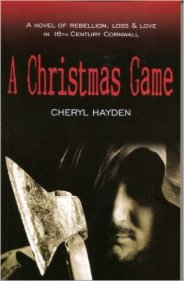
51grexi7ktl-_sx324_bo1204203200_We are in sixteenth century Cornwall with today’s historical novelist, Cheryl Hayden. Her story is based on the Prayer Book Rebellion, which is not one of the well known events of history but had a huge impact on the far south-west. It features the Winslade family, who were large landowners in Cornwall and in parts of Devon including the north-west, where I now live. There is romance and adventure bound up in the plot, which falls into the category of ‘faction’. Cheryl has a background in journalism, so her meticulously researched and well written account is not a surprise. The Cornish setting is particularly well drawn, with believable phrases and dialect. This is especially praiseworthy as the author is an Australian. She is also an academic historian and the Winslade family form part of her doctoral research. Academics are normally very reluctant to praise popular writing in their field, let alone fiction and the fact that this novel has attracted very positive comments from professors of Cornish Studies is a testament to Cheryl’s work. Reading this book immediately made me want to find out more about the events that form the backdrop to the story. I understand that there may be a second novel featuring the Winslades in the future; another for my wanted list.
The Midnight Adventures of an Historian. Latest DNA news and the contents of my second advent box are revealed

You may remember that, last year, I inadvertently applied to present webinars for Ontario Genealogy Society and failed to correctly assess the impact of the time difference. This saw me – yes, the me who is normally asleep by 10pm and never sees midnight, even on New Year’s Eve, presenting to a Canadian audience beginning at what was midnight my time. Last night I got to do this again. This time, not only was it midnight but the temperatures outside were doing a good job of replicating those experienced by my audience. In order to get the maximum bandwidth I am not in my cosy wood-burner heated living room, nor still in my relatively balmy bedroom but in the arctic spare bedroom. I suppose the upside of this was that the temperature helped to keep me awake. My session on historic causes of death seemed to go well – if you can judge how well you are doing when you can neither hear nor see your audience. At any rate, there were plenty of questions and some lovely comments at the end. In a peculiar brand of masochism I have agreed to present a webinar for next year’s series too!

Yesterday I posted my DNA kit. Thanks to a helpful suggestion, I opted for ‘genealogy kit’ on the customs form. It turns out, had I listened to the instructional video, that would have made a similar suggestion. Instructional video? I thought I had done well getting someone else to check the written instructions. I had to persuade the young man in our Greendalesque mobile post van that I actually needed a customs form. ‘It is quite small you won’t need one’. Really? No way was I having my DNA end up on one of those border force TV programmes, so I insisted on having a form, which he struggled to locate. Perhaps that was why he had suggested not bothering.

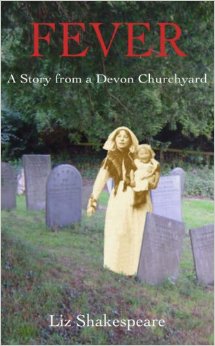
51amm97hjtl-_sy344_bo1204203200_The historical novels out of my advent box today are the books of my friend, local author Liz Shakespeare. Liz writes evocative stories set in Victorian North Devon. These take their inspiration from real characters and are meticulously researched. Fever: a story from a Devon churchyard recounts the anguish of the families in my neighbouring parish of Littleham, as the community is overwhelmed by an epidemic. A gripping story and plenty of social historical context, with a health history aspect that appeals to my interests. Another novel that recreates the era and the locality in striking detail is The Turning of the Tide, which is set in Clovelly and Bideford. It follows the life of Selina Burman who is rescued from the workhouse by a local doctor with an unusually modern outlook. Liz has also written a beautiful set of short stories All Around the Year, inspired by the Devon landscape. Her oral history of Littleham The Memory be Green was garnered whilst she had the opportunity to speak to those who remembered the early years of the twentieth century in her home parish. Not only is this a fascinating account but it could be replicated in other communities. Liz is currently taking pre-publication orders for her forthcoming novel The Postman Poet. This tells the story of Edward Capern, who walked from Bideford to Buckland Brewer on his daily round, resting in my house before making the return journey and penning poetry whilst he did so. My account of Liz’s re-enactment of Capern’s journey can be found here.

My DNA Adventure and I open the first of my advent boxes


dscf3504I was finally enticed by FamilyTreeDNA’s seasonal sale and purchased myself a family finder DNA kit. I am still not quite sure why I have done this but I never can resist a bargain. This morning, I was up early to provide my sample. The company advises doing this before you put in your dentures. That’s no problem, hopefully it will be a number of years before I will be inserting any dentures. It is also though supposed to be before breakfast. I am not much use before breakfast but I am very law abiding so taking the test has to be done very early, so I can eat. It is the first duty of the day, well after checking social media that is. I enlist assistance as I am notorious for not reading instructions. My assistant does not have his reading glasses with him – this is going well. I begin scraping away at my cheek with vigour whilst my assistant times the required 30-60 seconds. My jaw is unnaturally locked in an open position and it is really difficult to do this without dribbling. No one tells you that, or is it just me? About twenty seconds in I realise that I am using the flat side of the implement instead of the scrapy side. I fail to communicate this to my assistant by means of strange gurgling sounds (I am still scrapping and he is wondering why I haven’t stopped when the suggested number of seconds is up.) Sample safely ejected into phial provided, I start again with the other cheek.

dscf3505The waste bits of the scraper look like they have potential for turning in to instruments of witchcraft torture – excellent just what we need. No, seriously, this is not a joke. Deed done. Dilemma. How should I fill out the customs declaration? I am dubious about the etiquette associated with sending bodily fluids through the post. Can I legitimately classify it as a ‘gift’?

I have thought long and hard about who this ’family finder’ might find; the possibilities are limited. It is really designed to link you with 3rd-4th cousins, or closer relatives. Ok, who is that likely to be? I have no siblings, no first cousins and only six second cousins (those with whom I share great-grandparents). These are all on the same side of the family and two of them are adopted, so from a genetic point of view that leave me with four people, whom I already know, to match with. I must not neglect the ‘removeds’. These four second cousins have between them six children (my second cousins once removed), all of whom I know of. I believe one or two of them have produced children (my second cousins twice removed) but these are babies and unlikely to be looking for DNA matches.

I track back to my third cousins (shared great great grandparents). There are eight possible couples who have produced remarkably few descendants who are my third cousins. We are now in the realms of cousins who I have only discovered through family history. Over the 39 years that I have been seriously tracing my family (yes I was an infant when I started) I have looked for, contacted, or become aware of, third cousins on all of these eight branches; watch this space to see if DNA can turn up any more. While I am waiting for the test results, I will try to go back over these eight sets of great great grandparents and their descendants, to see if there are any I have missed. For now I can tell you that Philip and Mary Woolgar née Cardell had four children and I believe I have brought all their descendants’ lines down to my own generation or beyond. This is the line where I have second cousins but we are the only ones in our generation, so there are no third cousins on this line at all.

scan0002I am hoping to open a history themed book on my ‘advent calendar’ (aka blog) for each day of advent. Some of them will be written by people I know so, to make it fair to my author friends, the order is being decided by drawing the names out of a hat. Today’s offering is The Cruel Mother by the late Sian Busby, which was recommended to me by our of the participants on my ‘Telling your Family’s Story’ course. Don’t be put off by the book’s title, which is taken from a folk song. It is a true story of the author’s great-grandmother, who drowned her infant twins during a bout of puerperal insanity. This may not sound like a laugh a minute and it isn’t meant to be. It is however a brilliant insight into early twentieth century attitudes to mental illness and the repercussions that this incident had down the generations. It also tells the story of Sian’s attempt to sift fact from rumour as she sought to understand more about her family’s secret past. If you are interested in human behaviour, social history, psychology or family history you will enjoy this book.