DNA Detective Work and the story of a secretive agent

I decided that it was high time that I looked at some of my closer DNA matches, where I am unable to identify a common ancestor. I should explain that ‘closer’ in my case means not very close at all. My lack of cousins means that I only have three matches above 70cM and one of those is my daughter. My attention turned to a 48cM match with no tree. From shared matches, I had placed this person on the Smith/Seear side of my family tree. The Smith/Seears are tricky DNA wise because three generations of Smiths marry Seears, so I am often related to people on this line more than once. This means that suggested relationships are distorted. Without my pedigree collapse, the amount of shared cM with the mystery match might suggest that the relationship was in the region of a 3rd or 4th cousin, maybe with a removed or two.

The profile indicated that the user had joined Ancestry in 2016 and hadn’t signed in for over a year. I don’t want to give the actual name for privacy reasons but the user name looked like it could be the first half of an unusual female christian name and a surname run into one. This isn’t it but think constabolt might be Constance Bolt. I guessed at the name, Googled it and up came an obituary for the husband of someone with that name. This indicated that the person I was searching for was born in a particular smallish town in the south of England. Further internet searches revealed a maiden name and a middle christian name. To make this story easier to follow, yet still anonymise it, I am going to tell it with a fictitious maiden name. Let us say it was ‘Forester’, which probably has a similar rarity value as the actual name. This with the other information was unusual enough for me to locate a birth entry and discover that the lady, if she was still alive, would be in her nineties. Better still, her mother’s maiden name was Seear. Not only did it look as if I was on the right track but a great advantage over Smith. Yay! Eureka and all that. Now all I had to do was find a marriage for a Seear and a ‘Forester’ and I was away. This was going to be easy. Err, no. Not a marriage in sight. I searched for any other ‘Forester’- Seear children. None. Given that the marriage was likely to be not long after the first world war, it seemed probable that Miss Seear had married x before she was married to Mr ‘Forester’.

The Seears’ normal stomping ground is east London. There couldn’t be many in this small southern English town could there? There weren’t. I tried the 1911 census and the 1939 register for that area. I found a family in 1911 with two daughters who were potential wives for Mr ‘Forester’. They both married other people and died with those surnames; no second marriages to Mr ‘Forester’. The 1911 census indicated that there were other children who were not in the household, maybe I could find another daughter. According to the census there had been nine children, three had died and three more needed to be found. The family was headed by a married Emily Seear, no husband in sight. I found her in 1901, still in London, still married and still no husband, this gave me three more children. The children had unusual christian names but I couldn’t identify birth registrations for them all. Checking the births I could find on the GRO site gave me Emily’s maiden name but searching with Seear and the maiden name did not reveal the missing children, nor were they registered under Emily’s maiden name. I had her year of marriage from the 1911 census. This meant that I could find her marriage entry and the name of Mr Seear, who was potentially the grandfather of my DNA match. It was a name I recognised and suggested that the match and I were third cousins once removed twice over. I will continue to refer to him as Mr Seear, although, from this point, I was searching under his full name.

I was left with a gap and some questions. Which daughter of Emily Seear was the mother of my match, why weren’t all the children registered and where the heck was Mr Seear, who died in the 1920s but is elusive between his marriage and that point? He was clearly around to father nine children on Emily, at least one of whom really was his biological child, or there would be no DNA match.

By diligent searching I found one of the daughters marrying under a variant of Seear and then a subsequent marriage, under the surname of her first husband, to Mr ‘Forester’, which proved my link to my DNA match.

I did find the baptism of one of the children whose birth wasn’t registered but I couldn’t find the three who had died by 1911; perhaps Emily was counting still-births. There are some large gaps in the children but given what appears to be a rather odd relationship between Emily and Mr Seear that isn’t surprising.

So what do we know about Mr Seear? Given that he is my first cousin three times removed and not a close relative, I hadn’t researched him beyond his name and appearance with his parents in the 1861 and 1871 censuses before. He married in his home area in East London in August 1881, claiming to be a banker’s clerk, yet he can’t be found in the 1881 census, despite my knowing his address just four months later. Seear is a bit of a nightmare to search. Apart from the variants (Seer, Sear, Seeare and many more), it is often mis-transcribed as Leear or Teear, or indeed it seems something else entirely.

I did find a listing for Mr Seear going to Baltimore in 1883. His occupation was ‘agent’. Much as I’d love to think this was some kind of secret agent, I am quite sure it was as the representative of a company or organisation. Perhaps this is why there is an apparent gap between the first child in 1882 and the second in 1886. I totally failed to find Emily or Mr Seear in the 1891 census. I know they were in east London when a child was born at the end of 1891. I tried every technique I know, including search for christian names and dates of birth, without a surname. I tried the 1890 US census in case they all went to America; they were not there either.

I can’t find any children born between 1886 and 1891 when suddenly there were three children born in as many years, perhaps the relationship was re-kindled. There is then another gap before the final child in 1899. I have a baptism for this child on which Mr Seear calls himself a Dining Room Proprietor.

So we reach 1901 and no surprise that Mr Seear is conspicuous by his absence. Sadly, he seems to have kept his name out of the newspapers as well. Emily, describing herself as a married coffee house keeper, is still in the London area, with six children, including the mother of my DNA match but who is using a different christian name (I suspect an enumerator copying error as the names, although very different, have the same number of letters and shape).

Fast forward to 1911 when Emily and three children are in the south of England. Lo and behold Mr Seear turns up, living in London with his brother, claiming to be unmarried and working as a caterer for a licensed victualler. Two final sad entries, which show that Mr Seear spent time in the workhouse before he died.

This has taken me all morning but I am pleased to be able to untangle the tale. Shame about the other 16,000 unidentified DNA matches!

Image copyright R B

Who am I Related to?

As regular readers will know, I am comparatively new to the convoluted ‘excitements’ of Ancestry DNA matches. I’ve been having a little play. If you have nothing better to do, you might see how your matches compare. You probably won’t all read to the end so I will put today’s new novel hint at the beginning – #5 It contains a modern strand. The novel also has the beginnings of its own webpage now. This post is probably for those who like fiddling with numbers and charts. If that’s not you, please go and use your time more wisely and stop reading now.

So, back to the DNA. I have, according to Ancestry, two 3-4th cousin matches, 316 4th-6th cousin matches and as of this minute, 35,218 5th-8th cousin matches. I have looked at all those with common ancestors (allegedly 86 people although a couple have some incorrect trees). I have also checked all those that match at 16cM or more and all the shared matches of these people, plus a random selection of others. That’s over 2000 matches in all. So far, I have identified precisely how I am related to 78 people. The DNA that I share with some of these individuals is a little as 6cm. I am also more closely related to some than ancestry believes. Thanks to shared matching, I have an additional 237 matches, where I can tell which branch of the family is likely to be responsible for the link, although not the precise details of how we are connected.

I am very far from being a DNA expert, so please do tell me if all this is total nonsense. Anyway, I thought it might be fun to consider how my matches are distributed amongst different branches of my family and to speculate on why not all my great great grandparents are equally represented.

My paternal grandfather’s paternal grandfather

The Braund family from Devon and Cornwall can be traced back to the 1680s. 28 of my identified matches relate to this branch of the family and I know precisely how 20 of them relate to me. The closest relations are two 3rd cousins once removed, with whom I share 35 and 20cM. Most are 6th cousins but I do have a 7th cousin (who matches at 11cM) and a 7th cousin once removed (with 15 shared cM). I have not ruled out being related twice over with some of these individuals. In fact, in one case, I know I am.

My paternal grandfather’s paternal grandmother

The Nicholls family, also from Cornwall, can be traced back the 1630s. They yield just six matches, only one of which I can precisely identify. This is a 4th cousin once removed (a 20cM match).

My paternal grandfather’s maternal grandfather

The Bishops, another west country family, are responsible for a whopping 104 matches, most of whom have no trees or private trees. The 12 for whom I have precise details of how we are related, vary from a 3rd cousin once removed, who only shares 12cM of DNA, to several 6th cousins, one of whom shares 14cM.

My paternal grandfather’s maternal grandmother

The Buckinghams and their forebears come from Cornwall. I have 39 matches that I have identified as relating to this branch, three of whom have a known place on the family tree. These range from a 5th cousin (21cm) to a 6th cousin (11cm). The closest relative shares 43cM of DNA (precise relationship unknown).

This quarter of my family is responsible for nearly 60% of my identified matches. There are obviously a number of factors at work here. Firstly, as I have not inherited an equal amount of DNA from each grandparent, I am less likely to have matches with those whose DNA is more diluted in my make-up. Perhaps I have a higher proportion of west-country DNA (although Living DNA’s ethnicity estimate suggests not). In addition and probably more significantly, the south-west branches are likely to be linked to a higher proportion of emigrants, therefore there will be more residents of the USA amongst the wider family. Given the much higher number of US citizens who have tested, this is bound to have an impact. Also, by using shared matches to identify likely group members, there is a snowball effect.

My paternal grandmother’s paternal grandparents

What about the other three quarters of my ancestry? My paternal grandmother’s quarter is the poorest yield for DNA matches, with none for her father, the Hoggs from Northumberland and just two 4th cousins (19cM shared) for her paternal grandmother. I believe that this is largely because these lines are more difficult to trace, not just for me but for other researchers too. The Hogg line hits a brick wall in 1804. Therefore matches on these lines are probably hidden within the many hundreds of matches for whom I cannot identify a common ancestor. Of course, I cannot ignore the possibility that Mr Hogg may not actually be my genetic great great grandparent.

My paternal grandmother’s maternal grandparents

The Howe and Stratford lines from Buckinghamshire (with 7 matches, 4 of which are identified), give me one of my closest matches, a third cousin, yet we share just 27cM. It looks as if this grandparent is under-represented in my DNA, another possible reason for fewer matches. So, fewer than 3% of my matches come from my paternal grandmother.

My maternal grandfather’s ancestors

On my mother’s father’s side we hit the problem of endogamy; with the Smiths and the Seears intermarrying in three successive generations. This means that I am related to most of my matches in more than one way, making meaningful analysis difficult. I do have 46 matches in this line, five of whom can be located on my family tree. I have one matche to my Norfolk great great grandparent, Anne Bulley, a 4th cousin sharing 18cM of DNA). This again is a difficult-to-trace branch. Despite this, 15% of my matches relate to my maternal grandfather.

My maternal grandmother’s ancestors

Finally, to my maternal grandmother’s line. The Sussex Woolgars are well documented and can be traced back to the C15th, so perhaps it is not surprising that there are 23 relatives on this branch, ranging from a 4th cousin (with only 6cM shared) to a 6th cousin sharing 17cM. Six of these can be precisely identified.

On the virtually impossible to trace Cardell line I have two matches. These support my speculation as to the ancestry of my brick wall ancestor but more is needed.

The Essex Dawsons and Bowyers can be traced back to the 1650s, again giving potential for plenty of matches and there are 47 of them, of which I can pinpoint the exact relationship for 16, all of whom are 4th– 6th cousins. Thus, this grandparent gives me 23% of my matches, not far from her fair share.

In summary then, this is the percentage of matches that each grandparents is responsible for:-

Paternal grandfather 60%, paternal grandmother 3%, maternal grandfather 15%, maternal grandmother 23% – sorry, I know that adds up to 101% – blame rounding up/down.

Ancestry have just announced their Mother’s Day sale. Shall  take the plunge and get a daughter to test, so I can do all this for her paternal ancestry as well?

* My only connection with any DNA testing company, is as a customer. I have received no concessions, free gifts or financial inducements from any of them.

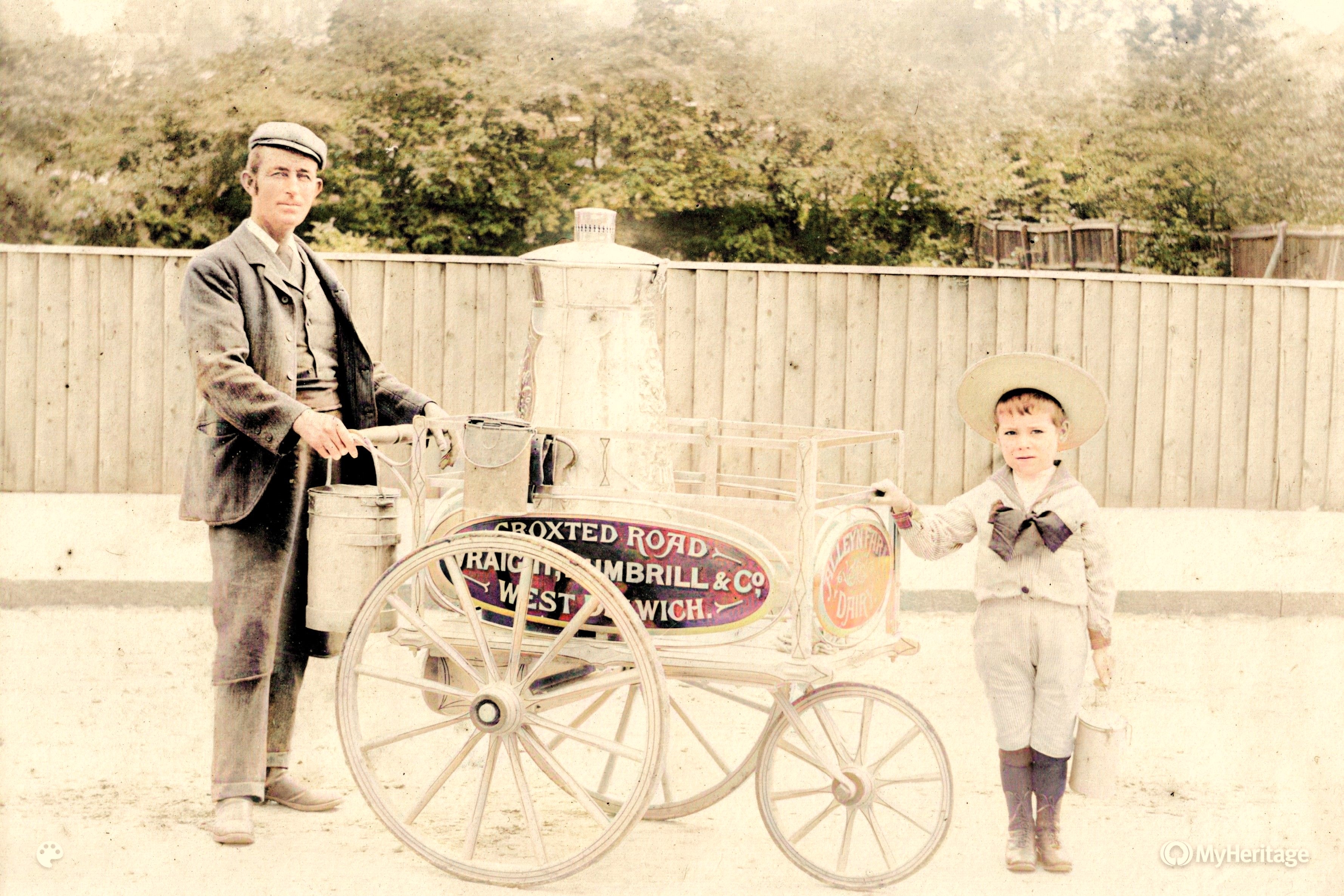
And just because I can, one of my favourite family photos, colourised by MyHeritage and then enhanced by me.Colourised Philip James and Percy James Woolgar c 1896
So Your DNA Results are ‘Wrong’

* My only connection with Living DNA, or any other DNA testing company, is as a customer. I have received no concessions, free gifts or financial inducements from any of them. I receive no benefits should you decide to purchase their tests.

In the light of the recent ethnicity updates from Living DNA, the perceived accuracy of these estimates has again been the subject of heated debate. Personally, regarding the Living DNA update, I am very pleased with the strong correlation between the documentary trees and the ethnicity estimates of the three kits that I am involved with. This may be because we all have, as far as we know, 100% British ancestry within the genealogical time-frame. Inevitably, amidst the excitement and praise, the updates have brought out plenty of ‘my results are wrong, this company is rubbish’ comments. Indeed, I too have looked at the ‘accuracy’ of the estimates (and used the word rubbish about previous results – although I did qualify it!).

I am a long way from being any kind of DNA expert but many of the main complainants seem to be missing a number of points. Firstly, these are estimates, it is an emerging science, we are a long way away from ethnicity profiles being a complete reflection of our ancestral origins. They will become more accurate over time but the results are currently only as accurate as the base populations from which they are derived. They are more accurate for some areas than others. In Living DNA’s case, it seems that those with British ancestry are more likely to find that their results are a better reflection of the documentary evidence, than those whose families originate elsewhere.

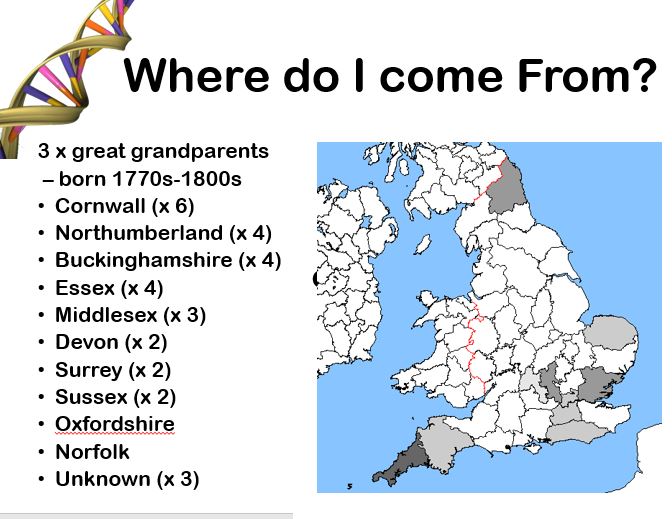
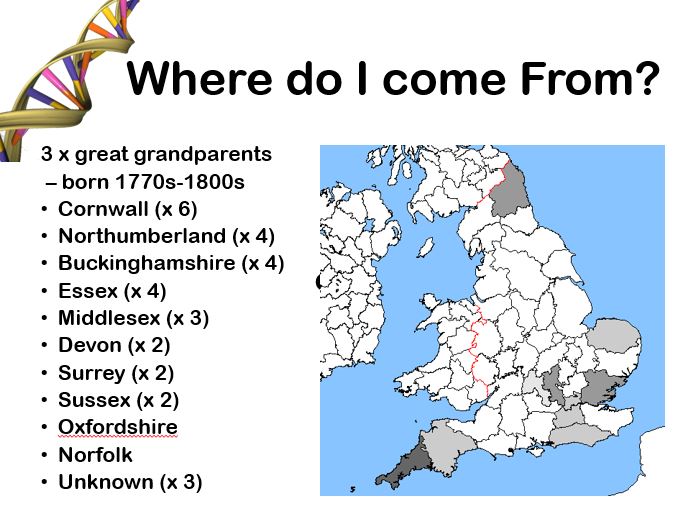
The crucial issue here is how we are measuring ‘accuracy’? Are we looking at where our grandparents were born? Our great grandparents? Their parents? In a British context, having talked to a number of family historians, it seems that you have to go back to those born about 1770-1800 (for me that is 3 x great-grandparents) before you stop adding additional birth counties (N.B. that is counties not countries) to your make-up. Here is an example:- My parents were born in two adjacent counties, Surrey and Middlesex. This does not reflect my earlier origins very well. If I go back to my grandparents, they were born in Surrey, Middlesex (x 2) and Cornwall, so I have added a county. Great grandparents adds Northumberland, Essex and Buckinghamshire to the mix of birthplaces. The next generation adds Sussex and Norfolk. The birthplaces of my 3 x great grandparents looks like the map below and beyond that only those counties illustrated feature. If I were able to go back beyond the genealogical time-frame (earlier than 1500) my deeper ancestry will be more diverse. Anyone with a British family trees will ultimately descend from those with origins in Europe (Saxons, Normans, Vikings, etc.) and beyond but it is unlikely that these individuals will ever appear on our documentary family trees.

Capture

Map created using Genmap

If you are non-British, there will be different considerations of course. Even for those whose ancestry is British, migration patterns cannot be ignored. For example, many who have Northern Irish ancestry in 1800 will find that these families came originally from Scotland or England. We may not know that because we are unable to trace our lines back that far but that may be what the DNA will reflect.

This is not all of course. We all assume that our documentary tree is genetically correct in every particular. It won’t be. Somewhere along one line or another, our solidly Yorkshire great-grandad won’t actually be the father of grandma. Great-grandma will have had a liaison with someone from Kent, or Germany, or Kazakhstan and we will never know, unless DNA matches give us a clue. Our only measure of accuracy is the tree we have lovingly researched and it is gratifying when our ethnicity estimate suggests we have got it right but it is not the company’s fault if we have got it wrong.

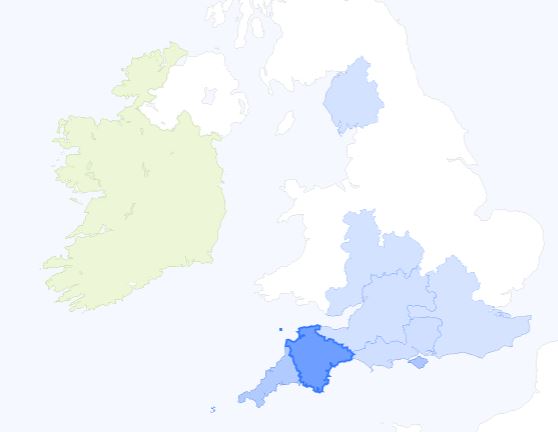
On the subject of updates, for my kits, the final Living DNA update is in and I should comment on that, as I have on the others. This person has ancestry from a very restricted geographical area (I promised not to use the word in-bred). So much so, that his sample formed part of the base data to identify Devon DNA. Going back to the ‘magic’ 1770-1800 mark (3 x great grandparents), 88% of his ancestry comes from within fifteen miles of his own birthplace and covers just two adjacent registration districts in north-west Devon. The other 12% is from Cornwall.

The original results were more diverse than this implies:

Devon 48.6%

Cornwall 24.5%

South-east England 13.8%

South England 7%

Cumbria 2.4%

Ireland 2%

South central England 1.6%

The new results reflect the documentary tree more closely:

Devon 64%

Cornwall 22.5%

South England 4%

Ireland 2.4%

South Central England 2.4%

South Wales Border 1.9%

Cumbria 1.7%

South-east England 1%

Now, anything other than the south-west appears to be just ‘noise’.

Capture

Map from Living DNA

Nothing to do with DNA but I know there are readers who are waiting for hint about my next historical novel. I have already said that it is, like Barefoot on the Cobbles, based on a true story. It is also, again like Barefoot, rooted in rigorous genealogical research. Oh and it does now have a title but I will be revealing that at a later date.

Another Day, Another Set of Living DNA Results

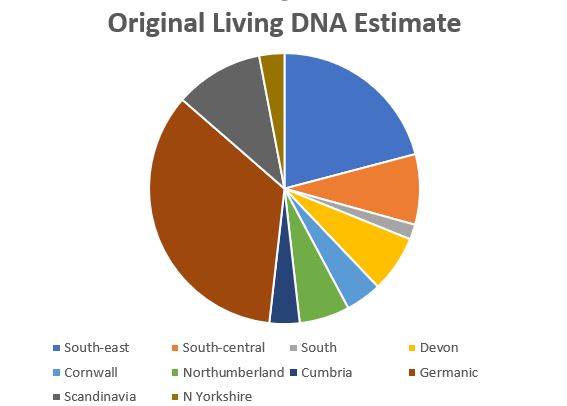
So today the second set of DNA results that I look after at Living DNA have received their update. These are Martha’s ethnicity estimate. Although I was very pleased with my own initial Living DNA results and their close resemblance to my documentary tree, Martha’s original results were, not to put too fine a point on it, pretty rubbish. Here are the comments that I made at the time. I do appreciate that our documentary trees do not always mirror our genetic trees and that ethnicity estimates are just that but Martha’s original results had us wondering if she had been swapped at birth, or, less dramatically, if she had been given someone else’s results altogether. As she matched both me and her maternal aunt, it seemed that neither scenario was the case.

Martha original Living DNA estimate

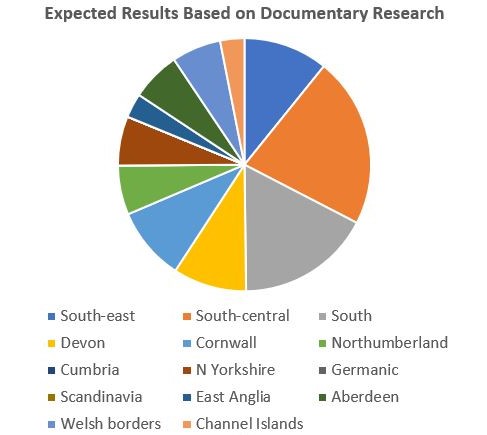
Martha expected results

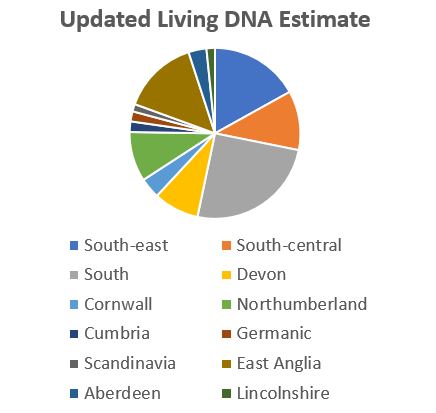
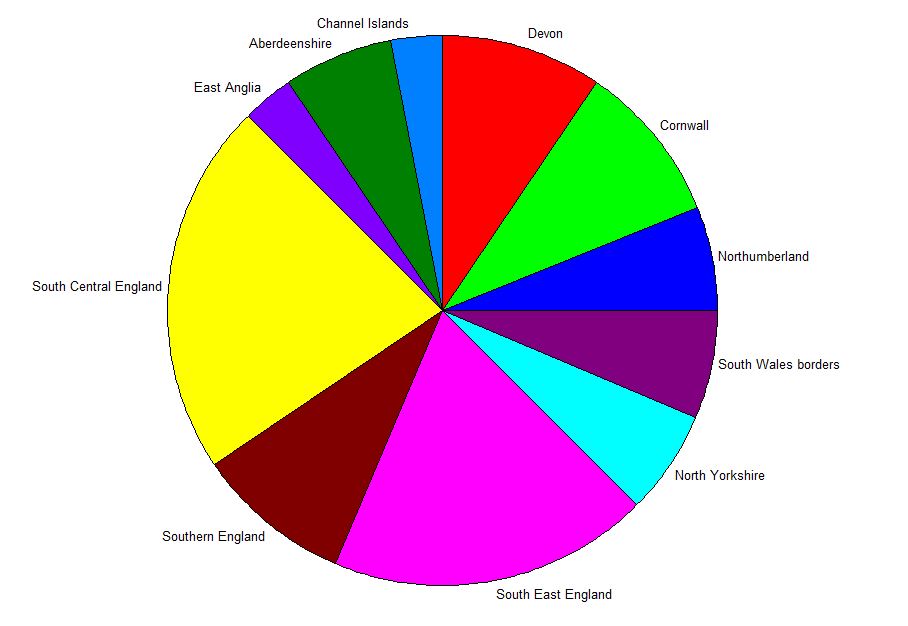
It was a lovely surprise therefore to find that the updated results were much closer to what forty years worth of documentary research might have led me to expect. Previously, 45% of Martha’s DNA was designated to be Germanic or Scandinavian. Migrations from Europe to the east coast notwithstanding, this was a ridiculously high amount. This has now diminished to a much more likely 3.3%. Last time there was no trace of her paternal Scottish ancestry, a significant proportion from the Forest of Dean, her Welsh borders roots, or the small amount from the Channel Islands. Now, the Forest of Dean shows up, as does Aberdeenshire, although there is still no sign of Worcestershire, which is included in the Welsh borders region. What is notable is the complete lack of Yorkshire ancestry this time. I have 6.7% from Yorkshire in my revised estimate and I have not yet found any ancestors from Yorkshire. Martha, on the other hand, who now has zero Yorkshire DNA, has a Yorkshire great great grandparent.

Martha Feb 2020 Living DNA estimate

So then how close is Martha’s new estimate to what I might expect? As I did for my results yesterday, let’s look at this one region at a time.

Devon and Cornwall first. If Martha had inherited equally from all her 3 x great grandparents (which I know she will not have), her profile should show 9.4% each from both Devon and Cornwall. Last time, this was slightly under represented with 6.8% from Devon and 4.3% from Cornwall. The new results reveal similar amounts: 8.6% for Devon and 3.9% for Cornwall. This swing from Cornwall to Devon, small in Martha’s case, is more marked in my revised estimate.

Northumberland was about right last time at 6%. This has increased to 9.4%. Scotland now appears with 3.4%, as opposed to an anticipated 6.3%. Taken together, these regions are as expected.

The south and south-east of the country is where the highest percentages lie, according to the documentary evidence, with 53% having origins in these regions. Last time, only 30% showed up but now it is a much more realistic 68%. It is difficult to comment on the distribution between the south, south-central, south-eastern and east Anglia regions, partly because Living DNA include Essex in both the south-east and East Anglia.

So the verdict so far, with two out of three updates in, mine has gone from good to still good and  Martha’s, has gone from poor to good. Overall, I am very satisfied. Let us see what the third update will bring.

New DNA Results from Living DNA – some thoughts

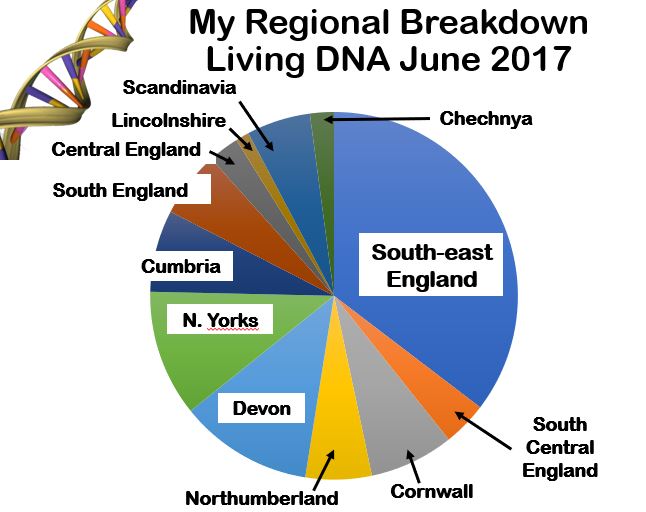
Well, that was exciting. My updated ethnicity estimate from Living DNA is in. My original results, which I received in June 2017, were a pretty fair reflection of my  what I expected, based on my documentary tree. Compared to my estimates from other companies, it was the closest match to what I have discovered during over forty years of research. Here is what I wrote at the time, some of which I have repeated here.

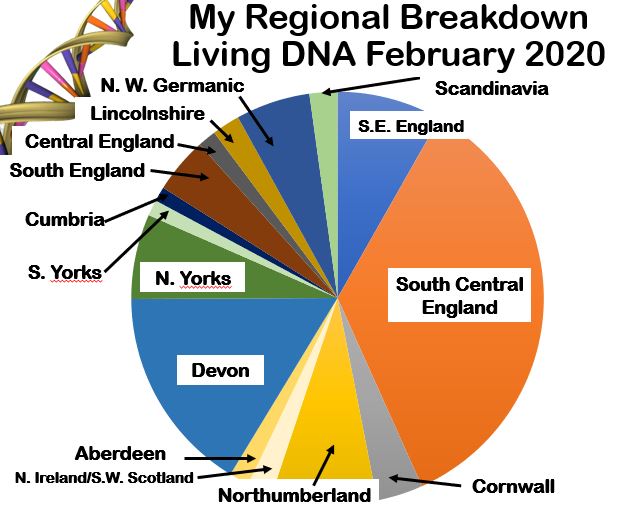
Today’s revised estimate is based on Living DNA’s improved, more refined data. There are no massive changes but it is interesting to examine the subtle differences and how the new results compare to my predictions, based on the paper trail.

I am now in my fifth decade of family history research and have an extensive pedigree based on documentary research. I am fortunate to know the geographical origins of 31 of my 32 3 x great grand-parents and 75% of the generation before that. This takes me back to the mid-eighteenth century, well before the point at which my ancestors converged on Greater London. Of course, these estimates are just that, ESTIMATES but as the science improves, we might expect that they will become more accurate.

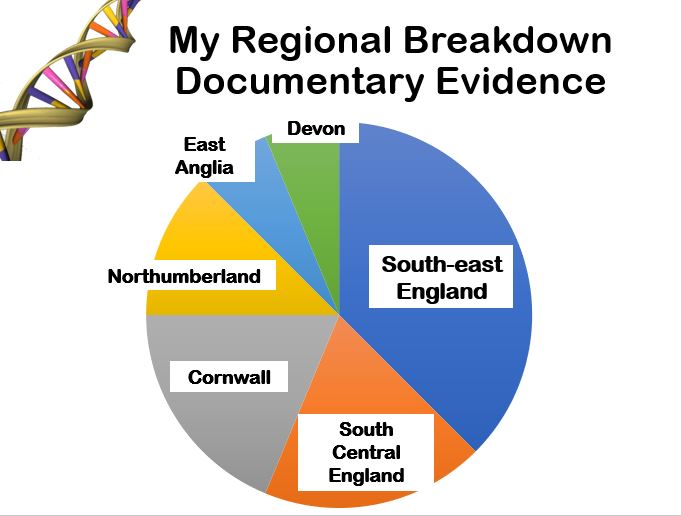
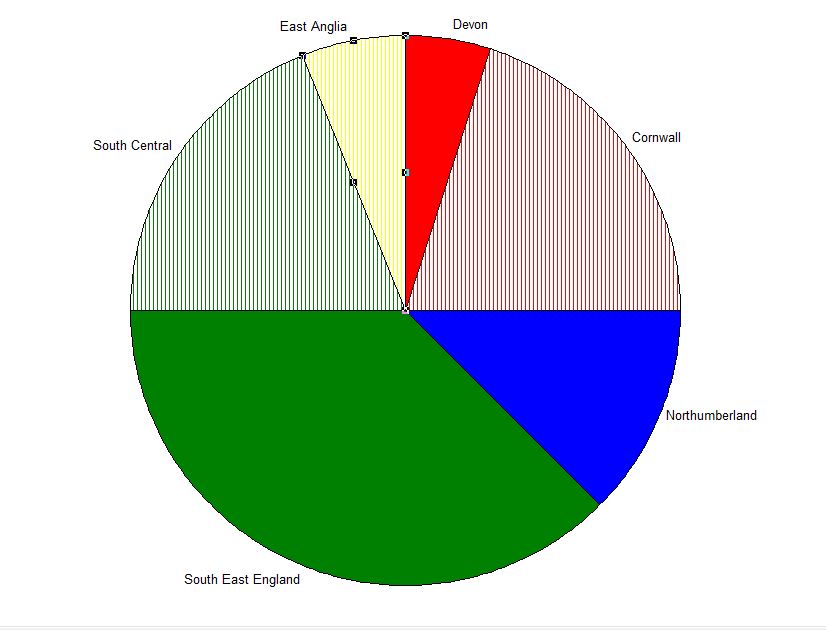
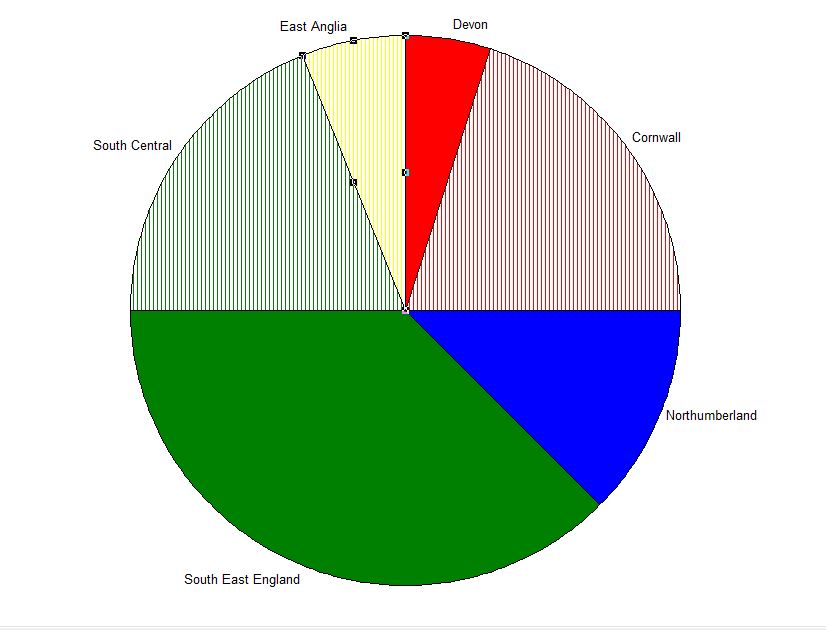
In preparation for the original results, I used my research to work out what I might expect. I am aware that the DNA that I have inherited does not come equally from all my 3 x great-grandparents and that some of them may have left no trace in my profile but I had no way of taking account of this. I am also assuming that my documentary pedigree is correct. Matches at other testing companies have, so far, not given me any reason to think that my genetic tree is different from my paper one. Based on my knowledge, my expectation was that my genetic make-up would reveal:-

Cornwall 20%

Devon 5%

Northumberland 12.5%

South Eastern England 37.5%

South Central England 19%

East Anglia 6%

So, as I did with the first results, let us examine a region at a time. Firstly the south-west, Devon and Cornwall. By my reckoning, the south-west makes up 25% of my ancestry, with 20% being Cornish and 5% for Devon. Living DNA’s first percentages were 7.4% Cornish and 11.7% from Devon. Now, the overall percentage is the same – 19.1% but the distinction between Devon and Cornwall has become less accurate, rather than more, with 3.5% Cornish and 15.6% now being allocated to Devon. As my south-west ancestors lived very close to the Devon-Cornwall border, on one side or another, I am not disappointed with this.

Next, Northumberland, which I would expect to be 12.5% of my ancestry. With the original results, by adding the estimates for Northumberland (5.8%) and Cumberland (7.2%), I had the anticipated 13%. This segment of my ancestry has now been refined to be slightly more accurate, with 7.9% for Northumberland, 1.1% for the North-west, 1.9% N.Ireland/S.W. Scotland and 1.5% Aberdeenshire, a total of 12.4%. I suspect that the lost 0.6% has defected to Europe.

In the south-east, again the more refined breakdowns have become less similar to the documentary tree. I believe that the bulk of my ancestors, 37.5%, come from the south-east, Essex and Sussex. Last time, Living DNA agreed, with 35.3%. Now, the new results show only 7.9% of my make-up being from the south-east. I would anticipate a further 19% to come from the south-central region. This was under-represented first time round, at only 3.9%. The swing to the south-central region has been huge; I now have 33.7% from there. Living DNA has also made minor adjustments to the percentages from the south, which has moved from 5.8% to 4.2% and to the central region, which has gone from 2.7% to 1.4%. So once again, I find that the percentage for the general area is what I would expect but the distribution within that area has become slightly less accurate.

So what does that leave? There is still no sign of my expected 6% East Anglian ancestry. As I commented last time, I suspect that that has become Scandinavian ancestry, which has decreased from 5.6% to 4%. Lincolnshire has increased from 1.2% to 2.1%. I have lost the anomalous 2.1% from Chechnya and gained 7.5% from north-west Germany, perhaps reflecting early migrations to the east coast.

What fascinated me last time and still does, is the alleged Yorkshire ancestry, which has decreased slightly, going from 11.1% for North Yorkshire, to 6.4% for North Yorkshire and 1.2% for South Yorkshire.  At present, I have one great, great grandmother whose origins are unknown but my best guess would be the Shropshire/Worcestershire borders. Should I be looking at Yorkshire instead, or might this be the DNA manifestation of Shropshire/Worcestershire?

I also have a 4 x great grandmother who appears on my tree in that position 3 times, due to the marriage of cousins in two successive generations, thus she represents 4.7% of my ancestry. I do not know her surname and I have no idea of her origins. At present, I have assumed she was from the south-east, which is where her children were born in the 1780s; I wonder if I may be wrong.

So, overall, I still find that Living DNA’s regional breakdown is broadly similar to my documentary tree. The minor tweaks that have come with new results have been a case of win some lose some. Overall though, I am pleased with Living DNA. I am still waiting for the updates on two other kits, so I will be reporting back further then. I am especially interested to see if the one which diverges dramatically from the paper trail has changed.

Capture

Map created using Genmap

Capture

Capture


Living DNA February 2020

* My only connection with Living DNA, or any other DNA testing company, is as a customer. I have received no concessions, free gifts or financial inducements from any of them.

DNA Dilemmas

The following post was another that I wrote for The In-depth Genealogist’s blog. I am writing it from the perspective of someone who has done DNA tests with three different companies and who runs a Y-DNA surname project.

DNA testing for genealogical purposes has never been more popular but it is not without its drawbacks. All too often, people bemoan the fact that potential DNA connections have provided no family information to their testing company of choice, or that they fail to respond to emails. There is however a more serious issue. Somewhere in the fairly small print most, if not all, the testing companies warn that those taking a test should be prepared for the results not being what they are expecting. In our excitement, how many of us read, mark and inwardly digest the implications of these caveats? What can possibly go wrong?

Nowadays, for many, it is a DNA test that sparks the research trail but others are experienced genealogists. For those serious researchers, before that test is taken, there has been time, money and most importantly, emotion invested in a particular family line. What happens then when the DNA results suggest that there is no genetic connection to that family at all? If we think, as we scrape our cheeks or spit in our tubes, about the possible outcome at all, have we really come to terms with how we would feel to no longer be a Smith but a Jones? Even if we are intrigued or excited about the thought that, somewhere in our ancestry, a Mrs Smith has had a child by someone who is not Mr Smith (Mr Jones perhaps) this will not just affect us. How will our siblings, parents, cousins, others who share this hiccup, feel? These relatives may or may not have been particularly interested in our genealogical delvings, they may even have been discouraging. Do we tell them and if so how? Will they be interested or appalled? Remember that it may be very difficult to pinpoint the precise point in our ancestry where the genetic pedigree deviates from the documentary. It could be 60 years ago or 600. It might be easier to accept a 6 x great grandmother going astray than a grandmother but in either case, we have lost that genetic link to a family that may have been ‘ours’ for decades.

What about those of us who run surname DNA projects, perhaps with the aim of proving that documentary family trees for a rare, potentially single origin, surname are genetically linked? Hopefully we explain to those who test that they may not match the normal profile for that surname but I suspect those testees all go ahead without really expecting it to apply to them. When non-matching results come back how do we break the news that they do not have a genetic link to that surname at all? To have tested in the first place they presumably feel some sense of belonging to the genetic line. I guess we can approach this in a similar way to those who have been adopted into the family but then it is not usually the family genealogist who has to break the news that someone is adopted and in most cases, there are now options for adoptees to identify their birth parents. Unless our non-matching DNA reveals a connection to a very unusual surname, the chance of finding the birth father of the product of Mrs X’s indiscretion is remote – even supposing that we can narrow down which Mrs X went astray.

When I took my first test, my head was prepared for a non-match, I am not sure that my heart was equally prepared. Fortunately for me, my slightly dodgy documentary direct paternal line was confirmed by DNA. How would I have felt if it was not? If I am honest, I really don’t know. I would be very interested to hear how others cope with DNA dilemmas.

This image is a work of the National Institutes of Health, part of the United States Department of Health and Human Services. As a work of the U.S. federal government, the image is in the public domain.

Online Family Trees and why I have Succumbed

I have never been a fan of online family trees. Whilst absolutely respecting other people’s right to make whatever choice suits them, it was something that I always vowed, quite vehemently, I would never do. I was wrong. First of all, a word about why I chose to keep my family tree offline. When I started my research, over forty years ago, there was no online. I suspect if I were a new recruit to genealogy now I would make some different choices. When I got fed up with hand-drawing copies of family trees to share with others, I capitalised on the fact that I had a computer and purchased some genealogy software; Family Tree Maker. I can’t remember exactly when this was but it was on floppy disks and I think it was version 3. I still use Family Tree Maker. The trees it produces are not ideal but it suits me better than the alternatives. The fact that my handwriting is an exercise in advanced paleography played no small part in my decision to abandon hand-drawn trees.

Let me be clear, my reluctance to put a family tree online had nothing to do with me not being willing to share my information; I have been doing that since 1977. The surnames that I am interested in have been widely advertised for decades and are listed on this website. Over the years, many distant relatives have benefited from my research and vice versa. Purely because of the length of time I have been researching, I often have more to give than receive but that is fine. I love to share information but I do like it to be a two-way process. I want it to be accompanied by a conversation about the sources I have used and why have I made the connections that I have, or why I have not. I want to share the stories and the contextual detail that I have researched, not just the names and dates. To this end, some narrative accounts about my ancestors are now also available on my website.

This has worked well for me until very recently. Why would I change? I have been vocal about my opinion of many of the genealogies that you find online. Let’s just say I am not impressed by vast, unsourced, ‘grab it all’ trees containing biologically impossible data and scores of unverifiable connections. I do accept that there are well-researched, accurate pedigrees, compiled by proficient genealogists on the www but there is also an overwhelming amount of dross. So much so that extracting the gems has made looking for the proverbial needle in a haystack seem like child’s play.

People have often marvelled that I can do family history research without an Ancestry account, particularly as I do still do some professional research. I have never felt the need. I have subscribed to FindmyPast since before it was called FindmyPast and that suits me because the coverage is better for the counties that I need most often. When I began researching in the years B.C. (before computers), tracing your family history was impossible without going to archives and this is still key to the work I do. In fact, I believe that archival research is still essential for all researchers, as so much is not online.

A few months ago, having had my DNA tested with other companies, I decided that I might as well add Ancestry DNA to my collection of autosomal results. Before I parted with my hard cash, I considered whether having no Ancestry subscription and no online tree would make the test worthless. I realised that it would hamper my chance of encouraging contacts but I decided that it would still be useful, especially at sale price. The results arrived. I was offered a significantly reduced rate for an Ancestry subscription. So, tempted by the data sets, notably the London parish registers and PCC wills, I took out my first ever Ancestry subscription. I still had no intention of ever putting my tree online. I filled in my profile with my ancestral surnames but I resisted the exhortations to start my tree, even one that was private.

I had fun with my DNA matches, as expected, none of them close. I have two 3rd-5th cousins and 284 at 4th-6th cousin level, which I would guess is probably significantly fewer than most people. Some I had made contact with before. I could, I thought, just sit back, with my lack of tree and see if anyone contacted me. I worked out how some of the matches were connected to me using their public trees. I began to colour code them into groups. I was having fun. Everyone was banging on about ThruLines, that sounded fun too but of course I couldn’t connect to anyone with no tree. As I worked through my matches, I realised that I was prioritising those with public trees, of course I was, no real surprise. I contacted a few people, some replied, some didn’t, not unexpected. I found a third cousin in Australia, practically my closest living blood relative. Obviously, I reasoned, people are going to do the same as I did, start with those with public trees, then perhaps consider contacting a few with private trees if the common matches looked promising. With tens of thousands of matches, no one was ever going to get round to contacting poor little treeless me.

I umm and erred a bit and I took the plunge. My original intention was just to add my direct ancestors, not least because of the time it would take to add the results of forty years’ worth of research. The reasoning behind creating this tree meant that there was no point in making it private. My concession to privacy is that I have listed my parents as alive when they aren’t, so they can’t be seen and I would not consider adding my descendants. I still have numerous Cornish direct ancestors to add, some of those were acquired so long ago that they haven’t even made it to Family Tree Maker! I have filled in some siblings, particularly where it clarifies a DNA link and I will gradually add more.

Before I began, I worried if anyone would take an unsourced tree seriously (I wouldn’t) and I couldn’t face the thought of adding a trillion source citations, which I keep on a card index, yes, really, I do know it is 2019. Once I had begun, I realised that Ancestry make it quite easy to add sources, which was a relief. Their hints do contain some serious flights of fancy but these can be ignored. Of course, the sources that are attached to my Ancestry tree are a fraction of those that I have for some of these individuals but at least the tree is not unsourced.

Transferring a Gedcom wasn’t an option as I have multiple files. I could have created a composite tree by merging them but I thought it was quicker to start again. Everyone I have added has been verified using original sources, or images of those sources. I do not rely on indexes, although they are obviously a helpful gateway to the documents.  For this reason, I have not and will not, graft someone else’s tree on to my own. Although I am equally committed to researching them, I have made no attempt to add my children’s ancestors, as the point of this is to understand DNA matches and these are not relevant to that task.

Admitting you are wrong is difficult but I like to think that I am open to altering my opinions and alter them I have. I now have a tree on Ancestry, I am even quite proud of it. It will never be the primary method of keeping my information. There are several reasons for this not least because I want to be able to work on my tree when I am not online but I have ‘come round’ to a certain extent and who knows, maybe my opinion will change again.

Capture

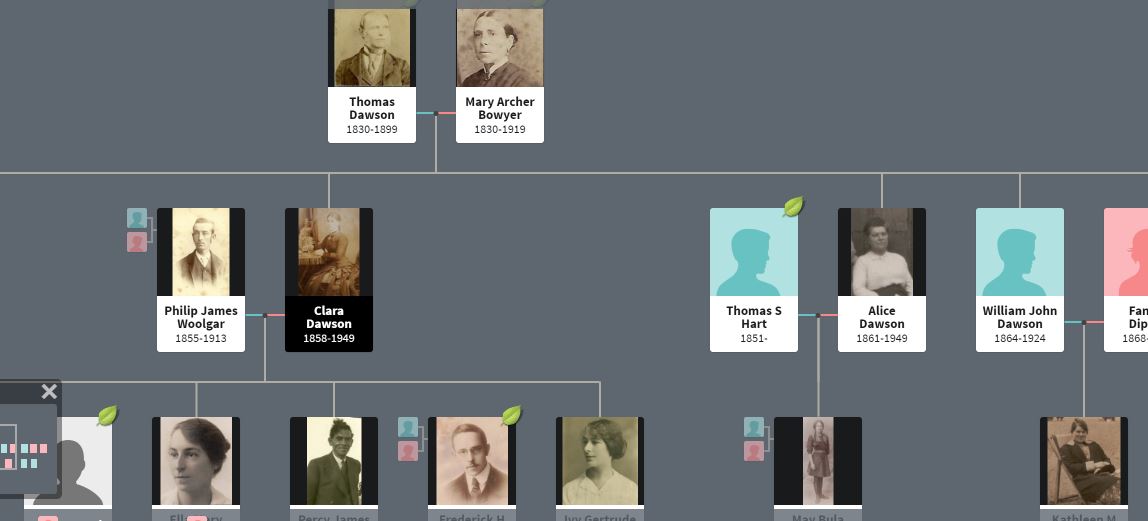
Part of a tree created at Ancestry.co.uk

Of Death Certificates, DNA and other Updates

The arrival of the huge pile small number of death certificates following my ‘beat the price rise’ ordering fest has focussed my mind on various branches of my family tree. I had fun investigating the ‘crushed by a train’ death. Safe to say, considerably more fun than was had by the poor victim at any rate. I have, after more than four decades of researching, begun to put some of my family history narratives online. I have to stress from the outset that these are not beautifully written stories. Instead, they are working documents, intended to set out all the known facts on a particular family, together with the sources for each piece of information. Some do have smatterings of local and social historical context added. So, if you are related to the Dawsons of Essex, the Bulleys of Norfolk, The Oughs of Cornwall, the Pepperells of Devon, the Hoggs of Northumberland, the Meads of Yorkshire, the Seears of London or several other related families, there is something there for you and more will, eventually, follow. Do take a look at the many other surnames of interest that are listed, who knows, we may be related.


My DNA estimates June 2017

My regional breakdown based on the documentary evidence

At Christmas, I persuaded Martha to take a DNA test. I was pretty convinced she hadn’t been swapped at birth, so I was certain who her parents were but I was interested in the profile for the ancestry that we do not share. We chose to go for Living DNA as I had been impressed by how accurately my own regional breakdown that they had provided matched the documentary evidence. I wrote about this here. Finding matches was not a priority. I must stress that I am a DNA dabbler and am by no means an expert. I do however understand a few basic principles (I think). I know that we inherit exactly half our DNA from each of our parents (except when it seems we don’t – see below). It is a random half, which is why siblings differ (unless they are identical twins) so in theory it would be possible to inherit nothing from one grandparent (although this would be very unlikely) and the further back you go, the likelihood that no DNA has come down from a particular ancestor increases greatly. I also know that if I am 20% Cornish, Martha will not necessarily be 10% Cornish. She may have inherited more or less than 10% of my Cornish DNA, or indeed none at all. I also understand a little about migration and population movements. You often see posts on online forums complaining that such and such a DNA company hasn’t shown any of granny’s Irish ancestry. This is ignoring the fact that many Irish families were Scottish or English in the sixteenth and seventeenth centuries. It also ignores the fact that these ethnicity estimates are just that, estimates. This is an emerging science and should really only be regarded as a bit of fun.


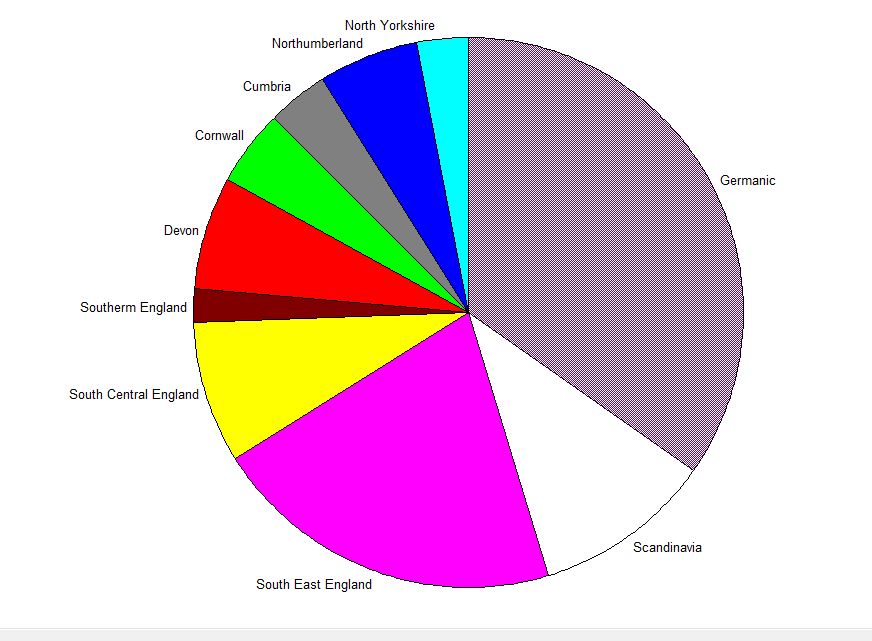
Martha Living DNA regipnal breakdown actual

Martha’s Living DNA regional breakdown

Nonetheless, when Martha’s regional breakdown arrived it was, to put it mildly, weird. She is now wearing lederhosen and eating sauerkraut. These are my thoughts, maybe my DNA expert friends will chip in and find holes in this argument. If half Martha’s DNA is mine, I am interested in the other half. It has been very easy to identify the majority of this. Martha shows as being 34.6% Germanic; I have none. She also has 5% more Scandinavian ancestry than I have, 4.5% more from South Central England and 0.2% more from Northumberland. That adds up to a whopping 44.3% that we do not share, which, as I understand it must represent what she inherits from her father. From whom, I am reasoning, she has also inherited 5.7% of something I can’t identify because it overlaps with mine. I have been following the documentary trail since before Martha was born and I am a reasonable way back on all lines.

Martha documentary

Martha’a regional breakdown based on the documentary evidence

This ethnicity profile in no way reflects what I know of her father’s ancestry, which I would expect to reflect elements from the Channel Islands and Scotland as well as a significant portion from Gloucestershire. The latter came from the Forest of Dean, which is known as historically being a remote community, very unlikely to have been influenced by European in-migration within the genealogical time-frame and beyond. Martha’s paternal aunt has tested with Ancestry and her ethnicity estimate more closely reflects the documentary trail, with nothing Germanic at all.


We have been eagerly awaiting Martha’s matches to appear and today they arrived. It may be a relief for her to know that she is who she thinks she is as she matches both me and her aunt, who uploaded her Ancestry results to Living DNA, with the expected relationship. I still don’t understand why, according to Living DNA Martha and I share 47.72% of our DNA and not 50% but I have a great deal to learn about DNA.

For those of you who have taken an interest in our BeingEdward story. I am pleased to report that the number who have read my original post has now reached four figures; so thank you so much to all who read and shared. This week, Martha has posted some insights into what life with BeingEdward means.

Oh and if you were wondering about the progress of the ‘spring’ cleaning, it may be better not to enquire. I have however now discovered that I have enough candles to survive any post-apocalyptic catastrophe, providing I can work out how to run the laptop using candle power.

Heredity, Hammocks and Heat: DNA and other adventures

I really wanted this post to be about some very exciting news but I am not allowed to tell anyone yet (no, no one in the family is, as far as I know, pregnant), so that will have to wait for another time. I could talk about the weather. Here in the UK we have been experiencing a mini heat wave. I was stuck in a northern city in a motel whose room did not go below 29 degrees for three days. What a joy to come back to my beautifully cool home (they knew what they were doing when they built houses in the 1600s) with the sounds of the local sheep baaing, I could even forgive the aroma of silage making. No problem, UK heatwaves never last long and we are back to normal today.

My partly revamped garden is still mid-makeover. Given the heat and my absence I am quite glad that I delayed laying new turf. I was pleased that the plants survived my healthy neglect during the record-breaking temperatures. The hot weather made it seem like a good idea to erect a hammock that I have had for about twenty years but never used (I think it was free with something). All it required was two trees sturdy enough to support my burgeoning weight (it’s all that eating on expenses that does it). My tiny garden isn’t over burdened with trees but two were identified and with assistance from the fisherman of my acquaintance we began to adjust the ropes to what seemed to be a sensible height. This kind of occasion is when it is useful to know someone who can tie a decent knot or two. After one or two false starts (I ended up sitting on the ground) the hammock was in place and I was enjoying a meditate. The observant amongst you will have noted the word ‘trees’ above. Hammocks tied to trees mean, inevitably, that you are, to some extent, under a tree. Trees mean birds. Birds have digestive processes, need I say more? No sooner had I laid back and closed my eyes than I was required to move. Somewhere there is photographic evidence of this. Fortunately the photographer finds getting pictures from his phone to anywhere else a little challenging – phew!

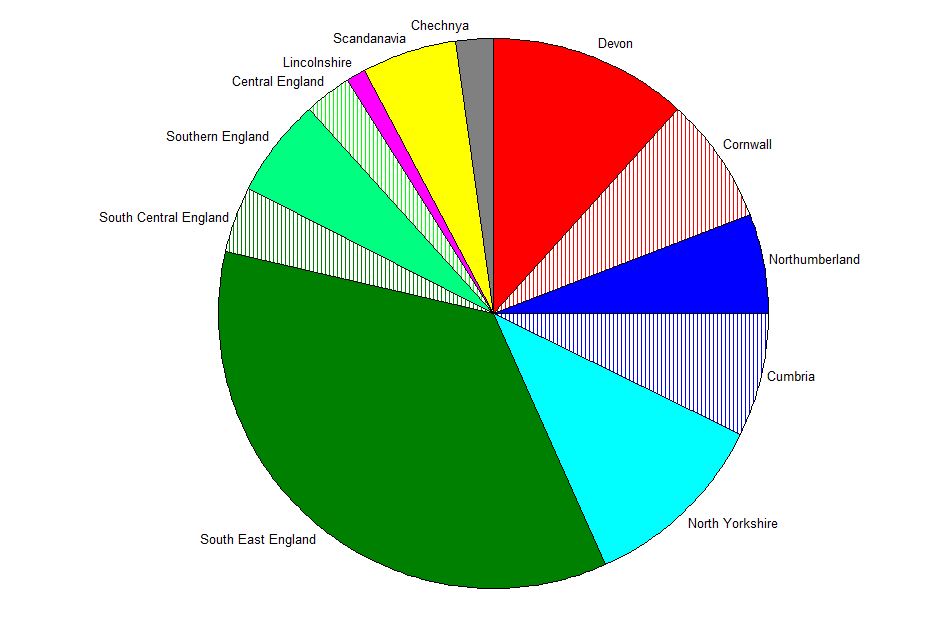
Actually there is some really exciting news that I can convey and that is that my DNA results from Living DNA have arrived. This company calculate your ethnic origin on a regional level. Having ancestry that is, at least on paper, 100% English, I was particularly interested to see what this would reveal. As a teenager I longed to be Spanish, pretended to have Spanish ancestry and despite my total inability at languages, even tried to teach myself Spanish. Was this due to some ancestral memory?

After more than forty years of researching my family history, I know the names and geographical origins of 31 of my 32 3x great grand-parents and 75% of the generation before that. This means that I have a pretty good idea where the families came from before they all began to converge on London in the nineteenth and early twentieth centuries.

Whilst I was patiently (well, ok actually not that patiently) awaiting the results. I analysed my documentary evidence to work out what I might expect. I am aware that the DNA that I have inherited does not come equally from all my 3 x great-grandparents and that some of them may have left no trace in my profile but I had no way of taking account of this. I had a slight issue in that Living DNA don’t seem to acknowledge the existence of Buckinghamshire, which accounts for an eighth of my ancestry but I used my initiative and counted it as South Central England.

So did the test support the proportions that I estimated and what surprises were in store? Living in Devon and having a direct paternal line that for 37 years I believed was Cornish but has now been traced back to Devon, I am particularly attached to the 25% of my ancestry that comes from south-west England. Based on my knowledge, my expectation was that my genetic make-up should show that I was 20% Cornish, with 5% from Devon. Living DNA’s percentages were 7.4% from Cornwall and 11.7% from Devon. As my lot spent their lives on both sides of the Tamar, very close to the Devon-Cornwall border, I can live with this.

Turning to the other end of the country, my estimated 12.5% for Northumberland became 5.8% according to Living DNA. I did wonder if some Scottish blood might creep in, as they lived in border parishes but it seems that I must leave Scottish descent to my children and grandchildren. Living DNA also suggested that 7.2% of my origins were from Cumbria, which, when added to the Northumbrian percentage, comes close to my estimate.

My DNA estimates June 2017

My estimates of my ethnic origins

The marriage of cousins in two successive generations (I know, accounts for a lot) means that I have what is known as a collapsed pedigree, with the same 4 x great grandparents appearing on my tree three times. They came, as far as I know, from the south-east and the bulk of my ancestry (37.5%) is from that region, why do I find this boring? Living DNA agreed, with 35.3% from south-eastern England. I calculated that 19% of my ancestry was from the south central region, not much more exciting. Living DNA put this at 3.9% but also identified 5.8% from Southern England and 2.7% from Central England, which redressed the balance a bit.

What appeared to be missing was the 6% that I believe came from East Anglia but this could be accounted for by the 5.6% that Living DNA attributed to Scandinavia. One of the East Anglian family names was Daines! I do however have another possibility for the Scandinavian connection. Interestingly my test results with Family Tree DNA make my origins 100% British Isles, with not a long ship or horned helmet in sight.

I am still mulling over Living DNA’s 11.1% from North Yorkshire. I somehow don’t see myself as a Yorkshire lass. No disrespect to my friends from Yorkshire, it just doesn’t feel like me. I don’t begin to understand cricket for a start. Could this be the missing 3 x great grandparent or the 4 x great grandmother, who appears three times in my ancestry but whose full name and birthplace I don’t know? Or does the North Yorkshire element represent something earlier in the Northumbrian line?

Interestingly, I also have 1.2% of my DNA from Lincolnshire. Although my maiden name, Braund, is firmly rooted in Devon and is found there back to the mid 1400s. Prior to that (11th-14th centuries) there are instances of the name in Lincolnshire but no connection has been found between the Braunds of Lincolnshire and those of Devon; could this minute trace in my DNA be attributable to this? The theory and it is just a theory, is that as both countries were key wool producing areas in Medieval times and are linked by drovers’ roads, this may have been how the name moved to Devon. The Lincolnshire Braunds are believed to have had Viking origins, so we are back to Scandinavia.


Living DNA June 2017

Living DNA’s analysis of my ethnic origins

Finally there is a random 2.1% from Chechnya. To save you looking that up, it is in the bottom right hand corner of Europe, not far from the Caspian Sea and given the political situation there, it probably isn’t the sort of place to be making an ancestral visit any time soon. I have heard of a few others whose profile contains this element and I feel this may be an anomaly that will be ironed out when more data becomes available. In the meantime Салам (hope Google translate has got that right). So much for being Spanish!


Who I Really Am – More Adventures with #DNA

The further back we delve into our family’s history, the greater the chance that there has been a ‘non-paternity’ event somewhere in our chain of great great grandparents and that one of our ancestors, child of Mrs X, was not the genetic offspring of Mr X, despite what the baptism register would have us believe. In fact, historically, the child of a married woman was always considered to be the progeny of her husband, however compelling the evidence to the contrary. I have heard of baptism entries reading along the lines of ‘…. son of William and Mary X, the husband was transported two years ago.’

I am a great believer in tracing not just blood parents but also those who have taken on parental responsibilities, such as adoptive or step-parents. These people’s values and attitudes will be passed on every bit as much as genes, so they are important. Nonetheless, most family historians do have a particular interest in their genetic line. How ever much we look like other members of our family, there is always that niggling doubt that one of our great great grandmothers may have strayed and we may not be who we think we are.

Next month marks the 40th anniversary of my first forays into real genealogical research, as opposed to just absorbing what my family members already knew. I was interested in all my blood lines but my direct paternal line fascinated me the most, mainly because I knew so little. I visited what was then the Public Record Office (PRO). I looked at the 1871 census returns (the most recent then available) on microfilm at Portugal Street (remember that?). I purchased my first certificates, for I believe £4.50. This confirmed that my family did indeed originate from a small Cornish village on the banks of the River Tamar, as I had been told.

cargreen-shop-old-postcardAt the age of twenty one I took a solo trip and visited Cornwall for the first time. I arrived at the nearest railway station on a Saturday evening. I stayed in a lovely B & B, which sticks in my memory because the proprietor was obsessed with recounting how her late husband had worked for the electricity board. On the Sunday, I obviously wanted to go ‘home’. The village was seven miles away and there was no public transport. Undaunted, I set off to walk. Since then I have firmly held the belief that Cornish miles are longer than those elsewhere. The local shop, which bore the family surname, was shut. I eventually wandered in to the local pub, not the easiest thing for a lone female in the rural Cornwall of 1977. I asked for relatives and met several fourth cousins. For the first time I saw someone of my own generation from my father’s side of the family. Despite being a clone of my mother and maternal grandmother, others perceived a physical resemblance. I was, naturally, very excited.

Although I research all branches of my ancestry, I suppose I have most emotional investment in my Braund line because it has been the subject of one-name research since 1982. We hold extended family reunions every year, I belong. What if I wasn’t really a Braund? I tried to tell myself that it didn’t matter, that I have borne the name and I am a Braund in all that counts. Despite having encouraged others who have taken DNA tests and received the results that do not match, with those words, ‘it does not matter’, I had a horrible feeling that I might be devastated if it turned out that my genetic roots lay elsewhere.

Someone from my branch of the family had already had a non-matching Y DNA test result but that was done because there were doubts about parentage in that line. So far, I didn’t match other Braunds who had done autosomal DNA tests but I had been convincing myself that that was ok because the paper trail showed that any connection would be very remote and date back to the seventeenth century or earlier. Within my first year of research I had traced back to my 6 x great grandfather Samuel Braund, thirty seven years later I added another generation but were these Braund ancestors really mine? Could DNA prove my genetic line? Apart from the lack of matches with other Braunds so far, my 3 x great grandfather was born out of wedlock to a Mary Jeffery. Ok, so he was named James Braund Jeffery, later took the surname Braund and appears to have been brought up by the Braund family but there were a few misgivings regarding how honest Miss Jeffery may have been.

If you have been following along with my weird and wonderful life you will know that I recently took an autosomal DNA test. My closest matches were in the 2nd-4th cousin range and one of these had a surname that I recognised as marrying in to the Braund family in my 4 x great grandfather’s generation. This person had the largest segment of common DNA of any of my matches. I emailed a tentative enquiry. The response confirmed that we were fourth cousins twice removed. My 5 x great grandparents were his 3 x great grandparents, thus confirming the genetic pedigree back to a couple who married in 1766. So I am sorry I cast aspersions on poor Mary Jeffery. I don’t even know what happened to her. I believe that she may have died in childbirth. Maybe one day I will find an autosomal match with a member of the Jeffery family. For now, I am relived that the DNA match has confirmed the pedigree that was crafted from 40 years’ of documentary research.