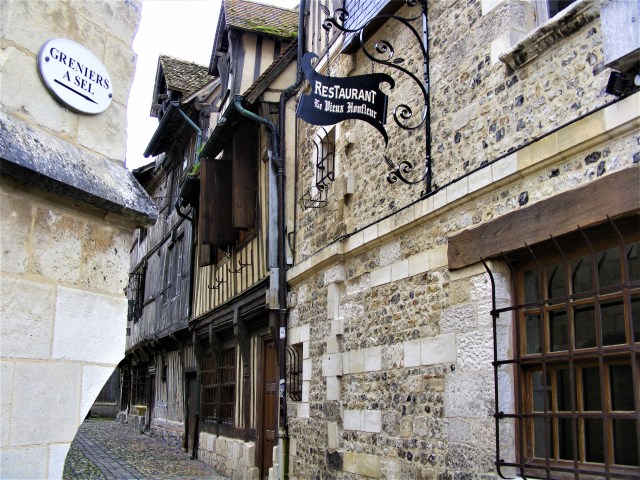
We leave the ship early, down a very steep gangplank, for our trip to Rouen. Hurricane Lorenzo is creating a pretty stiffish wind. Again, we drive across the enormous port of Le Havre, which was destroyed by the allied forces in 1944. There were three phases of destruction in France, the Viking invasions, the French Revolution and the Second World War. From today’s guide, Lana, we learn that Le Havre football club is the oldest premier division club in France. We drive to the beautiful city of Rouen, founded in the first century, although nothing Roman survives. Rouen an important harbour, became the capital of Normandy in 2016. Haropa is a new name for the combined harbour of Le Havre, Rouen and the Seine hinterland to Paris. We are told that the only bridge across the Seine in the Middle Ages was at Rouen. I find it hard to believe that this refers to the whole length of the river.
Capitalising on French internal conflict, the English waged the Hundred Years War against France, a misnomer as it actually lasted 114 years. This conflict saw Joan of Arc become the heroine of the French; she was captured and burned at the stake in Rouen market place on 30 May 1431. We see her memorial and the nearby, modern, fish-shaped church. Rouen contains eighty buildings that date from the Middle Ages. It made its wealth from the wool trade. The cathedral is breath-taking. Here are the snippets of information that we acquired. Its nineteenth century spire weighs 7000 tons. There are eighty statues on the façade, many of which are replacements from the acid rain-damaged originals; some of these are now on display inside the cathedral. There is a twelfth century tower and a fifteenth century ‘Butter’ Tower on the right, the latter financed by the profits from the butter trade. In 1999 the copper on the towers was replaced with a material that was less subject to corrosion. The nave is 136 metres long and the roof is 28 metres high. The cathedral has sixty-four bells. Much of the older stained glass was removed during the Second World War, so survived and could be replaced, whereas the nineteenth century glass was lost. Ever hopeful that I will one day find my ‘gateway’ ancestor, I photograph Rollo’s tomb. When he becomes my nth great grandfather, I will need that for my family history.

We walk through the city and see the Grand Horloge (Big Clock), which only has an hour hand. There are all the usual suspect chain shops as well as more individual ones. Sixteenth century blue and white pottery introduced from China, is popular. I manage to use my limited French to purchase two badges.
Back on board, we gather in the conference centre for an informal demonstration by Michelle, demonstrating some DNA tools. More good news as a result of one of my cruise talks. I have a request for a copy of the Fry family tree that featured in my Darlington to Wellington talk, as it relates to a member of the audience’s genealogy. In the evening, Carole Becker gives the final conference presentation, So you Think you are Married to a Genealogist, which is a great end to our programme. It is sad to think that our time aboard is at an end, as we are unlikely to see many of our fellow cruisers again. We have met some lovely people during our Unlock the Past adventures. This will be our final cruise with them; there is another to Tasmania in 2020 without us but that is, sadly, to be the last.
Chris has neglected to put one of his cases outside for collection He does so in a state of undress but is fortunately not spotted. He has also left his large trunk containing his medical equipment outside. Our stateroom attendant is under the impression that this contains family ashes! Given that the box is 24x18x10 inches, we must have brought the entire family tree with us. Chris doesn’t seem to have understood him when he queries this, I merely smile enigmatically and do not correct his misapprehension. So this is the end. Tomorrow we go home. The trip will take us via a family history conference but that will be another story.

 A group of Guild on One-name Studies’ members foregather in the Windjammer in the evening and we consume yet more copious amounts of food.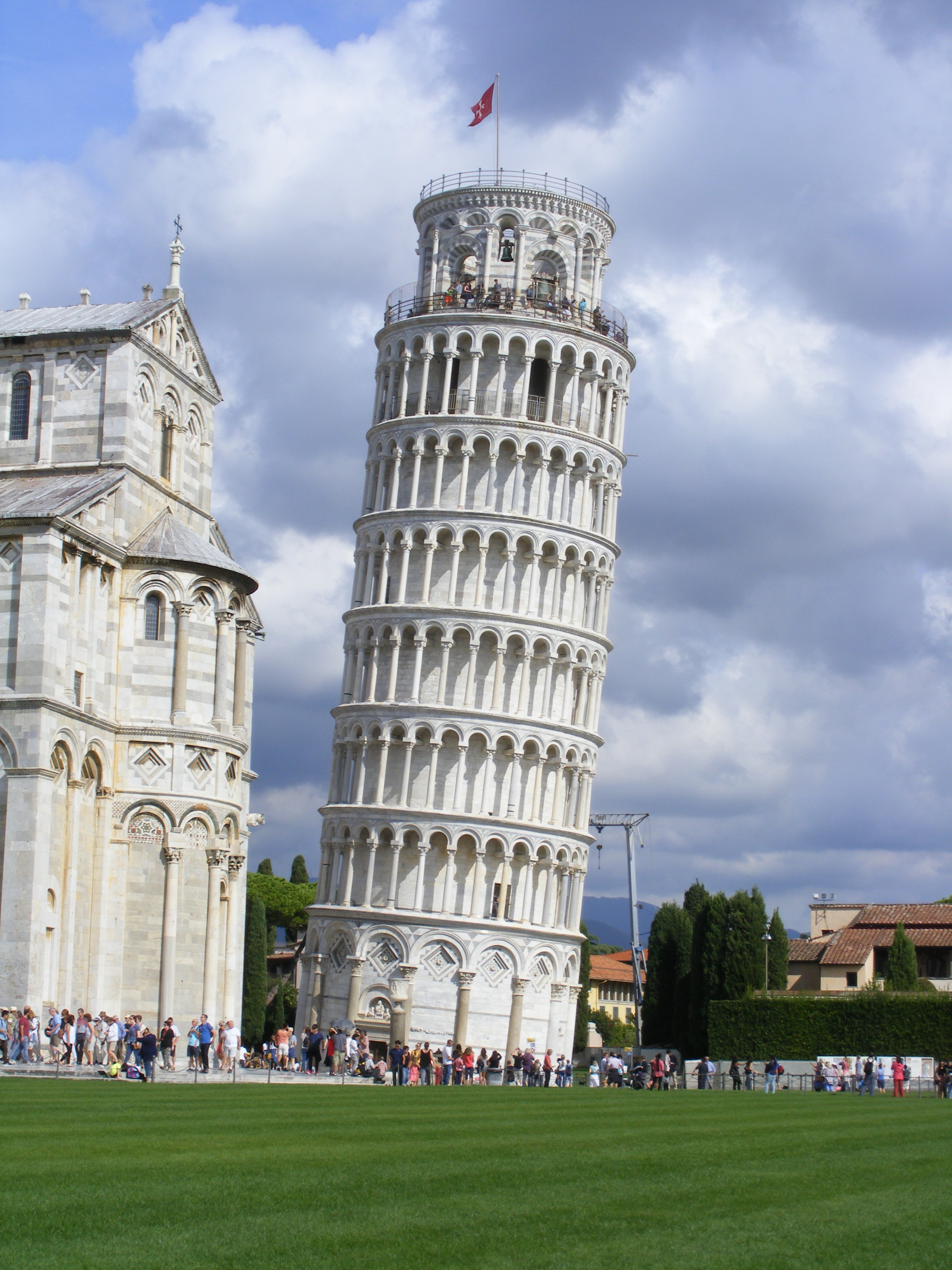


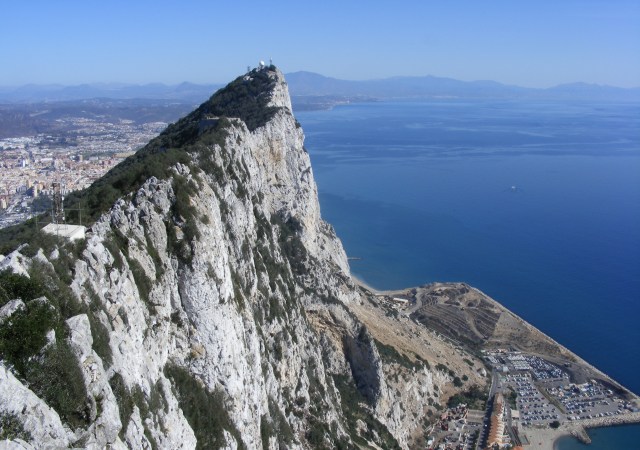 After an interesting and warm trip to Gibraltar, we return to the ship. The layer of pollution is evident over the sea but the views are still good. I was particularly interested in Michelle’s talk about ‘Thrulines and Theories of Relativity’. I am eager to get back to the land of the internet so that I can explore mine. It was probably just as well that it was our turn to entertain in the evening, as otherwise we would have struggled to stay awake. I have no idea why we are still so tired. ‘Coffers, Clysters’ is well-received as usual and one of our number receives a seventeenth century make-over.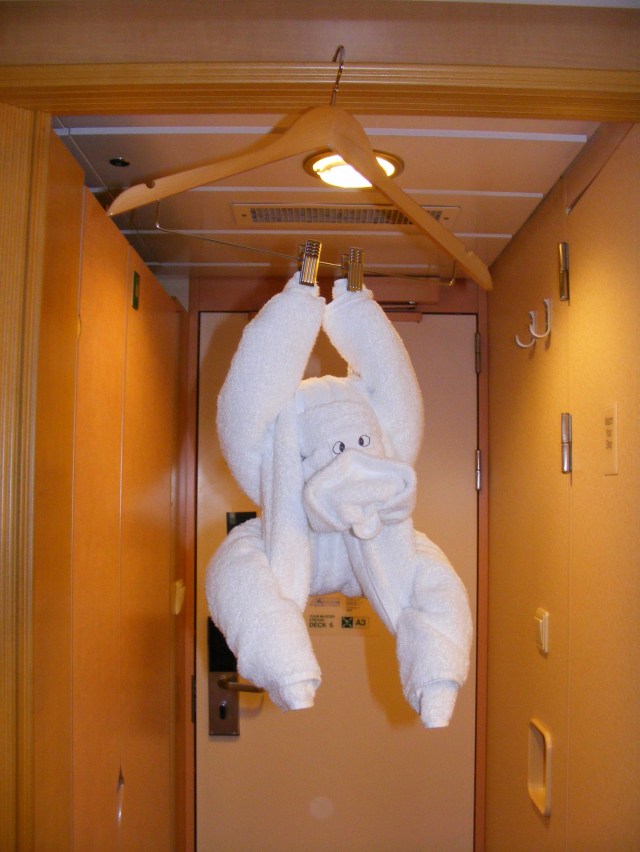
 Paul Milner begins the conference with an interesting session on ‘The English Context: history, sources, repositories and processes.’ A veritable minefield for those researching from overseas, as most of the audience are; there are only five Brits at the conference. We debate why some counties are shires and some are not. Could it be the migration patterns? Why is County Durham, the only county to be described in this way? Probably because it is the only non-shire to have a county town (or indeed city) of the same name as the county, so it is a way of distinguishing between the county and the city. And so to bed. On our way past a public area an enthusiastic member of the entertainments’ team is exhorting his audience to believe they are butterflies. Numerous apparently sane adults are waving their arms, sorry wings, about. We don’t linger to find out what all this is about. The ways of cruise ships are unfathomable.
 The History Interpreter - Janet Few